
Sunday, 23 January 2022

Saturday, 22 January 2022
Light : The Other Architecture : Explorations in Skin, Surface and Subjectivity.
Outpost 210121
Light : The Other Architecture


Painters have expanded upon a vision of light as vibrating particles and oscillations, conveyed through radiant pigments and a textured impasto lain on with brushwork. The grainy and colourful light they composed is never static, reflecting knowledge that light is like nothing else that enters our world, seeming to never come to rest and always in motion.
Even in the figural pictures of Edward Hopper, we find a light free of the objects with which it mingles.
Whether as a wave of sun spreading over the land, or a sunbeam piercing a dark room. Hopper made the light around the people he painted an evanescent force with which they commune, and seems to be saying that these simple encounters might help to soothe the existential loneliness of the modern citizen.
Henry Plummer, 2009.
For Philippe Dubois, the frame of the photography does not merely contain an imaged field, but is like a cutting device which is inflicted on the subject under the camera's gaze.
Unlike the constructive formation of the act of painting, in which detail is built up to fit within its pre-existing and limiting frame, the photograph depends on the coupe: its image is not produced, but deduced, cut out from its surroundings, in a reductive act of soustraction, of decoupage, of sampling, detachment and isolation.
Mary Sabbatino reads Mendieta's placement of the glass on her skin as a radical adjustment of the 'classic window in modernism', as the artist used the device to direct the spectatorial gaze onto her body.
Collapsing onto the flesh the window through which the ideally disembodied modernist gaze is controlled and tamed, Mendieta drew attention to the conditions of viewing in which the spectator is embroiled, elucidating the gaze here as one that fragments its object.
Skin, Surface and Subjectivity,
Glass : Modernist framing device directing the a spectatorial gaze/Photographic act of a cutting process inflicted on the subject under the cameras gaze.
Filtered Light :
Using the terms of the medium, to draw attention.
The positive image is produced out of absence, by the shadow cast on the surface of the negative.
A space haunted by the feminine absence and often naked, faceless, blurred and decapitated by the image's framing within the photographic process.
Her body and its framing of/by violence of the processes of negative to positive are implicit in her constant use of serial imagery and repeated motifs.
Bodies in space/Spatial Practice/Agency.
Spatial Theory, Triads, Thinking, Making, Being Seen, Others.
Architectural Body : Skin, Surface and Subjectivity.
Tactility (Entangled intertwining of vision and movement ) depends on the skin rather than the eye.
The act of viewing becomes its own adventure.
Attenuated moments (actualities), instances, periods between things.
The spatial representations of Francesca Woodman and Gordon Matta-Clark.
The artist's book, reading, re-reading and reacting to the existing pages, texts and time.
Art book/the forgotten book as an example of a micro, instance of the larger spatial practice, activated through the performance of the body, hands taping the pictures, thumbing through pages and writing annotations.
The concept of seeing the seeing is a synthesis of the artist's body and viewers bodies in space together.
Thursday, 13 January 2022
Architectural Light : Diffractions through Movement : Apparatuses, devices mediating natural/filtered light within spatial settings.
Outpost 130122


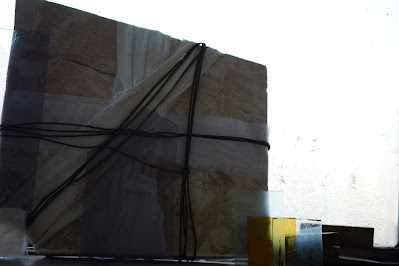

Studio Table
Filtered Light Reader
Architectural Light : Diffractions through Movement
Apparatuses, devices mediating natural/filtered light within spatial settings
On The Nature of Daylight
We Japanese fit additional canopies or verandas outside rooms that the rays of the sun in any case penetrate only with difficulty.
This is to keep out even more light and ensure that only a diffuse reflection can steal in from the garden through the paper windows.
So the aesthetic element in our rooms is nothing other that this indirect, dim lighting effect.
In Praise of Shadow, Tanizaki Jun'chiro.
Light made material
Kunsthaus Bregenz
Panes of toughened safety glass (2x10mm white glass, 4xPVB film), etched on one side.
Peter Zumthor.
Diaphanous : Translucent Materials/Membranes
Glass
Plastic
Metals
The Architecture Of Light
Recent approaches to designing with natural light.
Mary Ann Steane.
Examines how architects handle the relationship between light, material and the occupation of space, looking closely at the way in which these factors affect perception of and attunement to the visual environment.
The Architecture of Natural Light
Henry Plummer
The Other Architecture
Constructing metaphysical space
The beholding of light is itself a more excellent and a fairer thing than all the uses of it.
Francis Bacon, 1561-1626.
The Architecturally Sensitive Glass Works of Bernard Huber
Suzanne Beeh-Lustenberger
Gerhard Richter : Zufall, 748 5 RIC
Cologne Cathedral/South Transept Window
Glass Fields and Chance
How can arbitrariness be challenged?
By taking chance as the guiding principle in composing the colour fields, and thus employing one of the 'representatives of the real' as a partner in the production of the work.
The question, what is being 'moved' here?
Richter sets in motion a 'switch point' between decidable and undecidable, between controllable and uncontrollable; an in between point, a neither, nor, an exchange.
Chance as an intelligent object.
Chance is a trigger of movement, it produces an interval between starting point and destination.
The Spaces Between : Graphic Works on Glass
Myriam Wierschowski
Veils : Concealing and Opening
Reinhard Lambert Auer
Antique handblown glass samples and cullet
Bernhard Hubert
Glass : Transition-Glasprojekte
Architectural Movements into Light and Dark
Verena Krieger
Work on the Border- Transition of Space
Bernhard Huber's Light Room Installations with and without Glass
There are therefore two polar characteristics at the same time here, and you can see with the preliminary work of the artist that he experimented between these poles.
On one side there is a logically formal strictness and on the other the loose dynamics of apparent arbitrariness. Both together produce in their exciting simultaneousness the aesthetic charm of the glass roof installation.
Dawson Books Ltd/The Bertram Group
Sowing the seeds of knowledge
Not for resale
Books for educational use only
Work
Brian Clarke
6 Volume edition with slipcase
12.42 Kg
Sunday, 9 January 2022
On Being with Krista Tippett : Ann Hamilton Making, and the Spaces We Share
Hamilton asserts that we know things primarily through our skin, the largest organ on our body which both covers and reveals.
The philosopher Simone Weil defined prayer as “absolutely unmixed attention.”
The artist Ann Hamilton embodies this notion in her sweeping works of art that bring all the senses together.
She uses her hands to create installations that are both visually astounding and surprisingly intimate, and meet a longing many of us share, as she puts it, to be alone together.
https://onbeing.org/programs/ann-hamilton-making-and-the-spaces-we-share/

Embodied Knowledge.
Spatial Agency : Organism/Person/Environment
The body and space are reflexive and interdependent.
Movement and tactility in photography/representations
Merleau-Ponty on the intertwining of vision and movement, and that tactility in photography depends on the skin rather than the eye.
Friday, 7 January 2022
The origin point of the practice is the body, and of the works produced
Outpost 070122


The origin point of the practice is the body, and of the works produced.
Place understood as a site, physical but also overcoded by a conceptual by a conceptual intension, activated by and with the performative body of the artist in his/her spatial practice.
Her stillness disrupts an impression of her active presence
About expectations, disruptions and engagements with the built environment.
Body as a vector of thought through movement, organism/person/environment.
The body of the woman and the body of the camera are each partially exposed, partially revealed, and both are wholly connected to one another.
The uncanny effects are produced through these blurred distinctions, between reality and imagination, between body and architecture.
Body-Site
Flesh-Surfaces
Sensory-Engaging
Spatial-Narratives
Overlapping-Overcoding-Spatial Triads
Lived-Perceived-Conceived
Her body enacts a disjunction in time through the absence of her body and its subtle presence retained in movement.
Geometries of space of the body are made visible on the trace of a moment in real time and space.
Exploring the boundaries of her body and her spatial situation.
Yves Klein : Anthropometries
The painted ultramarine blue markings left on white canvas serve as indices made by the female painting performers and should act as timestamps of the work that was done by the female performers. Georganne Fronimos Boardman, 2017.
The Careful Crafting of a Utopia
Yves Klein and the Anthropometric Event of March 9, 1960.
Sarah M. Bartlett, 2016.
Serial Practices/Repetition and the production of thematically grouped images.
Acts of premeditated patterns and rituals.
Bodies and their performativity in the inspiration of the embodied moment in which they occurred/emerged.
Brian Clarke : Silence and Tumult.
Martin Harrison.
The dynamism and the kinetic quality of natural light is a fundamental component of his stained glass.
Deeply saturated coloured glass pierces a predominately opaque lead field.
Study for Gothic Rose, white pencil and collage on paper 84x59cm, 2012.
The Gothic wheel window, Clarke has appropriated the window's pattern as a template for drawings, as a basis for linear extemporization, and now a lead framework into which he has introduced his glass.
See also The Office of The Dead, 2008.
Glass screen executed in triple laminated float glass, within which the layers of blue, yellow and black vitreous paint translate the dot screen into a kind of stained-glass pointillism.
Study in Grisaille II, ceramic glazes on glass, 208x380cm, 2002.
Quotidian Symbols
Toy Aeroplanes
Lightbulbs
Graphic Symbols
The Cross
The Fleur-de-Lys
Brian Clarke : Nerves of Ecstasy
Robert C. Morgan.
As the Symbolist poet Stephane Mallarme once endeavoured to explain, an artist's role is not merely to define his work, but to suggest what art might become.
Clarke's insight is less about his enterprise of being than a way of working according to a vision that requires ultimate attention to material, situation, and intuitive principles that exceed the limitations of what he already knows. Therefore, the insight is to recognize and then realize art as a formative structure, as a way of revealing space through hidden sources of line and light and through a rabid contemplation of time.
Form, in the artistry of Brian Clarke, resists definition as it moves perpetually in the direction of a metaphor. Less through measurement or explanation, his objects, shapes, and figures move through space and time, often culminating in his architectural projects as a pulsating array of vivid colours and miraculous light.
He continues his studio practice on a daily basis, traditionally, he paints concrete images in which he juxtaposes delicate calligraphic tendrils in relation to his definitive grid-blocks.
As Clarke continues to move beyond a purely isolationist concept of art into a clear and synthetic understanding of structural relationships, his technical mastery of various densities and applications of linear and translucent imagery have augmented in scope.
The vaporous forms of the infinitely mutable cloud motif.
Fog, mist, and clouds became potent and perpetual metaphors.
Whether his works are destined to exist in two or three dimensions or in a linear or concrete form, Clarke's visual syntax engages our perceptions quickly before moving to the mind's eye. At this neurological junction, they may begin to vibrate and transform the way we see and envision the reality of our everyday world.
Thursday, 6 January 2022
Poetics of Space : Gaston Bachelard "The unconscious cannot be civilized"
The Poetics of Space : The house, from cellar to garret. The significance of the hut.
"He will revive the primitivity and the specificity of the fears. In our civilization, which has the same light everywhere, and puts electricity in its cellars, we no longer go to the cellar carrying a candle. But the unconscious cannot be civilized. It takes a candle when it goes to the cellar."
Gaston Bachelard.
Reading Into the Visual : Exploratory Images
Prints From Secrets and Ambiguity
Is there still an aesthetic illusion? And if not, a path to an “aesthetic” illusion, the radical illusion of secret, seduction and magic? Is there still, on the edges of hypervisibility, of virtuality, room for an image?
— Jean Baudrillard, The Conspiracy of Art, 2005
Jana Sterbak
Remote Control 1989
A heuristic technique (/hjᵿˈrɪstᵻk/; Ancient Greek: εὑρίσκω, "find" or "discover"), often called simply a heuristic, is any approach to problem solving, learning, or discovery that employs a practical method not guaranteed to be optimal or perfect, but sufficient for the immediate goals.
A Hut of One's Own, Ann Cline
Texts,Annotations, Foundations, Pathways, Corridors, Bookmarks, Walking, Thinking, Ramble, Cross Country, Disciplines,
Intermezzo : Nomadic Photographic Assemblage
<a href="https://russellmoreton.blogspot.co.uk/" rel="noreferrer nofollow">russellmoreton.blogspot.co.uk/</a>
a thousand plateaus
Deleuze, Guattari
Assemblage
Becoming
Body Without Organs
Nomad
Rhizome
Smooth Space
State
War Machine
The Uberficiation of the University
BY MARK CARRIGAN ON NOVEMBER 22, 2016
The Sharing Economy
Platform Capitalism
Uber.edu
The Reputation Economy
The Microentrepreneur of the Self
The Para-academic
The Artrepreneur
Affirmative Disruption
Interior : Gridshell
Singleton, West Sussex
Covehithe : Walking/Thinking/Physical Entanglements in the Landscape
Walking into Emergent Landscapes : Covehithe Beach
The OLD WAYS, a JOURNEY ON FOOT, Robert Macfarlane
“ Walking was a means of personal myth-making, but it also shaped his everyday longings:
Edward Thomas not only thought on paths and of them, but also with them.”
“To Thomas, paths connected real places but they also led out-wards to metaphysics, backwards to history and inward to the self. These traverses- between the conceptual, the spectral and the personal-occur often without signage in his writing, and are among its most characteristic events. He imagined himself in topographical terms.”
Assemblage/Design/Collage
Assemblage/Design/Collage


Sunday, 2 January 2022


Temporal Visions (The real thing remains hidden) : Fieldwork : Light/Movement and Phenomena
Affect/Nature : Movements and Variations
Barley Field
Hampshire


Barley Field
Hampshire


Saturday, 1 January 2022
Working Title : Creating Loops
Behind Appearance
A Study of the relations between painting and the natural sciences in this century
C. H. Waddington
Adam Fuss
Home and the World
Strange Loops
Art, Science and Consciousness
An Exploration of Mind, Matter and Form through the Work of Susan Derges
Stephen Gaughan
The Music of Waves
The Poetry of Particles
Thoughts on Implicate Order for Susan Derges
Martin Kemp
Adam Fuss
Eugenia Perry
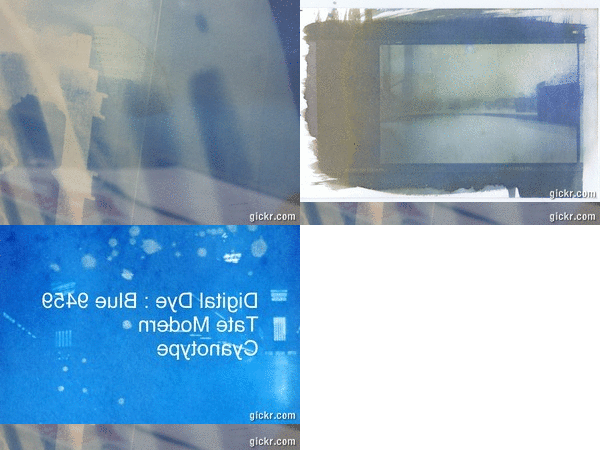
A Study of the relations between painting and the natural sciences in this century
C. H. Waddington
Adam Fuss
Home and the World
Strange Loops
Art, Science and Consciousness
An Exploration of Mind, Matter and Form through the Work of Susan Derges
Stephen Gaughan
The Music of Waves
The Poetry of Particles
Thoughts on Implicate Order for Susan Derges
Martin Kemp
Adam Fuss
Eugenia Perry
Subscribe to:
Posts (Atom)