Friday, 30 May 2025

Thursday, 29 May 2025
bricolaged notes from STUDIO UNBOUND : Lane Relyea
The Function of the Studio
Daniel Buren
The Studio is no longer as seen as belonging to a system.
No longer a retreat but it now INTEGRATES
It is all exterior.
The Network places the artist as a 'like item' within an integrative inventory or database.
Networks are both integrative and decentralizing in that they privilege casual or weak ties over formal commitments.
Being part of a network that privileges itinerancy and circulation over fixity, that diminishes hierarchies and boundaries in favour of mobility and flexibility across a more open extensive environment.
'The Studio made into a showroom display'
Antagonism and Relational Aesthetics. 2004
Claire Bishop
The Individual and The Social
A place where meanings, properties and behaviors fluctuate radically.
Bennett Simpson. Can you work as fast as you like to think. 2003


The hosting/re-created artist's workspaces, like a threshold between private and public actuality and potentiality.
Spaces of Fluid Interchange Between Objects, Activities, People.
Today studio and museum are superseded by more temporal, transient events.
The Notion of the Evolutionary Exhibition.
Placing greater emphasis on INFORMATION, DISCUSSION and GATHERINGS
Establishing NETWORKS, fluctuating between highly specialized work by scientists, artists, dancers and writers
Obrist/Vanderlinden, Laboratorium, Antwerp. 1999
MODULATION, Deleuze
Immaterial Social Acquaintances/Information
Along with the rise of Networks comes a new Ideology, one that Advertises Agency, Practice and Everyday Life.
The Dividual (The New Mobile Creator) Deleuze
Someone who is 'UNDULATORY In ORBIT, in a CONTINUOUS NETWORK
Colour Nexus : Promiscuous Mobility
Material Flows 2007/2017 Towards Disentanglement
Social behaviour is trapped in inescapable patterns of interaction coded by techno-linguistic machines, smartphones, screens of every size, and all of these sensory and emotional devices end up destroying our organism's sensibility by submitting it to the stress of competition and acceleration.
Franco "bifo" Berardi
OBSCURED MATERIAL
The Modulation of the Image


Tuesday, 27 May 2025
Disjunction and Event/Processual Research : Collage/Constrained Spaces/Spatial Body
Processual Making/Messy Entanglements : Creating sustained flows of engagement resulting in some connections that can occur but not others, working practices that can create a pattern or field of relations/resistance or constraint.
Movement is Material.
Mobility/New Social Assemblages
Ingold/Thrift
Movement creates differences, it resists and perpetuates between human bodies/spatial bodies.
Constrained spaces shaped by the tensions of the environment.
Combined works/conceptual frameworks with research as an integral part of the practice to produce ways of sensing/making ecologies of knowledge.
Ecology-as-Assemblage
An assemblage is able to retroactively affect its parts.
Human identities and bodies are inherently multiple, relational and dependant on more-than-human presences.
On Landscape Ontology, Bryant. 2011
The co-existence of such heterogeneous dimensions and demands makes up the 'event.' The event is a sudden intensity generated by the juxtaposition and superimposition of differences. The event tends to exacerbate differences rather than making everything similar.
Disjunction and Event.
Bernard Tschumi.
https://www.flickr.com/photos/russellmoreton/


.jpg)


.jpg)


Monday, 26 May 2025
LIVING Intensity : FRONTIERS OF ARCHITECTURE, Kirosan Observatory/Anti-Object/Anthropology/Art
040521
Anti Object
We are composed of matter and live in the midst of matter. Our objective should not be to renounce matter, but to search for a form of matter other than objects. What that form is called architecture, gardens, technology is not important.
Kengo Kuma

Procedural Architecture
Start by thinking of architecture as a tentative constructing toward a holding in place. Architecture's holding in place occurs within and as part of a prevailing atmospheric condition that others routinely call biosphere but which we, feeling the need to stress its dynamic nature, have renamed bioscleave.
Architectural Body
Madeline Gins and Arakawa


LIVING : FRONTIERS OF ARCHITECTURE
Louisiana Museum of Modern Art.
Wang Qingsong : Dormitory, China, 2005
Key Words : Observatory, Camera Obscura, Living, Seeing, Intensity
BEHAVIOROLOGY ( the study of the combination of natural dispositions, social environment and personal experience)
Deals with the special atmosphere and character of the suburb. In film, literature and art the suburb often has an undertone of something mysterious, eerie, of events that are kept hidden.
The dual desire to see and to be seen leads to instability. An object may be made transparent, but it remains an object. And transparent, it is more thoroughly under observation and more thoroughly dominated. Conditions in the suburbs are in a sense even more wretched than those in the panopticon.
Kengo Kuma/Observatory/Anti-Object
Uchronia, Burning Man Festival, Nevada. 2006
Rouen Concert Hall and Exhibition Complex
Architectural Envelope/Heterogeneous Composite
Movement Vectors/Layers : Interior Concrete Skin/Visible Arches of the Steel Skeleton


Painting Space : Yellow ochre on white gesso over kraft paper
An Anthropology of Landscape
Christopher Tilley
Kate Cameron-Daum
Spirituality in Contemporary Art
The Idea Of The Numinous
Jingu Yoon
New Global Ecologies
Baratunde Thurston
INTENSITY : Portable Architecture as Parable. Mark Prizeman
The act of moving through mobile societies makes this transient architecture understandable.
A nomad uses what is to hand and able to be replaced or adapted.
The success of a tent depends on the exploration of an idea in the workshop by wandering through the dream and not being restricted by the finite parameters of a drawn representation of the future object.
Like explorers planning to venture into the unknown, an ability to imagine the consequences of what one takes and what one leaves behind is imperative.
ERASING :
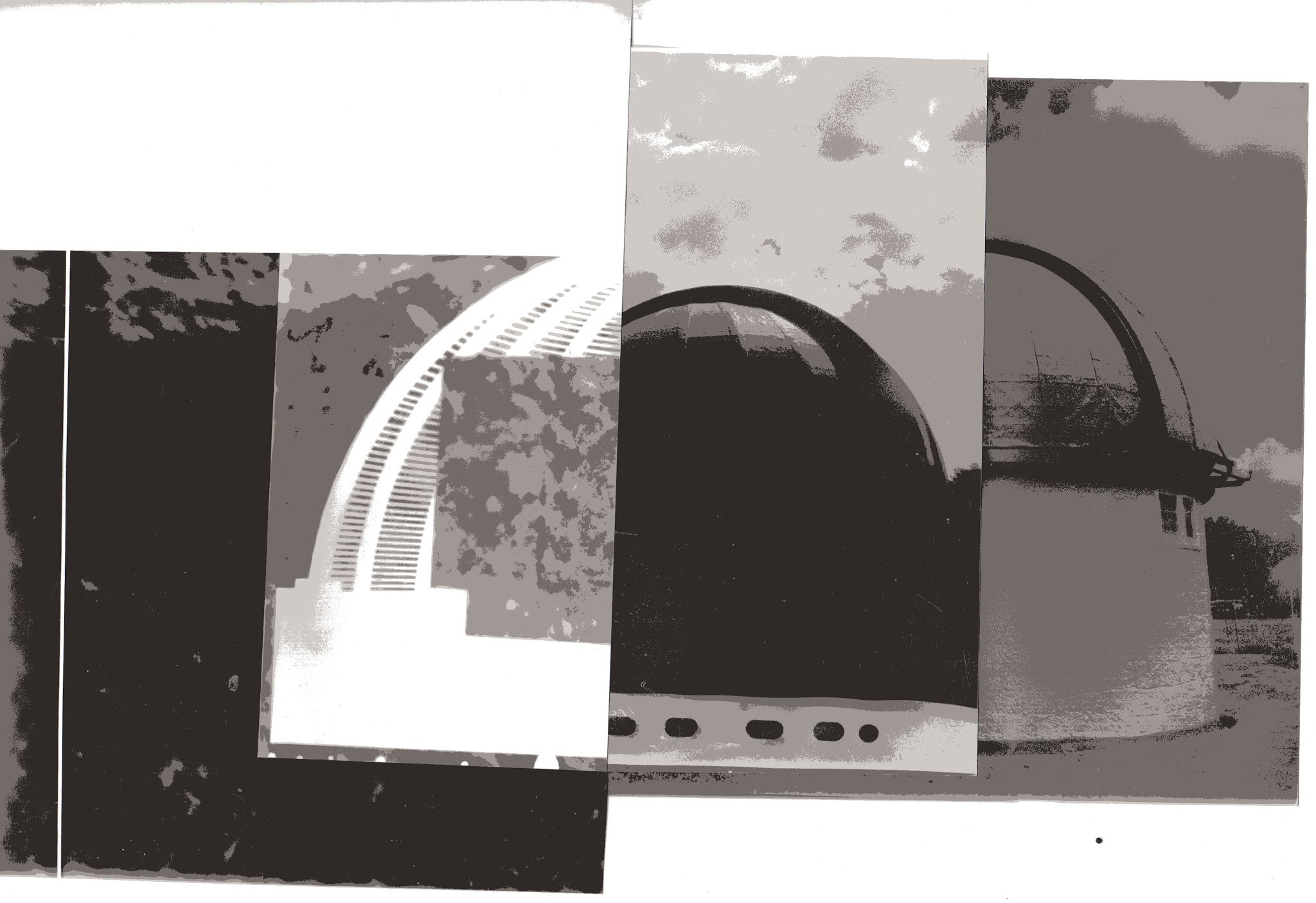
Kirosan Observatory, Kengo Kuma
Observatories demonstrate the self-centred nature of human perception. They are generally objects, that is the core of the problem. I wondered if this observatory could be made transparent, that is, effectively erased, so minimising the damage to the environment.
In terms of erasing an object, the settin is more important than the choice of material. In this case, the setting was a summit that had already been levelled and turned into a perfect pedestal. Anything that is set on a pedestal becomes an object, regardless of what it is made of or how discreetly it is placed.
Most works of contemporary art are tiresome because they rely on this particular property of the pedestal.
Observatory/Artists Outdoor Studio with astronomical 'Hortus Conclusus' /pavilion/segment built from the walled garden.


IMMATERIAL :
Layer upon layer of reality and image, the material and the immaterial, were thus overlapped.
The Camera Obscura and Telescope, Dumfries. 1836
It is not quite clear what the real astronomical purpose of camera obscurae was, not only the Royal Observatory at Edinburgh but also the Royal Observatory at Greenwich still posses theirs, though dismantled and stored in cupboards for a century or more.
Paramatta Observatory, New South Wales, 1822
Sepia stained cyanotypes of architectural building plans
Plaster tabletop viewing screen, concave, chalk/matt surface
Lead weights on natural ropes used to control the apparatus
What I am most interested in now is inverting the structure of a culture that is centred around the city. The twentieth century was an age of industry, and an age in which everything from material goods, information and culture flowed from the cities to local towns and villages. Following the same vector, architecture, too, flowed out from the centre to the periphery.
Kengo Kuma
APPARATUS :
The Observatory is a facility for stealing looks at visitors
Electronic technology is used in these devices to expose the imperfection of vision and reverse its privileged status. Under ordinary circumstances, the seeing object is under the illusion that he/she dominates what they see. However, seeing also opens up the possibility of being seen. Anyone who dominates another through vision is always vulnerable to a brutal reversal.
High and Low, 1963. Akira Kurosawa
I therefore tried designing a transparent object. My real aim was not to create an object, but to choreograph a sequence of movements by the subject, that is, to create a device controlling his/her vision. Anti-Object, Kengo Kuma.
Your Chance Encounter, 2010. Olafur Eliasson
Messr Barr and Stroud, Optical Engineers, Glasgow, used to produce obscuras for industry, they were much cheaper to purchase and maintain in a large industrial establishment than closed-circuit television.


Friday, 23 May 2025
Drawing on Life : Bento's Sketchbook/A Hut of One's Own : John Berger/Ann Cline/Bento de Spinoza
In the backyard of where she was living, Cline once decided to build a hut inspired by Kakuzo Okakura's The Book of Tea.
As my dwelling took shape, it began to shape my life as well. And when I sat inside reading the recluse poets, the terse simplicity of their record framed my own perception, one I likened to a camera recording a world of pure experience.


The hut has a sense of immediacy that no room-filled house can achieve. The hut focuses its dweller on immediacy and meaning fulness. "I had found the commodity of my dwelling through the poetry of its use," Cline concludes.
The hut addresses the core of ritual as a part of nature versus the supposed freedom of modernist thought and the architectural contrivances it pursues. The hut represents the convergence of ritual and naturalness, at the same time addressing cultural issues and practices.
With an agility larger structures can never match, huts bring together the physical environment with such disparate aspects of culture as necessity, fantasy, faith, and "life-style." The hut, then, may be humankind's supreme experiment.
This may seem a bold conclusion given the modesty of the hut throughout history, and the modest ambitions of its makers, but this is Cline's point, that the experiment in solitude and simplicity is bolder than any social or culturally-sanctioned experiments or projects, simply because the latter are contrived and unnatural, even anti natural.
https://www.hermitary.com/bookreviews/cline.html
Then the days of working at home on it. The image in my head was often clearer than the one on the paper. I redrew and redrew. The paper became grey with alterations and cancelations. The drawing didn’t get better, but gradually she, about to stand up, was more insistently there.
The effort of my corrections and the endurance of the paper have begun to resemble the resilience of Maria’s own body. The surface of the drawing - its skin, not its image — make me think of how there are moments when a dancer can make your hairs stand on end.
We who draw do so not only to make something observed visible to others, but also to accompany something invisible to its incalculable destination.


The bodies of dancers with their kind of devotion are dual. And this is visible whatever they are doing. A kind of Uncertainty Principle determines them; instead of being alternately particle and wave, their bodies are alternately giver and gift.
They know their own bodies in such a penetrating way that they can be within them, or before them and beyond them. And this alternates, sometimes changing every few seconds, some times every few minutes.
The duality of each body is what allows them, when they perform, to merge into a single entity. They lean against, lift, carry, roll over, separate from, co-join, buttress each other so that two or three bodies become a single dwelling, like a living cell is a dwelling for its molecules and messengers, or a forest for its animals.
The same duality explains why they are as much intrigued by falling as by leaping, and why the ground challenges them as much as the air.
Shadows Gathering around Objects, Causality, Art Ontologies : Correspondences in Drawing/Watching/Walking/Reading.


Outpost 071022
The Quadruple Object.
There are two kinds of objects and two kinds of qualities, real and sensual in both cases.
Real objects and qualities exist in their own right, while sensual objects and qualities exist only as the correlate of some real object, whether human or otherwise.
I am not saying that a work of Art reveals the secret of life and being to us.
A work of Art affords the peculiar pleasure, an aesthetic performance in which the inwardness of things, their executant reality is opened to us.
Ortega.
Giacometti.
Created a visual lexicon of nothingness and being, of community and isolation.
Making fleeting visions, interactions between the modelling object and the space within which it exists. Concentrating, extracting a female nude from the atmosphere of a city, creating a space that oscillated with their shared community and isolation.
There is no direct knowledge of anything only relations-on-knowledge.
The real object withdraws inaccessible from the scene, as the new object generated by metaphor takes over the situation.
The real objects at stake in aesthetics are ourselves.
It would be more accurate to say that in Art the part of the image which looks towards the object is always subordinated to our efforts, because as basically Thespian beings we become the new object generated by metaphor.
Object-Oriented Ontology.
A New Theory of Everything.
Graham Harman. 2018
Aesthetics Is The Root Of All Philosophy.

Robert Mangold.
Creating a new mysterious real object with new sensual qualities.
Compound Objects
Assemblages
The Quadruple Object.
Since objects cannot exist without qualities and vice versa, there are only four possible combinations.
In Object-Oriented Ontology real-sensual objects and qualities always come together.
Object Relations
Potentiality/Receptivity
The Theatricality of Metaphor.
Art makes explicit the tension between qualities that are experienced in the real/sensual object.
I myself am the sole real object in all experience, encountering any number of sensual things.
Every objective image, on entering or leaving our consciousness produces a subjective reaction.
Art is primarily theatrical in nature, since the spectator becomes a sort of 'method actor' a theatrical actor acting out the structure of metaphor.
Ortega, An Essay in Esthetics By Way of a Preface.
Ontology is the branch of philosophy that deals with ultimate questions of what reality and real things are.
Bruno Latour, defines modernism as the view that there are two permanently distinct kingdoms, known as nature and culture and that it is the task of modernity, to purify these two domains from each other.
Metaphor is not knowledge about a pre-existing object, rather it brings about the production of a new object.
All we are saying is that the real object at stake in metaphor is neither the absent cypress-object to which we never gain direct access, nor the human being who takes note of it. But rather the new amalgamated reality formed from the reader who poses as a cypress-object and the qualities of the flame.
The successful metaphor much like the successful joke, will occur only when the reader or auditor is sincerely deployed in living it.
The metaphor is theatrical, in the same sense as one is living one's role on stage.
