Tuesday, 27 July 2021

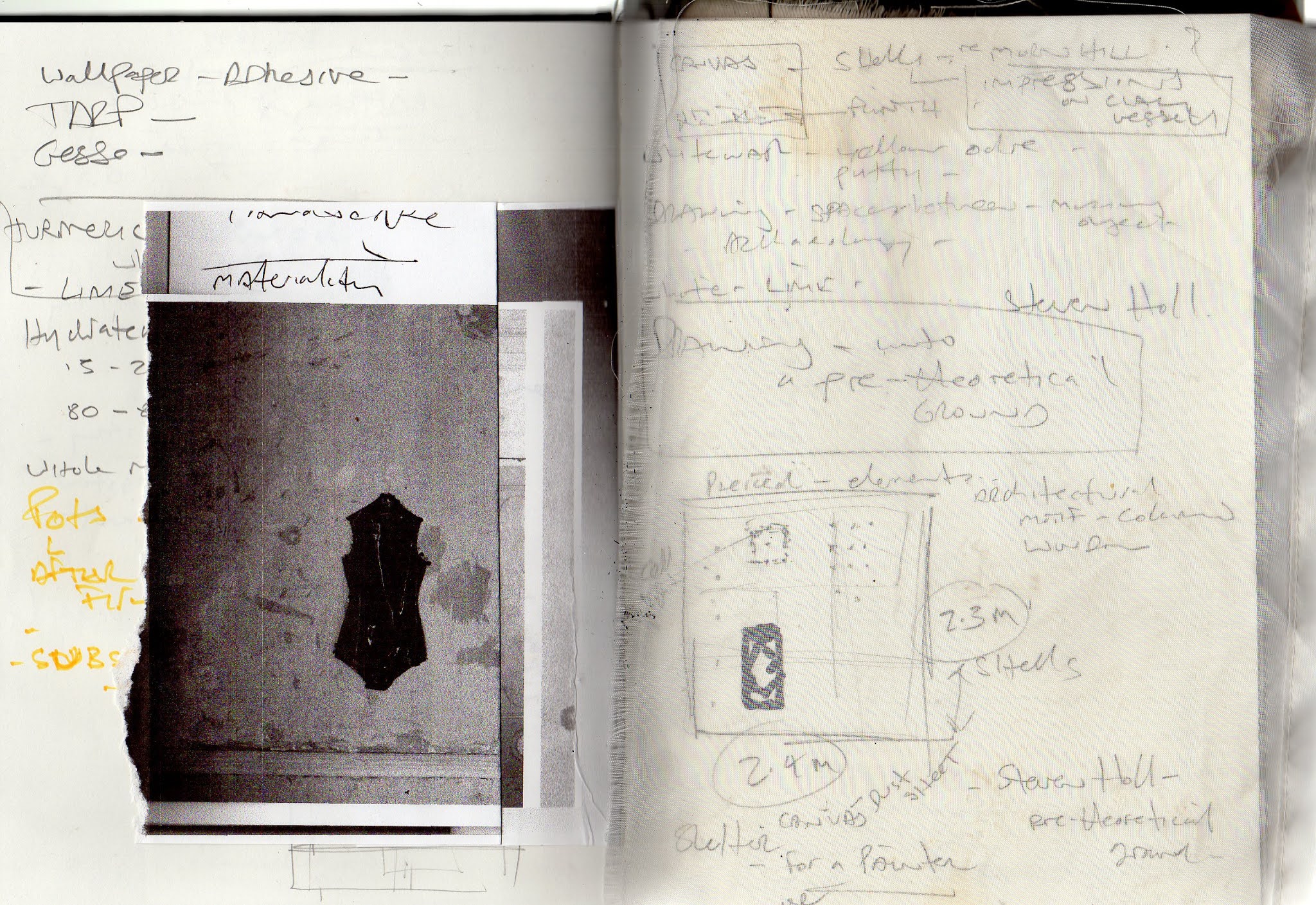
Sketch Books/Strange Loops : Drawings, Materials, Annotations, Collages and Constructions 2018-20

 OUTPOST STUDIO 3.16

Agency through sketchbooks


Apokatastasis : Jim Jarmusch, Jozef Van Wissem

Spatial Asperity/Mesh, Membrane and Gauze


Drawing and its attempts to map out/make visible contingent things

Contingency, is what remains, as it comes up against causality/constantly passing through

Objects/Things conceptualized by the exploration of drawing (intervals of blindness)


Linking Surface to the Aesthetic Experience of Space.

Experiences incorporating interests with environmental textures into Art.

Points of Contact/Confluence of Circumstances

Materials bound by contact/canvas

Patina, absences, gesso, textile wrappings, field chalk, exhumed oyster shells, yellow ochre,


A philosophy of Reading

Solitude/Libraries : Cell/Court/Domain

Clay, Waxed Surface, Liquid Rust, Calico,


Sensate Bandages/Windings/Armatures : Corporeal Landscapes/Assemblages/Things


Social Architectures/Anthropologies/Imaginary Projects


Timothy Morton : Realist Magic

The elasticity of sensation, affective and wonderous


Sally Mann : Matter Lent/Collodion wetplate negatives

Corpus, liquid light, flesh, spirit, trace, outline, human body, performative,


Thursday, 22 July 2021

Opening Collages : Ambiguous Borders

Curatorial Practices
The Alchemy of Building
Collages/Inclusions : Creative Ecologies

Yvonne Buchheim
Wish you were here to trip up memory lane. Belfast 2000
http://www.acid.uwe.ac.uk/buchheim/belfast1.htm

Alberto Perez-Gomez
POLYPHILO
or The Dark forest Revisited
An Erotic Epiphany of Architecture

Robert Mangold

Sarah Purvey
Landscape Series, Rhythm. 2012
Crank vessel with slips

Robert Macfarlane
The Old Ways
A Journey On Foot

Kengo Kuma
Transparent Pavilion


Tuesday, 20 July 2021

Mapping Relationships : Contexts and Locations #3

Collage and drawing with cyanotypes, photographs, negatives and painted surfaces.

The Laboratory , Canterbury 2009

Tim Ingold
MAKING 2013
Anthropology, Archaeology, Art and Architecture.

Practical Geometry
The Architect and The Carpenter
The Cathedral and The Laboratory
Templates and Geometry
The Return to Alchemy

Cyanotype image from pinhole camera with sound intervention/device within the apparatus of the camera, performative material gathered from the Canterbury School of Architecture.

UCA Spatial Practices MA under Oren Lieberman.

DSC_0876 : Figure/Field/Research

TRANSPARENT MEDIA : Form,structure, space, enchantment
Double Take
15 APR - 3 JUL 2016

A two-venue exhibition exploring the relationship between drawing and photography, taking place at Drawing Room and The Photographer’s Gallery, London.

Drawing and photography are each considered the most direct, ‘transparent’ media with which to engage with the world.  They share fascinating parallels:  the relationship to the indexical, the blank sheet of paper or surface, graphite and silver, pencil weight and aperture, the sense of an invisible ‘apparatus’ (the camera and pencil), the engagement with surface, light, negative and positive and the trace. Double Take seeks to explore the multifarious ways photography and drawing have been combined and mirrored to extend both practices into new arenas in modern and contemporary practices.

“… a freehand sketch diagram that was at the tangent between idea and imagination…if the parti – the first critical diagram – is not made well, it will be difficult for architecture to follow.  If there is no parti, there will be no architecture, only (at best) little more than the utility of construction.  Buried within their early sketches is the germ of a narrative or language.  The early diagrams are reflective conversations with the language of architecture.”

-  Alan Phillips, Brighton, UK

Marking Stick : Leylines, Directions and Sites. #11

Sequential Photograph : In the space around the "spatial turn" (539)
Art as Spatial Practice.
Space folds : Containing "Spatialities around historicality and sociality"

"All that is solid melts into air"

Karl Marx, Friedrich Engels,
(Poetic observation concerning the constant revolutionizing of social conditions)

Perceptions now gathering at the end of the millennium. Spatiality, Robert T. Tally Jr. 2013


Monday, 19 July 2021

Hans Coper : The Shape of Time/Working Notes/Diagrams

Sainsbury Centre 

UEA Norwich


 Hans Coper : Working Notes Crafts Study Centre. 2014.


Extracts from catalogue “The Esssential Potness, Hans Coper and Lucie Rie 2014”

“I become part of the process, I am learning to operate a sensitive instrument which may be resonant to my experience of existence now.”

“My concern is with extracting essence rather than with the experiment and exploration. The wheel imposes its economy, dictates limits, and provides momentum and continuity. Concentrating on continuous variations of simple themes I become part of the process.”

Artist Statement, Victoria and Albert Museum/Collingwood, Coper Exhibition 1969.


Small Beige Spade 1966.

The body comprises a thrown circular form, from which the bottom has been flattened into an oval and the lower section has been pressed together.
Throwing rings are visible on the inside.
Areas of the white engobe have loosened from the underlying layer during firing and formed blisters.

Cycladic Vase 1973.

Blisters in the slip have been sanded down to reveal a rust coloured underlying layer.

Medium Sized Spade 1973.

There is a clear delineation between the light upper section and the rougher and darker lower section.

Small Thistle Shaped Vase 1973.

There is a large incised circle on one side of the disc and a smaller circle on the other.
Hans Coper’s characteristic use of light engobe and dark manganese oxide has produced a hazy texture.

Black Aryballos 1966.

This ceramic form has its origins with the Oil Flask used by athletes in Greece and Asia Minor.


Tall elongated diabolo forms.

After being thrown the cup has been formed into an oval and then indented at four points.


Text Fragments/Lines of Interest 

Momentum Wheel.

It is difficult to determine in which order the parts were assembled.

The underlying surface is showing through the grooves that are linking the body and the base.

The manganese engobe is demarcating dark and light zones through an undulating incised line.

“Rings” caused by the placement of a prop in the kiln.

Brown-Beige Colorations.

Sensations caught within the form.

Soil like deposits/remains.

Reductions of the fired surface.

Abraded Surfaces

Incised Line.

Droplet.

Blisters, pricked open and sanded after firing. This process has produced an irregular, patch surface.

Parallel lines have been incised with a pointed object on the exterior of the base.


Thistle Shaped Vase 1966.

The dark brown patches (around the jointing of the pot) and flecks appear randomly distributed but have been purposefully placed to accentuate the structure of the vase. This flat vase with the contour of a stylised thistle flower is made up of five individually thrown pieces. The tall cylindrical foot supports a vertical disc, comprising of two individually thrown flat plates. It is as though the disc has sunk approximately ten centimetres into the foot.

Spherical Vase with Tall Broad Oval Neck 1966.

The transition from sphere to neck is accentuated with darker colourations.


Notes re/statements
  1. Specific to the form in question.
  2. Context in relation other similar forms.
  3. Key Words: Impregnated, Incised, Eroded, Reduction, Surface, Soil, Abraded Surfaces, Machining, Grinding, Assemblage, Components, Parts, Groups “Aryballos,Spade, Thistle, Diabolo, Cycladic, Spherical,” Sculptural, Pottery, Architectonic, Space between Forms, Spatial, Sensuality, Form and Fold, Bodily Spaces, Light and Dark, Clay, Water, Fire, Agency, Difference,


Rotterdam Exhibition with Lucie Rie. 1967

Hans Coper.

His arrangement was highly original and innovative, he showed his families of vases in groups, emphasising their subtle differences in form and surface treatment. The space between the pieces was just as important as the objects themselves. The architectonic character of Coper’s pots become visible through their dry, stone like skin and the sophisticated way in which Jane Gate photographs the work.

“Potters of reconciliation, they sought a marriage of function and beauty.”

Douglas Hill SF author/intro to exhibition.


P7478
Additions to description.

Thistle shaped vase constructed from five individually thrown pieces. The joints making up the pot have been selectively accentuated with the residues of the manganese engobe. Incised geometric marks remain from the initial turning process of the component parts, prior to the construction of the pot.


P7430
Additions to description.

Wheel thrown forms, comprising of bowl, open cylinder and an interior ring acting as a flower holder. The bowl form has been turned before being jointed with the upper section. The piece was then indented at four points to form an ovoid form. Pronounced incised horizontal marks remain from the joining, which has been further transposed by the action of becoming ovoid. Very subtle and restrained use of the manganese engobe followed by Coper’s characteristic post firing technique of abrading the surface of the ceramic.


P7539 
Additions to description.


Single thrown form with the remains of the sgraffito technique after the ceramic has been heavily abraded after firing. The vertical lines of the sgraffito technique and the form itself are similar to Lucie Rie’s flower vases, see Lucie Rie by Tony Berks page 112.


This single thrown form perhaps best illustrates the creative union of both Coper’s and Rie’s practices, the form almost a kind of beaker might itself been inspired by the “dark pots” Lucie Rie found whilst visiting Avebury Museum.


Notes on Hans Coper’s process and materials.


Material for Black Clay Body.

T Material 73.2%
Red Clay 18.3%
Manganese dioxide 1.2%
China Clay 7.3%

Material for White Clay Body.

T Material 100%


Slip/Engobe

Feldspar
Whiting
China Clay

(proportions remain unknown/never revealed by the potter)

Manganese dioxide 3parts
Yellow Ochre 2parts
(mixed with water and gum Arabic 1tsp per 500cc)

Firing 1250, Once Fired Ceramics.


Finishing.

Hans Coper used a metal scouring pad “Springo” to scratch the surface of the unfired pots. The exterior of the fired pots were then painstakingly burnished using an emery disc attached to an electric drill. This action resulted in turning the dry vitreous surface into a one having a graphite-like sheen (sea pebble).


Drawings in the form of tracings were gathered from the flat planes of the display cabinet; these were further superimposed in an attempt to map the surface and forms of the Hans Coper pots and to explore their volumes and interior spaces. These new sight lines subjectively link surface details with profiles into the possibility of new spatial forms. These plans and mappings became the starting point for a series of slab and thrown assemblages. Thrown and slab worked clay forms in T Material, preliminary drawings done in-situ some with annotations  Russell Moreton, 2014


Saturday, 17 July 2021

Space into Places : As Found, a concern for that which exists/A hut of one's own

CRAFTS STUDY CENTRE
Working Notes 2 July 2014-07-02

The Production/use of Space into Places to engender Societies.
A site specific induced inquiry into dwelling and building through/by way of an attentive awareness (anthropological) to people and place.

Ann Cline : A Hut of One's Own

Huts are always fascinating but the huts of sophisticated cultures are especially so: from the huts of ancient recluse poets to those of ornamental hermits, from the casitas of the Bronx to the huts of seventeenth-century tea masters, from the shacks of the homeless to the follies of postmodern architectures. All these huts deconstruct the optimistic sophistication of their age. Then they rearrange it. ...
Nowadays [one] who wishes to experience the poetry of life ... should have a hut of one's own.... Here, isolated from the wasteland and its new-world saviors, a person might gain perspective on life and the forces that threaten to smother it. ...
Only in a hut of one's own can a person follow his or her own desires — a rigorous discipline, and one that the poet Gary Snyder calls the hardest of all, presupposing as it does self-knowledge while balancing free action and cultural taboo, knowing whether desire is instructive or the imprint of culture or if personal, whether such desires are the product of thought, of contemplation, or the unconsciousness.
Even if this hut is only one's normal abode inhabited in a different way, here in a hut of one's own, a person may find one's very own self, the source of humanity's song.


Architectural Canvas : Working with diversity and specificity
Numinous Odyssey
Raveningham Sculpture Trail 2020


‘What I am most interested in now is inverting the structure of a culture that is centred around the city.’
‘The richness and strength of that(their) culture cannot be understood until one has worked with the people who live their- until one has eaten their food, drunk their sake, talked together with the craftsmen and made things with them.’
Kengo Kuma, Complete Works, (preface) 2012

‘As found is a small affair, it is about being careful.’
Peter Smithson, 2001

‘The ‘as found’ attitude is anti-utopian; its form is (site) specific, raw and immediate. It calls the will to question. It is a technique of reaction (Opposition/Kengo Kuma and Herzog and De Meuron and Multiplicity/Calvino and Zumthor) and a concern for that which exists.’
Schregenberger, 2005


The spatial practices of exhibition and education.
The humanities and architecture, Heidegger/Bachelard/Ingold/Herzog and De Meuron/Zumthor.

The politics of things/sociology and everyday life/dwelling and making.

Natural History learning/thinking through things/situations and vocations.

Contents/Contexts/Collection and Presentation.
Taxonomies and Subjectivity/Spatial Narratives of Layered Space (Spatiality)
Mark Dion, Archaeology, Thames Dig.(Allegories of a pseudo-archaeology)
Herzog and De Meuron, Archaeology of the Mind/Natural History.
Peter Greenaway, The Physical Self/Architecture and Allegory.


Visual/Spatial Vocabularies and Narratives (Livelihoods and Social Interactions)

Spatial Methodologies.

Worlds and Thresholds.
The Fanciful and The Scientific.
The Playful and The Reverent.
The Material and The Metaphysical.

Tensions in built spaces.
Between Evanescence and Substance.
Between Illusion and Specificity.
Between Slickness and Tactility.


Making Places where times and tastes, human fabrications and accidents of nature, all collide; in these situations under the shelter of a forming/becoming architecture these ‘spatial texts’ or ‘visual conversations’ of one sort or another are suggested and are manifested and explored through a praxis of inquiry and making.

The Projects Evolution.

Philosophy of Solitude, thresholds/spaces of a vital serenity, a poetics of dwelling and its angle of repose hovering somewhere between the transcendental and the real.

Relationships between Art, Photography, Craft and Building.

Expanded through Exhibition, Performance, Teaching and Making.

Realized as a dialogue/delivery (Built Work) into Architectural Terms between Sites of Collection and Sites of Construction.


Working Analysis.

CSC Object Analysis : Hans Coper/Innerness in the Ceramic Vessel and Architecture.
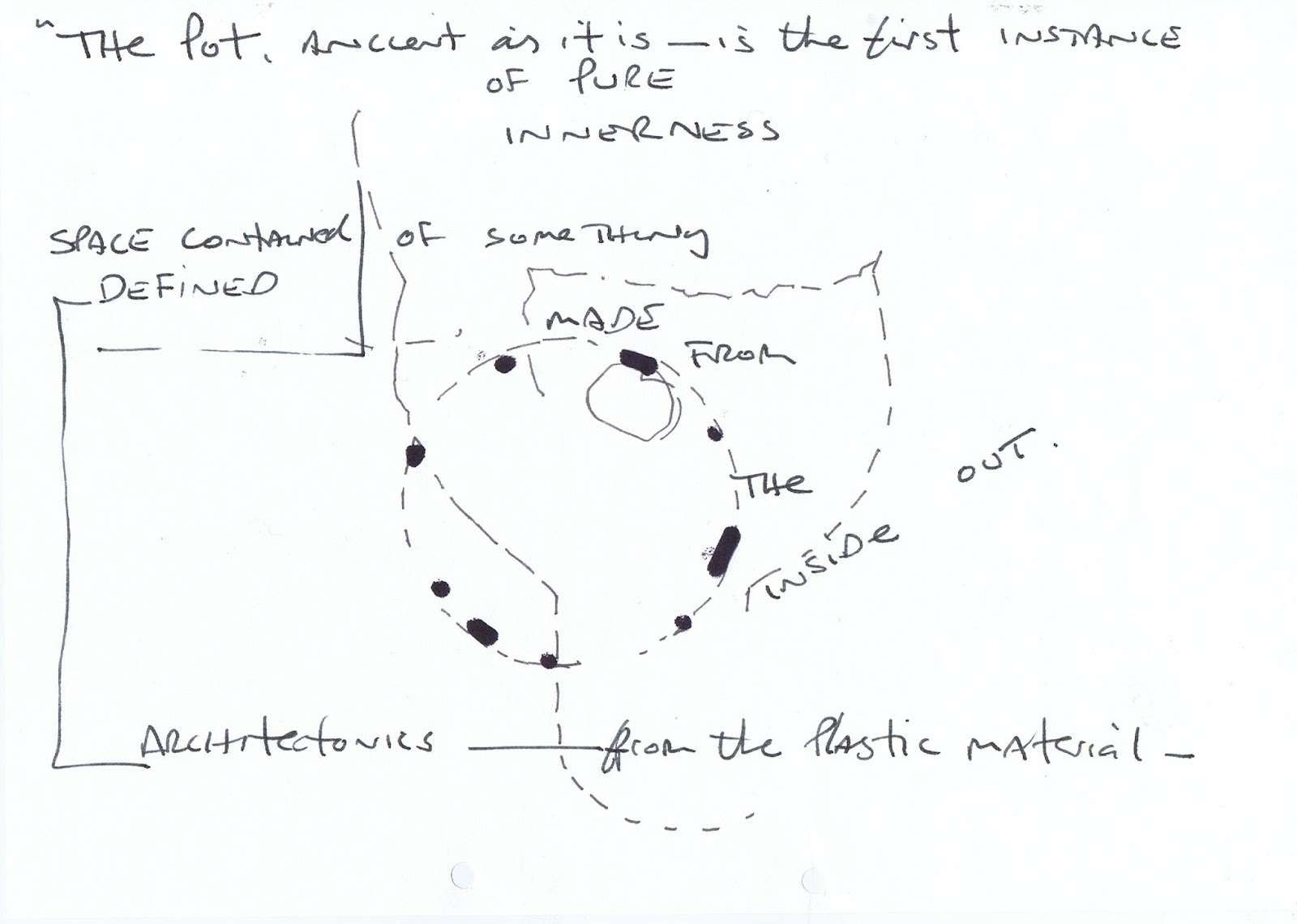
Making (act/sacred bond of both an individual and a civilization) from the inside out, from the interior, from the first movement or impulse, from the everyday condition/situation the as found nature of things. The innerness of the vessel of a room remains the property of our shared humanity, of our social being/becoming.

Why did this opportunity produce a wealth of transformative insights (conduits and territories) that are now active agents working across all facets of my practice?

Why does the teaching and the ultimate examination or rather the grading of the project destroy the delicate praxis that is trying to be engendered?

What, and why does the hidden agenda (any university course can only offer a limited introduction to a level of study) or hierarchical academic position corrupt the learning from not being a mutual experience, into a policing of interrogative and prescriptive learning outcomes?


Properties:

Pastoral Setting.
Built within and amongst a monastery.
Facility and retreat for cross disciplinary inquiry (Humanities and the Social Sciences).
Repository and archive of artefacts, texts and objects.
Exhibition and making spaces, workshops and residential living spaces.
Walled garden complex containing a reading pavilion and library.


Catalyst Events/Situations to engender the experience of learning.


West Dean, Singleton. Residential courses in the arts, both the grounds and the house are fully utilised in the social activity of learning.

Kilquhanity, Scotland. Free School in country setting, used as a site for exploratory fine art practices(converted a pottery into a camera obscura and drew a garden from the movements of the sun across a specific terrain).

Brockwood Park School, Bramdean. Re-imagining learning, conducted a walk across a landscape with clay, and hidden curriculum in the library with objects and texts centred around philosophy and architecture.

Winchester College, Winchester. Exhibition with talk on creative practice, display of large body drawings, cyanotypes, astronomical charts and architectural notebooks. Workshop conducted in the making and experimentation of using the cyanotype process (historical, light based, printing process 1843).

Link Gallery Winchester University, Winchester. Art and Archaeology around the Keatsian notion ‘Negative Capability’ photograms of anthropomorphic leper graves with excavated oyster shells found at the site (Morn Hill, Winchester).


Hyde Abbey Gatehouse and St Bart’s Church Winchester. Leylines exhibition of artist book photographs, drawings, maps and collages. Installation of archaeologist drawing frame with annotated lead labels, plumb bob, orientated to align with the speculative leyline phenomena.