Showing posts with label space. Show all posts

Friday, 13 June 2025

Cyanotype Drawings : Landscapes/Maps and Performative Drawings

Mapping Relationships : Contexts and Locations #2
Collage and drawing with cyanotypes, photographs, negatives and painted surfaces.

Mesh/Material/Light, Cyanotype Process
Cyanotype is a photographic printing process that produces a cyan-blue print. Engineers used the process well into the 20th century as a simple and low-cost process to produce copies of drawings, referred to as blueprints. The process uses two chemicals: ammonium iron(III) citrate and potassium ferricyanide.


The English scientist and astronomer Sir John Herschel discovered the procedure in 1842.[1] Though the process was developed by Herschel, he considered it as mainly a means of reproducing notes and diagrams, as in blueprints.[2] It was Anna Atkins who brought this to photography. She created a limited series of cyanotype books that documented ferns and other plant life from her extensive seaweed collection.[3] Atkins placed specimens directly onto coated paper, allowing the action of light to create a silhouette effect. By using this photogram process, Anna Atkins is regarded as the first female photographer.[4]

From Wikipedia, the free encyclopedia


The Cathedral : Place Studies

Pastoral Space: Material, Inquiry and Craft.#5

Material Agency : Carl Knappett, Lambros Malafouris
Visualising Environmental Agency
 
"Agents are defined as persons or things, which have the ability and intention to "cause" something "in the vicinity" or "in the mileau" to happen ( Gell 1998)"
"These latter artefacts are described with the term "index", to remove the appellation "art" and to imply that they are indexes of agency."
Some Stimulating Solutions, Andrew Cochrane.
 
Template and Form 2010.The Yard, Winchester.

Omslagsfoto : 

Landscapes from the Metropolis of Death. Otto Dov Kulka.

Mapping Relationships : Contexts and Locations #3
Collage and drawing with cyanotypes, photographs, negatives and painted surfaces.


Blueprint : Kengo Kuma, Sensing Spaces.

Panspermia : Cyanotype Drawing
Drawing on paper,150x240 cms
Full size human form drawn through "performance" on paper with cyanotype and black ink. Astronomical data and traces of seed heads together with reference material/notes (directed panspermia) in pencil.

Anthropomorphic and Botanical Cyanotype Drawing (Detail)
Botanical traces with leper graves


We live our lives sunk in vast forgetting. Milan Kundera, IGNORANCE.

Human mapping of social groups from the occupancy of the Winchester Cathedral "Space for Peace" 2011.
Mono Print : Cyanotype process on paper, 52x42cm.


Monday, 17 March 2025

Spatial Interventions/Problems/Praxis of Method : Novalis/Bachelard/Arte Povera.

Outpost 131223


Body Movement.

Robert J. Yudell.

The interplay between the world of our bodies and the world of our dwelling places is always in flux. We make places that are an expression of our haptic experiences even as those experiences are generated by the places we have already created. Whether we are conscious or innocent of this process, our bodies and our movements are in constant dialogue with our buildings.


Problems of Method.

Novalis/Bachelard.

No vision invites him to do so, it is the very substance he has touched with his hands and lips which summons him. It summons him materially by virtue of what seems to be a magical participation. The dreamer undresses and enters the pool, only at this moment do the images appear. They emerge from matter, they arise as if from a seed out of a primitive sensual reality. A rapture which cannot yet project itself on the feminine substantiality of water. Water becomes woman against his breast.


Gaston Bachelard would like to develop a philosophy that has no point of departure, and a philosophy that is not a point of departure. Bachelard in his books, attempts to systematize formal material and dynamic imagination.


Space contains compressed time.

On Poetic Imagination and Reverie.

The Autobiography of Lost Possibilities.

Gaston Bachelard.


A dispersed philosophy that must constantly operate on its very edge, at the very limit where its systematizing impulse is challenged by the actual creations in other domains of human activity. Bachelard becomes a 'hinge' between totalizing metaphysical systems and polyphilosophy.


Bachelard does not develop a fully fledged philosophy of values, rather his books offer lessons for working, reading, breathing and dreaming well, all of which constitute an art of living poetically. Throughout his work he developed the paradox, that the primitiveness of poetic consciousness is not immediately given, it can only be a conquest. Images reveal nothing to the lazy dreamer.

Colette Gaudin. 


Guiseppe Penone.

Souffle 6. 1978.


A large earthenware jar on which the artist has stamped the imprint of his own body. This process shows a sensorial conception of art, a concentration on the organic and the original, reasserting the permanent nature of myths and an animist conception. A vitality of matter, material and object.

The National Museum of Modern Art.

Georges Pompidou Centre.


Arte Povera as an artistic praxis, highly critical and anti-cultural. An art that explores a 'strange area' that is interested in elemental human situations. It was the art critic Germano Celano who in reference to the research done by the polish theatre director Jerzy Grotowski, outlined in his book 'Towards a Poor Theatre' proposed the notion of Arte Povera in 1967.


Epicurean Asceticism.


The Phenomenological Approach.


Problems of Method.


Reading as a dimension of consciousness.


For Anna Teresa Tymieniecka, the essence of life is not a feeling of being, of existence, but a feeling of participation in a flowing onward necessarily expressed in terms of time, and secondarily expressed in terms of space.


Poetry as a synthesis of human existence.


Bachelard's auditive metaphor 'reverberation' for the poetic image brings together through sound, both time and space. In its reverberation, the poetic image will have made a sonority, a situatedness of being.


Science and Poetry.


Concepts and images develop along two divergent lines of spiritual life. The image cannot give matter to the concept, the concept by giving stability to the image would stifle its existence.


Nascent Material/Media.

Drawings rendering an insistent corporeality.


Drawings loosing their haptic senses of mark-feeling and becoming increasingly camouflaged into an image based on representation of an objectified art form/context. 


Life Drawings subdued by visual representation.

Is the initial situation/situatedness/awkwardness of drawing process becoming overwritten.

Drawings feeling the body marking its presence in the space /stage of drawing.


Friday, 12 May 2023

New Ceramics/Drawings/Constructions/Apparatuses/Daylight

Ceramic Forms/Inscriptions/Lines of Knowing.

Wayfaring, walking/sensing between things. 

As wayfarers we experience what Robin Jarvis has called a progressional ordering of reality, or the integration of knowledge along a path of travel.

Up. Across and Along, Tim Ingold.


Structural Modalities/Making/Tensions : Spatial Forms to gather/interact with discursive research

Sensing Spaces : Through displacements and hidden volumes.


The Hut is a vessel in the making for reflective dwelling.

The Pot with its interior underpins its fidelity, its completeness.

Some pots are tuned and balanced for their “innerness”; others promote their surfaces (noise) at the expense of their interior integrity (quietness)


Vessels of Defined Spaces : Creatures of Light and Dark

In sensing a pots interior from its surface, we are as it were in some intimate tacit correspondence with its spatial sensing centre. We become known to it through its maker’s creative gesture of innemess. This anthropological inner space linking us to the potter is both sensual and distant; its vacancy allows us dwell in the maker’s absence.


To build, dwell and explore the space of drawing through intuitive and abstract making.

Drawings/Constructions/Apparatuses.

There is no stage at which humankind does not demarcate, beacon or sign their space, leaving traces that are both symbolic and practical.

The Production of Space.

Lefebrve.


Like drawings, assemblages drawn and made showing the paths taken.

Landing Sites/Holding Places.

Between The Body/Sensing Spaces/Voids.

Perceptions, body, organism, environment,

Mezzanines, lofts, basements, balconies, walkways, scaffolds, access platforms.


Living Architectures/Narratives/Dwelling within the Ruinous. 

Tarkovsky.

Bachelard.

Making Gestures and Connections in Space. 
The Memory of Objects.

The Provocative Combination of Densities.

Inner Architectures/Clay/Sensorial/Conceptual/Places


I placed a jar in Tennessee, 

And round it was, upon a hill. 

It made the slovenly wilderness 

Surround that hill.


The wilderness rose up to it,

And sprawled around, no longer wild. 

The jar was round upon the ground 

And tall and of a port in air.


It took dominion everywhere. 

The jar was gray and bare. 

It did not give of bird or bush, 

Like nothing else in Tennessee.


Wallace Stevens, ‘Anecdote of the Jar’ (1919)


Innerness for the potter is always at the heart of the practice, as manifested through the opening up of the thrown vessel.

Inner spaces of defined interiors forming vessels that are intrinsically cyclical through light and dark by way of their surfaces and volumes.


Like the cellar, the pots interior and its containment of light and shadow becomes a dwelling space for a submerged primordial memory. (Bachelard/Trigg)


The clay links the vessel to both locality and our geocentric position.


‘Pleasure is moving from darkness to light and vice-versa.’ 
Grafton Architects. Sensing Spaces: 2014


The pot promotes an architecture of the soul, of an intimate yet social interior illuminated through the imagination.

In The Making : Hollowing out Space through Innerness and Difference. 
Quietus : Interiors of Silence and Space.

Innerness : A (sensorial) space or even a place interior to its environment 


Splitting.
Spatial representations/cuttings into the urban/social fabric of architectural redundancy.

Gordon Matta-Clark.


The co-existence of overlaying fragments of construction, by selective excavation and creative demolition.

Castelvecchio an attitude to history. Carlo Scarpa.


Site is the un-doing of place.

Generative and provisional, site-specific investigations for sensing place.  


Hand Built, Slab Ceramics.

Oxide washes, incised lines and piercings undertaken to the raw clay forms.

Architectural Facades/Camera Obscura. 


Dark Room.
Garry Fabian Miller.

The internal mechanisms with which we see and experience visual and physical phenomena depend on a bottom-up approach. Building up from elements of abstraction, the opposite top-down approach of given figuration stifles necessary imagination.


Curiosity, imagination and enthusiasm all hold a power in the mind to ignite the creative act.

The Lake of The Mind.

Steven Holl.


Stochastic thinking suggests an interconnected ecosystem of architecture together with all of the arts to achieve new levels of correlation.lay


Thursday, 26 May 2022

BOUNDARIES AND JUNCTION POINTS ARE IN THE NATURE OF THINGS POINTS OF FRICTION

 BOUNDARIES AND JUNCTION POINTS

Lefebvre, The Production of Space.

Lefebvre in his chapter on Spatial Architectonics makes reference to the relationships established by boundaries and the relationship between boundaries and named places. These relationships promote significant and specific conditions or features to a space. This in turn results in various kinds of space. Lefebvre states that “every social space, then, once duly demarcated and oriented, implies a superimposition of certain relations upon networks of named places.”1

It is this superimposition of space that can within it demarcate other thresholds of experiences, within an existing demarcated space that interests me.

The act of “blocking in“ the dimensions of another space onto the floor of another create a temporal junction between a host space and a site within this host, a guest. This sets-up the notion of a temporal double occupancy held by the demarcation of a boundary and a site of proposal. This basic and temporal site marking could be said to have affinity towards some sort of anthropological marking, a territory. (Lefebvre defines anthropological marking as being at the stage when demarcation and orientation begin to create place and its social reality in archaic cultures)2. This activity also has associations with nomadic and agricultural-pastoral societies as they use paths and routes as spatio­ temporal markers or determinants.

Lefebvre acknowledges that geographical space created through the body, through routes which were inscribed by means of simple linear markings. These first markings, paths and tracks drawn into the landscape would become the pores through “which without colliding would produce the establishment of places (localities made special for one reason or another).”3Within my practice drawing is used to form sites which contain visual information, evidence of temporal activities and traces of actual objects. These territories within other territories create fields from with boundaries form material relations, differences. My drawings are inside the temporality of site I have instigated and yet they propose a territory and a surface of light years which could accommodate the temporality of terrestrial space.

Interestingly Lefebvre comments “there is no stage at which ’’man” does not demarcate, beacon or sign his space, leaving traces that are both symbolic and practical.”4

1 Lefebvre, The Production of Space, (London: Blackwell, 1991) page 193.

2 Ibid.,page 192.

3 Ibid.,page 192.

4 Ibid.,page 192.


SENSORY THEATRE

EX MACHINA, Robert Lepage

While Legage continues to pioneer the use of technology, his work is imbued with an intimacy and humanity that few can match. Edinburgh festival 2015

ABBATOIR FERME, Jan Fabre (Troubleyn, Performing Arts)

A SOMATIC ARCHIVE, of subjectivities whose perceptions and environments are going to change forever; like the particularities of the analogue trace in photography that is now becoming a distant experiential condition, an orphan extinct from the subjectivities of its originating culture/organism.

The Waverley Inquiry

A Theoretical and Somantic search amongst Ruins and Archetypes Historical Perspectives

Dwelling/Poetics Heidegger Archetypes/Symbols Jung

Flesh and Stone, Richard Sennett

Flesh and The Logic of Sensation, Deleuze/Bacon Contemporary Spatial Practices

Feminist Geographies The Posthuman

Posthuman thought inscribes the contemporary subject in the conditions of its own historicity.

Posthuman Subjectivity ,Rosi Braidotti LIGHT into SOMANTIC SPACES

Continuum and Chora (light and the shadow of chora)

Life expresses itself in a multiplicity of empirical act: there is nothing to say, but everything to do. Life, simply by being life, expresses itself by actualiizing flows of energies, through codes of vital information across complex somatic, cultural and technologically networked systems. (Braidotti, 2013:190)

De Architectura, Vitruvius

Architecture consists of order, arrangement, proportion or eurythmy, symmetry and decor, and distribution.

Arrangement as an “Idea” refers to the Aristotelian notion of “Image­ representation” as phaantasia a precondition to drawing, effectively occupying and revealing a space between being and becoming.

Contents List from a folder in the Theatre of Research Chora Body and Building

Space as Membrane

Chora (Exhibition) 1999

Lessons of a dream. Karsten Harries Concrete Blonde: Joanna Merwood

A probe into the negative spaces where mysteries are created. Surrealist Paris : Dagmar Motycka Watson

The non-perspectival space of the lived city Body and Building : George Dodds

Essays on the changing relation of body and architecture. Sphere and Cross : Karsten Harries

Vitruvian refections on the Pantheon Type Body and Building : Marcia f. Feuerstein

Inside the Bauhaus’s Darker Side

Desiring Landscapes/Landscapes of Desire. George Dodds A Tradition of Architectural Figures: Marco Frascari Interwining Metamorphoses : Germano Celant

On the work of Guiseppe Penone Space as a Membrane : Siegried Ebeling

Unlike a Library the Theatre of Research is a working space that creates and crafts both theoretical and practical objects, things and documentation. Its reason for being is to explore the praxis for creative narratives between the Arts and The Humanities. It attempts through performance, fine art and architecture to collage qualitative and diffractive dialogues into new relational discourses, the results of which become exhibited or staged as open workshops engendering praxis, publication and production. In its fledgling state it is seen as being part of a University faculty that has interests in the Arts and The Humanities. The possible linking with other establishments could be investigated. The working space becomes operational as a studio or laboratory that is engaged with full-time research led activities . Separate yet collaborative spaces and activities promote an environment for inquiry and personal development. The Theatre for research becomes a space that allows for the Post Production of ideas into new forms of social interaction. The theoretical merging with the practical into a relational narrative or methodology that enriches the practices of others, forming both new creative environments that can contain innovative ecologies that can question global perspectives.

INDEX OF IMMATERIAL ARCHITECTURES Jonathan Hill 2006

The Psychoanalysis of Fire. Gaston Bachelard 1964 (1938)

AIR

NATURAL FORCES

The Architecture of the Air (blurs the boundaries of architecture and nature) Loose spatial orders suggesting a fluidity of space, matter and use.

The experience of space was not a passive activity, nor was it considered to be pre­ dominantly retinal. Klein defines his subject matter ‘space’ as sensual, spiritual and an immaterial expanse in which the body is active and immersed; he sought to engage all the senses and to liberate the mind, body and imagination.

Quixotic Gestures that capture the experience and the engagement with natural forces. Klein’s architectural focuses on imprecise boundaries and inconsistent materials in active dialogue with the user.


Space through dialogue/movement defines the user

Most buildings make a clear distinction between the unpredictable natural forces outside and the predictable domestic spaces inside.

The Fireplace is unusual, therefore in that it is a natural force contained within the building.

The fireplace is also paradoxical in that if uncontrolled it threatens destruction of the home.

Evolving Atmospheres, Not Models

Architecture is the affect and its phenomena gained from the experience of the constructed form.

Architecture is a sensorial response to definitions of spatial arrangements. Architectures and their interiors can be infinitely re-imagined through interventions that might not noticeably alter their external appearance.

Materials and Place. The Secular Retreat. Zumthor and Heidegger.

Peter Zumthor acknowledges his knowledge and affinity with Heidegger’s writings, see Peter Zumthor, Buildings and Projects 1998,( Sharr,2007:91) In particular his Vais Spa is of particular note for the way in which Zumthor has created ‘evocative sequences of spaces’ within ‘its exquisite construction details’. (Sharr,2009:92)

‘Zumthor mirror’s Heidegger’s celebration of experience and emotion as measuring tools; he also emphasises sensory aspects of architectural experience. He notes that the physicality of materials can involve an individual with the world, evoking experiences and texturing horizons of place through memory.’ (Sharr,2009:92)

The measurement of a house through things that have sensual qualities, creating a memory of place, and its evocative measurement that can be choreographed through selective materials.

‘Flamed and polished stone, chrome, brass, leather and velvet are all deployed with care to enhance the inhabitant’s sense of embodiment when clothed or naked. The touch, smell and perhaps even taste, of these materials were orchestrated obsessively. The theatricality of steaming and bubbling water was enhanced by natural and artificial lighting, with murky darkness composed as intensely as light. Materials were crafted and joined to enhance or suppress their apparent mass. Their sensory potential was relentlessly exploited. With these tactics, Zumthor aimed to celebrate the liturgy of bathing by evoking emotions.’ (Shan,2009:95)

Zumthor comments about his architecture for the Spa at Vais. 

‘In the bath there is a bit of a mythological sense of place, there are bits of theatricality, even the mahogany in the changing rooms looks a bit sexy, like on an ocean liner or a little bit like a brothel. They are where you change from your ordinary clothes to go into this other atmosphere. The sensual quality is the most important, of course, that this architecture has these sensual qualities. (Spier,2001:17)

He is trying to configure particular theatrical and phenomenal experiences in architectural form. It is only when the qualities of these prospective places emerge, can Zumthor begin to configure and design the particulars of the buildings construction.

‘The measuring of body and mind, the navigation by intuition and judgement which Heidegger makes sense in sparks of insight, these all become ways for designing, for imagining future places on the basis of remembered feelings. He feels that this process creates the contexts with which people will experience his architecture. (Sharr,2009:95)

The Spa at Vais was conceived to appeal to sensual instincts first, and then open itself up to interpretation and analysis, the spa should be tactile, colourful, even sexy to inhabit. (Sharr,2009:96)

‘Zumthor imagines experiences of the spa to be punctuated by things which evoke memories, which represent associations. He like Heidegger conceives of human endeavour in terms of traditions; Zumthor crafts spatial representations of those traditions by locating things in what he considers to be their proper place in time and history. Heidegger was also anxious to locate his farmhouse dwellers according to rites and routines longer than a life.’ (Sharr,2009:96)

Dwelling and livelihood, rites and routines, are all authenticated and located by design; the simple, sensual, primary and elemental associations that create traditions that both Heidegger and Zumthor can subscribe to. All help to root the spa in an agrarian view of the mountains that is associated with livestock and the necessities of shelter.

Zumthor shares with Heidegger ‘a sympathy for the mystical, claiming mythological qualities for moments in the spa’, and to champion’ the immediate evidence of experience and memory over that of mathematical and statistical data. ’(Sharr,2009:96)


‘ It seems that, for Zumthor, the Vais spa achieves his design intentions by locating rituals of dwelling in place with all the Heideggerian associations of those terms. By choreographing enclosure, mass, light, materials and surfaces, Zumthor sets up conditions from which he can propose a rich layering of place perceptions, by allow people to identify places through their bathing rituals and their associative memories.’ (Sharr,2009:96)

There is perhaps for Zumthor and other Heideggerian architects ‘the suggestion that design involves the choreography of experience’. He advocates a piety of building, of trying to develop a design in a away it wants to be, ‘of configuring physical fabric around real and imagined experiences’.

Heidegger notes of Western societies and their professional architectural regulations do much to ‘obstruct proper relations between building and dwelling by promoting buildings as products or as art objects’. (Sharr,2009:98)

Genius Loci: Towards a Phenomenology of Architecture. Norberg-Schulz. Presents an opportunity for people to achieve an existential foothold in the world. Norberg-Schulz notes that inhabitation as like a layer over the architecture. In effect the architect designs, the contractor builds, and only then do the inhabitants build and dwell.

Zumthor with particular reference to his Vais project likes to perceive his architecture and the things within it as becoming associated with traditions, perhaps these become re-enacted as rich, operative histories made in and for the present.

Steven Holl shares similar working methods with Zumthor, he to is influenced by phenomenology on his thinking. He makes watercolour sketches in perspective, as a means of choreographing experience, painting itself is an intuitive act, which opens up spontaneous and unintended design possibilities.

Drawing processes and mapping that can re-imagine the spatial possibilities of architectural experiences.

The Choreography of Experience. A Manifesto.

Being attentive to atmospheres, moods and sites.

Being concerned with the social and political geometries of human gatherings. 

Being participatory to architectural tactics that enable informal gatherings.

Phenomenology and Politics.

Zumthor downplays the activeness of his role in design. The architect is keen to emphasise that he works instinctively with circumstances given to him. He claims a similar modesty in forming a rapport with site and locality. He is able to give the architectural idea a piety to become what it wants to be.

Heidegger’s problematic authenticity claims and the potential consequences of his romantic provincialism became more prominent in architectural debates about the merits of his model of building and dwelling.

Therefore ‘it remains a common assumption among architects that these positions are more or less in opposition. To caricature, phenomenology (at least in its Heideggerian incarnations) champions the value of immediate human experience over scientific, measurement and professional expertise, and tends to mytholize timelessness and situatedness. Critical theory, meanwhile, prioritises the political dimensions implicit or explicit in all human activities, and is opposed to monolithic claims of authenticity. (Sharr,2009:112)

Heidegger’s thinking, including that on architecture, is easily challenged from the perspectives of critical theory. The philosopher perceived the ‘essence’ of building and dwelling in authentic attunement to being, unapologetic about the tendencies of essentialism and authenticity to exclude people. His writings display little fondness for what he saw as the human distraction of politics. (Sharr,2009:112)

Heidegger’s work on architecture and, arguably, the architectural phenomenology which claimed him as a hero, has become a zero-sum game. Whatever it gives, its associations can also take away. Many architects and commentators have turned their backs on Heidegger in consequence although a few, including Zumthor, remain unswayed. (Sharr,2009:113)

Edward Casey, The Fate of Place. 

Gaston Bachelard, Poetics of Space.

Maurice Merleau-Ponty, Phenomenology of Perception.


Thursday, 3 March 2022

Temporal Perspectives : Urban Space and Place

Architectutally
Speaking
Practices of Art, Architecture and the Everyday
edited by Alan Read

Thirdspace  : expanding the scope of the geographical imagination
Edward W. Soja

Space-time and the politics of location
Doreen Massey

Space and Place
The Perspective of Experience
Yi-Fu Tuan

Experiential Perspective
Space, Place, and the Child
Body, Personal Relations, and Spatial Values
Spaciousness and Crowding
Spatial Ability, Knowledge, and Place
Architectural Space and Awareness
Time in Experiential Space
Intimate Experiences of Place
Attachment to Homeland
Visibility : the Creation of Place
Time and Place


for
space
Doreen Massey

Living in Spatial Times
Instantaneity/depthlessness

A Relational Politics of The Spatial
Making and Contesting time-spaces


Sunday, 9 January 2022

On Being with Krista Tippett : Ann Hamilton Making, and the Spaces We Share

Hamilton asserts that we know things primarily through our skin, the largest organ on our body which both covers and reveals.

The philosopher Simone Weil defined prayer as “absolutely unmixed attention.” 

The artist Ann Hamilton embodies this notion in her sweeping works of art that bring all the senses together. 

She uses her hands to create installations that are both visually astounding and surprisingly intimate, and meet a longing many of us share, as she puts it, to be alone together.

https://onbeing.org/programs/ann-hamilton-making-and-the-spaces-we-share/ 


Embodied Knowledge.

Spatial Agency : Organism/Person/Environment

The body and space are reflexive and interdependent.

Movement and tactility in photography/representations

Merleau-Ponty on the intertwining of vision and movement, and that tactility in photography depends on the skin rather than the eye.

Thursday, 5 August 2021

Drawing as a participant in amongst a world of active materials


Art as Spatial Practice.
Space folds : Containing "Spatialities around historicality and sociality"

"All that is solid melts into air"

Karl Marx, Friedrich Engels,
(Poetic observation concerning the constant revolutionizing of social conditions)

Perceptions now gathering at the end of the millennium. Spatiality, Robert T. Tally Jr. 2013

http://pictify.saatchigallery.com/user/russellmoreton

Thursday, 7 April 2016

Russell Moreton VITRINES : Art Spaces/interiors/interventions. 3

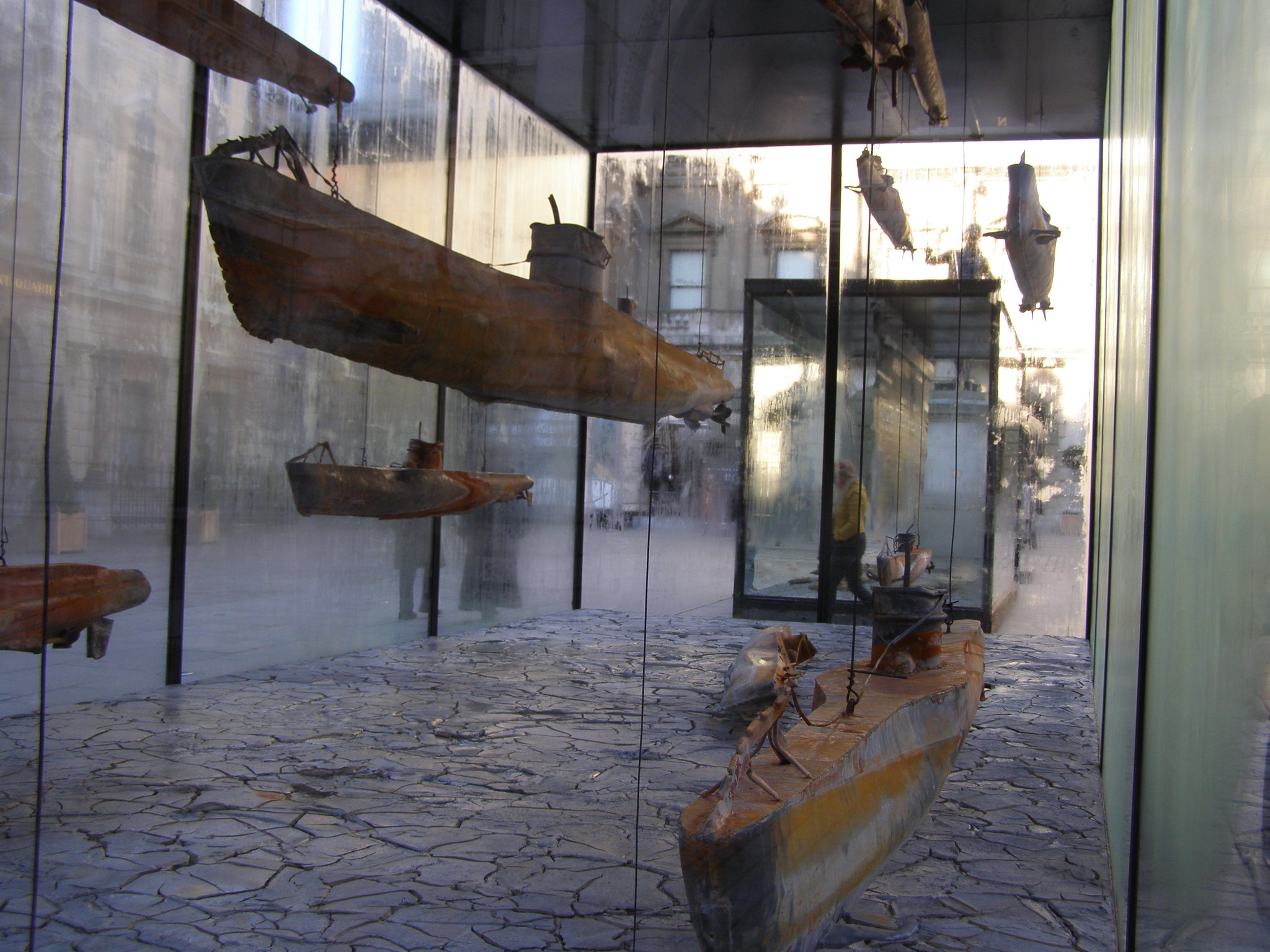
Anselm Kiefer :
In the Annenberg Courtyard 2014.
Velimir Khlebnikov: Fates of Nations: The New Theory of War
Anselm Kiefer often dedicates his works to intriguing figures of the past, be they poets or philosophers. This piece is one of a number of works emerging from Kiefer’s ongoing exploration of the Russian Futurist avant-garde writer, theorist and absurdist Velimir Khlebnikov (1885-1922).

After years of study, Khlebnikov concluded that a major sea battle took place every 317 years, or multiples thereof. Kiefer celebrates this heroic and ludicrous activity with a work that is both monument and anti-monument. Measuring almost 17 metres in total and consisting of two large glass vitrines, Kiefer creates a transparent, reflective sea-scape in three dimensions that calls to mind the Romantic sublime of painters from JMW Turner to Caspar David Friedrich. Kiefer uses the frames of the vitrines to stage a mysterious drama, in which viewers, seeing each other and their own reflections, become participants.


https://www.royalacademy.org.uk/article/kiefer-and-chipperfield-talk-space


Wednesday, 20 February 2013

Studio Spaces~Blue Sympathetically : Historical Spatial Frames/Registers

Blue Sympathetically : Engaging with the unknowable at the heart~midst of experience.
Studio Spaces : Historical Spatial Frames/Registers.


Alternative Photography
Documents from research archive

Tracing Light : Petworth House, West Sussex 2000
David Alan Mellor, Garry Fabian Miller.

Light And The Genius Loci
For Derrida, the sun not only marks the beginning of metaphoricity but it is also an inescapable reminder of the solar system and oscillations, hidings and occultrations, inherent in 'a certain history of the relationships; earth/sun inthe system of perception'.

Mutations Of Light
Petworth Window, 6 July 1999

Light's Windows And Rooms
Passing towards the Invisible.
The prospect of some metaphysical realm beyond the blue end of the spectrum and beyond material things illuminated to carnal sight, was a recurrent  theme in William Henry Fox Talbot's early speculations.

CATCHING THE LIGHT
The entangled history of light and mind
Arthur Zajonc

BROUGHT TO LIGHT
PHOTOGRAPHY AND THE INVISIBLE 1840-1900

Sight Unseen
Picturing The Universe
Corey Keller
Invisible objects, penciled by nature's own hand.
In his introduction to the exhibition catalogue Iconoclash: Beyond the Image Wars in Science, Religion, and Art, the historian of science Bruno Latour argues that scientific pictures are powerfully affective because they more than mere images; they are, as he puts it, the 'world itself'.

The Social
Photographic Eye
Jennifer Tucker
Nineteenth century science was characterized by both the appeal to visual evidence and the need for confirmation by the testimony of eyewitnesses. The latter explains why scientists pursued public viewings of their photographs by means of illustrated slide lectures, exhibitions, and reproduction in newspapers and magazines.
An understanding of the social boundaries of nineteenth century science helps make sense of a certain paradox within contemporary attitudes towards photography of the invisible. The ideal of mechanical objectivity in documenting visual knowledge demanded the elimination of the artist-observer and all of the subjectivity implicit in drawing by hand. 

Invisible Worlds
Visible Media
Tom Gunning
William Henry Fox Talbot, Slice of horse chestnut, seen through the solar microscope, 1840, salt print 18.6x22.5 cm.

Techniques Of The Observer
On Vision And Modernity In The Nineteenth Century
Jonathan Crary
The Camera Obscura and its Subject
Above all it indicates the appearance of a new model of subjectivity, the hegemony of a new subject-effect. First of all the camera obscura performs an operation of individuation; that is, it necessarily defines an observer as isolated, enclosed, and autonomous within its dark confines. It impels a kind of askesis, or withdrawal from the world, in order to regulate and purify one's relation to the manifold contents of the now 'exterior' world. 

UNDER THE SUN
By The Light Of The Fertile Observer
Metaphors of illumination in the photography of Christopher Bucklow, Susan Derges, Garry Fabian Miller, and Adam Fuss.
An Epiphany Of Light
David Alan Mellor

Christopher Bucklow , Guests
Jeanette Winterson, Gut Symmetries
Matter is provisional and that includes me. If the physics is correct then we are neither alive or dead as we commonly understand it, but in different states of potentiality.

From The Adamantine Land
Variations on the art of Christopher Bucklow
David Alan Mellor

Etienne-Jules Marey
A Passion For The Trace
Francois Dagognet

Painting, Photography, Film
Laszlo Moholy-Nagy
A Bauhaus Book

L. MOHOLY-NAGY:
DYNAMIC OF THE METROPOLIS
SKETCH FOR A FILM
ALSO TYPOPHOTO

OSKAR SCHLEMMER
MAN

Interaction of Color
Josef Albers

The Elements of Color
 Johannes Itten

Pedagogical Sketchbook
Paul Klee

The New Landscape in art and science
Gyorgy Kepes

The Colour  of Time
Garry Fabian Miller
The Majesty of Darkness
Adam Nicolson
The Unmade
The Pregnant
The Half Erotically Unmade

Camera Obscura of Ideology
Sarah Kofman
An optical instrument, which used in drawing, allows one to see at the same time the objects being drawn and the paper.

I Am Not This Body
Barbara Ess

Tuesday, 29 January 2013