RESEARCH METHODOLOGIES CRITICAL THEORY
SPATIAL PRACTICES : CANTERBURY 2009
PERIPHERAL VISION : RELATIONALITY, ROBERT COOPER.
I have quoted the entirety of this abstract, as its concise and articulate statement needs to be preserved as a fragment capable of reconstituting interest for others and, by keeping its first reading authentically present, it is presented “live” and synchronic with its other enactments.
“The act of relating is analysed as a constitutive feature of human agency .Relating is viewed as the continuous work of connecting and disconnecting in a fluctuating network of existential events. Relating re-lates the human world as a restless scene of flowing parts in which whole, self contained objects take second place to the continuous transmission of movement. The relating of the world of moving parts is illustrated through the examples of modem methods of mass production and the transmission of information which both produce a “weakening of reality.”
Keywords: human agency, information transmission, the latent, part-whole relationship, production-prediction
Robert Cooper’s observation that relating is a continuous connecting and disconnecting, probes the possibilities of spatial encounters that can be grafted onto and within our readings of place. The notion of the temporal and the contingent, are never far away in this “fluctuating network of existential events.”
Cooper makes an informative comment on modern methods of mass production and communication, “categories and things may make it easier for us to grasp reality but they also hide its underlying complexities.”1
This sense of partial visibility, made and controlled by things, intrigues me as does the parts on the periphery of perception which remains with the potential to become relational. My work seems to be seeking out and mediating the interspace between the individual and their environment. For me this interspace becomes the space of unfolding implications, whose dynamics, or resonances, are achieved through connections that imply disconnections.
The photographic evidence utilized in my practice, the way emergent findings are presented and then over written, suggests that this idea of inter space, is totally contingent. This gives a sense of an archaeology of perceptive meanings, which are manifested as visual consolations. These held in an ever emergent state of contingences interests me. The space and time of relativity and relationship, Cooper notes is a place where “nothing can be itself and everything is suspended in an unfinished betweenness that seems to refuse simple location and identity.”2
Betweenness/walking into a latent field of relationality?
“Relationality re-lates latency. It re-lates in the double sense of connecting terms and thus creating coherent structures of relations out of gaps and intervals of disconnection, as well as narrating and making explicit the dormant and implicit nature of latency.”3
1 Robert Cooper, Peripheral Vision: Relationality (London: Sage Publishing, 2005), page 1689.
2 .Ibid., page 1692.
3 .Ibid., page 1693.
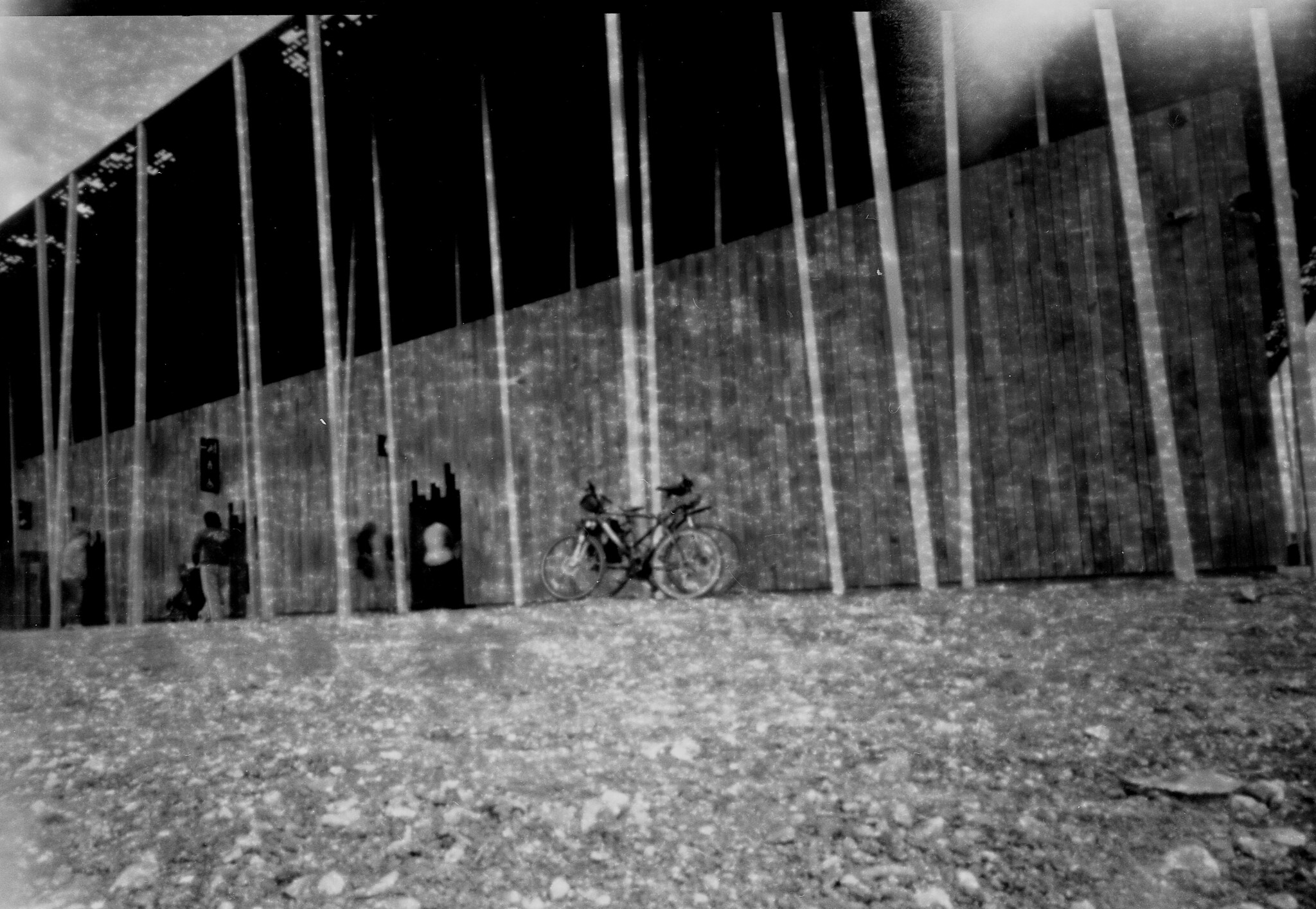
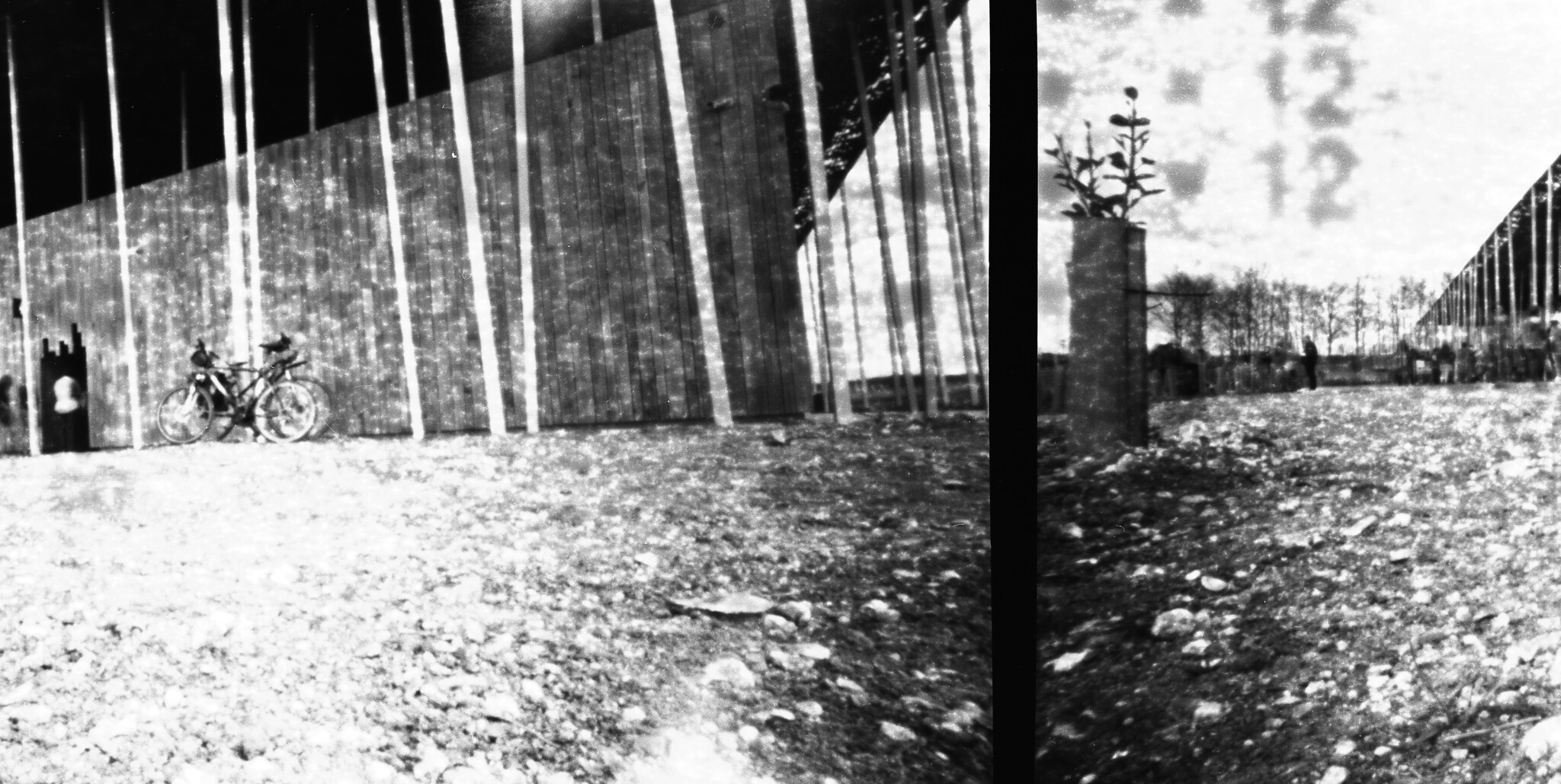
Helena Elferova~Synagoga : Photographic Pathologies~Saturnian lead, greyness, analogue processes.
https://www.flickr.com/photos/russellmoreton/
PORTRAITS, STILL VIDEO PORTRAITS AND THE ACCOUNT OF THE SOUL, JOANNA LOWRY.
This text taken from Stillness and Time: Photography and the Moving Image is of interest, as it analyses the properties of the compression of time into a single image and our reading of such material. It is this central issue of time, or rather that photography can intercept it, that interests me through the use of simple light gathering devices. Joanna Lowry remarks on the ability of photography to disrupt “ our common-sense understanding of the relationship between past and present, stopping the flow of time and holding it in an uncanny stillness for years on end, revealing to us a present without a future.”1
Photography seems to be more about what remains after time is interrupted; it reveals “a fissure in the field of the visible.”2 This fissure could be said to be a frame of a detachment of time, a hermetically sealed dimension, preserving its own unique value of dwelling and promoting a sense of temporality of human subjects, surrounded by an exactitude of place.
One of the interesting properties of these “time based stills” is that they give a visual site for the triangular relationship between subject, spectator and time. The time element is duration, so therefore these images are filmic semblances, witnessing their subjects, or as Benjamin termed them as “growing into the picture”. The spectator of these encounters (framed by time) becomes aware of a photographic duration. This duration is constantly emerging and it is also constantly forming “sedimentary remains”. Perhaps as Lowry comments “they offer us a new enchantment with the provisionally and fragility of the pose."3
This new enchantment, or the site of its alternation, is created by a photographic absorption of a human performance. This phenomenon, of an absorbed and distracted subject as Benjamin has noted, belongs to the earliest forms of photography. What is also relevant here, is the observation made by Mark Godfrey “new technologies produce new forms of subjectivity.”4 Photography produces and procures a difference and a distance. It is a “differentiated space of the visible.”5
1 .Joanna Lowry, Portraits, Still Video Portraits and the Account of the Soul (Brighton: Photoforum, 2006), page 65.
2 .Ibid.,
3 .Ibid., page 78.
4 .Mark Godfrey, Fiona Tann : Countenance (Oxford: Modem Art Oxford,2005), page76.
5 Joanna Lowry, Portraits, Still Video Portraits and the Account of the Soul (Brighton: Photoforum, 2006), page 77.
Artist Statement/Analysis re Spatial Practices/Methodologies
My previous experiences have been drawn from a physical relationship to “site” and the possibilities that might be embedded to be encountered for others. It is in the spatiality of Drawing from which I am attempting to create a form, that allows the multiplicity of material associations and yet has a sort of transparency and physicality, that allows specific readings to be experienced through this membrane. Spatial practices offers up a frame of references and cross multidisciplinary approaches that are already offering possible solutions.
My initial use of surfaces Ceramics and Glass, in architectural surroundings, is being redrawn into relationally with the notion of an interlocutor being an active participant and for those others whose proximities and contingences they might create.
Analysis of my assemblages, which are housed in book form, reveal a spatial overwriting of both written annotations and diagrammatical routing of specific elements. All of this occurs, or is illuminated adjacent too and between, photographic evidence of place.
This evidence of place is itself a surface of compressed time, inscribed during that time by light. Light therefore suggests itself as the ultimate vehicle of transparency, of both being able to illuminate information and also being able to stream and superimpose seamlessly contingent knowledge’s as they appear.
The intertextuality of Language, as something that might be configured as an inclusion into physical place is a possibility. My work seems to require this transparency on one hand and yet recent reviews of my drawings, reveal a dynamic engendered from precisely drawn articulations, to a nebulous semblance on the same surface. In effect my interests are on the transition points, thresholds even, of the periphery of perceptions being retained, whilst other things become open and emergent.
This dynamic across a spatial volume activates the possibilities of seeing things becoming interwoven with creative potentials.
Other observations, brought from the presentation of working practice, have been the issue of intensive notations, almost as if the photographic surfaces, themselves vestiges of solitudes were being re-enacted by a choreographic sense of re-encountering place. The embedded durations, overwritten by light within the photographic surface, give a semblance of the notion of inter- textuality, or rather its creative possibilities; in fact they are ensnared continuances.
J G Ballard refers in his writing that it is being envisaged in the visionary present. The extended durations of “the present” captured on a photographic surface could be said to be a concretization of the present by the past.
These extended durations of always “becoming present” have something about an indexical mark in a state of a constant erasure of becoming, held captive within them. A further visual distortion, achieved by the use of a chamber as the receptacle to mediate the relations between the light outside with the light that penetrates, produces a kind of visual psychosis, a distorted sense of being captive which seems to accompany the image.