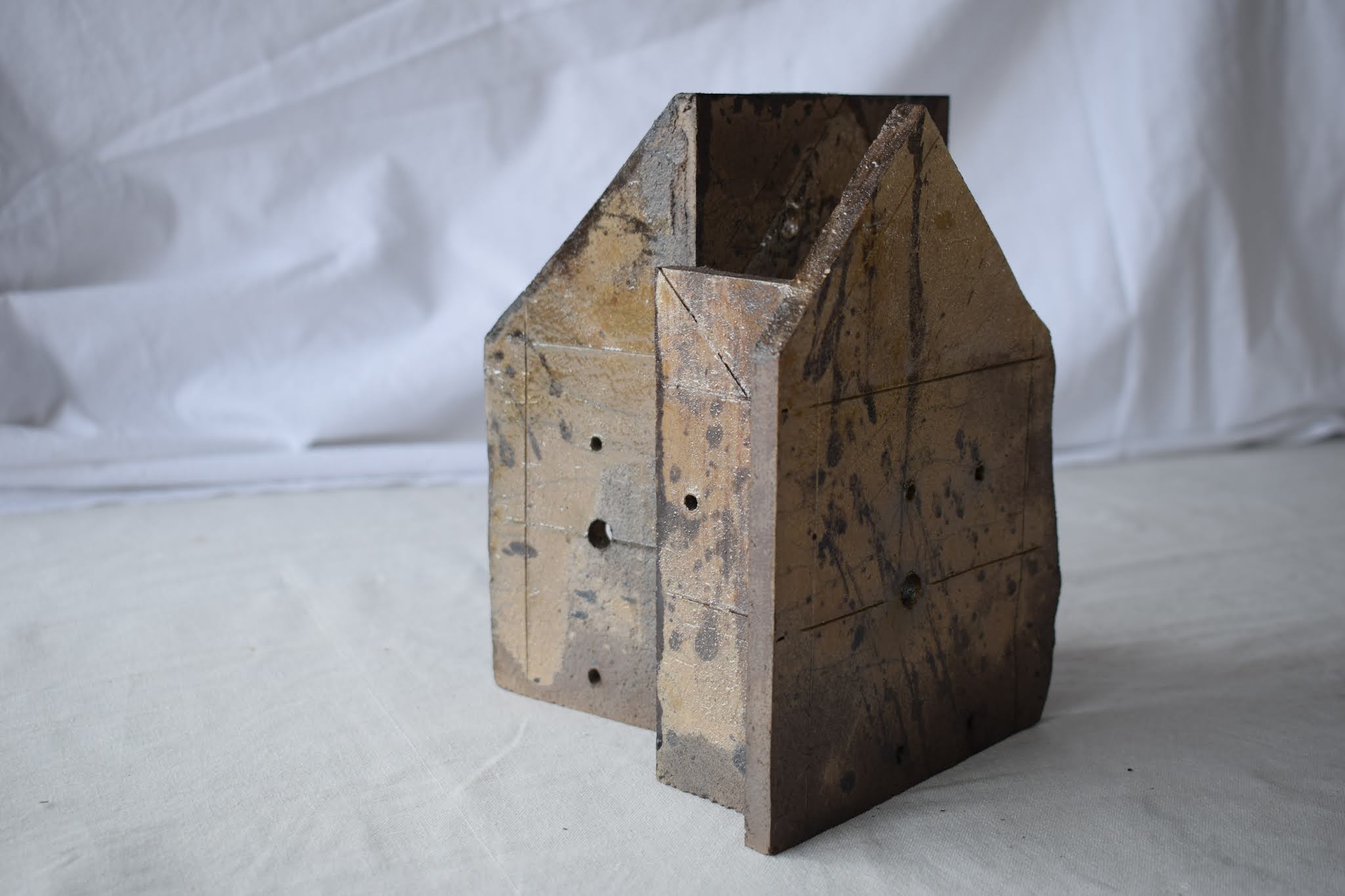
Showing posts with label Robert Cooper. Show all posts

Saturday, 26 July 2025

CARETAKING/INTERSPACES The Weird And The Eerie/fluctuating networks of existential events : Photographic pathologies of alterity

RESEARCH METHODOLOGIES CRITICAL THEORY

SPATIAL PRACTICES : CANTERBURY 2009

PERIPHERAL VISION : RELATIONALITY, ROBERT COOPER.

I have quoted the entirety of this abstract, as its concise and articulate statement needs to be preserved as a fragment capable of reconstituting interest for others and, by keeping its first reading authentically present, it is presented “live” and synchronic with its other enactments.

“The act of relating is analysed as a constitutive feature of human agency .Relating is viewed as the continuous work of connecting and disconnecting in a fluctuating network of existential events. Relating re-lates the human world as a restless scene of flowing parts in which whole, self contained objects take second place to the continuous transmission of movement. The relating of the world of moving parts is illustrated through the examples of modem methods of mass production and the transmission of information which both produce a “weakening of reality.”

Keywords: human agency, information transmission, the latent, part-whole relationship, production-prediction

Robert Cooper’s observation that relating is a continuous connecting and disconnecting, probes the possibilities of spatial encounters that can be grafted onto and within our readings of place. The notion of the temporal and the contingent, are never far away in this “fluctuating network of existential events.”

Cooper makes an informative comment on modern methods of mass production and communication, “categories and things may make it easier for us to grasp reality but they also hide its underlying complexities.”1

This sense of partial visibility, made and controlled by things, intrigues me as does the parts on the periphery of perception which remains with the potential to become relational. My work seems to be seeking out and mediating the interspace between the individual and their environment. For me this interspace becomes the space of unfolding implications, whose dynamics, or resonances, are achieved through connections that imply disconnections.

The photographic evidence utilized in my practice, the way emergent findings are presented and then over written, suggests that this idea of inter space, is totally contingent. This gives a sense of an archaeology of perceptive meanings, which are manifested as visual consolations. These held in an ever emergent state of contingences interests me. The space and time of relativity and relationship, Cooper notes is a place where “nothing can be itself and everything is suspended in an unfinished betweenness that seems to refuse simple location and identity.”2

Betweenness/walking into a latent field of relationality?

“Relationality re-lates latency. It re-lates in the double sense of connecting terms and thus creating coherent structures of relations out of gaps and intervals of disconnection, as well as narrating and making explicit the dormant and implicit nature of latency.”3

1 Robert Cooper, Peripheral Vision: Relationality (London: Sage Publishing, 2005), page 1689. 

2  .Ibid., page 1692.

3  .Ibid., page 1693.


Helena Elferova~Synagoga : Photographic Pathologies~Saturnian  lead, greyness, analogue processes.

https://www.flickr.com/photos/russellmoreton/


PORTRAITS, STILL VIDEO PORTRAITS AND THE ACCOUNT OF THE SOUL, JOANNA LOWRY.

This text taken from Stillness and Time: Photography and the Moving Image is of interest, as it analyses the properties of the compression of time into a single image and our reading of such material. It is this central issue of time, or rather that photography can intercept it, that interests me through the use of simple light gathering devices. Joanna Lowry remarks on the ability of photography to disrupt “ our common-sense understanding of the relationship between past and present, stopping the flow of time and holding it in an uncanny stillness for years on end, revealing to us a present without a future.”1

Photography seems to be more about what remains after time is interrupted; it reveals “a fissure in the field of the visible.”2 This fissure could be said to be a frame of a detachment of time, a hermetically sealed dimension, preserving its own unique value of dwelling and promoting a sense of temporality of human subjects, surrounded by an exactitude of place.

One of the interesting properties of these “time based stills” is that they give a visual site for the triangular relationship between subject, spectator and time. The time element is duration, so therefore these images are filmic semblances, witnessing their subjects, or as Benjamin termed them as “growing into the picture”. The spectator of these encounters (framed by time) becomes aware of a photographic duration. This duration is constantly emerging and it is also constantly forming “sedimentary remains”. Perhaps as Lowry comments “they offer us a new enchantment with the provisionally and fragility of the pose."3

This new enchantment, or the site of its alternation, is created by a photographic absorption of a human performance. This phenomenon, of an absorbed and distracted subject as Benjamin has noted, belongs to the earliest forms of photography. What is also relevant here, is the observation made by Mark Godfrey “new technologies produce new forms of subjectivity.”4 Photography produces and procures a difference and a distance. It is a “differentiated space of the visible.”5

1 .Joanna Lowry, Portraits, Still Video Portraits and the Account of the Soul (Brighton: Photoforum, 2006), page 65.

2  .Ibid.,

3  .Ibid., page 78.

4  .Mark Godfrey, Fiona Tann : Countenance (Oxford: Modem Art Oxford,2005), page76.

5 Joanna Lowry, Portraits, Still Video Portraits and the Account of the Soul (Brighton: Photoforum, 2006), page 77.


Artist Statement/Analysis  re Spatial Practices/Methodologies

My previous experiences have been drawn from a physical relationship to “site” and the possibilities that might be embedded to be encountered for others. It is in the spatiality of Drawing from which I am attempting to create a form, that allows the multiplicity of material associations and yet has a sort of transparency and physicality, that allows specific readings to be experienced through this membrane. Spatial practices offers up a frame of references and cross multidisciplinary approaches that are already offering possible solutions. 

My initial use of surfaces Ceramics and Glass, in architectural surroundings, is being redrawn into relationally with the notion of an interlocutor being an active participant and for those others whose proximities and contingences they might create. 

Analysis of my assemblages, which are housed in book form, reveal a spatial overwriting of both written annotations and diagrammatical routing of specific elements. All of this occurs, or is illuminated adjacent too and between, photographic evidence of place.

This evidence of place is itself a surface of compressed time, inscribed during that time by light. Light therefore suggests itself as the ultimate vehicle of transparency, of both being able to illuminate information and also being able to stream and superimpose seamlessly contingent knowledge’s as they appear. 
The intertextuality of Language, as something that might be configured as an inclusion into physical place is a possibility. My work seems to require this transparency on one hand and yet recent reviews of my drawings, reveal a dynamic engendered from precisely drawn articulations, to a nebulous semblance on the same surface. In effect my interests are on the transition points, thresholds even, of the periphery of perceptions being retained, whilst other things become open and emergent. 
This dynamic across a spatial volume activates the possibilities of seeing things becoming interwoven with creative potentials.

Other observations, brought from the presentation of working practice, have been the issue of intensive notations, almost as if the photographic surfaces, themselves vestiges of solitudes were being re-enacted by a choreographic sense of re-encountering place. The embedded durations, overwritten by light within the photographic surface, give a semblance of the notion of inter- textuality, or rather its creative possibilities; in fact they are ensnared continuances. 

J G Ballard refers in his writing that it is being envisaged in the visionary present. The extended durations of “the present” captured on a photographic surface could be said to be a concretization of the present by the past. 

These extended durations of always “becoming present” have something about an indexical mark in a state of a constant erasure of becoming, held captive within them. A further visual distortion, achieved by the use of a chamber as the receptacle to mediate the relations between the light outside with the light that penetrates, produces a kind of visual psychosis, a distorted sense of being captive which seems to accompany the image.


Friday, 20 October 2023

Art Works Outpost Studio 2021 : Discursive Constructions/Speculative Practices of Knowing : Possible Worlds/Robert Lepage 2001

Art Works : Discursive Constructions/Speculative Practices of Knowing
Outpost Studio
020921


On the horizon, then, at the furthest edge of the possible, it is a matter of producing the space of the human species-the collective (generic) work of the species-on the model of what used to be called "art" indeed, it is still so called, but art no longer has any meaning at the level of an "object" isolated by and for the individual.

Henri Lefebvre, 
Openings and Conclusions. 
On Installation and Site Specificity (introduction) Erika Suderburg

The point is not simply to put the observer or knower back in the world (as if the world were a container and we needed merely to acknowledge our situatedness in it) but to understand and take account of the fact that we are part of the world’s differential becoming.  And  furthermore, the point is not merely  that knowledge practices have material consequences but that practices of knowing are specific material engagements that participate in (re)configuring the world
Karen Barad, Meeting the Universe Halfway

OUTPOST STUDIO 2021
The Potential of The Abstract Field
Robert Cooper

The Materials of Life
Tim Ingold


Possible Worlds (2001)
Reviewed by Jason Korsner
Updated 11 July 2001

The fourth film by the French Canadian theatre director Robert Lepage - his first in English - cements his reputation as a film maker with a unique vision.

"Possible Worlds" is a poetic study of the nature of human existence, wrapped up in a murder mystery.

George Barber (McCamus) is found dead with $1000 in his pocket but with his brain missing. Interspersed with the subsequent police investigation, we see moments of George's life as he struggles to make sense of the world - or worlds - he lived in. "Each one of us exists in an infinite number of possible worlds," he muses, as he keeps meeting the same woman, Joyce (Swinton), although each Joyce he meets has a different past, a different present, and a different personality.

Lepage employs exquisite visuals as he explores George's imagination and the role it played in his life, asking fundamental questions like do our thoughts exist before we think them? Or is there another me?

Tom McCamus displays just the right amount of vacant confusion, while Tilda Swinton gives a remarkable performance - or four performances - reprising the same character in different but simultaneous worlds.

The pace is slow and deliberate, but any faster and the audience would get lost. "Possible Worlds" is not easy to watch, and poses more questions than it could ever hope to answer, but this intelligent film will certainly achieve the director's goal of inspiring discussion.

Saturday, 22 July 2023

Material Discursive Practices : The Edge its borders and boundaries : Richard Sennett

Diffraction, as a physical phenomena and a tool for analysis that attunes us to ongoing differences of the worlds continous becoming.

A Diffractive Methodology/Performativity
Knowledge Making Processes
The Agency of/and Cutting Together/Apart
Agency is doing/being in its intra-activity


Performing phenomena entails investigations of the material-discursive boundary-making practices that produce 'objects' and 'subjects', and other differences out of, and in terms of, a changing relationality.

A phenomena is a specific intra-action of an 'object'; and the 'measuring agencies'; the objectand the measuring agencies emerge from, rather than precede, the intra-action that produces them.
Karen Barad

The central idea is that 'the thing' 'we' research, is enacted in entantanglement with 'the way' we research it.
Agencies emerge with specific qualities, this means that we might recognize agency in different forms as relations, movements, repetitions, silences, distances, architecture, structures, feelings, things, us/them/it, words 
Sofie Sauzet, Phenomena-Agential Realism


Sunday, 18 June 2023

Spatial Diffractions : Architectures of Exclusion

 Outpost 280922


Peripheral Vision : Relationality.


Categories and things may make it easier for us to grasp reality, but they also hide its underlying complexities.

Robert Cooper, 2005.


Developing a constitutive nature within practices.


Qualitative Reseachers.


Entangled practices are productive, and who and what are excluded through these entangled practices matter, different intra-actions produce different phenomena.


It is in and through an understanding of these entangled practices presented by Barad that we can begin to understand how diffractive readings can help us in our work as qualitative reseachers to produce knowledge differently.


Interactions Matter.

Spatial Agency.


Walking 

Wayfinding in the City.


Thinking intra-actively.


Thinking with Barad's intra-action helps us fashion an approach that re-inserts the material into the process of analysis. It is a reclaiming of the material absent in its modernist limitations. It is the work of Karen Barad and other named as 'new materialists, or material feminists' to ask how our intra-action with other bodies (both human and nonhuman) produce subjectivities and performative enactments.


Such questioning shifts our thinking away from how performative speech acts or repetitive bodily actions produce subjectivity, but also how subjectivity can be understood as a set of linkages and connections with other things and other bodies, both human and nonhuman.


The Discursive Text/Material.


Phenomenology is interested in the now, what we see, how we perceive, and how those perceptions shape or come the world that is constitutive both of our environment and us.


The Keatsian concept of negative capability, that of being with uncertainty, of seeking to transcend and revise contexts, to reject constraints and open up dialogue as a throughfare for all thoughts, to ask questions and develop empathy.

John Keats 1795-1821.


Local artists and writers respond to the University of Winchester's

Magdalen Hill Archaeological Research Project.


On-site, co-directors Dr Simon Roffey and Dr Phil Marter talk about process.


A negative, destructive archaeology of taking away, of context sheets for a cut (negative) or a deposit (positive): how the processes are physical and sensory as well as interpretative, how their work is forensic, piecing together, visceral, more instinct than intellect, tactile and haptic, sculptural, revealing, never final, and as much an art as a science.


The Parallel Visions of Artists and Archaeologists.  


The artist's role here is to bring their own kind of knowledge setting aside logic and reason, to use the imagination and senses, to express through body and mind, the self, the messiness and uncertainty evoked by these material traces, mystery and wonder.

Colin Renfrew, Figuring It Out, 2003.


Spatial Diffractions in Interior Design.


A final diffraction is to think about how the office space itself creates a diffraction.


The office door, the opening, the threshold, can be viewed as the place through which waves pass, creating a diffraction.


This diffraction passes both ways: in inviting those who enter and those who fail to enter.


This opening further serves to reconstitute the office door as a threshold to be crossed, or as a threshold that welcomes. One invites, the other excludes.


We presented examples of how Sera and Cassandra were produced differently through intra-actions with office space, other bodies, clothing, and furniture, and similarly how their entanglement with these material fixtures resulted in a mutual constitution of the material and discursive.


It is through an enactment of a diffractive analysis and a re-thinking of our relationship to/with data, and to/with the material in our research sites, that we see much productive potential for research methodologists.


Project Spaces/Presentations.


Diagrams, maps and charts are all a symbolic depiction that emphasises mapping relationships.


Keywords: Agency, Spatial Agency, Practice, Making, Architectural Body,Relational Movements,Outreach, Urban Walking, Interactions, Cultivation Field,  Foraging, Finding, Gathering, Harvesting, Organism, Person, Environment, Anthropology, Archaeology, Art, 

Thursday, 7 October 2021

Intermediary States, Patina and Process/Sensation and Movement

 Intermediary States : Wonderous Mobility/New Individuations


The Abstract Field : Robert Cooper

Organism, Person, Environment : Processional Inquiry/Thinking/Becoming


Francis Bacon, Deleuze on the elasticity of  sensation and movement.


From its most vegetative to its most sublime functions, the living being has need of wonder to move. Irigaray, Ethics of Sexual Difference. 1993


Drawing from the body, creating a transformative force of both air and body


Methodologies for Spatial Agency, thinking in movement between potentialities 


On the Nature of Photography/Contingent Assemblages 


Spaces of wonder between process, material and becoming with the world


Monochromatic Paths of Patina and Process of What Remains Remembered


Anachronistic Makings : Thrown Ceramics and Pinhole Photography


Inscribed markings across the form and surface of a vessel, hollowed out to reflect its reflective void


Leaded window, a frottage as a working drawing


Raku Pot with sepia prints, landscape with pottery


Wrapped, wired and bandaged ceramic, gesso white and linen 


Luminescent veiled and painterley applied light captures an expression of being in the land


Sunday, 19 September 2021

Studio Workings/Hidden Orderings : Making from Scattered Attention/Undifferentiation.

OUTPOST STUDIOS 3.16

Cooper's 'Objects' of thinking are not objects, but that which goes beyond objects. It is not the objects that resist meaning (as we have seen they are full of meaning) but what goes beyond objects.

Peripheral Vision

Relationality

The act of relating is analysed as a constitutive feature of human agency. Relating is viewed as a continuous work of connecting and disconnecting in a fluctuating network of existential events.

Robert Cooper


The Hidden Order of Art. Anton Ehrewzwey


Anglian Potters
Members Profile

Studied Ceramics at Epsom School of Art and Design from 81-84. Worked in a number of studios including Grayshott Pottery and Dexterity Crafts. Working methods include thrown/altered/slab built forms, kilns generally self constructed, experimental and portable. Previous work has been slab built architectural forms fired at stoneware temperatures. Recent pots are hand thrown, low fired Raku with delicate fragile rims. Own practice explores interests in Architecture/Lighting and thinking with the vessel as a contemplative/activist form. Interested in the sculptural qualities of the vessel/pot to explore making/material. Informed by contemporary arts, sculpture and architecture. Teaching experience in Fine Art and Ceramics.