Showing posts with label Helena Eflerova. Show all posts

Saturday, 26 July 2025

CARETAKING/INTERSPACES The Weird And The Eerie/fluctuating networks of existential events : Photographic pathologies of alterity

RESEARCH METHODOLOGIES CRITICAL THEORY

SPATIAL PRACTICES : CANTERBURY 2009

PERIPHERAL VISION : RELATIONALITY, ROBERT COOPER.

I have quoted the entirety of this abstract, as its concise and articulate statement needs to be preserved as a fragment capable of reconstituting interest for others and, by keeping its first reading authentically present, it is presented “live” and synchronic with its other enactments.

“The act of relating is analysed as a constitutive feature of human agency .Relating is viewed as the continuous work of connecting and disconnecting in a fluctuating network of existential events. Relating re-lates the human world as a restless scene of flowing parts in which whole, self contained objects take second place to the continuous transmission of movement. The relating of the world of moving parts is illustrated through the examples of modem methods of mass production and the transmission of information which both produce a “weakening of reality.”

Keywords: human agency, information transmission, the latent, part-whole relationship, production-prediction

Robert Cooper’s observation that relating is a continuous connecting and disconnecting, probes the possibilities of spatial encounters that can be grafted onto and within our readings of place. The notion of the temporal and the contingent, are never far away in this “fluctuating network of existential events.”

Cooper makes an informative comment on modern methods of mass production and communication, “categories and things may make it easier for us to grasp reality but they also hide its underlying complexities.”1

This sense of partial visibility, made and controlled by things, intrigues me as does the parts on the periphery of perception which remains with the potential to become relational. My work seems to be seeking out and mediating the interspace between the individual and their environment. For me this interspace becomes the space of unfolding implications, whose dynamics, or resonances, are achieved through connections that imply disconnections.

The photographic evidence utilized in my practice, the way emergent findings are presented and then over written, suggests that this idea of inter space, is totally contingent. This gives a sense of an archaeology of perceptive meanings, which are manifested as visual consolations. These held in an ever emergent state of contingences interests me. The space and time of relativity and relationship, Cooper notes is a place where “nothing can be itself and everything is suspended in an unfinished betweenness that seems to refuse simple location and identity.”2

Betweenness/walking into a latent field of relationality?

“Relationality re-lates latency. It re-lates in the double sense of connecting terms and thus creating coherent structures of relations out of gaps and intervals of disconnection, as well as narrating and making explicit the dormant and implicit nature of latency.”3

1 Robert Cooper, Peripheral Vision: Relationality (London: Sage Publishing, 2005), page 1689. 

2  .Ibid., page 1692.

3  .Ibid., page 1693.


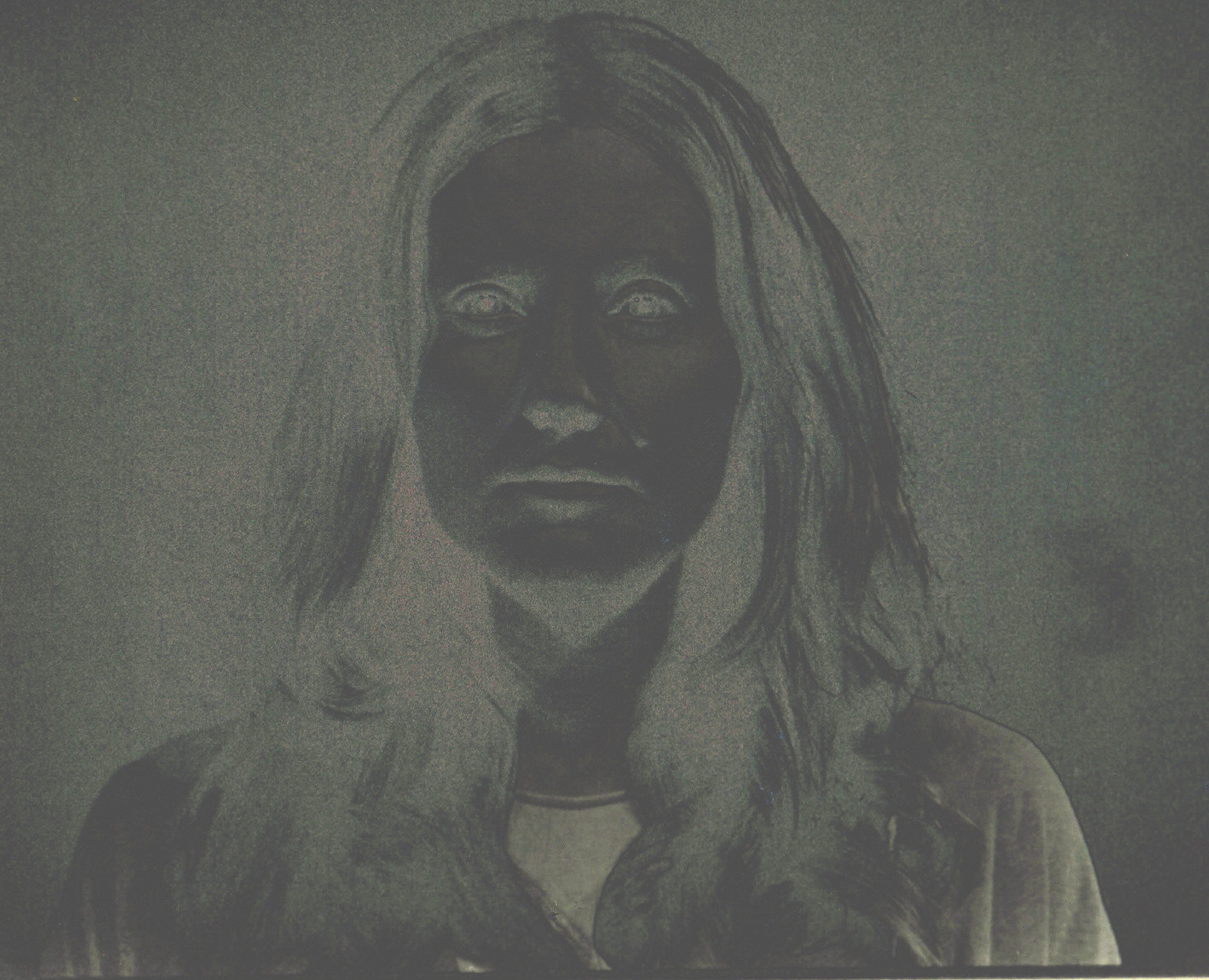
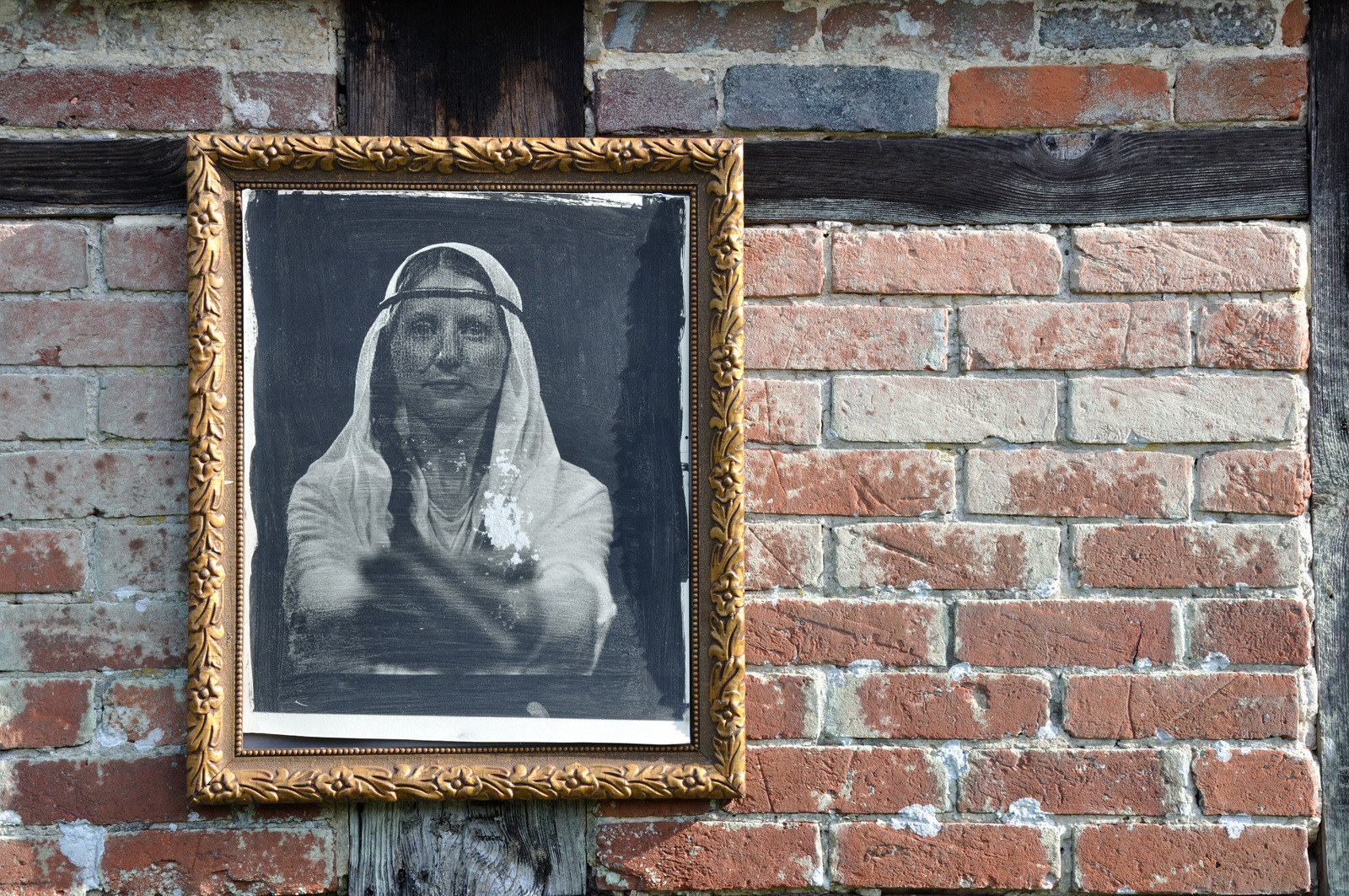
Helena Elferova~Synagoga : Photographic Pathologies~Saturnian  lead, greyness, analogue processes.

https://www.flickr.com/photos/russellmoreton/


PORTRAITS, STILL VIDEO PORTRAITS AND THE ACCOUNT OF THE SOUL, JOANNA LOWRY.

This text taken from Stillness and Time: Photography and the Moving Image is of interest, as it analyses the properties of the compression of time into a single image and our reading of such material. It is this central issue of time, or rather that photography can intercept it, that interests me through the use of simple light gathering devices. Joanna Lowry remarks on the ability of photography to disrupt “ our common-sense understanding of the relationship between past and present, stopping the flow of time and holding it in an uncanny stillness for years on end, revealing to us a present without a future.”1

Photography seems to be more about what remains after time is interrupted; it reveals “a fissure in the field of the visible.”2 This fissure could be said to be a frame of a detachment of time, a hermetically sealed dimension, preserving its own unique value of dwelling and promoting a sense of temporality of human subjects, surrounded by an exactitude of place.

One of the interesting properties of these “time based stills” is that they give a visual site for the triangular relationship between subject, spectator and time. The time element is duration, so therefore these images are filmic semblances, witnessing their subjects, or as Benjamin termed them as “growing into the picture”. The spectator of these encounters (framed by time) becomes aware of a photographic duration. This duration is constantly emerging and it is also constantly forming “sedimentary remains”. Perhaps as Lowry comments “they offer us a new enchantment with the provisionally and fragility of the pose."3

This new enchantment, or the site of its alternation, is created by a photographic absorption of a human performance. This phenomenon, of an absorbed and distracted subject as Benjamin has noted, belongs to the earliest forms of photography. What is also relevant here, is the observation made by Mark Godfrey “new technologies produce new forms of subjectivity.”4 Photography produces and procures a difference and a distance. It is a “differentiated space of the visible.”5

1 .Joanna Lowry, Portraits, Still Video Portraits and the Account of the Soul (Brighton: Photoforum, 2006), page 65.

2  .Ibid.,

3  .Ibid., page 78.

4  .Mark Godfrey, Fiona Tann : Countenance (Oxford: Modem Art Oxford,2005), page76.

5 Joanna Lowry, Portraits, Still Video Portraits and the Account of the Soul (Brighton: Photoforum, 2006), page 77.


Artist Statement/Analysis  re Spatial Practices/Methodologies

My previous experiences have been drawn from a physical relationship to “site” and the possibilities that might be embedded to be encountered for others. It is in the spatiality of Drawing from which I am attempting to create a form, that allows the multiplicity of material associations and yet has a sort of transparency and physicality, that allows specific readings to be experienced through this membrane. Spatial practices offers up a frame of references and cross multidisciplinary approaches that are already offering possible solutions. 
My initial use of surfaces Ceramics and Glass, in architectural surroundings, is being redrawn into relationally with the notion of an interlocutor being an active participant and for those others whose proximities and contingences they might create. 

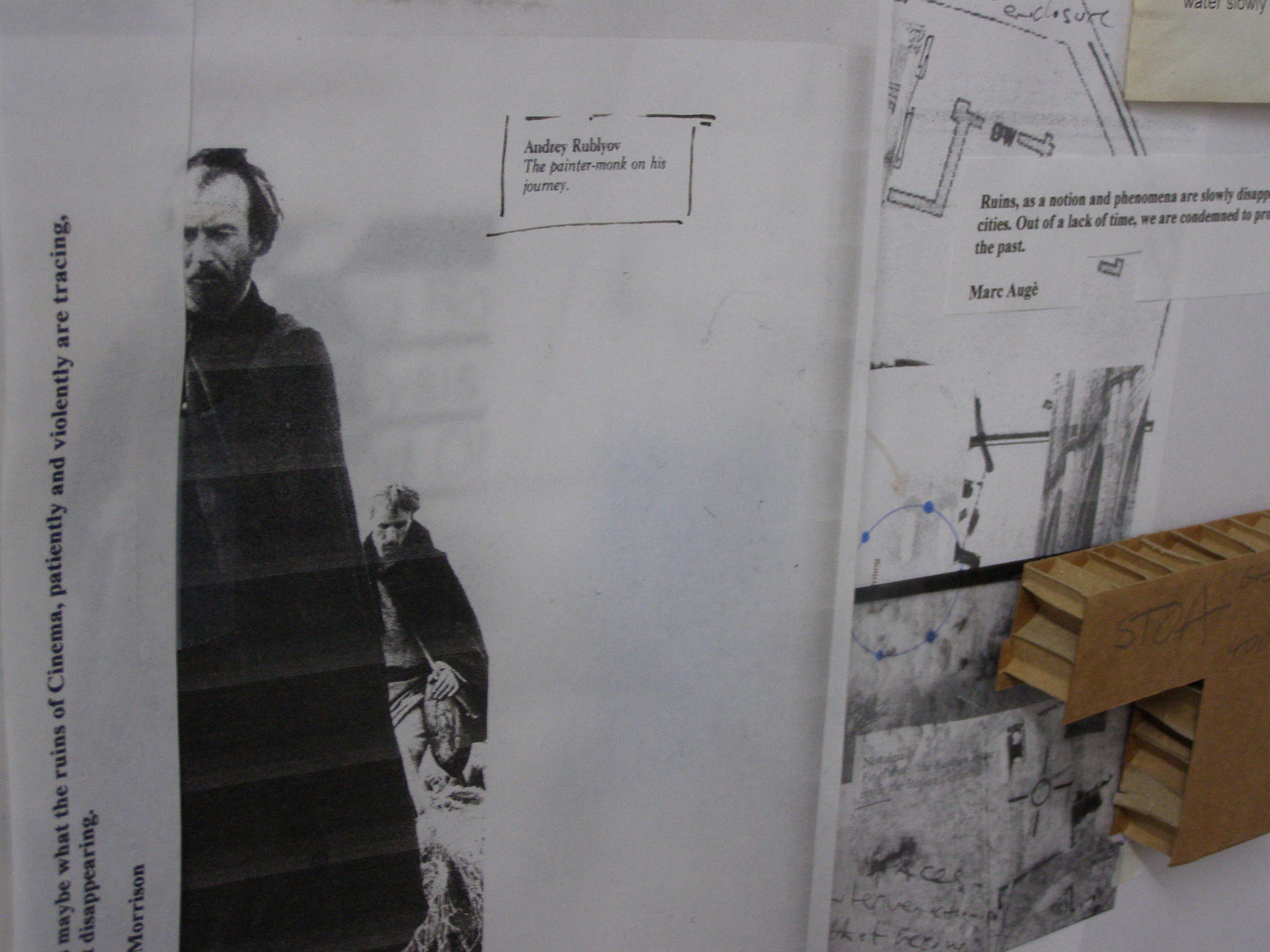
Analysis of my assemblages, which are housed in book form, reveal a spatial overwriting of both written annotations and diagrammatical routing of specific elements. All of this occurs, or is illuminated adjacent too and between, photographic evidence of place.

This evidence of place is itself a surface of compressed time, inscribed during that time by light. Light therefore suggests itself as the ultimate vehicle of transparency, of both being able to illuminate information and also being able to stream and superimpose seamlessly contingent knowledge’s as they appear. 
The intertextuality of Language, as something that might be configured as an inclusion into physical place is a possibility. My work seems to require this transparency on one hand and yet recent reviews of my drawings, reveal a dynamic engendered from precisely drawn articulations, to a nebulous semblance on the same surface. In effect my interests are on the transition points, thresholds even, of the periphery of perceptions being retained, whilst other things become open and emergent. 
This dynamic across a spatial volume activates the possibilities of seeing things becoming interwoven with creative potentials.

Other observations, brought from the presentation of working practice, have been the issue of intensive notations, almost as if the photographic surfaces, themselves vestiges of solitudes were being re-enacted by a choreographic sense of re-encountering place. The embedded durations, overwritten by light within the photographic surface, give a semblance of the notion of inter- textuality, or rather its creative possibilities; in fact they are ensnared continuances. 

J G Ballard refers in his writing that it is being envisaged in the visionary present. The extended durations of “the present” captured on a photographic surface could be said to be a concretization of the present by the past. 

These extended durations of always “becoming present” have something about an indexical mark in a state of a constant erasure of becoming, held captive within them. A further visual distortion, achieved by the use of a chamber as the receptacle to mediate the relations between the light outside with the light that penetrates, produces a kind of visual psychosis, a distorted sense of being captive which seems to accompany the image.


Monday, 28 April 2025

Human Bodies/Spatial Bodies : Theoretical Spaces between Objects.


Childhood a density of life not yet sensing the weight of living.

Expanding the space of the forgetting which is infinitely more creative/active than the space of what you remember.

Events manifested through drawing, navigate spaces and their relations between/amongst/entangled by human bodies and spatial bodies.

Outpost 031224


longing to see a woman's face/the words that maketh murder

PJ Harvey, let England shake. 2010

Helena Eflerova,


Wolvesey Castle. 2007

Site Space-Movement/Earthing The Body.

100 Childhood Voyages of Play : The Boat.


The work doesn't fail, it just looses clarity, it retreats.


On Ceramic Spaces/Silences.


Creating and then investigating a silence in its surroundings. A silence that participates in the perception of things it attends/surrounds and resonances with.


Reclamations:

Missing and Abandoned Contexts.


Visual Fine Art 2004-2008.

Winchester School of Art.


On developing subjectivities through contemporary art practices and research strategies. 


Philosophical theory/The Poetics of Space (Bachelard) documented alongside visual material/objects/images/installations.


Relationscapes: Human Body/Spatial Body.

Workings On Affective Potential.


Glenn Ligon: All Over The Place

The Fitzwilliam Museum.


On The Temporality Of Events.

Zuzana Kovar.


That they happen, that they occur, but they do not exist. They are virtual and always in process.

We cannot say that they exist but rather that they 'subsist' or 'inhere' ( having this minimum of being which is appropriate to that which is not a thing, a non-existing entity). They are not substantives or adjectives, but verbs. They are neither agents or patients, but results of actions and passions. They are impassive entities, impassive results. They are not living presents, but infinitives, the unlimited Aion, the becoming which divides itself infinitely in past and future, and always eludes the present.

Deleuze.


Sunday, 1 December 2024

Reclamations/Ruins on the photographic surface : Volatile Inscriptions around the Body/Cartwheels

The Photographic Image/Volatile Bodies/Architectural Ruins


Helena Eflerova
Interior Spaces, Waverley Abbey.


The future must no longer be determined by the past. I do not deny that the effects of the past are still with us. But I refuse to strengthen them by repeating them, to confer upon them an irremovability the equivalent of destiny, to confuse the biological and the cultural. Anticipation is imperative. 

Helene Cixous, “The Laugh of the Medusa” (1980:145)


The Language Of Women


Volatile Bodies/Sexed Bodies : Elizabeth Grosz

1  have  attempted  to  read  the  male  discourses  dealt  with  here  as  discourses for  and  about  men,  discourses  which  have  ignored  or  misunderstood  the  radical implications  of  insisting  on  a  recognition  of  sexual  specificity,  discourses  which have  presented  their  claims—radical  as  these  might  be—without  any  understand­ ing of their relevance to or usefulness for women’s self-representations. I have not attempted  to  give  an  alternative  account,  one  which  provides  materials  directly useful  for  women’s  self-representation.  To  do  so  would  involve  knowing  in  ad­vance,  preempting,  the  developments  in  women’s  self-understandings  which  are now  in  the  process  of  being  formulated  regarding  what  the  best  terms  are  for representing  women  as  intellectual,  social,  moral,  and  sexual  agents.  It  would involve  producing  new  discourses  and  knowledges,  new  modes  of  art  and  new forms  of  representational  practice  outside  of  the  patriarchal  frameworks  which have  thus  far  ensured  the  impossibility  of  women’s  autonomous  self-representa­tions,  thus  being  temporally  outside  or  beyond  itself.  No  one  yet  knows  what  the conditions are for developing knowledges, representations, models, programs, which provide women   with  nonpatriarchal  terms  for  representing  themselves  and the world from women’s interests and points of view. This book has been a pre­liminary  exploration  of  some  of  the  (patriarchal)  texts  which  feminists  may  find useful  in  extricating  the  body  from  the  mire  of  biologism  in  which  it  has  been entrenched.  But  the  terms  by  which  feminists  can  move  on  from  there,  can  su­persede  their  patriarchal  forebears,  are  not  dear  to  me.  But  perhaps  the  frame­ work  I  have  been  trying  to  use  in  this  book—a  framework  which  acknowledges both  the  psychical  or  interior  dimensions  of  subjectivity  and  the  surface  corporeal exposures of the subject to social inscription and training; a model which resists, as much  as possible,  both  dualism and  monism; a model which  insists on  (at least) two surfaces which cannot be collapsed into one and which do not always harmoniously  blend  with  and  support each  other; a model where the join,  the interaction of the two surfaces, is always a question of power; a model that may 
be represented  by  the geometrical form of the Mobius strip’s two-dimensional torsion in three-dimensional space—will nevertheless be of some use if feminists wish to avoid the impasses of traditional theorizing about the body.


Patti Smith
Cartwheels

Come my one, look at the world Bird beast butterfly
Girls sing notes of heaven Birds lift them up to the sky
Spring is departing Spring is departing
Her thoughts are darting like a rabbit Like a rabbit 'cross the moon
Shines of light over your hair As boys croon
Pretty in pink It makes me wonder
What could ever bring you down I see tears falling
From those eyes of brown
Hearing a voice, you turn your head You vanish into the mist
Of your thoughts And I
Want to grasp What brings you down
Open up those eyes of brown
The world is changing Your heart is growing
Hearing a voice you turn your head Girls turn by ones, by twos
Notes pour bad and tender Eradicate your blues
The good world The good world
Come my one, look around you Bird, beast, butterfly
Girls sing


Thursday, 14 September 2023

Corporeal Phantoms/Attendants/Skins : Alternatives/Others in Photography/Phantasy Surfaces

Landscapes : entering/intruding/emerging (holga819)

Working Title : Montage Samples
Historical Presence #4

Helena Eflerova, 18 minute rehearsal ,GASP 2009

Art as Spatial Practice.
Space folds : Containing "Spatialities around historicality and sociality"

"All that is solid melts into air"

Karl Marx, Friedrich Engels,
(Poetic observation concerning the constant revolutionizing of social conditions)

Perceptions now gathering at the end of the millennium. Spatiality, Robert T. Tally Jr. 2013

Do you live as Humans in the Holocene or as Earthbound in the Anthropocene? (50.37)

Dr. Bruno Latour on climate change and the "Anthropocene": Wall Exchange, Fall 2013

Camera Obscura : Physical Touch #2

Photograph (240) drawing

Sequential Photograph : Performing Photography/The Inseparable Attendant


Wednesday, 8 March 2023

Collage/abstracts (Heuristic Fragments) Reflective Material #1

Is there still an aesthetic illusion? And if not, a path to an “aesthetic” illusion, the radical illusion of secret, seduction and magic? Is there still, on the edges of hypervisibility, of virtuality, room for an image?

— Jean Baudrillard, The Conspiracy of Art, 2005


A heuristic technique (/hjᵿˈrɪstᵻk/; Ancient Greek: εὑρίσκω, "find" or "discover"), often called simply a heuristic, is any approach to problem solving, learning, or discovery that employs a practical method not guaranteed to be optimal or perfect, but sufficient for the immediate goals.

Heuristic Material : Collage 

1. encouraging a person to learn, discover, understand, or solve problems on his or her own, as by experimenting, evaluating possible answers or solutions, or by trial and error: a heuristic teaching method.
2. serving to indicate or point out; stimulating interest as a means of furthering investigation.

Reading Collage : Spatial Drawings/Documents/Analogue Photography

A Hut of One's Own, Ann Cline

Texts,Annotations, Foundations, Pathways, Corridors, Bookmarks, Walking, Thinking, Ramble, Cross Country, Disciplines, 

Herzog  and De Meuron
NATURAL HISTORY

Jana Sterbak
Remote Control 1989


Saturday, 7 August 2021

Drawing/Situatedness and Site : John Berger, simultaneously a now and an elsewhere

Drawing has the ability to hold complexities separate enough so as to be read, yet drawings also merge into a perceptive unity marked by a sensation or realisation of intuitive nowness authentically caught in the tension of the line.

John Berger’s definition of what a drawing might contain when it is simultaneously viewed as both a now and an elsewhere, marks for me a threshold of encountering space­ time, we are passing through as we perceive our very consciousness. 


I sometimes think of these drawings as sites, containing both physical and playful evidence of explorations. The cyanotype process captures objects and turns them into “inclusions” or vessels that might induce an interesting dialogue, a buried association or simply a stage for thought. I feel the objects recorded are the result of an assemblage of thoughts/interests close at hand driven into the visual through an expediency (working with light and time) and an aesthetic that contains my sense of materiality from which to nurture a creative subjectivity. Strangely it is this aesthetic that just keeps things separate enough but which still makes things actively conspiratorial. It appears to be able to render things in isolation and then bring them together. It is as if the intuition that comes from working and theorising within an art practice is placed into the realm of things, off loaded, detached, and orphaned to make its own way in the world. 


Link Gallery.

Forum Notes, 27 March 2010

Site is anti-place hovering precariously over the abyss of no-place.1 

Art Practitioner with earlier experience in ceramics and glass, recently completed visual arts course at Winchester, now at Canterbury completing MA course in spatial practices. Working mainly on drawing, photography and architectural interventions/ installations that explore our sense and experience of place. 


My work explores a philosophical inquiry into the need for a reflective solitude, a sense of dwelling amongst absences.

The use of materials from the locality (field chalk) implies a personal geography drawn from the direct relationship to an inherited Earth. There is the suggestion that the absence recorded by the trace is an inclusion, a legacy set into a field of materiality, but it might also suggest a metaphysical field of thought. 

This act of drawing becomes its own experimental field of exploration, a sort of “in-between reality’’/Maurice Merleau-Ponty) an enmeshed experience. Thought of and read as a material memory encountering the realm of the insubstantial.

This “undoing of place” might instigate a threshold and a situation/room from which to reflect upon critical spatial, sociological and psychological conditions and perceptions.

This work and others like it attempt to articulate an interest in the body as both a physicality ( social, spatial and per formative presence ) and a poetic surface in architectural space.

Influences, Myth of Butades, origin of drawing, Pliny

Interested in the inscription ( a surface inscribed, written or carved as a formal or permanent record ) of a presence, a trace that reveals an origin of feelings/gestures centred around the body.

Inscription brings with it a notion of performativity, that of body and place, and their interaction, situation and experience. This spatial activity renders a sense of a material memory surfaced by place.

Tacita Dean, Drawings are more than just visual therapy, they speak of collective experiences and dilemmas that trouble humanity.

This simple work gathers-up an intimate social inscription on a surface, a playful act to then associate natural material.

Drawing is the primal means of symbolic communication which predates and embraces writing, and as such it functions as a tool of conceptualization parallel with language.

Drawings offer a partial comprehended rumination of the mind, Avis Newman. Drawing, becomes a sort of dwelling amongst an intimate comer of oneself, perhaps even a site for the solitude for the imagination. Gaston Bachelard comments in the Poetics of Space that a corner in a room can become “a symbol of solitude."

Drawing like walking becomes a form of thinking. This thinking is further articulated and accompanied by the intrinsic qualities of substances and liquids that are placed in proximity so as to be encountered.

My use of chalk as a materiality, emblematic of a solidity, a localised material and a metaphor of a inherited and compressed layering of time. The whiteness of this found material draws associations with the surface of the paper, there similarities’ also render there material differences. The inclusion of wax onto the surface was an attempt to seal a sense of a reflective surface, a surface amongst the work that might accommodate the light and nowness of place. Any drawing is a static object, but contains the trace of actions, traces carried out in time. Perhaps this drawing is registering itself into a language of matter.

1  Edward S. Casey, The Fate of Place, a Philosophical History. (London: University of California Press, 1998) page 186.


ARTISTS CV/STATEMENT re INTERNATIONAL BOSPHORUS ART BIENNALE, ISTANBUL 2011.

RUSSELL MORETON 

Visual artist/maker of dwelling spaces.

Spatial Practices MA Canterbury UK.

Visual Fine Art BA hons Winchester UK 

Contemporary Crafts Sculpture Waterlooville UK 

Ceramics HSND Epsom UK

June 2011 Artist Statement/Outline of Interests.

Visual artist working with alternative photographic processes, clay and architectural glass. The current practice continues to explore themes and realities around the contemporary human condition. The exploration of these interests is predominately developed through drawing and traces of actual objects and performative gestures referencing the body as a site amongst the layering of material and data. The use in some works of site specificity and materials drawn from the location are used to further underpin a sense of engagement and dwelling. The resultant drawings with their traces of agency and exactitude, lightness and ambiguous multiplicities seem like a compression of a filmic substrate, a material memory brought to the surface. These personal consolations of working practice are initiating thoughts centred on building architectural spaces, from which to register and response to a sense of serenity and enchantment amongst the scripting of materials in spatial/social dialogues.

Astronomy, Science, Natural History, Architectural Spaces, Stained Glass, Early photographic Processes, Ceramics, Anthropology, Craft Disciplines, Theatre, Film, Arte Povera, Contemporary Art Practice/Research/Philosophy/Exploration.


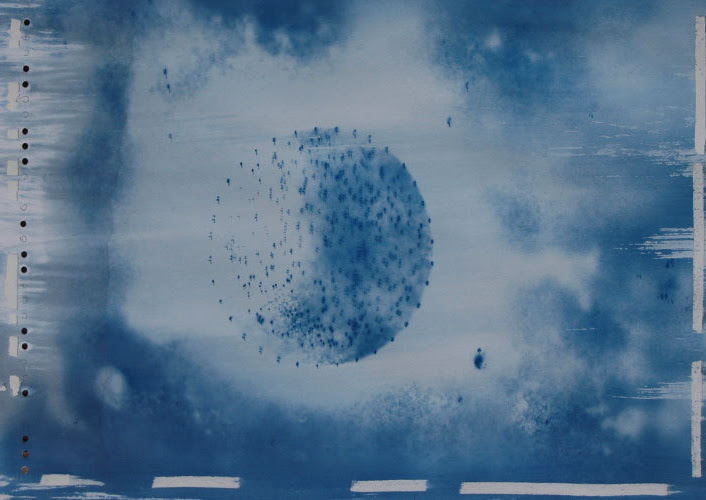
IMAGE, PANSPERMIA 2010 Added notes.

This work began as a performative drawing between the touch and tact of its maker, marking a personal and intimate involvement with both the corporeality of the female body and a loved one. This fragile union and fecundity is expressed by the photograms of “elderflower seedheads” left as evidence within the territory of the body/vessel. The personal intimate space of these initial acts and gestures are shifted against infinite space of the known universe. The title stems from speculation that life might have been introduced onto a fertile Earth from spores from space. Interestingly having dwelled with these initial thoughts, I feel that perhaps the work augurs an exodus at some point in the future.

Russell Moreton


CHAPEL ARTS, ARTISTS OPEN STUDIO AND TALK

TALKING AROUND A TABLE OF DRAWINGS

THE WORKING SPACE AS INSTALLATION

THE SPATIAL PRACTICE OF RUSSELL MORETON

Objects or vessels that might induce an interesting dialogue a stage for a future event or trajectory. I feel the objects are the result of an assembly of thoughts driven into the visual through an expediency and an aesthetic that just keeps things separate yet somehow they remain actively conspiratorial. It is all about the intuition that comes from working and theorising with and within an art practice.

The intension of the “charting table” (8x4 ply sheet on builders trestles) was to allow the subject of practice together with my activities to become visible, and in so doing create a public sense of speculation around the material on show. The spatial agenda would be addressed, bought into being as it were by the exposure and placement of objects, tables and projections into the main reception area at UCA Canterbury. It is hoped that the curiosity of some will solicit the interest of others and thereby create the unfolding of an event; the projection could be a real time monitor of the charting table. I am beginning to view the show as an exhibition/event around working practices, but unfortunately the sense of site dominates my practices situatedness. Conceived as a contingent/speculative intervention into the normal running of this space as a reception area. 


Resident artist will host an “open studio” at Chapel Arts Studios on 2 December. The chapel will be open from 12.30 onwards to view an installation and other material. The “talk around a table of drawings” will commence at around 6.45 pm.

Earlier training in ceramics and stained glass together with extensive experience in the construction industry are now being utilised in my contemporary practice.

My current spatial practice, is centred around a multi disciplinary approach underpinned by “drawing” to critical issues of site. This activity could be understood as an investigative creativity amongst the phenomenological aspects of architectural place and the potentials of producing working spaces/sites for the reflection of others. The working practice currently employs the use of clay, glass and photographic processes. The practice is informed by interests in astronomy, architectural space, theatre and anthropology.

The use of “site” as a working drawing from which to create a temporary intervention into place helps to instigate a threshold, a room or event from which to reflect upon critical spatial, sociological and psychological conditions and perceptions.


Anima-Animus : Winchester Cathedral/10 Days in the City

‘When animus and anima meet, the animus draws his sword of power and the anima ejects her poison of illusion and seduction’ Jung.


Russell Moreton uses analogue film processes that inquiry into both the surface and the materiality of the photographic image. He was invited by Helena Eflerova and Kye Wilson to document the filming process of Anima-Animus. He uses 35mm and medium format cameras together with a number of pinhole type cameras. In using historical processes like cyanotype and light sensitive silver gelatine, he explores the relationship of the image to its supporting surface. A number of his images are heavily worked in the darkroom to exploit differences between the seduction of the photographic surface and its actual physical presence altered by chemical and physical interventions. His work echoes themes around the body and the architectural spaces of institutions and beliefs.