Showing posts with label apparatuses. Show all posts
Showing posts with label apparatuses. Show all posts
Tuesday, 6 October 2026
Visual Workings~Collage Material : Spatial & Ceramic Practice: Research Collage ~ Persistent Bodies of Thought:
.jpg)
Visual Workings~Collage Material : Spatial & Ceramic Practice: Research Collage ~ Persistent Bodies of Thought:: Research Collage ~ Persistent Bodies of Thought: Spatial Bodies~Intermezzo~Alchemy : Nomadic Photographic Assemblage. Heuristic Devices~Appa...

Saturday, 19 September 2026
Spatial Bodies of Practice~Gathering/Multiplicity/Lightness/Synthesis
Spatiality is being discovered as a condition of correspondence between bodies.
What begins as lightness becomes density. Images, ruins, fragments, colour, readings and places gather without settling into a single structure. The work moves between material transformation and the impossibility of containing everything that has been encountered. Chora appears as trace, mark, map and body: a spatial condition where things can occupy one another without becoming the same. Read through the current practice, synthesis becomes less a resolution than a gathering of differences. The spatial body begins to form through multiplicity—through what touches, overlaps, withdraws and remains unresolved.
Speculative inquiry 190926
I think this post opens an important question for gathering:
Can gathering remain multiple without becoming synthesis?
This is significant because your current Permeable Chamber is almost the opposite of a synthetic container.
It gathers, but does not resolve.
It holds, but does not contain.
It allows correspondence without requiring agreement.
So perhaps something has shifted:
synthesis → multiplicity → gathering → permeability
The old post is therefore not simply about “synthesis”. It contains a tension that the current practice can activate: the desire to gather without closing the gathered material into a resolved whole.
That is very close to your recent formulation:
The Permeable Chamber is where gathering becomes a troubling reverberation.


Outpost 190822
LIGHTNESS
QUICKNESS
EXACTITUDE
VISIBILITY
MULTIPLICITY
Six Memos for The Next Millennium.
Italo Calvino, 1992.
The difference between the first versions I read and the final ones lies in structure, not content.
Calvino wanted to call the sixth lecture 'consistency' and he planned to write it in Cambridge.
I found the others, all in perfect order, in the Italian original, on his writing desk ready to be put into his suitcase.
Esther Calvino.
The Drought.
J.G. Ballard.
Allegories are, in the realm of thoughts what ruins are in the realm of things.
Walter Benjamin on the origin of German Tragic Drama.
Photographic ruins an amalgam/agency of what remains.
Brown and Blue.
A Field in England.
Cyanotype material on canvas with iron pigment.
Developing a spatial serenity/synthesis/synergy.
This amalgam of colour with various substances demonstrates the change and transformation of the material world, which can be interpreted as essentially an alchemistic procedure.
The goal of such procedures is ultimately to resolve the material object into its spiritual substance.
Yves Klein.
Beuys Brown and Klein Blue.
Magdalena Broska.
Air and Dreams.
An essay on the imagination of movement.
Gaston Bachelard.
Shotesham, site based inquiry,studio practice.
Spatial registers around the corporeal and the transcendental.
Ruin its relation to time.
Fragment as ruin and on melancholia as an attitude of retrospective contemplation.
Dialectics at a standstill, a moment where the past is recognized in the present as a ruin that was once desired, allowing allegory to be understood, felt as a contemplative calm, an equilibrium in the becoming and wrapping nowness of the self/situation.
Dialectical thinking involves the clarification of ideas through discussion and contradiction.
What remains after the process of dialectical thinking?
An initial thesis is opposed by an antithesis, then resolved through a synthesis of the two terms, which can in turn become a new thesis.
Objects/inclusions for painting with/layered transitions and movements.
Holga 120WPC, f135.
Ilford Delta 100/8 exposures 92x55mm.

The Gaze of Orpheus.
Maurice Blanchot.
The Essential Solitude
In the solitude of the work, we see a more essential solitude, a self communion.
MULTIPLICITY
The work grew denser and denser from the inside through its own organic vitality.
For Musil, knowledge is the awareness of the incompatibility of two opposite polarities. One of these he calls exactitude or at other times mathematics, pure spirit, or even the military mentality, while the other he calls soul, or irrationality, humanity, chaos.
Everything he knows or thinks he deposits in an encyclopedic book that he tries to keep in the form of a novel, but its structure continually changes; it comes to pieces in his hands.
The result is that not only does he never manage to finish the novel, but he never succeeds in deciding on its general outlines or how to contain the enormous mass of material within set limits.
The network that links all things is also Proust's theme, but in him this net is composed of points in space-time occupied in succession by everyone, which brings about an infinite multiplication of the dimensions of space and time.
The world expands until it can no longer be grasped, and knowledge, for Proust, is attained by suffering this intangibility. In this sense a typical experience of knowledge is the jealousy felt by the narrator for Albertine.
It is the extension of that being to all the points in space and time that it has occupied and will occupy.
But we cannot touch all these points. If only they were indicated to us, we might perhaps contrive to reach out to them. But we grope for them without finding them. Hence mistrust, jealousy, persecutions. We waste precious time on absurd clues and pass by the truth without suspecting it.
Remembrance of Things Past : The Captive.
Infra-ordinary.
Species of Spaces
We sleep through our lives in a dreamless sleep.
But where is our life?
Where is our body?
Where is our space?
Georges Perec.
CHORA : trace/mark/map/body
The drama of encountering space.
Recombinant Poetics via Interventions.
Thinking about temporal issues through visual, material and spatial registers.
Concerned with artworks and architectural projects that reconfigure the temporality of sites, repositioning the relationship of the past and the present in a number of different ways.
Allegory, Montage, Dialectical Image.
Between Art and Architecture.
Jane Rendell.
Performativity/Drama of Residency
Transient readings and encounters.
Other Enactments,Dialogues,Relationalities.
Sites of evidence/knowledge and understanding.
The scheme should incorporate both careful repair of existing fabric and a significant element of new construction in a contemporary design.
SPAB, design competition.
We are not calling for a new disordered architecture to match the disorder of culture; this would only affirm the chaotic.
Rather, we propose experiments in search of new orders, projections of new relationships.
We do not wish to transpose our study into a system or method.
The energy inherent in opening up relationships presents us with a continuity of ordering that compels refection.
Steven Holl.
Correlational Programming, Parallax.
This one has enormous potential for the current practice.
It gathers Calvino, Benjamin, cyanotype, ruins, Bachelard, Shotesham, material transformation, multiplicity, Proust, Perec, chora, montage, temporality and the refusal to turn the investigation into a fixed system. The particularly important phrase for me is the post's own recognition that “We do not wish to transpose our study into a system or method” and its interest in opening relationships.
That is remarkably close to where your current practice has arrived.
The deeper speculative proposition
What I think is emerging from these four posts is that the current spatial practice may not simply be about making ceramic bodies spatial.
It may be about something more particular:
Spatiality is being discovered as a condition of correspondence between bodies.
The earlier work repeatedly approaches this through different media:
cyanotype allows material to seep beyond the traced body;
collage and montage allow fragments to occupy a shared field;
diagram allows temporal and spatial relations to remain in movement;
the vessel allows surface and interior to sense one another;
walking allows place and body to continually alter one another.
Clay now becomes a particularly intense site for all of these propositions because it can receive, resist, absorb, register, perforate, enclose, open and transform.
Then firing changes the proposition again.
Wednesday, 29 July 2026
Intra-acting with the continuous weather world : Entanglement is not a dance for two partners, it is a dance for three.
Outpost 150922
Intra-acting with the continuous weather world.
Elective Affinities/Light/Time/Medium/Sound



Drawing Space.
The Material Discursive.
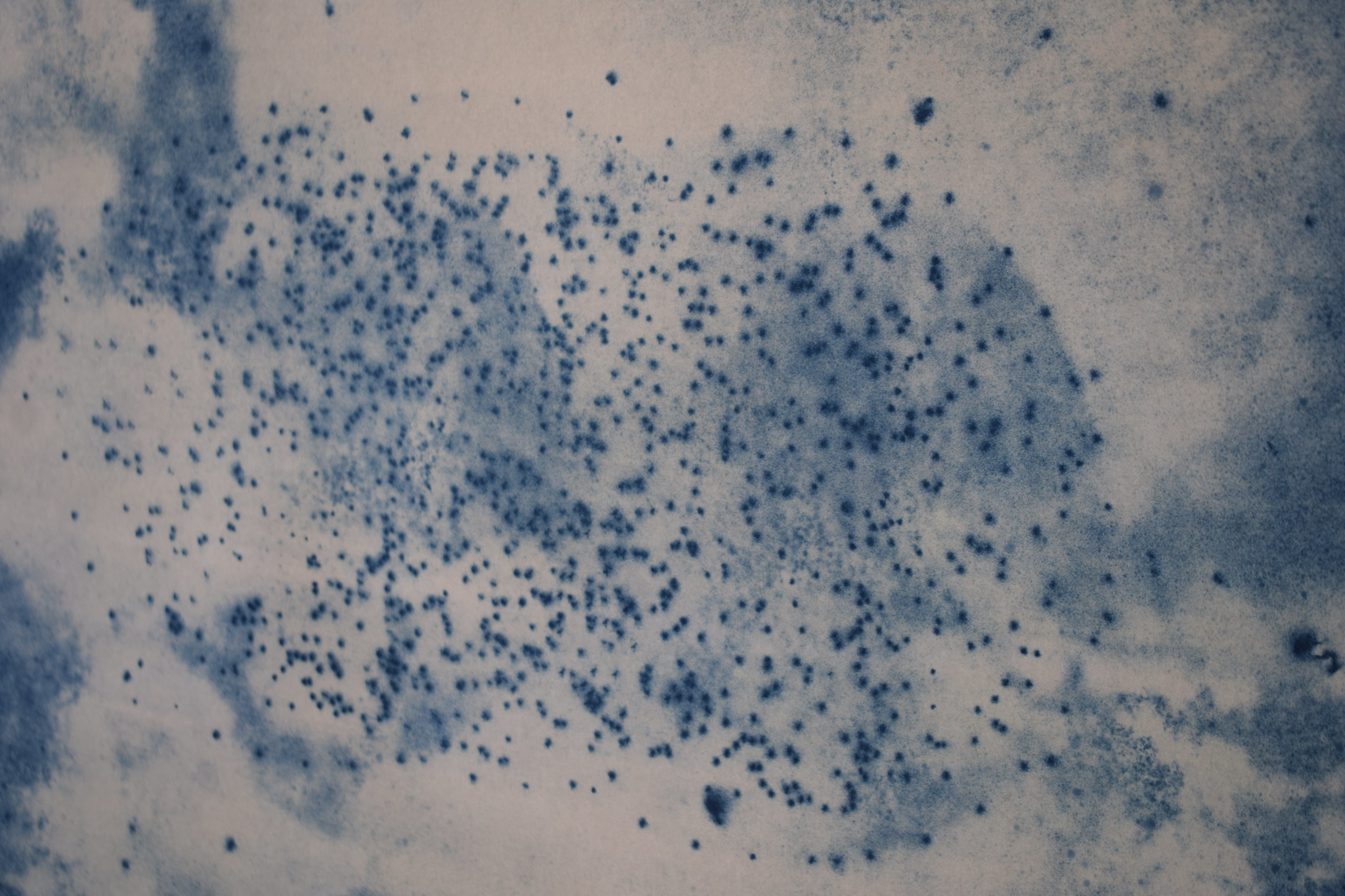
This artwork is a cyanotype print titled Spatial/Diffractive Bodies Situated in Place: Matters of Fidelity and Precariousness by UK-based visual artist Russell Moreton.
Artwork Details
Process: Cyanotype (alternative photographic process producing a Prussian blue monochrome print).
Elements: Trace drawings and photograms on paper incorporating organic matter and physical fragments from the built environment.
Theme: An exploration of material entanglements, spatial poetics, and the precarious relationships between bodies and place.
Figurative Configurations/Bodies and Landscapes.
Jenny Saville.
Intimate Drawings
Wall Scratchings
Situatedness of intra-activities.
A matrix and an archive.
It was the crucible of his art, and one of the most hauntingly eloquent spaces an artist has ever surrounded himself with.
In Giacometti's Studio.
The hermit's cave.
The alchemist's cell.
The chemist's laboratory.
Correlations do not become real, relational until the signals arrive.
Becoming Real.
The Exchange of Signals.
Framing Entanglements.
The Concretization of the Colour.
Nothing travels instantaneously and an exchange of signals is an interaction, where new elements of reality come about.
The joint properties of two objects exist only in relation to a third.
Everything that manifests itself does so in relation to something, a correlation between two objects is a property of the two objects and like all properties it exists it exists, is existential only in relation to a further third object.

.jpg)
Entanglement is not a dance for two partners, it is a dance for three.
Entanglement is none other than the external perspective on the very relations that weave reality.
The manifestation of one object to another in the course of an interaction in which properties of the object become actual.
Working notes/fragments.
Helgoland, Carlo Rovelli.
Lead label reads/stamped with “dwelling is always dwelling in nearness, Heidegger”.
Counterpoints/Contrapuntal Movements.
ENMESHED EXPERIENCES
WORKING WITH DOUBT
DURATION
THE FLUX OF A VECTOR FIELD
PARALLAX.
The existence/trace/invisibility/of a third object that interacts with both the systems is necessary to give reality to the correlations.
Resultants that incorporate the friction/asperities of their trajectories through medium/material.
Building as a body, a battleground of invisible forces.
The spine is the central elevator. The structure is a tube of concrete covered with insulation and tarred black wood boards.
Steven Holl.
Knut Hamsun Museum, Hamarey, Norway. 1996
Monumental sculptures take the form of vast, spectral structures built from corroded, sinewy metals and disintegrating found objects.
He seeks inspiration from sources that speak to the expansive, cyclical nature of the universe.
Kiefer looks to Norse mythology, Hebrew folklore, alchemy and theoretical physics to build dense imagery that is too often interpreted as simply apocalyptic.
While some might see wastelands and abject destruction, Kiefer sees vitality and resurrection. This attitude extends to the physical properties of his paintings and sculptures.
He embraces the ravages of time, while others might strive to suspend it in an effort to preserve a moment of imperceptible genius. Instead, his art buckles and shifts, constantly evolving and reforming under the burden of its own existence.
Artists on art, Holly Black. 2021
Sky Correlations
Cloud Space.
Particle Speculations
Seed Dispersal
Panspermia
Granular Gardens
Third Spaces
Spatial Vectors/Constellations.
Observational Blueprints/Apparatuses.
Pierced Constellations.
Vectors for Entanglements.
Spatial Agency.
Sunlight Circulations.
Daylight Drawings/New Worlds.
The Spab Magazine
Autumn 2022.
The Living and the Dead, 2017-18.
I am not interested in conservation.
If something falls down, it has meaning.
Anselm Kiefer.
Organism, Person, Environment.
Bioscleave, Architectural Body, Gins, Arakawa.
Time as experienced duration is relative to an individual and to a space.
Constantin Brancusi's studio and Endless Column, fabricated as a timepiece, where the finite time of place and culture is counterposed to infinity.
Visual substance, causal doing, investigating, agency, matter, phenomena, material discursive, iterative, creative, apparatuses, intra-activity, performativity, bodies that matter,
Friday, 26 June 2026
Art Workings~Visual Art Practice: Ceramics intertwined with an extensive visual art ...
Art Workings~Visual Art Practice: Ceramics intertwined with an extensive visual art ...: Making : Anthropological Objects ~ Fabrications on Humaning . Tim Ingold . Ceramics ~ Fired Clay
.jpg)

.jpg)
.jpg)

.jpg)
The Politics of Architecture : Theorizing through speculative spatial practices.
"He rubbed his eyes. The riddle of his surroundings was confusing but his mind was quite clear - evidently his sleep had benefited him. He was not in a bed at all as he understood the word, but lying naked on a very soft and yeilding mattress, in a trough of dark glass. The mattress was partly transparent, a fact he observed with a sense of insecurity, and below it was a mirror reflecting him greyly. Above his arm- and he saw with a shock that his skin was strangely dry and yellow - was bound a curious apparatus of rubber, bound so cunningly that it seemed to pass into his skin above and below. And this bed was placed in a case of greenish-coloured glass (as it seemed to him), a bar in the white framework of which had first arrested his attention. In the corner of the case was a stand of glittering and delicately made apparatus, for the most part quite strange appliances, though a maximum and minimum thermometer was recognizable."
H. G. Wells : The Sleeper Awakes. 1899/1910
Spatiality : The Spatial Turn, Robert T. Tally Jr. 2013
Immediate Architectural Interventions, Durations and Effects : Apparatuses, Things and People in the Making of the City and the World. Alberto Altes Arlandis, Oren Lieberman. 2013
Preface (1921) ” The great city of this story is no more than a nightmare of Capitalism triumphant, a nightmare that was dreamt a quarter of a century ago. It is a fantastic possibility no longer possible. Much evil may be in store for mankind, but to this immense, grim organization of servitude, our race will never come” H.G. Wells. Easton Glebe, Dunmow,1921.
.jpg)

.jpg)
.jpg)

.jpg)
Monday, 9 March 2026
Visual Poetics/Bricolage/Red is not a colour : The Studio/Space of Real Situations
Spatial Collage : Research/Discourse/Apparatus
Farnham University of the Creative Arts
rhythmanalysis : Space, Time and Everyday Life.
Lefebvre
Jannis Kounellis
Carlo Scarpa
Translates the painterly relationship of figure and ground into the space of real situations
The Visual Poetics of Jannis Kounellis, Suzanne Cotter and Andrew Nairne.
Modern Art Oxford, 2004-2005.
Timothy Morton : Realist Magic
The elasticity of sensation, affective and wonderous.


.jpg)
Speculative Raku Firing. 2012
Red is not a Colour. Bernard Tschumi.
bricolaged notes from STUDIO UNBOUND : Lane Relyea
Institutional Critique : Studio/Post Studio Activity
SPATIAL AGENCY : Spaces of Fluid Interchange Between Objects, Activities, People.
Today studio and museum are superseded by more temporal, transient events.
The Function of the Studio
Daniel Buren
The Studio is no longer as seen as belonging to a system.
No longer a retreat but it now INTEGRATES
It is all exterior.
Material Flows 2007/2017 Towards Disentanglement
Social behaviour is trapped in inescapable patterns of interaction coded by techno-linguistic machines, smartphones, screens of every size, and all of these sensory and emotional devices end up destroying our organism's sensibility by submitting it to the stress of competition and acceleration.
Franco "bifo" Berardi
The Network places the artist as a 'like item' within an integrative inventory or database.
Networks are both integrative and decentralizing in that they privilege casual or weak ties over formal commitments.
Being part of a network that privileges itinerancy and circulation over fixity, that diminishes hierarchies and boundaries in favour of mobility and flexibility across a more open extensive environment.
'The Studio made into a showroom display'
Antagonism and Relational Aesthetics. 2004
Claire Bishop
The Individual and The Social
A place where meanings, properties and behaviors fluctuate radically.
Bennett Simpson. Can you work as fast as you like to think. 2003
The hosting/re-created artist's workspaces, like a threshold between private and public actuality and potentiality.
The Notion of the Evolutionary Exhibition.
Placing greater emphasis on INFORMATION, DISCUSSION and GATHERINGS
Establishing NETWORKS, fluctuating between highly specialized work by scientists, artists, dancers and writers
Obrist/Vanderlinden, Laboratorium, Antwerp. 1999
MODULATION, Deleuze
Immaterial Social Acquaintances/Information
Along with the rise of Networks comes a new Ideology, one that Advertises Agency, Practice and Everyday Life.
The Dividual (The New Mobile Creator) Deleuze
Someone who is 'UNDULATORY In ORBIT, in a CONTINUOUS NETWORK
Colour Nexus : Promiscuous Mobility
OBSCURED MATERIAL

OUTPOST STUDIO 3.16
Notes from sketchbooks
Apokatastasis : Jim Jarmusch, Jozef Van Wissem
Spatial Asperity/Mesh, Membrane and Gauze
Drawing and its attempts to map out/make visible contingent things
Contingency, is what remains, as it comes up against causality/constantly passing through
Objects/Things conceptualized by the exploration of drawing (intervals of blindness)
Linking Surface to the Aesthetic Experience of Space.
Experiences incorporating interests with environmental textures into Art.
Points of Contact/Confluence of Circumstances
Materials bound by contact/canvas
Patina, absences, gesso, textile wrappings, field chalk, exhumed oyster shells, yellow ochre,
A philosophy of Reading
Solitude/Libraries : Cell/Court/Domain
Clay, Waxed Surface, Liquid Rust, Calico,
Sensate Bandages/Windings/Armatures : Corporeal Landscapes/Assemblages/Things
Social Architectures/Anthropologies/Imaginary Projects
Sally Mann : Matter Lent/Collodion wetplate negatives
Corpus, liquid light, flesh, spirit, trace, outline, human body, performative,
Monday, 16 February 2026
The Minor Gesture : The Diagram of the Painting/Fielding the Feeling of Force taking Form
Outpost 240723


.jpg)
The plurality alive in art, always risks being overtaken, colonized, immobilized and arrested by the forces of encounter it invites. Yet paraphrasing Nietzsche, Deleuze writes, a force would not survive if it did not first of all borrow the features of the forces with which it struggles. What a will wants is to affirm its difference. Through the will to power, force takes form.
Active force always risks capture by reactive force and the risk of translation, of rendering work within a stabilizing narrative of identity or representation.


https://www.flickr.com/photos/russellmoreton/
The diagram of the painting/drawing is its feeling of force taking form that is itself in movement.
Relationscapes, Erin Manning.
Propositions of Force/Appetition.
The Work's Diagram.
The force of the work is an emergent way of looking, more than an actual taking form.
Raveningham Diagrams for Sensing the Landscape. 2023.
Opening the present to its potential for experiential complexity.
Opening to the indeterminacy of experience.
Creating work that remains open to an infinity of potential evocations.
Making works that resonate with an ontogenitic plurality of sense(s).
The same object, the same phenomenon changes sense depending on what force which appropriates it. Deleuze.
We become sited in the fielding of the quasi chaos of microperceptions, an experience that leaves us out of breath, our muscles tense with the twitching of kinaesthetic empathy. We move with the intensive magnitude of the micromovements moving.
Erin Manning.
Landing sites choose us, creating an associated milieu that worlds the body-environment.
Some are perceptual, some are dimensionalizing, some are imaging.
Organism-Person-Environment
A decision is like a hook onto the environment to gain traction on it.
Fielding how we think-feel.
Nothing happens without kinaesthetic instigation and corporeal proddings.
A landing not so much into a place, as a dancing into attendance.
Architectural Body, Arakawa/Gins. 2002.
A choreographed encounter is never, wholly what it seems, you can't really choreograph movement because we are constantly in a process of fielding our surroundings, which also fields us. How we think-feel is a space-time of experience alters where and how we can experience it. This fielding is how Arakawa and Gins define a landing site.
Erin Manning.
The decision of the landing site is its focusing into experience.
For Whitehead a decision is a becoming actual of a virtual potential, and decision is what gives the event form and by consequence creates an individuation. The decision is the separating off, the honing in that makes a particular tonality take form.
We Land into the focus of an awareness that becomes us.
Actuality is the decision amid potentiality.
A decision creates the potential for consciousness, not the other way around.
Whitehead. 1929/Erin Manning-Interlude.
For Arakawa and Gins, landing sites corner experience in the making.
A landing site is an activity that is as expressive as it is organizational.
Apparatuses/Diagrams
Holding their form, their bodies pause, the camera waits for them.
In the work's final form, the force of its potential can still be felt, this is the works diagram.
The camera focuses these sites into an in-gathering that captures them as transitory thought-feelings. We feel the shift from dances in the making to haptic experiments in the viewing.
The camera works with the tensile activity of the dancers minimal gestures, moving now to one side as though filming four bodies in one, suspending our attention in tandem with the suspended bodies.
Sculpting in Time.
Films heavy with the languor of relationships forming between bodies, ground, and partitioned space.
For Tarkovsky, the presence of the camera is felt as though it were another body, forcefully moving us to watch, constraining us to see not only a location or a dance, but the tensile rhythm of groundedness itself. The camera bis not there only for the recording, it feels the weight of the waiting, physically as we watch. These shifting affective tonalities are landing sites. They are what Arakawa and Gins call a depositing of sited awareness.
Erin Manning.
Fielding Assemblage : Trace/Diagram/Canvas/Paper/Studio Wall
Textual/Conceptual Forces/Siting Awareness.
Cultivation Field Research Collage
Geological era 1800.
The deep intervention into nature by humans as biological and geological agents.
The Anthropocene denotes a new framework of thinking and action.
A space where the individuals mental reality meets 'cultural narratives'
Social Conditioning/Underpinning Education.
Spatial Register between Consciousness and Social Existence.
Windows/Boundaries between the personal and the commonly shared.
Confessional Animal/Jean-Jacques Rousseau.
Corpus/The Individual Presence/Jean-Luc Nancy
Camera Obscura of Ideology/Sarah Kofman
Ceramic Diagram of Interlocking/Partitioned Spaces.
From Models to Drawings.
Spatial Tonalities/Affective Environments
Filtered Light.
Monday, 11 August 2025
Sensing Places : Towards an Alchemy of Thinking.
Sensing Places : Towards an Alchemy of Thinking.
This site based exploratory apparatus, part self assembly, and part crafted brings together components, materials and filtered light. Built around the involvement of making in the landscape, this event based intervention creates a fictional space articulated through the alchemy of built spaces that merge the poetic with the tectonic.


Dwelling Apparatuses, Heidegger.
RAVENINGHAM 2025
WORKING NOTES
Developing relations on the specificity of a landscape and the weather.
Construction site, towards an alchemy of thinking and making space and the instants of the wonderous.


.jpg)


Some ways of thinking.
Processes enabling situations through strange constructions.
Diffractive apparatus of components, materials and filtered light.
Explorative, site specific and performative.
A fictive space articulated through the alchemy of light and water.
Sensing space, seating for a site of speculative inquiry.
Material Matters : Architectural/Perceptual/Sensing Phenomena.
Correspondences, Human Bodies/Spatial Bodies.
Reflections/Movements/Environments/Landscapes
Using site as a research instrument, a compounded object of self assembly, and crafted components, materials and substances. A sculptural intervention, event based merging the poetic with the tectonic.
Apparatus/Device/Model.
Sensing composition, situating a site for speculative inquiry.
An exploratory and site specific installation that can open up our interior world to the proximity of both the situation of a natural environment and the experience of a conceptually made object/space that facilitates a sense of wonder, resulting in an alchemy between these two realms of experience.
Art works constantly to brokers these relations within us.
Sunday, 31 March 2024
Curatorial Architectures/Assemblages : Transactive through interventions/a sensorium for display.
Matter/Making in Space : Passages in Sculpture
Working Notes 2018/19
Curatorial Architectures/Assemblages
Speculative Spatial/Curatorial Practices incorporating Fine Art and Architecture.
The Studio is no longer a retreat but it now integrates.
It is all exterior.
Ways of Curating, Hans Ulrich Obrist


Constructing active research material that becomes transactive through interventions and installations of display.
Blurring art and the everyday rituals of creative enterprise and survival.
Seeking to create innovative and immersive exhibition formats/situations that seek to engage a discursive and informed audience.
Building Relationscapes
Movement, Art, Philosophy
Sensorium
Embodied Experience
Technologies and Contemporary Art
Erin Manning
Caroline A, Jones
Playing with INTERTEXTUALITY
Setting the Stage MAKE SPACE
Immersive
Alienated
Interrogative
Residue
Resistant
Adaptive
Interactive Workshop
Exhibition
Presentation
Open Texts
RESPONSIVE ENVIRONMENTS
ARCHITECTURE, ART and Design Interiors
URBAN FALLOW (10 Days in the Laundry)
OPERATIVE DESIGN
CONDITIONAL DESIGN
ON MAKING SPACE
THE FEELING OF WHAT HAPPENS
BODY, EMOTION and the Making of Consciousness
Art Practices : the chaos of subjectivity and the organisation of a creative environment.
Sunday, 10 September 2023
Molecular Sieve/Performative Apparatuses : CREATING CREATIVE ANTHROPOLOGY INTO TEMPORAL SITES/10 DAYS WINCHESTER
Winchester - Hyde Abbey Laundry
The site of approximately 1,500 sq. metres comprises redundant industrial buildings and a yard at the edge of the city centre and close to the Winchester School of Art. The site is considered to be important in townscape terms and being vacant is an underused resource. The Laundry ceased trading in 2007 and has been empty since. It is a short walk from the city centre, near car parks, leisure centre, Winchester School of Art, the Colour Factory artists’ co-operative, but in an otherwise residential neighbourhood. The site consists of a large industrial space with high ceilings, a series of different sized workshops around this main zone, and on its upper floors, office accommodation, staff canteen and a workshop. The private owner and his developer wish to demolish the old buildings and develop the site for housing; however, WCC planning officers wish to see the site or part of the site, retained as offering employment within the city.
Urban Fallow could encourage the owner to consider live-work units and studios for artists to be constructed on the site and demonstrate that there is demand for this type of activity. The Council’s Estates, Arts Development and Economic Development staff have for some years, been looking for potential sites and business models to establish affordable studios in Winchester. While demand is known, the value of assisting in the establishment of such a scheme is unproven. Urban Fallow has the potential to provide further evidence and advocacy for a permanent studio facility on this site. Winchester City Council would want to work with Winchester School of Art (arts faculty of Southampton University) and the University of Winchester, and the Hampshire Economic Partnership as partners in this scheme.
The building in its present state, although unsuitable for most purposes, is viewed by creative practitioners from a range of practice, as having great potential as studio space (in great demand in Winchester where suitable premises are hard to find - and afford). In the current market conditions, the site is likely to remain ‘fallow’ for some time to come until these issues are resolved, and the market conditions improve.
Urban Fallow will bring into sharp focus areas of vacant urban land resulting from the slowdown in construction and the halting of some major redevelopment and housing projects. It is important that these spaces, many of which are significant in both scale and location are not allowed to deteriorate and damage the public perception of a place. The project will reanimate these areas of land by offering them for use by artists, architects, performers and other professionals with an interest in engaging with the public to develop temporary events and interventions. As well as transforming the spaces and reducing urban blight, this project could also have the effect of reinvigorating interest and potential investment in the spaces, encouraging developers and local authorities to look at them again with renewed creativity and optimism.
Urban Fallow/Solentcentre for architecture and design aims to develop a pragmatic but fluid approach to public access, cultural intervention, use and temporary transformation of urban spaces.
https://www.flickr.com/photos/russellmoreton/
CREATING CREATIVE ANTHROPOLOGY INTO TEMPORAL SITES


between the concrete and the spatial
THE WORKING PRACTICE IS FUNDAMENTALLY SUPPORTED BY ANTHROPOLOGICAL NOTIONS AROUND ISSUES OF SPACES, ORIGINS, SOCIAL RITUALS AND TABOOS


Heuristic Practices : The trace/space of the anthropological


Utilising processes and strategies and terminologies.
Demarcation, set the boundaries or limits.
Acculturate, assimilate to a different culture.
Ethnology, the study of the characteristics of different peoples and the differences and relationships between them.
NON- SPACES, Introduction to an anthropology of super modernity. Marc Auge.
My working practice intuitively reflects and responds to what Marc Auge considers to be the condition of Supermodemity, briefly his defining parameters on the idea of Supermodemity are.
Overabundance of events.
Spatial overabundance.
The individualization of references.
A SOCIETY IN EXCESS.
My creative practice attempts to reconstitute spaces from this condition of Supermodemity into temporal sites, places from which to solicit a sense of a mobile anthropology, a dwelling that is both intimate and public and promotes solitudes and subjectivity.
Marc Auge states the twenty-first century will be anthropological, not because the three figures of excess are just the current form of a perennial raw material which is the very ore of anthropology, but also because in situations of supermodemitiy the components pile up without destroying one another.1
Contemporary Practitioners like anthropologists will attempt to make sense, they will attempt to resolve, to make or rather remake meaning through the processes of observing the phenomena of acculturation. My practice has now entered into a process that proposes a site for research driven by condition of acculturation. This site of inquiry will attempt to set up an anthropological place of localised relations amidst the condition of Supermodemity.
This proposed temporal demarcation, a marking out of a territory which will become adaptive, reflexive and spatial. Sets out to engender the inquiry of the ethnologist, to attempt of rather to reflect on how the place is organised. This site marks a private acculturation of material sourced from the world, from a hermetic and esoteric realm of private geographies, now processed and made available, accessible to the social.
The observer in the role of the ethnologist with others is invited to formulate their own invention of place through their own curiosity of encounter. This demarcation of space into the social, anticipates an intervention which creates a common adventure for a group in movement.
An interesting comment about gendered space in classical literature examines the relationship between what might theoretically and spatially link the interior with its exterior boundary is to found Mythe et pensee chez les Grecs written by Jean-Pierre Vemant. In this account Vemant describes the spatial and social arrangements of the Hestia/Hermes couple. Marc Auge acknowledges this relation as
“Hestia symbolizes the circular hearth placed in the centre of the house, the closed space of the group withdrawn into itself (and thus in a sense of its relations with itself);
while Hermes, god of the threshold and the door, but also of crossroads and town gates, represents movement and relations with others.”2
Auge makes the critical point that in anthropology studied by both classic literature and history it is identity and relations that form spatial arrangements which are also inscribed in time. It is this time that materially renders the temporal dimension of these spaces and with it our reading of anthropology.
My earlier usage of long durational photographic devices (large pinhole cameras) was an attempt to realise the identity and relation of a place (its spatial activity and fixity) is totally contingent to its method of register and the particularities of fixed and temporal details. In fact these surfaces rendered from these devices are evidences of historical spaces of hidden social itineraries.
1 Marc Auge, Non-Places, introduction to an anthropology of super modernity. (London: Verso, 1992) page 41.
2 Marc Auge, Non-Places, introduction to an anthropology of supermodernity. (London: Verso, 1992) page58.
Fragment, research/Mechanisms of Seeing/The Architecture of Image
Architectural Apparatuses of Affect : Daniel Libeskind/Small Voids/Cameras
light; the darkness is a silent solid, the light etches its surface, it is simultaneously sign and cypher. The light etching itself on the dark surface is akin to a revelation, an epiphany before the building is transformed by its users and movement.
Daniel Libeskind’s building will, when finished, offer a path for the visitor, the path of history that crosses the void of commemoration. This void is the body of an absence—that of the Berlin Jews who perished in the Holocaust. The void makes us meet this absence, but we meet it by passing through it. When an absence, in the form of a void, meets the surface of daily reality, memory marks that surface. The Holocaust has created such a void, which, in projects such as the Berlin Museum with the Jewish Museum, is brought to the surface and given a place and a house. The void intersects the surface of time and creates a place of passage, of commemoration, of ritual in our daily life. The void is linear sign: lest we forget. But the incisions in the walls of the main exhibition spaces, spaces which house the historical material about the city of Berlin, create voids through which light is let in. These calligraphic empty spaces create a near biblical writing on the wall.
Cameras consist of small voids, the ‘camera’, a lens and photographic film. They are camerae obscurae that collect light and allow it to meet the surface of the film. But in fact the light comes from the larger void outside the camera. The moment the light has registered on the light-sensitive surface of the film, memories are constructed. The memory is literally conceived in this meeting and is added to life as an additional layer of being. The process through which void meets surface is therefore also about love—the love of ancestors and relatives, but also of life and its conception.
Russell Moreton, 10 Days in the Laundry


MOLECULAR SIEVE, is a performative analysis of “this place” utilising the simple properties of the pinhole camera. This appropriated apparatus makes visible the extrusive nature of time as it is deposited on the photographic surface. The extended durations required to register “place” impart a sense of dwelling as recorded by the apparatuses passive gaze. These surfaces record and register a relation constructed by the architecture of the chamber and what is beyond it. Movements when visible appear as simple abbreviated enactments caught like inclusions within this consolidated and timely consolation of place.

Time as it accumulates on a photographic surface.
This performative investigation utilizes a large pinhole chamber which is given mobility via a sack-barrow. This apparatus produces through its very inclusion into spaces a “spatial practitioner” in its own right. My aim is to utilize this device as a means of registering “worksites” both in the duration of the event and in its pre-performative state. The mobility of this research could be used to illustrate a constantly changing set of dynamics throughout the site and its event. The use of perhaps adjacent wall spaces or even a
“sandwich board” would render a tangible re-presentation of spatial information for the visitor. Darkroom facilities or conversely off-site arrangements would be organised.


Artist Statement 2009/10 Days
SITE is anti-place hovering precariously over the abyss of no-place.1
This “undoing of place” might instigate a threshold and a situation/room from which to reflect upon critical spatial, sociological and psychological conditions and perceptions.
Practitioner with earlier experience in ceramics and glass, recently completed visual arts course at Winchester, now at Canterbury studying spatial practices. Interested in drawing, photography and interventions that can explore our sense and experience of place. My work seems to harbour a need for a reflective solitude, a sense of dwelling amongst absences. The use of materials from the locality (field chalk) imply a personal geography drawn from the direct relationship to an inherited Earth. There is the suggestion that the absence recorded by the trace is an inclusion, a legacy set into a field of materiality, but it might also suggest a metaphysical field of thought. This act of drawing becomes its own experimental field of exploration, a sort of “in between reality"( Merleau-Ponty) an enmeshed experience. Perhaps all that remains is some sense of a material memory encountering the realm of the insubstantial.
Interested in collaborative projects and ventures that might facilitate issues of “site” as being the very undoing of place. Site for me is part of the rehearsal for the construction of place, site holds relations and intimacies/geographies that will be over-written by methodologies destined to be terminated to create place.


What is an Apparatus? Giorgio Agamben
by the term “apparatus” I mean a kind of a formation, so to speak, that at a given historical moment has as its major function the response to an urgency. The apparatus therefore has a dominant strategic function.
I said that the nature of an apparatus is essentially strategic, which means that we are speaking about a certain manipulation of relations of forces, of a rational and concrete intervention in the relations of forces, either so as to develop them in a particular direction, or to block them, to stabilize them, and to utilize them. The apparatus is thus always inscribed into a play of power, but it is also always linked to certain limits of knowledge that arise from it and, to an equal degree, condition it. The apparatus is precisely this: a set of strategies of the relations of forces supporting, and supported by, certain types of knowledge.
I wish to propose to you nothing less than a gen eral and massive partitioning of beings into two large groups or classes: on the one hand, living beings (or substances), and on the other, apparatuses in which living beings are incessantly captured. On one side, then, to return to the terminology of the theologians, lies the ontology of creatures, and on the other side, the oikonomia of apparatuses that seek to govern and guide them toward the good.
Subscribe to:
Posts (Atom)