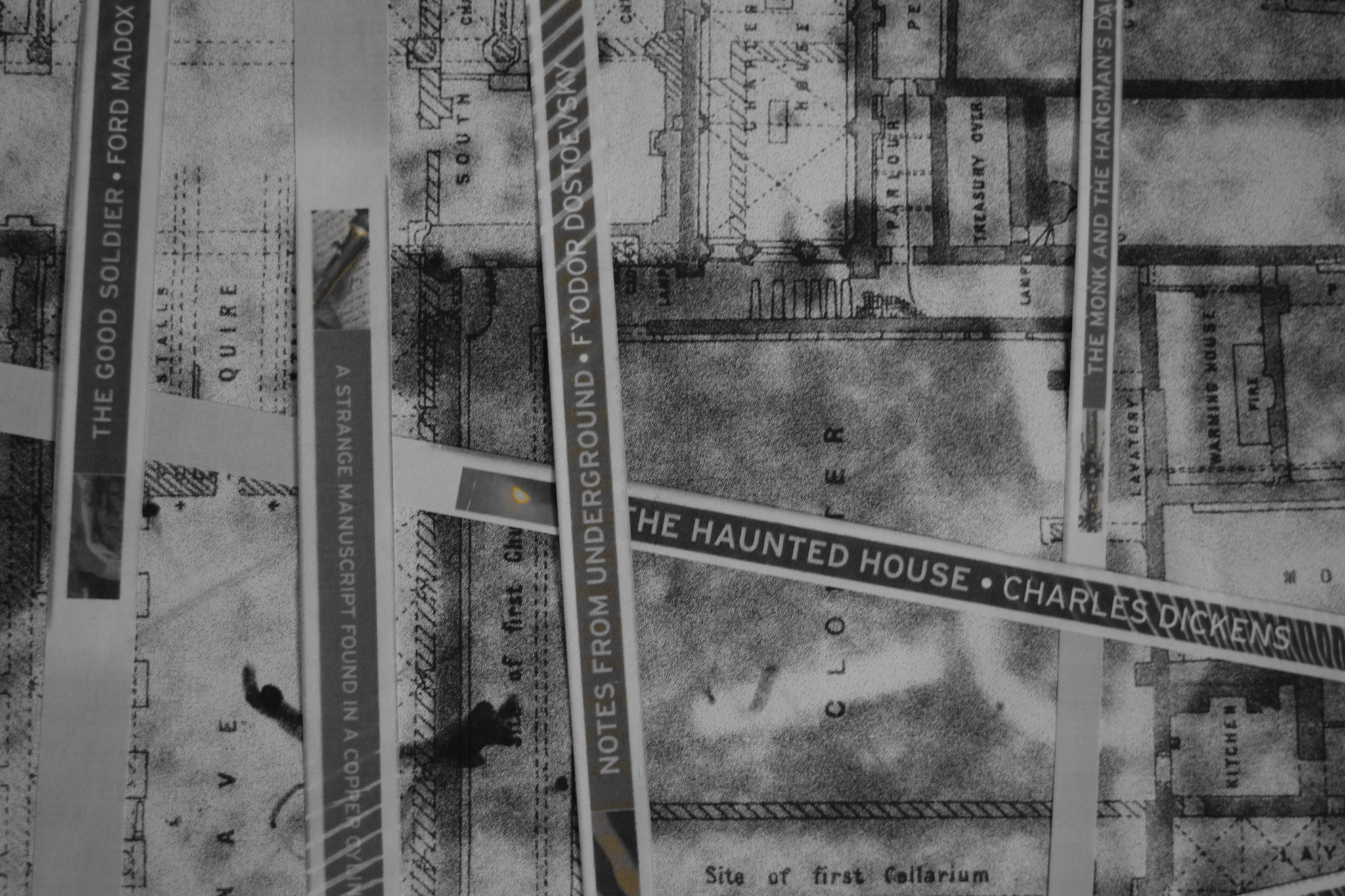
Winchester - Hyde Abbey Laundry
The site of approximately 1,500 sq. metres comprises redundant industrial buildings and a yard at the edge of the city centre and close to the Winchester School of Art. The site is considered to be important in townscape terms and being vacant is an underused resource. The Laundry ceased trading in 2007 and has been empty since. It is a short walk from the city centre, near car parks, leisure centre, Winchester School of Art, the Colour Factory artists’ co-operative, but in an otherwise residential neighbourhood. The site consists of a large industrial space with high ceilings, a series of different sized workshops around this main zone, and on its upper floors, office accommodation, staff canteen and a workshop. The private owner and his developer wish to demolish the old buildings and develop the site for housing; however, WCC planning officers wish to see the site or part of the site, retained as offering employment within the city.
Urban Fallow could encourage the owner to consider live-work units and studios for artists to be constructed on the site and demonstrate that there is demand for this type of activity. The Council’s Estates, Arts Development and Economic Development staff have for some years, been looking for potential sites and business models to establish affordable studios in Winchester. While demand is known, the value of assisting in the establishment of such a scheme is unproven. Urban Fallow has the potential to provide further evidence and advocacy for a permanent studio facility on this site. Winchester City Council would want to work with Winchester School of Art (arts faculty of Southampton University) and the University of Winchester, and the Hampshire Economic Partnership as partners in this scheme.
The building in its present state, although unsuitable for most purposes, is viewed by creative practitioners from a range of practice, as having great potential as studio space (in great demand in Winchester where suitable premises are hard to find - and afford). In the current market conditions, the site is likely to remain ‘fallow’ for some time to come until these issues are resolved, and the market conditions improve.
Urban Fallow will bring into sharp focus areas of vacant urban land resulting from the slowdown in construction and the halting of some major redevelopment and housing projects. It is important that these spaces, many of which are significant in both scale and location are not allowed to deteriorate and damage the public perception of a place. The project will reanimate these areas of land by offering them for use by artists, architects, performers and other professionals with an interest in engaging with the public to develop temporary events and interventions. As well as transforming the spaces and reducing urban blight, this project could also have the effect of reinvigorating interest and potential investment in the spaces, encouraging developers and local authorities to look at them again with renewed creativity and optimism.
Urban Fallow/Solentcentre for architecture and design aims to develop a pragmatic but fluid approach to public access, cultural intervention, use and temporary transformation of urban spaces.
https://www.flickr.com/photos/russellmoreton/
CREATING CREATIVE ANTHROPOLOGY INTO TEMPORAL SITES
between the concrete and the spatial
THE WORKING PRACTICE IS FUNDAMENTALLY SUPPORTED BY ANTHROPOLOGICAL NOTIONS AROUND ISSUES OF SPACES, ORIGINS, SOCIAL RITUALS AND TABOOS
CAPTURED BY APPARATUSES
Heuristic Practices : The trace/space of the anthropological
Utilising processes and strategies and terminologies.
Demarcation, set the boundaries or limits.
Acculturate, assimilate to a different culture.
Ethnology, the study of the characteristics of different peoples and the differences and relationships between them.
NON- SPACES, Introduction to an anthropology of super modernity. Marc Auge.
My working practice intuitively reflects and responds to what Marc Auge considers to be the condition of Supermodemity, briefly his defining parameters on the idea of Supermodemity are.
Overabundance of events.
Spatial overabundance.
The individualization of references.
A SOCIETY IN EXCESS.
My creative practice attempts to reconstitute spaces from this condition of Supermodemity into temporal sites, places from which to solicit a sense of a mobile anthropology, a dwelling that is both intimate and public and promotes solitudes and subjectivity.
Marc Auge states the twenty-first century will be anthropological, not because the three figures of excess are just the current form of a perennial raw material which is the very ore of anthropology, but also because in situations of supermodemitiy the components pile up without destroying one another.1
Contemporary Practitioners like anthropologists will attempt to make sense, they will attempt to resolve, to make or rather remake meaning through the processes of observing the phenomena of acculturation. My practice has now entered into a process that proposes a site for research driven by condition of acculturation. This site of inquiry will attempt to set up an anthropological place of localised relations amidst the condition of Supermodemity.
This proposed temporal demarcation, a marking out of a territory which will become adaptive, reflexive and spatial. Sets out to engender the inquiry of the ethnologist, to attempt of rather to reflect on how the place is organised. This site marks a private acculturation of material sourced from the world, from a hermetic and esoteric realm of private geographies, now processed and made available, accessible to the social.
The observer in the role of the ethnologist with others is invited to formulate their own invention of place through their own curiosity of encounter. This demarcation of space into the social, anticipates an intervention which creates a common adventure for a group in movement.
An interesting comment about gendered space in classical literature examines the relationship between what might theoretically and spatially link the interior with its exterior boundary is to found Mythe et pensee chez les Grecs written by Jean-Pierre Vemant. In this account Vemant describes the spatial and social arrangements of the Hestia/Hermes couple. Marc Auge acknowledges this relation as
“Hestia symbolizes the circular hearth placed in the centre of the house, the closed space of the group withdrawn into itself (and thus in a sense of its relations with itself);
while Hermes, god of the threshold and the door, but also of crossroads and town gates, represents movement and relations with others.”2
Auge makes the critical point that in anthropology studied by both classic literature and history it is identity and relations that form spatial arrangements which are also inscribed in time. It is this time that materially renders the temporal dimension of these spaces and with it our reading of anthropology.
My earlier usage of long durational photographic devices (large pinhole cameras) was an attempt to realise the identity and relation of a place (its spatial activity and fixity) is totally contingent to its method of register and the particularities of fixed and temporal details. In fact these surfaces rendered from these devices are evidences of historical spaces of hidden social itineraries.
1 Marc Auge, Non-Places, introduction to an anthropology of super modernity. (London: Verso, 1992) page 41.
2 Marc Auge, Non-Places, introduction to an anthropology of supermodernity. (London: Verso, 1992) page58.
Fragment, research/Mechanisms of Seeing/The Architecture of Image
Architectural Apparatuses of Affect : Daniel Libeskind/Small Voids/Cameras
light; the darkness is a silent solid, the light etches its surface, it is simultaneously sign and cypher. The light etching itself on the dark surface is akin to a revelation, an epiphany before the building is transformed by its users and movement.
Daniel Libeskind’s building will, when finished, offer a path for the visitor, the path of history that crosses the void of commemoration. This void is the body of an absence—that of the Berlin Jews who perished in the Holocaust. The void makes us meet this absence, but we meet it by passing through it. When an absence, in the form of a void, meets the surface of daily reality, memory marks that surface. The Holocaust has created such a void, which, in projects such as the Berlin Museum with the Jewish Museum, is brought to the surface and given a place and a house. The void intersects the surface of time and creates a place of passage, of commemoration, of ritual in our daily life. The void is linear sign: lest we forget. But the incisions in the walls of the main exhibition spaces, spaces which house the historical material about the city of Berlin, create voids through which light is let in. These calligraphic empty spaces create a near biblical writing on the wall.
Cameras consist of small voids, the ‘camera’, a lens and photographic film. They are camerae obscurae that collect light and allow it to meet the surface of the film. But in fact the light comes from the larger void outside the camera. The moment the light has registered on the light-sensitive surface of the film, memories are constructed. The memory is literally conceived in this meeting and is added to life as an additional layer of being. The process through which void meets surface is therefore also about love—the love of ancestors and relatives, but also of life and its conception.
Russell Moreton, 10 Days in the Laundry
MOLECULAR SIEVE, is a performative analysis of “this place” utilising the simple properties of the pinhole camera. This appropriated apparatus makes visible the extrusive nature of time as it is deposited on the photographic surface. The extended durations required to register “place” impart a sense of dwelling as recorded by the apparatuses passive gaze. These surfaces record and register a relation constructed by the architecture of the chamber and what is beyond it. Movements when visible appear as simple abbreviated enactments caught like inclusions within this consolidated and timely consolation of place.
Time as it accumulates on a photographic surface.
This performative investigation utilizes a large pinhole chamber which is given mobility via a sack-barrow. This apparatus produces through its very inclusion into spaces a “spatial practitioner” in its own right. My aim is to utilize this device as a means of registering “worksites” both in the duration of the event and in its pre-performative state. The mobility of this research could be used to illustrate a constantly changing set of dynamics throughout the site and its event. The use of perhaps adjacent wall spaces or even a
“sandwich board” would render a tangible re-presentation of spatial information for the visitor. Darkroom facilities or conversely off-site arrangements would be organised.
Artist Statement 2009/10 Days
SITE is anti-place hovering precariously over the abyss of no-place.1
This “undoing of place” might instigate a threshold and a situation/room from which to reflect upon critical spatial, sociological and psychological conditions and perceptions.
Practitioner with earlier experience in ceramics and glass, recently completed visual arts course at Winchester, now at Canterbury studying spatial practices. Interested in drawing, photography and interventions that can explore our sense and experience of place. My work seems to harbour a need for a reflective solitude, a sense of dwelling amongst absences. The use of materials from the locality (field chalk) imply a personal geography drawn from the direct relationship to an inherited Earth. There is the suggestion that the absence recorded by the trace is an inclusion, a legacy set into a field of materiality, but it might also suggest a metaphysical field of thought. This act of drawing becomes its own experimental field of exploration, a sort of “in between reality"( Merleau-Ponty) an enmeshed experience. Perhaps all that remains is some sense of a material memory encountering the realm of the insubstantial.
Interested in collaborative projects and ventures that might facilitate issues of “site” as being the very undoing of place. Site for me is part of the rehearsal for the construction of place, site holds relations and intimacies/geographies that will be over-written by methodologies destined to be terminated to create place.
What is an Apparatus? Giorgio Agamben
by the term “apparatus” I mean a kind of a formation, so to speak, that at a given historical moment has as its major function the response to an urgency. The apparatus therefore has a dominant strategic function.
I said that the nature of an apparatus is essentially strategic, which means that we are speaking about a certain manipulation of relations of forces, of a rational and concrete intervention in the relations of forces, either so as to develop them in a particular direction, or to block them, to stabilize them, and to utilize them. The apparatus is thus always inscribed into a play of power, but it is also always linked to certain limits of knowledge that arise from it and, to an equal degree, condition it. The apparatus is precisely this: a set of strategies of the relations of forces supporting, and supported by, certain types of knowledge.
I wish to propose to you nothing less than a gen eral and massive partitioning of beings into two large groups or classes: on the one hand, living beings (or substances), and on the other, apparatuses in which living beings are incessantly captured. On one side, then, to return to the terminology of the theologians, lies the ontology of creatures, and on the other side, the oikonomia of apparatuses that seek to govern and guide them toward the good.


.jpg)