Showing posts with label atmosphere. Show all posts

Saturday, 19 September 2026

EMOTIVE SPATIAL ENCOUNTERS/Innerness → Permeable Chamber : Performativity/Unbounded Outcomes

Interiority / Atmosphere

Wayfaring a spatiality that is being discovered as a condition of correspondence between bodies.

The space of the vessel is already more than an enclosure. Surface and interior become mutually perceptible, light moves towards darkness and back again, and the body of the pot becomes a site of correspondence between maker, material and inhabitant. Walking extends this relation into place: paths connect, scatter, remember and open outward. Read through the current practice, innerness begins to move away from enclosure towards permeability. The interior is not simply what is inside the body; it is something produced through contact between bodies, surfaces, atmospheres and movement. The chamber becomes active because it remains capable of encounter.


Active Thresholds~Hosting Permeability.


Speculative inquiry 190926

This post opens perhaps the most important architectural question for the current ceramic body:

What if interiority is not what a body contains, but what happens between bodies?


That is a substantial shift.

The earlier vocabulary is:

vessel → interior → innerness → dwelling → surface


The current vocabulary can re-enter it as:

body → threshold → aperture → permeability → correspondence → chamber


And this is where the old architectural research becomes materially redistributed through clay.

The hut, pot, interior, path, ruin, walking body and atmosphere do not have to become references for the ceramic. They become correspondent bodies that have already been thinking through the spatial questions that clay is now materially troubling.


MATERIAL and AFFECT

EMOTIVE SPATIAL ENCOUNTERS

RUINS and SUBJECTIVITY

Encounter with place through transpositions/re-deployment of materials/technologies and design.


The rules followed by medieval cathedral builders could not and did not prescribe their practice in every detail, but instead allowed scope for action to be precisely fine-tuned in relation to the exigencies of the situation at hand. The cathedral and the laboratory, MAKING, Tim Ingold

PATHS alert us to how we are scattered as well as affirmed by the places through which we move. Edward Thomas.


THE GEOGRAPHY OF WHAT HAPPENS: SPACE, POLITICS and AFFECT.

Nigel Thrift

VISUAL FINE ART / TRANSACTIVE through Digital Technologies POETIC / EVERYDAY ABSTRACTIONS

MAKING / MANIFESTING FORMS / STRANGE TOOLS

INDEXICAL / ITERATION ( new version, repetition, closer approximation, scrutiny, observations, sequence, finding a solution/perception to a problem)

UNBOUNDED OUTCOMES / ITERATION becomes the starting point of the next iteration PROGRESSION through PERFORMATIVITY

AGAINST SPACE

Making : anthropology, archaeology, art and architecture.

Tim Ingold

Immaterial architecture creation and contemplation artist and architect

The contemplation of art is primarily a form of visual awareness, of a single object by a single viewer, in which sound, smell and touch are as far as possible eradicated. Placed in a hermetic enclosure and protected against decay, the artwork is seen and not used. The viewer leaves no trace or mark because touch would undermine the artwork’s status as an idea and connect it to the material world.

To translate the drawing into the building requires an intimate knowledge of the techniques and materials of drawing and building.


ATMOSPHERES

THE EPIPHANY OF ARCHITECTURE

CIRCULATION, ENCLOSURES and their LIGHT


TOTAL ARCHITECTURE, Walter Gropius

TOTAL ART, Theo van Doesburg/DE STIJL


GESAMTKUNSTWERK, all embracing aesthetic, where art becomes architecture and architecture art. A synthesis, and revolving intersection where each medium exists at the service of formal innovation; a kind of essentialist discourse or tradition that might be buried in the past.

Brian Clarke, Nerves of Ecstasy by Robert C. Morgan, PACE 2013.


ARCHITECTURAL FORMS OF ENCOUNTER/DEBATE

HISTORIES, PHILOSOPHIES, AESTHETICS

Katsura Detached Palace. Kenzo Tange, Walter Gropius. 1960

(extended in a modular fashion and adapted to changing royal needs over the centuries)


Katsura consolidates all qualities in history but not in a creative way. Since it lacks in the strength of its unifying all members, its impression is lyricism but lacking unifying tension. KenzoTange


Ise : Prototype of Japanese Architecture. Kenzo Tange, Noboru Kawazoe. 1961

(Ise Shrine rebuilt every 20 years with new materials)

Ise Shrine manifests primate yet powerful, simple yet noble, and serene yet ecliptic qualities, which cannot help moving us. Tange


THE PRIMATIVE

JOMON POT, 2000 BCE, (Jomon period 14,000 BCE-300 BCE)

Jomon, (means Rope pattern) wildly decorated pottery, idols, and thatched pit dwellings. The style comes to stand for the savage and dynamic.

Jomon appeals to us with the flooding energy of the fundamental life of the people. It has a resilient strength and a sense of mass, which comes out of through their wild battles with nature: it also has a free and agile sensitivity. Kenzo Tange


THE ARISTOCRATIC

YAYOI EARTHENWARE, 350 AD, (Yayoi period 300 BCE-250 BCE)

In the Yayoi period, earthenware becomes more refined, and structures like granaries are raised on stilts, building developments reflect the emergence of social hierarchies.

In Yayoi, man and nature are synthesized to create a calm lyricism, acknowledging nature’s blessings. A passive attitude, submitting to the surroundings prevails. A flat equilibrium and quiet balance with no dynamism are left in a transient mood.

Kenzo Tange is originally drawn to the Yayoi style, but starts to oscillate with the Jomon style in the late ‘50s’ For Tange and the future Metabolists there is no conflict in their simultaneous study of tradition and modernism. Tange insists on exploiting tradition as a means of innovation, while building prolifically in a modern mode and strategizing the high-tech avant-garde of Metabolism.


There’s more truth about a camp than a house. Planning laws need not worry the improvised builder because temporary structures are more beautiful anyway, and you don’t need permission for them. There’s more truth about a camp because that is the position we are in. The house represents what we ourselves would like to be on earth: permanent, rooted, here for eternity. But a camp represents the true reality of things: we’re just passing through.

Wildwood, A Journey Through Trees. Roger Deakin.2007


PAO, a structure that you can repeatedly put up and dismantle. Because of occupant’s nomadic life, it needed to be lightweight, and be able to be built very quickly and have the ability to be taken apart and re-built many times. Even materials that have already been used can be reused so long as they are disassembled correctly and preserved properly.

To maximize the reuse of components one needs to standardize them so they can be pre-fabricated. The order of construction becomes important as it influences the disassembling of the structure; the technical features of joints, assemblages of materials and their localities can become both conceptual to the experience of the space and its architectonics and to the actual innovative building process.

In the Mesopotamia city of Ur, they bricked over houses buried in the mud and built new houses in the same spot over and over. Its been learned that they repeated this eight times. There was apparently a very strong impulse to create an eternal building.

Kiyonori Kikutake


Rem Koolhaas

SO THE MUD HOUSE BECAME THE RENAISSANCE AND THE TENT BECAME METABOLOLISM?

Kiyonori Kikutake

YES, IT BECAME A METABOLIST STRUCTURE MADE OF WOOD. AND I THINK THE NOTION OF ATTAINING ETERNITY WITH A MUD HOUSE-OR ATTEMPTING TO-IS REALLY FASCINATING.


In The Making : Hollowing out Space through Innerness and Difference. 

Quietus : Interiors of Silence and Space.

Innerness : A (sensorial) space or even a place interior to its environment. 

Sensing Spaces : Through displacements and hidden volumes.

Defined Interiors : By material, agency and social and private architectures. 

Interiors of Pots : Analogies with the Hut as both being dwelling places made from the inquiry of form and the need for a reflective solitude. Fragment as a broken shard, from notebook March 2014.


Innerness

The light of reflection and our immediacy moves from light to dark and from dark to light; from surface to interior and interior to surface. The pot becomes a cyclical vessel reflecting our geocentric origins.

The Hut is a vessel in the making for reflective dwelling.

The Pot with its interior underpins its fidelity, its completeness.

Some pots are tuned and balanced for their “innerness”; others promote their surfaces (noise) at the expense of their interior integrity (quietness).

Vessels of Defined Spaces : Creatures of Light and Dark


In sensing a pots interior from its surface, we are as it were in some intimate tacit correspondence with its spatial sensing centre. We become known to it through its maker’s creative gesture of innerness. This anthropological inner space linking us to the potter is both sensual and distant; its vacancy allows us dwell in the maker’s absence.

Reflections on Heidegger,

We traverse from light to dark many times as we gather in the pots (thingness) as it were unfolding in our presence (nearness).

Vessels as Spatial Metaphors around Innerness and Difference. 

The Jar


Heidegger as a pouring and gathering social metaphor. Anecdote of the Jar.

Dominion over the Unmade.

Wallace Stevens, poem cited by Edmund de Waal.

WORKING at the transitional surface/stage in the HUMANITIES as it re-boots itself into THE POSTMODERN.

A SOMATIC ARCHIVE, of subjectivities whose perceptions and environments are going to change forever; like the particularities of the analogue trace in photography that is now becoming a distant experiential condition, an orphan extinct from the subjectivities of its originating culture/organism.

The imagination and process aesthetic of the Posthuman Condition 


A Theoretical and Semantic search amongst Ruins and Archetypes 

Historical Perspectives

Dwelling/Poetics Heidegger Archetypes/Symbols Jung

Flesh and Stone, Richard Sennett

Flesh and The Logic of Sensation, Deleuze/Bacon 

Feminist Geographies The Posthuman

Posthuman thought inscribes the contemporary subject in the conditions of its own historicity.

Posthuman Subjectivity : Rosi Braidotti 

LIGHT into SOMANTIC SPACES

Continuum and Chora (light and the shadow of chora)

Life expresses itself in a multiplicity of empirical act: there is nothing to say, but everything to do. Life, simply by being life, expresses itself by actualiizing flows of energies, through codes of vital information across complex somatic, cultural and technologically networked systems. (Braidotti, 2013:190)

De Architectura, Vitruvius

Architecture consists of order, arrangement, proportion or eurythmy, symmetry and decor, and distribution.

Arrangement as an “Idea” refers to the Aristotelian notion of “Image­ representation” as phaantasia a precondition to drawing, effectively occupying and revealing a space between Being and becoming.


INTERIOR DESIGN UCA FARNHAM

DESIGN AND RESEARCH PROJECT 2015 SPACE BETWEEN PEOPLE.


SITE-PLACE-DIALOGUES

THE RUINED ABBEY, stands as architectural remnants of a pastoral community now set in parkland and open to the public as a site for recreation.

The Abbey and its experiential values and feelings have been employed as both a reality of a lived experience and as a virtual diffractive site for thinking through contemporary issues in arts (relational aesthetics), and architectural design through exploratory spatial inquires with the specifics of place studies.

What this project is not

Gift Shop and Visitors Centre What this project might become

Proposal for a symposium,

Personal Structures, artists and writers talk about “Time, Space and Existence”. Setting for an exhibition that can promote the symposium.

A room containing a virtual work of design that challenges and opens up the physical architecture.

A design for a interactive (mobile) component, a structure that can act as an interlocutory apparatus in the transposition of the phenomena of place.

Building Partitioning of Space.

Architectures as atmospheres that promote the contents and support the interaction of things including humans.

Design as a tool of transposition, of layering and collaging different spatial values both cultural and experiential.

Painting Subjectivities, matter drawn and crafted from site inquiry.

LIGHT VALUES

The Transmission of Light,

Instantaneous psychological effect that stimulates the senses. The Specificity of Colour

Synergistically working with place and symbolizing abstract concepts and thoughts.

Humans use colour in their surroundings for decorative purposes or to chronicle their every day lives and other important events.

Earthy, Corporeal, Spiritual, Pastoral. Capricious.

Colour has always been used symbolically, whether pained directly on the body or worn in garments to announce the wearers’ social status, their tribe or country’ or other significant group.

The Abbey, On-Site (qualitative research with stained glass samples) Analogous Colour Fields with Monochromatic Features, utilise complementary colours or forms to focus the difference and diversity of the design installation.

Red, Flashed Ruby glass.

Brown is the ultimate earth colour associated with a “durability” of terra-cotta, clay.

Amber, Light, Medium and Dark. Yellow, Orange, Imagination/Enlightenment, Intensity, Sunlight.

Purple, Red/Blue, Spirituality, New Age, Cutting Edge Technologies. Diversity, Complexity, Artistry, Uniqueness.


THE ABBEY AND THE CISTERCIAN ORDER

THE PHENOMENOLOGY OF CONSTRUCTION : Caruso St John

HISTORY IS THE RAW MATERIAL OF ARCHITECTURE. Aldo Rossi


TRADITION AND MODERNISM

CONTINUITY-LEGACY-TOWARDS AN ONTOLOGY OF CONSTRUCTION


Today the nuances of language that make up these architectures only exist as an intellectual discourse and do not operate at the emotional level that would have engaged the original inhabitants, or audiences of these buildings. And yet we are still emotionally affected by these structures. Denied access to the specific culture of their iconography. We respond, at a more visceral level, to the more general culture of their construction.

Adam Caruso on the medieval ruins of Fountains Abbey, Yorkshire.

Towards an Ontology of Construction, Knitting Weaving Pressing. 2002

Thinking with Walking/Paths/Huts

WALKING was a means of personal myth-making, but it also shaped his everyday longings; Edward Thomas not only thought on paths and of them, but also with them.

The Old Ways, A Journey on Foot. Robert Macfarlene


ON REFLECTION

What do I know when I am in this place that I can know nowhere else?

What does this place know of me that I cannot know of myself?

For Edward Thomas, paths connected real places but they also led out-wards to metaphysics, backwards to history and inward to the self. These traverses-between the conceptual, the spectral and the personal occur often without signage in his writing, and are among its most characteristic events.

HE IMAGINED HIMSELF IN TOPOGRAPHICAL TERMS


HEIDEGGER’S HUT

A TOPOLOGY OF BEING, PLACE, WORLD. Jeff Malpas


METHODOLOGIES OF DESIGN

GESALT, GRISAILLE, LEITMOTIF, MATRIX, FORMAL PATTERN, SURFACE


VISITORS : A film by Godfrey Reggio

MEANING IN THE FORM OF THE FILM

THE ACTIVITY OF PERCEPTION

We have art so that we may not perish by the truth. Friedrich Nietzsche


SENSORIUM AND STILLNESS, MOVEMENT AND MIRROR

A MIRROR ON WHAT IT IS TO BE HUMAN


THE RECIPROCAL GAZE :

The screen is gazing at us; we are framed by our own looking. A direct relationship (what the image tells me); a singularity held by the vivacity of the image, through the activity of perception and introspection.

THE SPECTATOR MAKES THE JOURNEY into the PREMORDIAL IMAGINATION OF THE CAMERA.

CONCRETE PHOTOGRAPHY, PHOTOGRAMS, IMPRESSIONS, TRACES


THE SENSATE AND THE CONCEPTUAL

PAINTING, Robert Mangold.

TRANSFORMATION AND PROPHECY

BEUYS-KLEIN-ROTHKO

ARCHITECTURAL LEXICON OF STRUCTURES AND SYMBOLS


WORKING NOTES 20 August 2018

Fragments/Thoughts CONSTELLATIONS NIGHT DRAWINGS

OUTPOST URBAN FROTTAGES/ Drawing Strategies


SCULPTURE TRAIL/ Minimalist, Post Modem, elements, assemblage, collage REFLEXIVITITY / AGENCY / POST STUDIO


Mobius Strip, experiential feedback into REAL LIFE / NOWNESS SEARCHING for creative anthropologies from the landscape.

ACTIVE and creative engagements. PERFORMATIVITY LANDSCAPES

SENSORY WALKS

USING the topology close to hand, the unique geographies of the rivers from source to sea.


The four together


I think these four should not be made to look like a chronological development. Their power is in the fact that each contains a different activity that the current practice can return to.


Older post Active body now

The Arts Trace → permeability

Lightness / Synthesis / Solitude Multiplicity → gathering

Time / Action / Diagram Kairos → futurity

Emotive Spatial Encounters Innerness → permeable chamber


And there is a really interesting movement across them:


Trace

↓

Gathering

↓

Movement / Kairos

↓

Interior / Atmosphere

↓

Clay

↓

Ceramic

↓

Permeable Chamber

↓

Futurity


But I wouldn't put that as a diagram explaining the archive. I think it is better understood as a wayfaring possibility through the archive.


The deeper speculative proposition


What I think is emerging from these four posts is that the current spatial practice may not simply be about making ceramic bodies spatial.

Spatiality is being discovered as a condition of correspondence between bodies.


The earlier work repeatedly approaches this through different media:


cyanotype allows material to seep beyond the traced body;

collage and montage allow fragments to occupy a shared field;

diagram allows temporal and spatial relations to remain in movement;

the vessel allows surface and interior to sense one another;

walking allows place and body to continually alter one another.


Clay now becomes a particularly intense site for all of these propositions because it can receive, resist, absorb, register, perforate, enclose, open and transform.

Then firing changes the proposition again.


The archive gathers the activities through which spatiality was already becoming perceptible: trace, movement, multiplicity, innerness, atmosphere and encounter. Clay does not resolve these bodies into form. It troubles them into correspondence.

The spatial practice was already there, dispersed across bodies. Clay became the place where they could touch.

That last sentence feels particularly close to what you are now calling In~~Touching.


Spatial Bodies of Practice~Gathering/Multiplicity/Lightness/Synthesis

Spatiality is being discovered as a condition of correspondence between bodies.

What begins as lightness becomes density. Images, ruins, fragments, colour, readings and places gather without settling into a single structure. The work moves between material transformation and the impossibility of containing everything that has been encountered. Chora appears as trace, mark, map and body: a spatial condition where things can occupy one another without becoming the same. Read through the current practice, synthesis becomes less a resolution than a gathering of differences. The spatial body begins to form through multiplicity—through what touches, overlaps, withdraws and remains unresolved.


Speculative inquiry 190926

I think this post opens an important question for gathering:

Can gathering remain multiple without becoming synthesis?

This is significant because your current Permeable Chamber is almost the opposite of a synthetic container.


It gathers, but does not resolve.

It holds, but does not contain.

It allows correspondence without requiring agreement.

So perhaps something has shifted:

synthesis → multiplicity → gathering → permeability

The old post is therefore not simply about “synthesis”. It contains a tension that the current practice can activate: the desire to gather without closing the gathered material into a resolved whole.

That is very close to your recent formulation:

The Permeable Chamber is where gathering becomes a troubling reverberation.


Outpost 190822


LIGHTNESS


QUICKNESS


EXACTITUDE


VISIBILITY


MULTIPLICITY


Six Memos for The Next Millennium.

Italo Calvino, 1992.

The difference between the first versions I read and the final ones lies in structure, not content. 

Calvino wanted to call the sixth lecture 'consistency' and he planned to write it in Cambridge. 

I found the others, all in perfect order, in the Italian original, on his writing desk ready to be put into his suitcase.

Esther Calvino.


The Drought.

J.G. Ballard.


Allegories are, in the realm of thoughts what ruins are in the realm of things.

Walter Benjamin on the origin of German Tragic Drama.


Photographic ruins an amalgam/agency of what remains.

Brown and Blue.

A Field in England.

Cyanotype material on canvas with iron pigment.


Developing a spatial serenity/synthesis/synergy.


This amalgam of colour with various substances demonstrates the change and transformation of the material world, which can be interpreted as essentially an alchemistic procedure.

The goal of such procedures is ultimately to resolve the material object into its spiritual substance.


Yves Klein.

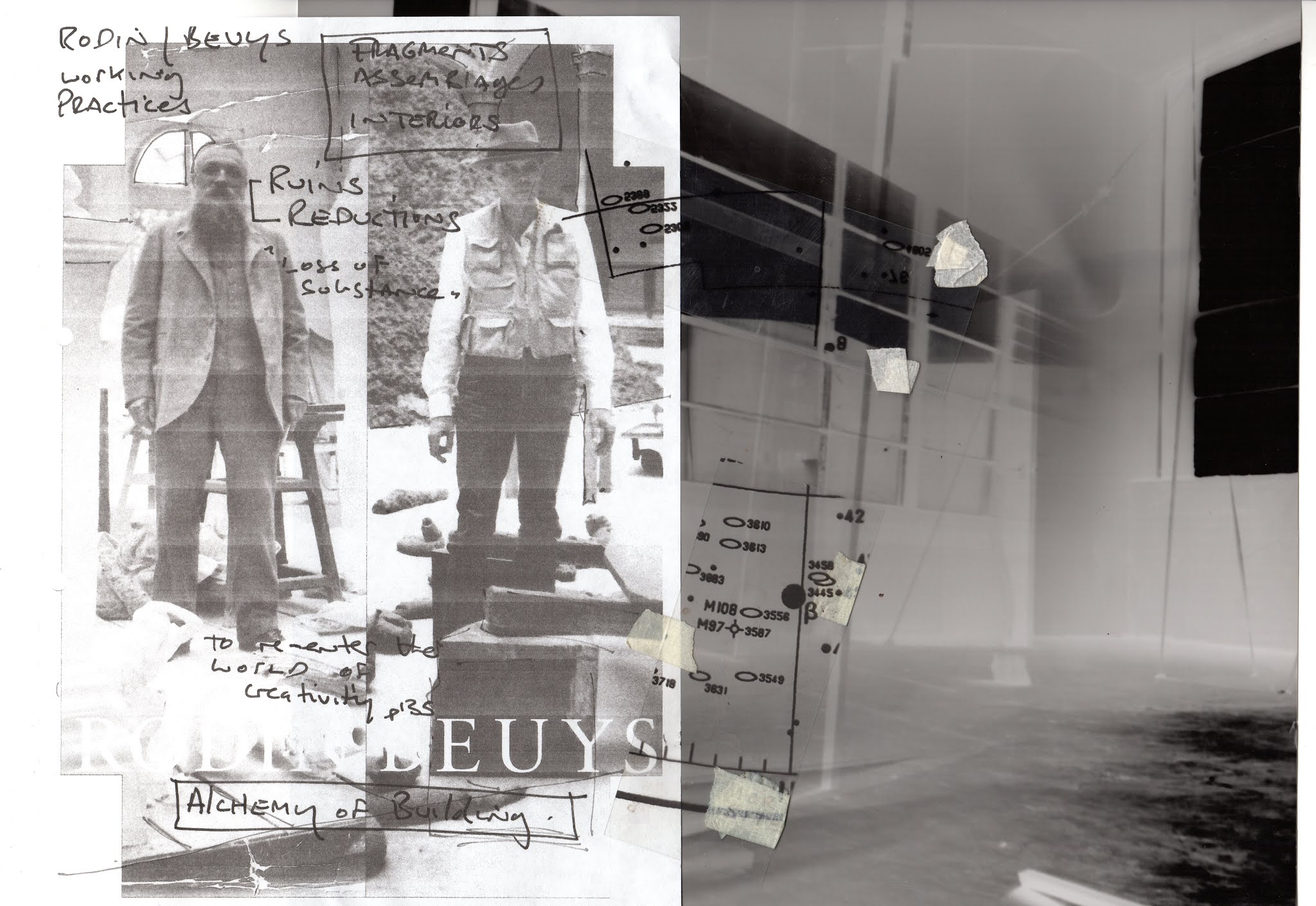
Beuys Brown and Klein Blue.

Magdalena Broska.


Air and Dreams.

An essay on the imagination of movement.

Gaston Bachelard.


Shotesham, site based inquiry,studio practice.

Spatial registers around the corporeal and the transcendental.


Ruin its relation to time.

Fragment as ruin and on melancholia as an attitude of retrospective contemplation.

Dialectics at a standstill, a moment where the past is recognized in the present as a ruin that was once desired, allowing allegory to be understood, felt as a contemplative calm, an equilibrium in the becoming and wrapping nowness of the self/situation.


Dialectical thinking involves the clarification of ideas through discussion and contradiction.


What remains after the process of dialectical thinking?


An initial thesis is opposed by an antithesis, then resolved through a synthesis of the two terms, which can in turn become a new thesis.


Objects/inclusions for painting with/layered transitions and movements.

Holga 120WPC, f135.

Ilford Delta 100/8 exposures 92x55mm.


The Gaze of Orpheus.

Maurice Blanchot.


The Essential Solitude

In the solitude of the work, we see a more essential solitude, a self communion.


MULTIPLICITY


The work grew denser and denser from the inside through its own organic vitality.


For Musil, knowledge is the awareness of the incompatibility of two opposite polarities. One of these he calls exactitude or at other times mathematics, pure spirit, or even the military mentality, while the other he calls soul, or irrationality, humanity, chaos.


Everything he knows or thinks he deposits in an encyclopedic book that he tries to keep in the form of a novel, but its structure continually changes; it comes to pieces in his hands.


The result is that not only does he never manage to finish the novel, but he never succeeds in deciding on its general outlines or how to contain the enormous mass of material within set limits.


The network that links all things is also Proust's theme, but in him this net is composed of points in space-time occupied in succession by everyone, which brings about an infinite multiplication of the dimensions of space and time.


The world expands until it can no longer be grasped, and knowledge, for Proust, is attained by suffering this intangibility. In this sense a typical experience of knowledge is the jealousy felt by the narrator for Albertine.


It is the extension of that being to all the points in space and time that it has occupied and will occupy.


But we cannot touch all these points. If only they were indicated to us, we might perhaps contrive to reach out to them. But we grope for them without finding them. Hence mistrust, jealousy, persecutions. We waste precious time on absurd clues and pass by the truth without suspecting it.


Remembrance of Things Past : The Captive.


Infra-ordinary.

Species of Spaces


We sleep through our lives in a dreamless sleep.

But where is our life?

Where is our body?

Where is our space?


Georges Perec.


CHORA : trace/mark/map/body

The drama of encountering space.


Recombinant Poetics via Interventions.


Thinking about temporal issues through visual, material and spatial registers.


Concerned with artworks and architectural projects that reconfigure the temporality of sites, repositioning the relationship of the past and the present in a number of different ways.


Allegory, Montage, Dialectical Image.

Between Art and Architecture.

Jane Rendell.


Performativity/Drama of Residency


Transient readings and encounters.


Other Enactments,Dialogues,Relationalities. 

Sites of evidence/knowledge and understanding.


The scheme should incorporate both careful repair of existing fabric and a significant element of new construction in a contemporary design.


SPAB, design competition.


We are not calling for a new disordered architecture to match the disorder of culture; this would only affirm the chaotic. 

Rather, we propose experiments in search of new orders, projections of new relationships.

We do not wish to transpose our study into a system or method.

The energy inherent in opening up relationships presents us with a continuity of ordering that compels refection.


Steven Holl. 

Correlational Programming, Parallax.


This one has enormous potential for the current practice.

It gathers Calvino, Benjamin, cyanotype, ruins, Bachelard, Shotesham, material transformation, multiplicity, Proust, Perec, chora, montage, temporality and the refusal to turn the investigation into a fixed system. The particularly important phrase for me is the post's own recognition that “We do not wish to transpose our study into a system or method” and its interest in opening relationships.

That is remarkably close to where your current practice has arrived.

The deeper speculative proposition


What I think is emerging from these four posts is that the current spatial practice may not simply be about making ceramic bodies spatial.


It may be about something more particular:

Spatiality is being discovered as a condition of correspondence between bodies.

The earlier work repeatedly approaches this through different media:


cyanotype allows material to seep beyond the traced body;

collage and montage allow fragments to occupy a shared field;

diagram allows temporal and spatial relations to remain in movement;

the vessel allows surface and interior to sense one another;

walking allows place and body to continually alter one another.


Clay now becomes a particularly intense site for all of these propositions because it can receive, resist, absorb, register, perforate, enclose, open and transform.

Then firing changes the proposition again.


Tuesday, 18 August 2026

Working Notes~Sensate Intelligence : Clay, Interior Skins of Light and Dark.

The Sensate Intelligence in Clay.

Contemporary Ceramics : Practices in Craft and Design.

01-05-2017 Original Blog.

10-08-2026 Some images added.

The ceramic body becomes a threshold between what is held and what passes through. Skin, interior, light and darkness gather around the vessel, making emptiness materially present. The surface is not simply the outside of a form; it is where inside and outside begin to negotiate. Clay becomes atmospheric here, opening towards memory, sensing and the experience of being situated within and around a body.


Interior Spaces. Environments and Atmospheres.
Ceramic Building Technologies.
Screens, Boundaries and Borders.

Sensuality, Materiality as Memory in the Poetics of Space.


Breaking The Mould : New Approaches to Ceramics. 2007

Ceramic Environments.
Space/Time based work, using clay in large-scale contexts, in gallery or outside spaces to create a fully immersive moment that challenges the common perception of what clay is capable of.

Surreal Geometries.
Makers who use large and small-scale sculpture that is in some way abstracted or represents a heightened version of reality.


The Vessel.
Works around the practicalities of functional ceramics.


Human Interest.
Explorations into the human form and human nature.

Beyond The Vessel.
Experimentation around the ideas of deconstructing the vessel.

Earthly Inspirations.
Formal and conceptual properties of using the very nature of clay.

Surface Pleasures.
The exterior skin of ceramics and clay.


Notes from The Essential Vessel, Natasha Daintry.


A Vessel defines emptiness as presence.

Vessel as a fundamental expression of being and non-being a ‘no-thing’

A vessel is both a hollow receptacle for liquid, and also a place where
“The mind of man balances and reconciles opposites” Tom Chetwynd,

“We turn clay to make a vessel; but it is on the space where there is nothing that the usefulness of the vessel depends.” Tzu, Lao, Tao Te Ching.


Around Form and Formlessness.
A Vessel is an effortless three-dimensional manifestation of form and formlessness.

‘The benign existential riddle of the vessel is that we only see the material bit that holds our coffee.’ (Daintry2007:8)


One comes about as a result of the other, and this search has a particular resonance at the beginning of this fledgling millennium as technological progress masks a perilous sense of physical and psychological uncertainty. (Daintry2007:6)

Pottery is bound up with the elemental needs of civilisation.
The search of form/cultural and individual through participating with the potters’ wheel.

Alternative “Thinking”States, Sensing, Doing and Being.

‘Its not easy to talk about sensing, doing and being. They’re not concepts as such, neat little fixed shiny packages of ideas, but more existential states which shift and move as you inhabit them-more amorphous, like clay.’ (Daintry2007:6)

Amorphous values of things/memory manifested through existential states (as a spatial device/movement/atmosphere) in architectural spaces?
Zumthor, Holl,Paalasa, Bachelard.

For the potter the making of a cup or bowl through the opening up or hollowing out of clay is itself ‘an essay into abstraction, a clothing of emptiness’; for a vessel is as much defined by the negative space in and around it, as the skin of the ceramic itself.

This skin is a sort of negotiation between inside and outside, between solid and fluid, and where they intersect. A vessel embodies something and nothing and is an effortless three-dimension manifestation of form and formlessness. (Daintry2007:8)

The vessel inhabits rich, liminal territory of uncertainty and abstraction. (Daintry2007:12)

Metaphors of Memory and Experience by way of the Vessel.
Spatial Negotiations (Metamorphosis) between Inside and Outside.

A vessel (as membrane/threshold that can hold social rituals/traditions and memories) seems to occupy space but simultaneously be occupied by space.

Water, although fluid it is supremely germinative and represents the condition of all potentials.(Eliade Mircea1983)

Permeable in flux, water and water’s symbolism became the pagan’s way of intuitively knowing the world. Matter was plastic, fluid and changeable. The body was plastic with parameters defined not only by individual consciousness, but also in relation to other realms of the physical world.

The pagan participated in a vast mythology where his identity changed according to narrative fantasies that combined and recombined human and animal activity endlessly, weaving together memory, reason and sensation. In this permeable world there is no sharp division between things or between life and death. It is a world of energetic flow where bodies can indifferently become attached or unattached from myriad objects and forms. (Daintry2007:9)

Flexible Ways of Seeing/Re-Making the World.

“A large part of the reason for making is to see things that I have never seen before, to build something which I cannot fully understand or explain.”
Artist Statement, Ken Eastman.

Theories of relativity and uncertainty have shown that all matter, even the airy oxygenated void inside a vessel is energy, and that it is composed of the same building blocks generated from exploded stars. (Daintry2007:10)

Italo Calvino : Six Memos for the Next Millennium. 1996

LIGHTNESS

Lucretius, preoccupied with infinitesimal entities on the nature of things.
A philosophy of lightness (Calvino) formed from Lucretius ‘he is the poet of physical concreteness, viewed in its permanent and immutable substance, but the first thing he tells us that emptiness is just as concrete as solid bodies.’(Calvino1996)

Knowledge of the world tends to dissolve the solidity of the world. (Daintry2007:10)

The synchronic flow between form and emptiness, solid and fluid is in itself an awareness of conjoining the concrete with emptiness. The drawings of Cy Twombly as Roland Barthes comments have the ‘appearance of a form (that) testifies to its simultaneous ineluctable disappearance’ this produces a sort of life-death thought and gesture caught within a semblance of writing (graphism). This mark making is evident in the drawings of Alberto Giacometti where the very mark itself seems to illustrate both its arrival and its disappearance. This erasure and its subsequent superimposure is a sensation caught in flux, the written in the unwritten.

The painted bottles of Giogio Morandi share a similar quality where reality floats somewhere between inscription and erasure. (Daintry2007:11)

Morandi ‘I believe that nothing can be more abstract, more unreal than what we actually see.’ He comments further on the specifics of an objects he paints that a ‘precipitous position can be seen in psychological terms as a confrontation with the void of existence.’(Tate Modern 2001)

‘The didactic boundaries of the outer pot surrender to an informal space within that seems far larger than the vessel itself.’ This is how Gareth Clark has described Ebuzziya Siesbye’s hand built pots, how they seem to levitate volume and float in space. (Daintry2007:11)

A “Retreat” as an entrance to a vast, limitless space- an inner landscape.

One can speak of this duality of inside and outside but the real experience is more kinetic, more fluid and interchangeable. (Daintry2007:11)

This dialectic of ‘outside’ and ‘inside’ is explored by Gaston Bachelard in his Poetics of Space. Bachelard points to an interlockingness that inverts the experience of in and out through the imagination. He notes that ‘we absorb a mixture of being and nothingness’ explaining that ‘being does not see itself; it does not stand out, it is not bordered by nothingness’. (Bachelard1994)

Form

Form as a Transport/Transitional Device to arrive/present somewhere/something.
The Abstract to The Concrete.
Architectural Experiences.
Anthropomorphic Qualities.
The Physical Self.

Materials and material sensuality in both architecture and the making processes of vessels.

Thinking and Learning through Objects.
Do we notice the minute differences between textures, light and spatial volumes?

This attending to the physicality of things has the effect of locating you in the world and connecting you to you own physicality. It represents a way of felt experience, of being known and knowing the world through the corporal. (Daintry2007:12)

The Body in Pain: The Unmaking and Making of the World. Elaine Scarry.
Theorises how creative efforts-making both stories and objects-construct the world. Scarry describes both tools and objects as being extensions of the body into the world and therefore they become ways of knowing it. Importantly Scarry documents how tools have become increasingly detached from the body over time. This detachment from our bodies is creating a disembodied relationship with ourselves, and the technological world we now inhabit.

Wanderlust, A History of Walking. Rebecca Solnit. 2002
The Mind at Three Miles an Hour.

Solnit explores Susan Bordo’s claim that ‘if the body is a metaphor for our locatedness in space and time and thus for the finitude of human perception and knowledge, then the postmodern body is no body at all.’ Solnit comments on this postmodern body that it is more of a passive object, appearing most often laid out upon an examining table or in bed. ‘A medical and sexual phenomenon, it is site of sensations, processes, and desires rather than a source of action and production, this body has nothing left but the erotic as a residue of what it means to be embodied. Which is not to disparage sex and the erotic as fascinating and profound, only to propose that they are so emphasised because other aspects of being embodied have atrophied for many people.’(Solnit 2002)

The pagan life that St Augustine (born 354AD) sought to reorganise was too complicated, sensuous and unsettling to be contained within a monotheistic belief system. He stood on the cusp of the two worlds, the sensual, fluid pagan one and the incipient Christian. He succeeded in steering the Christian church into absorbing the essentially Platonic philosophy of a timeless and non-material self, existing alongside the fleeting and decaying material world of the sensory body. Thus creating a reality that was divided onto two, the material and the non material. (Daintry2007:12)


Are we using objects to feel are way back into the world?


Does the interior spaces of Hans Coper’s ceramics reverberate with this archaic pagan sense of a permeable sensuality? Is this not what he himself writes about when he comments on the Platonic values of “the Egyptian vessel”.

Endless repetition, Graham Gussin can take you nowhere, to a non state, a kind of Utopia-meaning literally ‘no place’ Gregory Bateson cites this no place as like a plateau ‘a continuous, self-vibrating region of intensities whose development avoids any orientation towards a culminating point or external end’. (Daintry2007:13)

Voids within vessels become sources of emptiness that cause flows of intensities, held in place and time by being able to allow ourselves to become permeable to the place, to the situation.

Artists and potters who make reduced forms often work in series. They seemingly go over and over the same terrain in minute but varying detail

Throwing and its vocational situation allow the phenomena of ‘forgetting themselves in a function, W.H. Auden’ Finding deep satisfaction from losing themselves in their work.

What sense of interior space do we experience with Edmund de Waal’s installations, are we in some way becoming further located in a conceptualised and contextualised postmodern body. A body created and grafted into a “fetishism” by being nourished solely on conceptual concerns in highly contextualised and ultimately passive spaces.

Bachelard’s interlockingness, his mixture of being and nothingness (the sensory space of the void, Ma), is in effect the fluid and kinetically driven attendances we give to the physicality of things.


Ceramics are like an architecture experience as recorded by Pallasmaa “ The duty of architecture is to slow down perceptions and create silences” ceramics are also able to create a ‘sensory map of actions slowed down’.The viewer like the visitor has to slow down their own act of looking and begin to sense and feel their way inch by inch over the pots or the interior spaces of a room, in so doing one is beginning the process of undoing the conceptual knowledge of our current situation into a nowness that allows us to re-learn, to feel something from the inside out, in effect to regain our innerness through the ‘usefulness’ that Tzu, Lao explains as being the usefulness of which the vessel depends, Tao Te Ching.

This is the most immediately connected to your present practice.

It already contains an extraordinary amount of the vocabulary we have subsequently been developing: vessel, emptiness, inside/outside, skin, threshold, memory, atmosphere, permeability and spatial occupation. The post explicitly describes the ceramic skin as a negotiation between inside and outside and the vessel as simultaneously occupying and being occupied by space.

And importantly, it records itself as an older body: “01-05-2017 Original Blog”, with images added in 2026.

First constellation — Ceramic Bodies
Making Matter(s)~Truth
Overspilling Forms
The Ceramics Reader / Brickyard Ceramics
Making Iterations / Procedures
Working Notes : Clay, Interior Skins of Light and Dark

Archival / Anarchival: Anarchival

Migration judgement: Extremely strong.

This one could become a significant ancestral body for Permeable Chambers and In~~Touching.
Ceramic Bodies

Making Matter(s)~Truth
→ matter / experience / correspondence

Overspilling Forms
→ transformation / excess / displacement

The Ceramics Reader
→ material history / energy / persistence

Making Iterations
→ repetition / care / becoming

Sensate Intelligence
→ interiority / threshold / atmosphere

And underneath them there is an emerging trajectory:

matter → movement → energy → iteration → interiority

But I don't think that trajectory should be written into the archive as a linear argument.

It is better understood as a field of correspondence.

The constellation makes Ceramic Bodies feel much more convincing as a WordPress category than it did in isolation.

Because “body” is doing several different things across these posts:

  • body as material
  • body as vessel
  • body as architectural form
  • body as accumulation
  • body as surface
  • body as interior
  • body as movement
  • body as memory
  • body as something porous
  • body as something becoming

So Ceramic Bodies isn't simply a category for posts about your ceramic work.

It becomes a proposition:

What is a ceramic body capable of carrying?

That question allows all five posts to remain different.

And this is exactly the kind of hospitality we were talking about with the Anglian Potters statement. The category doesn't tell the reader what ceramics is. It opens a space in which ceramics, clay, making, history, architecture, body, atmosphere and thought can meet.


Friday, 29 July 2022

TIME/ACTION/DIAGRAM : Kairos~an attention to the moment in which something becomes possible.

Time here is not a line along which the work travels. It becomes a material of movement: the not yet meeting what has already gone, traces returning through new situations, images reversing, spaces carrying different temporalities at once. The diagram does not simply describe this movement; it participates in it. Kairos opens another sense of spatial practice—an attention to the moment in which something becomes possible. The current ceramic body enters this temporal field differently. Clay gathers duration through making; fire interrupts it; ceramic carries it forward. The body becomes a proposition waiting for another time, another atmosphere, another encounter.

Speculative inquiry 190926


The important movement here could be:

Can the ceramic body become a form of Kairos?

Not an object that represents time, but a body in which different temporalities become available to encounter.

That gives you a very strong correspondence with:

archive → trace → clay → firing → ceramic → futurity

The fired ceramic has a peculiar temporal condition. It contains a history of actions that cannot be repeated in quite the same way, while simultaneously becoming available to encounters that have not happened yet.


The trace looks backwards.

The proposition leans forwards.

The ceramic occupies the interval between them.


Outpost 290722

TIME/ACTION/DIAGRAM.

Maya Deren's 1948 film, Meditation on Violence.

Two parabolic arcs describe three types of Chinese boxing in a single continuous movement. 

The last portion of the film is printed in reverse motion.


DURATION

The not yet meets the already gone.

A fluid, flowing time is interwined with an experience of being where past, present and future merge. If one extreme of time is the experiential time of individual being, the other extreme is the abstract, anonymous, measured time of science.

Parallax, Steven Holl.


The Great Hall of Ascension can receive 10,000 people; its floor and ceiling are made of glass. It is intersected by the glass cages of nine elevators, each rising to its respective destination, traversing the other interiors with a discreet hiss. On the elevator shafts, electronic billboards announce different libraries. With fragments of texts, titles, names, songs descending in a continuous movement, the entire building seems supported by signs in a perpetual countdown to takeoff.

Rem Koolhaas.


Into The Frame Enters


The foreignness of the intimate or the violence and charity of perception.

R. Bruce Elder.


Kairos

The Movement and its Moment

Being Alive

Tim Ingold


Jannis Kounellis


At Castelvecchio, Sparpa embarked on a much more far-reaching idea of not only cleaning the building but attempting to clarify and expose the layers of history by selective excavation and creative demolition.

An Attitude to History, Carlo Scarpa.


It cannot be, it has gone!

They believe that we can do the same sort of work in the same spirit as our forefathers whereas for good or evil we are completely changed and we cannot do the work they did.

William Morris.


There is no stage at which human beings do not demarcate, beacon or sign their space, leaving traces that are both symbolic and practical.

The Production of Space, Lefebvre.


Autopoises and Cognition

The Realization of the Living

Humberto R. Maturana

Francisco J. Varela


We become observers through recursively generating representations of our interactions, and by interacting with several representations simultaneously we generate relations with the representations of which we can then interact and repeat this process recursively, thus remaining in a domain of interactions always larger than that of the representations.


We become self-conscious through self-observation, by making descriptions of ourselves (representations), and by interacting with our descriptions we can describe ourselves describing ourselves, in an endless recursive process. 


For colour and against line and drawing.


Works identified as Expanded Cinema often open up questions surrounding the spectator's construction of time/space relations, activating the spaces of cinema and narrative as well as other contexts of media reception. In doing so it offers an alternative and challenging perspective on film-making, visual arts practices and the narratives of social space, everyday life and cultural communication.


The concept of pure colour in a monochrome.


I seek to put the spectator in front of the fact that the colour is an individual, a character, a personality. I solicit a receptivity from the observer placed before my works.

This permits him to consider everything that effectively surrounds the monochrome painting.

Thus he can impregnate himself with colour and colour impregnates itself in him.

Thus, perhaps, he can enter into the world of colour.

Yves Klein.


Colourspace that is not visible but within which one is impregnated.


Parallax and the free movement of the landscape through physical forms.


To resolve the material object into its spiritual substance.


Presenting Pure Pigment.


I did not like colours ground with oil. They seemed to be dead. 

What pleased me above all was pure pigments in powder like the ones I often saw at the wholesale colour dealers.

They had a burst of natural and extraordinarily autonomous life.

Living and tangible colour material.  


Magdalena Broska

Beuys Brown and Klein Blue.


Fire Pictures

Rain Sculptures

Air Architecture

Cosmogonies


Although it was a room painted totally in white, the artist spoke of an extraordinarily intense experience of blue: it was a true blue, the blue of the blue depths of space.


The demonstration of nothingness, the void of a white space.


Klein wanted to demonstrate the idea of a development from blue, a visible, tangible colour, via white to immaterialised blue.


There is an imaginary beyond, a pure beyond, one without a within, in which Bachelard's beautiful sentence resides: First there is nothing, then there is a deep nothing, then a blue depth.


Blue blood of sensibility

Bachelard/Shelley.


A wide variety of different expressions for the process of progressive dematerialisation.


The release of colour from the binding agent.

Work with dematerialised materials such as the elements fire, water, air and dust.


The term Expanded Cinema identifies a film and video practice which activates the live context of watching, transforming cinema's historical and cultural architectures of reception into sites of cinematic experience that are heterogeneous, performative and non-determined.


Narrative Exploration in Expanded Cinema, seeks to explore the various histories of expanded cinema and their impact on the question of narrative, space and time in experimental film and art practices.


Film/Expanded Cinema. 

Temporal Spaces/Surfaces.

Transparency/Translucency, littoral and Phenomenal.


Mark Burry and Jane Burry

Prototyping for Architects.


Steven Holl 

Parallax.


Designing buildings as serial prototypes.

Spatial Clocks/Theoretical Objects/Entanglements.

Materials imbue the wind-permeable wall with rich textile qualities.

The whole house acted as a prototype, not only showcasing the latest developments in green technology but also exploring at full scale, the performance of the house and the way in which people interacted with it.

The artists wanted to make the same gesture that many cultures make when marking the land through which they have passed, the placing  of one stone on top of another to signal a route back.


The deeper speculative proposition


What I think is emerging from these four posts is that the current spatial practice may not simply be about making ceramic bodies spatial.


It may be about something more particular:


Spatiality is being discovered as a condition of correspondence between bodies.

The earlier work repeatedly approaches this through different media:


cyanotype allows material to seep beyond the traced body;

collage and montage allow fragments to occupy a shared field;

diagram allows temporal and spatial relations to remain in movement;

the vessel allows surface and interior to sense one another;

walking allows place and body to continually alter one another.


Clay now becomes a particularly intense site for all of these propositions because it can receive, resist, absorb, register, perforate, enclose, open and transform.

Then firing changes the proposition again.

The archive gathers the activities through which spatiality was already becoming perceptible: trace, movement, multiplicity, innerness, atmosphere and encounter. Clay does not resolve these bodies into form. It troubles them into correspondence.

The spatial practice was already there, dispersed across bodies. Clay became the place where they could touch.

That last sentence feels particularly close to what you are now calling In~~Touching.