Interiority / Atmosphere
Wayfaring a spatiality that is being discovered as a condition of correspondence between bodies.
The space of the vessel is already more than an enclosure. Surface and interior become mutually perceptible, light moves towards darkness and back again, and the body of the pot becomes a site of correspondence between maker, material and inhabitant. Walking extends this relation into place: paths connect, scatter, remember and open outward. Read through the current practice, innerness begins to move away from enclosure towards permeability. The interior is not simply what is inside the body; it is something produced through contact between bodies, surfaces, atmospheres and movement. The chamber becomes active because it remains capable of encounter.

Active Thresholds~Hosting Permeability.
Speculative inquiry 190926
This post opens perhaps the most important architectural question for the current ceramic body:
What if interiority is not what a body contains, but what happens between bodies?
That is a substantial shift.
The earlier vocabulary is:
vessel → interior → innerness → dwelling → surface
The current vocabulary can re-enter it as:
body → threshold → aperture → permeability → correspondence → chamber
And this is where the old architectural research becomes materially redistributed through clay.
The hut, pot, interior, path, ruin, walking body and atmosphere do not have to become references for the ceramic. They become correspondent bodies that have already been thinking through the spatial questions that clay is now materially troubling.
MATERIAL and AFFECT
EMOTIVE SPATIAL ENCOUNTERS
RUINS and SUBJECTIVITY
Encounter with place through transpositions/re-deployment of materials/technologies and design.


The rules followed by medieval cathedral builders could not and did not prescribe their practice in every detail, but instead allowed scope for action to be precisely fine-tuned in relation to the exigencies of the situation at hand. The cathedral and the laboratory, MAKING, Tim Ingold
PATHS alert us to how we are scattered as well as affirmed by the places through which we move. Edward Thomas.
.jpg)

THE GEOGRAPHY OF WHAT HAPPENS: SPACE, POLITICS and AFFECT.
Nigel Thrift
VISUAL FINE ART / TRANSACTIVE through Digital Technologies POETIC / EVERYDAY ABSTRACTIONS
MAKING / MANIFESTING FORMS / STRANGE TOOLS
INDEXICAL / ITERATION ( new version, repetition, closer approximation, scrutiny, observations, sequence, finding a solution/perception to a problem)
UNBOUNDED OUTCOMES / ITERATION becomes the starting point of the next iteration PROGRESSION through PERFORMATIVITY
AGAINST SPACE
Making : anthropology, archaeology, art and architecture.
Tim Ingold
Immaterial architecture creation and contemplation artist and architect
The contemplation of art is primarily a form of visual awareness, of a single object by a single viewer, in which sound, smell and touch are as far as possible eradicated. Placed in a hermetic enclosure and protected against decay, the artwork is seen and not used. The viewer leaves no trace or mark because touch would undermine the artwork’s status as an idea and connect it to the material world.
To translate the drawing into the building requires an intimate knowledge of the techniques and materials of drawing and building.
ATMOSPHERES
THE EPIPHANY OF ARCHITECTURE
CIRCULATION, ENCLOSURES and their LIGHT
TOTAL ARCHITECTURE, Walter Gropius
TOTAL ART, Theo van Doesburg/DE STIJL
GESAMTKUNSTWERK, all embracing aesthetic, where art becomes architecture and architecture art. A synthesis, and revolving intersection where each medium exists at the service of formal innovation; a kind of essentialist discourse or tradition that might be buried in the past.
Brian Clarke, Nerves of Ecstasy by Robert C. Morgan, PACE 2013.
ARCHITECTURAL FORMS OF ENCOUNTER/DEBATE
HISTORIES, PHILOSOPHIES, AESTHETICS
Katsura Detached Palace. Kenzo Tange, Walter Gropius. 1960
(extended in a modular fashion and adapted to changing royal needs over the centuries)
Katsura consolidates all qualities in history but not in a creative way. Since it lacks in the strength of its unifying all members, its impression is lyricism but lacking unifying tension. KenzoTange
Ise : Prototype of Japanese Architecture. Kenzo Tange, Noboru Kawazoe. 1961
(Ise Shrine rebuilt every 20 years with new materials)
Ise Shrine manifests primate yet powerful, simple yet noble, and serene yet ecliptic qualities, which cannot help moving us. Tange
THE PRIMATIVE
JOMON POT, 2000 BCE, (Jomon period 14,000 BCE-300 BCE)
Jomon, (means Rope pattern) wildly decorated pottery, idols, and thatched pit dwellings. The style comes to stand for the savage and dynamic.
Jomon appeals to us with the flooding energy of the fundamental life of the people. It has a resilient strength and a sense of mass, which comes out of through their wild battles with nature: it also has a free and agile sensitivity. Kenzo Tange
THE
ARISTOCRATIC
YAYOI EARTHENWARE, 350 AD, (Yayoi period 300 BCE-250 BCE)
In the Yayoi period, earthenware becomes more refined, and structures like granaries are raised on stilts, building developments reflect the emergence of social hierarchies.
In Yayoi, man and nature are synthesized to create a calm lyricism, acknowledging nature’s blessings. A passive attitude, submitting to the surroundings prevails. A flat equilibrium and quiet balance with no dynamism are left in a transient mood.
Kenzo Tange is originally drawn to the Yayoi style, but starts to oscillate with the Jomon style in the late ‘50s’ For Tange and the future Metabolists there is no conflict in their simultaneous study of tradition and modernism. Tange insists on exploiting tradition as a means of innovation, while building prolifically in a modern mode and strategizing the high-tech avant-garde of Metabolism.

There’s more truth about a camp than a house. Planning laws need not worry the improvised builder because temporary structures are more beautiful anyway, and you don’t need permission for them. There’s more truth about a camp because that is the position we are in. The house represents what we ourselves would like to be on earth: permanent, rooted, here for eternity. But a camp represents the true reality of things: we’re just passing through.
Wildwood, A Journey Through Trees. Roger Deakin.2007
PAO, a structure that you can repeatedly put up and dismantle. Because of occupant’s nomadic life, it needed to be lightweight, and be able to be built very quickly and have the ability to be taken apart and re-built many times. Even materials that have already been used can be reused so long as they are disassembled correctly and preserved properly.
To maximize the reuse of components one needs to standardize them so they can be pre-fabricated. The order of construction becomes important as it influences the disassembling of the structure; the technical features of joints, assemblages of materials and their localities can become both conceptual to the experience of the space and its architectonics and to the actual innovative building process.
In the Mesopotamia city of Ur, they bricked over houses buried in the mud and built new houses in the same spot over and over. Its been learned that they repeated this eight times. There was apparently a very strong impulse to create an eternal building.
Kiyonori Kikutake
Rem Koolhaas
SO THE MUD HOUSE BECAME THE RENAISSANCE AND THE TENT BECAME METABOLOLISM?
Kiyonori Kikutake
YES, IT BECAME A METABOLIST STRUCTURE MADE OF WOOD. AND I THINK THE NOTION OF ATTAINING ETERNITY WITH A MUD HOUSE-OR ATTEMPTING TO-IS REALLY FASCINATING.

In The Making : Hollowing out Space through Innerness and Difference.
Quietus : Interiors of Silence and Space.
Innerness : A (sensorial) space or even a place interior to its environment.
Sensing Spaces : Through displacements and hidden volumes.
Defined Interiors : By material, agency and social and private architectures.
Interiors of Pots : Analogies with the Hut as both being dwelling places made from the inquiry of form and the need for a reflective solitude. Fragment as a broken shard, from notebook March 2014.
Innerness
The light of reflection and our immediacy moves from light to dark and from dark to light; from surface to interior and interior to surface. The pot becomes a cyclical vessel reflecting our geocentric origins.
The Hut is a vessel in the making for reflective dwelling.
The Pot with its interior underpins its fidelity, its completeness.
Some pots are tuned and balanced for their “innerness”; others promote their surfaces (noise) at the expense of their interior integrity (quietness).
Vessels of Defined Spaces : Creatures of Light and Dark

In sensing a pots interior from its surface, we are as it were in some intimate tacit correspondence with its spatial sensing centre. We become known to it through its maker’s creative gesture of innerness. This anthropological inner space linking us to the potter is both sensual and distant; its vacancy allows us dwell in the maker’s absence.
Reflections on Heidegger,
We traverse from light to dark many times as we gather in the pots (thingness) as it were unfolding in our presence (nearness).
Vessels as Spatial Metaphors around Innerness and Difference.
The Jar

Heidegger as a pouring and gathering social metaphor. Anecdote of the Jar.
Dominion over the Unmade.
Wallace Stevens, poem cited by Edmund de Waal.
WORKING at the transitional surface/stage in the HUMANITIES as it re-boots itself into THE POSTMODERN.
A SOMATIC ARCHIVE, of subjectivities whose perceptions and environments are going to change forever; like the particularities of the analogue trace in photography that is now becoming a distant experiential condition, an orphan extinct from the subjectivities of its originating culture/organism.
The imagination and process aesthetic of the Posthuman Condition
A Theoretical and Semantic search amongst Ruins and Archetypes
Historical Perspectives
Dwelling/Poetics Heidegger Archetypes/Symbols Jung
Flesh and Stone, Richard Sennett
Flesh and The Logic of Sensation, Deleuze/Bacon
Feminist Geographies The Posthuman
Posthuman thought inscribes the contemporary subject in the conditions of its own historicity.
Posthuman Subjectivity : Rosi Braidotti
LIGHT into SOMANTIC SPACES
Continuum and Chora (light and the shadow of chora)
Life expresses itself in a multiplicity of empirical act: there is nothing to say, but everything to do. Life, simply by being life, expresses itself by actualiizing flows of energies, through codes of vital information across complex somatic, cultural and technologically networked systems. (Braidotti, 2013:190)
De Architectura, Vitruvius
Architecture consists of order, arrangement, proportion or eurythmy, symmetry and decor, and distribution.
Arrangement as an “Idea” refers to the Aristotelian notion of “Image representation” as phaantasia a precondition to drawing, effectively occupying and revealing a space between Being and becoming.
INTERIOR DESIGN UCA FARNHAM
DESIGN AND RESEARCH PROJECT 2015 SPACE BETWEEN PEOPLE.

SITE-PLACE-DIALOGUES
THE RUINED ABBEY, stands as architectural remnants of a pastoral community now set in parkland and open to the public as a site for recreation.
The Abbey and its experiential values and feelings have been employed as both a reality of a lived experience and as a virtual diffractive site for thinking through contemporary issues in arts (relational aesthetics), and architectural design through exploratory spatial inquires with the specifics of place studies.
What this project is not
Gift Shop and Visitors Centre What this project might become
Proposal for a symposium,
Personal Structures, artists and writers talk about “Time, Space and Existence”. Setting for an exhibition that can promote the symposium.
A room containing a virtual work of design that challenges and opens up the physical architecture.
A design for a interactive (mobile) component, a structure that can act as an interlocutory apparatus in the transposition of the phenomena of place.
Building Partitioning of Space.
Architectures as atmospheres that promote the contents and support the interaction of things including humans.
Design as a tool of transposition, of layering and collaging different spatial values both cultural and experiential.
Painting Subjectivities, matter drawn and crafted from site inquiry.
LIGHT VALUES
The Transmission of Light,
Instantaneous psychological effect that stimulates the senses. The Specificity of Colour
Synergistically working with place and symbolizing abstract concepts and thoughts.
Humans use colour in their surroundings for decorative purposes or to chronicle their every day lives and other important events.
Earthy, Corporeal, Spiritual, Pastoral. Capricious.
Colour has always been used symbolically, whether pained directly on the body or worn in garments to announce the wearers’ social status, their tribe or country’ or other significant group.
The Abbey, On-Site (qualitative research with stained glass samples) Analogous Colour Fields with Monochromatic Features, utilise complementary colours or forms to focus the difference and diversity of the design installation.
Red, Flashed Ruby glass.
Brown is the ultimate earth colour associated with a “durability” of terra-cotta, clay.
Amber, Light, Medium and Dark. Yellow, Orange, Imagination/Enlightenment, Intensity, Sunlight.
Purple, Red/Blue, Spirituality, New Age, Cutting Edge Technologies. Diversity, Complexity, Artistry, Uniqueness.
THE ABBEY AND THE CISTERCIAN ORDER
THE PHENOMENOLOGY OF CONSTRUCTION : Caruso St John
HISTORY IS THE RAW MATERIAL OF ARCHITECTURE. Aldo Rossi
TRADITION AND MODERNISM
CONTINUITY-LEGACY-TOWARDS AN ONTOLOGY OF CONSTRUCTION
Today the nuances of language that make up these architectures only exist as an intellectual discourse and do not operate at the emotional level that would have engaged the original inhabitants, or audiences of these buildings. And yet we are still emotionally affected by these structures. Denied access to the specific culture of their iconography. We respond, at a more visceral level, to the more general culture of their construction.
Adam Caruso on the medieval ruins of Fountains Abbey, Yorkshire.
Towards an Ontology of Construction, Knitting Weaving Pressing. 2002
Thinking with Walking/Paths/Huts
WALKING was a means of personal myth-making, but it also shaped his everyday longings; Edward Thomas not only thought on paths and of them, but also with them.
The Old Ways, A Journey on Foot. Robert Macfarlene
ON REFLECTION
What do I know when I am in this place that I can know nowhere else?
What does this place know of me that I cannot know of myself?
For Edward Thomas, paths connected real places but they also led out-wards to metaphysics, backwards to history and inward to the self. These traverses-between the conceptual, the spectral and the personal occur often without signage in his writing, and are among its most characteristic events.
HE IMAGINED HIMSELF IN TOPOGRAPHICAL TERMS
HEIDEGGER’S HUT
A TOPOLOGY OF BEING, PLACE, WORLD. Jeff Malpas
METHODOLOGIES OF DESIGN
GESALT, GRISAILLE, LEITMOTIF, MATRIX, FORMAL PATTERN, SURFACE
VISITORS : A film by Godfrey Reggio
MEANING IN THE FORM OF THE FILM
THE ACTIVITY OF PERCEPTION
We have art so that we may not perish by the truth. Friedrich Nietzsche
SENSORIUM AND STILLNESS, MOVEMENT AND MIRROR
A MIRROR ON WHAT IT IS TO BE HUMAN
THE RECIPROCAL GAZE :
The screen is gazing at us; we are framed by our own looking. A direct relationship (what the image tells me); a singularity held by the vivacity of the image, through the activity of perception and introspection.
THE SPECTATOR MAKES THE JOURNEY into the PREMORDIAL IMAGINATION OF THE CAMERA.
CONCRETE PHOTOGRAPHY, PHOTOGRAMS, IMPRESSIONS, TRACES
THE SENSATE AND THE CONCEPTUAL
PAINTING, Robert Mangold.
TRANSFORMATION AND PROPHECY
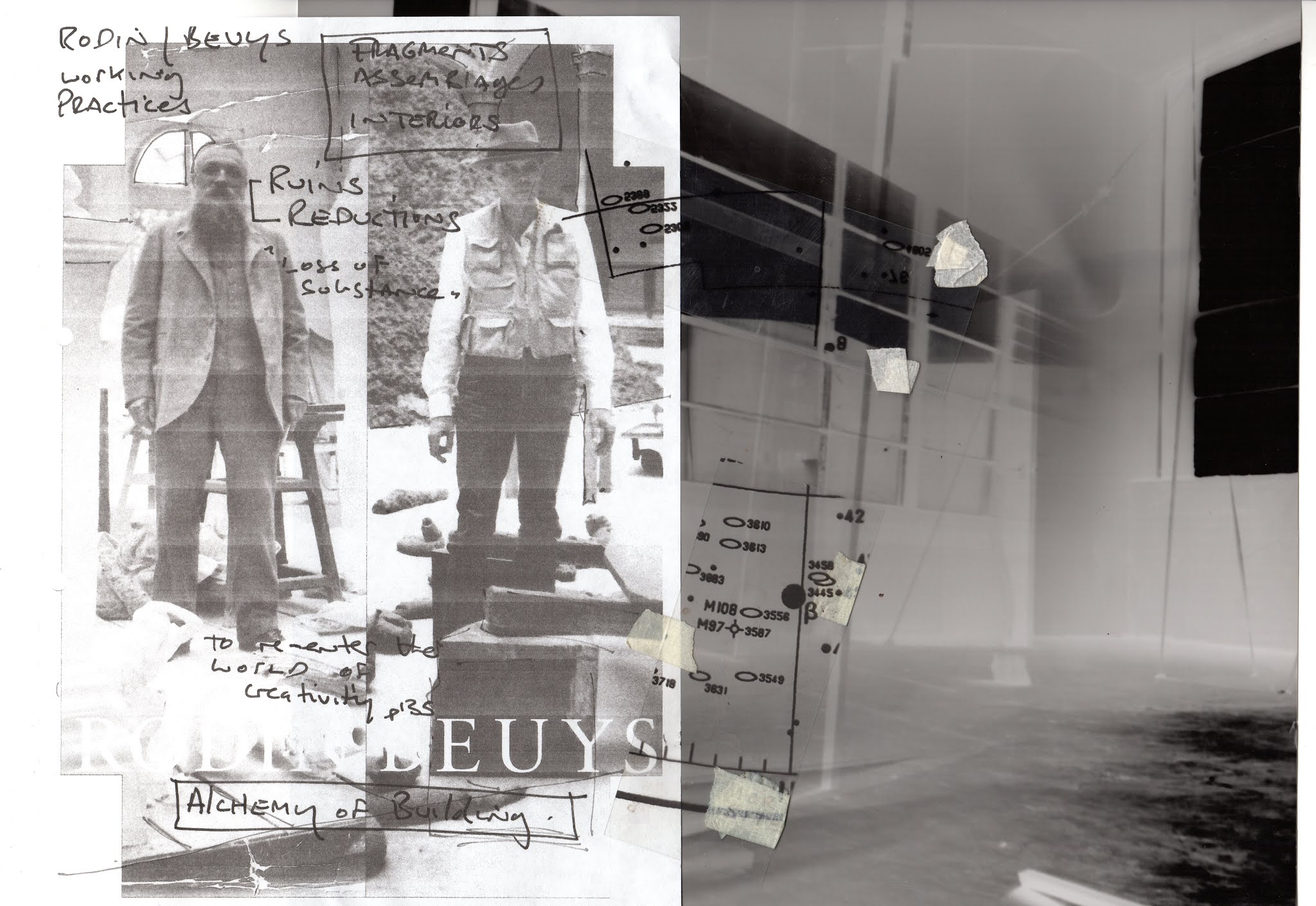
BEUYS-KLEIN-ROTHKO
ARCHITECTURAL LEXICON OF STRUCTURES AND SYMBOLS
WORKING NOTES 20 August 2018
Fragments/Thoughts CONSTELLATIONS NIGHT DRAWINGS
OUTPOST URBAN FROTTAGES/ Drawing Strategies
SCULPTURE TRAIL/ Minimalist, Post Modem, elements, assemblage, collage REFLEXIVITITY / AGENCY / POST STUDIO
Mobius Strip, experiential feedback into REAL LIFE / NOWNESS SEARCHING for creative anthropologies from the landscape.
ACTIVE and creative engagements. PERFORMATIVITY LANDSCAPES
SENSORY WALKS
USING the topology close to hand, the unique geographies of the rivers from source to sea.
The four together
I think these four should not be made to look like a chronological development. Their power is in the fact that each contains a different activity that the current practice can return to.
Older post Active body now
The Arts Trace → permeability
Lightness / Synthesis / Solitude Multiplicity → gathering
Time / Action / Diagram Kairos → futurity
Emotive Spatial Encounters Innerness → permeable chamber
And there is a really interesting movement across them:
Trace
↓
Gathering
↓
Movement / Kairos
↓
Interior / Atmosphere
↓
Clay
↓
Ceramic
↓
Permeable Chamber
↓
Futurity
But I wouldn't put that as a diagram explaining the archive. I think it is better understood as a wayfaring possibility through the archive.
The deeper speculative proposition
What I think is emerging from these four posts is that the current spatial practice may not simply be about making ceramic bodies spatial.
Spatiality is being discovered as a condition of correspondence between bodies.
The earlier work repeatedly approaches this through different media:
cyanotype allows material to seep beyond the traced body;
collage and montage allow fragments to occupy a shared field;
diagram allows temporal and spatial relations to remain in movement;
the vessel allows surface and interior to sense one another;
walking allows place and body to continually alter one another.
Clay now becomes a particularly intense site for all of these propositions because it can receive, resist, absorb, register, perforate, enclose, open and transform.
Then firing changes the proposition again.
The archive gathers the activities through which spatiality was already becoming perceptible: trace, movement, multiplicity, innerness, atmosphere and encounter. Clay does not resolve these bodies into form. It troubles them into correspondence.
The spatial practice was already there, dispersed across bodies. Clay became the place where they could touch.
That last sentence feels particularly close to what you are now calling In~~Touching.


