Showing posts with label affect. Show all posts

Tuesday, 23 June 2026

Primordial Memory/Dreaming/Making/Corporeality : Antony Gormley/Francesca Woodman/Bodies/movements of becoming.

Concept of the Body : Merleau-Ponty

Fundamental assumption that the body was not an object, the body is the condition and context through which I am able to have relations with objects. 

The mind in its insertion in (creating/becoming) corporeality creates the ambiguous relation with our body, and correlatively with perceived things/superimpositions/entanglements.

Understanding the material/body image in discursive terms


https://www.flickr.com/photos/russellmoreton/

The body generates and presumes interpretations, perspectives which serve its needs in the world, its will to power and its drive towards self expansion/self overcoming, the movement of becoming, vigorous, free, joyful activity. (Nietzsche)


Francesca Woodman explores the spatial relationship of the body in space and time.

These performative images and her relationship to the pictorial space, her body traces, are witnessed and further manipulated/annotated by drawn lines enclosing and creating other spaces.


Barad: Thinking with intra-action

There is an important sense in which practices of knowing cannot fully be claimed as human  practices,  not simply  because we use nonhuman  elements in  our practices but because knowing is a matter of part of the world making itself intelligible to another part. Practices of knowing and being are not isolable; they are mutually implicated. We don’t obtain  knowledge by  standing  outside the world; we know because we are of the world.  We are part of the world  in  its differential becoming.  The separation  of epistemology from ontology is a reverberation of a metaphysics that assumes an inher­ent difference between  human  and  nonhuman,  subject and  object,  mind  and  body, matter and discourse. Onto epistemology—the study of practices of knowing in being— is probably a better way to think about the kind of understanding that we need to come to terms with how specific interactions matter.

Karen Barad, Meeting the Universe Halfway: Quantum Physics and the Entanglement of Matter and Meaning (Durham: Duke University Press, 2007), 141.


Antony Gormley, states, that one of his central concerns has been to recover a sense of being in the conditions of today's increasingly materialist and mediated social environment. He uses sculpture, via the intimate process of the body cast, to construct surrogate forms, derived from an almost sacrificial process. A rehearsal of death of an absent body, recorded as an enclosed volume of air, entombed in a lead sarcophagus of fragmented body sections, soldered to reconstruct a new wholeness. He creates, within this sculptural volume, an “infinity of space within the body.” His works are embodiments of the body. They are literally body cases. The use of lead with its own alchemical and historical contexts and its particular non­ aesthetic further adds to the tomb like qualities of the work. 

Each sculpture invites occupation; it is complete when the imagination or the mind inhabits them.

Gormley’s body cases are almost orphans, cast adrift from their symbolic maternal mother. They have become shells; empty humanoid spaces, awaiting an identity in the mind of the post-modern witness. In return their identification identifies the witness. The experience of metaphysical inhabiting this surrogate human space might allow us to lose all sense of the present and our identity with ourselves. Gormley’s sculptures, with this lack of identity or questioning of identity with the space they are placed in, prompt a different mode of questioning the purpose of their presence. The viewer becomes more interrogatory, more concerned, almost asking the sculpture to confirm its placement, not its actual identity. We see in them something of ourselves, externalised for scrutiny, a dialogue of intervention caused by a bodily proximity to something unknown, which can compound meaning, or conversely it can fragment it. 


An investigation into a disembodied physicality, inducing elements of fetishism and narcissism, with the search for an identification of the feminine, within the confines of spaces, loaded with tactility, dust, dilapidation and decay?

Some of  Francesca Woodman’s work involves herself and female characters in staged film, feminised melodrama. Stills with an unknown and possibly convoluted narrative, together with ambiguous relationships amongst the characters. The images are shot as straight documentary stills and seem to be searching for the identity of the partially hidden women, as seen through the response and body language of the other characters facing us. These works are full of conceptual ambiguities.

Photographs are indexical; they point to something else; a mirror with a memory; a stage for an inquiry.

Francesca Woodman’s use of the camera’s ability to witness and document, is subverted into a personal language of aggressive tactility and the notion of the body’s identification being partially hidden or even lost; just its trace remains recorded in the latency of the camera’s recorded time.

Her work seems to have an inherent almost codified, femininity, probably due the semiotics and symbolism of early surrealist influences. She performs, re-enacts and exposes her body for the witnessing of the camera. She seems to, fleetingly, seduce and then disappear, just leaving a trace of her being, her sexuality and its actions, entrusted to the fragility of the light sensitive gelatin.

 (extracts from The Body, Francesca Woodman and Antony Gormley, WSA Russell Moreton 2006)


Reading The Landscape

This Enchanted Isle : Peter Woodcock 2000

Radio On by Chris Petit.

The film has a hallucinogenic noir-like quality, a weird hybrid of Fifties Americana and a displaced Britain. It is a seismographic disruption of British culture in a limbo land of displaced dreams, elements of an almost mythical Britain fleetingly appear.


What distinguishes Neo-Romanticism from traditional romanticism is the feeling of danger, the juxtaposition of the urban with the countryside, the element of darkness, dissolution, an almost pagan reverie breaking through the ruins of post-industrialism (Woodcock,2000:55)


England Dreaming : Primordial Memory/Dreaming

The darkness is a silent solid, the light etches its surface, it is simultaneously sign and cypher. The light etching itself on the dark surface is akin to a revelation, an epiphany before the building is transformed by its users and movement. (Daniel Libeskind)

The Drought : J G Ballard

The Tempest : Alchemy, Prospero.

The Neo-Romantic Vision from William Blake to the New Visionaries. 

‘A new alchemy is being formed which encompasses traditional methods of art, the new technology, and the revolutionary new scientific discoveries.’

Re-Enchanting the Land. (Woodcock,2000:140)

‘When one lacks outer space one creates inner space. Invention becomes more complex, cup and circle markings on stones, intricate Celtic spirals and knots, illuminated manuscripts, gothic architecture with its inherent story telling.’ (Woodcock,2000:131)

Throughout John Piper’s long and prolific life he remained fascinated not only with churches, country houses and landscapes but also ancient sites. He comments on the landscape of Snowdonia, each rock lying in the grass had a positive personality, for the first time I saw the bones and the structure and the lie of mountains, living with  them and climbing them as I was, lying on them in the sun and getting soaked with rain in their cloud cover and enclosed in their improbable, private rock-world in fog. Piper never dismissed the archaic spirit of place.  

(Woodcock,2000:31)


To take a picture is to have an interest in things as they are in the status quo remaining unchanged. It is to be in complicity with what makes a subject interesting.

Cameras consist of small voids, the ‘camera’, a lens and photographic film. They are camerae obscurae  that collect light and allow it to meet the surface of the film. But in fact the light comes from the larger void outside the camera. The moment the light has registered on the light-sensitive surface of the film, memories are constructed. The memory is literally conceived in this meeting and is added to life as an additional layer of being. The process through which void meets surface is therefore also about love—the love of ancestors and relatives, but also of life and its conception.

The camera records subjects considered disreputable, taboo and marginal. Sontag notes Times relentless passage and photographs as a pause of evidence, Together with the camera’s ability to turn people into objects that can be symbolically possessed. She recognizes the inherent pathos in .objects being photographed, and the compulsion to take photographs. Sontag realizes the photographic recycling of reality, acceptable as a daily activity in our consumer society. Photographs do not explain themselves, they just acknowledge.

Bibliography

Bachelard, Gaston, Psychoanalysis of fire, New York, Beacon press 1964 

Benjamin, George, Antony Gormley: critical mass, London, Royal Academy of the Arts 1998 

Curtis, Penelope, Sculpture in 20th Century Britain, Leeds, Henry Moore Institute 2003

Deneuve, Catherine, Bettina Rheims, Munchen, Schirmer-mosel, 1989 

Douglas, Mary, Purity and Danger, London, Ark Paperbacks, 1984 

Gormley, Antony, European Field, Museum of Modem Art, 1994 

Greenaway, Peter, The Physical self, Rotterdam, Museum-Boymans, 1992 

Israel, Deborah Turbeville: Wallflower, London, Quartet, 1978 

Karabelnik, Marianne, Stripped Bare, London, Merrell, 2004

Krauss, Rosalind, L ’Amour fou, New York, Abbeyville, 1985 

Moszynska, Anna, Antony Gormley Drawing, London, British Museum, 2002

Sollers, Philippe, Francesca Woodman, Paris, Foundation Cartier, 1998 

Solomon-Godeau, Abigail, Francesca Woodman, Photographic work, New York, Hunter College, 1996

Thewelt, Kllaus, Antony Gormley, Germany, Kerber Verlag, 1999 

Articles

Riches, Harriet, A disappearing Act; Francesca Woodman’s portrait of a reputation, Oxford Art Journal, 27.1 2004 95-113, Oxford university press

Rus, Eva, Surrealism and self-representation in the photography of Francesca Woodman, www.palazzoesposizioni.it/schede/woodman, 2004


Friday, 12 June 2026

Spatial Practices/An Affective Intensity~Agencement : Thinking Matter : Between Human/Spatial Relations

Outpost 261124


An Affective Intensity.

The juxtaposing volatility of abjecting spatial and human bodies.


Spatial Agency/Assemblages~Agencement in constant relational movement.


Abstracted-Diagrammatic-Inhabitations.


Expulsions from/for relational bodies.


A Provisional/Speculative Framework.

Tuschimi's Equation : A framework that sets out a logical outcome, but where the insertion of event introduces a deviation, a slippage from the planned/programmed outcome. Such that the 'architecture' is indeterminate.

Event=Space-Movement.


Creating Disjunction, superimposing assemblages of event/space/movement over(entangling) one another.


A Becoming Architecture.

To provoke potentials to occur.


Contracts (Architectural Transcripts), scripting spatial relations that utilise fictional scenarios in real spaces, are used as a way of working with temporal events.


Here architecture is pushed towards and over its limits to the point where it is no longer 'architecture' as we know it. But rather an architecture, an anticipation of an architecture (social construct) to come.


Immediate Architectural Intraventions.

Spatial Practice.

Thinking Matter : Between Human/Spatial Relations

WSA 2007-Outpost 2024


Real Space + Fictional 'Event'

The architectural origin of each 'episode' is found within a specific reality, and not in an abstract geometrical figure.

Tschumi.


Minoritarian Architecture/Deleuze.

They produce a type of labyrinth, with a momentary impossibility of escape.

They are architectures in a constant state of change, perpetually agitating the discipline's established norms.


Abject (ion) facilitates an affective intensity.

Art works (workings) made from an expelling human body in relations with spatial bodies.


Waiting Rooms

Soul Cages.

Black Books

Installations

Ceramic/Architectural Propositions


Zuzana Kovar.


Abject(ion) is a discussion of bodies of assemblages.


Abject events render a particular indeterminacy. There is an aim here through abject(ion) to re-purpose architectural methodologies in order to contemplate abject(ion) and specifically contemplate its dilution of boundaries between bodies. It is critical to reiterate that abject(ion) through its volatile and leaky nature inevitably comes to encompass more than one body.  


Material Markings/Inhabitation.


Life Drawings/Frottage/Graphite/Charcoal/Concrete.

Winchester Weeke Centre 2006.


Friday, 18 July 2025

Spatial Bodies/Visual Art Practices : Material Assemblages/Drawing : Cultivation Fields/Thinking Diffractively

Matter(s) of Inquiry : Abject(ion) Gathering Affective Energy.

Affective Formulation : Processual/Durational Material Flows/Mattering Matter(s).

Transitional Compositions and Events/Anti-Objects. 


‘We are composed of matter and live in the midst of matter. Our objective should not be to renounce matter, but to search for a form of matter other than objects. 

What that form is called-Architecture, Gardens, Technology- is not important.’
Kengo Kuma.


On Anti-Object : An extended essay that is not so much history or theory as a volume of self-assessment that gives an opportunity for the author to contextualise his own body of work through considered self-reflection.

‘A monument is a form that preserves time through the compression of space, a form in which visual perception is the parameter. A monument is a compression of time and space’ (Kuma,2008:92) Anti Object.

‘My purpose in writing this book is to criticise architecture that is self-centred and coercive.’ Kengo Kuma.

‘Like McTiernan or the theorist Paul Virilio, Kuma sees new digital and information technologies as leading us to an aesthetics of disappearance, rather than image or form.(Steele,2008:3)

‘My ultimate aim is to erase architecture’(Kuma,2008:3)
How then, can architecture be made to disappear?


Monday, 20 March 2023

Littoral Zones/Making Processes : Affect, an ecology of experience/Clay Work : Visceral Practices.

 Momentum Wheel : Lucie Rie Installation.

Clay/Ceramics as a concept to a way of thinking.

Speculative Tectonics : A Poetic of Construction.


The Clay can take to the mould and mould the clay.

Simondon, took the essence of matter or the material to lie in form-taking-activity.

Brian Massumi. 2009.


Clay Works --- In and Out of material : Clay plays the stone, the stone plays the clay

Tony Cragg


IN AND OUT OF MATERIAL


Demonstration


Tony Cragg : I basically mean the effectiveness of the object, of the material. But because the metaphysical and physical association are already occupied, I'm interested in somehow establishing some relationship with the materials and the things around me without using any preconceived notions of an already occupied language. It is a bit like taking away a Christian name and depersonalising something. What I mean is that it's an attempt on my side to restart the relationship with the material, which I think sculptors have to do anyway.


Jon Wood : Thinking of the increased awareness that this side of your work tries to capture and harness in the viewer, can you say a bit about the kind of sensitivities that you would like to be heightened? What would you see your work as demonstrations of and for? Your sculptures are triggers for what kind of thinking?


Tony Cragg : Well there is an attitude to looking at things and to looking at objects and materials which is based on a meditative tradition of contemplation : the universe in a grain of sand idea, or maybe even religious ideas where you actually get in contact on some level with the material world, on a deeper level than the one you obviously are capable of reaching in an everyday situation, so on an extraordinary level, outside of your own experiences.


I am not saying that that's not interesting or important. But I also think that this leaves the battleground for the everyday life to be governed by non-contemplative thought and non-meditative thought. And this may sound like a mixture of terms, but I think that there is a job to be done even on an everyday, “second for second” level of life—on the experiential level of life. I think there is a job to be done here improving the quality of contemplation about an awareness of the material world—the material world seen as an immediate extension of the communal social effort, the cultural effort that you are part of.


Jon Wood : How does it move from being an individual contemplative experience to being one that has a communal relevance?


Tony Cragg : In the main part it only has communal relevance. All you can do for yourself is formulate your sentences, cook yourself a meal that suits you, get dressed in a fashion that suits you, and everything else you have to put up with as having been made by other people for you. But obviously, even if they didn't ask your permission, there's something consensual about that, isn't there? Even though you don't like it, it doesn't look like you're making an effort to change it. And maybe there's some active thing there. My idea is that even if I don't like it, I wouldn't be able to change a great deal of it, but I could sow the seed for some change in the direction that I would feel would be important. It's a measure of how much responsibility one takes for the change. Looking for more in the visual world around me and looking for more language, in a sense, is one way of heightening sensibilities and expanding a vocabulary and then expanding the responses to a vocabulary is a way of heightening sensibilities. I'm not a politician, but I think we still live in a world that is greatly dominated by mesmerism and mystical models, which are very distracting because they actually stop us from really trying to face reality.


Realist Magic

Objects, Ontology,

Causality

Timothy Morton


Clay Work : Visceral Practices


https://www.flickr.com/photos/russellmoreton/

Pastoral Space: Material, Inquiry and Craft.

Longshore drift is a geographical process that consists of the transportation of sediments (clay, silt, sand and shingle) along a coast at an angle to the shoreline, which is dependent on prevailing wind direction, swash and backwash. 

This process occurs in the littoral zone, and in or close to the surf zone.


Material Agency : Carl Knappett, Lambros Malafouris

Visualising Environmental Agency.


"Agents are defined as persons or things, which have the ability and intention to "cause" something "in the vicinity" or "in the mileau" to happen ( Gell 1998)"

"These latter artefacts are described with the term "index", to remove the appellation "art" and to imply that they are indexes of agency."

Some Stimulating Solutions, Andrew Cochrane.


Tectonics in architecture is defined as "the science or art of construction, both in relation to use and artistic design." It refers not just to the "activity of making the materially requisite construction that answers certain needs, but rather to the activity that raises this construction to an art form." It is concerned with the modeling of material to bring the material into presence: from the physical into the meta-physical world.

http://dspace.mit.edu/handle/1721.1/78804


Situate them in such a way that useful space for life may form itself amidst them.

Kazimar Malevich 1924

Zaha Hadid on Malevich • BBC CH/4


Template and Form 2010.The Yard,Winchester.


Modern information theory claims that both the clay and the mould are engaged with matter and form. The clay is in a metastable state that possesses potential energy, unevenly distributed, but capable of effecting a metamorphosis. This quality of the clay is the source of its form. The mould places a limit on the expanding form of the molecular organisation of the clay as it fills the mould. The mould does not form the clay passively, but communicates a resonating action throughout the clay that alters the clay's molecular organisation.


Thursday, 27 October 2022

EMOTIVE SPATIAL ENCOUNTERS : Performativity/Unbounded Outcomes


MATERIAL and AFFECT

EMOTIVE SPATIAL ENCOUNTERS

RUINS and SUBJECTIVITY

Encounter with place through transpositions/re-deployment of materials/technologies and design.


The rules followed by medieval cathedral builders could not and did not prescribe their practice in every detail, but instead allowed scope for action to be precisely fine-tuned in relation to the exigencies of the situation at hand. The cathedral and the laboratory, MAKING, Tim Ingold

PATHS alert us to how we are scattered as well as affirmed by the places through which we move. Edward Thomas.


THE GEOGRAPHY OF WHAT HAPPENS: SPACE, POLITICS and AFFECT.

Nigel Thrift

VISUAL FINE ART / TRANSACTIVE through Digital Technologies POETIC / EVERYDAY ABSTRACTIONS

MAKING / MANIFESTING FORMS / STRANGE TOOLS

INDEXICAL / ITERATION ( new version, repetition, closer approximation, scrutiny, observations, sequence, finding a solution/perception to a problem)

UNBOUNDED OUTCOMES / ITERATION becomes the starting point of the next iteration PROGRESSION through PERFORMATIVITY

AGAINST SPACE

Making : anthropology, archaeology, art and architecture.

Tim Ingold

Immaterial architecture creation and contemplation artist and architect

The contemplation of art is primarily a form of visual awareness, of a single object by a single viewer, in which sound, smell and touch are as far as possible eradicated. Placed in a hermetic enclosure and protected against decay, the artwork is seen and not used. The viewer leaves no trace or mark because touch would undermine the artwork’s status as an idea and connect it to the material world.

To translate the drawing into the building requires an intimate knowledge of the techniques and materials of drawing and building.


ATMOSPHERES

THE EPIPHANY OF ARCHITECTURE

CIRCULATION, ENCLOSURES and their LIGHT


TOTAL ARCHITECTURE, Walter Gropius

TOTAL ART, Theo van Doesburg/DE STIJL


GESAMTKUNSTWERK, all embracing aesthetic, where art becomes architecture and architecture art. A synthesis, and revolving intersection where each medium exists at the service of formal innovation; a kind of essentialist discourse or tradition that might be buried in the past.

Brian Clarke, Nerves of Ecstasy by Robert C. Morgan, PACE 2013.


ARCHITECTURAL FORMS OF ENCOUNTER/DEBATE

HISTORIES, PHILOSOPHIES, AESTHETICS

Katsura Detached Palace. Kenzo Tange, Walter Gropius. 1960

(extended in a modular fashion and adapted to changing royal needs over the centuries)


Katsura consolidates all qualities in history but not in a creative way. Since it lacks in the strength of its unifying all members, its impression is lyricism but lacking unifying tension. KenzoTange


Ise : Prototype of Japanese Architecture. Kenzo Tange, Noboru Kawazoe. 1961

(Ise Shrine rebuilt every 20 years with new materials)

Ise Shrine manifests primate yet powerful, simple yet noble, and serene yet ecliptic qualities, which cannot help moving us. Tange


THE PRIMATIVE

JOMON POT, 2000 BCE, (Jomon period 14,000 BCE-300 BCE)

Jomon, (means Rope pattern) wildly decorated pottery, idols, and thatched pit dwellings. The style comes to stand for the savage and dynamic.

Jomon appeals to us with the flooding energy of the fundamental life of the people. It has a resilient strength and a sense of mass, which comes out of through their wild battles with nature: it also has a free and agile sensitivity. Kenzo Tange


THE ARISTOCRATIC

YAYOI EARTHENWARE, 350 AD, (Yayoi period 300 BCE-250 BCE)

In the Yayoi period, earthenware becomes more refined, and structures like granaries are raised on stilts, building developments reflect the emergence of social hierarchies.

In Yayoi, man and nature are synthesized to create a calm lyricism, acknowledging nature’s blessings. A passive attitude, submitting to the surroundings prevails. A flat equilibrium and quiet balance with no dynamism are left in a transient mood.

Kenzo Tange is originally drawn to the Yayoi style, but starts to oscillate with the Jomon style in the late ‘50s’ For Tange and the future Metabolists there is no conflict in their simultaneous study of tradition and modernism. Tange insists on exploiting tradition as a means of innovation, while building prolifically in a modern mode and strategizing the high-tech avant-garde of Metabolism.


There’s more truth about a camp than a house. Planning laws need not worry the improvised builder because temporary structures are more beautiful anyway, and you don’t need permission for them. There’s more truth about a camp because that is the position we are in. The house represents what we ourselves would like to be on earth: permanent, rooted, here for eternity. But a camp represents the true reality of things: we’re just passing through.

Wildwood, A Journey Through Trees. Roger Deakin.2007


PAO, a structure that you can repeatedly put up and dismantle. Because of occupant’s nomadic life, it needed to be lightweight, and be able to be built very quickly and have the ability to be taken apart and re-built many times. Even materials that have already been used can be reused so long as they are disassembled correctly and preserved properly.

To maximize the reuse of components one needs to standardize them so they can be pre-fabricated. The order of construction becomes important as it influences the disassembling of the structure; the technical features of joints, assemblages of materials and their localities can become both conceptual to the experience of the space and its architectonics and to the actual innovative building process.

In the Mesopotamia city of Ur, they bricked over houses buried in the mud and built new houses in the same spot over and over. Its been learned that they repeated this eight times. There was apparently a very strong impulse to create an eternal building.

Kiyonori Kikutake


Rem Koolhaas

SO THE MUD HOUSE BECAME THE RENAISSANCE AND THE TENT BECAME METABOLOLISM?

Kiyonori Kikutake

YES, IT BECAME A METABOLIST STRUCTURE MADE OF WOOD. AND I THINK THE NOTION OF ATTAINING ETERNITY WITH A MUD HOUSE-OR ATTEMPTING TO-IS REALLY FASCINATING.


In The Making : Hollowing out Space through Innerness and Difference. 

Quietus : Interiors of Silence and Space.

Innerness : A (sensorial) space or even a place interior to its environment. 

Sensing Spaces : Through displacements and hidden volumes.

Defined Interiors : By material, agency and social and private architectures. 

Interiors of Pots : Analogies with the Hut as both being dwelling places made from the inquiry of form and the need for a reflective solitude. Fragment as a broken shard, from notebook March 2014.


Innerness

The light of reflection and our immediacy moves from light to dark and from dark to light; from surface to interior and interior to surface. The pot becomes a cyclical vessel reflecting our geocentric origins.

The Hut is a vessel in the making for reflective dwelling.

The Pot with its interior underpins its fidelity, its completeness.

Some pots are tuned and balanced for their “innerness”; others promote their surfaces (noise) at the expense of their interior integrity (quietness).

Vessels of Defined Spaces : Creatures of Light and Dark


In sensing a pots interior from its surface, we are as it were in some intimate tacit correspondence with its spatial sensing centre. We become known to it through its maker’s creative gesture of innerness. This anthropological inner space linking us to the potter is both sensual and distant; its vacancy allows us dwell in the maker’s absence.

Reflections on Heidegger,

We traverse from light to dark many times as we gather in the pots (thingness) as it were unfolding in our presence (nearness).

Vessels as Spatial Metaphors around Innerness and Difference. 

The Jar


Heidegger as a pouring and gathering social metaphor. Anecdote of the Jar.

Dominion over the Unmade.

Wallace Stevens, poem cited by Edmund de Waal.

WORKING at the transitional surface/stage in the HUMANITIES as it re-boots itself into THE POSTMODERN.

A SOMATIC ARCHIVE, of subjectivities whose perceptions and environments are going to change forever; like the particularities of the analogue trace in photography that is now becoming a distant experiential condition, an orphan extinct from the subjectivities of its originating culture/organism.

The imagination and process aesthetic of the Posthuman Condition 


A Theoretical and Semantic search amongst Ruins and Archetypes 

Historical Perspectives

Dwelling/Poetics Heidegger Archetypes/Symbols Jung

Flesh and Stone, Richard Sennett

Flesh and The Logic of Sensation, Deleuze/Bacon 

Feminist Geographies The Posthuman

Posthuman thought inscribes the contemporary subject in the conditions of its own historicity.

Posthuman Subjectivity : Rosi Braidotti 

LIGHT into SOMANTIC SPACES

Continuum and Chora (light and the shadow of chora)

Life expresses itself in a multiplicity of empirical act: there is nothing to say, but everything to do. Life, simply by being life, expresses itself by actualiizing flows of energies, through codes of vital information across complex somatic, cultural and technologically networked systems. (Braidotti, 2013:190)

De Architectura, Vitruvius

Architecture consists of order, arrangement, proportion or eurythmy, symmetry and decor, and distribution.

Arrangement as an “Idea” refers to the Aristotelian notion of “Image­ representation” as phaantasia a precondition to drawing, effectively occupying and revealing a space between Being and becoming.


INTERIOR DESIGN UCA FARNHAM

DESIGN AND RESEARCH PROJECT 2015 SPACE BETWEEN PEOPLE.


SITE-PLACE-DIALOGUES

THE RUINED ABBEY, stands as architectural remnants of a pastoral community now set in parkland and open to the public as a site for recreation.

The Abbey and its experiential values and feelings have been employed as both a reality of a lived experience and as a virtual diffractive site for thinking through contemporary issues in arts (relational aesthetics), and architectural design through exploratory spatial inquires with the specifics of place studies.

What this project is not

Gift Shop and Visitors Centre What this project might become

Proposal for a symposium,

Personal Structures, artists and writers talk about “Time, Space and Existence”. Setting for an exhibition that can promote the symposium.

A room containing a virtual work of design that challenges and opens up the physical architecture.

A design for a interactive (mobile) component, a structure that can act as an interlocutory apparatus in the transposition of the phenomena of place.

Building Partitioning of Space.

Architectures as atmospheres that promote the contents and support the interaction of things including humans.

Design as a tool of transposition, of layering and collaging different spatial values both cultural and experiential.

Painting Subjectivities, matter drawn and crafted from site inquiry.

LIGHT VALUES

The Transmission of Light,

Instantaneous psychological effect that stimulates the senses. The Specificity of Colour

Synergistically working with place and symbolizing abstract concepts and thoughts.

Humans use colour in their surroundings for decorative purposes or to chronicle their every day lives and other important events.

Earthy, Corporeal, Spiritual, Pastoral. Capricious.

Colour has always been used symbolically, whether pained directly on the body or worn in garments to announce the wearers’ social status, their tribe or country’ or other significant group.

The Abbey, On-Site (qualitative research with stained glass samples) Analogous Colour Fields with Monochromatic Features, utilise complementary colours or forms to focus the difference and diversity of the design installation.

Red, Flashed Ruby glass.

Brown is the ultimate earth colour associated with a “durability” of terra-cotta, clay.

Amber, Light, Medium and Dark. Yellow, Orange, Imagination/Enlightenment, Intensity, Sunlight.

Purple, Red/Blue, Spirituality, New Age, Cutting Edge Technologies. Diversity, Complexity, Artistry, Uniqueness.


THE ABBEY AND THE CISTERCIAN ORDER

THE PHENOMENOLOGY OF CONSTRUCTION : Caruso St John

HISTORY IS THE RAW MATERIAL OF ARCHITECTURE. Aldo Rossi


TRADITION AND MODERNISM

CONTINUITY-LEGACY-TOWARDS AN ONTOLOGY OF CONSTRUCTION


Today the nuances of language that make up these architectures only exist as an intellectual discourse and do not operate at the emotional level that would have engaged the original inhabitants, or audiences of these buildings. And yet we are still emotionally affected by these structures. Denied access to the specific culture of their iconography. We respond, at a more visceral level, to the more general culture of their construction.

Adam Caruso on the medieval ruins of Fountains Abbey, Yorkshire.

Towards an Ontology of Construction, Knitting Weaving Pressing. 2002

Thinking with Walking/Paths/Huts

WALKING was a means of personal myth-making, but it also shaped his everyday longings; Edward Thomas not only thought on paths and of them, but also with them.

The Old Ways, A Journey on Foot. Robert Macfarlene


ON REFLECTION

What do I know when I am in this place that I can know nowhere else?

What does this place know of me that I cannot know of myself?

For Edward Thomas, paths connected real places but they also led out-wards to metaphysics, backwards to history and inward to the self. These traverses-between the conceptual, the spectral and the personal occur often without signage in his writing, and are among its most characteristic events.

HE IMAGINED HIMSELF IN TOPOGRAPHICAL TERMS


HEIDEGGER’S HUT

A TOPOLOGY OF BEING, PLACE, WORLD. Jeff Malpas


METHODOLOGIES OF DESIGN

GESALT, GRISAILLE, LEITMOTIF, MATRIX, FORMAL PATTERN, SURFACE


VISITORS : A film by Godfrey Reggio

MEANING IN THE FORM OF THE FILM

THE ACTIVITY OF PERCEPTION

We have art so that we may not perish by the truth. Friedrich Nietzsche


SENSORIUM AND STILLNESS, MOVEMENT AND MIRROR

A MIRROR ON WHAT IT IS TO BE HUMAN


THE RECIPROCAL GAZE :

The screen is gazing at us; we are framed by our own looking. A direct relationship (what the image tells me); a singularity held by the vivacity of the image, through the activity of perception and introspection.

THE SPECTATOR MAKES THE JOURNEY into the PREMORDIAL IMAGINATION OF THE CAMERA.

CONCRETE PHOTOGRAPHY, PHOTOGRAMS, IMPRESSIONS, TRACES


THE SENSATE AND THE CONCEPTUAL

PAINTING, Robert Mangold.

TRANSFORMATION AND PROPHECY

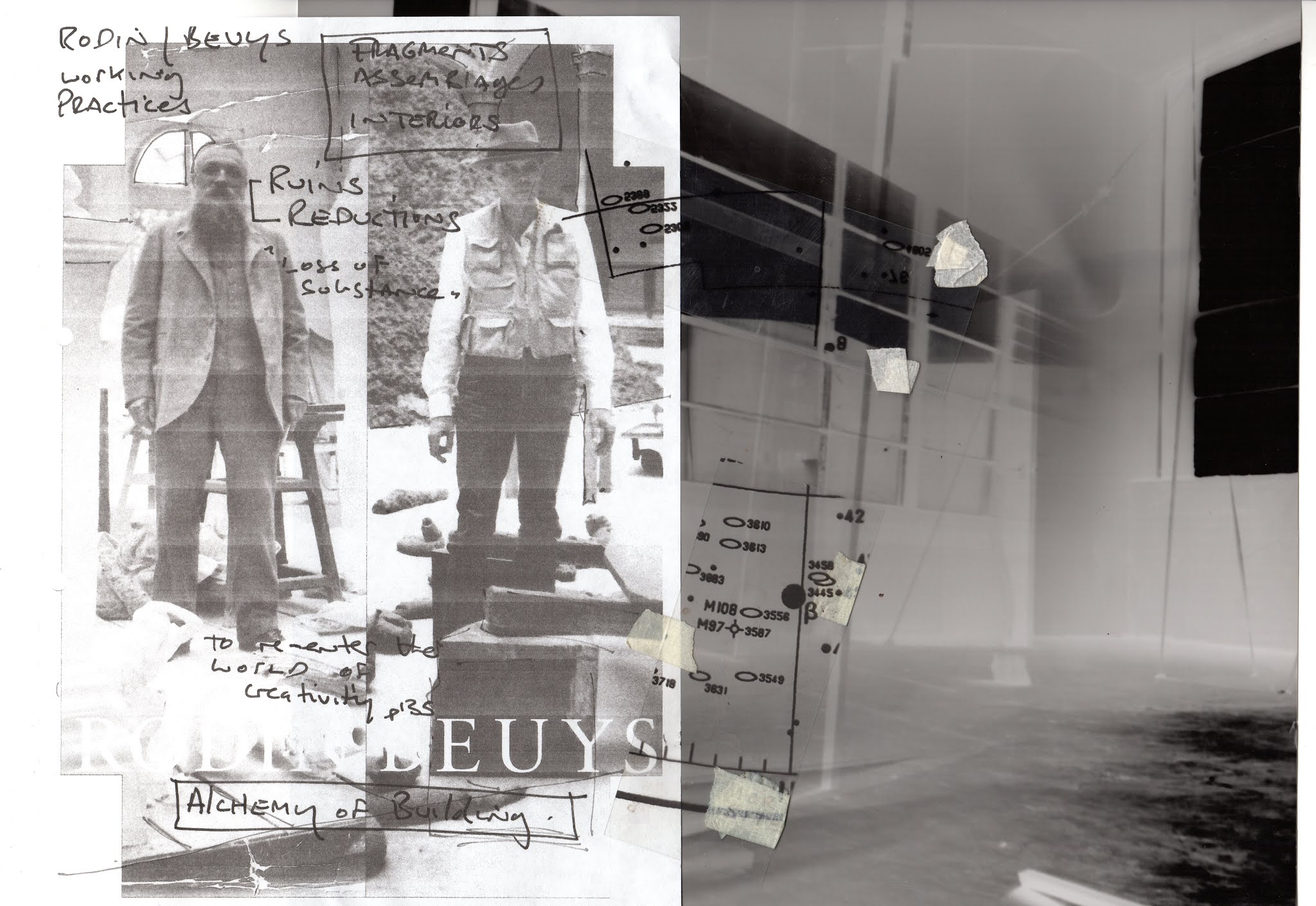
BEUYS-KLEIN-ROTHKO

ARCHITECTURAL LEXICON OF STRUCTURES AND SYMBOLS


WORKING NOTES 20 August 2018

Fragments/Thoughts CONSTELLATIONS NIGHT DRAWINGS

OUTPOST URBAN FROTTAGES/ Drawing Strategies


SCULPTURE TRAIL/ Minimalist, Post Modem, elements, assemblage, collage REFLEXIVITITY / AGENCY / POST STUDIO


Mobius Strip, experiential feedback into REAL LIFE / NOWNESS SEARCHING for creative anthropologies from the landscape.

ACTIVE and creative engagements. PERFORMATIVITY LANDSCAPES

SENSORY WALKS

USING the topology close to hand, the unique geographies of the rivers from source to sea.