
Pastoral Space: Material,Inquiry and Craft.#3, a photo by Russell Moreton on Flickr.

Blueprint from pinhole camera, Bramdean, Hampshire.
Hermann Hesse, Poems.
W. G. Sebald, After Nature.
Harleston, Norfolk.


Russell Moreton
Drawing around the body, 2010 Pencil,cyanotype and ink on paper with astronomical data.
https://independent.academia.edu/RussellMoreton


Practitioner using the creative receptiveness of material together with the inclusion of drawing to harbour transits and passages of human presence, vulnerabilities centred around the human condition. My work adopts strategies which articulate a sense of absence and anonymity within the abandonment of the work to its location. I feel drawn to this registering of passage, encounter together with its farewell. The choice of materials gathered together implies a personal geography, with both an emotional and aesthetic sense of locality and place. The performative recording by physical means which renders itself as a trace of human presence, now becomes a vacant territory open for the consideration of others.
My work continues to investigate this sense of material response with the performative trace of a human absences. The place-ment of these acts attempts to promote thresholds from which to reflect upon spatial, sociological and psychological conditions and perceptions.
Currently working in clay, low fired to produce and promote a fragile vessel. This vessel is installed to act as a dwelling presence reverberating in a resting place. from which work is drawn into the human form to register a surface of absences resulting from past gestures and solitudes
Order and randomness, meticulousness and impulsiveness, drawing excess and graphic reduction are just some of the vibrant, tension-loaded poles that characterize the large-format drawings of the German artist Jorinde Voigt (b. 1977).
Her works condense various elements of the cultural environment in the dynamic sequences of strokes, turbulently curving lines, diagrammatic structures, numbers, word fragments and collaged color areas of her drawings – which the passionate cello player refers to as “scores” or “notations”. She systematically analyses pop songs or pieces of classical music, kisses, temperature profiles, an eagle’s flight-path, horizon lines or the color values of individual plants and the contents of philosophical texts. Voigt uses measureable parameters like place, time, or sound volume, and self-defined rules or selected algorithms, and combines these fragments and impressions of reality to produce dynamic relational structures, thus creating a polyphony of different ways of perceiving the world.
Jorinde Voigt’s largest solo exhibition to date – which builds a bridge from her early notations, reminiscent of classical conceptual art, to her most recent works that reflect the human desire to fly – traces the development of the specific system of symbols the artist uses to document and orchestrate processes of perception, imagination and thought.
Curator: Stephanie Damianitsch
Russell Moreton a visual artist uses simple gestures of drawn Human traces gathered and presented amongst natural materials. Exploring themes around the Human condition, vulnerability and abandonment. Materials are employed to further underpin our sense of place and time. The act and gesture of drawing adds a ephemeral mark amongst the materiality and locality of place. Currently using clay to register these themes, installing work Augury Vessel 2010 into Chapel Arts as part of their research residency programme.


Outpost 210121
Light : The Other Architecture


Painters have expanded upon a vision of light as vibrating particles and oscillations, conveyed through radiant pigments and a textured impasto lain on with brushwork. The grainy and colourful light they composed is never static, reflecting knowledge that light is like nothing else that enters our world, seeming to never come to rest and always in motion.
Even in the figural pictures of Edward Hopper, we find a light free of the objects with which it mingles.
Whether as a wave of sun spreading over the land, or a sunbeam piercing a dark room. Hopper made the light around the people he painted an evanescent force with which they commune, and seems to be saying that these simple encounters might help to soothe the existential loneliness of the modern citizen.
Henry Plummer, 2009.
For Philippe Dubois, the frame of the photography does not merely contain an imaged field, but is like a cutting device which is inflicted on the subject under the camera's gaze.
Unlike the constructive formation of the act of painting, in which detail is built up to fit within its pre-existing and limiting frame, the photograph depends on the coupe: its image is not produced, but deduced, cut out from its surroundings, in a reductive act of soustraction, of decoupage, of sampling, detachment and isolation.
Mary Sabbatino reads Mendieta's placement of the glass on her skin as a radical adjustment of the 'classic window in modernism', as the artist used the device to direct the spectatorial gaze onto her body.
Collapsing onto the flesh the window through which the ideally disembodied modernist gaze is controlled and tamed, Mendieta drew attention to the conditions of viewing in which the spectator is embroiled, elucidating the gaze here as one that fragments its object.
Skin, Surface and Subjectivity,
Glass : Modernist framing device directing the a spectatorial gaze/Photographic act of a cutting process inflicted on the subject under the cameras gaze.
Filtered Light :
Using the terms of the medium, to draw attention.
The positive image is produced out of absence, by the shadow cast on the surface of the negative.
A space haunted by the feminine absence and often naked, faceless, blurred and decapitated by the image's framing within the photographic process.
Her body and its framing of/by violence of the processes of negative to positive are implicit in her constant use of serial imagery and repeated motifs.
Bodies in space/Spatial Practice/Agency.
Spatial Theory, Triads, Thinking, Making, Being Seen, Others.
Architectural Body : Skin, Surface and Subjectivity.
Tactility (Entangled intertwining of vision and movement ) depends on the skin rather than the eye.
The act of viewing becomes its own adventure.
Attenuated moments (actualities), instances, periods between things.
The spatial representations of Francesca Woodman and Gordon Matta-Clark.
The artist's book, reading, re-reading and reacting to the existing pages, texts and time.
Art book/the forgotten book as an example of a micro, instance of the larger spatial practice, activated through the performance of the body, hands taping the pictures, thumbing through pages and writing annotations.
The concept of seeing the seeing is a synthesis of the artist's body and viewers bodies in space together.
Outpost 130122


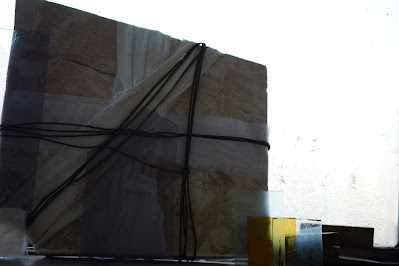

Studio Table
Filtered Light Reader
Architectural Light : Diffractions through Movement
Apparatuses, devices mediating natural/filtered light within spatial settings
On The Nature of Daylight
We Japanese fit additional canopies or verandas outside rooms that the rays of the sun in any case penetrate only with difficulty.
This is to keep out even more light and ensure that only a diffuse reflection can steal in from the garden through the paper windows.
So the aesthetic element in our rooms is nothing other that this indirect, dim lighting effect.
In Praise of Shadow, Tanizaki Jun'chiro.
Light made material
Kunsthaus Bregenz
Panes of toughened safety glass (2x10mm white glass, 4xPVB film), etched on one side.
Peter Zumthor.
Diaphanous : Translucent Materials/Membranes
Glass
Plastic
Metals
The Architecture Of Light
Recent approaches to designing with natural light.
Mary Ann Steane.
Examines how architects handle the relationship between light, material and the occupation of space, looking closely at the way in which these factors affect perception of and attunement to the visual environment.
The Architecture of Natural Light
Henry Plummer
The Other Architecture
Constructing metaphysical space
The beholding of light is itself a more excellent and a fairer thing than all the uses of it.
Francis Bacon, 1561-1626.
The Architecturally Sensitive Glass Works of Bernard Huber
Suzanne Beeh-Lustenberger
Gerhard Richter : Zufall, 748 5 RIC
Cologne Cathedral/South Transept Window
Glass Fields and Chance
How can arbitrariness be challenged?
By taking chance as the guiding principle in composing the colour fields, and thus employing one of the 'representatives of the real' as a partner in the production of the work.
The question, what is being 'moved' here?
Richter sets in motion a 'switch point' between decidable and undecidable, between controllable and uncontrollable; an in between point, a neither, nor, an exchange.
Chance as an intelligent object.
Chance is a trigger of movement, it produces an interval between starting point and destination.
The Spaces Between : Graphic Works on Glass
Myriam Wierschowski
Veils : Concealing and Opening
Reinhard Lambert Auer
Antique handblown glass samples and cullet
Bernhard Hubert
Glass : Transition-Glasprojekte
Architectural Movements into Light and Dark
Verena Krieger
Work on the Border- Transition of Space
Bernhard Huber's Light Room Installations with and without Glass
There are therefore two polar characteristics at the same time here, and you can see with the preliminary work of the artist that he experimented between these poles.
On one side there is a logically formal strictness and on the other the loose dynamics of apparent arbitrariness. Both together produce in their exciting simultaneousness the aesthetic charm of the glass roof installation.
Dawson Books Ltd/The Bertram Group
Sowing the seeds of knowledge
Not for resale
Books for educational use only
Work
Brian Clarke
6 Volume edition with slipcase
12.42 Kg


