Showing posts with label cyanotype. Show all posts

Sunday, 21 June 2026

Biosphere/Archipelago : Sun Drawing/Cyanotype/Spheres of Activity

Bioscleave/Blue Particle Cloud/Diagram.

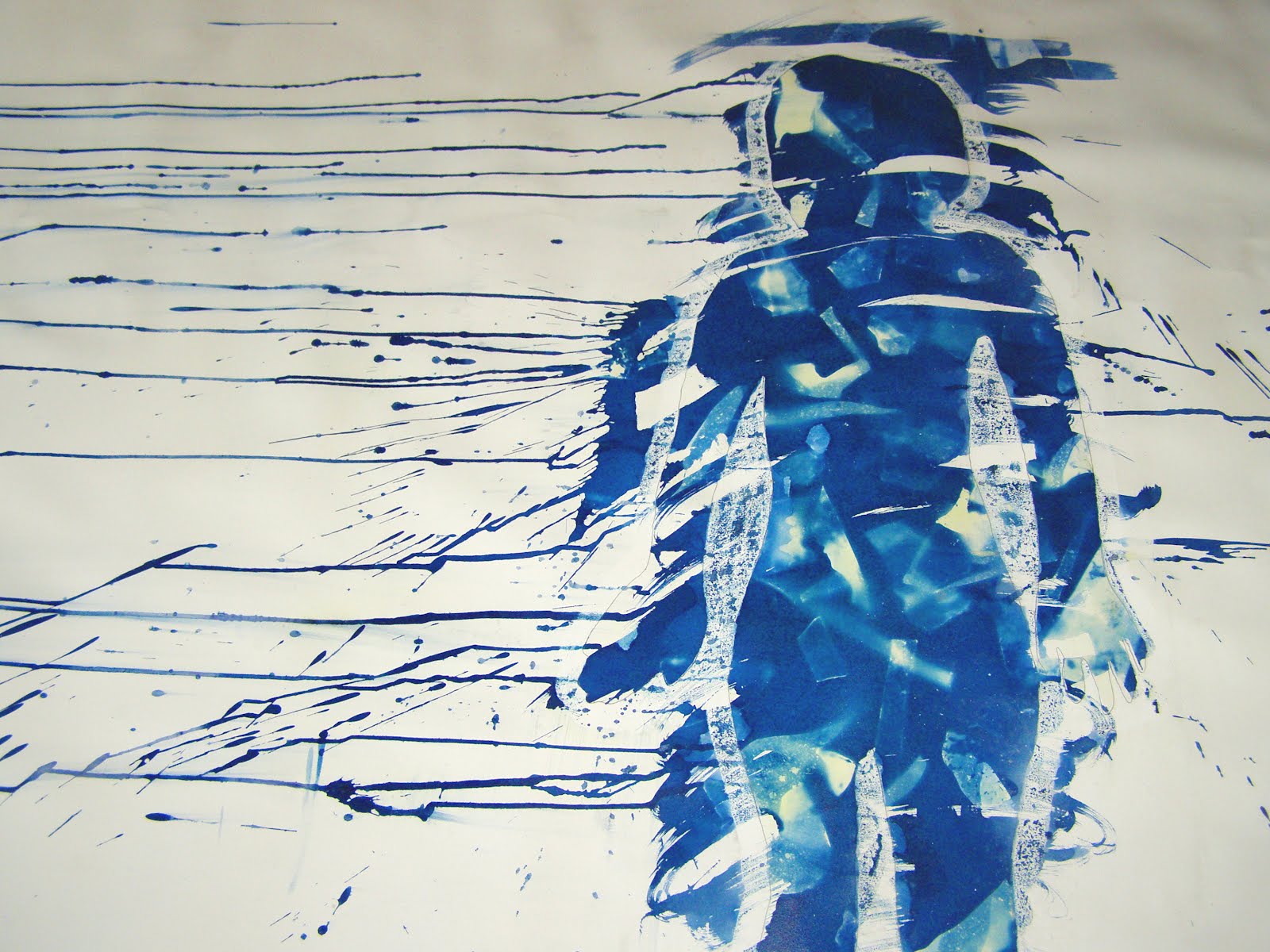
Biosphere/Archipelago : Sun Drawing/Cyanotype


The sun has gone mad and stripped the earth of its ionosphere. For decades blasting radiation has poured upon earth, melting the polar caps and turning permafrost into streams, rivers, oceans. Huge deltas have been built, lakes formed, seas have risen.

The Drowned World, JG Ballard.

blueprints, cyanotype, alternative printing processes, light drawings, 

precision and indeterminacy, human form, ecology, 

environments, contemporary art practice


ARCHITECTURAL Body

An ORGANISM that PERSONS

Gins and Arakawa 2002


Although the human condition is a crisis condition if ever there was one, few individuals and societies act with the dispatch a state of emergency requires. The fact that the human condition is a crises condition gets routinely covered up, with culture invariably functioning to obscure how dire the condition is and to float it as bearable


If organisms form themselves as persons by uptaking the environment, then they involve not only bodies but domains, spheres of activity and influence


Start by thinking of architecture as a tentative constructing toward a holding in place. Architecture's holding in place occurs within and as part of a prevailing atmospheric condition that others routinely call biosphere but which we, feeling the need to stress its dynamic nature, have renamed bioscleave

Procedural Architecture/Architectural Body

Gins and Arakawa


The role of architecture as a tool for researching the body-environment towards the implementation of these considerations is paramount

The goal of an experimental teaching and learning space based on architectural procedures would be that the process of design and construction would allow students/staff to rethink, re-imagine and enact the curriculum

An Arakawa and Gins Experimental Teaching Space/A Feasibility Study 2013

Jondi Keane


Contexts:

Practice-based research , Research , Studio practice

Artforms:

Painting , Mixed media , Drawing

Tags:

Bioscleave, Architectural Research, Arakawa and Gins, 

cyanotype, diagram, collage, texts, current concerns, contemporary practice


Cyanotype from a site drawing, Space for Peace, Winchester Cathedral


Shroud

Richard Stillman

Yard and Metre Event, Winchester


As the marks resonated, did they sound true?

Could we tolerate margins of error or latitude?

Is there strength in that built by blue ink?

It is hard to see without certainty.


Why have they flown, gathered, shrouded?

Is the date significant? A memorial?

Or is it white noise reverberating,

striking parallels, refusing focus, insisting?


The shape of the cross is still distinct

but opening out, refusing definition,

never quite caught as an intention,

pinned on dimensions it wants to refuse.


When objects or atmospheres collide energy is transferred, a new force may be created. And, as forensic scientists can attest, when objects touch they exchange traces, each leaves something of itself with the other.

This is why artists enjoy collaborating. Working with another artist can give a jolt of inspiration, a spark of creative thinking, a surge of new skill, the stimulus for a new work. And the experience will leave its mark in some way on each individual’s practice.

The specific ‘collision’ may also result in a work which has its own integrity, which does not belong’ to either party and where their particular contributions merge indistinguishably - in effect fusion takes place.

This is the thinking behind 10 days | Creative Collisions and for The Yard artists and Hyde Writers it was the ideal excuse to come together, to let the shockwaves flow and see what new possibilities emerged. As with all the best creative practice, in science or in art, this has been an experiment, it involved risk, trust and open minds. Whether or not the outcomes are fully resolved they will be filled with potential - and with potency.

Stephen Boyce


Contexts:

Arts in health , Community , Publication , Socially Engaged , Writing

Artforms:

Painting , Performance , Photography , Printmaking , Text

Tags:

Space for Peace, 10 Days, Creative Collisions, Winchester Yard Artists, 

Hyde Writers, collaborations. visual art, poetry

Sunday, 14 June 2026

Spatial Bodies : Visual Art Materialisms~Processual Workings


Drawing iterations into the ritual body~site~time

Body Assemblage/Diffracted Material #1-3 : Composition~Dissolution

https://www.flickr.com/photos/russellmoreton/

https://russellmoreton.tumblr.com

Artist's Statement. 2012

UK based visual fine artist working in alternative photographic processes, installation and drawing. Interested in using "Spatial Practices" to inquire into architectural space through fine art and performative interventions. Practicing craftsman in architectural glass and ceramics.

Russell Moreton, Winchester. 


Friday, 27 March 2026

Littoral Environments : Arts and Subjectivity (the making of things)

Text Extract/Inclusion. "Pure Presence"

The enchantment of modern life: attachments, crossings, and ethics : Jane Bennett 2001.

It is a commonplace that the modern world cannot be experienced as enchanted--that the very concept of enchantment belongs to past ages of superstition. Jane Bennett challenges that view. She seeks to rehabilitate enchantment, showing not only how it is still possible to experience genuine wonder, but how such experience is crucial to motivating ethical behavior. A creative blend of political theory, philosophy, and literary studies, this book is a powerful and innovative contribution to an emerging interdisciplinary conversation about the deep connections between ethics, aesthetics, and politics.

As Bennett describes it, enchantment is a sense of openness to the unusual, the captivating, and the disturbing in everyday life. She guides us through a wide and often surprising range of sources of enchantment, showing that we can still find enchantment in nature, for example, but also in such unexpected places as modern technology, advertising, and even bureaucracy. She then explains how everyday moments of enchantment can be cultivated to build an ethics of generosity, stimulating the emotional energy and honing the perceptual refinement necessary to follow moral codes. Throughout, Bennett draws on thinkers and writers as diverse as Kant, Schiller, Thoreau, Kafka, Marx, Weber, Adorno, and Deleuze. With its range and daring, The Enchantment of Modern Life is a provocative challenge to the centuries-old ''narrative of disenchantment,'' one that presents a new ''alter-tale'' that discloses our profound attachment to the human and nonhuman world.


The making of things and discovering relationships.

Constructing site and situation based methodologies.

Playing out in the public realm, exploring through spatial engagements the "virtues" of courage, caution, confidence and risk.

Friday, 23 May 2025

Shadows Gathering around Objects, Causality, Art Ontologies : Correspondences in Drawing/Watching/Walking/Reading.


Outpost 071022


The Quadruple Object.

There are two kinds of objects and two kinds of qualities, real and sensual in both cases.

Real objects and qualities exist in their own right, while sensual objects and qualities exist only as the correlate of some real object, whether human or otherwise.


I am not saying that a work of Art reveals the secret of life and being to us.

A work of Art affords the peculiar pleasure, an aesthetic performance in which the inwardness of things, their executant reality is opened to us.

Ortega.


Giacometti.

Created a visual lexicon of nothingness and being, of community and isolation.

Making fleeting visions, interactions between the modelling object and the space within which it exists. Concentrating, extracting a female nude from the atmosphere of a city, creating a space that oscillated with their shared community and isolation.


There is no direct knowledge of anything only relations-on-knowledge.


The real object withdraws inaccessible from the scene, as the new object generated by metaphor takes over the situation.


The real objects at stake in aesthetics are ourselves.


It would be more accurate to say that in Art the part of the image which looks towards the object is always subordinated to our efforts, because as basically Thespian beings we become the new object generated by metaphor.


Object-Oriented Ontology.

A New Theory of Everything.

Graham Harman. 2018


Aesthetics Is The Root Of All Philosophy.


Robert Mangold.


Creating a new mysterious real object with new sensual qualities.


Compound Objects

Assemblages

The Quadruple Object.


Since objects cannot exist without qualities and vice versa, there are only four possible combinations.


In Object-Oriented Ontology real-sensual objects and qualities always come together.


Object Relations

Potentiality/Receptivity

The Theatricality of Metaphor.


Art makes explicit the tension between qualities that are experienced in the real/sensual object.


I myself am the sole real object in all experience, encountering any number of sensual things.


Every objective image, on entering or leaving our consciousness produces a subjective reaction.


Art is primarily theatrical in nature, since the spectator becomes a sort of 'method actor' a theatrical actor acting out the structure of metaphor. 


Ortega, An Essay in Esthetics By Way of a Preface. 


Ontology is the branch of philosophy that deals with ultimate questions of what reality and real things are.


Bruno Latour, defines modernism as the view that there are two permanently distinct kingdoms, known as nature and culture and that it is the task of modernity, to purify these two domains from each other.


Metaphor is not knowledge about a pre-existing object, rather it  brings about the production of a new object.


All we are saying is that the real object at stake in metaphor is neither the absent cypress-object to which we never gain direct access, nor the human being who takes note of it. But rather the new amalgamated reality formed from the reader who poses as a cypress-object and the qualities of the flame.


The successful metaphor much like the successful joke, will occur only when the reader or auditor is sincerely deployed in living it.


The metaphor is theatrical, in the same sense as one is living one's role on stage.


Saturday, 5 April 2025

Objects and Traces/Map Reading : Visual Archaeology/Anthropology in Social Space

The map fosters interpretation and exploration

Inseparable Attendant : Place and Process

Assemblage and blueprint : Site drawing/Leper Graves

Drawing figure/ground, documentation of work in progress.

Life "drawing" trace on paper with water and field chalk. Work submitted to Interfaith Group Show at the Link Gallery, Winchester 2010.

"This particular event invokes for me the notion of simple material relations and collaborative gestures that underpin human agency. Art space/practice can promote these working intimations."       Artist's Statement (archive)  07.12.2009.

Anthropological Landscape : Morn Hill, Winchester

Panspermia : Cyanotype Drawing
150x240 cms
Human form drawn on paper with cyanotype and black ink. Astronomical data and traces of seed heads together with reference material/notes (directed panspermia) in pencil.


180621

Sunday, 1 December 2024

Spatial Practices/Apparatuses/Events : The Scriptorium : Collage, Architecture and Blueprints.


A HUT WITHIN THE INFLUENCE AND NATURE OF ARCHITECTURE

The tendency of technological culture to standardize environmental condition and make the environment entirely predictable is causing a serious sensory impoverishment. Our buildings have lost their opacity and depth, sensory invitation and discovery, mystery and shadow.

Juhani Pallasmaa. Hapticity and Time.

Notes on Fragile Architecture. 2000


Contemporary artists aim to produce specific relations with the technologies they adopt and adapt;
This schematic offers a partial taxonomy.
Caroline A. Jones, Sensorium : Embodied Experience, Technology and Contemporary Art 2006

Immersive
the "cave" paradigm, the virtual helmet, the black-box video, the earphone set

Alienated
taking technology and "making it strange," exaggerating attributes to provoke shock, using technologies to switch senses or induce disorientation

Interrogative
work that repurposes  or remakes devices to enhance their insidious or wondrous properties; available data translated into sensible systems

Residual
work that holds on to an earlier technology, repurposes or even fetishizes an abandoned one

Resistant
work that refuses to use marketed technologies for their stated purpose; work that pushes viewers to reject technologies or subvert them

Adaptive
work that takes up technologies and extends or applies them for creative purposes, producing new subjects for the technologies in question 


Domain-Court-Cell : Research Collages, UCA Interior Design MA

Friday, 20 October 2023

Art Works Outpost Studio 2021 : Discursive Constructions/Speculative Practices of Knowing : Possible Worlds/Robert Lepage 2001

Art Works : Discursive Constructions/Speculative Practices of Knowing
Outpost Studio
020921


On the horizon, then, at the furthest edge of the possible, it is a matter of producing the space of the human species-the collective (generic) work of the species-on the model of what used to be called "art" indeed, it is still so called, but art no longer has any meaning at the level of an "object" isolated by and for the individual.

Henri Lefebvre, 
Openings and Conclusions. 
On Installation and Site Specificity (introduction) Erika Suderburg

The point is not simply to put the observer or knower back in the world (as if the world were a container and we needed merely to acknowledge our situatedness in it) but to understand and take account of the fact that we are part of the world’s differential becoming.  And  furthermore, the point is not merely  that knowledge practices have material consequences but that practices of knowing are specific material engagements that participate in (re)configuring the world
Karen Barad, Meeting the Universe Halfway

OUTPOST STUDIO 2021
The Potential of The Abstract Field
Robert Cooper

The Materials of Life
Tim Ingold


Possible Worlds (2001)
Reviewed by Jason Korsner
Updated 11 July 2001

The fourth film by the French Canadian theatre director Robert Lepage - his first in English - cements his reputation as a film maker with a unique vision.

"Possible Worlds" is a poetic study of the nature of human existence, wrapped up in a murder mystery.

George Barber (McCamus) is found dead with $1000 in his pocket but with his brain missing. Interspersed with the subsequent police investigation, we see moments of George's life as he struggles to make sense of the world - or worlds - he lived in. "Each one of us exists in an infinite number of possible worlds," he muses, as he keeps meeting the same woman, Joyce (Swinton), although each Joyce he meets has a different past, a different present, and a different personality.

Lepage employs exquisite visuals as he explores George's imagination and the role it played in his life, asking fundamental questions like do our thoughts exist before we think them? Or is there another me?

Tom McCamus displays just the right amount of vacant confusion, while Tilda Swinton gives a remarkable performance - or four performances - reprising the same character in different but simultaneous worlds.

The pace is slow and deliberate, but any faster and the audience would get lost. "Possible Worlds" is not easy to watch, and poses more questions than it could ever hope to answer, but this intelligent film will certainly achieve the director's goal of inspiring discussion.

Tuesday, 8 August 2023

The Shape Of LIGHT : DISCURSIVE CONTENTS

Writing and Seeing Architecture/Performativity/Intertextuality
Originally Published10/02/2019.

RELATIONSCAPES
Movement, Art, Philosophy
Technologies of Lived Abstraction
Erin Manning

Playing with INTERTEXTUALITY
Setting the Stage MAKE SPACE


STUDIES FOR SPACE

Urban Fallow, 10 Days in The Laundry, Winchester UK. 2009.
Sculptural interventions by Nicola Saunderson

RESPONSIVE ENVIRONMENTS
ARCHITECTURE
ART AND DESIGN


THE SHAPE OF LIGHT
WRITING AND SEEING ARCHITECTURE
DRAWING,Line, Shape, Volume, Light Values


Time as a Structure and an Event

Transparency, Time and Matter.

Sculptural Space
Sculpting in Time
Filmic/Photographic Narratives/Poetics of Place


Francesca Woodman
Tarkovsky
Christian de Portzamparc
Philippe Sollers
Scott Doorley
Scott Witthoft
Natalie D'Arbetoff
Lucy Bullivant


Friday, 21 July 2023

Drawing Rooms/Slow Philosophy/Arte Povera : Cyanotypes/Collages/Photography/Installations

Slow Philosophy. 2017
Reading against the institution
Michelle Boulous Walker

Saturnian Form : Lead and Library Dates
Russell Moreton

Emilio Prini
The filter and welcome to the angel, 1967
Environment with participants, doves, artificial green grass, socks, ultra-violet light.
Dimensions variable,
Installation, Studio Bentivoglio, Bologna.

Artist-run exhibition space

Emilio Prini well illustrates the spirit of Arte Povera: the artist is not the creator of artefacts, nor even of a documented 'happening'. In the transferral of energy and subjectivity into matter or an event, the work exists in the instant it comes into being and is simultaneously received.

To document his work in photographs and present these as a record of it contradicts the very basis of Prini's art.
Arte Povera, Themes and Movements
Carolyn Christov-Bakargiev

Intermedia Chart
Dick Higgins
Molvena, Italy. 1993