Wednesday, 31 May 2023

Monday, 29 May 2023
On the property/structure of things/materials/colours : About philosophy/drawing
Outpost Studio 261021
On the property/structure of things/materials/colours
Drawings going beyond figure/ground relationships


The manifestation of weight derives from form along with substance.
I no longer wanted to make markings on a piece of paper, I wanted to make the drawing integral to its structure and properties.
About Drawing, Richard Serra.
Serra has questioned whether his 'Deadweight' series borders on the pictorial, because these drawings set two similar shapes against a common ground as if to construct a compound figure. However Serra's use of overlap protects against this possibility and preserves the material independence of the two sheets of paper.
Preface, Being and Becoming. C. Robert Mesle.
The secret of life is enjoying the passing of time. James Taylor
Process-Relational Philosophy.
An Introduction to Alfred North Whitehead. 2008
The assumption of a moving viewer, Richard Serra in a Japanese Temple Garden.
Richard Serra believes that the physical grasp of a space must occur through time in the form of movement or effort, so he temporally extends his own working of a surface.
Tempered, measured movement such as the application of layers of paintstick, narrows the conceptual gap between the space and time we imagine to experience bodily.
Serra's program (a temporal art of substance), to link bodily consciousness to material substance, to integrate vision and touch as well as space and time.
Movement/Sensation marks both space and time, it does so psychologically as well as physically.
The Interaction Of Color
Albers theorized the relation of space and time to weight.
The two basic quantities or substances question, how much and how often, distinguishes two kinds of quantities, one of size, extension in area, and one of recurrence, an extension in number. These measurements establish weight in space and weight in time.
Serra's accumulated, living movement, his layering of paintstick, collects weight in space and weight in time.
The human body (corpus humanum) is composed of many individuals (of different nature), each one of which is highly composite.
The individuals of which the human body is composed are some fluid, some soft and some hard.
The individuals composing the human body, and consequently the human body itself is affected in many ways by external bodies.
The human body needs for its preservation many other bodies from which it is, so to speak, continually regenerated.
When a fluid part of the human body is so determined by an external body that it impinges frequently on another part which is soft, it changes its surface and as it were imprints on it the traces of the external impelling body.
The human body can move external bodies in many ways, and dispose them in many ways.
The human mind is apt for perceiving many things, and more so according as its body can be disposed in more ways.
Bento de Spinoza : Ethics, Part II, Postulates I-VI, Proposition XIV
Bento,s Sketchbook : John Berger. 2011
Manuel Neri
Bodies of intensity, imprinted with a ghostly figural outline.
Sculptures and drawings showing ambivalence,hostile, intimate, relationships.
The contradictory shocks between form and substance are absorbed by the emotional resilience of the dialectic of pleasure and doubt. Neri proves this in the course of his own work, through his successive approaches to different materials, which make him oscillate between allusive figuration and the most direct realism.
Pierre Restany. 1988
How do things translate into lived experience?
Whatever the answer, it will be known only in relation to the particularity of a personal physical encounter with the work, never as a principle of order or composition.
Drawing Thick, Richard Serra.
Agencies/ways of doing, phenomena and research emerge with specific relationalities to things at hand.
A diffractive methodology is a knowledge making process, creating ongoing differences, states of being/becoming.
Diffraction as a tool for analysis, attunes us to the differences generated by our knowledge.
Opening up ways for greater sensitivity towards how we are part of the worlds continuous becoming.
Organism-Person-Environment : The Architectural Body.
Arakawa and Gins
The theoretical object/body in doing/sensate built architecture
Living Spaces : Spatial Agencies/Creative Philosophies into a world of continual process and becoming, where each person relates to every other and to all of nature.
Architectural Thinking/The Interrelated Universe : Process and Reality
Mattering : Mind-Movement-Material
Spatial Interventions in Architecture
Filtered Light and the interactions of objects
Entanglements of Materials and Substances
Asperities, opacities, reflections, textiles,
Lines Of Flight : Drawing on Mattering
Steven Holl, House,St Ignatius, Scale
Place Making/Drawing/Materials/Construction
Beach Ruins : Belgium
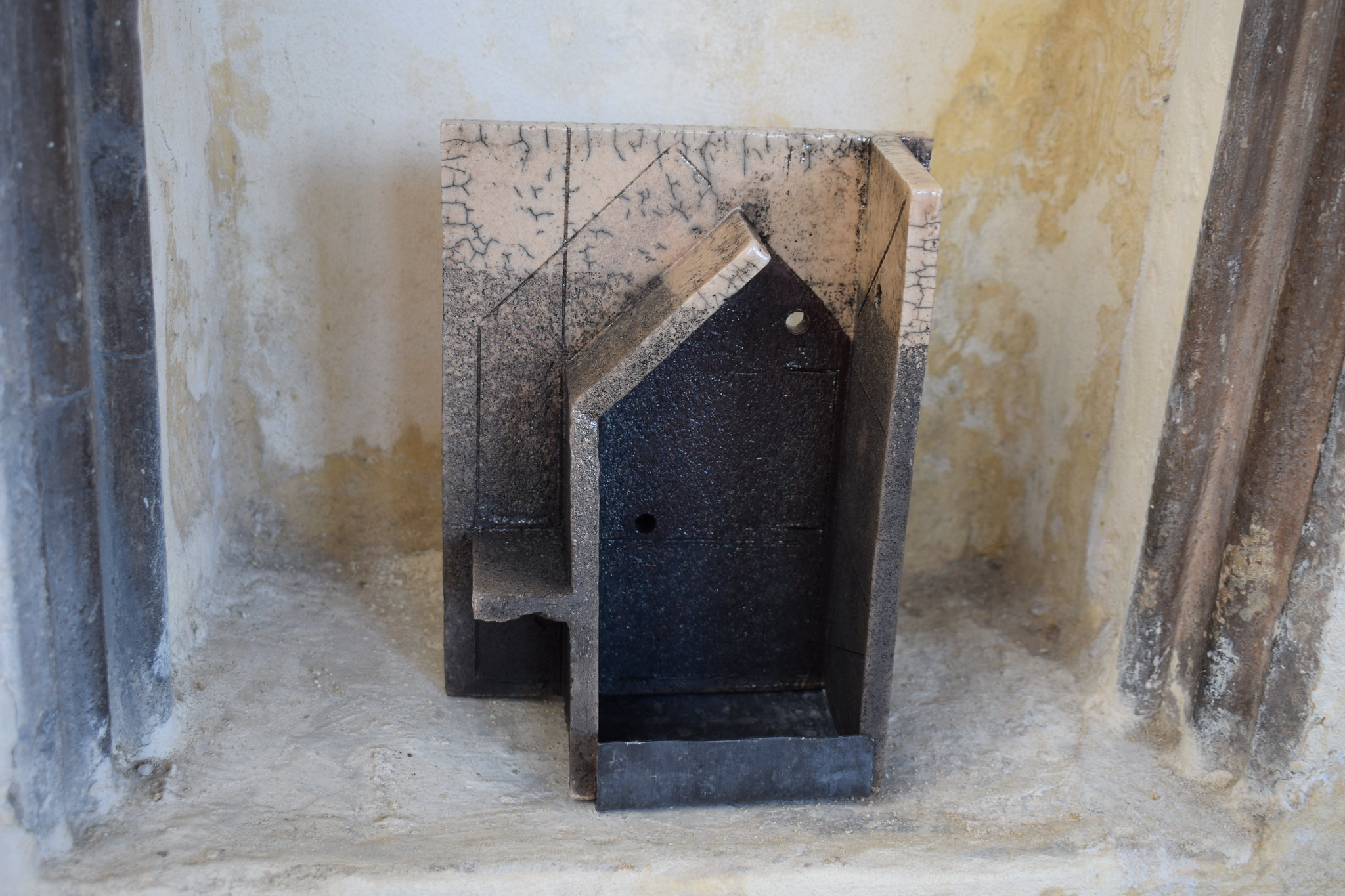
Rutile/Yellow Ochre washes, transparent glass/glaze, texture/textile and pierced clay/concrete.
Ceramic Slab Constructions : Facades/Massing for pacemaker utilities/living spaces
Material as drawing, drawing as construction, architectural models constructed into the assemblage of the making drawing.
Painted Clay Constructions : Gesso, Cyanotype, Cotton, Wire, Glass.
Process-Relational Philosophy : Alfred North Whitehead
Vibrant Matter : Jane Bennett
Blackness is a property, not a quality, that is to say, something fundamental, not an incidental embellishment.
About Drawing, Richard Serra.

Wednesday, 24 May 2023
Re-visiting the proposal : Making at Raveningham/Building on the lightest of things
Dwelling. Up, across and along relations in the landscape.
Giving Sensation Place.
An Education Of Attention.
Creative Curriculum Making.


%20(1).jpg)
.jpg)
.jpg)
.jpg)
.jpg)

Developing a creative inquiry and its presentation through generative art based methodologies.
Re-imagining learning through site based education, art practices and philosophy.
Installing a creative practice as a 'place driven site' for subjective experience, gathering things and personal inquiry from which to present 'findings' into the social environment.
For Tim Ingold, life is the very process wherein forms are generated and held in place.
And dwelling means that the forms people build, whether in the imagination or on the ground arise within the current of their involved activity in the specific relational contexts of their practical engagement with their surroundings.
Tim Ingold, Lines. 2007
Proposal Raveningham 2023
The Simple Presence of Things.
Peter Zumthor.
Raveningham Sculpture Trail 2023
Russell Moreton.
Making and working in drawings, diagrams and constructions that are habitable environments.
Speculative Cosmic Garden and Sculptural Array for Solargraphy.
Interested in revisiting an earlier project that I created at Kilquhanity (A Pathway Between Sunrise and Sunset), in which I mapped out transits and movements of the sun onto the landscape through demarcated pathways and intersections. I propose then to add to these ground markings an apparatus or array to hold small can cameras pointing skyward to record the movement of the sun over the duration of the Sculpture Trail.
Using the phenomena of light as both a conceptual and practical framework requires a mixture of pinhole cameras, contact photograms and shadow sticks that will demarcate lines and arcs, that will in turn create overlapping territories onto the landscape. The array construction will act in counterpoint to the landmarks, a fixed arrangement looking perpetually skyward.
Russell Moreton
Spatial practitioner employing a speculative site based practice linking visual fine art, education, architecture and philosophy.
Sunday, 21 May 2023
A Nomadic Narrative/One Place After Another.
A nomadic narrative, a path articulated by the passage of the artist which is phenomenological, social, institutional and discursive.
Site specificity of competing definitions, overlapping with one another and operating simultaneously within both cultural practices and the artist's own single project.


.jpg)

One Place After Another.
Notes On Site Specificity
Miwon Kwon. 1997
Thursday, 18 May 2023
Transience of Presence : Drawing Gestures, Postures and Movements/Philosophies of Art
Outpost 241121


Philosophies of Art
Mark Rothko, 1940-41.
Without question the work I found as incomplete and in places, frustratingly obscure, but it was a book, and a substantial one. It was clearly written as a volume, its contents speaking to a public rather than constituting an artist's private musings
Christopher Rothko, 2004.
The Artist's Dilemma
Art as a Natural Biological Function
Art as a Form of Action
The Integrity of the Plastic Process
Art, Reality, and Sensuality
Particularization and Generalization
Genalization since the Renaissance
Emotional and Dramatic Impressionism
Objective Impressionism
Plasticity
Space
Beauty
Naturalism
Subject and Subject Matter
The Myth
The Attempted Myth of Today
Primitive Civilizations Influence on Modern Art
Modern Art
Primitivism
Indigenous Art
Rembrandt discovered that his patrons were not interested in his plastic preoccupations with light when he painted The Night Watch, and that they preferred the obvious illustrative gifts of his contemporaries and followers. Monet and Cezanne discovered the same, watching Sargent and the exhibitors at the academy sell far inferior goods, succeeding because they adopted the French masters' method in its superficial aspects, while including enough familiarity so that the spectator revelled in the familiar while he was talking about the unfamiliar.
Things and Bodies/Shifting Signs
The haptic image/indexical/involuntary markings and the present instant, a body at the limit of its moment when it is most definitely intensely alive and in the present.
Beyond the body's blurred contours and indexical markers, to see through, to see sense challenged.
Time is persistently liminal, a suspended, extended present.
Mattering/Mutability,Accident, Flux
Experience/Existence/Presence
Life Drawing/Staging Oneself/Others
Body in Space/Resilience,Endures
Organism-Person-Environment
Haptic slippages/propositions between subject and object, human and non human, between what is alive and what is animate.
Drawing/Anamorphic Perceptions, apprehended and felt, more than seen.
Drawing is not the form; it is the way of seeing the form.
Edgar Degas.
The human figure, like any animated object is alive. Even when in a seemingly static position- whether sitting or lying- it is actually in constant motion. To capture this fundamental fact, which makes the body profoundly different from a statue or a mannequin, one must learn to see both its physical structure and its actions in space.
Daniela Brambilla.
Between seeing and drawing, what is felt, hidden, made rendering visible.
Blindness, searching, instants marking the barely known phenomena between organism, person and environment.
The searching and reflexive nature of drawing, a questioning through the performative social body, and its perceptual spatial agency and with materials, environments and others.
Human Figure Drawing
Drawing Gestures, Postures and Movements.
Daniela Brambilla, 2014.
With a series of curved lines drawn quickly, without lifting the pencil from the paper, in a loose way and almost without looking away from the subject, identify the lines that make up not the outside, the external contour or the details, but the morphological whole of the figure at that precise moment- in a certain sense the internal engine, a synthesis between intentions and actions, between mind and body.
To achieve this result draw around the form's centre and at the same time beyond it, without defining volumes with closed lines.
Gesture
Seeing Contours
Superposition
Interior and Exterior
Proportions
Modelling
What It Isn't
Memory
Balance
Techniques
Light and Shadow
Chiaroscuro
Viewpoint
What to Say?
Movements of the Soul
The Forms of Age
The Sketchbook
Imagination
If you have learnt to write, you will also learn how to draw. The manual skill is the same; you are just changing your way of seeing and feeling. To understand the meaning of this statement, ask yourself: “Where am I when I am drawing?”
Thinking Bodies : Deleuze and Guattari's becoming-woman
Nicole Dawson, 2008.
Deleuze and Guattari have argued that we cannot reach outside of a dualistic conceptualization of human bodies simply by seeking to transcend or bypass it. They contend: “The only way to get outside the dualism is to be-between, to pass between, the intermezzo”. We do not get past or move beyond the dualism. This is not a successive stage of progression. The dualism is a conceptual event whose historical and contemporary activity gives rise to consequences that cannot be invalidated or ignored, thus, the situation is not such that we put the dualism behind us, move on or forward as if unaffected. The only place to go, to move, if we are to get outside the dualism is between: “one must pass ...through binaries, not in order to reproduce them but to find terms and modes that befuddle their operations, connections that demonstrate the impossibility of their binarization, terms, relations, and practices that link the binarily opposed terms”.
A Thousand Plateaus : Capitalism and Schizophrenia, Deleuze and Guattari.
Volatile Bodies : Towards a Corporeal Feminism, Elizabeth Grosz.
Tuesday, 16 May 2023
Sunday, 14 May 2023
Outpost 100523
The line that develops freely and in its own time goes out for a walk, and in reading it the eyes follow the same path as did the hand in drawing it.
The Thinking Eye, Paul Klee. 1961
Lefebvre acknowledges that geographical space created through the body, through routes which were inscribed by means of simple linear markings. These first markings, paths and tracks drawn into the landscape would become the pores through which without colliding would produce the establishment of places and localities made special for one reason or another.
The Walk and The Assembly.
Tim Ingold.
Life Drawing.
Herbert Boeckl is not concerned with beauty of line, as his predecessors Klimt and Schiele were; he always sees the body in the context of space and draws 'from within': he builds up his figures from a structural core. The surface thus takes on a strongly moulded, modelled aspect.
Georg Eisler.
From Naked to Nude.
Wayfaring a Human Landscape.

Material : The ways/movements of practice.
Making : The designed/the discursive.
The lines of the network in a contemporary sense, join the dots, they are connectors.
The lines of the meshwork by contrast are the trails along which is lived.
Up, Across and Along.
Tim Ingold.
Saturday, 13 May 2023


.jpg)
Twilight Abstractions : Liminal Zones/Psychological Realities


.jpg)