Showing posts with label site. Show all posts

Sunday, 26 October 2025

Site~Emergent~Ecologies~Landscapes : Drawing translations within/between the photographic document.

Site~Making~Fieldworks.

Borderlands.

Alternative Photography.

Enchantments and Crossings : Somatic Effects~Enchantments


Topologies, mappings and their correspondences (thinking~feeling) between here, there, and elsewhere.

Playing with 'phronesis' a poetics of a spatial encounter and its enclosure forming an immediate immersive environment.

Developing inquiry through a process of familiarization and not-knowing, being undone by theory where things emerge, are accumulated, and are nurtured into being through relations (Continuous~weather-world sites) with human bodies and spatial bodies.  

Archiving materials, sites and events, resulting in an incidental aesthetic gathering.


Outpost Studio 030222

Immersed in Matter(s) of an Emergent and Continuous Weather World.

Covehithe : Walking/Thinking/Physical Entanglements in the Landscape.

Walking into Emergent Landscapes : Covehithe Beach.


The OLD WAYS, a JOURNEY ON FOOT, Robert Macfarlane

Walking was a means of personal myth-making, but it also shaped his everyday longings:

Edward Thomas not only thought on paths and of them, but also with them.

To Thomas, paths connected real places but they also led out-wards to metaphysics, backwards to history and inward to the self. These traverses- between the conceptual, the spectral and the personal-occur often without signage in his writing, and are among its most characteristic events. He imagined himself in topographical terms.


Deeper Darkness, Photographic Memory/Process, Metonymy, Negative,

Analogue, Negated Nocturne. Walking, Others, Presence, Becoming,


Saturday, 5 April 2025

Objects and Traces/Map Reading : Visual Archaeology/Anthropology in Social Space

The map fosters interpretation and exploration

Inseparable Attendant : Place and Process

Assemblage and blueprint : Site drawing/Leper Graves

Drawing figure/ground, documentation of work in progress.

Life "drawing" trace on paper with water and field chalk. Work submitted to Interfaith Group Show at the Link Gallery, Winchester 2010.

"This particular event invokes for me the notion of simple material relations and collaborative gestures that underpin human agency. Art space/practice can promote these working intimations."       Artist's Statement (archive)  07.12.2009.

Anthropological Landscape : Morn Hill, Winchester

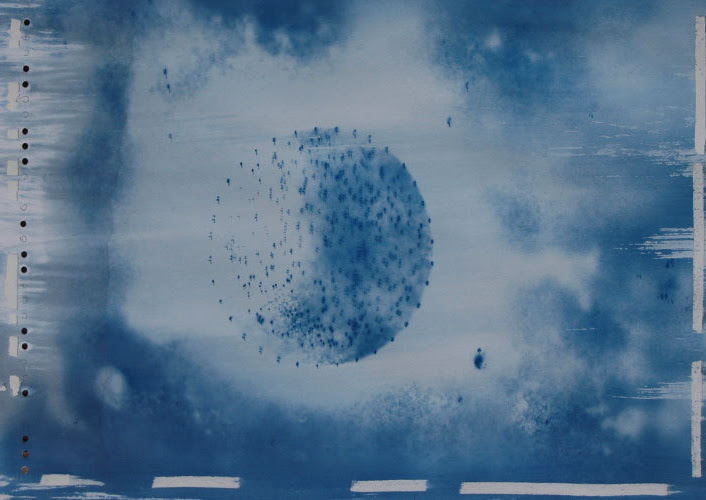
Panspermia : Cyanotype Drawing
150x240 cms
Human form drawn on paper with cyanotype and black ink. Astronomical data and traces of seed heads together with reference material/notes (directed panspermia) in pencil.


180621

Thursday, 3 August 2023

Learning-In-The-Making/Processual Learning : Reading/Intraventions at Hungate.

HUNGATE

Staging of a caring curiosity that wants to know and understand and explore relations.


Site Visit/Working Notes.

070223 


Hungate, Norwich.

Building/Surface Movements : Breathing Forms

Water/Light/Vessel/Body : Sacred/Secular/Holy/Profane

Scriptorium, Waverley Abbey Project

Collage/Matters of Concern : Discursive/Graphic/Diagrammatic/Mappings


https://www.flickr.com/photos/russellmoreton/


https://www.flickr.com/photos/russellmoreton/


Architectural Body

A Holding In Place

Dwelling/Situatedness/Inhabitation

A Domain Of Entanglement

A Vital Emotional Dimension


Landscapes Of Action


Relationscapes

Learning-In-The-Making


Processual learning occurs in movements, gestures, postures, expressions and exchanges with other bodies and things.


Rituals through water linking the organism-person-environment.


Fonts as an apparatus linking the corporeal and the spiritual body with others.


Dwelling/Inhabitation is a perspective that treats the immersion of the organism-person in an environment or life-world as an inescapable condition of existence.


Life is the very process wherein forms are generated and held in place.

Tim Ingold.


Baptism/Water/Society as a holding/resting in place.


Letting the building breathe, with and through the narratives of others.


Site/an intravention or creative apparatus for the un-doing/un-folding of place.


Partrners-with-things


Practices that do engage in the complexities and contingencies of corporeal experiences.


Conceptual Frameworks/Cognitive/Corporeal/Imaginative


We need to live the consequences of non-stop curiosity inside mortal situated relentlessly relational worlding.

Donna Haraway.


Exploratory Movements/Dwelling/Duration/Light/Pinhole Camera


Reading

The Eyes of the Skin

Architecture and the Senses.


PARALLAX

Steven Holl.


Banga

Patti Smith


WATER


Matter and Desire

An Erotic Ecology

Andreas Weber


Sacred/Secular/Holy/Profane


The Mind as a leaky vessel


Wensum/Chalk Stream


Lime Plaster/Yellow Ochre/Lead/Silver Stain/Pot Metals


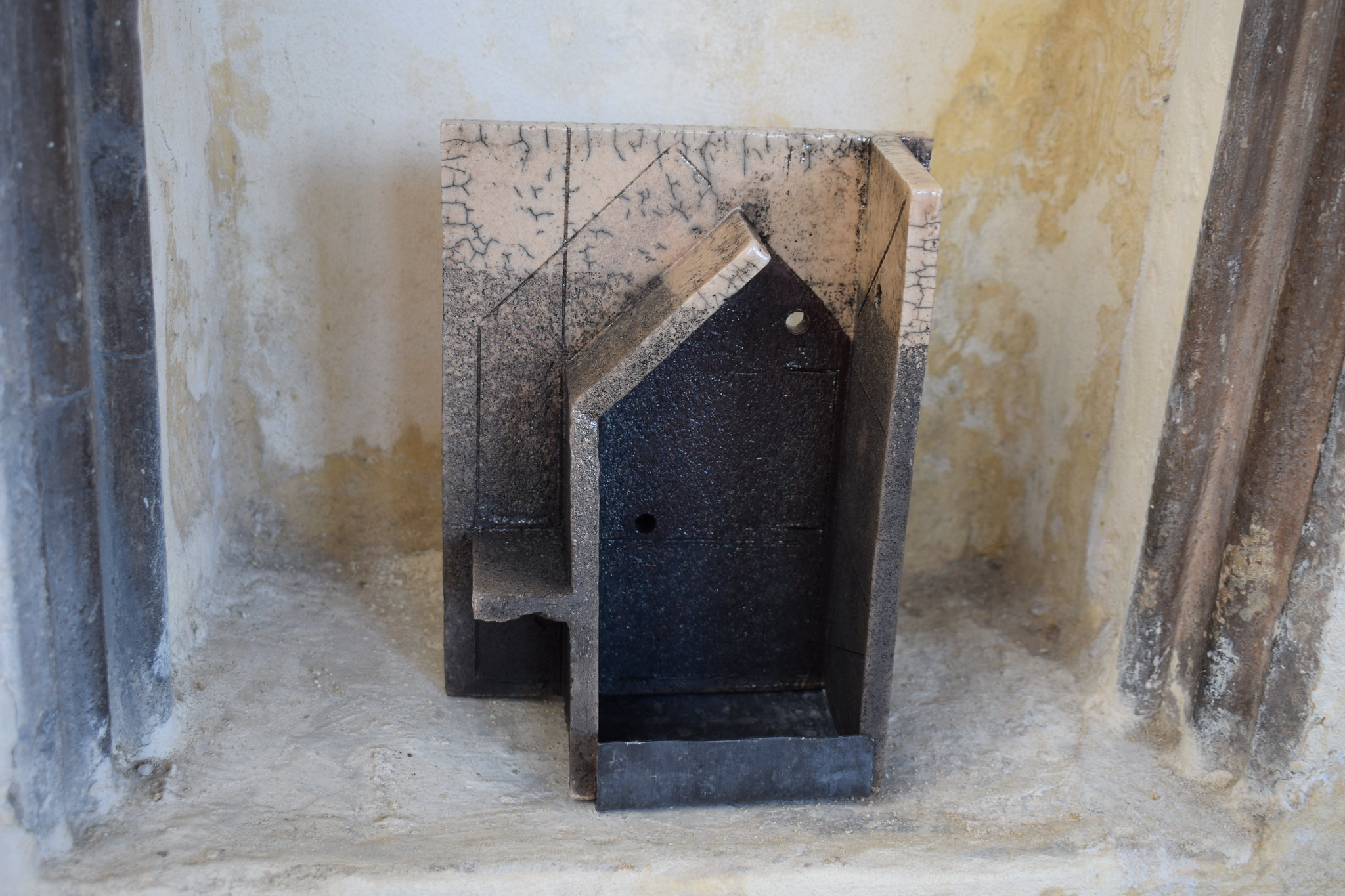
Ceramic/Cloth Wrappings/Canvas/Construction/Scriptorium/Lead Trays/Photographic Materials


Sunday, 21 May 2023

A Nomadic Narrative/One Place After Another.

 A nomadic narrative, a path articulated by the passage of the artist which is phenomenological, social, institutional and discursive.

Site specificity of competing definitions, overlapping with one another and operating simultaneously within both cultural practices and the artist's own single project.


A provisional conclusion might be that in advanced art practices of the past thirty rears, the operative definition of the site has been  transformed from a physical location, grounded, fixed, actual, to a discursive vector, ungrounded, fluid, virtual.

One Place After Another.

Notes On Site Specificity 

Miwon Kwon. 1997

Friday, 14 October 2022

Refractive Phenomena : Site Circumstances, Water/Glass/Film.

 Outpost 141022


Water : A Phenomenal Lens.

Refractive Phenomena.

Void Space Water Gardens.

Steven Holl.


The haptic realm of architecture is defined by the sense of touch.


When the materiality of the details forming an architectural space become evident, the haptic realm is opened up. Sensory experience is intensified; psychological dimensions are engaged.


The psychological power of reflections overcomes the science of refraction.


As rational metaphysics teaches that man becomes all things by understanding them, imaginative metaphysics shows that man becomes all things by not understanding them, for when he does not understand he, becomes them by transforming himself into them.

Vico, New Science.


One of the tragedies of modern urban life is that a complex of urban constructions often puts us out of touch with the poetry and unpredictability of the everyday change in the weather.


Patti Smith

Baptised by the New World 


Site : Circumstance and Idea.


Phenomenal zones function life a manifold of parts, presenting the question of a whole more substantial than any of its components. 


Each challenge in architecture is unique; each has a particular site and circumstance or program, and for each to fuse sit, circumstance, and a multiplicity of phenomena, an organizing idea .. a driving concept is required.


The unity of the whole emerges from the thread that runs through the variety of parts; whether it be one discrete idea or the interrelation of several concepts.


To find a balance between the science of water and the exhilarating qualities of experience, consider the many states and transformative properties of the substance. We might consider water a 'phenomenal lens' with powers of reflection, spatial reversal, refraction, and the transformation of rays of light.


The 'void space' water gardens and the interior ceilings of the adjacent apartments are connected by reflected light from the ponds. These 'void spaces' containing three inches of water over black smooth stones from Ise, are analogous to a sacred space within the every day world of domestic urban life.


Hungate Medieval Art.

Water, Working Title.

Exhibition, St Peter Hungate, Norwich. 2023.

Sculpture, Installation, Sonic Art, Performance and Film Screenings.


The live reflection of echo and re-echo within a stone cathedral increases our awareness of the vastness, geometry and material of its space.


Water, its use in Christian rituals, baptism, confirmation, confession, ordination, matrimony and anointing of the sick.


Responding to the physicality of stone fonts as objects to hold holy water.


Objects produced according to the doctrines of the Roman Catholic church before the Reformation.


An attention to phenomenal properties of the transformation of light through material can present poetic tools for making spaces of exhilarating perceptions. Refraction phenomena produce a particular magic in architecture that is adjacent to or incorporates water.


Of Sound.


Quieting the mind

deep in the forest

water drips down

Hosha.


The brevity of a Japanese haiku poem isolates the 'thing-in-itself' of experience and perception of material and detail.


Space brings the resonance of the acoustic near to life.

John Cage.


In some European cities, the regular sound of the church bell's community call creates a psychological space. Its perceptual associations are tied to the materiality of the bell, its resonant tower, and the adjacent square. This kind of 'sound space' cannot be accurately recreated with electronic speakers.


Sound is absorbed and perceived by the entire body. A sequence of sounds can have a mesmerizing effect on the psyche.


John Cage went into an anechoic chamber over sixty years ago in order to 'hear sounds' and found that experience gave his life direction. Cage's radical and poetic experiments with sound bridged the conventional gap between musical phenomena and the physical and psychological effects of sound.


Electronic music has increased the ranges available to composers and changes in thinking have reframed sound and time.


Scripting Aural Phenomena.


The architecture of music, the structure of aural phenomena might have a graphic parallel in architectural notations; plans sections, axonometrics, etc. Many composers have used time-space notations in order to compose with irregular rhythms. Notations which allow for accidental chromatic notes, microtones, clusters of vertical bands between marked pitches all appear different from conventional notation.


Accordingly we consider a re-framing of space, light and time in architecture.


Paul Valery suggested the closeness of music and architecture, that sculpture and painting one can turn way from, but music surrounds us as does the space of architecture.


Detail : The Haptic Realm.


Today the industrial and commercial forces at work on the 'products' for architecture tend towards the synthetic; wooden casement windows are delivered with waterproof plastic vinyl coatings, metals are 'anodized' or coated with a synthetic outer finish, tiles are glazed with coloured synthetic coatings, stone is simulated as is wood grain. 


The sense of touch is dulle or canceled with these commercial industrial methods, as is the texture and essence of material and detail displaced. 


The total perception of architectural spaces depends much on the material and detail found and experienced through the haptic realm.


The texture of a silk drape, the sharp corners of cut steel, the mottled shade and shadow of rough sprayed plaster or the sound of a spoon striking a concave wooden bowl, all reveal an authentic essence which stimulates the senses.


Fields.

Diagrams of Field Conditions.


All grids are fields, but not all fields are grids. 


On of the potentials of the field is to redefine the relation between figure and ground. If  we think of the figure not as a demarcated object read against a stable field, but as an effect emerging from the field itself- as moments of intensity, as peaks or valley within a continuous field, as the figure and field become more enmeshed.


Rather than considering photography as a means to capture an instant, some artists subverted this practice to express duration in time. Sometimes through collages, sequences and superimpositions, in some cases through a single long exposure.


Photographers are exploring different methods to synthesize the fourth dimension within the bidimensional range of the frame. The results provide a wide variety of unexpected solutions, some extremely synthetic while others very fragmented, pushing further the boundaries of the practice.

Thursday, 21 July 2022

Immaterial Architectures : Raveningham Pavilion and The Architecture of Natural Light


Christopher Wilmarth ; Poetics/Duality of Light and gravity
Other Architecture
Constructing Metaphysical Space

Wilmarth's art reveals his essential concern with the mystical and physical properties of light, especially the ways in which light evokes reverie and generates sensations of space and containment.

The Architecture of Natural Light : Henry Plummer

EVANESCENCE
Orchestration of light to mutate through time

Intensity and integrity of Wilmarth's practice/vision.

PROCESSION
Choreography of light/moving eye

VEILS OF GLASS
Refraction of light/diaphanous film

Wilmarth made possibly his strongest, most beautiful works on paper, exploring a new level of expression while retaining continuity with past work.

ATOMIZATION
Sifting of light/through a porous screen

These drawings also contain allusions to the human presence. Their haunting, foreboding quality is prefigured in the grave, austere tones of some of the glass and steel structures.

CANALIZATION
Channelling of light/through a hollow mass

The duality of light and shadow and contrasts between abstraction and representation continue to be central concerns in his final drawings.

ATMOSPHERIC SILENCE
Suffusion of light with a unified mood

Wilmarth's sculptures from the early 1980's are influenced by the poetry of Stephane Mallarme.To affirm Mallarme's emphasis on the spiritual, the artist used a simple ovoid form, evoking a multitude of symbols, including the human head. These ovoids were made of blown glass, which Wilmarth viewed as "frozen breath". The artist pursued this figurative impulse into the mid 1980s, combining the anthropomorphic ovoid shapes with the larger abstract forms of his earlier sculpture.

LUMINESCENCE
Materialization of light in physical matter

Wilmarth composed with planes of delicate colour and light, placing plates of blackened steel behind translucent sheets of etched glass imbued with a luminous, greenish cast.

"He employed a painterly technique that emphasized the tactility and fichness of his materials, which like an alchemist he persistently sought to transform. He continually examined the concept of duality: contrasts between light and shadow, transparency and opacity, heaviness and weightlessness, materiality  and ethereality, form and spirit are repeatedly presented; the synthesis of geometric with organic forms, the range between abstraction and representation are constantly explored."
Laura Rosenstock, catalogue essay.


Saturday, 7 August 2021

Drawing/Situatedness and Site : John Berger, simultaneously a now and an elsewhere

Drawing has the ability to hold complexities separate enough so as to be read, yet drawings also merge into a perceptive unity marked by a sensation or realisation of intuitive nowness authentically caught in the tension of the line.

John Berger’s definition of what a drawing might contain when it is simultaneously viewed as both a now and an elsewhere, marks for me a threshold of encountering space­ time, we are passing through as we perceive our very consciousness. 


I sometimes think of these drawings as sites, containing both physical and playful evidence of explorations. The cyanotype process captures objects and turns them into “inclusions” or vessels that might induce an interesting dialogue, a buried association or simply a stage for thought. I feel the objects recorded are the result of an assemblage of thoughts/interests close at hand driven into the visual through an expediency (working with light and time) and an aesthetic that contains my sense of materiality from which to nurture a creative subjectivity. Strangely it is this aesthetic that just keeps things separate enough but which still makes things actively conspiratorial. It appears to be able to render things in isolation and then bring them together. It is as if the intuition that comes from working and theorising within an art practice is placed into the realm of things, off loaded, detached, and orphaned to make its own way in the world. 


Link Gallery.

Forum Notes, 27 March 2010

Site is anti-place hovering precariously over the abyss of no-place.1 

Art Practitioner with earlier experience in ceramics and glass, recently completed visual arts course at Winchester, now at Canterbury completing MA course in spatial practices. Working mainly on drawing, photography and architectural interventions/ installations that explore our sense and experience of place. 


My work explores a philosophical inquiry into the need for a reflective solitude, a sense of dwelling amongst absences.

The use of materials from the locality (field chalk) implies a personal geography drawn from the direct relationship to an inherited Earth. There is the suggestion that the absence recorded by the trace is an inclusion, a legacy set into a field of materiality, but it might also suggest a metaphysical field of thought. 

This act of drawing becomes its own experimental field of exploration, a sort of “in-between reality’’/Maurice Merleau-Ponty) an enmeshed experience. Thought of and read as a material memory encountering the realm of the insubstantial.

This “undoing of place” might instigate a threshold and a situation/room from which to reflect upon critical spatial, sociological and psychological conditions and perceptions.

This work and others like it attempt to articulate an interest in the body as both a physicality ( social, spatial and per formative presence ) and a poetic surface in architectural space.

Influences, Myth of Butades, origin of drawing, Pliny

Interested in the inscription ( a surface inscribed, written or carved as a formal or permanent record ) of a presence, a trace that reveals an origin of feelings/gestures centred around the body.

Inscription brings with it a notion of performativity, that of body and place, and their interaction, situation and experience. This spatial activity renders a sense of a material memory surfaced by place.

Tacita Dean, Drawings are more than just visual therapy, they speak of collective experiences and dilemmas that trouble humanity.

This simple work gathers-up an intimate social inscription on a surface, a playful act to then associate natural material.

Drawing is the primal means of symbolic communication which predates and embraces writing, and as such it functions as a tool of conceptualization parallel with language.

Drawings offer a partial comprehended rumination of the mind, Avis Newman. Drawing, becomes a sort of dwelling amongst an intimate comer of oneself, perhaps even a site for the solitude for the imagination. Gaston Bachelard comments in the Poetics of Space that a corner in a room can become “a symbol of solitude."

Drawing like walking becomes a form of thinking. This thinking is further articulated and accompanied by the intrinsic qualities of substances and liquids that are placed in proximity so as to be encountered.

My use of chalk as a materiality, emblematic of a solidity, a localised material and a metaphor of a inherited and compressed layering of time. The whiteness of this found material draws associations with the surface of the paper, there similarities’ also render there material differences. The inclusion of wax onto the surface was an attempt to seal a sense of a reflective surface, a surface amongst the work that might accommodate the light and nowness of place. Any drawing is a static object, but contains the trace of actions, traces carried out in time. Perhaps this drawing is registering itself into a language of matter.

1  Edward S. Casey, The Fate of Place, a Philosophical History. (London: University of California Press, 1998) page 186.


ARTISTS CV/STATEMENT re INTERNATIONAL BOSPHORUS ART BIENNALE, ISTANBUL 2011.

RUSSELL MORETON 

Visual artist/maker of dwelling spaces.

Spatial Practices MA Canterbury UK.

Visual Fine Art BA hons Winchester UK 

Contemporary Crafts Sculpture Waterlooville UK 

Ceramics HSND Epsom UK

June 2011 Artist Statement/Outline of Interests.

Visual artist working with alternative photographic processes, clay and architectural glass. The current practice continues to explore themes and realities around the contemporary human condition. The exploration of these interests is predominately developed through drawing and traces of actual objects and performative gestures referencing the body as a site amongst the layering of material and data. The use in some works of site specificity and materials drawn from the location are used to further underpin a sense of engagement and dwelling. The resultant drawings with their traces of agency and exactitude, lightness and ambiguous multiplicities seem like a compression of a filmic substrate, a material memory brought to the surface. These personal consolations of working practice are initiating thoughts centred on building architectural spaces, from which to register and response to a sense of serenity and enchantment amongst the scripting of materials in spatial/social dialogues.

Astronomy, Science, Natural History, Architectural Spaces, Stained Glass, Early photographic Processes, Ceramics, Anthropology, Craft Disciplines, Theatre, Film, Arte Povera, Contemporary Art Practice/Research/Philosophy/Exploration.


IMAGE, PANSPERMIA 2010 Added notes.

This work began as a performative drawing between the touch and tact of its maker, marking a personal and intimate involvement with both the corporeality of the female body and a loved one. This fragile union and fecundity is expressed by the photograms of “elderflower seedheads” left as evidence within the territory of the body/vessel. The personal intimate space of these initial acts and gestures are shifted against infinite space of the known universe. The title stems from speculation that life might have been introduced onto a fertile Earth from spores from space. Interestingly having dwelled with these initial thoughts, I feel that perhaps the work augurs an exodus at some point in the future.

Russell Moreton


CHAPEL ARTS, ARTISTS OPEN STUDIO AND TALK

TALKING AROUND A TABLE OF DRAWINGS

THE WORKING SPACE AS INSTALLATION

THE SPATIAL PRACTICE OF RUSSELL MORETON

Objects or vessels that might induce an interesting dialogue a stage for a future event or trajectory. I feel the objects are the result of an assembly of thoughts driven into the visual through an expediency and an aesthetic that just keeps things separate yet somehow they remain actively conspiratorial. It is all about the intuition that comes from working and theorising with and within an art practice.

The intension of the “charting table” (8x4 ply sheet on builders trestles) was to allow the subject of practice together with my activities to become visible, and in so doing create a public sense of speculation around the material on show. The spatial agenda would be addressed, bought into being as it were by the exposure and placement of objects, tables and projections into the main reception area at UCA Canterbury. It is hoped that the curiosity of some will solicit the interest of others and thereby create the unfolding of an event; the projection could be a real time monitor of the charting table. I am beginning to view the show as an exhibition/event around working practices, but unfortunately the sense of site dominates my practices situatedness. Conceived as a contingent/speculative intervention into the normal running of this space as a reception area. 


Resident artist will host an “open studio” at Chapel Arts Studios on 2 December. The chapel will be open from 12.30 onwards to view an installation and other material. The “talk around a table of drawings” will commence at around 6.45 pm.

Earlier training in ceramics and stained glass together with extensive experience in the construction industry are now being utilised in my contemporary practice.

My current spatial practice, is centred around a multi disciplinary approach underpinned by “drawing” to critical issues of site. This activity could be understood as an investigative creativity amongst the phenomenological aspects of architectural place and the potentials of producing working spaces/sites for the reflection of others. The working practice currently employs the use of clay, glass and photographic processes. The practice is informed by interests in astronomy, architectural space, theatre and anthropology.

The use of “site” as a working drawing from which to create a temporary intervention into place helps to instigate a threshold, a room or event from which to reflect upon critical spatial, sociological and psychological conditions and perceptions.


Anima-Animus : Winchester Cathedral/10 Days in the City

‘When animus and anima meet, the animus draws his sword of power and the anima ejects her poison of illusion and seduction’ Jung.


Russell Moreton uses analogue film processes that inquiry into both the surface and the materiality of the photographic image. He was invited by Helena Eflerova and Kye Wilson to document the filming process of Anima-Animus. He uses 35mm and medium format cameras together with a number of pinhole type cameras. In using historical processes like cyanotype and light sensitive silver gelatine, he explores the relationship of the image to its supporting surface. A number of his images are heavily worked in the darkroom to exploit differences between the seduction of the photographic surface and its actual physical presence altered by chemical and physical interventions. His work echoes themes around the body and the architectural spaces of institutions and beliefs.