Material absorbed in its own thoughts :
Saturday, 18 May 2024
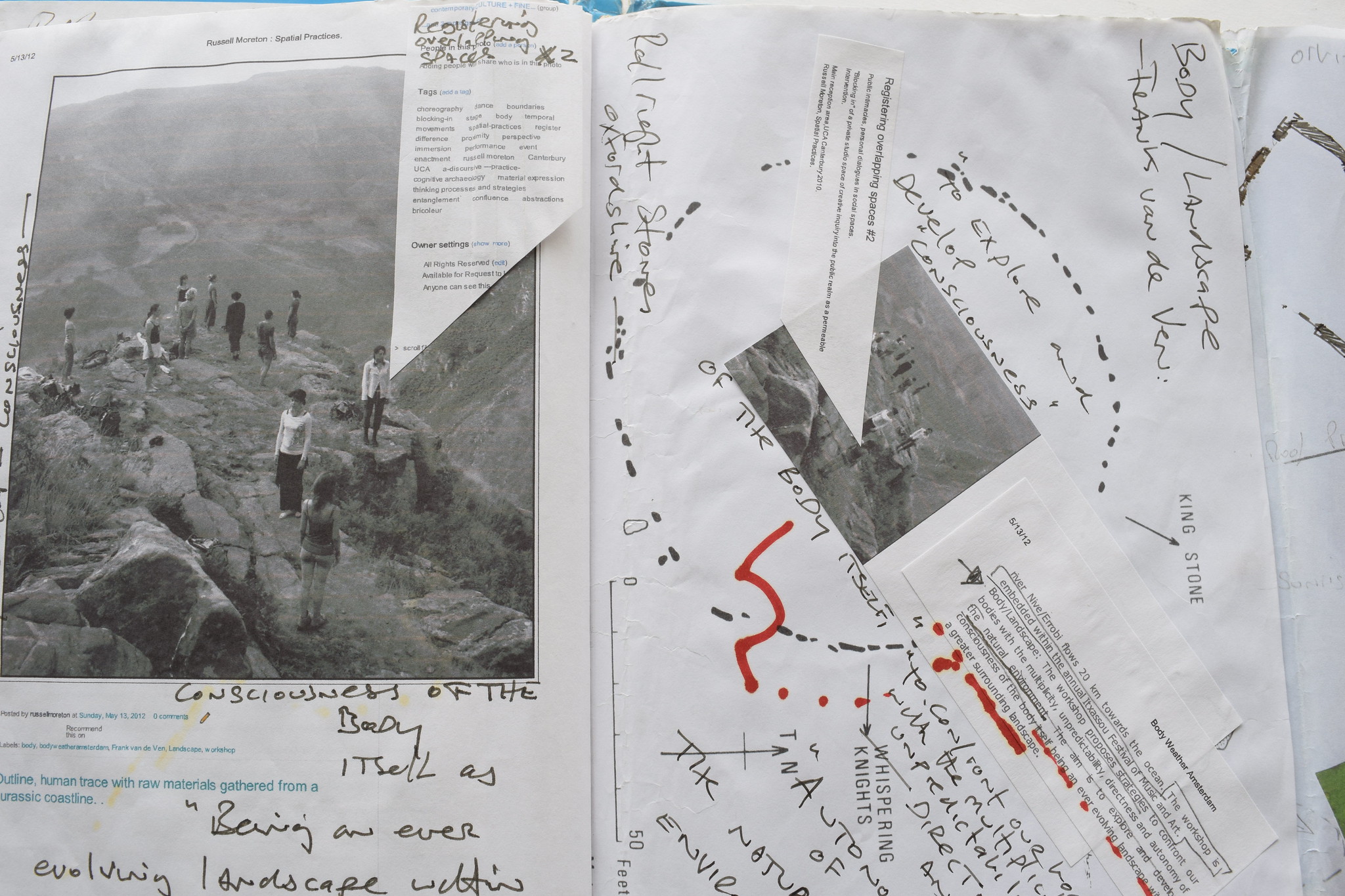
Body/Landscapes : Frank van de Ven. 2007
Friday, 17 May 2024
Spatiality/Body Politics : Drawing Geographies
In drawing the moments of choice have been kept visible.
John Berger, Berger On Drawing.
A drawing is essentially a private work, related only to the artists own needs.
The Drawn Line-A Recession-A Past Statement Brought Forward
The Body of Drawing
Drawings by Sculptors
South Bank
Drawing registers the transforming effects of the imagination and the memory.
Drawings are images of flux; flux both imaginative and physical.
Drawing is a verb.
There is no way to make a drawing-there is only drawing.
Richard Serra
The Drawing Book
Tania Kovats
Drawing is something where you have a really direct-immediate relationship with the material. You make a mark, and then you make another mark in relation to that mark.
Kiki Smith
The Body
Rodin's lines dont just represent carnality; they are themselves carnal, invasive, sexy. Uninterrupted by the space between the material and the body; the line made by the drawing hand stands in for other haptic things. The body is where drawing begins and where it ends.
Looking at images does not lead us to the truth, it leads us into temptation.
Marlene Dumas
Sexuality and Space
Beatrice Colomina
Drawing and Random Interference
From Chaos To Order And Back Again
Sally O'Reilly
Quantum Chance
Janna Levin
AFTERIMAGE : Drawing Through Process
Cornelia H. Butler
Fiona Banner
Life Drawing
Performance Nude
Marking Time
Examining Life Drawing as Methexis
Margaret Mayhew
Rather than regarding life-drawing as an event of realism, it may be more productive to
explore it as an assemblage of events, a field of practices, or as a cluster of performances.
Monday, 13 May 2024
Drawing Is An Immediate Art/of presence and transparency/phenomena 'unfolding'.
Outpost 130524
The Primal Scene of Drawing.
Drawing as Gesture.
Coda : Coded Imprints/Mediality
Contemporary drawing tending towards graphism, illegible writing, that can be seen as a regression from image and coded sign to what could be described as states of the 'pre-sign', of moments of inscription and the emergence of the signifier from the gesture or act of making a mark.
Drawing Is An Immediate Art/of presence and transparency/phenomena 'unfolding'.
A fusion between the artist's mind, the artist,s hand and the beholder's gaze.
Even in the most fragmented of forms there is a recognition of our sense of self and our history as we mark. It is not only the functioning of perception that interests me, but also the activity of sensation.
Avis Newman.
The raw drawn line at its emergence into the world.
Line can no more escape the present tense of its entry into the world than it can escape into oil paints secret hiding places of erasure and concealment. This fundamental condition can bring it therefore much closer to the viewer's own situation than can the image in paint.
The drawn line in real time with its own momentum, its own trajectory.
A walk for a walk's sake, the mobile agent is a point shifting its position-forward.
Paul Klee.
The present of viewing and the present of the drawn line, hook onto each other, mesh together like interlocking temporal gears. They co-inhabit an irreversible permanently open and exposed field of becoming, whose moment of closure will never arrive.
Though it is impossible to reconstruct with any real accuracy the precise sequence whereby drawn lines on paper finally come together as a completed image. The permanent visibility of each unit of production, of each individual line on its own, means that there is no escaping the sense of the line as emerging from an initial state, blank paper to the state we eventually see.
The drawn line in a sense always exists bin the present tense, in the time of its own unfolding. The ongoing time of a present that constantly presses forward.
The blankness of the paper exerts a pressure that cannot be reduced or done away with, relentless its blankness forces everything into the open into a field of exposure without shields or screens, with no hiding places, a radically open zone that always operates in real time.
If painting presents being.
The drawn line presents becoming.
Line gives you the image, together with the whole history of its becoming-image.
However definitive, perfect, unalterable the drawn line may be, each of its lines, even the last line that was drawn is permanently open, to the present of a time that is always unfolding. Even that final line, the line that closed the image is in itself open to a present that bars the act of closure.
A Walk for a Walk's Sake.
Norman Bryson.
Cy Twombly.
Works on Paper. 1979.
Such gestures do not ask to be interpreted.
Making marks that open-up a space where in which the distinction between human and non-human is undecidable. How are we to respond to gestures that do not ask to be interpreted since they are meaningless, or more precisely they are gestures in meaningless.
If drawing is to be taken as just such a gesture, how are we to respond to it?
It it is not directed to meaning or interpretation, what does it demand of us?
Instead of considering what its meaning is, we could place the emphasis on the fact that a gesture has been made, the fact that something has been left for us. A mark inscribed on a piece of paper, perhaps by someone. We would thus receive the gestural mark as the trace of the other without any need for that mark to be meaningful. We may well do so without reverting to the 'what' and interpreting the gesture as an expression.
We need to say nothing more than the other has left this mark.
The Marks, Traces and Gestures of Drawing.
Michael Newman.
The gesture is communication of a communicability.
Means Without Ends.
Giorgio Agamben. 2000
The gesture is the exhibition of a mediality. It allows the emergence of the being-in-a-medium of human beings and thus it opens the ethical dimension for them. What is relayed to human beings in gestures is not the sphere of an end in itself, but rather the sphere of a pure and endless mediality. It has precisely nothing to say because what it shows is the being-in-language of human beings as pure mediality. However because being-in-language is not something that could be said in sentences, the gesture is essentially always a gesture of not being able to figure something out in language. It is always a gag in the proper meaning of the term.
For Michael Newman, the drawn mark could be taken as a 'gag' in precisely the way Agamben outlines. Its relation to language lies not in language as a goal, but precisely in its turning back on itself to expose its mediality, which is the condition of language.
Materiality and Mediality
Materiality and Mediality takes as its focus the reciprocal relationship between the facture of objects and the making of meaning. The questions addressed in this focus build upon ongoing research on textility. Material observations of textiles from Gottfried Semper onward have played a special role in the historiography of our field, and the study of textiles demands both new economic, social, and material approaches to the history of art, from canvas painting to tapestry, while also emphasizing global movements of materials, techniques, and makers.
More broadly, the study of materials encompasses both the complex negotiation of human makers with material resistances, and the way materials change physically and in terms of their reception over time. From the extraction and procurement of raw materials to the sensual qualities of finished products, the study of an object’s materiality brings forth histories of labor, trade, technology, and the environment that have been traditionally considered beyond the remit of art history. Concomitantly, media theory is a useful tool to examine how medium shapes the behavior of works of art, which becomes especially pronounced when new media emerge and spread. Both materiality and mediality impact the aesthetic, social, and ritual understanding of works of art. The study of materials and media invite approaches to the history of art that span geographies and chronologies in new and challenging ways. Materiality and Mediality serves as a broad framework to examine visual culture using sets of methodological tools that can shed new light on canonical works of art while simultaneously integrating overlooked objects into larger art historical narratives.
https://www.biblhertz.it/en/dept-weddigen/materiality-mediality
We are thus left with the question of how the mark received as trace of the other relates to the mark as gesture, even if the trace necessarily withdraws from the mark. How does the mark-as-gesture not reduce the trace to its mediation to expression in a medium and thus reduce the other to being a figment of my world, an actor on the stage that I project. The other is reduced to the same if the medium is conceived as a common substance, a kind of thing that joins two entities, communication as exposure breaks with this ontology.
Sunday, 12 May 2024
Metonymy : The Body Of Drawing/On Precarious Enclosures/Ceramics/Wanting Shelter.
Outpost 290424
Zola Jesus : Arkhon
Metonymy as often treated as a subtype of metaphor by cognitive linguistics has a different working mechanism. Metaphor is based on perceived similarity between things, while metonymy on the relationship within things.
The trace and trait of mark making is a durational gesture on the way to becoming an line/outline/contour.
Mark-Making 'names' something absolutely inhuman, the shadow and the strain and the loss of any criterion to distinguish between the intended and the unintended and between human indications and marks produced by natural processes.
Line, takes marks, traces out of duration into forms set in eternity.
Seeing the relation between the daughter's and the father's image making as that between metonymy based on contiguity, and metaphor based on similarity, each produces in a different way a defective image. The portrait image based on resemblance fails to unite the inner essence of the subject, just as a shadow traces only the contours of the body.
In Drawing the problem is to 'slow' the consideration of the mark, so that it does not move too quickly toward line-contour-figuration or image. But to allow it to hesitate on the edge.
Images In Mind.
Pliny's Story of the Origin of Drawing.
Deborah Tarn Steiner.
Contemporary Fine Art Practices.
The Lines of Thinking about Drawing.
Michael Newman.
Drawing-as markingtime-memory-matter in the work of Avis Newman.
Working/Thinking with-Imprint-Index-Trace-Mark-Photograph-
Inside The Visible.
Catherine De Zegher. 1996
The image exists after the object.
First we see, then we imagine.
Maurice Blanchot.
To the artist, the creation of objects is a process of sequencing their work processes, rather than the completion of work.
Eva Hesse's practice offered Christina Iglesias a model for a process-based way of working, rooted in a deliberately limited range of materials.
Eva Hesse, Lucy Lippard.
On Making Skins-Shells.
Metonymy.
The sculptural spaces Christina Iglesias constructs are kinds of dream-catchers. They are there to transport our imagination. We again see how the light in the text is filtered and refracted on its journey through different materials, in a way that is very similar to the experience afforded by Iglesias's sculpture, in that sense, she creates spaces that are materialized poetry.
Ceramics as Performative/Speculative/Experimental and Discursive.
Adventures Of The Fire, into a process of experimentation that is expressed as an incompleteness through forming an incomplete part of a bowl, and in doing this it presents a new form as a gate. Experimentation is always towards the new and as such it presents a basic direction about creation. As a venture, a process of experimentation, that is all about the new, notwithstanding if it is successful or unsuccessful.
When seen separately as individual pieces, these works with their widely varied experimentation on forms and new techniques/technologies are perceived as ordinary ceramics and craftwork. But when they are assembled together according to a different method of display, they collectively become an installation and a formative artwork/network. One module constitutes one artwork and each artwork creates one space, then it is no longer necessary to divide ceramics into genres of traditional ceramics and contemporary ceramics, or ceramics as expression and ceramics for use.
The Space Of Fire-Charcoal, includes ceramics that impart a feeling of charcoal or have colour that contrasts with charcoal.
The Space Of Earth-Clay, presents contemporary formative works in front of a curving wall of layered fragments of bisque-fired pots, earthenware, stoneware, white porcelain, bancheong and celadon. Stories about the flow of time and plasticity of clay are told here.
On Making and Taking Up Stories.
On Feelings and Correspondences.
Ceramic Space and Life.
We humans occupy space as big as our physical bodies and expansion of space occupied by individuals give rise to the concept of collective space. A space enables its members to communicate with each other and produces unique culture and creates communication within itself. If such meaning of space is expanded, each and every object takes space as its volume.
Space contains objects, and people experience cultural communication within the space.
Every space that is occupied by each work presented at this exhibition feels different depending on the shape-colour-volume-texture and meaning of the work, not to mention the physical dimensions of the space in which the individual work is placed.
An individual work has meaning by itself, regardless of where and how it is juxtaposed in the space and how viewers perceive it. Such existence and meaning give rise to art of a new concept within a space. An installation itself becomes an exhibition, one space exists as one single artwork.
Ceramic Gate, while being one single piece of art, also shows how architecture is directly integrated into ceramics, this installation was designed to be in harmony with the existing gallery building, while also presenting ceramics as a core formative element. This installation was a joint work of participating artists in Ceramic Space and Life, and it is considered as suggesting a model (methodology) for the combination and integration of architecture and ceramics.
Eight spaces to present an architectural concept, displaying works grouped into natural elements of People-Water-Fire-Clay-Metal-Light-Wood.
Each of the eight sections of the exhibition sheds light on the fundamental nature and artistic values of ceramics, by displaying ceramics of different types, traditional and contemporary, and ceramics as expression, and ceramics for use together, and at the same time new meaning is created as each individual work communicates with the space in which it is placed.
The space, illuminates ceramics into spatial harmonies of Space Art and Ceramic Art, gathered here these 150 works will suggest the future direction of ceramics by showing marks and traces of the past.
Ceramic-Object.
Hong-won Lee, Curator
On Precarious Enclosures/Wanting Shelter.
No ideas haunt us as much as those of stable matter and fixed place.
An intense attentiveness is born of the perpetual sense of being an outsider and the continual readjustment in viewpoint that it requires.
Cristina Iglesias.
Alone or Aligned?
An Aesthetic Identity.
Lynne Cooke.
1993 was a pivotal year for Cristina Iglesias, for the first time her work was convincingly contextualized in relation to her peers and mentors. That same year she entered into an agreement with Artscape Nordland to create a site-specific sculpture in a remote area of Northern Norway.
In Sintitulo untitled ( Laurel Leaves) 1993-94, she explored a way of staging spatial relations rooted in Modernist architectural histories that has since remained the core of her aesthetic.
Barbara Stafford situated Iglesias's work in a cultural history in which places of shelter and refuge serve a fundamental role in that they address psychic as well as functional needs. Referencing both organic and man-made structures from archaic times onward, Stafford argued that Iglesias's works evoke both the age-old escapist dream of being hedged from life and the desire still urgent today for a terrestrial paradise wanting shelter.
For Stafford, Iglesias's precarious enclosures at once vulnerable and somehow out of place, put an intolerable pressure on the meaning of mental security. Eloquently situating her art in relation to architectural typologies and histories, Stafford establishes the terms in which Iglesias's practice would be parsed henceforth.
The Daughter of Butades.
Drawing traces is the act of differentiation of figure and ground (the reserve).
Butades's daughter and her many marks around the shadow, do not yet form the unified-idealizing contour, nor yet the figure against the ground.
Architectural and Environmental Ceramics.
Perforated Screens.
Gate-Wall-Pavilion-Object
Ceramic Houses
Nader Khalili. 1990
Architectural Ceramics for the Studio Potter.
Peter King. 1999
Saturday, 11 May 2024
Christopher Wilmarth : Light and Gravity
Christopher Wilmarth delighted the world with light-filled sculptures of glass and steel that were deeply poetic in their moods and extraordinarily rich in their modernist heritage. But in 1987, at the peak of his career, a long struggle with depression ended tragically for Wilmarth. The internationally acclaimed artist committed suicide at age 44, and his work largely fell from the public view. Now, Wilmarth's legacy is recaptured in this beautifully written, richly illustrated book by art critic, historian, and poet Steven Henry Madoff. The first in-depth look at Wilmarth's extraordinary life as an artist, the book explores both the light and the darkness that underlie his work. Madoff offers a critical overview of the artist's career, examining the sculptor's response not only to historical masters such as Cezanne, Brancusi, Matisse, and Giacometti, but also to the art world of his times--particularly the dominant influence of Minimalism. Using the newly created Wilmarth archive at Harvard University's Fogg Art Museum, Madoff anchors this moving interpretation with the sculptor's own writings unearthed from journals, student notebooks, artist sketchbooks, and letters. Madoff draws as well from interviews, articles, and poems that Wilmarth published in his lifetime, along with the body of criticism covering Wilmarth's development over the years. Acclaimed biographer Nancy Milford contributes a poignant memoir of her years of friendship with the artist, and Fogg associate curator Edward Saywell offers a powerful selection of Wilmarth's writings. The sculptor's romantic outlook, his gorgeously light-infused art, and his dramatic decline into work of harrowing darkness are sensitively examined in a book that reintroduces Christopher Wilmarth's sculptures and graphics to the contemporary art audience.
Between Thresholds/Spatial Stories : The Unbound Articulations/Gestures of Drawing.
Outpost 200224
In the activity of thinking in drawing, a drawing is not seen as a historical item, but as an embodiment of contemporary spirit unravelling before our eyes, it is always in the present tense, always a becoming.
The Stage of Drawing, Catherine de Zegher. 2003
The Mirrored Self.
Coded Imprints.
Invested Bodies.
Chronicling Space.
To develop her project of questioning, Avis Newman returns to the initial moment of tracing and considers the genesis of the mark, from the viewpoint of the original spatial play that the hand stages and the importance given to the gestures of the hand as recorded in the traces left on the paper. She considers that the very nature of drawing is its psychic investments that are bound up in the gestures originating from the hand. The hand captures what neither the eye nor language can grasp. The gesture, its movement in space is anterior to what is drawn and articulated in the trace (Gesture, Max Kommerl).
Spatial Concepts/Paths/Places/Lines
Drawing Thresholds that we pass through.
Spatial Stories.
Michel de Certeau.
A space exists when one takes into consideration vectors of direction, velocities, and time variables. Thus space is composed of intersections of mobile elements. It is in a sense actuated by the ensemble of movements deployed within it. Space occurs as the effect produced by the operations that orient it, situate it, temporalize it, and make it function in a polyvalent unity of conflictual programs or contractual proximities.
On this view, in relation to place, space is like the word when it is spoken, that is, when it is caught in the ambiguity of an actualization, transformed into a term dependent upon many different conventions, situated as the act of a present (or of a time), and modified by the transformations caused by successive contexts. In contradistinction to the place, it has thus none of the univocity or stability of a 'proper.'
In short, space is a practiced place.
Thus the street geometrically defined by urban planning is transformed into a space by walkers. In the same way, an act of reading is the space produced by the practice of a particular place: a written text, i.e., a place constituted by a system of signs.
The essential structure of our being is of being situated in relationship to a milieu, as being situated by a desire, indissociable from a direction of existence and implanted in the space of a landscape. From this point of view there are as many spaces as there are distinct spatial experiences. Our/the perspective is determined by a phenomenology of existing in/of the world.
Intimus/Interior Design Theory Reader.
Spaces-Between-Thresholds.
How a space of blankness of no thing is 'overcome' and 'changed' into a space of relationships and encounters.
On spaces crossed/paths taken by their particular thresholds.
A poetic spatiality on the telling of possibilities and multiple coexistences, that are solidifying into spatial allusions which remain on hold. For the viewer, observer the invitation is not to unpick this tangle which has no centre, but to take part in the game of multiplication. To set off on a journey alongside and go with its surface flows. Into its spatial enigma, its garden of abstractions and concepts, amide nascent states in nature.
Thresholds : Brion Cemetery by Carlo Scarpa. 2017
Ina Macaione.
If painting presents being, the drawn line presents becoming.
Norman Bryson.
Threshold as a emergent liminal space between emotional, physical domains, merging and separating through spatial movements/vectors/viewpoints and paths of desire.
The Small Space of a Constructed Limit.
The concept of architecture is the crossing of a space, a volume contained in an infinite space that creates a spatial sensation that becomes physically felt as one enters the space contained by that which is unmeasurable and infinite.
On Reading Gestures/In Real Time from the Drawn Line.
Drawing Conversations.
The Blank Evolving Page/The Unbounded Self.
Working from undifferentiated spaces into spaces that have become in some way have become claimed and formulated.
Drawing/Visual Investments/Acting through gesture and evidence of beingness.
Through the acts of drawing the image comes into being, it comes about through the accumulation of repetitive acts of marking/inscription that are not anchored and not preconceived.
Avis Newman has developed a project of questioning of what drawing is?
All writing is drawing.
For Newman, looking at drawings, one may see not the thing itself, but its possibility, its suggestion and the uncertainty as to what stage it is in its becoming.
Gesture as the other side of language, a muteness inherent in humankind's very capacity for language, its speechless dwelling in language. Gesture for Agamben is not an absolutely non-linguistic element but rather something closely tied to language. It is first of all a forceful presence in language itself, one that is older and more originary than conceptual expression.
Potentialities. 1999
Giorgio Agamben.
The Spatial Development of the Manuscript. 1994
Serge Tisseron.
Exhibition Spaces.
In architecture we enter space and its poetics.
Wrapped Body : Ceramic/Textile/Wire and Wax on Gesso.
A complex set of 'Propositions' emerging through her/our reflection on the found material.
A curatorial practice in which the work of Art itself, and not a theory in need of illustration, generates the searching criteria for an exhibition, a creating/curating a methodology that parallels the creative process of an artist.
An exhibition that acknowledges the significance of fragmented moments of consciousness of spaces of uncertainty. The creator is the one who agrees to venture forth with no certainty and follow this thread, unwinding ahead of him like Ariadne's thread and falling behind him like a spider's web.
The Stage of Drawing. 2003
Catherine de Zegher.
Avis Newman has long approached drawing as what she calls, an act of consciousness, an affirmation that I am conscious, I exist marked in a trace left by the gesture on the page. Her conception of drawing as a generative space of thought is a the very core of her practice and her selection for this exhibition.
A page that though blank is never truly empty.
Monday, 6 May 2024
Colouring Light : Brian Clarke : An Artist Apart/Unframing Architecture
Sylviane Agacinski, IN-BETWEEN (a notion which is neither a concept nor an image, Tschumi)
At some time, perhaps many times in his life , every man is likely to meet with a thing in art or nature or human life or books which astonishes and gives him a profound satisfaction, not so much because it is rich or beautiful or strange , as because it is a symbol of a thing which, without the symbol, he could never grasp and enjoy.
Edward Thomas
The Inn/One Green Field
In the course of a lifetime there are few decisive conversations: with a classmate in high school, a father or mother, a best friend, an admired mentor, a person whose newfound presence will shape the rest of our existence.
Alain Fleischer, LE FRESNOY : WHY THAT? WHY THERE?
Bernard Tschumi : Architecture In/Between
Architecture, Light, Art,
The real drawing takes place in the mind, Brian Clarke
Drawing in a volume, Zaha Hadid
Thursday, 2 May 2024
Melancholy Landscapes : The Plague/Vermilion Sands
Film Collages, hybrid processes and temporal states
Liminality : Literature/Philosophy/Visual Art
Landscapes : entering/intruding/emerging (holga819)
Existential Gestures : Looking away from the sea
Ballard : Vermilion Sands : Speculative Fields/Spatial Practices
Albert Camus : The Plague, 1947. (Penguin Fiction)
The townspeople of Oran are in the grip of a virulent plague.
Cut off from the rest of the world, living in fear, they each respond in their own way to the grim challenge of the deadly bacillus. Among them is Dr Rieux, a humanitarian and healer, and it is through his eyes that that we witness the devastating course of the epidemic.
Written in 1947, just after the Nazi occupation of France, Camus's magnificent novel is also a story of courage and determination against the arbitrariness and seeming absurdity of human existence.
'Camus represents a particularly modern type of temperament, a mystic soul in a Godless universe, thirsty for the absolute, forever rebellious against the essential injustice of the human condition'
Shusha Guppy, Sunday Times


.jpg)

.jpg)
.jpg)

.jpg)


.jpg)