Sunday, 3 November 2024

Drawing : Layers of relationships, intimacy and circumstance

Outpost 070324

Speculative Haptic Experimentation.


Oxyrhynchus.

Jenny Saville.

John Elderfield. 2015

Several new works are inspired by the ancient Egyptian rubbish dump at Oxyrhynchus, one of the most important archaeological sites ever discovered. Heaps of discarded documents and literature; fragments incredibly preserved are now invaluable. Greek texts as Euclid's Elements and the poems of Sappho are among the excavated papyri.

Saville alludes to this history through a deep layering of paired subjects, faces, torsos, and limbs overlap with shadows and reflections creating palimpsests of living bodies and ancestral apparitions. Silhouettes drawn in charcoal through the surfaces of oil paint underscore the motion of the central embracing figures, while evoking the timeless process of sketching.

Time, figures, and carnality is further compressed by Saville's adaptation of various historical approaches to portraiture. From De Kooning's fluid abstractions of the female figure, to the almost combined couples of Picasso's late paintings and Japanese Shunga prints.


These intermediate studies echo the shifting status of the unearthed papers, once discarded now treasured. The depth and density of things now excavated from their surroundings are now brought into thinner layers of relationships, intimacy and circumstance. Saville's own figures merge ethereally with settings that have been loosely appropriated from photographs and evoke the backdrops of Renaissance Paintings.


The Human Clay.

The School of London

On Drawing, John Berger.


Michael Grimshaw.

40 Drawings 1968-1995


Drawing is the architecture of the spirit.


The drawings in this exhibition track a progression, both chronologically and through shifts of language. Inevitably there are tangents and seductions.

The more I draw the more I discover that drawing is really an echo of our being. Its sound, its voice is beyond ideas and runs all reason ragged.

I was interested in drawing 'ordinariness' because nothing seemed more interesting or as magical. This feeling is still no less dull than it was then.

The dense, mysterious spaces and shapes of her paisley dress terrified me and her shifting, speaking head was so impossible to understand as I sat in front of her on the carpet in an urgent and perplexed state. I struggled to make sense of what I saw and felt. These drawings often drew laughter from my mother and father but, in spite of their gentle mockery, I sensed that somewhere buried ion this activity of drawing there lay a wondrous elemental power.

When I look and see an ink drawing of Tobias by Rembrandt, a stubbed pencil remark of Martha lying in the bath by Pierre Bonnard or, say, a cigarette smoking hand by Philip Guston, then clearly, beyond ideas, it is the vision, the coming closer, that really matters.

Today this mysterious quality remains as primal and as tantalising as it did then. My own conceit, the facade and crude consciousness of ideas cannot undo the profound igniting and unconscious power of drawing.


Corpus/Borderlands : A Society in Excess, Marc Auge.

Corpus : Photographic drawings from human outlines

Borderlines : Cley 19, speculative submission for exhibition


ANTHROPOLOGICAL NOTIONS AROUND ISSUES OF SPACES, ORIGINS, SOCIAL RITUALS AND TABOOS.


CREATING CREATIVE ANTHROPOLOGY INTO TEMPORAL SITES, between the concrete and the spatial.

Utilising processes and strategies and terminologies. 

Demarcation, set the boundaries or limits.

Acculturate, assimilate to a different culture.

Ethnology, the study of the characteristics of different peoples and the differences and relationships between them.

NON- SPACES, Introduction to an anthropology of super modernity. Marc Auge. My working practice intuitively reflects and responds to what Marc Auge considers to be the condition of Supermodemity, briefly his defining parameters on the idea of Supermodemity are.

Overabundance of events. 

Spatial overabundance.

The individualization of references. A SOCIETY IN EXCESS.

My creative practice attempts to reconstitute spaces from this condition of Supermodemity into temporal sites, places from which to solicit a sense of a mobile anthropology, a dwelling that is both intimate and public and promotes solitudes and subjectivity.

Marc Auge states the twenty-first century will be anthropological, not because the three figures of excess are just the current form of a perennial raw material which is the very ore of anthropology, but also because in situations of supermodemitiy the components pile up without destroying one another.1

Contemporary Practitioners like anthropologists will attempt to make sense, they will attempt to resolve, to make or rather remake meaning through the processes of observing the phenomena of acculturation. 

1  Marc Auge, Non-Places, introduction to an anthropology of super modernity. (London: Verso, 1992) page 41.


Submission Guidelines

All proposals must be for new work that addresses the brief, artists are encouraged to experiment, be playful and push the boundaries of their practice.

BORDERLINES

Artists translate cultural moments and offer responses to their environment, whether geographical, political or spiritual. Inviting artist's to respond to the theme Borderlines as it requires an inquisitive approach to the site that surrounds them and to the climate in which we live.

Geographical Environmental Landscape

Terrain

Migration (Wildlife/Humans) Transmigration

Socio Political Departure

Borderlands

Borderlines

Borders

Lines

Spiritual Embodied Walking

Wandering 

Wanderlust 

Movement


Borderlines, simultaneously both boundary and threshold.

Visible, Existential, Imaginative, Porous, Contingent, Reflexive, Nowness, Un-Knowing, Awkwardness, Liminality, Territory, Subjectivity,


Concrete Collage : Raku fragment, clay form/photograph, drawing, handwriting and painted surfaces.

 Ancient Lights : Abstract Painting and Constructional Drawing for Architectural Glass. 

Anthropological Landscape : Drawing from archaeological dig, liquid light, field chalk, charcoal. 

Cley, St Margaret's South Entrance : Collage, Sketchbook, working ideas for small glass panels. 

Cell, Court, Domain, Field : Layered paper, paint, and absent objects.

Architectural Concerns : Collage ,drawing, installation, blue prints, historical building plans. Scriptorium : Architectural model for a reading space within a pastoral landscape or community.


Working Notes/Extracts and Fragments from site visit. St Margaret's Church

Silence and stillness, social/historical shelter from/within the landscape

A place acting through our sensate/spiritual world, a space crafted by the specificity of its making/usage. 

An interior sensing space of a protected and defended/fortified silence, affirming beliefs and community.

Subtle and muted, stillness, embodiment from the patina of use. Bleached woodwork, lightness, dryness and the humidity of absences.


Empty and eroded stone mullion windows/ancient lights, architecture framing its un-making worn, broken and repaired flooring surfaces, ceramic and stone.

What does Borderlines mean to you? Boundary and Threshold

Visible, existential, imaginative, porous, contingent, reflexive, nowness, un-knowing, awkwardness, liminal, territory,

Material Process/Inquiry, Praxis, Content, Context

Form, Existential Qualities/Values AGENCY


Mindfullness of the brief to discover things through the inquiry and engagement with the site. 

Develop Inquiry

Documentation, Artist Book, and other media mixed media painting

Small series of glass panels ceramic tiles/facades

Photographic material/photograms, drawings/hangings on Chinese paper


Melancholy Landscapes : The Plague/Vermilion Sands

Film Collages, hybrid processes and temporal states Liminality: Literature/Philosophy/Visual Art

Landscapes : entering/intruding/emerging (holga819) Existential Gestures : Looking away from the sea

Ballard : Vermilion Sands : Speculative Fields/Spatial Practices Albert Camus : The Plague, 1947. (Penguin Fiction)

The townspeople of Oran are in the grip of a virulent plague.

Cut off from the rest of the world, living in fear, they each respond in their own way to the grim challenge of the deadly bacillus. Among them is Dr Rieux, a humanitarian and healer, and it is through his eyes that that we witness the devastating course of the epidemic.

Written in 1947, just after the Nazi occupation of France, Camus's magnificent novel is also a story of courage and determination against the arbitrariness and seeming absurdity of human existence.

'Camus represents a particularly modem type of temperament, a mystic soul in a Godless universe, thirsty for the absolute, forever rebellious against the essential injustice of the human condition'

Shusha Guppy, Sunday Times


Walking into Emergent Landscapes 


Walking/Thinking/Physical Entanglements in the Landscape

Deeper Darkness, Photographic Memory/Process, Metonymy, Negative,

Analogue, Negated Nocturne. Walking, Others, Presence, Becoming,


Walking into Emergent Landscapes : Covehithe Beach

The OLD WAYS, a JOURNEY ON FOOT, Robert Macfarlane

“ Walking was a means of personal myth-making, but it also shaped his everyday longings:

 Edward Thomas not only thought on paths and of them, but also with them.”


“To Thomas, paths connected real places but they also led out-wards to metaphysics, backwards to history and inward to the self. These traverses- between the conceptual, the spectral and the personal-occur often without signage in his writing, and are among its most characteristic events. He imagined himself in topographical terms.”


Saturday, 2 November 2024

The Drawing Stage : The Mark that Functions/Comes into a Mediality/Form/Language

Outpost 210524

Light Drawings/Duration/Surface/Intermediaries.


Drawing/Inscriptions/Mediality/Conversation


I created 'False Divisions' in an effort to name the parts which in practice are so multifaceted as to continuously express the existence of all others.

What defines/constitutes drawing? 

One thinks of its properties, line, marks, surfaces, its characteristic colourlessness, its acts, gestures, rhythms and spaces of thought.

Avis Newman.


The Stage Of Drawing-Gesture-And-Acts.

Avis Newman.

Catherine de Zegher.


As I made my choices, the body of the exhibition grew as an assemblage of parts comprising groups within groups, clusters, pairs, singularities, a 'body of relations' as one might understand a body of thought. In the selection and organisation, I tried to suggest that drawing is by definition in a state of flux finding inspiration in 'modes of thought' that are not linear. But which propose a space of fluctuations and overlapping relationships and allow for an uncertainty and a play between parts as in Melanie Klein's formulations of positions.


Drawing, draws us in close, into an act of scrutiny, retracing the drawer's movements between hand and eye is one of the profound pleasures of looking which connects us to a recognition of our own past acts. When we look, we enter the intimate space of a work that is as close to the action of an artist's thought as one can get.


Avis Newman understands drawing more fundamentally as to evidence the materialization of an act of consciousness, where a gestural act, embodies an act of thought. Her concern has been with the visual traces of those phenomena, which are embedded in all our actions and ultimately connect us through language.


In the inscriptive act of drawing there exists the shadow of our ambivalent relation to making marks, before the time when 'image' and 'text' are differentiated to go their separate ways. When one looks at a drawing there is a consciousness of the ghost of the 'text' in the 'image' in the Image. It is that combination of events where the mind simultaneously perceives in a single stroke the registration of a gesture affirming the existence of another, a line of delineation that speaks of this or that and the mark that functions (comes into a mediality) as a sign which possibly is connected to other signs. In such circumstances thoughts float between reading and perceiving. It is in this inscriptive nature of the activity of drawing that can hold we can hold in suspension this differentiated state of consciousness, irrespective of what is being drawn.


Generative Forms.

Drawing Assemblages.


Germ Cell/Idea/Breath.

The synthesis of Geometric with Organic Forms.


Christopher Wilmarth

Nine Clearing Works.

A portal, an architectural entranceway.

Wilmarth continually examined the concept of duality, contrasts between light and shadow, transparency and opacity, heaviness and weightlessness, materiality and ethereality. He employed a 'painterly technique' that emphasized the tactility and richness of his materials, which like an alchemist he persistently sought to transform.

His sculptures retain the spiritual implications of 'place' endowed with particular qualities of light, clearings that can create a release, where light can open even when the place remains the same, just like the mind and new thoughts, creating moments of these pavement epiphanies of confinement and release.

Works from 1985 onwards contain and further develop a figurative impulse ( re-emerging of the anthropomorphic ovoid shapes) with the larger more emphatically abstract 'places'. Fusing the organic with the geometric and conjuring a multitude of symbols, head-soul-heart-aura-egg-germ cell-womb-cup.

Laura Rosenstock. 1989


A Clearing for a Standing Man. 1974

Poetics of place and person articulated by the evocative power of light.

He endowed his sculptures with a sense of  'Place' and 'Person' which was critical to his intension as was his lifelong concern with the evocative power of light.

Light gains character as it touches the world, from what is lighted and who is there to see. I associate the significant moments of my life with the character of light at the time. The universal implications of my original experience have located in and become signified by kinds of light. My sculptures are places to generate this experience compressed into light and shadow and return them to the world as a physical poem.

On Mallarmé, Wilmarth notes that his imagination and reverie meant more to him than anything  that was actually of this world. His work is about the anguish and longing of experience not fully realized, and Wilmarth found something of himself in it, especially the feeling that for Mallarmé 'the essence of a work consists precisely in what is not expressed'.  

Christopher Wilmarth. 


Christina Iglesias.

Shelters


Ceramics of Organic Abstraction.

A loosely defined style characterised by an ongoing exploration of biomorphic or organic form and surface.


Garth Clark.

Rising Above The Polemic : Organic Abstraction in British Ceramics. 1995.

References to landscape and natural phenomena, nature's associations of fecundity, earthiness, process, growth and decay.

Gordon Baldwin.


Thursday, 31 October 2024

Situation/Architecture : Energy/Clay. Joseph Beuys, Tate Modern 2013.


Joseph Beuys : Table with Accumulator 1958-85

In this work, an accumulator – a kind of rechargeable battery in which energy can be stored - is attached by wires to two pieces of clay, as if drawing power from the earth itself. For Beuys, the production and storage of energy was a metaphor for the creative and spiritual energy that he wanted to foster both in the individual viewer and in society as a whole. This was one of the works that Beuys included in the 1982 Zeitgeist exhibition, accompanying the various elements of Lightning with Stag in its Glare.


https://www.flickr.com/photos/russellmoreton/

04/01/2014

Sunday, 13 October 2024

Drawing : From Blindness to Evidence/Figures, Doors and Passages.

Outpost 131024


Taking Sides.

On The Phenomena of Vision : From Blindness to Evidence.

The debt at the origin of all drawing.

https://www.flickr.com/photos/russellmoreton/


Derrida in 'Memoirs of the Blind' opens our eyes to this strange filiation, to this sort of conversation or duel between different generations of 'Taking Sides'. It not only teaches us much about blindness, vision, and drawing – about philosophy and art – but leaves us another way to understand the legacy of drawing and vision, the legacy of representation, the legacy of legacy itself.


I have grown to believe that a really intelligent man makes an indifferent painter, for painting requires a certain blindness – a partial refusal to be aware of all the options.

Mrs Talmann, spoken words from The Draughtsman's Contract


It thus will have seen to it to interrupt the legacy of a monocular vision in order to lead us by the hand towards this other legacy that is passed down in darkness. Opening eyes, then, yes – but only in order to cancel them, and to recall that the draughtsman's contract always concerns a pleasure and a condition that are not only out of sight, but out of this world.


Jacques Derrida.

Memoirs of the Blind.

The Self Portrait and Other Ruins.

Witnessing/Testimony/Legacies/Inheritances.


Like a dream, then, of whispering clouds, one can almost hear this obscure communication between past, present, and future, between Derrida and Greenaway, between them and us, between all those 'taking sides' on the other side of vision – in the night.


These are Derrida's themes in 'Memoirs of the Blind'


Blindness, dispropriation and the interruption of a lineage or filiation: the cancellation of what makes representation possible, the difference between the body proper and the supplement, the living body and the scarecrow, and the ruination and death of all foresight, all representation, and all legacies. 


A singular genealogy, a singular illustration of oneself among all these illustrious blind men who keep each other in memory, who greet and recognize one another in the night,

Derrida.


An exhibition ( of selected works) that reflects Derrida's inquiry on vision through the metaphor of blind men and visionaries.


Drawing/Filiations, the relations of one thing to another from which  it is derived or descended.


The Draughtsman's Contract.

Peter Greenaway.


A film about the differences between drawing, painting and sculpture, about allegory and ruin, about masks and funeral monuments, about strategies and debts, optics and blinds, about living statues and sounds represented in drawing. But above all it is about witnessing and testimony, about legacies and inheritances. The very themes of 'Memoirs of the Blind'.

Pascale-Anne Brault, Michael Naas.


Friday, 11 October 2024

Walmer Yard by Peter Salter talk by John Comparelli

Arakawa and Gins : Architectural Review.

 https://www.architectural-review.com/essays/reputations/arakawa-1936-2010-and-gins-1941-2014

Arakawa (1936-2010) and Gins (1941-2014)

Using architecture as their medium, Arakawa and Gins encouraged people to reassess perceptions, liberate their senses and challenge mortality

svg%3E

Illustration by Saki Matsumoto

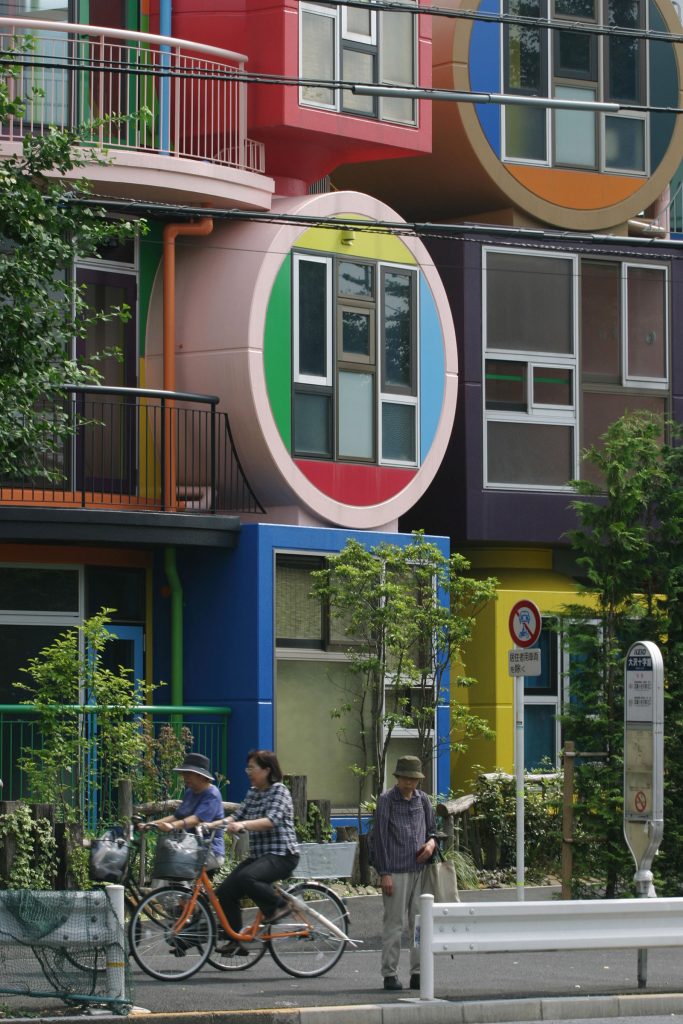
In 2010, artists-turned-architects Shūsaku Arakawa and Madeline Gins founded the Reversible Destiny Foundation at their loft and studio on Houston Street in New York, a network for collaborations primarily intended to further their project pursuing immortality through speculative architecture and theoretical inquiries. Created under their provocative mandate ‘we have decided not to die’, these visionary sites of ‘reversible destiny’, implemented in the 1990s and early 2000s, aimed to increase mental and bodily awareness. Their buildings were designed to train the occupant to ‘not die’ through built features including uneven and undulating floors, unusual shifts in scale, and vibrant colour combinations, intended to make the occupant confront their body and senses. 

Arakawa and Gins’ modus was to create environments that demand attention, challenging the senses through constant visual and physical stimulation, compelling us to re-evaluate our world and ourselves. In problematising our bodily states, they suggest, we cannot subsist in stasis or succumb to death. As Gins said, ‘We don’t have to be passive. We can reverse the usual downhill course of things’.

svg%3E

Screen Valves, 1985-87

svg%3E

Drawing for a Ubiquitous Site X, 1990

Developed over a five-decade-long creative partnership, Arakawa and Gins’ collective projects encompassed architecture, film, painting, philosophy, poetry and scientific research. Their oeuvre is an odyssey in metamorphosis and mutability – themes the pair would continue to explore throughout their career. Central to their artistic experiments was an underlying questioning of the potential of human perception and experience, and how understanding ourselves as bodies in space can be shaped and reshaped, thought and rethought.

The couple (in both work and life) belonged to the downtown New York art milieu of the 1960s. Arakawa, born in Nagoya, Japan in 1936, attended the Musashino Art University in Tokyo where he began his affiliation with the Neo-Dadaist Organizers, the avant-garde group who borrowed from the materials of everyday life to exploit notions of wit and deadpan humour, and elicit participatory performances that made viewers self-aware of the very act of looking. Gins was born in New York in 1941 and, shortly after graduating from Barnard College in 1962 with a Physics and Eastern Philosophy degree, turned to experimental fiction and poetry. Arakawa moved to New York in the autumn of 1961 and quickly befriended Marcel Duchamp along with other notable figures including John Cage, and was exhibiting works at the Dwan Gallery in Los Angeles by 1965. He met Gins in 1962 while taking classes at the former Brooklyn Museum Art School (BMAS), at a time when many seriously questioned socio-cultural and political life in the US. This, paired with the fact that Arakawa was born in the recent aftermath of the Second World War, alludes to their collaborative efforts to construct a more optimistic version of the world, one that bridged the discourse of conceptual art with the rhetoric of Dadaism and philosophical investigations into phenomenology, linguistics and cognition.

svg%3E

© 1994-2018 Estate of Madeline Gins. Reproduced with permission of the Estate of Madeline Gins

Biography

Key works

Screen Valves, 1985-87 Ubiquitous Site * Nagi’s Ryoanji * Architectural Body, 1994
Critical Resemblance House, Yoro Park, 1995
Elliptical Field, Yoro Park, 1995
We Have Decided Not to Die, 1997
Reversible Destiny Lofts, Mitaka, 2005
Bioscleave House, East Hampton, 2008
Biotopological Scale-Juggling Escalator, New York, 2013

Quote

‘Most people, in choosing a new home, look for comfort ... Nonsense. People, particularly old people, shouldn’t relax and sit back to help them decline’

Through their independent practices – Arakawa as a conceptual artist turned painter and Gins as an experimental writer – both explored signification through the use of words and symbols, and sought to push possibilities in art and language. Arakawa’s early paintings challenge the capacity of cognition and many already reference architectural elements, such as highly schematic imagery, that suggest blueprints and diagrams, including the windows depicted in his Alphabet Skin (1965-66). In her books, poems and scripts, including her first two publications WORD RAIN (or a Discursive Introduction to the Intimate Philosophical Investigations of G,R,E,T,A, G,A,R,B,O, It Says) from 1969 and What the President Will Say and Do!! in 1984, Gins employed linguistic stunts and playful typographic treatments to explore philosophical issues within an activated space between reader and author. 

A concern for sensorial and perceptual stimulation is evident in their first truly collaborative project, begun in 1963. The Mechanism of Meaning is a collection of 83 mixed-media, human-sized puzzle-panels, proposing a series of visual, language, and thought exercises, many of them requiring physical interaction to test the automatic ways in which people perceive their surroundings. Intended to shape our cognitive apparatus, The Mechanism of Meaning anticipates later works by Arakawa and Gins that became increasingly spatial, going from the page to three dimensions, and eventually to the realm of architecture. In 1969, Arakawa and Gins contributed to guerrilla literary and art project Street Works IV, creating artworks on the pavements of Manhattan; Arakawa planned to ‘remove the Empire State Building and place it in front of the Architectural League’. 

svg%3E

Reversible Destiny Lofts, Mitaka, Tokyo

svg%3E

Reversible Destiny Lofts, Mitaka, Tokyo

Forgoing traditional notions of comfort and convenience, their work intended to confront the physical body with corporeal and mental challenges in an attempt to multiply the ways the body interacts with architecture. Their first consideration of architectural space at full-scale was in 1983 with Container for Mind-Blank-Body, an unrealised proposal for the Venetian island Madonna del Monte. The project lives on as extraordinary exploratory drawings, which illustrate the sequence of different sensorial units one would pass through, featuring undulating topography, walls to be walked through, and trench-like passageways to confront the body’s limitations.

‘Arakawa and Gins put architecture in the service of the mutable body, aiding in the structuring of the self’ 

Many of these elements can be found at Yoro Park in Gifu, Japan; this 18,000m2 urban experiment from 1995 is an elliptical public space known for its tilted terrain and conceptual sculptures. In Critical Resemblance House, one of the park’s buildings, a maze of walls bisect everyday items such as a bath, chair or toilet, questioning how we define objects and their respective functions. The potential for the reassignment of meanings and experiences is also central to Ubiquitous Site * Nagi’s Ryoanji * Architectural Body, one of three large-scale permanent installations at Arata Isozaki’s Nagi Museum of Contemporary Art in Okayama. Realised in 1994, the capsule-shaped installation is also Arakawa and Gins’ first permanent architectural work; two replicas of the Ryoanji Garden in Kyoto affixed to the walls mirror one another while a see-saw appears on the floor and ceiling in different scales, toying with our perceptions and causing a sense of dislocation. Two residential projects, Reversible Destiny Lofts, Mitaka in Tokyo from 2005 and Bioscleave House (Lifespan Extending Villa) in East Hampton, NY, three years later, incorporate multi-coloured spaces – the lofts are rendered in 14 paint colours while Bioscleave has 52. With textured, bumpy floors to stimulate the senses, these two projects allow inhabitants to ‘discover the full potential of the body’. 

svg%3E

Elliptical Field at Yoro Park, Japan, 1995

svg%3E

Critical Resemblance House at Yoro Park, Japan, 1995

These are the only full-scale architecture projects realised in their lifetime, yet they constitute the ideas and methodologies Arakawa and Gins explored throughout their careers, and speak to their ultimate commitment to architecture. As with the duo’s early independent investigations, their radical architectural ethos attempted to systematically undo physical and mental habits in an effort to unsettle automatisms and what they perceived as a complacency with normative behaviours. They saw their architectural projects as strategies for heightened awareness and life-extending experiments, where commonplace sensorial experiences are deliberately denied, and replaced with ‘procedures’ for new ways of thinking and moving in space: a practice conceived to re-educate, or even coerce, the body. Space, time and the self are seen as a dynamic progression of experiences, rather than as one static, concluding experience. 

To transform the mind and body through space, they expanded on diverse discourses, straddling conceptual art, experimental poetry, philosophical inquiry, linguistics, cognition, disability studies, medical research and phenomenology, bringing these pluralistic interests into their architectural projects. Gins once referred to the architectural manifestation of their work as ‘an interactive laboratory for everyday life’. 

svg%3E

Bioscleave House, East Hampton, 2008

svg%3E

Bioscleave House, East Hampton, 2008

Their approach to architecture, like all subjects they pursued, might be best understood as a way to pose questions more than offering precise answers. As Duchamp put painting back ‘in the service of the mind’, Arakawa and Gins put architecture in the service of the mutable body. Central to this ideology is the notion that architecture can aid in the structuring of the self. In what could be described as the artists’ architectural treatise, the human form is inseparable from site, as body, person and world are interlaced. Both Arakawa and Gins were independently inspired by American blind-deaf writer Helen Keller. Gins’ genre-bending, multi-person biography, Helen Keller or Arakawa (1994) commingles the lives of the historical figure, the artist Arakawa, as well as the author, Gins, to collapse time, place and identities, and question what constitutes an able body.

In their attempt to radically reshape the conditions of perception, they devised their own set of terms to describe their goals, including ‘architectural body’, articulated in their 2002 manifesto-book of the same name. In it, they describe the reciprocity between body and architecture, and how, through architecture, meaning is created and defined through a process of self-invention.

svg%3E

Ubiquitous Site * Nagi’s Ryoanji * Architectural Body, 1994

Later speculative projects were envisioned on an urban scale, including the development of apartment complexes, public housing and plans for entire cities, which live on today as schematic studies, models and digital renderings. Arakawa and Gins brought to these projects similar elements from their past works, including labyrinthine terrains, colourful and volumetric architectures (cubes, spheres, pyramids) and a continued experimentation with programme and space. Of the 2003 unrealised Isle of Reversible Destiny, Fukuoka, Gins wrote: ‘A very natural-appearing engineered terrain, an extremely re-articulated terrain makes it possible for the body and the city to operate conjointly – as much kinaesthetically, proprioceptively, and tactilely as visually.’ Though these projects were never realised, their questioning of what constitutes a body, through an approach to creating designs for the reconstruction of experience, brings their work into proximity with fields such as artificial life research. 

Since their deaths (Arakawa in 2010 and Gins in 2014), many have argued the various interpretations of their work. Some have suggested it was metaphorical provocation. Some believe it was to be taken at face value. Others still offer the idea that the work was about the act of processing, rather than an argument about whether or not they truly believed architecture could reverse death. For Arakawa and Gins, the best way to understand the world (and thus ourselves), is to overturn it as it is. If anything, such an ambitious and experimental undertaking remains their greatest legacy.