Showing posts with label Peter Greenaway. Show all posts

Friday, 19 June 2026

Hortus Conclusus~As a Shared Ecological~Creative Practice : A Serious Place, Peter Zumthor on sheltered places of great intimacy where I want to stay for a long time.

Your draft has strong ideas and rich references, but much of the writing is in note form, and some sentences are long or repetitive. Below is a revised version that keeps your academic tone while making the argument clearer, more fluid, and easier to follow.

This version has a stronger narrative flow. Rather than reading as a sequence of research notes, it develops a continuous argument about the hortus conclusus as a model of sensory experience, pastoral practice, contemplation, and spatial identity. It also reduces repetition while preserving your quotations and references.

chatgpt.com


Felt Relations~Sympathy : What things feel when they shape each other.

Exploring Materiality and Connectivity in Anthropology and Beyond.

Philipp Schorch, Martin Saxer, Marlen Elders.


In The Gathering Shadows of Material Things.

Tim Ingold.


The Sympathy of Things.

Lars Spuybroek


Original research material from Interiors UCA Farnham 2014.

With a refined selection of materials, Zumthor creates a contemplative space that evokes the spiritual dimension of our physical environment. In doing so, he emphasises the role that the senses and emotions play in our experience of architecture (Zumthor 2011: 15).


The garden is enclosed on all sides yet open to the sky: an architectural setting that offers both protection and openness. Zumthor describes such spaces as "sheltered places of great intimacy where I want to stay for a long time" (Zumthor 2011: 15).


For Zumthor, the garden is more than a collection of plants. Every species evokes distinct memories of light, smell, sound, and touch. Gardens become places where sensory experience and memory are inseparable:


"Every plant name listed here evokes a distinct image; with each of them I associate specific lighting, smells and sounds, many kinds of rest, and a deep awareness of the earth and its flora." (Zumthor 2011: 15)


He continues by describing the garden as the most intimate form of landscape:


"A garden is the most intimate landscape ensemble I know of. In it we cultivate the plants we need. A garden requires care and protection. And so we encircle it, we defend it and fend for it. We give it shelter. The garden turns into a place." (Zumthor 2011: 15)


The enclosed garden becomes a sanctuary—a small protected world held within a larger landscape. As Zumthor observes, "something small has found sanctuary within something big" (Zumthor 2011: 15).


The medieval illustration Orchard from the Bible of Wenceslaus IV (Austrian National Library, Vienna) visualises this idea through the illuminated depiction of husbandry and communal labour within the secure enclosure of a walled garden. The image presents pastoral work as both productive and contemplative, echoing Zumthor's conception of the hortus conclusus as a protected space where cultivation, community, and intimacy converge.


Working with one's hands, cultivating the earth within sheltered spaces, becomes a shared pastoral practice that binds people to place.


Zumthor reinforces this pastoral character by placing a pavilion at the centre of the garden. He imagines it as a place for future gatherings and quiet contemplation, anticipating "the natural energy and beauty of the tableau vivant of grasses, flowers and shrubs. I am looking forward to the colours and shapes, the smell of the soil, the movement of the leaves" (Zumthor 2011: 15). The garden is therefore experienced not only visually but through the full range of the senses.


Elizabeth Knox's The Vintner's Luck similarly evokes an intimate relationship between landscape and human experience. The taste of wine becomes inseparable from the soil that produced it; earth and wine are of the same substance, united by locality and landscape.


Alexander Kluge develops a related idea in Gardens Are Like Wells, suggesting that every person possesses an "enclosed garden"—an inner space of reflection that exists regardless of one's outward life.


He writes that monasteries in medieval Europe functioned as wells in which "the clear waters of antiquity mingled with the dark waters of faith." At the heart of these monasteries lay an enclosed garden, where the finest plants and medicinal herbs were cultivated (Kluge 2011: 19).


Significantly, Kluge argues that these gardens existed outside the ordinary routines of monastic life. They were timeless places, dedicated to the Virgin Mary while remaining open to classical and alternative traditions, including Homer, Ovid, and the Gnostics. The enclosed garden therefore became a place where literature, contemplation, and spirituality could coexist. It represents an interiority capable of uniting mind and perception amid the complexity of contemporary life.


Kluge concludes that civilisation requires spaces that remain outside systems of production and utility:


"Civilisation and societies need ground that is uncultivated, gaps that are not subject to the principle of unity, something that is sufficient unto itself, which we do not consume: a sacrifice. Cities need spaces of piety." (Kluge 2011: 21)


This sentiment resonates with Richard Sennett's assertion that "we need places in which we can engage in acts of mourning." Such spaces provide opportunities for reflection, remembrance, and emotional renewal beyond the demands of everyday life.


The Development Company for Television Programmes (DCTP), in Gardens of Information, also adopts the emblem of the hortus conclusus. Here, the enclosed garden symbolises the relationship between barren landscapes and places of meaning. Their ambition is "to rescue facts from human indifference" and "to make gardens out of raw material and the bare bones of information" (Kluge 2011: 21). The garden becomes a metaphor for transforming fragmented knowledge into coherent and meaningful experience.


This understanding connects with ideas of spatial practice in the twenty-first century. Rather than forming relationships through abstract systems, institutions, or grand narratives, meaning emerges through inclusive practices rooted in particular places. The hortus conclusus can therefore be understood as a model of concentrated identity—an inquiry, a person, or a practice held within an intimate setting where thought, making, and community come together.


Wednesday, 18 March 2026

Speculative Gestures of Agencing Attention : Template and Form/Enchantments and Insights between materials

Making Objects : Of a critical and theoretical nature.

Clay : Atmospheric Interpretations.

Ceramics~Abstract Painting : Re-Consolidations/Abstract Vessels.

https://www.curatorspace.com/artists/russellmoreton


THE BODY AS A TERRITORY IN RAW CLAY

Developing Formative Histories/Indexical and Involuntary Markings 

Observational essay/account whilst work is resident in the Yard,

Pastoral Space: Material, Inquiry and Craft

Temporality. The state of existing within or having some relationship with time. A clay form with its pre-performative drawing used as a template.

These distinctively different yet closely related works are arranged with the clay piece on its custom made trolley with its calico material that acts as a sheet on which the clay work rests. The drawing is placed behind it fastened to a wall with the drawings bottom edge just making contact with the floor adjacent to the castors that grant the clays supportive trolley mobility. The clay work has a direct relation to this adjacent drawing, the drawing is revealing the traced female that is just discernable on the surface of the clay. On closer inspection of the drawing it is just possible to see a rubbing taken from the periphery of the clay form. Both the paper and the clay seem to be in some reflective mode of mutual intimacy, marks transferred between one another during the manufacture of both are subtly replicated on the form of one and the surface of another. The pierced clay slab (vessel) is the first visible casualty of the entropic process of shrinkage. A significant crack separates the clay vessel into two separate but unique entities that share the same defect as if they were still whole. This division through the continent of the body has been subtly marked by the raised furrow of silica deposited when the clay bodies were in closer proximity. The calico has also rendered a new visual territory around the entire periphery of the form, created by the deposited silica sand and the resultant shrinkage that is taking place. There is the sense of this form moving in two dimensions, creating an extended footprint of previously covered territory whilst continuing to shrink bodily within the details and markings on its surface. This phenomena seems to give the piece a strange complexity of both temporality and a duration on which that temporality is directly charted, the calico is instrumental in registering this perception. The agencies of both the silica sand and the calico sheet between them regulate and guide our understanding of the observation of the clays infinitesimal shrinkage. The compression of the clays structure due to its shrinkage increases its density and visually alters the arrangement of the piercing that are mapped over its surface, the concise circles and holes cut through the clay have now blended into the overall tension imparted by shrinkage, there is a sense that precision of the marks, their machined appearance which contrasted to the locality to the clay around them has been lost, reclaimed by the inner natural torsions taking control of the piece as a whole. The clays surface with its sandy granular deposits whose particle size has become visually larger at the expense of its hosts shrinkage now auger for a territory, a land mass devoid of water, the sense of this territory becoming anhydrous, giving rise to thoughts of thirst and fragility, even the once precise holes give the impression of barren watering places isolated within a landscape in a state of drought. The once visible markings are now obscured by the action of the shrinking territory and its granular coating as it now gains in its ability to obscure features. The traced and drawn female form is still harboured somewhere under this obscuring sand. Yet she now resides as a brittle uncompromising inscription of her former self, the plasticity that once gave her a sensuality into the yielding and pliable surface has succumbed to the unstoppable internal shrinkage of the clay particles starved of moisture. The clay is acknowledging the atmosphere of its given surroundings, our environment.


The Draught, J G Ballard 

The Woman in the Dunes, Kobo Abe

The Disposition of the Body, Peter Greenaway (The Draughtsman’s Contract)


The clay suffers, dehydrates as its moisture is absorbed by the surrounding atmosphere, giving up its plasticity and its almost inhuman sensuality and tactility. Presented amongst us, it is rendered into a state of its own homogeneity Conversely the working drawing which has evolved from being a simple template to aid the registration of celestial information within the territory of the body. Has itself become involved in its own creation as an art object. On completing its initial purpose, the task of transferring details onto the surface of the embryonic clay form. It has now become embroiled and entangled as it were with the creative issues of the clay form; “they” have become members of the same intuitions the same creative flux, sisters. The drawn “sister” contains the origin of their shared inscription, the originating female trace. The gesture and act still remains, visible only by physical impression of transference; which is left proud, raised and projecting passed the original flatness of the paper. These material read together render insights into superimposed temporalities shared by the art object, they question and reveal the reverse side of origins, of the work or its working drawing, they all underline the complexities and multiplicities of contemporary art practice.


The Drawing strangely or ironically displays values in a state of stasis, now lost with its sister. The cyanotype “sea” with its fluidity bleeding into the porosity of the news print. The “ streams” of residues washed from other areas are now deposited into the interior space where they have collected finally to evaporate leaving their watery remains. Only the clarity of the “permanent” marker pen remains untouched by any entropic activity. Objectively the drawing materials has slowed down to the point when one might grant it a measure of completeness. Its particular temporalities now exist within the interactions it can manifest from others, other things, other situations that are drawn into its proximity, its particular field of intuitive reverberations, its unique dwelling place.

The clay form seems to have gathered up its history of temporal acts that culminate in its present form. This presented object, with temporalities marked on site has become a vehicle, a vessel for its own entropic voyage, another temporality that itself adds a spatial dimension. This object for me appears to be totally contingent yet relational to aspects of space and time, it exists uniquely “once” in the present, presence it creates with its observer. The result of this contingent object is that “we through it” are constantly travelling away from its point of origin, we as a result feel the passage of the entropic value of time through the human condition. Whereas the drawing does refer to a now and a past, an elsewhere ,it seems locked between these two comprehensions.

The clay form has clearly an entropic element which seems to give rise to phenomenologically driven inquiry which in turn helps to creates our sense of a spatiality. Uniquely formed between observation and our own movement, we are in effect made to sense that the object heralds our own becoming.


Material Agency : Carl Knappett, Lambros Malafouris

Visualising Environmental Agency


"Agents are defined as persons or things, which have the ability and intention to "cause" something "in the vicinity" or "in the mileau" to happen ( Art and Agency, Alfred Gell 1998)"

"These latter artefacts are described with the term "index", to remove the appellation "art" and to imply that they are indexes of agency."

Some Stimulating Solutions, Andrew Cochrane.


Drawing intervention and speculative sculptural environment. 


Speculative Learning Environment : Russell Moreton.

Re- Imagining Education, Brockwood Park School. 

Teacher Education Manual

Insight-Bohm-Krishnamurti. 1979

David Bohm, Are we saying that insight is an energy which illuminates the activity of the brain, and that in this illumination the brain itself begins to act differently?

Krishnamurti, You are quite right. That's all-that is what takes place. That is -this flash has altered completely the pattern which the material process has set.


a thousand plateaus

Deleuze, Guattari


Assemblage

Becoming

Body Without Organs

Nomad

Rhizome

Smooth Space

State

War Machine

The book, as described above, is a jumbling together of discrete parts or pieces that is capable of producing any number effects, rather than a tightly organized and coherent whole producing one dominant reading.

The beauty of the assemblage is that, since it lacks organization, it can draw into its body any number of disparate elements. The book itself can be an assemblage, but its status as an assemblage does not prevent it from containing assemblages within itself or entering into new assemblages with readers, libraries, bonfires, bookstores, etc.


Sunday, 13 October 2024

Drawing : From Blindness to Evidence/Figures, Doors and Passages.

Outpost 131024


Taking Sides.

On The Phenomena of Vision : From Blindness to Evidence.

The debt at the origin of all drawing.

https://www.flickr.com/photos/russellmoreton/


Derrida in 'Memoirs of the Blind' opens our eyes to this strange filiation, to this sort of conversation or duel between different generations of 'Taking Sides'. It not only teaches us much about blindness, vision, and drawing – about philosophy and art – but leaves us another way to understand the legacy of drawing and vision, the legacy of representation, the legacy of legacy itself.


I have grown to believe that a really intelligent man makes an indifferent painter, for painting requires a certain blindness – a partial refusal to be aware of all the options.

Mrs Talmann, spoken words from The Draughtsman's Contract


It thus will have seen to it to interrupt the legacy of a monocular vision in order to lead us by the hand towards this other legacy that is passed down in darkness. Opening eyes, then, yes – but only in order to cancel them, and to recall that the draughtsman's contract always concerns a pleasure and a condition that are not only out of sight, but out of this world.


Jacques Derrida.

Memoirs of the Blind.

The Self Portrait and Other Ruins.

Witnessing/Testimony/Legacies/Inheritances.


Like a dream, then, of whispering clouds, one can almost hear this obscure communication between past, present, and future, between Derrida and Greenaway, between them and us, between all those 'taking sides' on the other side of vision – in the night.


These are Derrida's themes in 'Memoirs of the Blind'


Blindness, dispropriation and the interruption of a lineage or filiation: the cancellation of what makes representation possible, the difference between the body proper and the supplement, the living body and the scarecrow, and the ruination and death of all foresight, all representation, and all legacies. 


A singular genealogy, a singular illustration of oneself among all these illustrious blind men who keep each other in memory, who greet and recognize one another in the night,

Derrida.


An exhibition ( of selected works) that reflects Derrida's inquiry on vision through the metaphor of blind men and visionaries.


Drawing/Filiations, the relations of one thing to another from which  it is derived or descended.


The Draughtsman's Contract.

Peter Greenaway.


A film about the differences between drawing, painting and sculpture, about allegory and ruin, about masks and funeral monuments, about strategies and debts, optics and blinds, about living statues and sounds represented in drawing. But above all it is about witnessing and testimony, about legacies and inheritances. The very themes of 'Memoirs of the Blind'.

Pascale-Anne Brault, Michael Naas.


Wednesday, 12 April 2023

Openings and Conclusions/Frameworks with Enclosures : Site Specificity/Installation

On the horizon, then, at the furthest edge of the possible, it is a matter of producing the space of the human species-the collective (generic) work of the species-on the model of what used to be called "art" ; indeed, it is still so called, but art no longer has any meaning at the level of an "object" isolated by and for the individual.

Henri Lefebvre, Openings and Conclusions.
On Installation and Site Specificity (introduction) Erika Suderburg

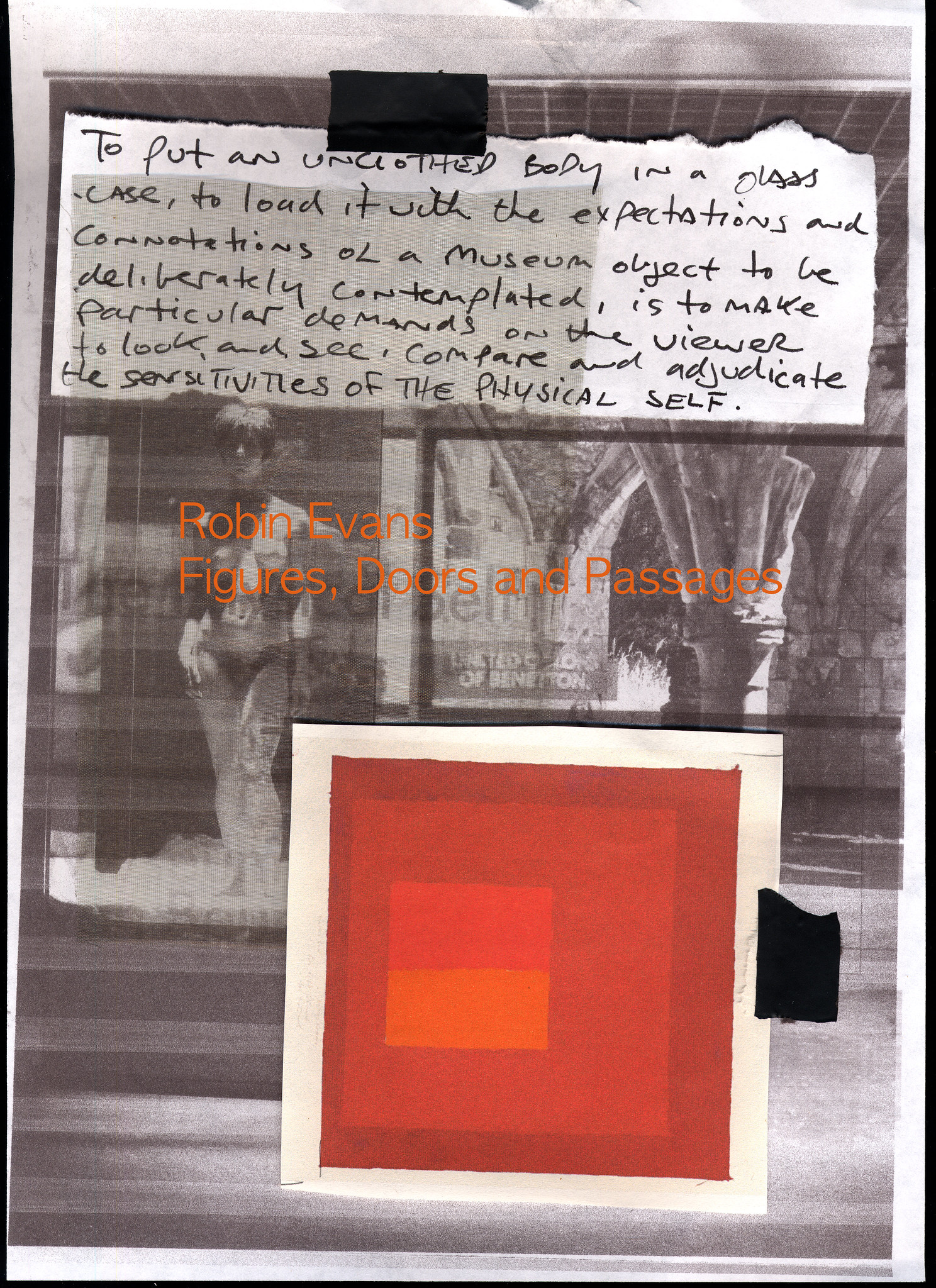
Collage on paper,written fragments and images from Peter Greenaway, Josef Albers and Robin Evans.

Photo montage of The Physical Self (Greenaway) and Waverley Abbey UK.
Visual research as part of The Waverley Project/Obscura and Reading Room.

TheThinking Hand: Existential and Embodied Wisdom in Architecture.
Juhani Pallasmaa

Frameworks with Enclosures

Of the mason's who built them, we can say that they both designed as they drew, and drew as they designed. But their designing, like their drawing, was a process of work, not a  project of the mind.


Tim Ingold 'Making'


Monday, 23 May 2022

Art and Architecture : a place between, Jane Rendell, Peter Greenaway, Intertextuality/Transparency

 OPEN TEXTS. 

Allow readers to have multiple interpretations, they allow for the possibility of  “determinations”.

Intertextuality fundamental concept “that no text much as it might like to appear so, is original and unique in itself. Rather it is a tissue of the inevitable , and to an extent unwittingly references to and quotation from other texts.” 


SELECTED BIBLIOGRAPHY AND REFERENCES 

Edward S. Casey, The Fate of Place (Berkley: University of California Press, 1998 ) 

Juhani Pallasmaa, Eyes of the Skin, Architecture and the Senses (Chichester: Wiley, 2005 )

Peter Greenaway, The Physical Self (Rotterdam: Boymans-van Beuningen Museum, 1992)

Henri Lefebvre, The Production of Space (Oxford: Blackwell, 2000) 

J. G. Ballard, High Rise (London: Jonathan Cape, 1967)

David Wood, The Deconstruction of Time (Evanston: Northwestern University Press, 2001 )

Ian Buchanan, Deleuze and Space (Edinburgh: Edinburgh University Press, 2006) 

Vilem Flusser, Towards a Philosophy of Photography (London: Reaktion, 2000 )

Robert Cooper, Peripheral Vision: Relationality (London: Sage Publishing, 2005) 

Jonathan Murdoch, Post Structuralist Geography ( London: Sage Publishing, 2006) 

Markus Miessen, Did Someone Say Participate, an atlas of Spatial Practice (Cambridge, Massachusetts: MIT Press, 2006)

Russell Ferguson, Francis Alys, Politics of Rehearsal (Los Angeles: Hammer Museum, 2008)

Elizabeth Grosz, Space, Time, and Perversion (London: Routledge, 1996) 

Tracey Wan, The Artists Body (London: Phaidon Press, 2000)

Francois Dagonet, Etienne-jules Marey: a passion for the trace ( New York: Zonebooks, 1992 )

Colin Rowe, Transparency ( Basel: Birkhauser, 1997)

Avis Newman, The Stage of Drawing, Gesture and Act (London: The Tate Drawing Centre, 2001)

Giuseppe Penone, The Eroded Steps (Halifax: HMST, 1989)

Glen Onwin, The Recovery of dissolved substances ( Halifax: HMST, 1992) 

Carolyn Bakargiev, Arte Povera (London: Phaiden Press, 2003)

David Green, Stillness and Time, Photography and the moving image ( Brighton: Photoworks, 2006)

Catherine Lupton, Chris Marker, memories of the future (London: Reaktion, 2004 ) 

Martin Amis, Times Arrow (London: Jonathan Cape, 1991)

Yve Lomax, Sounding the Event: escapades in the dialogue and matters of art, nature and time (London: I. B. Tauris, 2005 )

John Wood, The Virtual Embodied, presence, practice, technology (London: Routledge, 1998)

Lucy Bullivant, Responsive Environments, Architecture Art and Design { London: V&A, 2005)

Gaston Bachelard, The Poetics of Space (Boston: Beacon Press, 1994)

Italo Calvino, Six Memos for the next millennium (London: Jonathan Cape, 1992) 

Douwe Draaisma Metaphors of Memory (Cambridge: Cambridge University Press, 2000)

Paul St George, Sequences: Contemporary chronophotography and experimental digital art ( London: Wallflower, 2008)

Hans Christian von Baeyer Information, The new language of Science (London: Weidenfeld and Nicolson, 2003)

Andrey Tarkovsky, Sculpting in Time (Austin: University of Texas Press, 1986) 

Susan Broadhurst, Liminal Acts ,a critical review of contemporary performance and theory ( London: Cassell, 1999)

Eduardo Cadava, Words of Light (New Jersey: Princetown University Press, 1997) 

Giuliana Bruno, Public Intimacy ( London: MIT press, 2007 )

Jeanette Winterson, Written on the body (London: Jonathan Cape, 1992)

Jane Rendell, Art and Architecture, a place between (London: I. B. Tauris, 2006 ) 

Thierry de Duve, The Definitively unfinished Marcel Duchamp ( Cambridge, mass: MIT Press, 1991 )

Always fascinated by the “return shelves” in a library, its like a barometer of specific activity, it holds within it occurrences and possibilities that are un-calculable to predict It concurs traits of other events/projects happening outside, it reflects those items of the libraries resource have been selected and those not. It is perhaps the curiosity, the reading between what is presented that prompts speculation and ultimately one forms/registers a subjectivity and an opinion based around ones own particular space of time. These shelves “sample” my potentialities amid a on-going field of relations of which I am part as my “returns” configure a new abstraction of data.


RESEARCH METHODOLOGIES:

Fluctuating networks of existential events.

Emergent state of continguences that create materials for relationality.


TRANSPARENCY: LITERAL AND PHENOMENAL. COLIN ROWE AND ROBERT SLUTZKY.

Space-time, simultaneity, interpenetration, superimposition, ambivalence. Transparency has a material condition that is pervious to light and air. Together with an “intellectual imperative” this has an “inherent demand for that which should de easily detected, perfectly evident, and free from dissimulation.”1 Transparency allows things to interpenetrate. Things can become masked and ambivalent by this superimposition but the things themselves remain authentic and unabridged.

Transparency can grant us a “simultaneous perception of different spatial locations.” These values of being able to interpenetrate simultaneously and thus create a potential threshold that is in a state of in-betweeness. 

Transparency by its very nature confronts us with the contradiction of spatial dimensions. Contradictions that might require the physicality of the body to authenticate. There are also Contradictions centred on a linguistic transparency. 

Transparency could become a site or form of temporal phenomena, granting some sort of deconstruction when viewed as a simultaneous multiplicity.

The interesting proprieties of transparency is its ability to have the quality of a substance ( glass, plastics, film, water) together with qualities we ascribe to it when we use it in the context of organisational systems. It is this literal and phenomenal spatiality that is infinitely relational. This relation allows us to invest transparency with a literal depth so as we can assume the phenomenal substance beyond it. 

This sense of a spatial transparency is exploited as a filmic phenomenon, film directors by moving in and out of the framic reference of the camera, create within the mind of the viewer an illusion of a spatiality that is both transparent and virtual.

The use of transparency as a device to aid the spatial organisation of place in architecture is under investigation. Notions that “worksites” could be “assigned directional systems” which could help to engender relations of human enterprise and encounter. 

The organizational transparency of the figure ground relation in architectural mapping creates a differentiation to the integral ordering of space. This opens up the possibilities of investigative ideas around poche (a drawing method showing material structure and space in relation to each other) poche is related to transparency by precise inversion (material and space). 

Transparency can be used as a method of creating multiplicities through the device of superimposition.In so doing it creates surfaces that have mutuality by the nature of being able to be visually overwritten.

1.Colin Rowe and Robert Slutzky, Transparency: Literal and Phenomenal (Berlin: Birkhauser Basel, 1998),page 22.


ALLEGORY, MONTAGE AND DIALECTICAL IMAGE, JANE RENDELL.

This chapter, in Jane Rendell’s Art and Architecture, A Place Between, offers a number of possibilities for the interpretation of my current investigative research. In particular, her analysis of Walter Benjamin’s discussion on the temporal aspects of allegorical and montage techniques in works of art.1

 Rendell cites Benjamin’s The Origin of German Tragic Drama,2 as having a particular form of a baroque theatre, where the temporal, and the corporeal body, meet the transcendental. Within the structure of these there plays a sadness of life represented as a “nature petrified in the form of fragments of death.”3

This notion of using objects as allegorical devices within the duration and place of an event, interests me.

This allegorical device within “Place” is further elaborated by Benjamin himself when he remarks, “allegories are, in the realm of thoughts, what ruins are in the realm of things”.4

This relationship with time and allegory could be performative and immersive. Benjamin notes baroque allegory to be “an appreciation of the transience of things, as well as an expression of sadness over the futility of attempting to save for eternity those things that are transient.”5 This expression could be rendered as a work of art. Joseph Beuys has used the device of vitrines that suggest the collection of relics from a museum. His work Sweeping Up 1972/85 is a vitrine containing contents originated from an “action” performed by Beuys. In this work the contents were collected after a political parade in Berlin. This work, on view in Tate Modem, has a sensibility of indexical residues suffused with almost alchemeric properties. The notion of a vitrine being able to carry a visual joke or pun is perhaps Duchampian. Peter Greenaway’s curated exhibition, The Physical Self6 explores these notions further, through static displays of both objects and human bodies presented in the context of a museum. Greenaway has in effect, attempted to use a museum setting to amplify the sense of retrospectective contemplation of our own temporality.

Rendell remarks on Benjamin’s interest in the dialectical image, explained as an image whose “moment where the past is recognized in the present as a ruin that was once desired.”7 The interesting thing is that Benjamin’s dialectical image is an “attempt to capture dialectical contradiction in an instant, as a visual image or object.”8 It is this dialectical threshold the “point at which thesis and antithesis converged”9 that could be utilized as a physical possibility (intervention) within a place. The clarification of ideas through interactions and contradictions through a performative exploration with an immersion with site might be made to occur. The uses, as noted by Rendell, of montage and Dadaist artwork in film, was admired by Benjamin for its shock tactics and are also  associative with the notion of interventions whose purpose is to “interrupt the context into which it is inserted.”10 This idea of an intervention, could work as an emergent phenomena that sets up a sense of temporal dynamics in a location or place.

A number of contemporary artists have used a wide range of physical interventions with their particular dialogues with place. Jane Prophets, Conductor 2000 was a site specific response to Wapping Hydraulic Pumping station. Prophet utilized water and electro luminescent cables in her installation. Glen Onwins, As Above So Below 1991, was again a site specific intervention, utilizing black and white dyed brine, gypsum and coal with green light, all installed at Square Chapel, Halifax. Graham Gussin, Spill 1999, was a filmic work of a situation in which a disused commercial building was infiltrated by “fog” (dry ice). 


The architect Rem Koolhaas has used an intervention device in the initial design, which produces an architectural structure that is inherently “weak”, then requiring a major structural intervention to be made to stabilize the building. This in turn re-scripts the building through chance and change and produces innovative and creative possibilities through contingences now made apparent.

To bring about some sense of conclusion regarding Benjamin’s dialectical image or rather its device of using “dialectics at a standstill” that create an intervention of retrospective contemplation, is Jane Rendell’s suggestion, taken from Howard Caygill, that Benjamin’s writing was part of the “speculative effort to discover and invent new forms.”11 This speculative nature promotes “moments where the viewer is required to act as critic and to engage in a slower time.”12 The interlocutor into a site could be said to be given the dialectical task of synthesizing/theorizing what has been “present”, with what has become emergent with their own encounter .This notion of both site specificity and open text is of interest.

Further potentials within “place” for an immersive engagement that might foster an “open reading”. This scripting of ones presence as an interlocutor amongst others could create a performative gesture. Like a drawing whose informative mark is just a starting point amongst others unknowable until the intimacy of the unfamiliar is breached, so the “place “ is inscribed or known by its initial un-familiarity.


1  .Jane Rendell, Art and Architecture: A place Between (London: I. B. Tauris,2006), page75.

2  .Benjamin, Origin of German Tragic Drama, translated by John Osborne (London: Verso, 1977).

3  .Ibid., page 178.

4  .Ibid., page 178.

5  .Benjamin, Origin of German Tragic Drama, translated by John Osborne (London: Verso, 1977),page223.

6  .Peter Greenaway, The Physical Self (Rotterdam: Museum Boymans-van Beuningen,1992).

7  .Jane Rendell, Art and Architecture: A Place Between, (London: I. B. Tauris,2006), page 77.

8  .Ibid., page 77.

9  .Ibid., page 77.

l0  .Jane Rendell, Art and Architecture: A Place Between (London: I. B. Tauris, 2006),page 78.

11 .Howard Caygill, The Colour of Experience (London: Routledge, 1998),page74-75.

12 .Jane Rendell, Art and Architecture: A Place Between (London: I. B. Tauris, 2006), pagel43.

Mise-en abyme “Play within a Play”

“A play within a play alludes to and explicates the plot of a larger play within which it is staged"


THE PHYSICAL SELF: PETER GREENAWAY, 

MUSEUM BOYMANS-VAN BEUNINGEN ROTTERDAM.

Peter Greenaway’s work interests me with its playful and investigative attitudes to the visualization of dialogues around what he himself calls “the physical human predicament.” 

His exhibition is centred on the interactions on the issue of “the physical human predicament” and the available “contents” of the place of its presentation. The situation and contents of the display of historical artefacts and naked human beings in glass cases are relational attempts to illustrate Greenaway’s sense of the dissimilarities between objects and human existence. 

This work touches the territory of the allegorical. Walter Benjamin has said of the allegorical “allegories are, in the realm of thoughts, what ruins are in the realm of things.”1 This relation is embodied by the physical display of living human beings being firstly dislocated/annexed and then displayed as “an equivalent”, along side with that of the artefacts objectivity. 

This shared proximity prompts, as does allegory notions of the transcendental, as to what of “the human”, remains from this objectivity. This presentation is not so dissimilar from a theatrical showcase, with elements of “baroque theatre” and objects from a personal taxonomy drawn mostly with haptic associations. Artefacts could be said to be “orphans” taken out of the ruins of place. 

The museum becomes their adopted orphanage, a repositoiy, where they can be viewed scrutinized. Greenaway makes this comment about the inclusion of the human, “to put an unclothed body in a glass case, to load it with the expectations and connotations of a museum object, to be deliberately contemplated, is to make particular demands on a viewer to look and see, compare and adjudicate the sensitivities of the physical self.”2

MOTHER AND CHILD 

AGE

MAN AND WOMAN 

MAN

WOMAN 

TOUCH 

FEET 

HANDS 

NARCISSISM

1  Benjamin, The Origin of German Tragic Drama, translated by John Osborne (London: Verso, 1977), page 178.

2 Peter Greenaway, The Physical Self (Rotterdam: Museum Boymans-van Beuingen, 1992), page 13.


Wednesday, 8 September 2021

Hortus Conclusus : A Serious Place

Hortus Conclusus : Enclosed Garden
Often translated as meaning “a serious place”
To construct a contemplative room, a garden within a garden.
Pavilion as both a monumental physical structure and as a site of emotional encounter.


With a refined selection of materials he has created a contemplative space that evokes the spiritual dimension of our physical environment, in so doing he is successfully emphasising the role the senses and emotions play in our experience of architecture. (Zumthor 2011: 15)

Enclosed all round and open to the sky.
A garden in an architectural setting.
“ Sheltered places of great intimacy where I want to stay for a long time.” (Zumthor 2011: 15)

Every plant name listed here evokes a distinct image; with each of them I associate specific lighting, smells and sounds, many kinds of rest, and a deep awareness of the earth and its flora.

A garden is the most intimate landscape ensemble I know of. In it we cultivate the plants we need. A garden requires care and protection. And so we encircle it, we defend it and fend for it. We give it shelter. The garden turns into a place.

There is something else that strikes me in this image of a garden fenced off within the larger landscape around it: something small has found sanctuary within something big.
(Zumthor 2011: 15)


Illustration of “Orchard” from Bible of Wenceslaus IV,Vienna, Austrian National Library

Depicts in the manner of an illuminated manuscript, the husbandry and community of the medieval workforce in the secure and sheltered space of a walled garden. This pastoral craft/gathering is evocative of Zumthor’s Hortus Concluses.

Working with ones hands, with the earth in sheltered spaces of a pastoral community.

Zumthor underscores this pastoral setting when he places a pavilion at the centre of the garden; he talks of future meeting there, of looking forward “to the natural energy and beauty of the tableau vivant of grasses, flowers and shrubs. I am looking forward to the colours and shapes, the smell of the soil, the movement of the leaves.” (Zumthor 2011: 15)

The Vintner’s Luck, Elizabeth Knox.
Tasting the soil in the wine, the soil and the wine are of the same substance, from the same locality; they are bonded together by the landscape.

Gardens Are Like Wells: Alexander Kluge
Inside every person (however serious or playful) lies an “enclosed garden”

Monasteries in medieval Europe were wells in which the clear waters of antiquity mingled with the dark waters of faith. At the centre of these monasteries was a garden, the most important part of which was enclosed. It was here that the most beautiful plants and medicinal herbs were concentrated. (Kluge 2011: 19)

Interestingly Kluge notes that these gardens were not everyday places, they were “timeless” because they were not subject to the general daily rituals of monastic life. These gardens were dedicated to the Blessed Virgin, but exposed perhaps to other texts, Homer, Ovid or the Gnostics. This relationship of literature finding a place of contemplation in the enclosed garden speaks perhaps of an “innerness”, an ability to unite mind and eye in the confusing realities of our age.

Civilisation and societies need ground that is uncultivated, gaps that are not subject to the principle of unity, something that is sufficient unto itself, which we do not consume: a sacrifice. Cities need spaces of piety. (Kluge 2011: 21)

“We need places in which we can engage in acts of mourning” Richard Sennett
(Sociologist)


Gardens of Information: DCPT (Development Company for Television Programmes)


Using the emblem of the Hortus Conclusus/The Enclosed Garden to stand for the relationship between the barren wastes on the one hand, and the happy isle on the other.

“To rescue facts from human indifference”

“To make gardens out of raw material and the bare bones of information.”

“A precursor of individualism, but has unmistakable traits in a way individualism never can.” (Kluge 2011: 21)


Spatial Practices for the Next Millennium.

Forming relationships not through superstructures, concepts or societies, but through inclusive structures/practices and localities. The Hortus Conclusus could stand for this type of concentration of identity (an inquiry, a person and a practice) within an intimate setting or situation.


Wednesday, 9 June 2021

Drawing/Openings and Conclusions/Collages for the Reading Room : Heuristic/Discursive/Practical/Agency

Ordinary things contain the deepest mysteries


On the horizon, then, at the furthest edge of the possible, it is a matter of producing the space of the human species-the collective (generic) work of the species-on the model of what used to be called "art" ; indeed, it is still so called, but art no longer has any meaning at the level of an "object" isolated by and for the individual.

Henri Lefebvre, Openings and Conclusions. from On Installation and Site Specificity (introduction) Erika Suderburg


Is there still an aesthetic illusion? And if not, a path to an “aesthetic” illusion, the radical illusion of secret, seduction and magic? Is there still, on the edges of hypervisibility, of virtuality, room for an image?

Jean Baudrillard : The Conspiracy of Art, 2005


The Social Condenser in Operation.

Five figures and a stature distributed evenly in its isotropic space; a picture of the socialized as opposed to the sociable.

Robin Evans : Figures, Doors and Passages.


A Hut of One's Own : Ann Cline

Texts, Annotations, Foundations, Pathways, Corridors, Bookmarks, Walking, Thinking, Ramble, Cross Country, Disciplines, 

Collage on paper, written fragments and images from Peter Greenaway, Josef Albers and Robin Evans. Photo montage of The Physical Self (Greenaway) and Waverley Abbey UK. 

Visual research as part of The Waverley Project/Obscura and Reading Room. 

A heuristic technique (/hjᵿˈrɪstᵻk/; Ancient Greek: εὑρίσκω, "find" or "discover"), often called simply a heuristic, is any approach to problem solving, learning, or discovery that employs a practical method not guaranteed to be optimal or perfect, but sufficient for the immediate goals.


Thursday, 28 January 2016

Russell Moreton Openings and Conclusions 6


https://uk.pinterest.com/russellmoreton/

Collage on paper,written fragments and images from Peter Greenaway, Josef Albers and Robin Evans. Photo montage of The Physical Self (Greenaway) and Waverley Abbey UK.Visual research as part of The Waverley Project/Obscura and Reading Room. 

On the horizon, then, at the furthest edge of the possible, it is a matter of producing the space of the human species-the collective (generic) work of the species-on the model of what used to be called "art" ; indeed, it is still so called, but art no longer has any meaning at the level of an "object" isolated by and for the individual.

Henri Lefebvre, Openings and Conclusions. from On Installation and Site Specificity (introduction) Erika Suderburg