Showing posts with label anthropology. Show all posts

Friday, 3 July 2026

Ceramics and Architecture : Architecting and its ecologies/matters of concern.

Outpost 100223

Spatial Bodies~Environments :  Matter(s) of Interference


Architecting and its ecologies/matters of concern.

Circulating Objects : Lines/Holloways.

Making~Journeys.

The items shown in the image are ceramic sculptures by artist Russell Moreton. 

These pieces are part of his exploratory, architectural-themed work. 

They are characterized by a processual nature that focuses on the imprint of the artist and the material itself. 

The sculptures often feature a raw, distressed finish, incorporating white paint and visible construction marks. 

Moreton's practice in these ceramics investigates themes of silence, architectural space, and the interconnectedness of interior spaces. 


The image displays a workspace cluttered with various documents, papers, and art-related materials, suggesting an environment dedicated to research, archival work, or artistic preparation.

Workspace Setting: The desk is heavily organized with stacks of papers, binders, and printed documents, which is characteristic of an academic, curatorial, or creative office space.

Artistic Materials: A large, black-and-white print or photographic work is prominently displayed on a board in the background, surrounded by smaller reference materials pinned to the wall.

Documentation: The presence of extensive paperwork and what appears to be exhibition or research documentation suggests the space is used for managing art projects, publications, or historical research.

Professional Environment: The overall composition implies a professional or semi-professional setting, likely related to art history, gallery management, or creative practice, where the physical handling of documents and visual references is central to daily work.


The body's participation in explorations, engagements and its care in attending to the values of immediacy, vulnerability, fragility, improvisation, performance, movement, multiplicity and becoming.


Apparatuses and their ecologies for learning.

The choreographic object/agent.

The role of the body is scored through a shifting agency and the power of techniques of things.


Theoretical objects of things which do theory without us imposing it, on them.

Oren Lieberman. 2013.


The Production of The Unexpected.

The Joy of Speculative Play.


Perception/Thought/Action

A caring curiosity that wants to know and understand and explore relations.


Projective Speculations.

Ecologies/Locations.

Questioning/Research.


The objects in the image are slab-built ceramic sculptures created by the artist Russell Moreton. 

Artist: Russell Moreton.

Medium: Clay.

Technique: Hand-built using slab construction.

Style: The works are processual in nature, featuring raw, distressed finishes and architectural themes.

Inspiration: The artist's work often explores the interconnectedness of interior spaces, architectural settings, and the imprint of the maker.


Processual learning occurs in movements, gestures, postures, expressions and exchanges with other bodies and things.


Landscapes Of Actions.

Modalities Of Intravention

Constitutive Qualities Of Dance.


Ephemerality

Corporeality

Precariousness

Scoring

Performativity


If we start by moving, by thinking through moving, and by living through moving. We'll arrive to that disturbing vision : that the predicament of dance is to be an art of erasure. Dance always vanishes in front of our eyes in order to create a new past. The dance exists ultimately as a mnemonic ghost of what had just lived there.

Lepecki. 1996.


Bodily interactions highlight the entanglement of material through a process/processual understanding and situated analysis.


The Archive.

Matters of Concern.

Terms of Engagement.

Interrogate with descriptors and new issues of practice.


Bringing Things to Life.

Starting conditions for responsible and curiosity driven engagements with the world.


Place-Refreshed.

New-Agencies


The Interconnectedness of Places.

For Ingold, congealed places become relationships/connections for lines of occupation.


Curriculum making/experience as the enactment of dwelling in places.

Landscape Constructions/Observatory/Garden.

Raveningham, drawing,mapping, landmarking paths, wayfinding, territories.


Ceramics and  Architecture

Marking The Line.

In response to Sir John Soane.

Joanna Bird. 2013


Arranging the physical space/circulation to receive forms/intraventions.


Christie Brown, her practice engages with mythology and narrative and the parellels between psychoanalysis and archaeology through figurative work, which references archaic collections and the significance of inanimate objects in human lives.


Carina Ciscato, relocated to London in 1999, where she worked in the studio of Julian Stair and Edmund de Waal. The move, the contrast in culture and in attitudes to ceramics, has seen her work grow in confidence and move in exciting new architectural directions.


Nicholas Rena, his art is concerned with reconciling the domestic and the sacred, through the medium of the vessel, a form that reveals in a single look an exterior, the figure- and an interior – the inner life. Rena's strong , expressionist forms make explicit this duality, this communion and tension between our inner and outer life. His intensity and feeling for interior space imbues his work with immense presence and stillness.


Clare Twomey is an advocate for craft as commensurable to the wider visual arts. Her practice can be understood as 'post studio ceramics' as her work engages with clay yet often at a critical distance.

Twomey's work negotiates the realms of performance, serial production, and transience, and often involves site-specific installations. She is especially concerned with the affective relations that bind people with things, and how objects can enable a dialogue with a viewer.


Joanna Bird Pottery

Director of the Joanna Bird Foundation.

London.


Ceramic Forms and Paintings.

Materials/Substances on a drawn and constructed surface.

Drawings, wax and yellow ochre on layered canvas and paper.


Water : A Phenomenal Lens.

The transformative properties of the substance.


The 'void space' water gardens and the interior ceilings of the adjacent apartments are connected by reflected light from the ponds. These 'void spaces', three inches of water over black smooth stones from Ise, are analogous to a sacred space within the every day world of domestic urban life.


An attention to phenomenal properties of the transformation of light through material can present poetic tools for making spaces of exhilarating perceptions.


Imaginative metaphysics shows that man becomes all things by not understanding them- for when he does not understand he- becomes them by transformation himself into/with them.


Refraction/Reflection/Spatial Reversal Phenomena.


Time : Duration and Perception.


Duration as a multiplicity of secession, fusion, and organisation.

Henri Bergson.


One's perception modifies consciousness, attention is broadened, time is distended, just as in the density of language.


Thus when I measure time, I measure impressions, modifications of consciousness.

Saint Augustin.


Time conceived as the analog between architecture and cinema, passing time was measured and observed in a precise strip of sunlight which slowly formed different reflections as it passed across the glossy lack floor.


The physical and perceptual experience of architecture is not a scattering or dispersion, but a concentration of energy. This physically experienced 'lived time' is measured in the memory and the soul in contrast to the dismemberment of fragmented messages of media..


Steven Holl.


Hungate, Norwich. 


Anglian Potters

Undercroft, Norwich. 2023


Helgate Proposal

Exploratory Ceramic Practice.


Clay Making. 

Plaster Work.

Commissioning of Gas Kiln for large scale works.

Glass Tech Kiln.

Thursday, 16 April 2026

Making Correspondences : Anthropology Alongside Visual Art Materialisms


Visual Art Archive : Russell Moreton


Making : Anthropological Objects~Fabrications on Humaning.

Tim Ingold.

Ceramics~Fired Clay.

https://www.curatorspace.com/artists/russellmoreton

Russell Moreton : A visual fine artist is exploring themes around 'Making' involving the imprint of the artist, and metaphysical immersive nature of contemporary art practices and architecture. He is interested in developing collaborative and speculative making spaces where craft, theory, art and architecture can come together.

A site-based practice that further develops into speculative learning, creative propositions for knowledge production through Spatial Practices.

Moreton's site-based practices using clay as his principle material further develops his inquiry into a site based speculative learning, and with it creative propositions for knowledge production through his ceramic objects. He finds in ceramics an analogy with architecture, in particular a resonance of a spatial structure in which the the drama of the building has now ceased.

His practice investigates the interconnectedness of making interior spaces. These works in clay are processual in nature, developed by a need to demarcate and fold material into spatial forms and volumes. The act and gesture of drawing further adds ephemeral marks of process amongst the materiality of the built spaces. Clay slips and other incised marks on both sides of the clay are all interwoven into his spatial forms.

Assembled forms are then divided into several spatial interiors, in which the use of piercings are used through the surface to set up a circulation for light to enter into the interiors. Further firings and more ceramic coatings are applied to further investigate the involuntary relationships that have emerged. These objects are unknowable as they are extracted from the kiln, and as such they act as forms that can take on a theoretical nature, gathering his discursive researches and readings into a performative ceramic body.

For Moreton ceramics help to facilitate the essential auditory experience of silence, as experience by architecture as tranquillity. He is drawn by the solitudes of libraries and the sounds of construction, of pounding on materials, of making and constructing space. Architecture also presents this drama of construction silenced into matter, space and time. His finished fired constructions could become a museum for a waiting, patient silence. The silence of architecture, like that of clay is a responsive, remembering and meditative gathering, a correspondence of matter(s).


Interior Design MA, UCA Farnham. Spatial Practices MA, Canterbury School of Architecture. Visual Art BA Hons, Winchester School of Art. Ceramics HSND, Epsom School of Art and Design.

Russell Moreton Saatchi Artist.


Waiting Room Installation 2007 : Visual Art Winchester School of  Art.

Outpost Studios, Gildengate HouseWeather world correspondencesstained glassplastic tape.


Textual Readings~Documents in Movement~Thought.


Changefulness : Clay inscriptions carried through to fired clay. 

The Sympathy of Painted Light (detail). 2025, Ceramic, 170mmW and 270mmW x 260mmH x 80mmD.

Fired Clay Books~Folded and fabricated interiors. 

Making~ Developed from earlier craft based methodologies of working in ceramics, glass and construction. My practice now embodies professional studies in visual art, spatial practice, interior design and teaching art in education.

https://axisweb.org/artist/russellmoreton


For Bachelard : Reverberations~Conduits between philosophy~poetic writing relations of human and spatial bodies.

The artwork featured in the image is titled "Apparatuses: A Litany of Echoes~Resonances" by the visual artist Russell Moreton. 
Artist's Practice: Russell Moreton is a visual fine artist who explores themes surrounding "making," architectural space, and the interplay of materials like clay to demarcate and construct environments.
Materiality: His work frequently investigates the imprint of the artist and the metaphysical, immersive nature of his chosen media, often utilizing processes that evoke construction and the physical manipulation of materials.
Architectural Inspiration: Moreton is notably drawn to the solitudes of libraries and the sounds of construction, often using his practice to engage with the concept of architecture as tranquility.

This item is a sculptural work by fine artist Russell Moreton. It is a slab-built ceramic piece, often exploring themes of architectural space, silence, and materiality. The artwork is part of his practice involving the investigation of interior spaces and constructing space through clay. 


Thursday, 9 April 2026

Anthropological Concerns~Thing~Ties : The Social Life of Materials and Making

Creative Fictions/The Social Life of Thing~Ties.

Spatialities exploring dynamic inductive reasoning.


Making~Dissolution : Building Documents/Composite Bodies


Urbanism : Making Disorder

Urban Bodies : Disorder~Dwelling~Dissolution


Performing and Crafting Spaces.

Spatial Material : Making Learning Experiences~Holloways.


Vibrant Matter.

Studio Spaces : Undone by theory.


On Materiality~Ruination : Ceramics Of Scepticism.

Palimpsest Mapping, Site Occupations and Structures.

Scriptorium : Drawing~Listening~Reading : Spatial Document.

Listening Compositions~Bodies : Creative Matter(s)/Materialisms.


Thursday, 22 January 2026

The Body and Spatial Boundaries~A Spatial Inquiry into Skin, Surface and Subjectivity.

Outpost 280122

The World on Edge

The Body and Spatial Boundaries.

russellmoreton.com


Tim Ingold.

From science to art and back again: The pendulum of an anthropologist.

https://ojs.unica.it/index.php/anuac/article/view/2237/2055


Merleau-Ponty, intertwining of vision and movement into an embodied knowledge.


The body and space are reflexive/diffractive and interdependent, we need spatial contexts/entanglements for our physical bodies and the intangibles of our inner beings.


The un-doing of place/sites of making

Responses to place and interventions on temporal space.


A spatial practice cannot be divorced from its response to the specificity of place.


Acts of exploratory dissection, in which one is un-making/making into a space with new realms of sensory engagement.


Architecture comes from the making of a room, a room is not a room without natural light.


All spaces need natural light, That is because the moods which are created by the time of day and seasons of the year are constantly helping you in evoking what a space can be if it has natural light and can't be if it doesn't. Artificial light is a single tiny static moment in light and can never equal the nuances of mood created by the time of day and the wonder of the seasons.

Louis Kahn, 1959.


Light forms a real presence in empty space, and even within/between physical things, its vibrant intensity stemming from a complex interaction of light with matter and the way in which solid volumes could throw attention to the flowing energy they trapped and displayed.

The Architecture of Natural Light, Henry Plummer, 2009.


She rarely used artificial lighting and instead relied on the often sharp geometries of a room's natural daylight.


He created new openings, that welcomed new infiltrations of light, sound and smells all revealed through the previously unseen materials and their structural layers. 


It was the urgency of the forthcoming demolition that Matta-Clark inserted himself in order to artistically deconstruct, while also reconstructing to produce radical spatial interventions. 


Beyond privileging her body as subject and ruinous spaces as sites, Woodman made certain methodologies and technical approaches characteristic aspects of her spatial practice in furthering the effects of the body and the space it encounters. 


Spaces to be activated by her performative body, offering new photographic carnalities of flesh, taken from imprints of the bare, textured concrete walls of the factories interior.

Exploring the surfaces and movements of her own body, by transferring traces of the surrounding architectural material onto her skin by pressing her skin into the wall. 


Francesca  Woodman's work, although performative, is explicitly photographic, her work is not only informed by a history of photography, but it is also actively engaged with addressing some of the medium's limits and possibilities. 


The relationship between self and objectified image through a re-staging of the drama of the photographic medium process on her own skin.

Skin, Surface and Subjectivity

Harriet Katherine Riches, 2004.


A generation of young photographers were becoming more and more interested in how the photograph sees than what it sees. Woodman's method of exploring and exposing the process of image making itself also resonates with the critical framework in which photography was being interpreted at the time. Her work is a critique on the way in which the photographic medium is itself a means through which meaning is fixed, identity lost and subjectivity de-formed. 


Woodman's work could be read as a post-modern project of appropriation and de-familiarisation.


Woodman draws attention to the way in which the subject always evades the frame/framing of the photographic representation.


Using the terms of the medium, to draw attention, to evasion or disappearance, to using and re-situating the cropping edge onto her body, and ultimately diffusing her image by the light on which the photographs visualisation depends.


Movements/thinking, staged within photographic moments of capture, producing, entangling and amalgamated, overwritten subjectivities presented on the photographic surface.


By frequently configuring the photograph's relationship to her body as one that is tenuous or fragile, fleeting in which a subject is captured in flight, as if slipping from its surface reality, its situation.


Saturday, 17 January 2026

Oceanic Metaphors~An Interpenetrated Meshwork

On Human Correspondence.

For Marcel Mauss, real-life human beings inhabit a fluid reality in which nothing is ever the same from one moment to the next and in which nothing ever repeats. In this oceanic world every being has to find a place for itself by sending out tendrils which can bind it to others.

Thus hanging on to one another beings strive to resist the current that would otherwise sweep them asunder. Things do not aggregate and they do not fuse. They do however interpenetrate their many tendrils and tentacles interweave to form a boundless and ever extending meshwork.


On The Gift~Octopuses and Anemones.

The Life of Lines.

Tim Ingold


Tuesday, 30 December 2025

Moments/Marks/Gestures differ because of their fecundity.

Outpost 010724


The Rehabilitation Of The Imagination.

Correspondences between humankind and the world.

https://www.flickr.com/photos/russellmoreton/

russellmoreton.com


In the heart of matter there grows an obscure vegetation; in the night of matter black flowers blossom. They already have their velvet and the formula of their scent.

Gaston Bachelard 


Imagination must infuse a second life into familiar images, it must create 'metaphors of metaphors'.

Reverie, reconciles the world and the subject, present and past, solitude and communication.

Gaston Bachelard.


Moments differ because of their fecundity.

The Intuition Of The Instant.


The imagination is not a state, it is the human existence itself.

William Blake. 


For Bachelard, Blake's poetics, presents a complex around the dialectics of rock and cloud. A dynamic imagination, he is a poet of absolute imagination for whom the unreal directs the real.


The Reverberation of Images.


In a word, the phenomenological approach is a description of the immediate relationship of phenomena with a particular consciousness. It allows Bachelard to renew his warnings against the temptation to study images as things. Images are lived, experienced, re-imagined in an act of consciousness which restores at once their timelessness and their newness.


Therefore a poetic image does not duplicate present reality.


From phenomenology Bachelard retains above all the admonition to return to 'phenomena themselves' this requires putting aside naïve belief in the reality of things and approaching phenomena through consciousness which is always intentional, always consciousness of something.


I realized then we were thinking the same thing. As we looked into each other's eyes, I felt, once again, the anxiety that had taken root in our hearts a long time ago. The light reflecting from the spray of the fountain lit R's face.


The boy was fiddling with a nondescript stone as though it were a toy with some elaborate hidden mechanism. His plain light blue gloves had obviously been knit by hand. They were connected to each other with a strand of yarn, to keep them from becoming separated. I remembered wearing the same kind, long ago, and, in this basement so full of anxiety, they seemed like the lone sign of innocence and peace.


The Memory Police.

Yoko Ogawa.


The Immaterial Body.

Proposals through transparency and trans-illumination.


Sensate Inscriptions. 

The Mechanized Image.


Thresholds and projections of creative perception.


Drawing into the visual field.

Paint, pigments, lines, bought to light. 

Gestures, lines from sensations and its seeing.


Life Drawing/Corporeal Social Bodies.

Drawing/Sensations into the memory and anxieties of physical things.


Drawing attention to the relations of the body.

Social and sexual politics.


The Modernist Offence.

Schiele And The Naked Female Body.

Gemma Blackshaw.


Feminist art historians have developed new ways of thinking about the relationship between sex and spectatorship.


As Abigail Soloman-Godeau has claimed in her exploration of photography and female subjectivity in the Second French Empire, the barriers between what is deeped licit and illicit, acceptably seductive or wantonly salacious, aesthetic or prurient, are never solid because contingent, never steadfast because they traffic with each other – are indeed dependant upon each other.


How might such an engagement with difference, with the binary system, shift not only our understanding but also our appreciation of Schiele's representation of the naked female body, of what continues to be described and displayed as 'the nude'? 


Egon Schiele.

The Radical Nude.


Monday, 26 May 2025

LIVING Intensity : FRONTIERS OF ARCHITECTURE, Kirosan Observatory/Anti-Object/Anthropology/Art

040521

Anti Object

We are composed of matter and live in the midst of matter. Our objective should not be to renounce matter, but to search for a form of matter other than objects. What that form is called architecture, gardens, technology is not important. 

Kengo Kuma


Procedural Architecture

Start by thinking of architecture as a tentative constructing toward a holding in place. Architecture's holding in place occurs within and as part of a prevailing atmospheric condition that others routinely call biosphere but which we, feeling the need to stress its dynamic nature, have renamed bioscleave.

Architectural Body

Madeline Gins and Arakawa


LIVING : FRONTIERS OF ARCHITECTURE

Louisiana Museum of Modern Art.


Wang Qingsong : Dormitory, China, 2005


Key Words : Observatory, Camera Obscura, Living, Seeing, Intensity


BEHAVIOROLOGY ( the study of the combination of natural dispositions, social environment and personal experience)


Deals with the special atmosphere and character of the suburb. In film, literature and art the suburb often has an undertone of something mysterious, eerie, of events that are kept hidden.


The dual desire to see and to be seen leads to instability. An object may be made transparent, but it remains an object. And transparent, it is more thoroughly under observation and more thoroughly dominated. Conditions in the suburbs are in a sense even more wretched than those in the panopticon.

Kengo Kuma/Observatory/Anti-Object


Uchronia, Burning Man Festival, Nevada. 2006


Rouen Concert Hall and Exhibition Complex

Architectural Envelope/Heterogeneous Composite

Movement Vectors/Layers : Interior Concrete Skin/Visible Arches of the Steel Skeleton


Painting Space : Yellow ochre on white gesso over kraft paper

An Anthropology of Landscape

Christopher Tilley

Kate Cameron-Daum


Spirituality in Contemporary Art

The Idea Of The Numinous

Jingu Yoon


New Global Ecologies

Baratunde Thurston


INTENSITY : Portable Architecture as Parable. Mark Prizeman

The act of moving through mobile societies makes this transient architecture understandable.


A nomad uses what is to hand and able to be replaced or adapted.


The success of a tent depends on the exploration of an idea in the workshop by wandering through the dream and not being restricted by the finite parameters of a drawn representation of the future object.

Like explorers planning to venture into the unknown, an ability to imagine the consequences of what one takes and what one leaves behind is imperative.


ERASING :


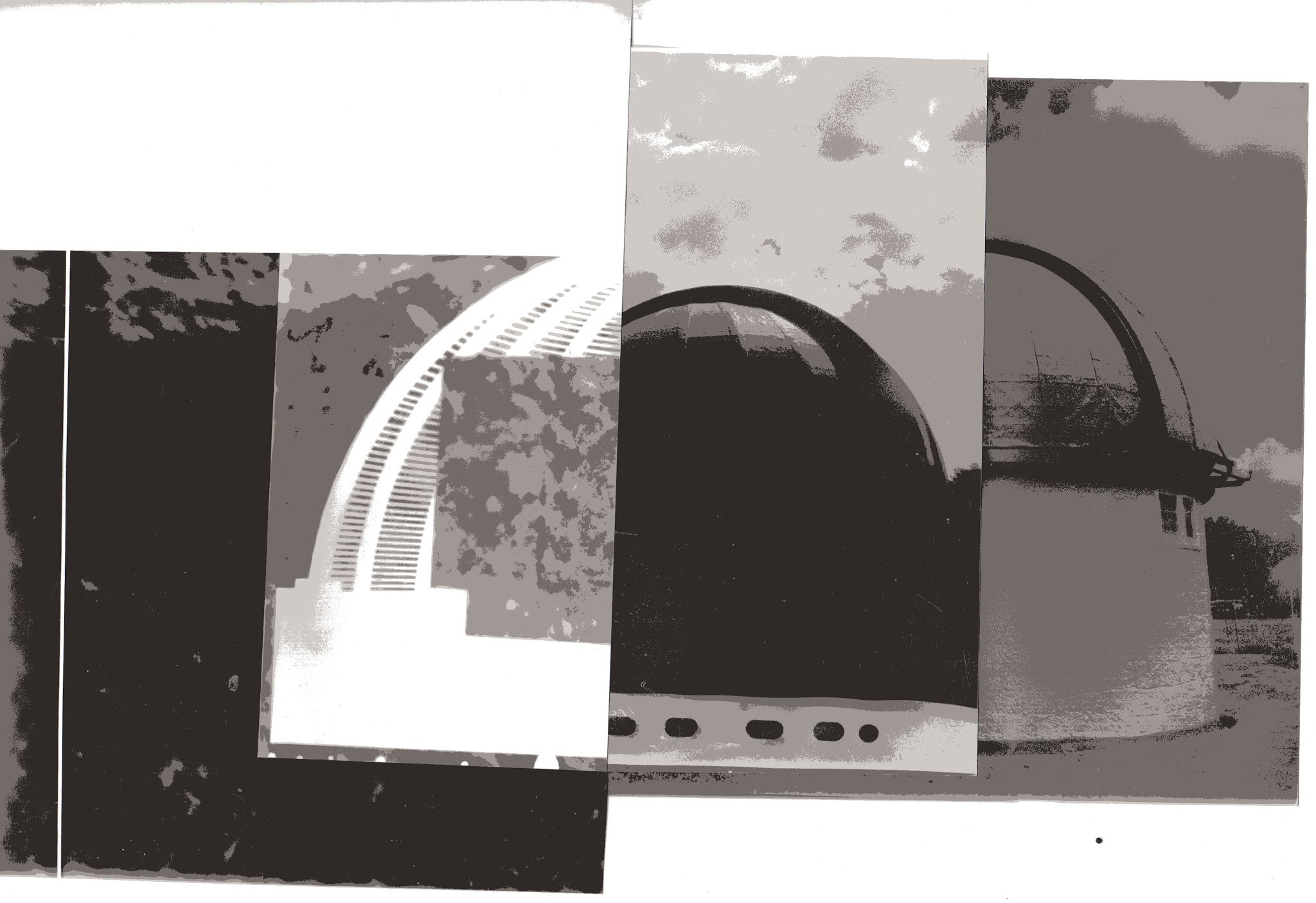
Kirosan Observatory, Kengo Kuma

Observatories demonstrate the self-centred nature of human perception. They are generally objects, that is the core of the problem. I wondered if this observatory could be made transparent, that is, effectively erased, so minimising the damage to the environment.


In terms of erasing an object, the settin is more important than the choice of material. In this case, the setting was a summit that had already been levelled and turned into a perfect pedestal. Anything that is set on a pedestal becomes an object, regardless of what it is made of or how discreetly it is placed.

Most works of contemporary art are tiresome because they rely on this particular property of the pedestal.


Observatory/Artists Outdoor Studio with astronomical 'Hortus Conclusus' /pavilion/segment built from the walled garden.


IMMATERIAL :

Layer upon layer of reality and image, the material and the immaterial, were thus overlapped. 

The Camera Obscura and Telescope, Dumfries. 1836

It is not quite clear what the real astronomical purpose of camera obscurae was, not only the Royal Observatory at Edinburgh but also the Royal Observatory at Greenwich still posses theirs, though dismantled and stored in cupboards for a century or more.


Paramatta Observatory, New South Wales, 1822

Sepia stained cyanotypes of architectural building plans


Plaster tabletop viewing screen, concave, chalk/matt surface

Lead weights on natural ropes used to control the apparatus


What I am most interested in now is inverting the structure of a culture that is centred around the city. The twentieth century was an age of industry, and an age in which everything from material goods, information and culture flowed from the cities to local towns and villages. Following the same vector, architecture, too, flowed out from the centre to the periphery.

Kengo Kuma


APPARATUS :


The Observatory is a facility for stealing looks at visitors


Electronic technology is used in these devices to expose the imperfection of vision and reverse its privileged status. Under ordinary circumstances, the seeing object is under the illusion that he/she dominates what they see. However, seeing also opens up the possibility of being seen. Anyone who dominates another through vision is always vulnerable to a brutal reversal.

High and Low, 1963. Akira Kurosawa


I therefore tried designing a transparent object. My real aim was not to create an object, but to choreograph a sequence of movements by the subject, that is, to create a device controlling his/her vision. Anti-Object, Kengo Kuma.

Your Chance Encounter, 2010. Olafur Eliasson


Messr Barr and Stroud, Optical Engineers, Glasgow, used to produce obscuras for industry, they were much cheaper to purchase and maintain in a large industrial establishment than closed-circuit television.