Showing posts with label exploration. Show all posts

Saturday, 2 November 2024

The Drawing Stage : The Mark that Functions/Comes into a Mediality/Form/Language

Outpost 210524

Light Drawings/Duration/Surface/Intermediaries.


Drawing/Inscriptions/Mediality/Conversation


I created 'False Divisions' in an effort to name the parts which in practice are so multifaceted as to continuously express the existence of all others.

What defines/constitutes drawing? 

One thinks of its properties, line, marks, surfaces, its characteristic colourlessness, its acts, gestures, rhythms and spaces of thought.

Avis Newman.


The Stage Of Drawing-Gesture-And-Acts.

Avis Newman.

Catherine de Zegher.


As I made my choices, the body of the exhibition grew as an assemblage of parts comprising groups within groups, clusters, pairs, singularities, a 'body of relations' as one might understand a body of thought. In the selection and organisation, I tried to suggest that drawing is by definition in a state of flux finding inspiration in 'modes of thought' that are not linear. But which propose a space of fluctuations and overlapping relationships and allow for an uncertainty and a play between parts as in Melanie Klein's formulations of positions.


Drawing, draws us in close, into an act of scrutiny, retracing the drawer's movements between hand and eye is one of the profound pleasures of looking which connects us to a recognition of our own past acts. When we look, we enter the intimate space of a work that is as close to the action of an artist's thought as one can get.


Avis Newman understands drawing more fundamentally as to evidence the materialization of an act of consciousness, where a gestural act, embodies an act of thought. Her concern has been with the visual traces of those phenomena, which are embedded in all our actions and ultimately connect us through language.


In the inscriptive act of drawing there exists the shadow of our ambivalent relation to making marks, before the time when 'image' and 'text' are differentiated to go their separate ways. When one looks at a drawing there is a consciousness of the ghost of the 'text' in the 'image' in the Image. It is that combination of events where the mind simultaneously perceives in a single stroke the registration of a gesture affirming the existence of another, a line of delineation that speaks of this or that and the mark that functions (comes into a mediality) as a sign which possibly is connected to other signs. In such circumstances thoughts float between reading and perceiving. It is in this inscriptive nature of the activity of drawing that can hold we can hold in suspension this differentiated state of consciousness, irrespective of what is being drawn.


Generative Forms.

Drawing Assemblages.


Germ Cell/Idea/Breath.

The synthesis of Geometric with Organic Forms.


Christopher Wilmarth

Nine Clearing Works.

A portal, an architectural entranceway.

Wilmarth continually examined the concept of duality, contrasts between light and shadow, transparency and opacity, heaviness and weightlessness, materiality and ethereality. He employed a 'painterly technique' that emphasized the tactility and richness of his materials, which like an alchemist he persistently sought to transform.

His sculptures retain the spiritual implications of 'place' endowed with particular qualities of light, clearings that can create a release, where light can open even when the place remains the same, just like the mind and new thoughts, creating moments of these pavement epiphanies of confinement and release.

Works from 1985 onwards contain and further develop a figurative impulse ( re-emerging of the anthropomorphic ovoid shapes) with the larger more emphatically abstract 'places'. Fusing the organic with the geometric and conjuring a multitude of symbols, head-soul-heart-aura-egg-germ cell-womb-cup.

Laura Rosenstock. 1989


A Clearing for a Standing Man. 1974

Poetics of place and person articulated by the evocative power of light.

He endowed his sculptures with a sense of  'Place' and 'Person' which was critical to his intension as was his lifelong concern with the evocative power of light.

Light gains character as it touches the world, from what is lighted and who is there to see. I associate the significant moments of my life with the character of light at the time. The universal implications of my original experience have located in and become signified by kinds of light. My sculptures are places to generate this experience compressed into light and shadow and return them to the world as a physical poem.

On Mallarmé, Wilmarth notes that his imagination and reverie meant more to him than anything  that was actually of this world. His work is about the anguish and longing of experience not fully realized, and Wilmarth found something of himself in it, especially the feeling that for Mallarmé 'the essence of a work consists precisely in what is not expressed'.  

Christopher Wilmarth. 


Christina Iglesias.

Shelters


Ceramics of Organic Abstraction.

A loosely defined style characterised by an ongoing exploration of biomorphic or organic form and surface.


Garth Clark.

Rising Above The Polemic : Organic Abstraction in British Ceramics. 1995.

References to landscape and natural phenomena, nature's associations of fecundity, earthiness, process, growth and decay.

Gordon Baldwin.


Saturday, 7 August 2021

Drawing/Situatedness and Site : John Berger, simultaneously a now and an elsewhere

Drawing has the ability to hold complexities separate enough so as to be read, yet drawings also merge into a perceptive unity marked by a sensation or realisation of intuitive nowness authentically caught in the tension of the line.

John Berger’s definition of what a drawing might contain when it is simultaneously viewed as both a now and an elsewhere, marks for me a threshold of encountering space­ time, we are passing through as we perceive our very consciousness. 


I sometimes think of these drawings as sites, containing both physical and playful evidence of explorations. The cyanotype process captures objects and turns them into “inclusions” or vessels that might induce an interesting dialogue, a buried association or simply a stage for thought. I feel the objects recorded are the result of an assemblage of thoughts/interests close at hand driven into the visual through an expediency (working with light and time) and an aesthetic that contains my sense of materiality from which to nurture a creative subjectivity. Strangely it is this aesthetic that just keeps things separate enough but which still makes things actively conspiratorial. It appears to be able to render things in isolation and then bring them together. It is as if the intuition that comes from working and theorising within an art practice is placed into the realm of things, off loaded, detached, and orphaned to make its own way in the world. 


Link Gallery.

Forum Notes, 27 March 2010

Site is anti-place hovering precariously over the abyss of no-place.1 

Art Practitioner with earlier experience in ceramics and glass, recently completed visual arts course at Winchester, now at Canterbury completing MA course in spatial practices. Working mainly on drawing, photography and architectural interventions/ installations that explore our sense and experience of place. 


My work explores a philosophical inquiry into the need for a reflective solitude, a sense of dwelling amongst absences.

The use of materials from the locality (field chalk) implies a personal geography drawn from the direct relationship to an inherited Earth. There is the suggestion that the absence recorded by the trace is an inclusion, a legacy set into a field of materiality, but it might also suggest a metaphysical field of thought. 

This act of drawing becomes its own experimental field of exploration, a sort of “in-between reality’’/Maurice Merleau-Ponty) an enmeshed experience. Thought of and read as a material memory encountering the realm of the insubstantial.

This “undoing of place” might instigate a threshold and a situation/room from which to reflect upon critical spatial, sociological and psychological conditions and perceptions.

This work and others like it attempt to articulate an interest in the body as both a physicality ( social, spatial and per formative presence ) and a poetic surface in architectural space.

Influences, Myth of Butades, origin of drawing, Pliny

Interested in the inscription ( a surface inscribed, written or carved as a formal or permanent record ) of a presence, a trace that reveals an origin of feelings/gestures centred around the body.

Inscription brings with it a notion of performativity, that of body and place, and their interaction, situation and experience. This spatial activity renders a sense of a material memory surfaced by place.

Tacita Dean, Drawings are more than just visual therapy, they speak of collective experiences and dilemmas that trouble humanity.

This simple work gathers-up an intimate social inscription on a surface, a playful act to then associate natural material.

Drawing is the primal means of symbolic communication which predates and embraces writing, and as such it functions as a tool of conceptualization parallel with language.

Drawings offer a partial comprehended rumination of the mind, Avis Newman. Drawing, becomes a sort of dwelling amongst an intimate comer of oneself, perhaps even a site for the solitude for the imagination. Gaston Bachelard comments in the Poetics of Space that a corner in a room can become “a symbol of solitude."

Drawing like walking becomes a form of thinking. This thinking is further articulated and accompanied by the intrinsic qualities of substances and liquids that are placed in proximity so as to be encountered.

My use of chalk as a materiality, emblematic of a solidity, a localised material and a metaphor of a inherited and compressed layering of time. The whiteness of this found material draws associations with the surface of the paper, there similarities’ also render there material differences. The inclusion of wax onto the surface was an attempt to seal a sense of a reflective surface, a surface amongst the work that might accommodate the light and nowness of place. Any drawing is a static object, but contains the trace of actions, traces carried out in time. Perhaps this drawing is registering itself into a language of matter.

1  Edward S. Casey, The Fate of Place, a Philosophical History. (London: University of California Press, 1998) page 186.


ARTISTS CV/STATEMENT re INTERNATIONAL BOSPHORUS ART BIENNALE, ISTANBUL 2011.

RUSSELL MORETON 

Visual artist/maker of dwelling spaces.

Spatial Practices MA Canterbury UK.

Visual Fine Art BA hons Winchester UK 

Contemporary Crafts Sculpture Waterlooville UK 

Ceramics HSND Epsom UK

June 2011 Artist Statement/Outline of Interests.

Visual artist working with alternative photographic processes, clay and architectural glass. The current practice continues to explore themes and realities around the contemporary human condition. The exploration of these interests is predominately developed through drawing and traces of actual objects and performative gestures referencing the body as a site amongst the layering of material and data. The use in some works of site specificity and materials drawn from the location are used to further underpin a sense of engagement and dwelling. The resultant drawings with their traces of agency and exactitude, lightness and ambiguous multiplicities seem like a compression of a filmic substrate, a material memory brought to the surface. These personal consolations of working practice are initiating thoughts centred on building architectural spaces, from which to register and response to a sense of serenity and enchantment amongst the scripting of materials in spatial/social dialogues.

Astronomy, Science, Natural History, Architectural Spaces, Stained Glass, Early photographic Processes, Ceramics, Anthropology, Craft Disciplines, Theatre, Film, Arte Povera, Contemporary Art Practice/Research/Philosophy/Exploration.


IMAGE, PANSPERMIA 2010 Added notes.

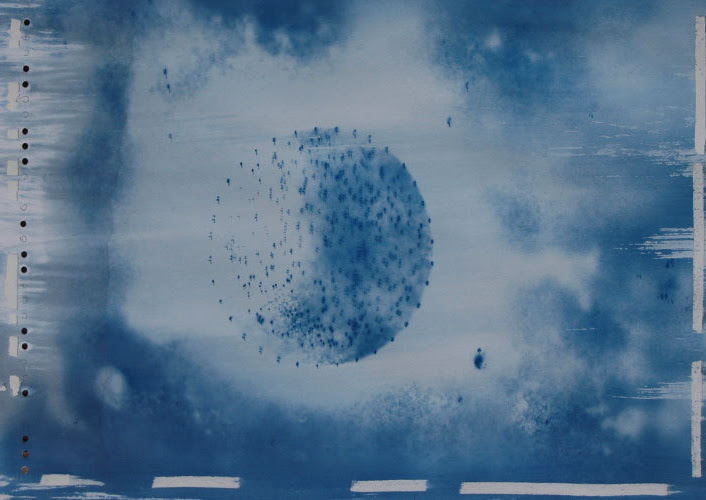
This work began as a performative drawing between the touch and tact of its maker, marking a personal and intimate involvement with both the corporeality of the female body and a loved one. This fragile union and fecundity is expressed by the photograms of “elderflower seedheads” left as evidence within the territory of the body/vessel. The personal intimate space of these initial acts and gestures are shifted against infinite space of the known universe. The title stems from speculation that life might have been introduced onto a fertile Earth from spores from space. Interestingly having dwelled with these initial thoughts, I feel that perhaps the work augurs an exodus at some point in the future.

Russell Moreton


CHAPEL ARTS, ARTISTS OPEN STUDIO AND TALK

TALKING AROUND A TABLE OF DRAWINGS

THE WORKING SPACE AS INSTALLATION

THE SPATIAL PRACTICE OF RUSSELL MORETON

Objects or vessels that might induce an interesting dialogue a stage for a future event or trajectory. I feel the objects are the result of an assembly of thoughts driven into the visual through an expediency and an aesthetic that just keeps things separate yet somehow they remain actively conspiratorial. It is all about the intuition that comes from working and theorising with and within an art practice.

The intension of the “charting table” (8x4 ply sheet on builders trestles) was to allow the subject of practice together with my activities to become visible, and in so doing create a public sense of speculation around the material on show. The spatial agenda would be addressed, bought into being as it were by the exposure and placement of objects, tables and projections into the main reception area at UCA Canterbury. It is hoped that the curiosity of some will solicit the interest of others and thereby create the unfolding of an event; the projection could be a real time monitor of the charting table. I am beginning to view the show as an exhibition/event around working practices, but unfortunately the sense of site dominates my practices situatedness. Conceived as a contingent/speculative intervention into the normal running of this space as a reception area. 


Resident artist will host an “open studio” at Chapel Arts Studios on 2 December. The chapel will be open from 12.30 onwards to view an installation and other material. The “talk around a table of drawings” will commence at around 6.45 pm.

Earlier training in ceramics and stained glass together with extensive experience in the construction industry are now being utilised in my contemporary practice.

My current spatial practice, is centred around a multi disciplinary approach underpinned by “drawing” to critical issues of site. This activity could be understood as an investigative creativity amongst the phenomenological aspects of architectural place and the potentials of producing working spaces/sites for the reflection of others. The working practice currently employs the use of clay, glass and photographic processes. The practice is informed by interests in astronomy, architectural space, theatre and anthropology.

The use of “site” as a working drawing from which to create a temporary intervention into place helps to instigate a threshold, a room or event from which to reflect upon critical spatial, sociological and psychological conditions and perceptions.


Anima-Animus : Winchester Cathedral/10 Days in the City

‘When animus and anima meet, the animus draws his sword of power and the anima ejects her poison of illusion and seduction’ Jung.


Russell Moreton uses analogue film processes that inquiry into both the surface and the materiality of the photographic image. He was invited by Helena Eflerova and Kye Wilson to document the filming process of Anima-Animus. He uses 35mm and medium format cameras together with a number of pinhole type cameras. In using historical processes like cyanotype and light sensitive silver gelatine, he explores the relationship of the image to its supporting surface. A number of his images are heavily worked in the darkroom to exploit differences between the seduction of the photographic surface and its actual physical presence altered by chemical and physical interventions. His work echoes themes around the body and the architectural spaces of institutions and beliefs.


Friday, 25 June 2021

Spatial Mediators and Intercessors : Creating Loops/Rhetorical Silences/Strange Tools


Immaterial Architectures
Painting/Form for Reading Spaces/Intervals
Pattern and Chaos/Liminality/Tectonics
Architectural surface for a Library,  raw materials, light, silence and solitude.

Christopher Wilmarth ; Poetics/Duality of Light and gravity
Other Architecture
Constructing Metaphysical Space

Wilmarth's art reveals his essential concern with the mystical and physical properties of light, especially the ways in which light evokes reverie and generates sensations of space and containment.

The Architecture of Natural Light : Henry Plummer

EVANESCENCE
Orchestration of light to mutate through time

Intensity and integrity of Wilmarth's practice/vision.

PROCESSION
Choreography of light/moving eye

VEILS OF GLASS
Refraction of light/diaphanous film

Wilmarth made possibly his strongest, most beautiful works on paper, exploring a new level of expression while retaining continuity with past work.

ATOMIZATION
Sifting of light/through a porous screen

These drawings also contain allusions to the human presence. Their haunting, foreboding quality is prefigured in the grave, austere tones of some of the glass and steel structures.

CANALIZATION
Channelling of light/through a hollow mass

The duality of light and shadow and contrasts between abstraction and representation continue to be central concerns in his final drawings.

ATMOSPHERIC SILENCE
Suffusion of light with a unified mood

Wilmarth's sculptures from the early 1980's are influenced by the poetry of Stephane Mallarme. To affirm Mallarme's emphasis on the spiritual, the artist used a simple ovoid form, evoking a multitude of symbols, including the human head. These ovoids were made of blown glass, which Wilmarth viewed as "frozen breath". The artist pursued this figurative impulse into the mid 1980s, combining the anthropomorphic ovoid shapes with the larger abstract forms of his earlier sculpture.

LUMINESCENCE
Materialization of light in physical matter

Wilmarth composed with planes of delicate colour and light, placing plates of blackened steel behind translucent sheets of etched glass imbued with a luminous, greenish cast.

"He employed a painterly technique that emphasized the tactility and fichness of his materials, which like an alchemist he persistently sought to transform. He continually examined the concept of duality: contrasts between light and shadow, transparency and opacity, heaviness and weightlessness, materiality  and ethereality, form and spirit are repeatedly presented; the synthesis of geometric with organic forms, the range between abstraction and representation are constantly explored."
Laura Rosenstock, catalogue essay.


White Noise : Nocturnes of Silence


Behind Appearance
A Study of the relations between painting and the natural sciences in this century
C. H. Waddington

Adam Fuss
Home and the World

Strange Loops
Art, Science and Consciousness
An Exploration of Mind, Matter and Form through the Work of Susan Derges
Stephen Gaughan

The Music of Waves
The Poetry of Particles
Thoughts on Implicate Order for Susan Derges
Martin Kemp

Adam Fuss
Eugenia Perry


Aesthetic Allure
Rhetorical Silences/Strange Tools

the sensual energy of the dimension in which causality/aesthetics happens

Graham Harman, Timothy Morton

Paintings/Research/Archive/Art Practice
Cyanotype material,objects on canvas.
Russell Moreton 2018

https://www.flickr.com/photos/russellmoreton/40286364403/in/dateposted-public/


Spaces/Aesthetics : 'Spatiality' between Objects, Concepts and Beings

In his discussion of mediators, Gilles Deleuze (1995,121) describes being taken up in the motion of a big wave. He notes that instead of looking for 'points of origin' attention should be directed to mediators that enable a 'putting-into-orbit' that facilitate the movement of concepts, sensations and matter without recourse to origins or destinations.

Katve-Kaisa Kontturi uses the term 'intercessor' instead of  'mediator' as it aligns better with Deleuze's argument, where importance is placed not on mediating between already formulated shapes or beings, but on opening beings up to movement through a third actant.
For Deleuze (1995,125), Intercessors are about entering into or creating a series.

Gilles Deleuze. 1995, Negotioations, 1972-1990.
Translated by Martin Joughin. New York: Columbia University Press.

Notes, Introduction
Ways of Following
Art, Materiality, Collaboration
Katve-Kaisa Kontturi

Open Humanities Press
London 2018


Immaterial Architectures : Raveningham Pavilion #1
DSC_3283 Raku Beakers : Lead Glaze/Yellow Ochre
DSC_4049 Field Aesthetic : Causality/Layered Drawings
DSC_3776 Sacred/Secular : Vessels on Painting
DSC_4097 Field Aesthetic : Causality/Layered Drawings
DSC_8923 Artists Studio : Collage/Photography/Painting

Outpost Studies
Norwich
UK


Tuesday, 5 June 2012

Cultivation Field 8th - 22nd June 2012 3rd Floor, 42 Market Place, Reading, RG1 2DE and The Keep, 571 Oxford Road, Reading, RG30 1HL Opening: 7th June 2012 17.00-19.00 at 42 Market Place and 19:00-21:00 at The Keep Open hours: 8th June 12:00-16:00; 9th to 22nd June 12:00-18:00 (42 Market Place is closed on Tuesdays) Third Thursday event on 21st June 18:00-21:30 at The Keep, presentations by Sarah Lewison, Alexandra MyGlynn and other to be announced Cultivation Field explores plant and land cultivation through diverse art practices. Plant life could be considered a low-tech material, because it is vegetation, but in the second decade of the twenty-first century plant life is in constant production as part of consumerist high tech industry. Cultivation Field looks at the cracks in land cultivation systems, collective engagement within local communities, plant based objects and methods of production. Included in this exhibition is a film work about Fritz Haeg’s Edible Estates project in New York. The film tells a historic story of land cultivation on Manhattan Island in relation to contemporary collective engagement with local communities. Brook & Black’s work Plot 16: the Fermenting Room; was developed for their Modern Art Oxford’s allotment residency at Rose Hill. Here brook & black grew hops on a frame that replicated MOA’s building, which was once a brewery. Adi Gelbart’s film Vermin is a vegetable sci-fi. Pil & Galia Kollectiv’s Asparagus: A Horticultural Ballet shows the moment when their dancers dressed as asparagus enter the park to contemplate 1950’s garden furniture. Sarah Lewison’s work with And, And, And on the Monsanto hearings is included in Documenta 13. Sarah Lewison will be talking presenting this work as part of Cultivation Field exhibition. A Rachael Champion installation will be in the grounds of The Keep’s garden. Caitlin Parker’s photographs are images taken at Chernobyl in 2007 where plant life has grown in formerly human occupied space. Julian Perry’s paintings of allotment sheds at Manor Gardens Allotments are reminders of the evictions that took place to make way for this year’s Olympic site. Reading as a town was once a site of much plant cultivation. The company Sutton Seeds was started there in 1806. One of the exhibition venues is close to the area in which Sutton Seeds was situated until the 1960’s. Participating artists: Robyn Appleton, Tom Baskeyfield, Shameela Beeloo, Rebecca Beinart, Camilla Berner, brook & black, Rob Carter, Rachael Champion, Andrew Dodds, Maria Deegan, Adi Gelbart, Fritz Haeg, Maria Hofstadler, Tom Ingate, Ulrika Jansson, Pil & Galia Kollectiv, Rosalie Kim, Gayle Chong Kwan, Sarah Lewison, Alexandra McGlynn, Stéphanie Nava, Raquel Estrada-Nora, Phil Newcombe, Francesca Owen, Caitlin Parker, Julian Perry, Minna Pöllänen, Janette Porter, Sneha Solanki, Stih & Schnock, Jo Thomas, Carly Troncale, Charlie Tweed, Jane Cradock-Watson, Elizabeth Wewiora Cultivation Field is curated by Kate Corder who is a practise based PhD candidate in the Art Department at University of Reading. The exhibition follows on from the Cultivation Field Postgraduate Symposium that took place in September 2011, also organised by Kate Corder. The Cultivation Field exhibition is support by Arts Council England and the Earley Charity, Reading. Additional support comes from the Art Department at the University of Reading, The Jelly, Open hand Open Space, Office for Contemporary Art Norway, Sutton Seeds and Laura’s Organics. Cultivation Field Kate Corder cultivationfield@gmail.com www.cultivationfield.org