Showing posts with label Alt proc. Show all posts

Saturday, 24 February 2024

Psychogeography : Narratives across a site plan (Waverley Abbey)


In The Process of Translation
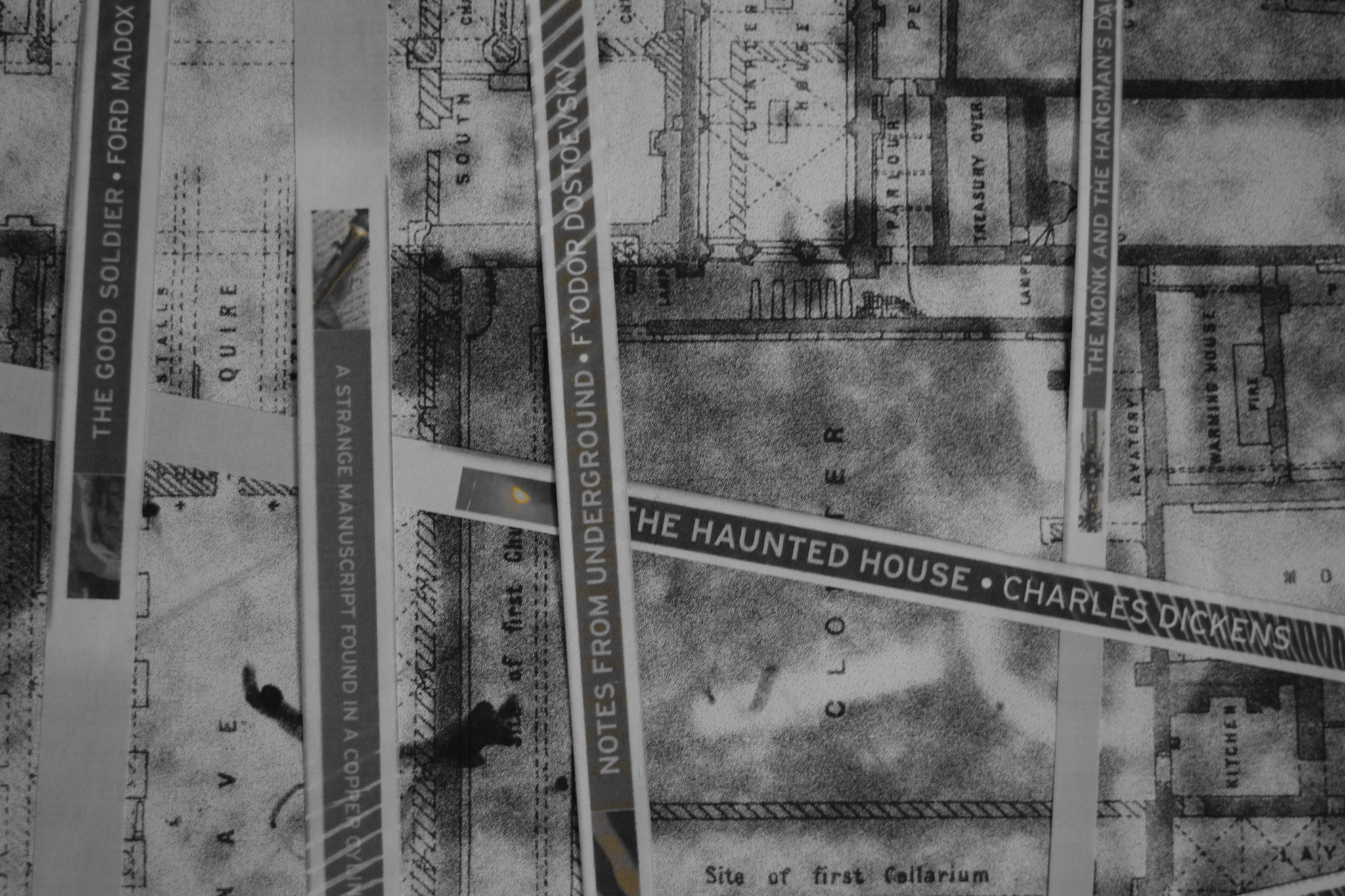


https://uk.pinterest.com/russellmoreton/art-and-process/


Waverley : Psychogeography


Waverley Abbey was the first Cistercian abbey in England, founded in 1128 by William Giffard, Bishop of Winchester. It is situated about one mile south of Farnham, Surrey, in a bend of the River Wey.


History

During the first century of its existence, it founded six monasteries, and despite the members thus sent away, it had 70 monks and 120 lay brothers in 1187. It kept about thirty ploughs. The site was subject to regular flooding, however, and in 1203 the foundations for a new church and monastery were laid on higher ground. The new church was dedicated in 1231. King John visited Waverley in 1209, and Henry III in 1225. The abbey also produced the famous annals of Waverley, an important source for the period. By the end of the thirteenth century the abbey was becoming less important. By the time it was suppressed by Henry VIII in 1536 as part of the dissolution of the monasteries there were only thirteen monks in the community and the abbey had an annual net income of £174. Stones from the abbey when it lay in ruins were taken to build nearby houses, including the house at Loseley Park. The ruins of Waverley Abbey are managed today by English Heritage. The sign at the entrance to the ruins states that it was the inspiration for Sir Walter Scott's novel Waverley . However, this is probably not the case. Sir Walter Scott chose to adopt the name for his fictional hero Edward Waverley, the heir to an estate in southern England who travels north and becomes embroiled in the Jacobite uprising of 1745. Waverley Abbey was however featured in Arthur Conan Doyle's classical romance, Sir Nigel. It was the scene of his winning of his war horse, Pommers, and his youthful embarrassment of the avaricious abbey authorities.

Posted by Russell Moreton at Thursday, February 11, 2016 

Friday, 22 July 2016

Russell Moreton : Ruined Interior : Consumerism and Culture.

"Spatial turn" The increased attention to matters of space, place and mapping in literary and cultural studies, as well as in social theory, philosophy, and other disciplinary fields.

Spatiality, Robert T. Tally Jr. Routledge 2013.


 Spatial Intervention into Historical Site/Text.

 
"He rubbed his eyes. The riddle of his surroundings was confusing but his mind was quite clear - evidently his sleep had benefited him. He was not in a bed at all as he understood the word, but lying naked on a very soft and yeilding mattress, in a trough of dark glass. The mattress was partly transparent, a fact he observed with a sense of insecurity, and below it was a mirror reflecting him greyly. Above his arm- and he saw with a shock that his skin was strangely dry and yellow - was bound a curious apparatus of rubber, bound so cunningly that it seemed to pass into his skin above and below. And this bed was placed in a case of greenish-coloured glass (as it seemed to him), a bar in the white framework of which had first arrested his attention. In the corner of the case was a stand of glittering and delicately made apparatus, for the most part quite strange appliances, though a maximum and minimum thermometer was recognizable."
H. G. Wells : The Sleeper Awakes. 1899/1910/1924
Spatiality : The Spatial Turn, Robert T. Tally Jr. 2013
Immediate Architectural Interventions, Durations and Effects : Apparatuses, Things and People in the Making of the City and the World. Alberto Altes Arlandis, Oren Lieberman.


Dark Session's : Shadowy speculations in the pottery. Kilquhanity 2011

via artreview.com
Silver gelatin prints from a "room obscura" set up at Kilquhanity, Scotland 2011 as part of "Back to Free school, Drawing out the Archive".