Showing posts with label psychogeography. Show all posts

Saturday, 24 February 2024

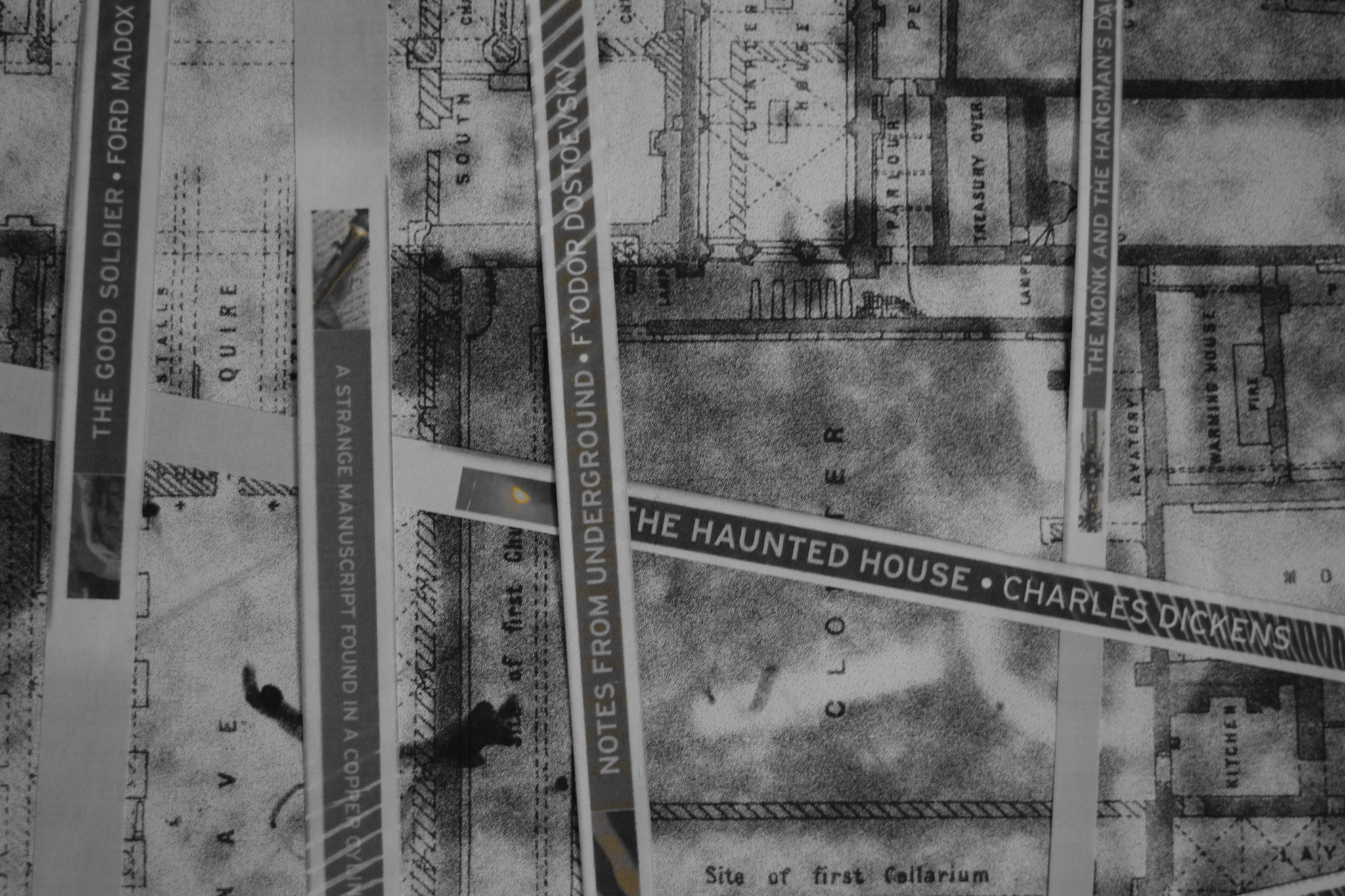
Psychogeography : Narratives across a site plan (Waverley Abbey)


In The Process of Translation


https://uk.pinterest.com/russellmoreton/art-and-process/


Waverley : Psychogeography


Waverley Abbey was the first Cistercian abbey in England, founded in 1128 by William Giffard, Bishop of Winchester. It is situated about one mile south of Farnham, Surrey, in a bend of the River Wey.


History

During the first century of its existence, it founded six monasteries, and despite the members thus sent away, it had 70 monks and 120 lay brothers in 1187. It kept about thirty ploughs. The site was subject to regular flooding, however, and in 1203 the foundations for a new church and monastery were laid on higher ground. The new church was dedicated in 1231. King John visited Waverley in 1209, and Henry III in 1225. The abbey also produced the famous annals of Waverley, an important source for the period. By the end of the thirteenth century the abbey was becoming less important. By the time it was suppressed by Henry VIII in 1536 as part of the dissolution of the monasteries there were only thirteen monks in the community and the abbey had an annual net income of £174. Stones from the abbey when it lay in ruins were taken to build nearby houses, including the house at Loseley Park. The ruins of Waverley Abbey are managed today by English Heritage. The sign at the entrance to the ruins states that it was the inspiration for Sir Walter Scott's novel Waverley . However, this is probably not the case. Sir Walter Scott chose to adopt the name for his fictional hero Edward Waverley, the heir to an estate in southern England who travels north and becomes embroiled in the Jacobite uprising of 1745. Waverley Abbey was however featured in Arthur Conan Doyle's classical romance, Sir Nigel. It was the scene of his winning of his war horse, Pommers, and his youthful embarrassment of the avaricious abbey authorities.

Posted by Russell Moreton at Thursday, February 11, 2016 

Wednesday, 8 March 2023

Collage/abstracts (Heuristic Fragments) Reflective Material #1

Is there still an aesthetic illusion? And if not, a path to an “aesthetic” illusion, the radical illusion of secret, seduction and magic? Is there still, on the edges of hypervisibility, of virtuality, room for an image?

— Jean Baudrillard, The Conspiracy of Art, 2005


A heuristic technique (/hjᵿˈrɪstᵻk/; Ancient Greek: εὑρίσκω, "find" or "discover"), often called simply a heuristic, is any approach to problem solving, learning, or discovery that employs a practical method not guaranteed to be optimal or perfect, but sufficient for the immediate goals.

Heuristic Material : Collage 

1. encouraging a person to learn, discover, understand, or solve problems on his or her own, as by experimenting, evaluating possible answers or solutions, or by trial and error: a heuristic teaching method.
2. serving to indicate or point out; stimulating interest as a means of furthering investigation.

Reading Collage : Spatial Drawings/Documents/Analogue Photography

A Hut of One's Own, Ann Cline

Texts,Annotations, Foundations, Pathways, Corridors, Bookmarks, Walking, Thinking, Ramble, Cross Country, Disciplines, 

Herzog  and De Meuron
NATURAL HISTORY

Jana Sterbak
Remote Control 1989


Wednesday, 15 June 2022

Reflective Journal : Diffusion/Spatial Intelligence/Between Figure and Ground

Reflective Journal : Diffusion/The Time Machine. Borderline Projects/Strange Attractors.

rhythmanalysis : Space, Time and Everyday Life.
Lefebvre

Jannis Kounellis
Carlo Scarpa

"Translates the painterly relationship of figure and ground into the space of real situations"
The Visual Poetics of Jannis Kounellis, Suzanne Cotter and Andrew Nairne.
Modern Art Oxford, 2004-2005.

Spatial Intelligence
New Futures for Architecture
Leon van Schaik

Archaeological Site, Morn Hill, Winchester.


Psychogeography is an approach to geography that emphasizes playfulness and "drifting" around urban environments. It has links to the Situationist International. Psychogeography was defined in 1955 by Guy Debord as "the study of the precise laws and specific effects of the geographical environment, consciously organized or not, on the emotions and behavior of individuals."[1]Another definition is "a whole toy box full of playful, inventive strategies for exploring cities... just about anything that takes pedestrians off their predictable paths and jolts them into a new awareness of the urban landscape."[2]

https://en.wikipedia.org/wiki/Psychogeography


Tuesday, 5 October 2021

Spatial Drawings/Psychogeography #2 : Analogue Photography


Core, Periphery and Semiperiphery : Spatial Drawings #2

Autonomous Project/Creative Anarchism
Psychogeography : The Skies over East Anglia (35mm film)

Reflective Narratives

fig504 Photographic Forms/Intervals (10 Days in the Laundry)
Art as Spatial Practice.
Space folds : Containing "Spatialities around historicality and sociality"

"All that is solid melts into air"

Karl Marx, Friedrich Engels,
(Poetic observation concerning the constant revolutionizing of social conditions)


Perceptions now gathering at the end of the millennium. Spatiality, Robert T. Tally Jr. 2013


Sunday, 5 March 2017

A Sense of Looking : A Vicarious Topography

Drawings : Speculative Constructions in Photography

fig478 Photographic Forms/Intervals
Art as Spatial Practice.
Space folds : Containing "Spatialities around historicality and sociality"

"All that is solid melts into air"

Karl Marx, Friedrich Engels,
(Poetic observation concerning the constant revolutionizing of social conditions)

Perceptions now gathering at the end of the millennium. Spatiality, Robert T. Tally Jr. 2013

Possible Worlds
 The Sensual Reciprocity of This Enchanted Isle

fig604 Light is doing things

Autonomous Project/Creative Anarchism
Psychogeography : The Skies over East Anglia (35mm film)

Corporal Trace/Movement
A Sense of Looking : A Vicarious Topography