Showing posts with label Anselm Kiefer. Show all posts

Friday, 19 June 2026

Hortus Conclusus~As a Shared Ecological~Creative Practice : A Serious Place, Peter Zumthor on sheltered places of great intimacy where I want to stay for a long time.

Your draft has strong ideas and rich references, but much of the writing is in note form, and some sentences are long or repetitive. Below is a revised version that keeps your academic tone while making the argument clearer, more fluid, and easier to follow.

This version has a stronger narrative flow. Rather than reading as a sequence of research notes, it develops a continuous argument about the hortus conclusus as a model of sensory experience, pastoral practice, contemplation, and spatial identity. It also reduces repetition while preserving your quotations and references.

chatgpt.com


Felt Relations~Sympathy : What things feel when they shape each other.

Exploring Materiality and Connectivity in Anthropology and Beyond.

Philipp Schorch, Martin Saxer, Marlen Elders.


In The Gathering Shadows of Material Things.

Tim Ingold.


The Sympathy of Things.

Lars Spuybroek


Original research material from Interiors UCA Farnham 2014.

With a refined selection of materials, Zumthor creates a contemplative space that evokes the spiritual dimension of our physical environment. In doing so, he emphasises the role that the senses and emotions play in our experience of architecture (Zumthor 2011: 15).


The garden is enclosed on all sides yet open to the sky: an architectural setting that offers both protection and openness. Zumthor describes such spaces as "sheltered places of great intimacy where I want to stay for a long time" (Zumthor 2011: 15).


For Zumthor, the garden is more than a collection of plants. Every species evokes distinct memories of light, smell, sound, and touch. Gardens become places where sensory experience and memory are inseparable:


"Every plant name listed here evokes a distinct image; with each of them I associate specific lighting, smells and sounds, many kinds of rest, and a deep awareness of the earth and its flora." (Zumthor 2011: 15)


He continues by describing the garden as the most intimate form of landscape:


"A garden is the most intimate landscape ensemble I know of. In it we cultivate the plants we need. A garden requires care and protection. And so we encircle it, we defend it and fend for it. We give it shelter. The garden turns into a place." (Zumthor 2011: 15)


The enclosed garden becomes a sanctuary—a small protected world held within a larger landscape. As Zumthor observes, "something small has found sanctuary within something big" (Zumthor 2011: 15).


The medieval illustration Orchard from the Bible of Wenceslaus IV (Austrian National Library, Vienna) visualises this idea through the illuminated depiction of husbandry and communal labour within the secure enclosure of a walled garden. The image presents pastoral work as both productive and contemplative, echoing Zumthor's conception of the hortus conclusus as a protected space where cultivation, community, and intimacy converge.


Working with one's hands, cultivating the earth within sheltered spaces, becomes a shared pastoral practice that binds people to place.


Zumthor reinforces this pastoral character by placing a pavilion at the centre of the garden. He imagines it as a place for future gatherings and quiet contemplation, anticipating "the natural energy and beauty of the tableau vivant of grasses, flowers and shrubs. I am looking forward to the colours and shapes, the smell of the soil, the movement of the leaves" (Zumthor 2011: 15). The garden is therefore experienced not only visually but through the full range of the senses.


Elizabeth Knox's The Vintner's Luck similarly evokes an intimate relationship between landscape and human experience. The taste of wine becomes inseparable from the soil that produced it; earth and wine are of the same substance, united by locality and landscape.


Alexander Kluge develops a related idea in Gardens Are Like Wells, suggesting that every person possesses an "enclosed garden"—an inner space of reflection that exists regardless of one's outward life.


He writes that monasteries in medieval Europe functioned as wells in which "the clear waters of antiquity mingled with the dark waters of faith." At the heart of these monasteries lay an enclosed garden, where the finest plants and medicinal herbs were cultivated (Kluge 2011: 19).


Significantly, Kluge argues that these gardens existed outside the ordinary routines of monastic life. They were timeless places, dedicated to the Virgin Mary while remaining open to classical and alternative traditions, including Homer, Ovid, and the Gnostics. The enclosed garden therefore became a place where literature, contemplation, and spirituality could coexist. It represents an interiority capable of uniting mind and perception amid the complexity of contemporary life.


Kluge concludes that civilisation requires spaces that remain outside systems of production and utility:


"Civilisation and societies need ground that is uncultivated, gaps that are not subject to the principle of unity, something that is sufficient unto itself, which we do not consume: a sacrifice. Cities need spaces of piety." (Kluge 2011: 21)


This sentiment resonates with Richard Sennett's assertion that "we need places in which we can engage in acts of mourning." Such spaces provide opportunities for reflection, remembrance, and emotional renewal beyond the demands of everyday life.


The Development Company for Television Programmes (DCTP), in Gardens of Information, also adopts the emblem of the hortus conclusus. Here, the enclosed garden symbolises the relationship between barren landscapes and places of meaning. Their ambition is "to rescue facts from human indifference" and "to make gardens out of raw material and the bare bones of information" (Kluge 2011: 21). The garden becomes a metaphor for transforming fragmented knowledge into coherent and meaningful experience.


This understanding connects with ideas of spatial practice in the twenty-first century. Rather than forming relationships through abstract systems, institutions, or grand narratives, meaning emerges through inclusive practices rooted in particular places. The hortus conclusus can therefore be understood as a model of concentrated identity—an inquiry, a person, or a practice held within an intimate setting where thought, making, and community come together.


Saturday, 16 November 2024

The Darkness of Interiors/ The Absence of Openings.

Outpost 081024

Connections remaining sensuously in play.

The Darkness of Interiors/ The Absence of Openings.

https://www.flickr.com/photos/russellmoreton/


On the formation of the Japanese house.

In making for ourselves a place to live we first spread a parasol to throw a shadow on the earth, and in the pale light of the shadow we put together a house. The quality that we call beauty must always grow from the realities of life, and our ancestors, forced to live in dark rooms, presently came to discover beauty in shadows.

In Praise of Shadows, Jun'ichiro Tanizaki. 1933


The Trace Drawing

Interstitial Mappings/Spaces/Interiors/Parts/Intimacies.


Obviously, it is not being suggested that we should somehow be able to think something timber back into its tree, nevertheless, the reciprocal associations enjoyed by obtaining the one from the other depend upon certain conditions of connection remaining sensuously in play.

Peter Beardsell.


Making with circumstance/attention to place.

Giving buildings decisive readings that inform our readings of place.


A 'decisiveness' arrived at through attention and circumstance.


Living in a world reconstructed by information, deformed by restrictive economies.


Ontologically/Making Relations, having something to do with its being, not with exactly how it appears or its data – measure. Flat ontology is an idea that things exist in the same kind of way, no matter what they are. 


Things are much more mashed together than we like to think, and also much more distinct.


The biosphere is made of its parts, but it is distinct from its parts, and these parts are not reducible 'upwards' into wholes – the 'biosphere'.

There is one Biosphere, and its whole is less than the sum of its parts. Because the whole is one, and the parts are many and things exist in the same kind of way (flat ontology). Parts are distinct and non reducible if they exist in the same kind of way, no matter what they are.

Timothy Morton. 


You Are The Weather.

Roni Horn.


Weather isn't just a symptom or climate.


Anselm Kiefer.

The High Priestess. 1989


VIII : Book 88


In this book as a whole nature and architecture alike convey only the absence of life.

Armin Zweite.


Grey Works/Charcoal.

Lead/Ceramic/Inscriptions.


Weird Things


Things are entangled with interpretations of things, yet different from them.


Tim Morton, the thinker of that thought.


Reflecting on the bamboo screens and log columns of Osaka and Kamiichi, I realise that those details could be read as some kind of mask for a bucolic future. However, the choice of detail is derived from the capability of the material's presence to determine the quality of space- what the late David Pye refers to in his book Nature and the  Art of Workmanship as 'the weather in the space'. Japan has confirmed my view that architecture is inclusive – a collusion between different technologies and constructions that make the relevant accommodation for society.

Peter Salter. 


A Hut Life.

A life-lived as it is evolving.

Of Japanese/Chinese reclusive poets.


Interstitial Spaces.

The interior structure braces the external timber shell against snow loads. Between the braces are interior rooms for looking out. Moving between these rooms is like walking in the space 'between' which is sometimes 'clogged' by structure.

Kamiichi Pavilion, Peter Salter. 1995 


The hut and its hut life is a material process of living a relation, not (restricted or contextualized) as form or its container. The hut retains that which is frequently 'explained away' by relating things to a decade, a country, a state of human economic relations.


Roof top turrets, bits of former utility. A city of huts, of hut dwellers, of found places, of inspiration for new memories even as they invoke old ones. Visiting one another's sites, they climb creaky stairs and slip onto rooftops, balconies, or parapets. There they touch something deep in the needs and memory of people. Something that refuses to be dismissed, yet is fully alive only in the hut.

Anne Cline.


Kamiichi Mountain Pavilion.

4+1 Peter Salter : Building Projects.


The Buildings Reactions to the Weather/Ground/River and View.


Steadily the snow buries the building, but the exterior shell, which takes compression like a boat and behaves almost as if the building were in water, inversely anticipates the snow-load. This annual load exerts wear and tear, and will repeatedly leave its marks and defacements by way of distortion and pressure. But the building is designed to encode and record these batterings.

Conditions of Connection, Peter Beardsell.


The building is located in a clearing on the edge of a meltwater river. The intent is to provide a place to rest and enjoy the view. The building is first seen from a bridge through a clearing in the trees. Visitors approach it by a path along the river's edge.


Once within the building, their movement is directed towards a special room which is oriented towards the borrowed landscape, with a view of the two mountain peaks at the head of the valley.


A large gutter on the south side brings this water into the building, as if to guide the visitor. This same gutter also becomes the entrance canopy to the building, offering shade from the summer sun. The building aims to be cool in summer, full of shadows, with views out to the bright reflected light.


The building is naturally lit, with no electricity, and fresh water is provided by a hand-pump. All timber used in the construction has been taken from renewable or second-hand sources. The building is closed down in winter and becomes a part of the snow covered landscape.


Before the onset of winter, the townspeople of Kamiichi come to clean and prepare the building for the expected snow. It is then left to the small hibernating mammals and roosting birds. In the spring the shutters are opened and the snow barriers removed.


The copper water tank collects water from the gutter on the south elevation. Three overflows celebrate the abundance of meltwaters in the spring.


Section of first proposal. It was intended that the building should collect snow along its slatted roof structure, allowing the melted snow to drip down through the interior of the building.


Paper cut-outs were used to reassess the mass of the building proposition.


The building is snow-bound for seven months of the year, with snow reaching 12m. It is shaped hydro-dynamically to resist the snow, with two timber latticed compression shells. Within these shell structures a new landscape is created, as a resting place for climbers and a winter hibernation space for animals.


Students in Peter Salter's Diploma Unit are often asked to work at scales of 1:500 and 1:5, and nothing in-between. The defining properties of a strategy (not a programme) describable at 1:500 should carry a definitional force capable of determining detail at 1:5. Intermediate scales are disallowed to let a strategy's connective energies make their way, unimpeded, into detail. One applying pressure on the other, both tightens and expands the possibilities of connection and exchange.


Afterword/Making with beautiful circumstances.


Rules For Detail/A Search For Legibility Through Detail.

Peter Salter.


Rules are made to govern the definition of space through the accuracy of constructional detail. In the reading of such detail the spatial emphasis of the room can be understood to be mute or otherwise, giving it a kind of legibility. This ordering and quality of space help determine the accommodation and relevance of the architecture in circumstances where the programmatic brief is unavailable, underdeveloped or redundant. Legibility implies a variation in the reading and definition of the proposition. This is explored through a number of recurring strategies:


To make ever finer territories in order to relieve the burden of scale upon the architectural piece.


To look for possible scale differences – architecture as furniture – as a way of offering emphasis within a sequence of rooms.


To work with an additive architectural programme rather than a conglomerate form.


To introduce the metaphor of the boat as a raft that assembles parts of programme common to the wider building form.


Each strategy offers tactics for proceeding and the possibility of detail. Each implies a layering, a kind of stratification of idea and details; the control of the spatial hierarchy and the design of the door furniture can be layered together.


The strategy offers rules for construction when intuition runs out, and a way of testing form. The layering suggests an in-situ construction – a serialising of programme that offers a crafted building.


Ceramics

Anglian Potters.

Cambridge Exhibition.

https://www.anglianpotters.org.uk/members/russell-moreton/

Sunday, 23 July 2023

Art and Architecture : Anselm Kiefer/architectural creation/art/hermeneutics/history


Art and Architecture : Anselm Kiefer and David Chipperfield at the RA

VITRINES : Art Spaces/interiors/interventions. 


Anselm Kiefer : 
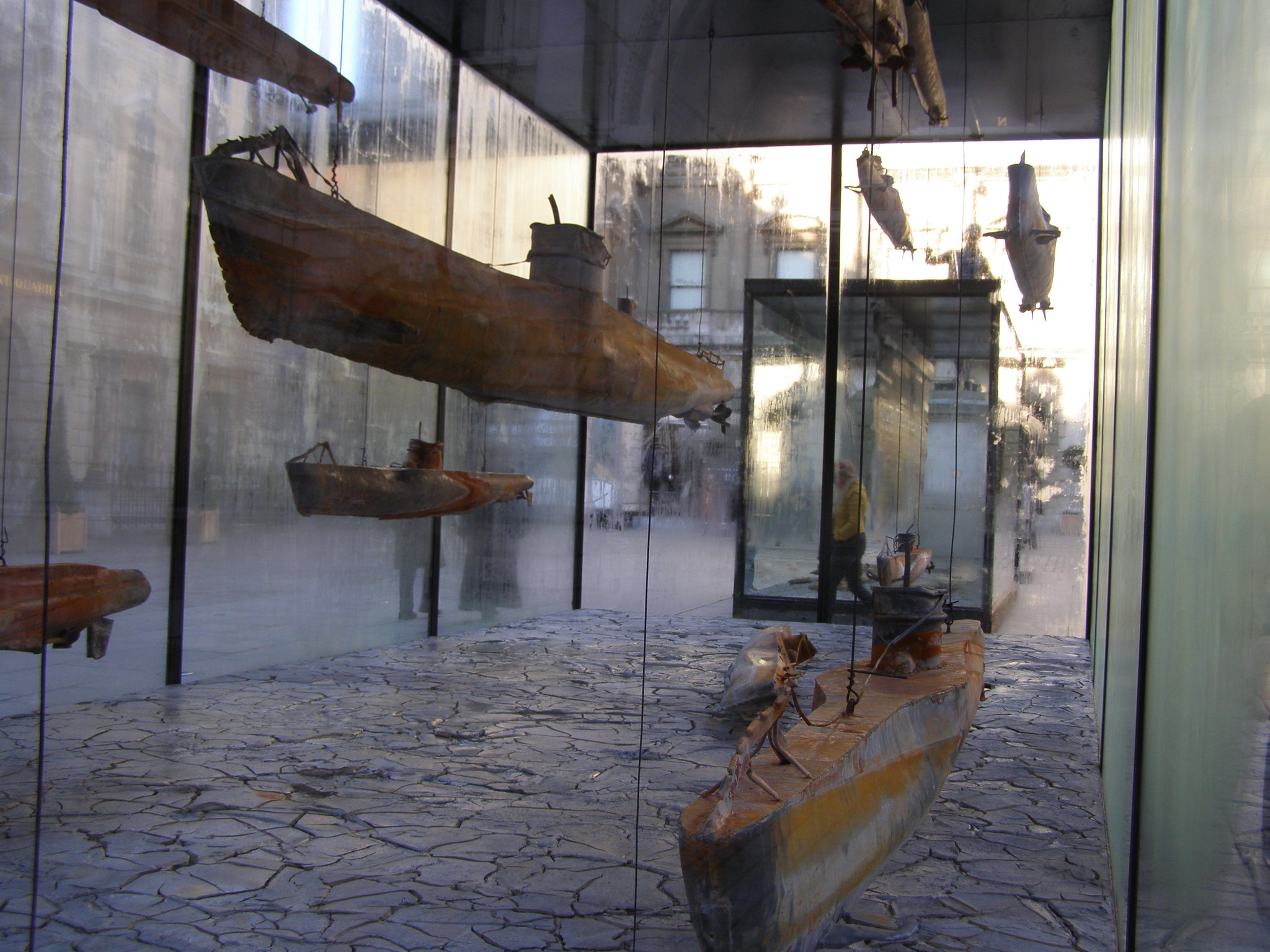
In the Annenberg Courtyard

Velimir Khlebnikov: Fates of Nations: The New Theory of War
Anselm Kiefer often dedicates his works to intriguing figures of the past, be they poets or philosophers. This piece is one of a number of works emerging from Kiefer’s ongoing exploration of the Russian Futurist avant-garde writer, theorist and absurdist Velimir Khlebnikov (1885-1922).

After years of study, Khlebnikov concluded that a major sea battle took place every 317 years, or multiples thereof. Kiefer celebrates this heroic and ludicrous activity with a work that is both monument and anti-monument. Measuring almost 17 metres in total and consisting of two large glass vitrines, Kiefer creates a transparent, reflective sea-scape in three dimensions that calls to mind the Romantic sublime of painters from JMW Turner to Caspar David Friedrich. Kiefer uses the frames of the vitrines to stage a mysterious drama, in which viewers, seeing each other and their own reflections, become participants.


Keywords: Anselm Kiefer architecture art hermeneutics history

The Architectural Lessons of Anselm Kiefer's La Ribaute

Stephen Wischer.

This article examines the architectural significance of Anselm Kiefer’s situated art practice, exploring how relationships of poetry, history and culture, presented across all of his work, provide vital lessons for architectural thinking and doing. Kiefer’s creation of La Ribaute, outside Barjac, France, is particularly well suited to the study of a hermeneutic approach to architectural creation, since the reinterpretation of historical and mythical themes across painting, sculpture, earthworks and architecture critically situates modern creative practice within the larger continuum of human culture and knowledge.

Stephen Wischer is an Associate Professor of Architecture at North Dakota State University, where his teaching of history/theory seminars and design studios emphasize interdisciplinary relationships between art, architecture, writing and philosophy. His artwork and architectural investigation involve intensive process-based explorations which have been exhibited in both Canada and the United States. His doctoral research at McGill University in Montreal, Quebec, explores hermeneutic readings of artistic creation and historical texts in relation to architectural praxis.

Monday, 3 July 2023

Existential/Propositional Objectiles/ Spaces/In-Situ : Architecture/Photography/Installation


Objects exist in the between of a proposition and its eventness, and in so doing they are inciting co-constellations of movement-moving.

Forsythe invites his students to participate in creating physical solutions to dramaturgic propositions. 
Erin Mannng.

Sainsbury Centre, University of East Anglia

Tate Modern

Millennium Bridge

VITRINES : Art Spaces/interiors/interventions
Anselm Kiefer :
In the Annenberg Courtyard
Velimir Khlebnikov: Fates of Nations: The New Theory of War
Anselm Kiefer often dedicates his works to intriguing figures of the past, be they poets or philosophers. This piece is one of a number of works emerging from Kiefer’s ongoing exploration of the Russian Futurist avant-garde writer, theorist and absurdist Velimir Khlebnikov (1885-1922).

After years of study, Khlebnikov concluded that a major sea battle took place every 317 years, or multiples thereof. Kiefer celebrates this heroic and ludicrous activity with a work that is both monument and anti-monument. Measuring almost 17 metres in total and consisting of two large glass vitrines, Kiefer creates a transparent, reflective sea-scape in three dimensions that calls to mind the Romantic sublime of painters from JMW Turner to Caspar David Friedrich. Kiefer uses the frames of the vitrines to stage a mysterious drama, in which viewers, seeing each other and their own reflections, become participants.

Paul Soldner
Sainsbury Centre
University of East Anglia


2017/2023


Friday, 23 June 2023

Tentative Building Profiles : Speculative landing sites of surface, image and texts

 5

Procedural Architecture

Reading Collage : Spatial Drawings/Documents/Analogue Photography

Dialogic learning is learning that takes place through dialogue. It is typically the result of egalitarian dialogue; in other words, the consequence of a dialogue in which different people provide arguments based on validity claims and not on power claims.


Jana Sterbak

Remote Control 1989

A Hut of One's Own, Ann Cline

Texts,Annotations, Foundations, Pathways, Corridors, Bookmarks, Walking, Thinking, Ramble, Cross Country, Disciplines,


VITRINES : Art Spaces/interiors/interventions. 

Anselm Kiefer :

In the Annenberg Courtyard
Velimir Khlebnikov: Fates of Nations: The New Theory of War
Anselm Kiefer often dedicates his works to intriguing figures of the past, be they poets or philosophers. This piece is one of a number of works emerging from Kiefer’s ongoing exploration of the Russian Futurist avant-garde writer, theorist and absurdist Velimir Khlebnikov (1885-1922).

After years of study, Khlebnikov concluded that a major sea battle took place every 317 years, or multiples thereof. Kiefer celebrates this heroic and ludicrous activity with a work that is both monument and anti-monument. Measuring almost 17 metres in total and consisting of two large glass vitrines, Kiefer creates a transparent, reflective sea-scape in three dimensions that calls to mind the Romantic sublime of painters from JMW Turner to Caspar David Friedrich. Kiefer uses the frames of the vitrines to stage a mysterious drama, in which viewers, seeing each other and their own reflections, become participants.


Start by thinking of architecture as a tentative constructing toward a holding in place. Architecture's holding in place occurs within and as part of a prevailing atmospheric condition that others routinely call biosphere but which we, feeling the need to stress its dynamic nature, have renamed bioscleave.

Architectural Body

Madeline Gins and Arakawa


Working Notes/Holding in Place


Wayfinding/Movements through accumulated research

Running scripts, enactments, instances, involvements

Collaborative texts, complexity, emergent, discursive 


From The Bookcase to The Field Table : Landing Sites of Inquiry


Camouflage

Neil Leach

For Benjamin, the twentieth century is an age of alienation. Human beings are no longer 'cocooned' within their dwelling spaces. Architectural spaces are no longer reflections of the human spirit. Something has been lost.

Mimesis, 19.


New Concepts of Architecture

Existence, Space and Architecture

Christian Norberg-Schulz

A child 'concretizes' its existential space.


A Philosophy of Emptiness

Gay Watson

Artistic Emptiness

Everything flows, nothing remains.

Heraclitus


Rethinking Architecture

Neil Leach

Figure 1, Sketch by Jacques Derrida for Choral Work project. 343

Foucault, Figure 2 Bentham's Panopticon (1791). 360

Page laid in, The Atrocity Exhibition by J. G. Ballard, new revised edition,annotations, commentary, illustrations and photos.


Tracing Eisaenman

Plenum, juxtaposed to form/haptic values/body absences

Robert Mangold

Between moments of 'meaning' lie spaces or blanks of immediate experience. Such blanks are actuality. Usually the blank, the actuality, goes unnoticed because it works so efficiently to differentiate one meaningful event from another. Kubler discussed this in The Shape of Time.


Interactions of the Abstract Body

Josiah McElheny

Object Lesson/Heuristic Device

The term 'heuristic' is understood here to denote a method of addressing and solving problems that draws not on logic but on experience, learning and testing. In this regard stories and fictional narratives can be heuristic devices in acting as ideal models that are not to be emulated but which help to situate characters, actions and objects.


Space Between People

Degrees of virtualization

Mario Gerosa


Adaptive Architectural Design

Device-Apparatus

Place

Function

Adaptation

The second phase of project activity acknowledges that the proposal involves two sites; the landscape of settlement and the artifice of the factory. The design is intended to be a reflection of the conditions of each, so there was a need to work directly with the manufacturing process, at full scale, as early as possible. This would provide an immediate counterpoint to the earlier representations and a necessary part of exploring the manufacturing medium in the context of architectural design. 69


Building The Drawing

The Illegal Architect

Immaterial Architecture

Mark Cousins suggests that the discipline of architecture is weak because it involves not just objects but relations between subjects and objects. And if the discipline of architecture is weak, then so, too, is the practice of architects. Architecture must be immaterial and spatially porous, as well as solid and stable where necessary, and so should be the practice of architects.

Jonathan Hill

Index of immaterial architectures


Herzog and De Meuron

Natural History

Exhibiting Herzog and De Meuron

We are not out to fill the exhibition space in the usual manner and to adorn it with records of our architectonic work. Exhibitions of that kind just bore us, since their didactic value would be conveying false information regarding our architecture. People imagine that they can follow the process, from the sketch to the final, photographed work, but in reality nothing has really been understood, all that has happened is that records of an architectural reality have been added together.


My studio is a piece of architecture that is silent. The things of which it is made say all and at the same time nothing. Its strength lies in its demanding silence. A stern silence in order to permit works to occur. I imagine that a painting by Newman could be hung there.


The arrival of Beuys in a world that was gradually falling asleep amidst minimalism generated a kind of confusion that was truly excellent for opening up the mind. Comfort vanished, driven away by subversive complexity.


Speculative architecture

On the aesthetics of Herzog and De Meuron


Without opposition nothing is revealed,

no image appears in a clear mirror

if one side is not darkened

Jacob Bohme, De tribus principii (1619)


Reflections on a photographic medium

Memorial to the Unknown Photographer

Thomas Ruff's Newspaper Photos

Valeria Liebermann


Working Collages

Karl Blossfeldt


Anti Object

We are composed of matter and live in the midst of matter. Our objective should not be to renounce matter, but to search for a form of matter other than objects. What that form is called architecture, gardens, technology is not important. 

Kengo Kuma


Wednesday, 2 March 2022

Open Laboratory : Photographic Work : Borderlands

Art as Spatial Practice.
Space folds : Containing "Spatialities around historicality and sociality"

"All that is solid melts into air"

Karl Marx, Friedrich Engels,
(Poetic observation concerning the constant revolutionizing of social conditions)

Perceptions now gathering at the end of the millennium. Spatiality, Robert T. Tally Jr. 2013
Anthrocene, Nick Cave and the Bad Seeds, Skeleton Tree.

Oxford Dictionary of Geography: spatiality

Anselm Kiefer :
In the Annenberg Courtyard
Velimir Khlebnikov: Fates of Nations: The New Theory of War
Anselm Kiefer often dedicates his works to intriguing figures of the past, be they poets or philosophers. This piece is one of a number of works emerging from Kiefer’s ongoing exploration of the Russian Futurist avant-garde writer, theorist and absurdist Velimir Khlebnikov (1885-1922).

After years of study, Khlebnikov concluded that a major sea battle took place every 317 years, or multiples thereof. Kiefer celebrates this heroic and ludicrous activity with a work that is both monument and anti-monument. Measuring almost 17 metres in total and consisting of two large glass vitrines, Kiefer creates a transparent, reflective sea-scape in three dimensions that calls to mind the Romantic sublime of painters from JMW Turner to Caspar David Friedrich. Kiefer uses the frames of the vitrines to stage a mysterious drama, in which viewers, seeing each other and their own reflections, become participants.

The effect that space has on actions, interactions, entities, concepts, and theories. Physical spatiality can also be metaphorical. It is used to show social power—thrones are higher than the seats of commoners, and ‘high tables’ for university teachers in most Oxbridge colleges physically elevate the teachers over the taught. People use proximity to show how intimate they want to be with others (See personal space), or orientation; we may face someone or turn away from them. Institutions and governments have used large architectural spaces to invoke awe, while restaurateurs may create ‘cosiness’ in small spaces.

Alternative Photography
Enchantments and Crossings : Somatic Effects


 Borderlands : Analogue Montage : Photographic Document

Walberswick : Beach Slides/Digital Pinhole

VITRINES : Art Spaces/interiors/interventions

Biosphere/Blue Cloud Network : Cyanotype Drawing Process

Sequential Photographs : Analogue Process


Monday, 25 October 2021

Mapping Under The Dome : Dark Tones/Alternative Photography

Darkness is a better form of freedom
Therese Oulton, in conversation, January 2013
Women In Dark Times
Jacqueline Rose

Jozef Van Wissem & Jim Jarmusch
The Mystery of Heaven
Sacred Bones Records. 2012

Everyone Stands Under His Own Dome of Heaven 1970

'Each man has his own dome, his own perceptions, his own theories. There is no one god for all'
Anselm Kiefer

In paintings of often stunning luminosity, Therese Oulton manages to paint us into the darkest spaces of our times.
A form of experience permanently menaced by itself.
Jacqueline Rose


https://www.flickr.com/photos/russellmoreton/39854735761

Sunday, 10 October 2021

The Momentum of Things, becomes self sustaining

TWILIGHT : Photography in the Magic Hour.
Martin Barnes, Kate Best.

One needs infinitely distant sentences that one barely understands, as a mainstay over the millennia.
The Human Province, Elias Canetti.

The Momentum of Things, becomes self sustaining.
Untitled 1983/84, Bill Henson.

Collage, photocopies, mesh, text, non spaces.

Drawing, tissue paper, tape, body outline with astronomical data on paper.

Andover Installation : October at the Chapel.


Thursday, 7 April 2016

Russell Moreton VITRINES : Art Spaces/interiors/interventions. 3

Anselm Kiefer :
In the Annenberg Courtyard 2014.
Velimir Khlebnikov: Fates of Nations: The New Theory of War
Anselm Kiefer often dedicates his works to intriguing figures of the past, be they poets or philosophers. This piece is one of a number of works emerging from Kiefer’s ongoing exploration of the Russian Futurist avant-garde writer, theorist and absurdist Velimir Khlebnikov (1885-1922).

After years of study, Khlebnikov concluded that a major sea battle took place every 317 years, or multiples thereof. Kiefer celebrates this heroic and ludicrous activity with a work that is both monument and anti-monument. Measuring almost 17 metres in total and consisting of two large glass vitrines, Kiefer creates a transparent, reflective sea-scape in three dimensions that calls to mind the Romantic sublime of painters from JMW Turner to Caspar David Friedrich. Kiefer uses the frames of the vitrines to stage a mysterious drama, in which viewers, seeing each other and their own reflections, become participants.


https://www.royalacademy.org.uk/article/kiefer-and-chipperfield-talk-space