Showing posts with label design. Show all posts

Friday, 28 November 2025

Dwelling/Reverberation/Poetics : Physical Grammar/Passages

Outpost 200623

On The Experiential Level of Life

Investigating/Expanding 'The Spatial/Sculptural'
Space over Time/Operative Design


Tony Cragg
IN AND OUT OF MATERIAL


Demonstration

Tony Cragg : I basically mean the effectiveness of the object, of the material. But because the metaphysical and physical association are already occupied, I'm interested in somehow establishing some relationship with the materials and the things around me without using any preconceived notions of an already occupied language. It is a bit like taking away a Christian name and depersonalising something. What I mean is that it's an attempt on my side to restart the relationship with the material, which I think sculptors have to do anyway.

Jon Wood : Thinking of the increased awareness that this side of your work tries to capture and harness in the viewer, can you say a bit about the kind of sensitivities that you would like to be heightened? What would you see your work as demonstrations of and for? Your sculptures are triggers for what kind of thinking?

Tony Cragg : Well there is an attitude to looking at things and to looking at objects and materials which is based on a meditative tradition of contemplation : the universe in a grain of sand idea, or maybe even religious ideas where you actually get in contact on some level with the material world, on a deeper level than the one you obviously are capable of reaching in an everyday situation, so on an extraordinary level, outside of your own experiences.
I am not saying that that's not interesting or important. But I also think that this leaves the battleground for the everyday life to be governed by non-contemplative thought and non-meditative thought. And this may sound like a mixture of terms, but I think that there is a job to be done even on an everyday, “second for second” level of life—on the experiential level of life. I think there is a job to be done here improving the quality of contemplation about an awareness of the material world—the material world seen as an immediate extension of the communal social effort, the cultural effort that you are part of.

Jon Wood : How does it move from being an individual contemplative experience to being one that has a communal relevance?

Tony Cragg : In the main part it only has communal relevance. All you can do for yourself is formulate your sentences, cook yourself a meal that suits you, get dressed in a fashion that suits you, and everything else you have to put up with as having been made by other people for you. But obviously, even if they didn't ask your permission, there's something consensual about that, isn't there? Even though you don't like it, it doesn't look like you're making an effort to change it. And maybe there's some active thing there. My idea is that even if I don't like it, I wouldn't be able to change a great deal of it, but I could sow the seed for some change in the direction that I would feel would be important. It's a measure of how much responsibility one takes for the change. Looking for more in the visual world around me and looking for more language, in a sense, is one way of heightening sensibilities and expanding a vocabulary and then expanding the responses to a vocabulary is a way of heightening sensibilities. I'm not a politician, but I think we still live in a world that is greatly dominated by mesmerism and mystical models, which are very distracting because they actually stop us from really trying to face reality.


Objects/Subjects in Space : Passages in Sculpture

OPERATIVE DESIGN : SPATIAL VERBS
To serve as a fundamental tool for spatial and architectural interpretation
Spatial operations, illustrated beginnings to activate architectural inquiry.


This catalogue thus introduces the possibility of understanding spatial formation as a process that can be derived from fundamental actions, here grouped into volumetric addition, subtraction, or displacement, which define a lexicon of starting points for the creation of space and also imply the relationship between oneself and the space created.

OPERATIONS
to | Expand | Extrude | Inflate | Branch | Merge | Nest | Offset | Bend | Skew | Split | Twist | Interlock | Intersect | Lift | Lodge | Overlap | Rotate | Shift | Carve | Compress | Fracture | Grade | Notch | Pinch | Shear | Taper | Embed | Extract | Inscribe | Puncture |

MAKE SPACE

Space matters. We read our physical environment like we read a human face.

The Eyes Of The Skin
Architecture and the Senses
Juhani Pallasmaam Steven Holl
2005

How to set the stage for creative collaboration
Scott Doorley, Scott Witthoft, David Kelley
2012

Surface + Volume
Generative Process
Combinations and Aggregations
Implementations

Writing and Seeing Architectue
Christian de Portzamparc, Philippe Sollers
2008

In and Out of material : Passages in Sculpture


COMBINATIONS
to | Inscribe + Inscribe | Intersect + Intersect | Split + Split | Embed + Embed | Taper + Taper | Bend + Bend | Branch + Branch | Shift + Shift | Notch + Notch | Inscribe + Intersect | Intersect + Split | Split + Embed | Embed + Taper | Taper + Bend | Bend + Branch | Branch + Expand | Expand + Shift | Shift + Notch | Notch + Twist |  

Languages,dialogues,conflicts that can evoke form,experience and interaction.
Research, inquiry and practice as a systematic approach through operative terms.
Investigating the 'Spatial' its formal/experiential essence/action and character for spatial opportunities.

The Feeling Of What Happens
Body,emotion and the making of consciousness
Antonio Damasio
1999

The Architecture Of The Jumping Universe
A Polemic
How Complexity Science is Changing Architecture and Culture
Charles Jencks
1995

RESPONSIVE ENVIRONMENTS
ARCHITECTURE, ART AND DESIGN
V&A Contemporary, Lucy Bullivant
2006

to fold
to modulate
of tension
of entropy

Richard Serra, "Verb List Compilation: Actions to Relate to Oneself" [1967-1968]

to roll to crease to fold to store to bend to shorten to twist to dapple to crumple to shave to tear to chip to split to cut to sever to drop to remove to simplify to differ to disarrange to open to mix to splash to knot to spill to droop to flow to curve to lift to inlay to impress to fire to flood to smear to rotate to swirl to support to hook to suspend to spread to hang to collect of tension of gravity of entropy of nature of grouping of layering of felting to grasp to tighten to bundle to heap to gather to scatter to arrange to repair to discard to pair to distribute to surfeit to compliment to enclose to surround to encircle to hole to cover to wrap to dig to tie to bind to weave to join to match to laminate to bond to hinge to mark to expand to dilute to light to modulate to distill of waves of electromagnetic of inertia of ionization of polarization of refraction of tides of reflection of equilibrium of symmetry of friction to stretch to bounce to erase to spray to systematize to refer to force of mapping of location of context of time of cabonization to continue

AGGREGATIONS
to | Reflect | Expand
Reflect + Pack | Skew
Pack | Inflate
Pack + Stack | Branch
Stack | Bend
Array + Stack | Rotate
Array | Taper
Join + Array | Pinch

Join | Split

Poetics and Place
The Architectures Of Sign, Subjects and Site
Kristen Kreider
2014

A Hut of One's Own
Ann Cline

Open Office/Making Space : Passages in Sculpture


Texts,Annotations, Foundations, Pathways, Corridors, Bookmarks, Walking, Thinking, Ramble, Cross Country, Disciplines, 


SPATIALITY
Writer as mapmaker, literature of the city and urban space, concepts of literary geography, cartographics and geocriticism.
Robert T. Tally Jr
2013

OPERATIVE DESIGN
A Catalogue of Spatial Verbs
2012/18

IMPLEMENTATIONS

to | Carve + Offset
Poli House : Pezo von Ellrichshausen
Offset program | Perimeter Services | Thickened Openings

to | Embed + Branch
Villa 1 : Powerhouse Company
Branched Programs | Volume Wrapper | Embedded Entry

to | Embed + Overlap
Casa para un Carpintero : RCR Arquitectes
Overlapping Program | Circulation Core | Embedded Entry

to | Expand + Nest
House N : Sou Fujimoto Architects
Expanded Outer Volume | Nested Private Program | Nested Living + Dining


Collage/Drawing Frame : Passages in Sculpture
to | Overlap + Expand
House in Minamimachi 2 : Suppose Design Office
Overlapping Light Wells | Stacked Program | Expanded Volumes

to | Bend + Shift
Nursing Home : Aires Mateus
Shifted Volumes | Bent Massing | Embedded Massing

to | Embed + Taper
Leimondo Nursery School : Archivision Hirotani Studio
Tapered Volumes | Thickened Roof | Embedded Program

to | Lift + Carve
Gouveia Law Courts : Barbosa and Guimaraes
Carved Massing | Lifted Program | Carved Plinth

to | Lift + Extrude
Carabanchel Housing : Dosmasuno Arquitectos
Extruded Living Spaces | Lifted Massing | Carved Plinth

to | Overlap + Rotate
Ironbank : RTA Studio

Rotated Volumes | Stacked Utility and Circulation Cores | Plinth and Street Facade

Anthony Di Mari
Nore Yoo

Volumetric Spatial Operations/Agents/Variations/Combinations

Additions
Subtractions

Displacements


Colour/Making Space : Passages in Sculpture/Architectural Glass
Mesh Topologies : Pattern and Chaos
Speculative Narratives 12
DSC_0018 Spatial/Visual Apparatus
Spatiality : Space over Time
DSC_0476 Spatial/Architectural Drawing
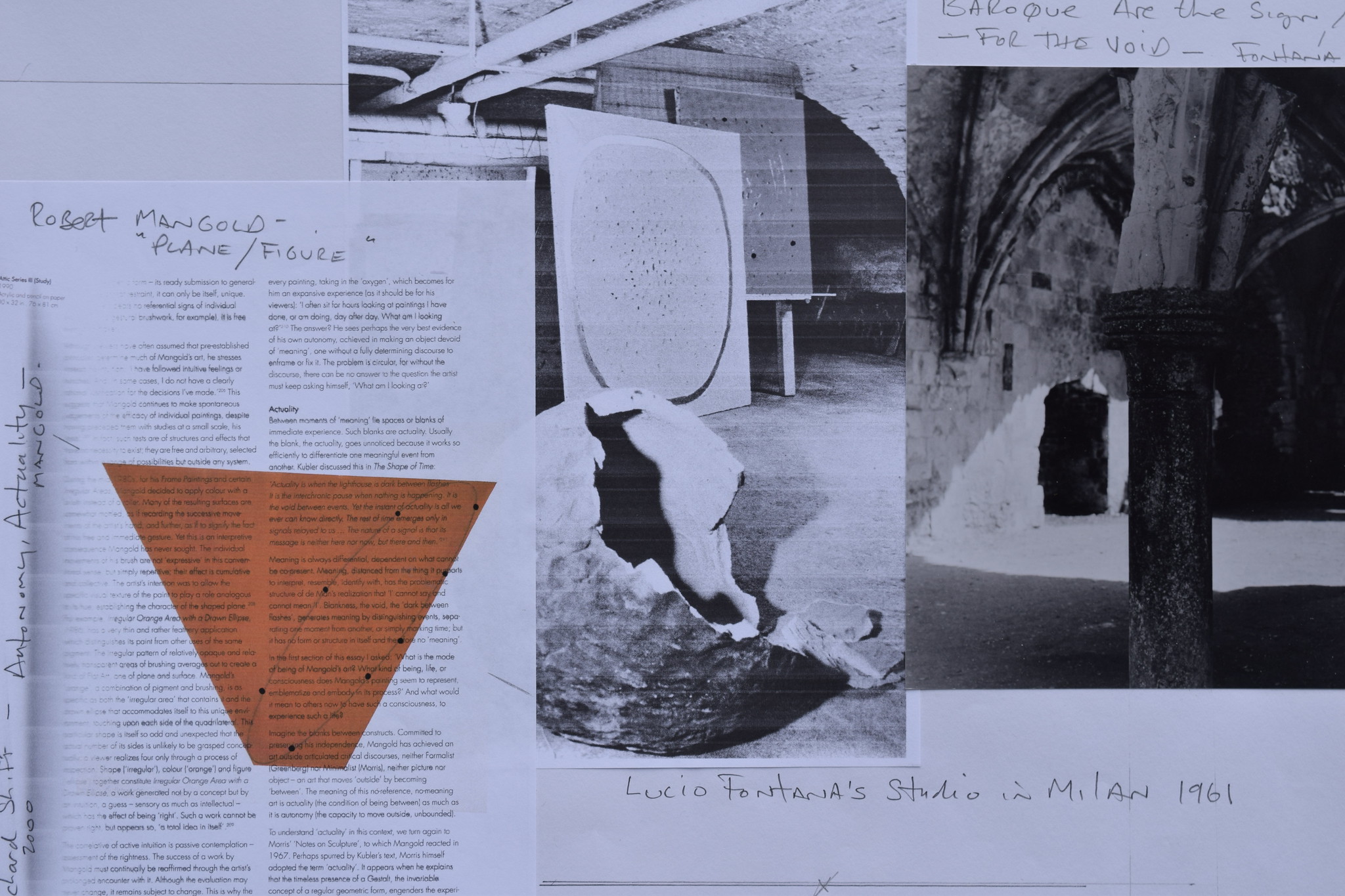
Reading Collage : Spatial Drawings/Documents/Analogue Photography
Speculative Narratives 8
Flickr


Sunday, 9 November 2025

Camouflage/Concept and Design : Re-Working Aesthetics/The Everyday

Everyday Aesthetics : Ordinary Lives

If the everyday can be considered an ecology where passions circulate in a perpetual state of intensification and entropic decline, the empirical self (and not just David Hume's version of it) is essentially in a state of flux. This posits the human as an organism constantly adjusting to its passionate environment, with a self that is constantly appearing and disappearing, crystallising and dissolving.

Ben Highmore


Camouflage : Neil Leach

Camouflage offers  a mechanism of locating the self against the otherwise homogenising placelessness of contemporary existence. It thereby promotes a sense of attachment and connection to place.

Camouflage may  therefore provide a sense of belonging in a society where the hegemony of traditional structures of belonging - the family, church and so on - has begun to break down. This aesthetic sense of belonging can be compared to other modes of belonging, such as religious devotion or romantic attachment.

In highlighting the creative capacity of human beings to adapt to their environment, this book offers a more optimistic account of human existence, which valorizes the present as the site of productive endeavor.

Here we might cite the work of more positive thinkers, such as Fredric Jameson who looks to the realm of representation for a mechanism of reinserting the individual within society. Jameson has  developed a notion of  ‘cognitive mapping', which serves  to overcome the lack of spatial co-ordinates within a society of late capitalism. He sees the potential of such mapping within the aesthetic  domain. What we need today, Jameson seems to be saying, is a viable form of aesthetic expression that reinserts the individual into society. The aesthetic  domain can therefore be seen to be somewhat Janus-faced. It is  both the source of many  of our problems, in a culture in which everything is co-opted into images and commodities, and potentially the way out.

Aesthetic  production should maintain the capacity  to operate as  a mediation between the self and the environment, but only aesthetic production whose design has been carefully  controlled can achieve this. The difference between productive and unproductive modes of expression is therefore a question of design. In this respect we can recognise the important social role of design in providing a form of connectivity for ‘cognitively  mapping an individual within the environment. 

Design becomes  a crucial consideration for the effective operation of camouflage.

Design plays a crucial social role in offering a form of connectivity, a mode of symbolisation, that allows  people to relate to their environment. Exquisitely designed works such as S, M, L, XL can therefore be interpreted not simply as highly aesthetic publications that could be accused of a process of ‘glossification’ — of turning the world into a designer representation of itself. 
Rather they  can be seen to be operating in the very space of contemporary culture, a space that is highly visual.

The concept of ‘Camouflage’ can therefore also respond to some of the questions that Koolhaas himself raises. In his essay on the Generic City, for example, Koolhaas offers a critique of the placelessness of the contemporary cityscape, where each city is virtually indistinguishable from the next. The theory  of camouflage, however, would seem to suggest that design itself can overcome this  condition by  providing a mechanism for relating the individual to the environment. 

Design here must be contrasted to junk. If the junk  city  has  become the placeless  generic  city, the exquisitely  designed city  can become the city  of a new form of spatial mapping. This  theory  of camouflage is therefore presented not only  as  a retroactive manifesto through which to appreciate Koolhaas’s work, but also as a contribution to the debates which he initiates.
The concept of ‘Camouflage’ will allow us, at least, to move beyond the often simplistic denigration of the aesthetic realm within recent critiques of postmodern culture, and to grasp the complexities involved in our negotiation with the world afforded through that realm. Above all, it will allow us  to recognise the important strategic  significance of aesthetics in contemporary culture in general and in Rem Koolhaas’s work in particular.


The Architectural Plan

An Anthropology of Architecture

Embodiment and Architectural Form
Process-Relational Philosophy


Building The Drawing

The drawing as analogue allows more subtle relations, of technique, material and process, to develop between drawing and building.
Immaterial Architecture
The Illegal Architect
Jonathan Hill

Oak Tree
Oil
Paper
Plaster
Rust
Sgratfito
Silence
Sound
Steel
Television
Weather

Frosted Light
Index of immaterial architectures

TRANSPARENCY : LITERAL AND PHENOMENAL
Colin Rowe, Robert Slutzky

Interactions of the Abstract Body
Josiah McElheny

Object Lesson
Interactive Abstract  Body (Square)
The Spatial Body (After Fontana)

Tracing Eisenman
Stan Allen
Indexical Characters

FABRIC=MASS+ FORM
Alan Chandler
The interest in fabric formwork is in its deployment in a building process, which is faster than conventional formwork. Fabric formwork is inherently more sustainable due to the minimising of both concrete and shuttering, and more radically, allows the constructor to intervene in the process of casting even as the cast is taking place.


ANTI OBJECT
Kengo Kuma
We are composed of matter and live in the midst of matter. Our objective should not be to  renounce matter, but to search for a form of matter other than objects.
What that form is called- ARCHITECTURE, GARDENS< TECHNOLOGY is not important.

ReThinking Matereriality
The engagement of mind with the material world
Elizabeth DeMarrais, Chris Gosden, Colin Renfrew

The Affordances of Things
Towards a  Theory of Material Engagement
Aesthetics, Intelligence and Emotions
Relationality of Mind and Matter

Material Agency
Towards a Non-Anthropocentric Approach
Carl Knappett, Lambros Malafouris

At The Potter's Wheel : An Argument for Material Agency
We should replace our view of cognition as residing inside the potter's head, with that of cognition enacted at the potter's wheel.

The Neglected Networks of Material Agency : Artefacts, Pictures and Texts

Material Agency as Cognitive Scaffolding

The Cognitive Life of Things
Material Engagement and the Extended Mind
Lambros Malafouris, Colin Renfrew

Minds, Things and Materiality
Michael Wheeler

Communities of Things and Objects : A Spatial Perspective
Carl Knappett

Imagining the Cognitive Life of Things
Edwin Hutchins

Things and Their Embodied Environments
Architectures for Perception
Structuring Perception through Material Artifacts
Charles Goodwin

Leach Pottery, Studio and Museum
A Potter's Book
Bernard Leach

Adventures of the Fire, Vessels Through Time
Ceramic Pavilion
People make space, and space contains people
Ceramic space and life

Gordon Baldwin
Objects For A Landscape
David Whiting
Vessels-Spaces that cannot be drawn, rather they  need to be experienced.
Imagining a Vessel in a Rock on a Beach, 2006,(charcoal on paper)

The Architecture of The Ceramic Vessel
The use of the vessel in the investigation of our world.
The exploration through the dichotomy of the analysis between exterior and interior, of one pot to another and from  the message they convey.

MATERIAL MATTERS
ARCHITECTURE
AND MATERIAL PRACTICE
Katie Lloyd Thomas

PLENUMS : RETHINKING MATTER, GEOMETRY AND SUBJECTIVITY
Peg Rawes

ARCHITECTURE
IN THE AGE  OF DIVIDED REPRESENTATION
The Question of Creativity in the Shadow of Production
Dalibor Vesely
The Nature of Communicative Space
Creativity in the Shadow of Modern Technology
The Rehabilitation of Fragment
Towards a Poetics of Architecture

The Projective Cast
Architecture and its Three Geometries
Robin Evans
Architects do not produce geometry, they consume it

Analysing ARCHITECTURE
Simon Unwin
Geometries of Being
Architecture as Making Frames
Space and Structure


Wednesday, 24 July 2024

Joseph Cornell : a fusion of the timeless and the everyday

Collage: Diversions, Contradictions and Anomalies.

Collage's integral methods of discordance and displacement have so insistently reflected turbulent developments in twentieth century art, science and geopolitics that our response might be to categorise the whole genre as iconoclasm or subversive fantasy.

Sally O'Reilly


23/02/2017 


Sunday, 20 August 2023

Palimpsest/Architectural Models/Formworks : Installation/Ceramic Forms/Sketchbooks


Painting Canvas/Formwork 3mx3m : Shelter/Sensing Place/Painting in the Landscape

FABRIC DEVELOPMENTS = MASS + FORM

Collected Notes : Raveningham Sculpture Trail 2020

Studio Blackboard

ODYSSEY  Aesthetic Intervals/Timbre/Traces  


Raveningham Architectural Canvas/Form
 
Framed-Un-Framed Construction Sensing/Site  2020

Aesthetics between objects

Fragments from note books

Art Works, a constellation of coincidences/intuitions resting the not being made

Re-animating context
Aesthetic perception, how aesthetics are represented in a object by philosophers and scientists  

Espace-Milieu : Painting as environment entanglements
Painting in a landscape situation.
Canvas as spatial phenomena, reading both sides.

Asymmetries between a particular past and a general future
The passing of the present through the pure past

Difference and Repetition : Production/Synthesis of Temporality
Art Practice/Gathered from Everyday Life : Micropolitics of slowness and repetition.

The Living Present, constructed from habits, anticipations and recurrences

Chaos, territory, art 
Deleuze and the framing of the earth
Elizabeth Grosz


Immateriality/Temporal/Transitions material and movement/Human agency
A Species of Spaces

Construction/Making/Collage  
Forming, slowness and repetition, elements of painting
Assemblage, sensation, surface, objects and spaces between them gathered/thresholds
Sheltering/Weathered/ Exploring a fragility of a painting in the landscape

Robert Mangold, Paintings and Architectural Forms


Ephemeral Architecture

Canvas as spatial verb
Yellow Ochre, Molochite, Gesso, Canvas, Paper, Textiles, Wood, Lead, Nails

Canvas as folded construction/shelter/place
Operative Design, A Catalogue of Spatial Verbs

Georg Simmel, text Frames, Handles, Landscapes and the aesthetic ecology of things

03/05/2021


Thursday, 19 August 2021

Reading Rooms : Waverley Project


Interior Design presented as a sociological spatial practice.

Design as an interactive structure, an interlocutory interior in the making of space and spatial relations.

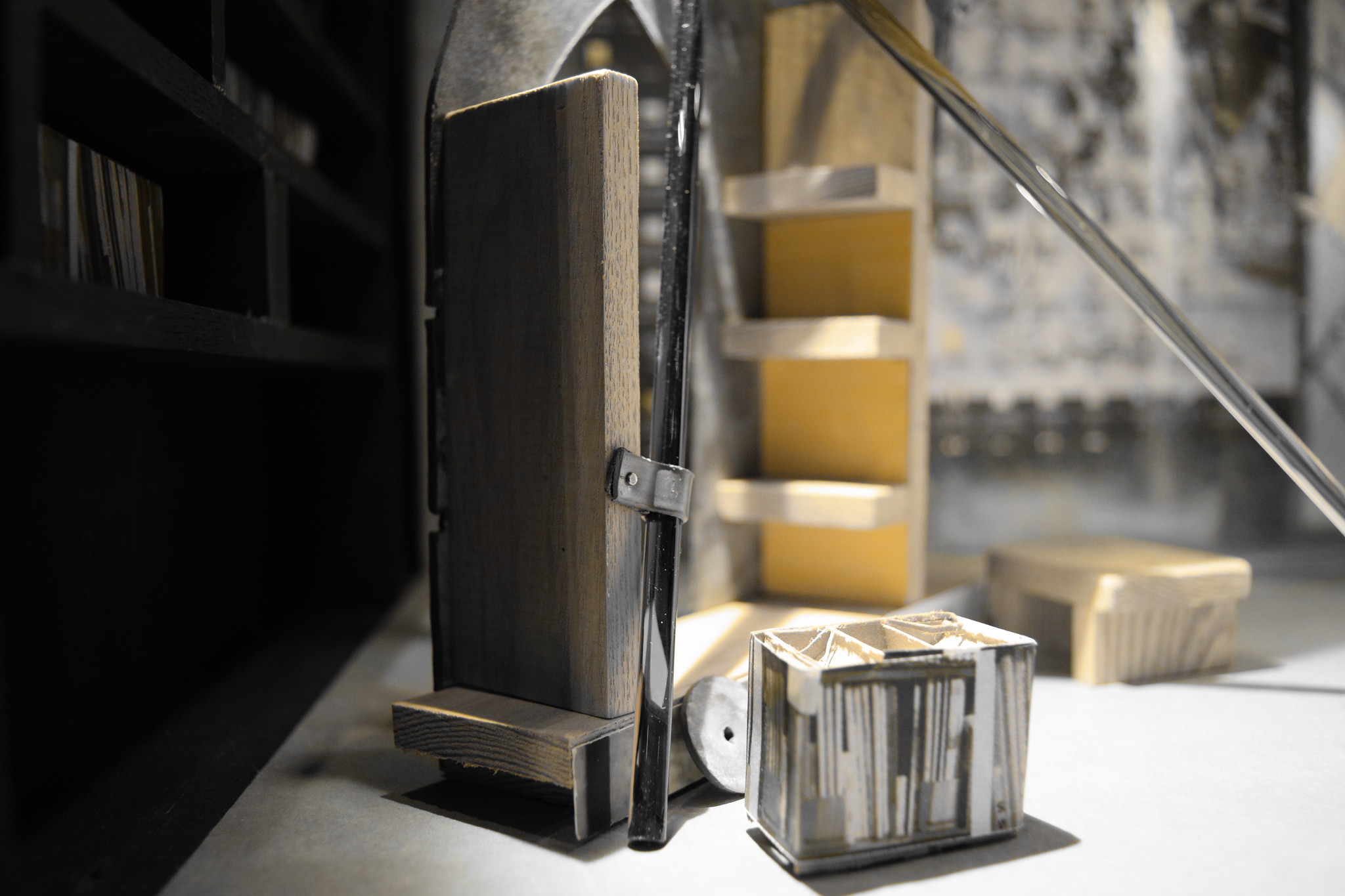
The Scriptorium brings together a varied and discursive set of ideas and objects, texts and interior architectures. The performativity of the research is presented through specifically designed apparatuses and staged in a niche like space. The gaps or relations between things become more interesting than the designed elements.


https://www.flickr.com/photos/russellmoreton/26625231676/in/dateposted-public/


Monday, 7 June 2021

Other ways, other than buildings of making : Reading Rooms/Performative Collages and Models

Spatial Agency : Other ways of thinking about social space and its architectural structuring.

Other ways, other than buildings of making a spatial difference.

Collage and Architecture. Jennifer A. E. Shields
Collage Methodologies in Architectural Analysis + Design
Architecture as Collage


Social Space, is dynamic space, things happen, and its production continues over time and hence it is not fixed to/by a single moment of completion.  

Performative Collages : Dualities of agency and structure, linked but separately identifiable conditions or proposals.

Agents are neither completely free as individuals, nor are they completely entrapped by structure. They are negotiators of existing conditions in order to partially reform them. 

Spaces are charged with the dynamics of power, empowerment, interaction, isolation, control, freedom, alienation.

Social space is intractably political space, in so much as people live out their lives in this space.