Showing posts with label Anglian Potters. Show all posts

Wednesday, 21 May 2025

Being Alive~Creating physical origins/entities : Correlations of Utility and Relevance.

 Outpost 111122


https://www.flickr.com/photos/russellmoreton/

Creating physical origins.


Biology of Cognition.


We become observers through recursively generating representations of our interactions, and by interacting with several representations simultaneously we generate relations with the representations of which we can then interact and repeat this process recursively, thus remaining in a domain of interactions always larger than that of the representations.


We become self-conscious through self-observation; by making descriptions of ourselves (representations), and by interacting with our descriptions we can describe ourselves describing ourselves, in an endless recursive process.


Autopoiesis and Cognition.

The Realization of The Living. 1970.

Humberto R. Maturana.

Francisco J. Varela.


For Niels Bohr,


Nature is richer than our metaphysical prejudices, it has more imagination than we do.


The well defined and solid picture of the world given by the old physics is an illusion.


Meaningful Information : Utility and Relevance.

Natural systems rooted in the physical world.


Correlations that care both physical but also intentional.

Relative information is generated by the interactions that weave the world.


The organism cares about its relevant relative information, it connects between something internal and something else generally external, 


Helgoland.

Carlo Rovelli.


The Minds Eye

Bridget Riley.


POETICS/ARCHITECTURE.

Effective Correlations : Architectural Body.

Recasting/Reconfiguring Life.

Madeline Gins and Arakawa. 2002. 


Drawing Apparatuses: OUTPOST 2022.

Daylight observed, spatial exposures and tracked blueprints.


Intermediaries induce space between (relations) object and process, they create, set in motion diffractive phenomena.


Deconstruction, removal and revealing of objects by taking away, an archaeological process of context sheets to reference a layered and exploratory removal of material.


SPAB Shotesham Working Party.

An attitude to historical buildings.

Well-being within the preservation and social agency of what remains of the building.

Working with lime, soft capping, clay lump, flintwork.


The ruin, its tower and the early church in the landscape.


Wayfinding/Shelters/Involuntary Remains/Sculptural Outcrops. Exposed Architectural Fragments.


Lime/Flint a plastic architecture, a fabric made up of instances of building gathered from the locality.


The 'lift-line' and the shuttering and infilling of flint-work, prior to the whitewash render finish.


Undifferentiated Landscapes.

A Field of Earth.

Jean Dubuffer.


Dubuffer used a plasterer's technique, in which walls are coated using shaken branches instead of loaded trowels. He applied many layers, scattered substances such as sand and other materials, the mortar was scratched, poked and prodded until it gave the impressions of teeming matter, alive and sparkling, he could then use it to evoke all kinds of indeterminate textures, even galaxies and nebula.


Earth Colours.

CHROMAPHILIA.


A mortar of mixed material, of added soil, ash, gravels and other earth elements added to this viscous paste.

Anthropology, a study of what remains from  human societies, rituals and artefacts.

A contemporary art/architecture that takes on anthropological and sociological concerns.

The sensorial realm of practical making, learning and well-being through the hapticity of craft.

Mobility-Movement-Being Alive.

Tim Ingold.


Red Kiln 

Hebden Bridge, 2007.

Refurbish, new fibre lining, ceramic fibre adhesive, fire cement, gas burners.

Re-locate and re-assemble for larger architectural ceramics.


Outpost Members

Submit archive material. 


Anglian Potters.

Demo day with Rebecca Appleby.

Creative explorations of concept, media and scale.


An Artist Who Uses Clay As Her Medium.


In 2019 Rebecca started a new body of work titled 'Graces' which was of great significance and helped her to re-ground her practice in sculptural exploration of symbolic relationship between architecture, industrial and bodily transfiguration. 


In 2021 Rebecca was awarded a grant from the Arts Council to take risks and connect with a broader network and audiences, enriching and invigorating her career.


Interested in Order-Chaos-Impermanence, philosophical concepts addressing change.


Influenced by ceramists Gordon Baldwin, David Roberts.


Work/Making/Exhibition Titles


Urban Traces/Fragments/Translations.

Ceramics and The City.

Palimpsest. 

Fractures/Personal Trauma.

Concrete Cancer.


Ceramic sculptural works derived from Painting, Collage and Drawing.

Research material around abstract painting and architectural de-construction.


Ashraf Hanna, clay body, 55% mixed molochites.

Handbuilt slab forms fired to 1180 degrees centrigrade.

Monoprinting with slips on newsprint, underglazing, body oxide washes,  paper stencils, scratched, sprayed, and incised mark making. 


Tuesday, 4 March 2025

A Body Of Relations : Knowledge Production/Creative-Embodied-Practices

GILDENGATE HOUSE

*STUDIOS UPDATE*

Due to redevelopment of the area, OUTPOST Studios will be closing in February 2025. Founded in 2010, we are thankful for 15 years in this fantastic space! Home to 90+ artists at any one time, hundreds of artists have benefited from studio space over this timeframe.


OUTPOST STUDIO 181121

Organism-Person-Environment/Architectural Body, Arakawa and Gins.

Haptic slippages between subject and object, between what is alive and what is animate.

Drawing/Anamorphic Perceptions, apprehended and felt, more than seen.


https://axisweb.org/artist/russellmoreton

https://www.anglianpotters.org.uk/members/russell-moreton/


Glass/Skin/Permeable/Translucent, Diaphanous and Wondrous.

The Sensation of Flesh/Skin, Surface and Subjectivity.


Material Thinking and the Agency of Matter.

Barbara Bolt. 2007.

Things and Bodies/Shifting Signs


The haptic image/indexical/involuntary markings and the present instant, a body at the limit of its moment when it is most definitely intensely alive and in the present.

Beyond the body's blurred contours and indexical markers, to see through, to see sense challenged.

Time is persistently liminal, a suspended, extended present.


Mattering/Mutability, Accident, Flux

Experience/Existence/Presence 


Life Drawing/Staging Oneself/Others

Body in Space/Resilience, Endures


An ecological view of cognition, knowledge of the world comes from engagement with things.

Rather than studying the world as an object, we  correspond with it in its own movement of growth or becoming. This correspondence sets up a relation with the world which opens up our perception to what is going on so that we can respond to it.

Tim Ingold. 2013.


Making as a process of thinking.


Making involves the socialised, skilled artist body labouring with materials, responding constantly to tactile, visual and emotional feedback from the emerging form. 

I am exploring emergent objects as landscapes, inhabiting them and of making sense through them.

Barbara Bolt. 2007.


Creative 'practice' and the embodiment of the 'social'.

The Life Class/The Artist's Studio.


Knowledge is emergent as the artist engages with the environments and processes of practice.


Adopting a conception of cognition as ecological assumes thinking and perceiving occur as an organism moves through its environment.


The artwork and the work of art produce a knowledge that is performed in the moving interactions of body, material, and social actors in space and time of which the artwork is a trace.

Tim Ingold. 2000.


Event Spaces, as an experience of distributed artistic subjectivity and shared art-of-inquiry. 


A Body Of Relations

Reconfiguring The Life Class

Yuen Fong Ling. 2016.


Intermediaries and happenings between my body and other bodies and their technologies, where their performativity is revealed offering new perspectives on the roles within the life class.


In my fixed physical position as the life model, the notion of the 'pose' reflects a union of the conscious and unconscious, instilled by the act of being looked at, and the ways to record this through optical devices and machines.


Modelling Subjectivities

Life Drawing, Popular Culture and Contemporary Art Education.

Margaret Mayhew. 2010.


Drawing is important because it delineates between elements in the physical, visual, psychological and cultural field, it also delineates between bodies and spaces, art and fashion, and present uncertainty verses timeless tradition.


The act of drawing itself involves considerable self control on behalf of the drawers, not only in mastering hand-eye coordination, but in concentrating on the present moment, the present action and in the immense discipline of looking at a naked body, culturally marked as sexually available, and not displaying sexual interest.

Margaret Mayhew. 2010.


The body is never isolated in its activity but always already engaged with the world. 

Merleau Ponty. 1999.


Through the configuration of the body as potentially transparent, against which the human being can only push with her hands at the limits physical and psychic geographies that are between inside and outside. 


Photography and the permeability of time evoking a physical experience of observing and examining other worlds.

Aesthetics of intimacy, photography and bodies of desire, the gaze of the passionate camera.


The intimacy and equivalences created through the photographic experience.

Her inert body both inside and outside the vitrine.

Potentially something dangerous about the  experiments with her body, with and into its layering and embodiment within speculative spacetime dimensions.

Here the viewer has the sensation of seeing through a double protective layer of glass and skin.


Art Practice/Building Distant Realities/Wonder

Like glass and within the glass, with the skin that separates the body from outer/other space as well as inner geographies and selves.


Written on the body, maps and navigations of interior spaces. Winterson/Woodman.

Her poetic image of a space that presses psychically on her from the outside.

The earthbound, partial female body, transgressions of the everyday limitations on the body.


The psychic geography manifested within frames of spatiality that becomes an inner space that flips outwards and defies limits.


Through and beyond the drawn/sculpted and painted body.

Site for psychic inner explorations, a corporeality for others rooted in the body's present moment of experience.


Diffracting Drawing and Painting.

Mattering as a reconfiguration of its own making, understanding and encountering.


Atmospheres : Architectural Environments, Surrounding Objects. 

Peter Zumthor. 2010.


Manuel Neri, Studio, Benicia, 1980

Francesca Woodman, Untitled contact sheet, Providence, Rhode Island, 1976


Saturday, 16 November 2024

The Darkness of Interiors/ The Absence of Openings.

Outpost 081024

Connections remaining sensuously in play.

The Darkness of Interiors/ The Absence of Openings.

https://www.flickr.com/photos/russellmoreton/


On the formation of the Japanese house.

In making for ourselves a place to live we first spread a parasol to throw a shadow on the earth, and in the pale light of the shadow we put together a house. The quality that we call beauty must always grow from the realities of life, and our ancestors, forced to live in dark rooms, presently came to discover beauty in shadows.

In Praise of Shadows, Jun'ichiro Tanizaki. 1933


The Trace Drawing

Interstitial Mappings/Spaces/Interiors/Parts/Intimacies.


Obviously, it is not being suggested that we should somehow be able to think something timber back into its tree, nevertheless, the reciprocal associations enjoyed by obtaining the one from the other depend upon certain conditions of connection remaining sensuously in play.

Peter Beardsell.


Making with circumstance/attention to place.

Giving buildings decisive readings that inform our readings of place.


A 'decisiveness' arrived at through attention and circumstance.


Living in a world reconstructed by information, deformed by restrictive economies.


Ontologically/Making Relations, having something to do with its being, not with exactly how it appears or its data – measure. Flat ontology is an idea that things exist in the same kind of way, no matter what they are. 


Things are much more mashed together than we like to think, and also much more distinct.


The biosphere is made of its parts, but it is distinct from its parts, and these parts are not reducible 'upwards' into wholes – the 'biosphere'.

There is one Biosphere, and its whole is less than the sum of its parts. Because the whole is one, and the parts are many and things exist in the same kind of way (flat ontology). Parts are distinct and non reducible if they exist in the same kind of way, no matter what they are.

Timothy Morton. 


You Are The Weather.

Roni Horn.


Weather isn't just a symptom or climate.


Anselm Kiefer.

The High Priestess. 1989


VIII : Book 88


In this book as a whole nature and architecture alike convey only the absence of life.

Armin Zweite.


Grey Works/Charcoal.

Lead/Ceramic/Inscriptions.


Weird Things


Things are entangled with interpretations of things, yet different from them.


Tim Morton, the thinker of that thought.


Reflecting on the bamboo screens and log columns of Osaka and Kamiichi, I realise that those details could be read as some kind of mask for a bucolic future. However, the choice of detail is derived from the capability of the material's presence to determine the quality of space- what the late David Pye refers to in his book Nature and the  Art of Workmanship as 'the weather in the space'. Japan has confirmed my view that architecture is inclusive – a collusion between different technologies and constructions that make the relevant accommodation for society.

Peter Salter. 


A Hut Life.

A life-lived as it is evolving.

Of Japanese/Chinese reclusive poets.


Interstitial Spaces.

The interior structure braces the external timber shell against snow loads. Between the braces are interior rooms for looking out. Moving between these rooms is like walking in the space 'between' which is sometimes 'clogged' by structure.

Kamiichi Pavilion, Peter Salter. 1995 


The hut and its hut life is a material process of living a relation, not (restricted or contextualized) as form or its container. The hut retains that which is frequently 'explained away' by relating things to a decade, a country, a state of human economic relations.


Roof top turrets, bits of former utility. A city of huts, of hut dwellers, of found places, of inspiration for new memories even as they invoke old ones. Visiting one another's sites, they climb creaky stairs and slip onto rooftops, balconies, or parapets. There they touch something deep in the needs and memory of people. Something that refuses to be dismissed, yet is fully alive only in the hut.

Anne Cline.


Kamiichi Mountain Pavilion.

4+1 Peter Salter : Building Projects.


The Buildings Reactions to the Weather/Ground/River and View.


Steadily the snow buries the building, but the exterior shell, which takes compression like a boat and behaves almost as if the building were in water, inversely anticipates the snow-load. This annual load exerts wear and tear, and will repeatedly leave its marks and defacements by way of distortion and pressure. But the building is designed to encode and record these batterings.

Conditions of Connection, Peter Beardsell.


The building is located in a clearing on the edge of a meltwater river. The intent is to provide a place to rest and enjoy the view. The building is first seen from a bridge through a clearing in the trees. Visitors approach it by a path along the river's edge.


Once within the building, their movement is directed towards a special room which is oriented towards the borrowed landscape, with a view of the two mountain peaks at the head of the valley.


A large gutter on the south side brings this water into the building, as if to guide the visitor. This same gutter also becomes the entrance canopy to the building, offering shade from the summer sun. The building aims to be cool in summer, full of shadows, with views out to the bright reflected light.


The building is naturally lit, with no electricity, and fresh water is provided by a hand-pump. All timber used in the construction has been taken from renewable or second-hand sources. The building is closed down in winter and becomes a part of the snow covered landscape.


Before the onset of winter, the townspeople of Kamiichi come to clean and prepare the building for the expected snow. It is then left to the small hibernating mammals and roosting birds. In the spring the shutters are opened and the snow barriers removed.


The copper water tank collects water from the gutter on the south elevation. Three overflows celebrate the abundance of meltwaters in the spring.


Section of first proposal. It was intended that the building should collect snow along its slatted roof structure, allowing the melted snow to drip down through the interior of the building.


Paper cut-outs were used to reassess the mass of the building proposition.


The building is snow-bound for seven months of the year, with snow reaching 12m. It is shaped hydro-dynamically to resist the snow, with two timber latticed compression shells. Within these shell structures a new landscape is created, as a resting place for climbers and a winter hibernation space for animals.


Students in Peter Salter's Diploma Unit are often asked to work at scales of 1:500 and 1:5, and nothing in-between. The defining properties of a strategy (not a programme) describable at 1:500 should carry a definitional force capable of determining detail at 1:5. Intermediate scales are disallowed to let a strategy's connective energies make their way, unimpeded, into detail. One applying pressure on the other, both tightens and expands the possibilities of connection and exchange.


Afterword/Making with beautiful circumstances.


Rules For Detail/A Search For Legibility Through Detail.

Peter Salter.


Rules are made to govern the definition of space through the accuracy of constructional detail. In the reading of such detail the spatial emphasis of the room can be understood to be mute or otherwise, giving it a kind of legibility. This ordering and quality of space help determine the accommodation and relevance of the architecture in circumstances where the programmatic brief is unavailable, underdeveloped or redundant. Legibility implies a variation in the reading and definition of the proposition. This is explored through a number of recurring strategies:


To make ever finer territories in order to relieve the burden of scale upon the architectural piece.


To look for possible scale differences – architecture as furniture – as a way of offering emphasis within a sequence of rooms.


To work with an additive architectural programme rather than a conglomerate form.


To introduce the metaphor of the boat as a raft that assembles parts of programme common to the wider building form.


Each strategy offers tactics for proceeding and the possibility of detail. Each implies a layering, a kind of stratification of idea and details; the control of the spatial hierarchy and the design of the door furniture can be layered together.


The strategy offers rules for construction when intuition runs out, and a way of testing form. The layering suggests an in-situ construction – a serialising of programme that offers a crafted building.


Ceramics

Anglian Potters.

Cambridge Exhibition.

https://www.anglianpotters.org.uk/members/russell-moreton/

Friday, 2 February 2024

Making Statements/Making Things : Hungate/Anglian Potters.

The Enabling Constraint.


Objects become relational in conjunction with the ways in which the environment proposes its own constitutive limits . Erin Manning.

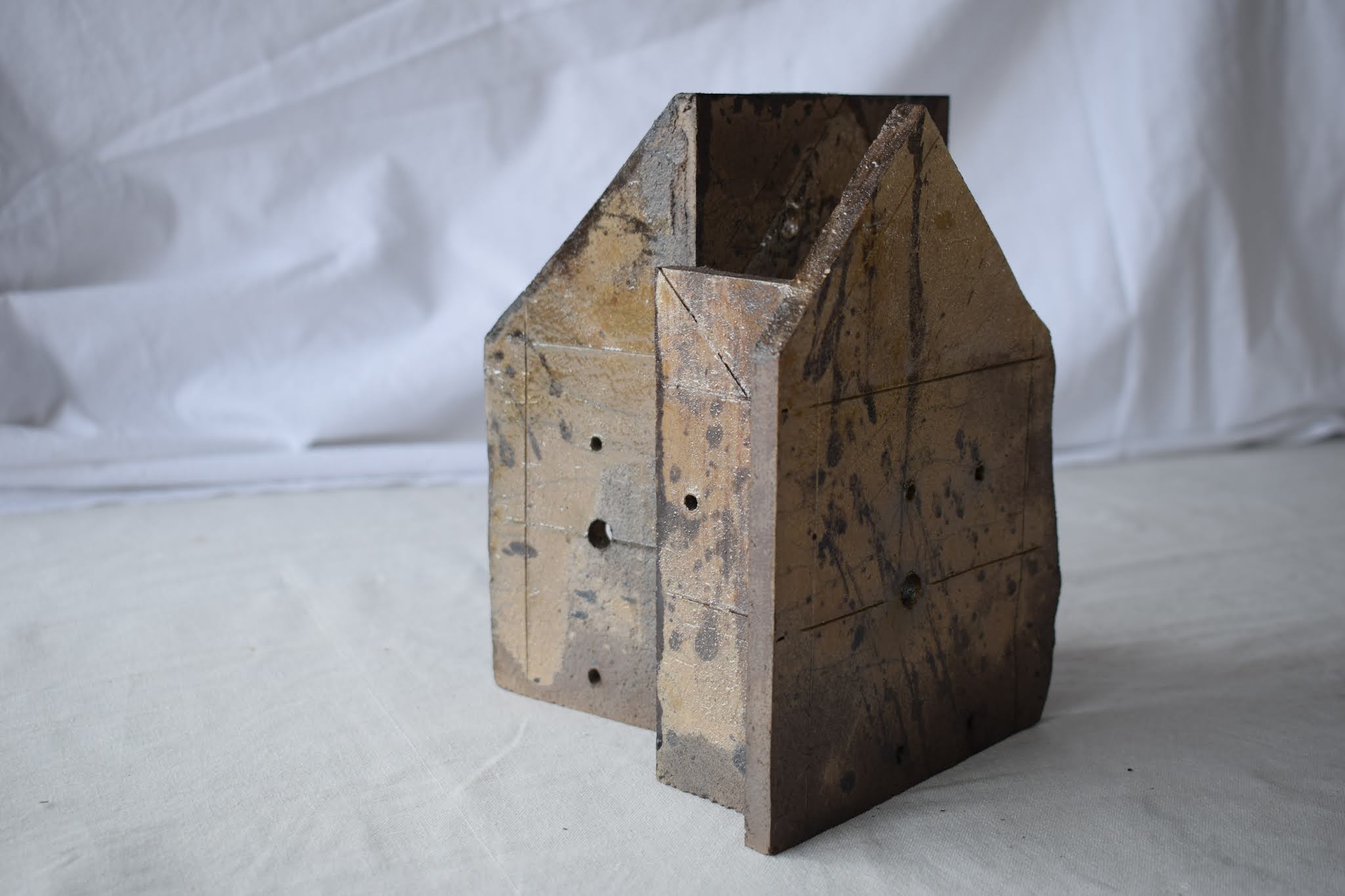
Architectural slab built pieces investigate ceramic forms as a dwelling place or a model for a building construction. Some thrown shapes on the theme of crucibles fired by the Raku process. Recent work has been exhibited in historical sites and locations, exploring contexts of ceramics and rituals. Studied Ceramics at Epsom School of Art and Design UCA, Visual Fine Art at Winchester, Teaching at Brockwood Park School.

Anglian Potters

https://www.anglianpotters.org.uk/members/russell-moreton/


Water at Hungate.

Hungate Architectural Explorations. 

Air/Place/Breath/Light/Architecture/Ritual/Social Space

Cell-Court-Domain.

Russell Moreton is a visual artist interested in gathering research and responding to the historical site of St Peter, Hungate. He has explored the exhibition theme 'Water' as both a spiritual and corporeal inquiry for site-specific artworks. He has spent time developing working ideas that have an affective resonance to the architectural setting of their presentation. His use of slab built ceramics vessels echo the stillness and muted silence experienced within the medieval fabric of the Hungate. He has used a figural drawing on Chinese paper, processed by the evident passage of water to explore the representation of the human form in this particular place.


Sunday, 20 August 2023

Palimpsest/Architectural Models/Formworks : Installation/Ceramic Forms/Sketchbooks


Painting Canvas/Formwork 3mx3m : Shelter/Sensing Place/Painting in the Landscape

FABRIC DEVELOPMENTS = MASS + FORM

Collected Notes : Raveningham Sculpture Trail 2020

Studio Blackboard

ODYSSEY  Aesthetic Intervals/Timbre/Traces  


Raveningham Architectural Canvas/Form
 
Framed-Un-Framed Construction Sensing/Site  2020

Aesthetics between objects

Fragments from note books

Art Works, a constellation of coincidences/intuitions resting the not being made

Re-animating context
Aesthetic perception, how aesthetics are represented in a object by philosophers and scientists  

Espace-Milieu : Painting as environment entanglements
Painting in a landscape situation.
Canvas as spatial phenomena, reading both sides.

Asymmetries between a particular past and a general future
The passing of the present through the pure past

Difference and Repetition : Production/Synthesis of Temporality
Art Practice/Gathered from Everyday Life : Micropolitics of slowness and repetition.

The Living Present, constructed from habits, anticipations and recurrences

Chaos, territory, art 
Deleuze and the framing of the earth
Elizabeth Grosz


Immateriality/Temporal/Transitions material and movement/Human agency
A Species of Spaces

Construction/Making/Collage  
Forming, slowness and repetition, elements of painting
Assemblage, sensation, surface, objects and spaces between them gathered/thresholds
Sheltering/Weathered/ Exploring a fragility of a painting in the landscape

Robert Mangold, Paintings and Architectural Forms


Ephemeral Architecture

Canvas as spatial verb
Yellow Ochre, Molochite, Gesso, Canvas, Paper, Textiles, Wood, Lead, Nails

Canvas as folded construction/shelter/place
Operative Design, A Catalogue of Spatial Verbs

Georg Simmel, text Frames, Handles, Landscapes and the aesthetic ecology of things

03/05/2021


Sunday, 19 September 2021

Studio Workings/Hidden Orderings : Making from Scattered Attention/Undifferentiation.

OUTPOST STUDIOS 3.16

Cooper's 'Objects' of thinking are not objects, but that which goes beyond objects. It is not the objects that resist meaning (as we have seen they are full of meaning) but what goes beyond objects.

Peripheral Vision

Relationality

The act of relating is analysed as a constitutive feature of human agency. Relating is viewed as a continuous work of connecting and disconnecting in a fluctuating network of existential events.

Robert Cooper


The Hidden Order of Art. Anton Ehrewzwey


Anglian Potters
Members Profile

Studied Ceramics at Epsom School of Art and Design from 81-84. Worked in a number of studios including Grayshott Pottery and Dexterity Crafts. Working methods include thrown/altered/slab built forms, kilns generally self constructed, experimental and portable. Previous work has been slab built architectural forms fired at stoneware temperatures. Recent pots are hand thrown, low fired Raku with delicate fragile rims. Own practice explores interests in Architecture/Lighting and thinking with the vessel as a contemplative/activist form. Interested in the sculptural qualities of the vessel/pot to explore making/material. Informed by contemporary arts, sculpture and architecture. Teaching experience in Fine Art and Ceramics.