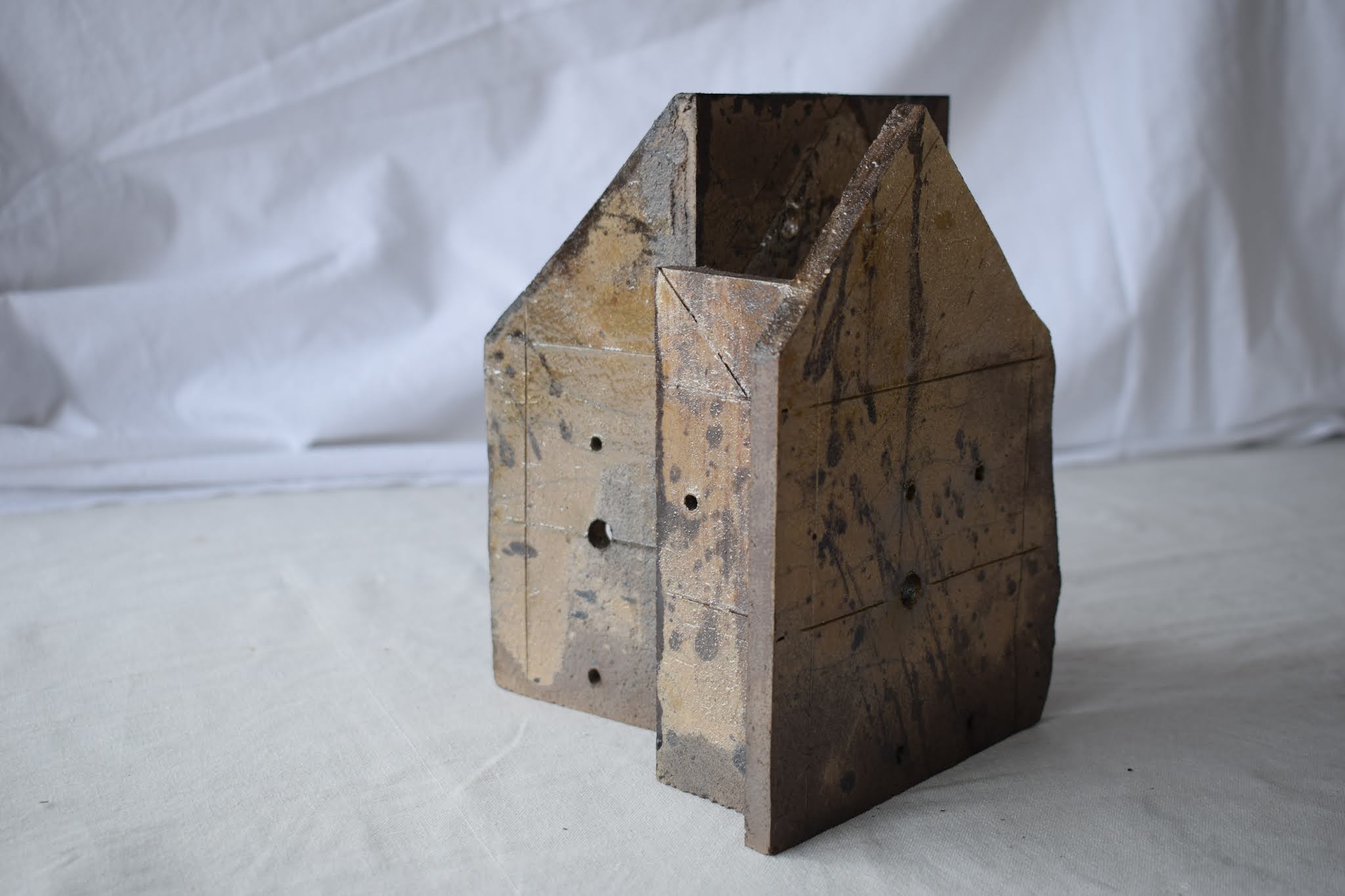
Outpost 190723
Ceramic Forms/Speculative Spaces.
The ambient wholeness of the world at large is impossible to take in.
Erin Manning/Arakawa and Gins.
Demarcations/Sensations in the Landscape of Perception.
The Apparent Blindness of Little Perceptions.
White Sticks and Subsidiaries.
The Meaning of the Tactile Experience.
Curriculum Making as the Enactment of Dwelling in Places.
The Environment without Objects.
Bringing Things To Life.
Creative Entanglements In A World Of Materials.
Tim Ingold.
Subsidiaries exist, as such by bearing down on the focus to which we are attending from them, and are integrated one to the other by the act of a person, and last only as long as a person, the knower, sustains this integration by indwelling (living in) them.
The proof of the existence of two kinds of awareness comes when we try to observe how we do all this. If our blind man shifts his attention from the tip of his cane to his hand, the meaning on the end of the cane disappears (or becomes something else). Deprived of the meaning of its actions, any description of the process is merely a description of the 'mechanics' and not perception at all.
Robert Irwin.
Relationscapes : Erin Manning.
For Arakawa and Gins.
Fielding Microperceptibility.
Suddenly we are no longer simply watching things moving, we are feeling movement moving. We are moving with our watching fielding the finding form of microperceptions. This finding form of microperceptibility that gives rise, to a quasi registering of an affective tonality rather than a particular emotion.
We move-with the movement even as we are moved by it,
The more ambiguous the surroundings, the greater number of Imaging Landing Sites.
Imaging Landing Sites are virtual events in the making, they foreground the kinaesthetic flickering that propels the taking form of an event.
Landing Sites are event markers in and of the event fabric that is organism-person-environment.
Landing Sites corner the experience in the making.
Imaging Landing Sites give affective resonance to the relation between experience and feeling, they give force to the taking form of the experience.
Arakawa and Gins.
Hungate Glass Abstracts
Raveningham Site Drawing on Architectural Paper.
White Sticks/Visual Feeling/Drawing on Blindness/Feeling through Subsidiaries.
Feeling Drawing/Drawing with Trace and Inscription.
Breathing/Perceiving in the landscape through the phenomenal sensations of subsidiaries/white sticks integrating an awareness of both an indwelling (living in) and a visual demarcation of that movement of gathering sensations.
Drawing into the phenomenal by using media/tools and sensations/experiences through the site of the situated body of the knower.
Personal Knowledge, Michael Polanyi.
The semantic aspect of this transformation is that the information the man gets by feeling with the cane is the meaning of the tactile experience.
Picture a blind man probing his way with a cane. While he is alert to the feelings in the hand holding the cane, the crucial distinction may be defined by saying that these feelings are not watched in themselves, but he watches something else by way of them, that is by keeping aware of them.
He has a subsidiary awareness of the feelings in his hand, feelings which are merged into focal awareness at the end of the cane, constituting two kinds of awareness that are mutually exclusive-'from awareness' and 'focal awareness.' There is here a particularly interesting phenomenal transformation. The sensations of the cane on his hand (the surface of the cane as it touches the palm of his hand, etc.) are lost. Instead, he feels the end of the cane as it touches an object.
Being and Circumstance.
Notes Towards a Conditional Art.
Robert Irwin.
All perceptual knowing is knowing in action (change) and the equivalent of the phenomenal.
Change is the most basic condition (physic) of our universe. In its dynamic, change (alongside time and space) constitutes a given in all things, and is indeed what we are talking about when we are talking about when we speak of the phenomenal in perception. Most critically, change is the key physical and physiological factor in our being able to perceive at all.
For Irwin, our perceptual process is a kind of 'perpetual motion' assimilator. No change, no perceptual consciousness. So while it is perfectly understandable that the overwhelming majority of our conceptual energies are spent on organizing this myriad of perceptual data into some 'familiar picture' we can work and live with, what is not so understandable is how much of those intellectual energies have been spent on trying to avoid this fact and its effects on our lives.
LEARNING TO LEARN
On Learning
Brockwood Park School.
J. Krishnamurti.
MAKING : Anthropology, Archaeology, Art and Architecture.
Towards an Ecology of Materials.
Knowing is Movement/Knowing from the inside.
Tim Ingold.
Transvaluation Symposium 2015.
Performative Intraventions and Matters of Care.
Choreographing Values.
Thinking Things-in-Phenomena.
Diffractive Readings.
Karen Barad.
Oren Lieberman and Alberto Altes.
LiAi : Laboratory of Immediate Architectural Intervention.
The shift we propose in architectural practices and pedagogies- towards a privileging of processes and modalities of responsible making and learning- starts with an active stance that focuses on the transformational nature of interventions performed in real times and places.
Through the performative, we shift our attention from what a thing looks like to what a thing does, and from objects and artefacts to 'movements' as well as to the effects of our practices and actions in life. This transformational 'mode' echoes the proposed category of worlding- with its accompanying history of 'indefinition' and 'indetermination' as well as its clear co-responsive engagement in the making of the world-and locates us in the realm of 'situatedness', or inside phenomena.
We are within, and active parts of, specific situations that we encounter in relationship to a series of concerns, things that really matter and have to do with the ongoing becoming of the world. Becoming inside these situations requires a certain fidelity, a certain willingness to stay and to endure; a caring in duration. In this duration it is both possible and necessary to develop situated knowledges, which emerge as 'ways-of-doing-and-making' from our engagement in worlding practices, practices which are also, for that reason, learning experiences.


.jpg)
.jpg)