Showing posts with label beach. Show all posts

Thursday, 9 April 2026

Vessels of Retreat/Dark Pots/ : The Body and its Entanglements with Things/St Ninian's Cave, Scotland.

Vessels of Retreat : Dark Pots around the Innerness of Ceramics.

2025, Ceramic, 180mmW x 265mmH x 65mmW.


Curriculum making as the enactment of dwelling in places,


Thrown ceramic vessels fired on the remote beach at St Ninian’s Cave, Scotland.

These vessels were originally thrown on a momentum wheel situated in the small niche like space of a scriptorium. The interiority of the bowls seek to reflect the quietness and openness of a ‘retreat’ through material and the muted light of its surroundings. A post firing process was employed of removing the bowls and their still molten interior into a chamber excavated on the beach to become reduced by local organic material and to cool. Once cooled the bowls were washed in the Irish Sea to reveal their glazed interiors for the first time.

Heidegger’s topology, Being Place, World.

Jeff Malpas on the concept of place and how it relates to core philosophical issues found in Heidegger’s engagement with place, his philosophical starting point: of finding ourselves already ’’there” situated in the world, in “place.”

Clarifying the relation between space and place which contains inherent difficulties in as much as they are necessarily connected (inasmuch as place carries a spatial element within it even while space is also a certain abstraction from out of place), but there has been a pervasive tendency for place to be understood in terms of purely spatial. Jeff Malpas

SPACE= ROOM TO MOVE

or as a verb To Make EMPTY, EVACUATE, EMPTY OUT. The Production of Space/Human Agency/Place

PLACE=VTLLAGE, TOWN, or OTHER SETTLED LOCALITY.

PLACE=HOME

PLACE=A VERY SPECIFIC FORM OF BOUNDEDNESS/GATHERING As a gathering of elements that are themselves mutually defined only through the way in which they are gathered together within the place they also constitute.

DESIGN=TO PUT IN PLACE

Place referred to merely in the sense of position or location - usually the location or position of some already identified and determined entity.

Slippages, Anomalies and liminal spaces. Our relationships with space and place.

THE MEMORY OF PLACE

A PHENOMENOLOGY OF THE UNCANNY

Dylan Trigg’s The Memory of Place charts the memorial landscape into the body and its experience of the world. Trigg analyses monuments in the representation of public memory, “transitional” concepts such as airports and highway rest stops; and the “ruins” of both memory and place in sites such as Auschwitz. The Memory of Place argues that the eerie disquiet of the uncanny is at the core of the remembering body, and thus of ourselves.

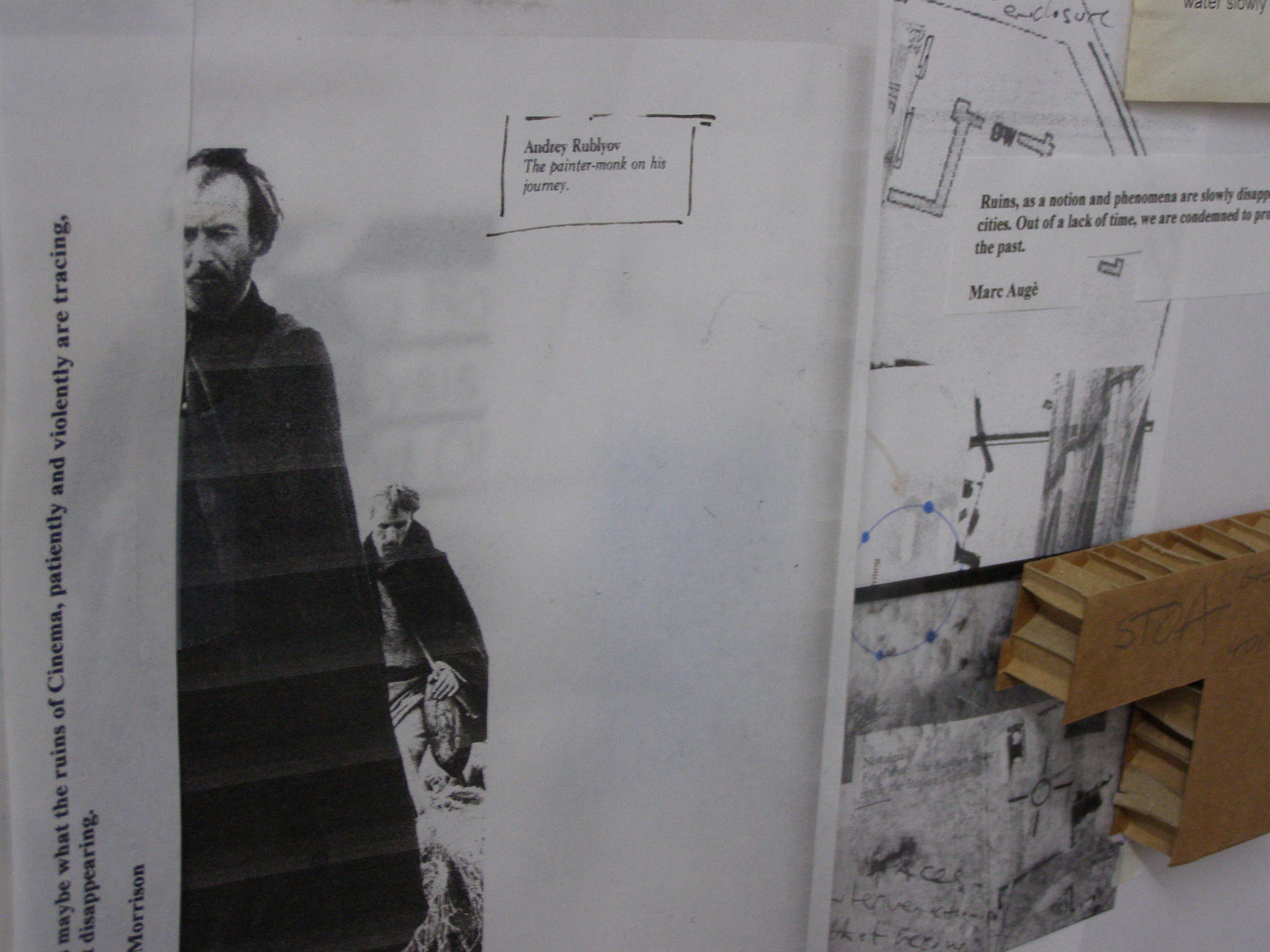
STOA, a complex topology.

The Stoics took their name from the place where they met. In the stoa they talked as they walked along the long shaded alcoves. The stoa offered shelter from the sun and rain without becoming an enclosed room. It was an in-between and transitional space, neither outside nor inside. Conversations could commence through casual interruptions in a site of gossip, rumour and information.

We imagine the stoa as a spatial metaphor for the emergence of critical consciousness within the transnational public sphere. It is a space for criticality without the formal requirement of political deliberation and for sociality without the duty of domestication.

The stoa is the pivot point at which private and public spheres interact and from which the cosmopolitan sense of being and belonging from the vantage point of the stoa, then the telematic linking of two screens in the public squares of Australia and Korea can be viewed in a new light.

The linking of these screens creates a new transnational public space, a space for the creation of a new discourse on the topology of the cosmopolitan imagination in contemporary art practice.

Thinking the place of art within this context is more than jumping from either the local to the global, the private/oikos to the public/bouletrion, or even the singular to the universal. It is more like the liminal zone of the stoa.

Public Screens and Participatory Public Space Nikos Papastergiadis, Scott McQuire

Flesh and Stone,

The Body and the City in Western Civilization. Richard Sennett.1994

Basically a long shed, the stoa contained both cold and hot, sheltered and exposed dimensions; the back side of the shoa was walled in, the front side consisted of of a colonnade which gave access onto the open space of the agora. Though free-standing the stoas were not conceived as independent structures, but rather as edging for the open space of the agora.

Sennett: Flesh and Stone, page 50. Bringing Things to Life

Creative Entanglements in a World of Materials Tim Ingold

EWO= The Environment Without Objects

THINKING AT WAVERLEY, as a site of multiplicity and memory. Walking is Thinking, Richard Long

Heidegger-To participate with the thing in its thinging

Our most fundamental architectural experiences, as Juhani Pallasmaa explains, are verbal rather than nominal in form. They consist not of encounters with objects - the facade, door-frame, window and fireplace - but of acts of approaching and entering, looking in or out, and soaking up the warmth of the hearth (Pallasmaa 1996: 45). 

As inhabitants, we experience the house not so much as an object but as a thing. (Ingold 2008: 8)

Curriculum making as the enactment of dwelling in places

Ceramic Gate/Waverley Stoa : Objects in a landscape/studio space of Gordon Baldwin


One Place After Another: Notes on Site Specificity, Miwon Kwon. 1997

The Reading Room (a library of subjective taxonomies on the alchemy of building)

The Listening Room (a soundscape interior in time with its environment)

The Sheltering Corridor (a modernist Stoa as a place for encounters/dialogues)

The Pot Room (a installation of thrown objects creating the interior partitions)

The Empty Studio (a adaptation of architecture through the ritual of creativity)


Kengo Kuma, Anti-Object, mindfully and experientially explores voids, vernacular materials and agency of spaces.

Utsu means nothing or emptiness, the void.

Wa means the border between nothing and something.

I want to make what we don’t see, and that means I must make what we see. My work is a container for what we don’t see.

Taizo Kuroda, Potter.


Natural Connections, Exhibition Proposal.

Humanities about the processes and experiences that map the evolving human condition.

Humanities and the Arts.

The Body and its Entanglements with Things.

The Ceramic House, 

A space of life. 

Exhibition 

Architecture of the ceramic vessel

Ideologies of Innerness 

The Archive

Flesh can house no memory of bone; only bone speaks memory of flesh. Voids, spaces between the bones, residues of the flesh

Flesh and Stone, Richard Sennett


Understanding the beliefs and practices that enable Relational Egalitarianism 

Kuper, Tim Ingold


Exhibitions, Pavilions, Huts and Observatories.

The Parallel of Life and Art, Alison and Peter Smithson The Physical Self, Peter Greenaway

Thames Dig, Mark Dion

The Barcelona Pavilion, Mies de Rohm

The Solar Pavilion, Alison and Peter Smithson


Field Photography: Light on Natural Phenomena and Site.


Pinhole photography and photograms on light sensitive paper with annotations from both research material and working practices. Visual material and artefacts acquired from archaeological sites whilst participating in recording the archaeological process at St Mary Magdalene Leper Hospital, Mom Hill, Winchester. The work explores subjectivities in the recording of natural phenomena, the spirit of place and its scientific inquiry and production of fabricated forms in the realm of a contemporary art context.

Friday, 27 March 2026

Littoral Environments : Arts and Subjectivity (the making of things)

Text Extract/Inclusion. "Pure Presence"

The enchantment of modern life: attachments, crossings, and ethics : Jane Bennett 2001.

It is a commonplace that the modern world cannot be experienced as enchanted--that the very concept of enchantment belongs to past ages of superstition. Jane Bennett challenges that view. She seeks to rehabilitate enchantment, showing not only how it is still possible to experience genuine wonder, but how such experience is crucial to motivating ethical behavior. A creative blend of political theory, philosophy, and literary studies, this book is a powerful and innovative contribution to an emerging interdisciplinary conversation about the deep connections between ethics, aesthetics, and politics.

As Bennett describes it, enchantment is a sense of openness to the unusual, the captivating, and the disturbing in everyday life. She guides us through a wide and often surprising range of sources of enchantment, showing that we can still find enchantment in nature, for example, but also in such unexpected places as modern technology, advertising, and even bureaucracy. She then explains how everyday moments of enchantment can be cultivated to build an ethics of generosity, stimulating the emotional energy and honing the perceptual refinement necessary to follow moral codes. Throughout, Bennett draws on thinkers and writers as diverse as Kant, Schiller, Thoreau, Kafka, Marx, Weber, Adorno, and Deleuze. With its range and daring, The Enchantment of Modern Life is a provocative challenge to the centuries-old ''narrative of disenchantment,'' one that presents a new ''alter-tale'' that discloses our profound attachment to the human and nonhuman world.


The making of things and discovering relationships.

Constructing site and situation based methodologies.

Playing out in the public realm, exploring through spatial engagements the "virtues" of courage, caution, confidence and risk.

Monday, 9 March 2026

Wanderlust : Visual Feelings of Anarchism and Beauty

Wanderlust : A History of Walking, Rebecca Solnit.

The Mind at Three Miles an Hour
This kind of unstructured, associative thinking is the kind most often connected to walking, and it suggests walking as not an analytical but improvisational act.

Land : Antony Gormley, Clare Richardson, Jeanette Winterson.

Temporary is human. We don't live long. Our ancestors lived less long. Graveyards and ruins remind us of the atom and jot of our span. Against the reality of temporary, humans stage heroic battles for permanence : Archives, museums, endowments, societies.

Wandering is "not purposeful". A lot of art is made while wandering about either in your mind or on foot, Its a necessary aimlessness.
Jeanette Winterson

Anarchism : A Very Short Introduction, Colin Ward.

It is possible to discern four principles that would shape an anarchist theory of organisations: that they should be voluntary, functional, temporary and small.

The Rings of Saturn : W.G.Sebald.

I pressed on to towards Dunwich, which seemed so far in the distance as to be quite beyond my reach. It was as if I had been walking for hours before the tiled roofs of houses and the crest of a wooded hill gradually became defined.


Inside Phenomena/Catching The Light
Layered drawing : Sensuality, Drawing and Astronomical Space.
Locality/Social Complexity- Works on Paper
An ephemeral structure built to house a poetic impulse : The Book of Tea/A Hut of Ones Own
Reading Into the Visual : Exploratory Images
Littoral Zone


Wednesday, 8 March 2023

Collage/abstracts (Heuristic Fragments) Reflective Material #1

Is there still an aesthetic illusion? And if not, a path to an “aesthetic” illusion, the radical illusion of secret, seduction and magic? Is there still, on the edges of hypervisibility, of virtuality, room for an image?

— Jean Baudrillard, The Conspiracy of Art, 2005


A heuristic technique (/hjᵿˈrɪstᵻk/; Ancient Greek: εὑρίσκω, "find" or "discover"), often called simply a heuristic, is any approach to problem solving, learning, or discovery that employs a practical method not guaranteed to be optimal or perfect, but sufficient for the immediate goals.

Heuristic Material : Collage 

1. encouraging a person to learn, discover, understand, or solve problems on his or her own, as by experimenting, evaluating possible answers or solutions, or by trial and error: a heuristic teaching method.
2. serving to indicate or point out; stimulating interest as a means of furthering investigation.

Reading Collage : Spatial Drawings/Documents/Analogue Photography

A Hut of One's Own, Ann Cline

Texts,Annotations, Foundations, Pathways, Corridors, Bookmarks, Walking, Thinking, Ramble, Cross Country, Disciplines, 

Herzog  and De Meuron
NATURAL HISTORY

Jana Sterbak
Remote Control 1989


Sunday, 12 September 2021

On The Beach : Photographic Clouds of Potentialities/Boundary Based Agency

Inside Phenomena/Catching The Light
Wind Turbines : Coastal Geometries/Machines
North Sea Rim
Sea Palling
Visual Device : Textual Intervention

Albert Camus : The Plague, 1947. (Penguin Fiction)

The townspeople of Oran are in the grip of a virulent plague.

Cut off from the rest of the world, living in fear, they each respond in their own way to the grim challenge of the deadly bacillus. Among them is Dr Rieux, a humanitarian and healer, and it is through his eyes that that we witness the devastating course of the epidemic.

Written in 1947, just after the Nazi occupation of France, Camus's magnificent novel is also a story of courage and determination against the arbitrariness and seeming absurdity of human existence.

'Camus represents a particularly modern type of temperament, a mystic soul in a Godless universe, thirsty for the absolute, forever rebellious against the essential injustice of the human condition'
Shusha Guppy, Sunday Times

Existential Gestures : Looking away from the sea
Low Tide
Lightness
Quickness
Exactitude
Visibility
Multiplicity
CONSISTENCY/Guattari
The Three Ecologies

Italo Calvino
Six Memos for  the Next Millennium

Locality/Social Complexity- Notebooks
Flux : Consciousness
In and Out of Material
Beach


Sunday, 19 February 2017

Pastoral Space: Material, Inquiry, Art and Craft


Material Agency : Carl Knappett, Lambros Malafouris
Visualising Environmental Agency

"Agents are defined as persons or things, which have the ability and intention to "cause" something "in the vicinity" or "in the mileau" to happen ( Gell 1998)"

"These latter artefacts are described with the term "index", to remove the appellation "art" and to imply that they are indexes of agency."

Some Stimulating Solutions, Andrew Cochrane.


Transformative Drawing Processes
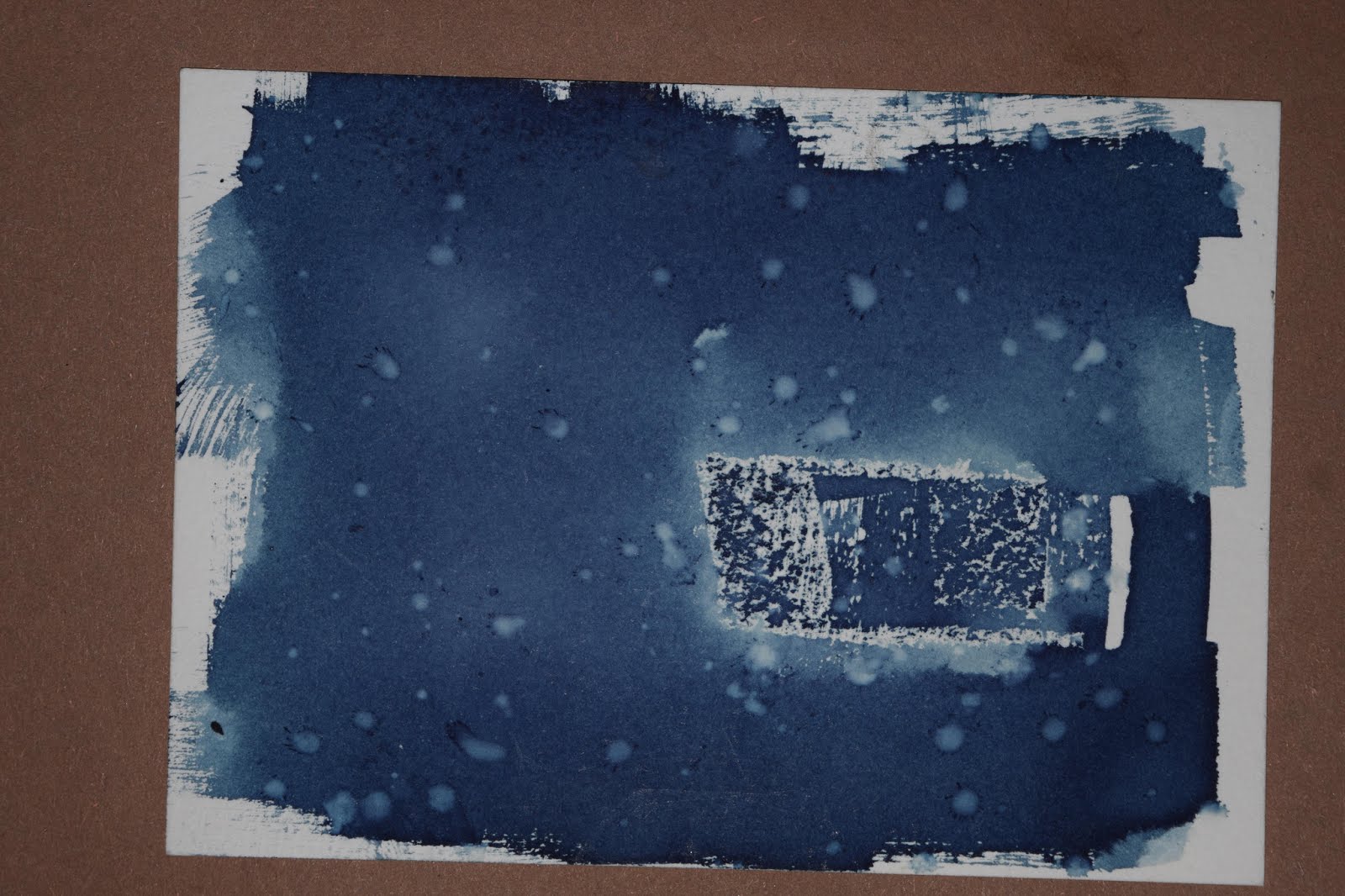
Sun Printed Cyanotype
The sun has gone mad and stripped the earth of its ionosphere. For decades blasting radiation has poured upon earth, melting the polar caps and turning permafrost into streams, rivers, oceans. Huge deltas have been built, lakes formed, seas have risen.

The Drowned World, JG Ballard.