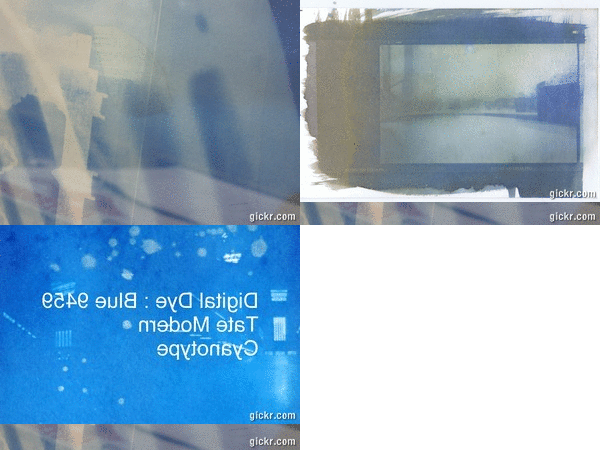
Outpost 070122
The origin point of the practice is the body, and of the works produced.
Place understood as a site, physical but also overcoded by a conceptual by a conceptual intension, activated by and with the performative body of the artist in his/her spatial practice.
Her stillness disrupts an impression of her active presence
About expectations, disruptions and engagements with the built environment.
Body as a vector of thought through movement, organism/person/environment.
The body of the woman and the body of the camera are each partially exposed, partially revealed, and both are wholly connected to one another.
The uncanny effects are produced through these blurred distinctions, between reality and imagination, between body and architecture.
Body-Site
Flesh-Surfaces
Sensory-Engaging
Spatial-Narratives
Overlapping-Overcoding-Spatial Triads
Lived-Perceived-Conceived
Her body enacts a disjunction in time through the absence of her body and its subtle presence retained in movement.
Geometries of space of the body are made visible on the trace of a moment in real time and space.
Exploring the boundaries of her body and her spatial situation.
Yves Klein : Anthropometries
The painted ultramarine blue markings left on white canvas serve as indices made by the female painting performers and should act as timestamps of the work that was done by the female performers. Georganne Fronimos Boardman, 2017.
The Careful Crafting of a Utopia
Yves Klein and the Anthropometric Event of March 9, 1960.
Sarah M. Bartlett, 2016.
Serial Practices/Repetition and the production of thematically grouped images.
Acts of premeditated patterns and rituals.
Bodies and their performativity in the inspiration of the embodied moment in which they occurred/emerged.
Brian Clarke : Silence and Tumult.
Martin Harrison.
The dynamism and the kinetic quality of natural light is a fundamental component of his stained glass.
Deeply saturated coloured glass pierces a predominately opaque lead field.
Study for Gothic Rose, white pencil and collage on paper 84x59cm, 2012.
The Gothic wheel window, Clarke has appropriated the window's pattern as a template for drawings, as a basis for linear extemporization, and now a lead framework into which he has introduced his glass.
See also The Office of The Dead, 2008.
Glass screen executed in triple laminated float glass, within which the layers of blue, yellow and black vitreous paint translate the dot screen into a kind of stained-glass pointillism.
Study in Grisaille II, ceramic glazes on glass, 208x380cm, 2002.
Quotidian Symbols
Toy Aeroplanes
Lightbulbs
Graphic Symbols
The Cross
The Fleur-de-Lys
Brian Clarke : Nerves of Ecstasy
Robert C. Morgan.
As the Symbolist poet Stephane Mallarme once endeavoured to explain, an artist's role is not merely to define his work, but to suggest what art might become.
Clarke's insight is less about his enterprise of being than a way of working according to a vision that requires ultimate attention to material, situation, and intuitive principles that exceed the limitations of what he already knows. Therefore, the insight is to recognize and then realize art as a formative structure, as a way of revealing space through hidden sources of line and light and through a rabid contemplation of time.
Form, in the artistry of Brian Clarke, resists definition as it moves perpetually in the direction of a metaphor. Less through measurement or explanation, his objects, shapes, and figures move through space and time, often culminating in his architectural projects as a pulsating array of vivid colours and miraculous light.
He continues his studio practice on a daily basis, traditionally, he paints concrete images in which he juxtaposes delicate calligraphic tendrils in relation to his definitive grid-blocks.
As Clarke continues to move beyond a purely isolationist concept of art into a clear and synthetic understanding of structural relationships, his technical mastery of various densities and applications of linear and translucent imagery have augmented in scope.
The vaporous forms of the infinitely mutable cloud motif.
Fog, mist, and clouds became potent and perpetual metaphors.
Whether his works are destined to exist in two or three dimensions or in a linear or concrete form, Clarke's visual syntax engages our perceptions quickly before moving to the mind's eye. At this neurological junction, they may begin to vibrate and transform the way we see and envision the reality of our everyday world.