Showing posts with label Tacita Dean. Show all posts

Tuesday, 6 August 2024

The Architecture and Analogies found in Interior Spaces : Analogue Processes in Photography


 Analogue Processes in Photography 

"The imprint of light on emulsion"

"The alchemy of circumstance and chemistry"


Tacita Dean : Filmworks, Kodak Analogue, page 96/97


Analogue : On Zoe Leonard and Tacita Dean. Margaret Iversen 2012

It is only now, with the rise of digitalization and the near-obsolescence of traditional technology, that we are becoming fully aware of the distinctive character of analogue photography. This owl-of-Minerva-like appreciation of the analogue has prompted photographic art practices that mine the medium for its specificity. Indeed, one could argue that analogue photography has only recently become a medium in the fullest sense of the term, for it is only when artists refuse to switch over to digital photographic technologies that the question of what constitutes analogue photography as a medium is selfconsciously posed. While the benefits of digitalization—in terms of accessibility, dissemination, speed, and efficiency—are universally acknowledged, some people are also beginning to reflect on what is being lost in this great technological revolution

http://murrayguy.com/wp-content/uploads/2013/01/Iversen-Critical-Inquiry-36-4-Summer-20121.pdf

Translucency/Waverley Abbey, (Harold Brakspear FSA, courtesy of Damien Blower)
Pinhole Photography, Winchester Discovery Centre and Library.

In Solarized Light : The Unbound Body #2
Photogram from Victorian corset.

Concrete Surfaces : Anatomy #2
Dark Gothic Sensuality
Contact Photography
Science and Art

Alternative Processes, Tate Modern.
Photography and Architectural Space.
Cyanotype from Pinhole Camera

Clay Impression : Form and Segments
Surrounding Objects : Critical Proximity ~2
Research Material
Photographic Drawings

PETER ZUMTHOR                 ATMOSPHERES 

Architectural Environments
Surrounding Objects
2006 Birkhauser, Basel, Switzerland.

Geodesic Drawings : Observatory #2

Core, Periphery and Semiperiphery : Spatial Drawings #1

EMULSION : Photographic Landscape

A few feet below the ground a thick line of rock would mark us off from all that had gone before. Condensed into that six-inch sooty layer would be our cities, vehicles, roads, bridges, weapons. Also, all sorts of chemical compounds not found in the previous geological record.

Ian McEwan : The Children Act,  2014.


Reverberations from excavated land #1 (Excavated Shells)
Reverberations from excavated land #5 (Leper Graves)

The Leper Hospital : Anthropomorphic Geography/Landscape on Photographic Ground
Against SPACE : Place-Movement-Knowledge

"I wish to argue, in this chapter against the notion of space. Of all the terms we use to describe the world we inhabit, it is the most abstract, the most empty, the most detached from the realities of life and experience."

Tim Ingold

Environments
Land
Earth
Pastures
Country
Ground
Landscape
Indoors
Open
Sky

Air

Excavated Landscapes : Morn Hill #2


2017


Tuesday, 19 March 2024

Collage: Diversions, Contradictions and Anomalies.

 Collage: Diversions, Contradictions and Anomalies.


Collage's integral methods of discordance and displacement have so insistently reflected turbulent developments in twentieth century art, science and geopolitics that our response might be to categorise the whole genre as iconoclasm or subversive fantasy.

Sally O'Reilly


Space and Place
THE PERSPECTIVE OF EXPERIENCE
Yi-Fu Tuan


1959 : Patti Smith
Peace and Noise


Lingering at the threshold between word and image
Cy Twombly
Claire Daigle

Although his work resonates strongly with generations of younger artists, ranging from Brice Marden to Richard Prince to Tacita Dean to Patti Smith, it has a general propensity to polarise its audience between perplexity and unbridled admiration. 

Certainly, the fortuities of a name are being pushed too far here, but what does Twombly do but offer up words in all of their resonance: literal, metaphoric, corporeal, material? His citations often have the vanitas effect of graffiti: ‘Cy was here’. Lingering at the threshold between word and image, Twombly renders visible those things – experience, emotion, the body’s share – that lie beyond the reach of verbal articulation.


Research Material
Photographic Drawings


PETER ZUMTHOR ATMOSPHERES

Architectural Environments
Surrounding Objects
2006 Birkhauser, Basel, Switzerland.

Tuesday, 8 November 2022

The Re-Constituted Reality : Tacita Dean/Hamburger/Sebald


The Re-Constituted Reality of Photography
Spatiality : Space over Time


Space folds : Containing "Spatialities around historicality and sociality

All that is solid melts into air

Karl Marx, Friedrich Engels,
(Poetic observation concerning the constant revolutionizing of social conditions)

Perceptions now gathering at the end of the millennium. 
Spatiality, Robert T. Tally Jr. 2013


WATERLOG
After SEBALD : Essays and Illuminations

http://www.tate.org.uk/art/artworks/dean-michael-hamburger-t12880

The film Michael Hamburger was created as a result of a commission for an exhibition entitled Waterlog, held at the Norwich Castle Museum and Art Gallery and the nearby Sainsbury Centre for Visual Arts in early 2007, before it travelled to The Collection in Lincoln in autumn of the same year. Tacita Dean was one of seven British artists invited to respond to ‘the wider landscape of the east of England, with the idea of the literary journey as one its overarching themes’ (curator Steven Bode in Waterlog, p.6). This literary journey is embodied in the book The Rings of Saturn (Frankfurt am Main, 1995) by the German writer WG Sebald (1944–2001), who settled permanently in England in 1970, making Norwich his home. Part memoir, part fiction and part poetic and philosophical meditation, Sebald’s book describes a meandering circular walk that begins and ends in Norwich. Dean chose to make a portrait of the poet and translator Michael Hamburger (1924–2007), whom Sebald visits in the seventh chapter of the book. She has explained:
I had a personal connection to [Michael Hamburger] and I was told he had an orchard. When I filmed him I filmed quite a lot and I talked to him about Sebald and all sorts of other things but in the end I made my film just about apples. It was in cutting the film that I realized it was the most important thing and through apples he talked about everything else as a metaphor ... My work has become about traces and capturing things before they disappear. It’s all about the recording of an atmosphere and usually it’s transient in a sort of way.


Dean’s anamorphic film is a series of almost exclusively static shots filmed in the Suffolk garden and house of her subject. Utilising natural light and unusual points-of-view – often filming either against the light or looking through windows – the looped 28 minutes of widescreen imagery constitutes a portrait whose subject is barely visible, evoking an intensely private personality. Hamburger features in semi-darkness, as a silhouette, as a pair of hands, handling apples, or seated with his back turned to the audience; in one shot only slivers of him are visible intermittently through a chink in a curtain drawn across an internal glass-paned door. This subtle visual representation is echoed in the words he speaks – a discourse exclusively focused on his apples – the different types, their origins and characteristics. Between shots of him, the camera focuses on apples on trees in the garden, rows of apples on a wooden surface in the house, and many rows and piles of books. One shot lingers on a copy, in English, of poetry by the German writer Günter Grass (born 1927). The climax of the film is a reading of one of his own poems by Hamburger, written on the occasion of the death of his friend, the poet Ted Hughes (1930–98). For Hamburger, the link of their friendship is expressed through an apple – the Devonshire Quarenden apple growing in Hughes’s garden – from pips of one of which donated by Hughes, Hamburger grew two trees. He explains that he did this, partly because he was attracted to it by its dark colour, but also because Hughes ‘was a very good friend and it was a kind of link between us if I could have this apple in a Suffolk garden where it didn’t really belong’. His poem lingers on the apple as remembrance and the notion of the fruit’s continuity in contrast with human mortality, ending with the words: ‘hardened, mellowed the fruit to outlast our days’. Dean extends the theme of mortal transience by following Hamburger’s reading with a shot of him smoking in semi-darkness, succeeded by views of a rainbow in the sky above his house. This climax is rendered more poignant by the fact that Hamburger died in June 2007, only a few months after Dean completed her film.

Michael Hamburger is the most recent in a series of film portraits Dean has made that include Mario Merz 2003 (a portrait of the artist by chance also made shortly before his death), The Uncles 2004 (footage of two of the artist’s uncles talking about the family’s relation to Ealing Film Studios, set up by Basil Dean, her grandfather) and Presentation Sisters 2005 (featuring a group of five nuns living in Cork, Ireland). All share with Michael Hamburger an elliptical approach to portraiture which functions as a kind of poetical allegory. Dean’s work is based on networks of coincidental linkages that originate – usually invisibly – with the artist, and more visibly with a person, thing or event in the world, extending outwards into the larger macrocosm of time and space. She shares this preoccupation with Sebald; her essay on him, first printed as an artist’s book as part of a seven volume publication in 2003 (Göttingen and Paris) and reprinted in Waterlog (pp.92–109), describes her personal connection to him through a series of historical coincidences. In The Rings of Saturn, Sebald describes Hamburger’s emigration from Germany with his family to the United Kingdom in 1933, the fears and loss of emigration, his memories of his native Berlin and the ways in which they inform his dreams. He meditates on the question of why his identification with Hamburger, as a fellow German who has made his home in England, should run deeper than a question of national identity, writing, ‘how is that one perceives oneself in another human being or, if not oneself, then one’s own precursor? ... why it was that on my first visit to Michael’s house I instantly felt as if I lived or had once lived there, in every respect precisely as he does, I cannot explain.’ (The Rings of Saturn, London 2002, pp.182–3.)

In common with all Dean’s films created since 2001, Michael Hamburger contains no titles, credit sequences or additional sound, other than what is present during filming. It is projected from a booth onto a screen on the opposite wall in a darkened room, showing on a continuous loop. It was produced in an edition of four, of which Tate’s copy is the first.

Further reading:
Waterlog: Journeys Around an Exhibition, exhibition catalogue, Norwich Castle Museum and Art Gallery, 2007, pp.40–7, reproduced 42–4.

Elizabeth Manchester
July 2009


Art as Spatial Practice.
10 Days in the Laundry, Winchester.

Photograph (13) Illuminated Cathedral
Photograph (350) Anthropocene

Spliced Interior : Waverley Abbey
Pinhole Camera, exposure and movements within the ruined interior.
Russell Moreton


Monday, 13 September 2021

Relationscapes/Material Flows : infra Body, Personal Relations and Spatial Agency

Slow Philosophy
Reading against the institution

Troubleyn Laboratorium
Jan Fabre

Every colour has its own perspective.
Jenny Saville

Material flows and currents of sensory awareness in which images and objects reciprocally take shape.
Tim Ingold

The Dynamic Real
Vibrant Matter
Jane Bennett

infra
Max Richter
Wayne McGregor
Julian Opie

Vitality
Difference
New Materialisms
Elizabeth Grosz

Diffraction attends to specific material entanglements, a discursive phenomenon that makes the effects of different differences evident.
Performativity, subject and image do not pre-exist as such, but merge through intra-actions. 
Karen Barad

Collage, Superimposition, Bounded and Un-Bounded 


Space and Place
THE PERSPECTIVE OF EXPERIENCE
Yi-Fu Tuan

1959 : Patti Smith
Peace and Noise

Lingering at the threshold between word and image
Cy Twombly
Claire Daigle

https://www.tate.org.uk/context-comment/articles/lingering-threshold-between-word-and-image

Although his work resonates strongly with generations of younger artists, ranging from Brice Marden to Richard Prince to Tacita Dean to Patti Smith, it has a general propensity to polarise its audience between perplexity and unbridled admiration.

Certainly, the fortuities of a name are being pushed too far here, but what does Twombly do but offer up words in all of their resonance: literal, metaphoric, corporeal, material? His citations often have the vanitas effect of graffiti: ‘Cy was here’. Lingering at the threshold between word and image, Twombly renders visible those things – experience, emotion, the body’s share – that lie beyond the reach of verbal articulation.

Existential Gestures : Looking away from the sea

Albert Camus : The Plague, 1947. (Penguin Fiction)

The townspeople of Oran are in the grip of a virulent plague.

Cut off from the rest of the world, living in fear, they each respond in their own way to the grim challenge of the deadly bacillus. Among them is Dr Rieux, a humanitarian and healer, and it is through his eyes that that we witness the devastating course of the epidemic.

Written in 1947, just after the Nazi occupation of France, Camus's magnificent novel is also a story of courage and determination against the arbitrariness and seeming absurdity of human existence.

'Camus represents a particularly modern type of temperament, a mystic soul in a Godless universe, thirsty for the absolute, forever rebellious against the essential injustice of the human condition'
Shusha Guppy, Sunday Times


Tuesday, 18 May 2021

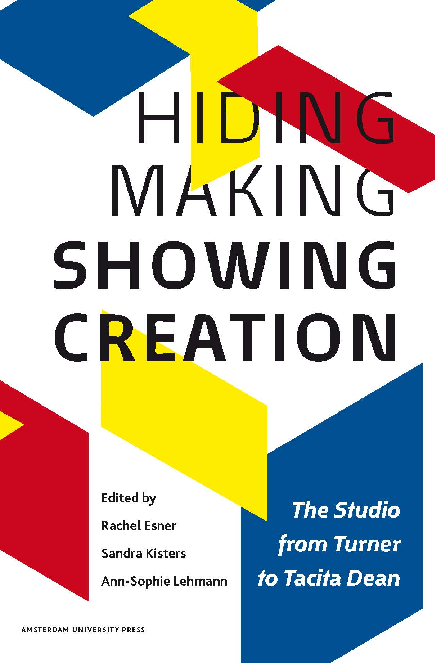
Hiding Making Showing Creation : The Studio from Turner to Tacita Dean 2013, Academia post

 Making : Tim Ingold

The Materials Of Life

Re-Shaping Learning


You read the paper FROM IMAGE TO INTERACTION: MEANING AND AGENCY IN THE ARTS. A related paper is available on Academia.

Rachel Esner, Sandra Kisters, Ann-Sophie Lehmann (eds), Hiding Making, Showing Creation. The Studio from Turner to Tacita Dean, Amsterdam: AUP 2013
Paper Thumbnail
Author Photo Ann-Sophie Lehmann
2013
View PDF ▸ Download PDF ⬇

Your recent reading history: