Showing posts with label UCA Canterbury. Show all posts

Wednesday, 4 February 2026

Wednesday, 16 July 2025

Humanities : Spatial Involvements/The Laboratory of Anthropology, Archaeology, Art and Architecture

Spatial Practice/UCA Canterbury 2009/10

Researching Proactive Apparatuses : A laboratory for speculative social evolution.


SENSORIUM  AND STILLNESS, MOVEMENT AND MIRROR

A MIRROR ON WHAT IT IS TO BE HUMAN


Spatial involvements as a surface of contingent enactments giving “us” a sense of our temporality, exactitude and anonymity that becomes “preserved” by Place/Studies (Rendell).

Drawing a relationality through others in site.


VISITORS : A film by Godfrey Reggio

We have art so that we may not perish by the truth. Friedrich Nietzsche


MEANING IN THE FORM OF THE FILM


THE RECIPROCAL GAZE :

The screen is gazing at us; we are framed by our own looking. A direct relationship (what the image tells me); a singularity held by the vivacity of the image, through the activity of perception and introspection.

THE SPECTATOR MAKES THE JOURNEY into the PREMORDIAL IMAGINATION OF THE CAMERA.

CONCRETE PHOTOGRAPHY, PHOTOGRAMS, IMPRESSIONS, TRACES


THE SENSATE AND THE CONCEPTUAL

PAINTING, Robert Mangold.


TRANSFORMATION AND PROPHECY

BEUYS-KLEIN-ROTHKO

ARCHITECTURAL LEXICON OF STRUCTURES AND SYMBOLS

GESALT, 

GRISAILLE, 

LEITMOTIF, 

MATRIX,

FORMAL PATTERN,

SURFACE

John Wood, The Virtual Embodied, (London: Routledge, 1998)


The Virtual Embodied, “ explores the ideas of embodiment, knowledge and space to address fundamental questions about technology and human presence,” these parameters are being investigated and researched in my creative practice.

Embodied knowledge and virtual space.

Physical, Psychological and Virtual Realities, Max Velmans.

List of “typical beliefs about physical, psychological and virtual realities”. PHYSICAL REALITY

Extended in space-in the world

Exists independently of the observer

Has tangible properties, e.g. Mass and solidity

Descartes s proposed our classical view of the mind/body split into res extensa ( material that extends in space) and res cogitans (thinking material). We commonly associate the physical world as having both extension and location in space.

PSYCHOLOGICAL REALITY 

Non-extended in space-in the mind 

Existence depends on the observer

Is relatively intangible and insubstantial

Psychological realities do not have spatial dimensions, and their location is only metaphorically “ in the mind”. It is crucial to note that psychological realities are only real for a given observer. Velmans notes” these intuitions are confirmed by the fact that physical realities have tangible, substantial properties such as mass, solidity and weight. Whilst psychological properties are, by comparison, intangible and insubstantial”.

VIRTUAL REALITY

Appears to have extension in space, but has no actual extension Appears to be in the world, but is actually in the mind

Existence depends on the interaction of the observer with VR equipment

Can appear to have tangible properties ( with suitable equipment) but does not have such properties.

Virtual realities via appropriate headsets which give “feedback” from bodily movements and visual displays, conspire to give the appearance of a virtual world extended into our physical space, but they have no actual 3D physical extension. Interestingly such worlds are physical in the fact that they rely on the physical existence and placement of equipment, virtual realities seek to create apparent changes in “self location” which do not correspond with actual changes in location. New developments can now give a physical realm into the virtual by the use of body interfaces that can restrict the movement of the body to correspond to the visual perception of a virtual identity.


Fragment from material resonances project, spatial practice research, CSA.

THE ACTIVITY OF PERCEPTION

Perception is in the “condition” of an interruption. 

Rehearsal is the creative part of any performance.


Humanities : Spatial Relations

Interested in the speculative nature of work-sites that contain a narrative intervention via a device that registers and records the documentary and its rehearsal.

Work as revealed into a final sequence of superimposures on a surface created from the collective transparency of the text.

Thresholds that reveal the interspace between the Human and its condition/environment.

Photographic surface of events, a visual entropy resolved as a history of consolidated exactitudes/enactments.

The photographic surface shows that which no longer exists, it concretizes contingences on offer into an image of irreversibility.

Double Occupancy , Dwelling with the critique and its realization of an uncovering event, criticism collides with and into the work. Deleuze, Baroque house (65).

Presenting both a virtual walk through “text” ,using the transparency of “text” both as a literal transparency and its phenomenal “physicality” as applied to surface and structures within the site. Using the body of the visitor to enable

enactments/sensitivities to be derived from the site encounter. Enactments triggered by the singularity of an individuals engagement with walking amongst the working site. The final experience/superimpose remains uniquely a product of the visitor. This site driven explorative experience undertaken by both a passitivity and a curiosity on the part of “the guest” creates a self /space/time/ place relation, a localised intimacy that promotes an encapsulated sense of enchantment/wisdom.

The entirety of the “text” is stored latent in the interlocutor as they investigate the physicality of material relationships and spatial significations. In this respect the interlocutor defines his/her “traits” through a recognition and curiosity with their own body as it weaves a narrative of navigation through the experience of “site”. This theorizing by the body of its encounters, material and spatial, alone or within the proximities of others interests me as a “trace” of the encountering space through the human agent. This working notion and its site begin to posit the idea of an 

“interspace” between the human and its environment. This theoretical and abstracted site could be utilized to research interventions and their effects, to attempt to register the spatial relations/traits of contemporary society. How might this material and its spatial census (human/ site temporalities) be gathered, registered and finally presented.

10 days, Observational material from site, They sense this articulating moment, their consolation becomes recursively and inexplicably consolidated with others unfamiliar undistinguishable, they are rendered into the resultant homogeneity of a surface relation bonded by specifics of space and time.

10 Days, Observational/Reflection, Journal notes Their erasure by the transits of change and chance of others over-writing themselves to reveal the transparency of temporalities as registered by the photographic duration of capture.

What remains is an exactitude of “what occurred” in a form/manner unknowable to those present, by dwelling in this visual interface of the photographic surface, things become inexplicably and irreversibly compounded with a time stretched and stilled.

Photography has the unusual attributes to be able to act as a particle accelerator on the human subject, it can present material assessed from numerous durational encounters with time. It can render a seduction and conversely an invisibility.


Spatial Practice is in effect a laboratory (of the self and worlds) from which I define and register and relate material tested under those conditions. This makes me part of the process and part of the results, part also of the problem of the investigation.

Reflections on the use of “the Negative” expedient use of material creates this inherent property, interesting analogy with human process of vision, in as much as the after-image rendered by the eye is always in the negative. This final image of what was is in effect being erased by the negative/negated. The perspective of the negative reveals more informative relations about the spatial/displacement of the environment in which the “objectivity” is being both immersed and conversely displaced. Like the displacement of a solid form by a liquid of the same displacement, the negative reveals the object displacing/relating in spatial terms. The negative gives proof to our mutual dependency and our forgetting of air as both surface and support.

In Drawing and Mapping it is tensions between the negative and the positive objectivity of things that helps to define a limit, a definition of form that is both simultaneously relational and indexical. The “Trace” also maintains these properties but interestingly it contains a transparency, a dimensionality that makes it both reflective and confrontational, it remains registered to the present but unable to escape its signification of the past.

Public Intimacy, Architecture and the Visual Arts. Giuliana Bruno.

Series of "essays" on the relations between Architecture and The Arts. Bruno notes the critical role in which architecture constitutes and supports a "public intimacy" initiated through both historical references and Contemporary Art. This spatiality of a public constructed space that grants the reception of an intimacy is seen by Bruno as being a "new moving space- a screen of vital cultural memory". She proposes a view that Architecture is mobilized as a screen/vessel in which to define a frame of memory. Architecture in this sense becomes not just "a matter of space but an art of time." Interestingly it is in the work of Rebecca Horn that she notes the combination of both the scientific and the artistic. This combination has a resonance with the architectural model and intended purpose of the anatomical theatre. Rebecca Hom and a growing number of contemporary practitioners are actively engaged in creating "works" which use architectonics and situation to create personal and profound experiences, intimacies evolved from public spaces. This new conceptualization of "body space" and its relationship to the production of space is ultimately being absorbed back into Architectural practice, the work of Nigel Coates "Guide to Ecstacity" and Rem Koolhaas use of materials and interventions that challenge our sensory and cultural aesthetics about architecture illustrate issues around the spatialisation of the body and its intimate consumption in the public realm of the senses.

To Live is to pass from one space to another. Georges Perec.

Bruno Taut, The New Dwelling, Women as Creator, (Leipzig : Klinkhardt und Biermann, 1924).

Taut asserts that it is a woman's way of inhabiting space that creates and modifies architecture, see also Mark Wigley, White walls, Designer dresses: The fashioning of Modern Architecture. (Cambridge: MIT press , 1995)

I would say that my fiction is set in the visionary present. J G Ballard.

Underlining the Hostility of the external world, The Autopsy Room/Theatre.

Victims surrender all that is left of their unique identities, what is left after the basic components are separated, nothing much to claim not even a faint presence of existence. We feel pity and the oblivion patiently waiting for us. J G Ballard on CSI

Frozen frames of a perverse geometry, flickering into a narrative of their own volition. The work is accompanied by a critical voyeurism that has the ability to reveal a prognosis.

Ballard, Every paragraph of this "fiction is frightening obscure and an obtuse puzzle. Surreal geometries, with a pervasive atmosphere of doom and imminent cataclysm that "exposes" the sordidly within us all.

Ballard, Obsessions- Dystopias/Sexuality/Technology and their discontinuities' Ballard, Abstractions-Science/Psychiatry/Mathematics.

Questions the "concrete delinearations of morality, ethics and sanity". 

Notion that Aesthetics/Landscapes can harbour relations, The Gaze, male/female. 

THE RESEARCH POSTER, a document outlining a field of inquiry, placing ones pitch into the public domain. 

Life is Data

Progress is Optional

Understanding is a product of good marketing.

Attempting to keep the moment from being realized. Robert Rauschenberg 

On Photography, Rauschenberg.

My photography is supported by a personal conflict between curiosity and shyness. Rauschenberg uses his camera as a social shied, he has "a need to be where it will always never be the same again." He comments that "photography is the most direct communication in non-violent contacts". His concern is to move at a speed within which to act in the "archaeology" of what light or its darkness touches.

The object itself is dictating your possibilities.

Validity, cannot exist without standards. How long are standards fresh? Every minute everything is different everywhere. Where is the basis for criticism. Criticism collides into the work ,it attempts to arrest it, it deliberately attempts to affect a stop.

Oren Lieberman, The "Plastic Wallet thing/Spatial Practice interview Canterbury" They promote attention, They are seductive in their surface, they "house" temporalities into a permanent/recognisable system or archive. They are deterministic in the sense of belonging to an instantly recognisable protective and presentational system of storing information. The indexical "holes" themselves promote the notion of a terminology on the material within them, sort of ironic when they contain thoughts and issues about methodologies. Perhaps these useful wallets have just become another material victim of contemporary homogeneities. Corrupt their inherent homogeneity by removal or adaptation of their indexical register (the punched holes) thereby making them unique or of a non­ purpose, or for a purpose not yet disclosed/realised.


Tim Ingold
MAKING 2013
Anthropology, Archaeology, Art and Architecture.

Practical Geometry
The Architect and The Carpenter
The Cathedral and The Laboratory
Templates and Geometry
The Return to Alchemy

Cyanotype image from pinhole camera with sound intervention/device within the apparatus of the camera, performative material gathered from the Canterbury School of Architecture.

UCA Spatial Practices MA under Oren Lieberman.


The marked agency and its absence of the artist leaves the site live and open. Oxford MOMA 2006 Jannis Kounallis left his coat hanging by a window adjacent and in the same room as his installation.


RUSSELL MORETON. MA SPATIAL PRACTICES.

Artist Statement used to accompany promotional powerpoint display at UCA Canterbury, 2009.

Spatial Practice provides an interesting set of methodologies in which to explore our own “relationality”1. This is particularly relevant in respect to my understanding and subsequent proposal for the role of the interlocutor within my work. Becoming increasingly interested in the concept of “ open text ”2 to explore the nature of space and its relational properties that create place, or rather a self placed. At present using Photography (large pinhole chambers) embedded in working environments to further explore properties of latency, transparency and the peripheral dwelling of spatial material.


The Practice.

Currently exploring the dynamics and dwellings of spatial relations. The use of a large oil drum as a “pin hole camera” creates a tool that records/witnesses a specific duration (dwelling) in place. This duration of approximately 45 minutes renders visual data that underpins our temporality as we constantly re-form spatial relations with each other and that of the architectural environment. The internal architectonics of the chamber gives a sense of both the proximity of peripheral space and the distance/dislocation of a filmic surface concretized by time. These imaged surfaces render a sense of place, an aura and a psychosis/pathology around images and their representation.

1 Robert Cooper, Peripheral Vision: Relationality ( London: Sage Publishing, 2005) 

2 Jane Rendell, Art and Architecture: A Place Between ( London: I. B. Tauris, 2006)


METHODOLOGIES/PROJECT PROPOSAL

TIME 

RELATIONALITY 

CONTINGENT 

SURFACE 

CONSOLATIONS 

The Trace becoming a material witness to an event/situation

Use of “information” gathered from site being re-invested with another sense of time and ambient light.

Transparent/Translucent materials “surfaced” by contemporary digital technologies, corporate media presentational light boxes, large format 24 square metres.

Use of “interventions” liquids between visual and haptic membranes, utilization of direct drawing within and amongst the “media technologies”.

Direct more of “working practice” into larger scale painting investigations with drawing and photography as inclusions. Suggest notion of temporary space situated in fine art.

Explore relationships of “objects” as the custodian of place. Analysis of the Reception and relations generated by this “first objectivity”.

Relation of “what was ”to what is left being a “spatial involvement” placed back into the continuum of ongoing spatial relations.

Spatial involvements as a surface of contingent enactments giving “us” a sense of our temporality, exactitude and anonymity that becomes “preserved” by Place/Studies (Rendell).

Drawing a relationality through others in site.

Drawn inscriptions that leave traces for others to respond

Documents of a theoretical investigation over the surface from both beneath (the place) and from above (the event). 

A performative membrane/drawing/diagram/script that gains its authenticity/performativity from being there and allowing what might occur to be witnessed.

Drawing as a “open text” that allows a perspectival immersion/situatedness, because it is still active, un-resolved needing to be taken further under the authorship of viewer.

These fragments of precise interventions/enactments  engender a dynamic of relational possibilities.


Friday, 22 December 2023

Laboratory of Architecture : Spatial Practices MA, UCA Canterbury.

Methodologies : Speculative/Diffractive Modes of Inquiry and Making
Derrida (Glas, University of Nabraska Press, 1986):
‘The art of this text is the air it causes to circulate between its screens. The chainings are invisible, everything seems improvised or juxtaposed. This text induces by agglutinating rather than demonstrating, by coupling and decoupling, gluing and ungluing, rather than exhibiting the continuous, and analogical, instructive, suffocating necessity of a discursive rhetoric.’

Marcus Doel (‘Meanwhile - Cats, Glunks, werewolves and other poststructuralists’ in Mike Crang and Nigel Thrift, eds., Thinking Space, Routledge, London, 2000):
‘... .to approach the text as a map, a tool kit, a record: there are entrances and exits everywhere; fold it however you want; follow whatever trajectory you fancy. It’s still philosophy. A book, a work, an event: they all vary in and of themselves.. ..hence the setting off of the variable ‘and’ in place of the constant to-ing and fro-ing of the sedentary ‘is’ and ‘is not’; identity-difference; self-other; being-nothingness. Every ‘one’, every ‘each’ every ‘a’ is packed with innumerable others that are bursting to get out for a breath of fresh air, a taste of the outside, a stroll in the open.’

Luce Irigaray, The Irigaray Reader, Margaret Whitford, ed. (Blackwell, Oxford, 
1991):
‘Everything then should be thought of as volume(s), helix(es), diagonal(s), spiral(s), curl(s), tum(s), revolution(s), pirouette(s)....An increasingly dizzying speculation which pierces, drills, bores a volume still assumed to be solid. And therefore violated in its shell, fractured, trepanned, burst, sounded even unto its centre. Or belly. Caught up in faster and faster whirlings, swirlings, until matter shatters and falls into (its) dust.... Fluid must remain that secret, sacred remainder of the one’.

Jean Francois Lyotard, Libidinal Economy (Indiana University Press, Bloomington, 
1993):
‘The adversary and accomplice of writing.... is language... One writes against language but necessarily with it. To say what one already knows how to say is not writing. One wants to say what it does not know how to say.. .one violates it, one seduces it, one introduces into it an unknown.’

Cyanotype image from pinhole camera with sound intervention/device within the apparatus of the camera, performative material gathered from the Canterbury School of Architecture.
UCA Spatial Practices MA under Oren Lieberman.

MA Fine Art / Spatial Practices Introduction to Theory
Dr Judith Rugg 
Consider the following:
‘A metaphor speaks indirectly - it implies. To be theoretical, one has to explicate - to open the folds.’ Yve Lomax, Writing the Image (2000).
‘Time is multi-dimensional, an uneven bundle of swerves (not linear). The idea of the self as a self-conscious presence in the now, must be abandoned.’ Jacques Derrida, On Grammatology (1976).
‘To go off writing, I must escape from the broad daylight which takes me by the eyes, which takes my eyes and fills them with broad raw visions. I do not want to see what is shown. I want to see what is secret. What is hidden amongst the visible. I want to se the skein of the light.’ Helene Cixous, ‘Writing Blind. Conversation with the donkey’ in Stigmata (1998).
‘Cultures do not relate to the “reality” of the world but to the world as narrative and illusion. These are subtle and vital for human existence. We live in the Golden Age of the alienation and the dissolution between real and fake, true and false in the triumph of consumer capitalism.’ Jean Baudrillard, Radical Uncertainty
'Seeing red is a matter of reading. And reading is properly symbolic. ’ Trinh T Minh- ha, All Owning Spectatorship.
‘Gender reality is performative which means, quite simply, that it is real only to the extent to that it is performed. Certain kinds of acts are usually interpreted as expressive of gender core or identity... which either confirm or contest that expectation in some way.’ Judith Butler, Performative Acts and Gender Constitution.
‘A space exists when one takes into account vectors of direction, velocities and time variables. Thus space is composed of intersections of moving elements. It is in a sense actuated by the ensemble of movements deployed within it... that orient it, situate it. In short, space is a practiced place.’ Michel de Certeau, The Practice of Everyday Life.
‘When it has totally disappeared, we will logically be under the total hallucination of power - a haunting memory that is already in evidence everywhere, expressing at once the compulsion to get rid of it... and the panicked nostalgia over its loss. The melancholy of societies without power: that has already stirred up fascism, that overdose of a strong referential in a society that can’t terminate its mourning.’ Baudrillard, ‘The Procession of Simulacra’ in Simulacra and Simulation.
‘...a Chinese encyclopedia in which is it written that “animals are divided into: a) belonging to the Emperor; b) embalmed; c) tame; d) sucking pigs; e) sirens; f) fabulous; g) stray dogs; h) frenzied; i) innumerable; j) drawn with a fine camel hair brush.” Michel Foucault, The Order of Things: An Archaeology of the Human Sciences (Introduction) 1991.
‘The walls will never be really cast down. Hence, the melancholia of all landscapes. We owe them a debt. They immediately demand the deflagration of the mind, and then obtain it immediately. Without it, they would be places not landscapes. And yet the mind never burns enough.’ Lyotard, ‘Scapeland’ in The Lyotard Reader, A. Benjamin, ed.
‘Now more than ever, nature cannot be separated from culture, just as monstrous and mutant algae invade the lagoon of Venice, so our television screens are populated - saturated, by ‘degenerate’ images and statements. In the field of social ecology, men like Donald Trump are permitted to proliferate freely, like another species of algae, taking over entire districts of New York and Atlantic City; he ‘redevelops’, driving out poor families...’ Felix Guattari, The Three Ecologies (1989).
‘To think about the geography of the female subject of feminism is not to be able to name a specific kind of spatiality which she would produce; rather, it is to be vigilant about the consequences of different kinds of spatiality; and to keep dreaming of a space and a subject which we cannot yet imagine.’ Gillian Rose, ‘Making space for the female subject of feminism.’ In Steve Pile and M. Keith, eds, Mapping the Subject (1995)
In this age of motor cars and aeroplanes, only slight atavistic terrors still lurk beneath the blackened halls, and that comedy of farewell and reunion played out against the background of Pullman cars transforms the platform into a provincial stage.’ Walter Benjamin (see Graeme Gilloch, Myths and Metropolis: Walter Benjamin and the City, 1996).
‘It is safest to grasp the concept of the postmodern as an attempt to think the present historically in an age that has forgotten how to think in the first place. In that case, it either “expresses” some deeper irrepressible historical impulse (in however distorted a fashion), or effectively “represses” and diverts it, depending on the side of ambiguity you happen to favour.’ Frederic Jameson, Postmodernism or, the Cultural Logic of Late Capitalism (1991).

Tim Ingold
MAKING 2013
Anthropology, Archaeology, Art and Architecture.


Practical Geometry

The Architect and The Carpenter

The Cathedral and The Laboratory

Templates and Geometry

The Return to Alchemy


Collage Workings : UCA Interior Design MA, UCA Farnham


Monday, 27 March 2023

Juhani Pallasmaa : The Thinking Hand/Spatial Representation/Working Drawings,Collages and Cyanotypes.

“In my view, the task of architecture is to maintain the differentiation and hierarchical and qualitative articulation of existential space. Instead of participating in the process of further speeding up the experience of the world, architecture has to slow down experience, halt time, and defend the natural slowness and diversity of experience. Architecture must defend us against excessive exposure, noise and communication. Finally, the task of architecture is to maintain and defend silence.”
Juhani Pallasmaa : The Thinking Hand.
Existential and Embodied Wisdom in Architecture. 2009


Saturday, 7 August 2021

Drawing/Situatedness and Site : John Berger, simultaneously a now and an elsewhere

Drawing has the ability to hold complexities separate enough so as to be read, yet drawings also merge into a perceptive unity marked by a sensation or realisation of intuitive nowness authentically caught in the tension of the line.

John Berger’s definition of what a drawing might contain when it is simultaneously viewed as both a now and an elsewhere, marks for me a threshold of encountering space­ time, we are passing through as we perceive our very consciousness. 


I sometimes think of these drawings as sites, containing both physical and playful evidence of explorations. The cyanotype process captures objects and turns them into “inclusions” or vessels that might induce an interesting dialogue, a buried association or simply a stage for thought. I feel the objects recorded are the result of an assemblage of thoughts/interests close at hand driven into the visual through an expediency (working with light and time) and an aesthetic that contains my sense of materiality from which to nurture a creative subjectivity. Strangely it is this aesthetic that just keeps things separate enough but which still makes things actively conspiratorial. It appears to be able to render things in isolation and then bring them together. It is as if the intuition that comes from working and theorising within an art practice is placed into the realm of things, off loaded, detached, and orphaned to make its own way in the world. 


Link Gallery.

Forum Notes, 27 March 2010

Site is anti-place hovering precariously over the abyss of no-place.1 

Art Practitioner with earlier experience in ceramics and glass, recently completed visual arts course at Winchester, now at Canterbury completing MA course in spatial practices. Working mainly on drawing, photography and architectural interventions/ installations that explore our sense and experience of place. 


My work explores a philosophical inquiry into the need for a reflective solitude, a sense of dwelling amongst absences.

The use of materials from the locality (field chalk) implies a personal geography drawn from the direct relationship to an inherited Earth. There is the suggestion that the absence recorded by the trace is an inclusion, a legacy set into a field of materiality, but it might also suggest a metaphysical field of thought. 

This act of drawing becomes its own experimental field of exploration, a sort of “in-between reality’’/Maurice Merleau-Ponty) an enmeshed experience. Thought of and read as a material memory encountering the realm of the insubstantial.

This “undoing of place” might instigate a threshold and a situation/room from which to reflect upon critical spatial, sociological and psychological conditions and perceptions.

This work and others like it attempt to articulate an interest in the body as both a physicality ( social, spatial and per formative presence ) and a poetic surface in architectural space.

Influences, Myth of Butades, origin of drawing, Pliny

Interested in the inscription ( a surface inscribed, written or carved as a formal or permanent record ) of a presence, a trace that reveals an origin of feelings/gestures centred around the body.

Inscription brings with it a notion of performativity, that of body and place, and their interaction, situation and experience. This spatial activity renders a sense of a material memory surfaced by place.

Tacita Dean, Drawings are more than just visual therapy, they speak of collective experiences and dilemmas that trouble humanity.

This simple work gathers-up an intimate social inscription on a surface, a playful act to then associate natural material.

Drawing is the primal means of symbolic communication which predates and embraces writing, and as such it functions as a tool of conceptualization parallel with language.

Drawings offer a partial comprehended rumination of the mind, Avis Newman. Drawing, becomes a sort of dwelling amongst an intimate comer of oneself, perhaps even a site for the solitude for the imagination. Gaston Bachelard comments in the Poetics of Space that a corner in a room can become “a symbol of solitude."

Drawing like walking becomes a form of thinking. This thinking is further articulated and accompanied by the intrinsic qualities of substances and liquids that are placed in proximity so as to be encountered.

My use of chalk as a materiality, emblematic of a solidity, a localised material and a metaphor of a inherited and compressed layering of time. The whiteness of this found material draws associations with the surface of the paper, there similarities’ also render there material differences. The inclusion of wax onto the surface was an attempt to seal a sense of a reflective surface, a surface amongst the work that might accommodate the light and nowness of place. Any drawing is a static object, but contains the trace of actions, traces carried out in time. Perhaps this drawing is registering itself into a language of matter.

1  Edward S. Casey, The Fate of Place, a Philosophical History. (London: University of California Press, 1998) page 186.


ARTISTS CV/STATEMENT re INTERNATIONAL BOSPHORUS ART BIENNALE, ISTANBUL 2011.

RUSSELL MORETON 

Visual artist/maker of dwelling spaces.

Spatial Practices MA Canterbury UK.

Visual Fine Art BA hons Winchester UK 

Contemporary Crafts Sculpture Waterlooville UK 

Ceramics HSND Epsom UK

June 2011 Artist Statement/Outline of Interests.

Visual artist working with alternative photographic processes, clay and architectural glass. The current practice continues to explore themes and realities around the contemporary human condition. The exploration of these interests is predominately developed through drawing and traces of actual objects and performative gestures referencing the body as a site amongst the layering of material and data. The use in some works of site specificity and materials drawn from the location are used to further underpin a sense of engagement and dwelling. The resultant drawings with their traces of agency and exactitude, lightness and ambiguous multiplicities seem like a compression of a filmic substrate, a material memory brought to the surface. These personal consolations of working practice are initiating thoughts centred on building architectural spaces, from which to register and response to a sense of serenity and enchantment amongst the scripting of materials in spatial/social dialogues.

Astronomy, Science, Natural History, Architectural Spaces, Stained Glass, Early photographic Processes, Ceramics, Anthropology, Craft Disciplines, Theatre, Film, Arte Povera, Contemporary Art Practice/Research/Philosophy/Exploration.


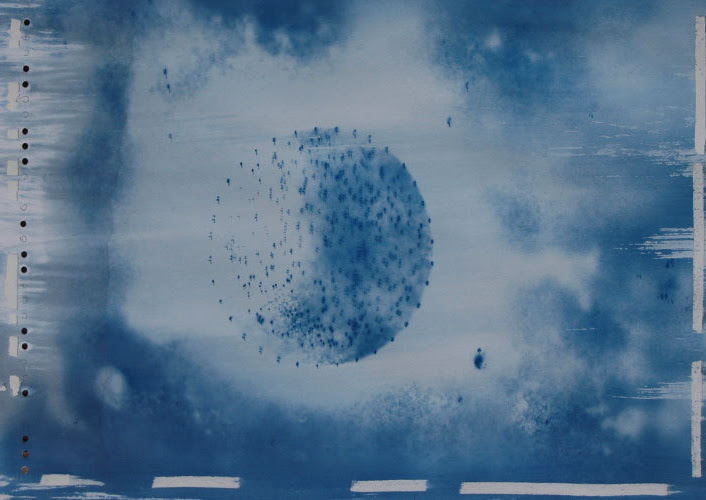
IMAGE, PANSPERMIA 2010 Added notes.

This work began as a performative drawing between the touch and tact of its maker, marking a personal and intimate involvement with both the corporeality of the female body and a loved one. This fragile union and fecundity is expressed by the photograms of “elderflower seedheads” left as evidence within the territory of the body/vessel. The personal intimate space of these initial acts and gestures are shifted against infinite space of the known universe. The title stems from speculation that life might have been introduced onto a fertile Earth from spores from space. Interestingly having dwelled with these initial thoughts, I feel that perhaps the work augurs an exodus at some point in the future.

Russell Moreton


CHAPEL ARTS, ARTISTS OPEN STUDIO AND TALK

TALKING AROUND A TABLE OF DRAWINGS

THE WORKING SPACE AS INSTALLATION

THE SPATIAL PRACTICE OF RUSSELL MORETON

Objects or vessels that might induce an interesting dialogue a stage for a future event or trajectory. I feel the objects are the result of an assembly of thoughts driven into the visual through an expediency and an aesthetic that just keeps things separate yet somehow they remain actively conspiratorial. It is all about the intuition that comes from working and theorising with and within an art practice.

The intension of the “charting table” (8x4 ply sheet on builders trestles) was to allow the subject of practice together with my activities to become visible, and in so doing create a public sense of speculation around the material on show. The spatial agenda would be addressed, bought into being as it were by the exposure and placement of objects, tables and projections into the main reception area at UCA Canterbury. It is hoped that the curiosity of some will solicit the interest of others and thereby create the unfolding of an event; the projection could be a real time monitor of the charting table. I am beginning to view the show as an exhibition/event around working practices, but unfortunately the sense of site dominates my practices situatedness. Conceived as a contingent/speculative intervention into the normal running of this space as a reception area. 


Resident artist will host an “open studio” at Chapel Arts Studios on 2 December. The chapel will be open from 12.30 onwards to view an installation and other material. The “talk around a table of drawings” will commence at around 6.45 pm.

Earlier training in ceramics and stained glass together with extensive experience in the construction industry are now being utilised in my contemporary practice.

My current spatial practice, is centred around a multi disciplinary approach underpinned by “drawing” to critical issues of site. This activity could be understood as an investigative creativity amongst the phenomenological aspects of architectural place and the potentials of producing working spaces/sites for the reflection of others. The working practice currently employs the use of clay, glass and photographic processes. The practice is informed by interests in astronomy, architectural space, theatre and anthropology.

The use of “site” as a working drawing from which to create a temporary intervention into place helps to instigate a threshold, a room or event from which to reflect upon critical spatial, sociological and psychological conditions and perceptions.


Anima-Animus : Winchester Cathedral/10 Days in the City

‘When animus and anima meet, the animus draws his sword of power and the anima ejects her poison of illusion and seduction’ Jung.


Russell Moreton uses analogue film processes that inquiry into both the surface and the materiality of the photographic image. He was invited by Helena Eflerova and Kye Wilson to document the filming process of Anima-Animus. He uses 35mm and medium format cameras together with a number of pinhole type cameras. In using historical processes like cyanotype and light sensitive silver gelatine, he explores the relationship of the image to its supporting surface. A number of his images are heavily worked in the darkroom to exploit differences between the seduction of the photographic surface and its actual physical presence altered by chemical and physical interventions. His work echoes themes around the body and the architectural spaces of institutions and beliefs.


Sunday, 9 May 2021

Working Spaces/Six Memos : Sites of Inquiry and Dialogue/Investigative Thinking/Post Studio

Every action happens in its own right and every action is an analogy of something else. 

What I do need be no more than what appears at the moment of the happening.

Peter Brook, The Open Stage.


BOUNDARIES AND JUNCTION POINTS ARE IN THE NATURE OF THINGS POINTS OF FRICTION.

Lefebvre, The Production of Space.


MAKING : Essentializing of site and community through artistic presentation and production.


ITALO CALVINO

SIX MEMOS FOR THE NEXT MILLENNIUM

LIGHTNESS 

QUICKNESS 

EXACTITUDE 

VISIBILITY 

MULTIPLICITY

CONSISTENCY not written at the time of the authors death.


SETTING UP THE IMMEDIATE THEATRE

MA Spatial Practices, Canterbury.

Project analysis and comment from Prof. Oren Lieberman, Dr Terry Perk, Dr Judith Rugg.

The desire to register working spaces is an interesting, and I believe fruitful, direction in the work. It is important that through this registration, you allow and encourage a theory to evolve. ‘Register’ is a useful term in that it accommodates both the index (through the notion of recording information) as well as the performative registering of, say, an opinion. As the pinhole apparatus registers ‘public’ spaces as well, it would be worthwhile assigning them the value of ‘work’ spaces also.

Also: you should understand the apparatus as a significant performative, spatial practitioner in its own right, and be careful about focussing only on the very engaging images produced by it.

Developing an engaging thesis exploring various forms and frameworks for thinking about thematics of photography and architecture in relation to space and its potential meanings and productions.

Using both practical workshops and theoretical enquiry to explore the differing values for both reading or engaging with the poetics of spatial formation in an ‘post’ sense of the studio. 

The work explores the concept of the open text in various ways and traces a development of the research from various approaches. This is a useful document of investigative thinking around ways of working for the project.

There are some methodological approaches proposed here through a range of contestatory areas - in particular, the nature of the document and the text as spatial tools or ways of thinking about the interfaces between them.

Some fascinating areas of insight and propositions on the nature of space - especially concepts of latency, peripheral space and methods of interaction/intervention. How could this area be explored in conceptual and crucial terms for the development of the project? - Behind your fluid approach, there is a sense of the need of the relational.

The bibliography could be further developed in terms of defining its taxonomies and the rationale or relationships between them and with the proposal.


Marc Auge, Non-Places, introduction to an anthropology of super modernity (London: Verso, 1992).

Gaston Bachelard, The Psychoanalysis of Fire (Boston :Beacon Press, 1964). 

John Berger, Berger on Drawing ( Aghabullogue: Occasional Press, 2005). 

Peter Brook, The Open Stage (London: 1968).

Giuliana Bruno, Public Intimacy, Architecture and the Visual Arts (Massachusetts: MIT Press, 2007).

Italo Calvino, Six Memos for the Next Millennium (London: Jonathan Cape, 1992). 

Martin Clark, The Dark Monarch, Magic and Modernity in British Art (London: Tate St Ives,2009).

Mary Douglas, Purity and Danger (London: Routledge, 1994).

John Houston, The Abstract Vessel, Ceramics in Studio (London: Bellow Publishing, 1991).

Lefebvre, The Production of Space (London: Blackwell, 1991).

James Lovelock, The Vanishing Face of Gaia, A Final Warning (London: Penguin books,2009).

James Salter, A Sport and a Pastime (San Francisco: North Point Press, 1967). 

Richard Serra, The Matter of Time (Bilbao: Steidl Publishers,2005).

Rose Temkin, Thinking is Form: The Drawings of Joseph Beuys (London: Thames and Hudson, 1993).

Tracey Warr, The Artists Body ( London: Phaidon Press,2000).

Christopher Wilmarth, Drawings into Sculpture (New York: Fogg Art Museum,2003).

I propose to register a site by its boundary. This new space will attempt to represent the internal dimensions of the artist’s current working studio space and be given a similar terrestrial orientation. Into the interior of this marked space objects from the working studio are to be reinstalled. This intervention attempts to create a spatial temporality into which a contemporary art practice will act as a context. The intervention sets out to display the complexities of the contemporary practitioner, the research material and works completed and those that are to instigated as a direct adaptation/response to the situation and site at hand. The temporal nature of this staged work reflects issues of mobility needed by the professional practitioner to be able to set up working sites and the ability to transpose them into other hosting environments, other challenging opportunities.


BIBLIOGRAPHY OF DISPLAYED/BOOK MARKED MATERIAL.

Edward Casey, The Fate of Place (Berkeley: University of California Press, 1998)

                     Giving a face to place in the present, 

                     By way of the body.

Yve Lomax, Sounding The Event (London: I. B. Tauris, 2006)

                     An impossible refrain, 

                     Fortuity,

Giuliana Bruno, Public Intimacy, Architecture and the Visual Arts (London: MIT Press, 2007)

Modernist Ruins Filmic Archaeologies,

DRAWING SPACES.

This activity of marking out an elsewhere (the studio space) and presenting it here and now is a fundamental quality of drawing. The act of drawing is in itself a private act undertaken primarily for the artists benefit. The finalisation of the research project revolves around issues of public intimacy with art objects whilst being in public spaces. This investigation into public intimacy and the reception of contemporary art practice as an open site; complete with works completed but not yet “framed” for any given spatial or social context attempts to stage this reality. Together with supplementary material present including in some cases work in progress, this might allow the temporal space frame of an absent space the ability to create a privileged and therefore valued experience of art objects within and amongst the intimacy of their conception.


Letting the practice stage its own intimate theatre might engender more collaborate speculation and interdisciplinary workings. “Spatial Practices” envisaged practitioners from Architecture, Fine Art and Performance driven disciplines, my own research at Canterbury has attempted to orchestrate a spatio-temporal theatre of reception for this purpose.

The Architecture of Science in Art: An Anatomy Lesson, 

                      The room as the real protagonist of the film. 

Bridget Elliott, Peter Greenaway, Architecture and Allegory (London: Academy Editions, 1997)

                       On Common Ground, 

                       Allegory as Architecture.

                       (Un)Natural Histories Collecting Cultures, Crossing Limits.

Ian Buchanan, Deleuze and Space (Edinburgh: Edinburgh University Press, 2005)

                       The Nomadic Subject in Smooth Space, 

                       Territories and the Refrain,

The nomadic subject open to unconventional spatial orientations can make new connections in keeping with the movements of life as it unfolds. 

Irit Rogoff, Terra Infirma, geography's visual culture (London: Routledge, 2000) 

Vicente Todoli, Time Zones, Recent Film and Video (London: Tate Publishing, 2005)

                    The Where of Now,

Bernard Poerksen, The Certainty of Uncertainty, Dialogues introducing Constructivism (Exeter: Imprint Academic, 2004)

Gerhard Richter, Zufall, The Cologne Cathedral Window (Koln: Walther Konig, 2007)

Glen Onwin, As Above So Below (Halifax: HMST, 1991) Caroline Christov, Arte Povera (London: Phaidon, 1999)

Guy Brett, Force Fields, phrases of the kinetic (London: Hayward Gallery, 2000)


The Laboratory : Spatial Practices, 

Canterbury School of Architecture. 2009

Post studio practice/social processuality


Superimposition of studio space into the main foyer of a university. The disclosure of creative practices, spatial relations entangled by the private and the public.

Lefebvre in his chapter on Spatial Architectonics makes reference to the relationships established by boundaries and the relationship between boundaries and named places. These relationships promote significant and specific conditions or features to a space. This in turn results in various kinds of space. Lefebvre states that “every social space, then, once duly demarcated and oriented, implies a superimposition of certain relations upon networks of named places.”1

It is this superimposition of space that can within it demarcate other thresholds of experiences, within an existing demarcated space that interests me.

The act of “blocking in “ the dimensions of another space onto the floor of another create a temporal junction between a host space and a site within this host, a guest. This sets-up the notion of a temporal double occupancy held by the demarcation of a boundary and a site of proposal. This basic and temporal site marking could be said to have affinity towards some sort of anthropological marking, a territory. (Lefebvre defines anthropological marking as being at the stage when demarcation and orientation begin to create place and its social reality in archaic cultures)2. This activity also has associations with nomadic and agricultural-pastoral societies as they use paths and routes as spatio­ temporal markers or determinants.


Lefebvre acknowledges that geographical space created through the body, through routes which were inscribed by means of simple linear markings. These first markings, paths and tracks drawn into the landscape would become the pores through “which without colliding would produce the establishment of places (localities made special for one reason or another).”3Within my practice drawing is used to form sites which contain visual information, evidence of temporal activities and traces of actual objects. These territories within other territories create fields from with boundaries form material relations, differences. My drawings are inside the temporality of site I have instigated and yet they propose a territory and a surface of light years which could accommodate the temporality of terrestrial space.

Interestingly Lefebvre comments “there is no stage at which ’’man” does not demarcate, beacon or sign his space, leaving traces that are both symbolic and practical.”4

1 Lefebvre. The Production of Space, (London: Blackwell, 1991) pagel93.

2 Ibid..page 192

3 Ibid., page 192. 

4 Ibid.,page 192


UCA CANTERBURY 2010.Brief outline of final realisation.

I propose to physically register a site by creating its boundary, by way of applying 50mm self adhesive tape to the main reception area at UCA Canterbury. This new space will attempt to represent the internal dimensions of the artist’s current working studio space (5.0xl2.0metres) and as such it be given a similar terrestrial orientation. If it is necessary (through issues of setting up and health safety) a contingency plan would be to crop the footprint of the space by the use of a broken detail line where required. Into the interior of this marked space objects from the working studio are to be reinstalled and where possible to match existing placements, these initial positions will be documented to allow the registration of changes to be recognised. It is envisaged that these first points of departure may well migrate as the site becomes populated by activity and the spatial dynamics of the hosting space. This intervention (the superimposed space onto and within the existing) attempts to create a spatial temporality into which a contemporary art practice will act as a context for an investigatory and performative setting in public space of a creative private practice. The intervention sets out to display the complexities of the contemporary practitioner, the research material and works completed and those that are to instigated as a direct adaptation/response to the situation and site at hand. The temporal nature of this staged work reflects issues of mobility needed by the professional practitioner to be able to set up working sites and the ability to transpose them into other hosting environments, other challenging opportunities.