Showing posts with label UCA Farnham. Show all posts

Thursday, 11 June 2026

Anarchive Workings~Layered Making/Indexical Relationscapes : Interventions into models/stratifications of research

Interior Design MA~Anarchive

An anarchive is a creative process and philosophy that resists traditional, static archiving. Instead of just storing past traces, it acts as a "feed-forward mechanism" that uses archival material to continuously spark new art, sensations, and becoming.

Spatial Apparatuses, Building/Social Devices and Agendas/Rooms

Indexical Relationscapes.

Events as Interventions producing Intraventions from Sociology, Architecture and the Humanities/Contemporary Arts.

Relationscapes

Erin Manning
Movement/Art/Philosophy

 
For Brian.

The self is only a threshold, a door, a becoming between two multiplicities.

Gilles Deleuze and Felix Guattari, A Thousand Plateaus.


Waverley Project : Areas of Project Research. 


The Reading Room (a library of subjective taxonomies on the alchemy of building)


The Listening Room (a soundscape interior in time with its environment)


The Sheltering Corridor (a modernist Stoa as a place for encounters/dialogues)


The Pot Room (a installation of thrown objects creating the interior partitions)


The Empty Studio (a adaptation of architecture through the ritual of creativity)


The Perception of The Environment, Livelihood, Dwelling and Skill
Tim Ingold.
Archaeology, Anthropology, Art and Architecture.


Anti-Object.
A building intervenes between subject and space.’ Kengo Kuma

Caruso St John : The Phenomenology of Construction  


Things.
As found is a small affair, it is about being careful, the as found (is) where the art is in the picking up, turning over and putting with. Things need to be ordinary and heroic at the same time.’ Alison and Peter Smithson


Public Intimacy in Social Spaces.

Architecture and The Contemporary Arts.

Learning through Making, (The Parallel of Life and Art) Anthropology, Archaeology, Art and Architecture.


Visitor’s Centre, with interpretive exhibition (Stonehenge/Denton Corker Marshall) or an immersive intervention (Winchester Cathedral,Anima-Animus/Elferova and Wilson).


A place where the interior space evokes a sense of place/a becoming (Existential, Historical, Social, Cultural) see ‘The Physical Self’ exhibition curated by Peter Greenaway. The Fate of Place/Human Sociology.


A contemplative space or spiritual/secular retreat featuring a series of interventions (Follies/Pavilions/Huts/Heidegger/Tschumi) that focuses the gaze on a particular view or detail, framing a distant reference (landmark or natural phenomenon, research into Lutyen’s ‘Thunder House’ for Gertrude Jekyll).


Museum of Wisdom. Kengo Kuma.

Noh Stage In The Forest. Kengo Kuma.

Hortus Conclusus. Peter Zumthor.

The Solar Pavilion. Alison and Peter Smithson.

The Secular Retreat, Living Architecture. Peter Zumthor.

Heidegger/Hut,
Bachelard/Poetics,
Ingold/Making.

Construct (Definition) DSC_0029
Ann Cline
A Hut of One's Own
Life Outside The Circle of Architecture.

Herzog  and De Meuron
NATURAL HISTORY

Walking and Mapping
Speculative Environments/Ecolects

Spatial Collage/Assemblage : Yellow/Lead/Photography
Fragments and layers from, Winchester Cathedral, Tidbury Ring Geodesic Dome, Star Atlas.  

Brian Clarke. Beauties (from the two Cultures) 1981.
Brian Clarke. The Office of The Dead 2008. 

It was the region, not the nation, which was the motor force of human development; the almost sensual reciprocity between men and women and their surroundings, was the seat of comprehensible liberty and the mainspring of cultural evolution.
Cities of Tomorrow, Peter Hall.1988
Anarchism, A very short introduction, Colin Ward.2004

Foucault, Sexuality and the 'Confessing Animal' 


My photographs are part of my way of thinking about and imagining spaces and light, of pondering and approaching an idea. In this case, the photographs generate a way of looking at a structure that exists only in order to provoke a sensorial and intellectual experience.
Cristina Iglesias : METONYMY 2013

https://literarydevices.net/metonymy/

https://www.simplypsychology.org/Zone-of-Proximal-Development.html

fig496 Proximity
10 Days at The Laundry : Winchester UK

Architectural Transposition : Anti-Object
Kengo Kuma's, Transparent and temporary shelter at Waverley Abbey

Possible Worlds
The Sensual Reciprocity of This Enchanted Isle


UCA MA Interior Design 2015

Wednesday, 18 September 2024

Inside Phenomena : Innerness and Interior : Material Matters

Theory and Analysis.
Architecture and Material Practice.

Katie Lloyd Thomas.
Material Matters : Architecture and Material Practice.

Hylomorphism which understands materials as a subset of matter, does not provide a way of positively distinguishing materials, and underscores the architectural tendency to use materials as mere finishes, exchangeable and superficial. In turn it is no surprise that materials become supplementary in architecture and are used to decorate or to signify.

Gaston Bachelard is a rare example of a philosopher concerned with this problem. Not only is he aware of philosophy's tendency to privilege form over matter, he raises the question of individuation: I was immediately struck by the neglect of the material cause in aesthetic philosophy. In particular it seemed to me that the individualizing power of matter had been underestimated. Why does everyone always associate the notion of the individual with form?
Gaston Bachelard, Water and Dreams: An Essay on the Imagination of Matter.


Russell Moreton
MA Interiors.
UCA Farnham. 2014

In the future will we be able to extract the Platonic values that Hans Coper writes about with regard to the Egyptian vessel?

This essay is an attempt to get to understand my current concerns centred around the interior spaces of things and places. This sense of the interior is itself held in place by the notion of some kind of vessel or material whether it is a pot or an architectural structure. It is this vessel and its materiality together with its form and its formlessness that I want to explore more closely.
In architecture an interior can become a ‘sensing space’ with its own particular characteristics it becomes a host space, an extension of our own existential space; it can promote memories, sensations and can act as a reflective refuge from our post modern lives. Do these vessels and spaces re-enact the particulars of traditions and livelihoods, of other lives; are they in fact built expressions on the basic needs of a civilisation whether they be pots or architecture?
Do we in some way attempt to reconcile and balance opposites, the outside with the inside; and as a result the practicality of a space depends on a larger degree to issues regarding its actual emptiness? I am interested in both the interior of a vessel, and the interior sensations of being in a space. The Poetics of Space by Gaston Bachelard is also interested in this dialectic between ‘inside’ and ‘outside’.

In her essay The Essential Vessel, Natasha Daintry (Daintry, 2007:9) cites The Tao Te Ching ‘we turn clay to make a vessel, but it is on the space where there is nothing that the usefulness of the vessel depends.’ It follows then that this might be where the vessel starts to embody ‘something and nothing and becomes an effortless three dimensional manifestation of both form and formlessness.’ (Daintry,2007, :8) It is interesting to note that the potter is dealing simultaneously with both form and its attendant space as he hollows out the clay to create what might be termed an ‘essay to abstraction, a clothing of emptiness.’(Daintry,2007:8) This defined air is the ‘most transcendently human of all made things; volume, inner space, an interior, the carved out air that connects the morning teacup with the domes and spandrels of San Maco. There’s nothing there but clay and air, then there’s defined air.’(Gopnik, 2014:6) Adam Gopnik essay on the pots of Edmund de Waal speaks of an ‘innerness’ and De Waal speaks of ‘a breath held inward’. My own experience of De Waals work in the Architects House at Roche Court, Salisbury, is that of a multitude of similar porcelain pots that were all uniquely able to hold just a single thought or a memory. The installed pots and their simple wooden support became a permeable wall for remembered silences.
This sentiment and its sensitivity to describing visible aspects of the world that are conjoining the concrete with emptiness becomes a poetic on the permeability of spaces and their vessels. The philosopher, Lucretius who was interested in infinitesimal entities comments in his poetic work ‘On the Nature of Things’ records how ‘knowledge of the world tends to dissolve the solidity of the world.’(Daintry, 2007:8) This lightness and its associative attendances can be found in ‘Hans Coper’s only extant piece of writing.’(DeWaal, 2004:34)

A pre-dynastic Egyptian pot, roughly egg-shaped, the size of my hand made thousands of years ago, possibly by a slave, it has survived in more than one sense. A humble, passive, somehow absurd object – yet potent, mysterious, sensuous. It conveys no comment, no self expression, but it seems to contain and reflect its maker and the human world it inhabits, to contribute its minute quantum of energy – and homage. Hans Coper, 1969.

Does Hans Coper’s text reflect through this archaic pot the human sense of innerness that this vessel still dwells with? ‘Theories of relativity and uncertainty have shown that all matter, even the airy oxygenated void inside a vessel is energy, and that it is composed of the same building blocks generated from exploded stars.’ (Daintry, 2007:8) Hans Coper’s Egyptian pot certainly as he observes, is still contributing its minute quantum of energy from thousands of years ago; an innerness put into being by the human hand. The sensing, doing and being that is caught, even marooned in this vessel talks of existential states, rituals, of things that shift and move as you inhabit the interlockingness of skin, volume and displacement.
There is a material memory at work here, an artefact from another epoch, another mindset, but our corporality and the physical traces left in the clay concur its humanity. Pottery is given a priority in its ability to reveal cultures of the past.
‘The special historical value of pottery is due to its stillness underground. Almost uniquely, it does not corrode or disintegrate when exposed to earth and water, and so it forms the most important part of the physical record of the past. Like an invisible architecture, inverted and buried out of sight, they are our most reliable evidence of human endeavour.’ (Adamson, 2009:36)

Gaston Bachelard writes in his Poetics of Space that ‘We absorb a mixture of being and nothingness.’ He is interested in the dialectic of ‘outside’ and ‘inside’. He asks is outside vast and fluid and inside concrete and small? He surmises that perhaps there is some membrane or intermediate surface that could separate the two states or rather a duality of ‘outside’ and ‘inside’. But these are concepts and abstractions, ‘the real experience is more kinetic, more fluid and interchangeable.’ (Daintry,2007:11) Can it be that as Bachelard argues that the mind and its imagination actually blurs the duality of inside and outside. He comments ’everything, even size, is a human value, even the miniature can accumulate size.’ In this way he explains further ‘being does not see itself, it does not stand out, it is not bordered by nothingness: one is never sure of finding it, or of finding a solid when one approaches a centre of being. We absorb a mixture of being and nothingness.’(Bachelard,1994:53)
Bachelard seems to be in accord with the poetics of Lucretius as described by Italo Calvino in his Six Memos for the Next Millennium as ‘the poet of physical concreteness, viewed in its permanent and immutable substance, but the first thing he tells us is that emptiness is just as concrete as solid bodies.’(Calvino,1996: 61) There is a lightness and an exactitude in this ‘interior space’ that exists between its states of form and its formlessness. The vessel seems to have the ability to inhabit, mediate and transpose spaces between the ‘rich liminal territory of uncertainty and abstraction.’ (Daintry,2007:12)
The transformative power of the vessel on changing spaces and our perceptions through its existential condition is illustrated in the poem “Anecdote of the Jar by Wallace Stevens” cited by Edmund De Waal. The jar or rather its vessel qualities becomes a spatial metaphor as it ‘practices’ the landscape around it by taking dominion as it were over the unmade. Perhaps Wallace Stevens’s ‘Jar’ promotes an architecture for the soul, an intimate yet social interior illuminated through the imagination?
Natasha Daintry asks are we now using objects to lead us back to ourselves, objects that before were used as a way of feeling our way into the world? (Daintry,2007:13) She remarks on the strong resonance that clay in particular has to human civilisation and as a material that can socially inform us.
I am interested in exploring further these notions of material and spaces, of form and formlessness through the social contexts and professional practices of Hans Coper and Edmund de Waal. I am particularly interested in the making process ‘throwing’ as it promotes the situation of attending to the physicality of things which has the effect of locating you in the world and connecting you to your own physicality. Daintry comments ‘it represents a way of existence of felt experience, of being known, and knowing the world through the corporeal.’ (Daintry,2007:13)


Pottery Making, Inner Spaces, Installation Art and the Post modern.

‘When potters throw a certain curve in a vessel wall, they are in affect in dialogue with every kindred pot that they have seen or held. Like an archaeologist’s excavated shard, the experiential dimension of making can act as a bridge across temporal distances.’ (Adamson, 2009:44) The pot can be seen as a cultural trace that can bring a sense of immediacy from across the centuries.

Hans Coper’s assembled ceramics are constructed from a number of thrown components, throwing a process that he remarks on by saying ‘I become part of the process, I am learning to operate a sensitive instrument, which may be resonant to my experience of existence now.’(Birks,1983:63) Tony Birks comments that all his works were containers and that they were all thrown and that some of their energy is the direct response of being solely conceived on the wheel. This ceramic practice of throwing gave him his sense of livelihood, dwelling and skill.
Coper’s pots celebrate the studio potters pioneering spirit of innovation and discovery through the daily practice and discipline of a craft. He produced composite forms of his own invention that underpinned his modernist aesthetic. His ceramics have evolved through a series of archetypes, families and groupings, from which he could propose subtle amendments and adaptations.
Hans Coper’s pots are objects that seem to spatialize their surroundings with their complex inner spaces. They seem to set up in their interiors, narratives and intimacies that radiate outwards to the surface of the vessel and then beyond into the scale of the world.
The Pots themselves have an almost mechanical surface treatment. This is caused by abrading the glazed engobe layer. This seems to give their interior space a reverence for the handmade and sensibilities of the once plastic clay.
Hans Coper’s candlesticks made for Coventry Cathedral could be seen as epochal points of reflection and reconciliation with humanity.
His pots take up dominion as thinking, sensorial vessels, artefacts that enter into our existential social realm.
Hans Coper was part of an ethical avant-garde. He produced modernist artefacts that sat on his studio shelves; his pots had no need of biography, plinth or cabinet. They exist solely through the agency and inquiry of their makers’ situation; they reference the modernist traits of their time, yet they are touched by an archaic timelessness, an entropy that they and we can never escape. These pots now question the new social consciousness that has itself left art in the world of the Post modern, which is itself addictive, conditioned and fetishized. Hans Coper’s pots remain humble in their humility despite market forces; but can they really gives us some sense of ‘a vision that affords perspective on our existence and the hidden aspirations of man?’ (Kuspit,1994:5)
Suzi Gablik in The Re-enchantment of Art confirms that our way of thinking about art (has become conditioned) to the point where we have become incredibly addicted to certain kinds of experience at the expense of others, such as community, or ritual. Not only does the particular way of life for which we have been programmed lack any cosmic, or transpersonal dimension, but its underlying principles (have become) manic production and consumption, maximum energy flow, mind-less waste and greed. (Gablik, 1991:2)
In sharp contrast to the abraded and textured reworkings found on Hans Coper’s pots, Edmund de Waal’s contemporary installations furnished with his own hand thrown porcelain pots; shimmer and shine with a suffused surface of reflections producing a delicate aesthetic that promotes his ‘dialogue about the use, preciousness, survival, presentation and display of ceramics.’(Graves, 2008:8)
His large scale installations show large groups of ceramic vessels, these are often in historic architectural settings. He is both an artist and an historian of ceramics. His installation Signs and Wonders contains up to 425 pieces of wheel thrown porcelain. Through working with specific settings De Waal has produced installations that by their very impermanence offer ‘new and unexpected dialogues’ through staged interventions that are ‘framing pots within architectural features or the intimate spaces of furniture.’ (Graves, 2009:10) This site specific installation is located high up in and under the main oculus window at the Victoria and Albert museum in London. The installation will be visible to viewers as they look upwards into the space of the monumental central dome.
Signs and Wonders could be about seeing and sensing pots from a distance, De Waal is seeking to reflect the sentiments found in Wallace Stevens poem that makes the pot itself appear as a still centre from which we can step back from and observe as it helps us to gather in our surroundings.
‘De Waal has placed his pots in circulation, but not in the sense that they can be held and passed around. They are even, to some degree withheld.’ (Adamson, 2009:34) De Waal’s porcelain vessels (shape shifters) are in effect objects from memory brought into a shifting nature of influences from the Chinese porcelains, the 1800 Century European porcelains and the collections of the Modern era from Vienna, Bauhaus and the Constructivists. ‘The way in which the pots are displayed has become an integral part of the work. And increasingly there is a sense that it is about putting on a show, albeit one that might be for a private audience.’ (Graves, 2009:8)
This work is not about tactility, immediacy or possession, perhaps De Waal has succeeded in producing a collection that is also ‘a talisman of subjectivity’ of one man’s personal vision of ceramics.
His work and the interior spaces associated with it are in some way becoming endemic of his and our post modern world. Is there some sense that De Waal’s throwing, his vessel making has itself just become a function, an endless repetition. Is there a fear that the presentation and the framing of De Waal’s vessels actually ends up with him filling in the spaces he has strived to construct?
Although the body has been existential throughout the throwing process and is clearly represented in Edmund de Waals work. It might now appear that these new thrown pots destined for another staged presentation, are being crafted with this aim in mind.
Rebecca Solnit explores Susan Bordo’s claim that ‘if the body is a metaphor for our locatedness in space and time and thus for the finitude of human perception and knowledge, then the post modern body is no body at all.’ Solnit comments on this post modern body that it is more of a passive object, appearing most often laid out upon an examining table or in bed. ‘A medical and sexual phenomenon, it is site of sensations, processes, and desires rather than a source of action and production, this body has nothing left but the erotic as a residue of what it means to be embodied. Which is not to disparage sex and the erotic as fascinating and profound, only to propose that they are so emphasised because other aspects of being embodied have atrophied for many people.’(Solnit, 2002)

We return back to the urgent need to make and experience things that in someway that lead us back to ourselves. The creative architectural work of Peter Zumthor is something that I am engaging with. He has developed architectural design practices that consider each project in terms of a comprehensive and encompassing sensory experience. He looks beyond the mere physical form and its fabric. He attempts to address issues of the body and how it may interact within a built environment. The use of memory as a spatial narrative to accompany the atmosphere of his spaces is realised through evocative material surfaces and densities. I feel that there is a synergy here between the opening up of the interior of a pot and the opening up of a space to dwell in.
In sensing a pots interior from its surface, we are as it were in some intimate tacit correspondence with its spatial sensing centre. We become known to it through its maker’s creative gesture of innerness. This anthropological inner space linking us to the potter is both sensual and distant; its vacancy allows us dwell in the maker’s absence. We become part of the vessel, we enter its philosophy of solitude.


Friday, 22 December 2023

Laboratory of Architecture : Spatial Practices MA, UCA Canterbury.

Methodologies : Speculative/Diffractive Modes of Inquiry and Making
Derrida (Glas, University of Nabraska Press, 1986):
‘The art of this text is the air it causes to circulate between its screens. The chainings are invisible, everything seems improvised or juxtaposed. This text induces by agglutinating rather than demonstrating, by coupling and decoupling, gluing and ungluing, rather than exhibiting the continuous, and analogical, instructive, suffocating necessity of a discursive rhetoric.’

Marcus Doel (‘Meanwhile - Cats, Glunks, werewolves and other poststructuralists’ in Mike Crang and Nigel Thrift, eds., Thinking Space, Routledge, London, 2000):
‘... .to approach the text as a map, a tool kit, a record: there are entrances and exits everywhere; fold it however you want; follow whatever trajectory you fancy. It’s still philosophy. A book, a work, an event: they all vary in and of themselves.. ..hence the setting off of the variable ‘and’ in place of the constant to-ing and fro-ing of the sedentary ‘is’ and ‘is not’; identity-difference; self-other; being-nothingness. Every ‘one’, every ‘each’ every ‘a’ is packed with innumerable others that are bursting to get out for a breath of fresh air, a taste of the outside, a stroll in the open.’

Luce Irigaray, The Irigaray Reader, Margaret Whitford, ed. (Blackwell, Oxford, 
1991):
‘Everything then should be thought of as volume(s), helix(es), diagonal(s), spiral(s), curl(s), tum(s), revolution(s), pirouette(s)....An increasingly dizzying speculation which pierces, drills, bores a volume still assumed to be solid. And therefore violated in its shell, fractured, trepanned, burst, sounded even unto its centre. Or belly. Caught up in faster and faster whirlings, swirlings, until matter shatters and falls into (its) dust.... Fluid must remain that secret, sacred remainder of the one’.

Jean Francois Lyotard, Libidinal Economy (Indiana University Press, Bloomington, 
1993):
‘The adversary and accomplice of writing.... is language... One writes against language but necessarily with it. To say what one already knows how to say is not writing. One wants to say what it does not know how to say.. .one violates it, one seduces it, one introduces into it an unknown.’

Cyanotype image from pinhole camera with sound intervention/device within the apparatus of the camera, performative material gathered from the Canterbury School of Architecture.
UCA Spatial Practices MA under Oren Lieberman.

MA Fine Art / Spatial Practices Introduction to Theory
Dr Judith Rugg 
Consider the following:
‘A metaphor speaks indirectly - it implies. To be theoretical, one has to explicate - to open the folds.’ Yve Lomax, Writing the Image (2000).
‘Time is multi-dimensional, an uneven bundle of swerves (not linear). The idea of the self as a self-conscious presence in the now, must be abandoned.’ Jacques Derrida, On Grammatology (1976).
‘To go off writing, I must escape from the broad daylight which takes me by the eyes, which takes my eyes and fills them with broad raw visions. I do not want to see what is shown. I want to see what is secret. What is hidden amongst the visible. I want to se the skein of the light.’ Helene Cixous, ‘Writing Blind. Conversation with the donkey’ in Stigmata (1998).
‘Cultures do not relate to the “reality” of the world but to the world as narrative and illusion. These are subtle and vital for human existence. We live in the Golden Age of the alienation and the dissolution between real and fake, true and false in the triumph of consumer capitalism.’ Jean Baudrillard, Radical Uncertainty
'Seeing red is a matter of reading. And reading is properly symbolic. ’ Trinh T Minh- ha, All Owning Spectatorship.
‘Gender reality is performative which means, quite simply, that it is real only to the extent to that it is performed. Certain kinds of acts are usually interpreted as expressive of gender core or identity... which either confirm or contest that expectation in some way.’ Judith Butler, Performative Acts and Gender Constitution.
‘A space exists when one takes into account vectors of direction, velocities and time variables. Thus space is composed of intersections of moving elements. It is in a sense actuated by the ensemble of movements deployed within it... that orient it, situate it. In short, space is a practiced place.’ Michel de Certeau, The Practice of Everyday Life.
‘When it has totally disappeared, we will logically be under the total hallucination of power - a haunting memory that is already in evidence everywhere, expressing at once the compulsion to get rid of it... and the panicked nostalgia over its loss. The melancholy of societies without power: that has already stirred up fascism, that overdose of a strong referential in a society that can’t terminate its mourning.’ Baudrillard, ‘The Procession of Simulacra’ in Simulacra and Simulation.
‘...a Chinese encyclopedia in which is it written that “animals are divided into: a) belonging to the Emperor; b) embalmed; c) tame; d) sucking pigs; e) sirens; f) fabulous; g) stray dogs; h) frenzied; i) innumerable; j) drawn with a fine camel hair brush.” Michel Foucault, The Order of Things: An Archaeology of the Human Sciences (Introduction) 1991.
‘The walls will never be really cast down. Hence, the melancholia of all landscapes. We owe them a debt. They immediately demand the deflagration of the mind, and then obtain it immediately. Without it, they would be places not landscapes. And yet the mind never burns enough.’ Lyotard, ‘Scapeland’ in The Lyotard Reader, A. Benjamin, ed.
‘Now more than ever, nature cannot be separated from culture, just as monstrous and mutant algae invade the lagoon of Venice, so our television screens are populated - saturated, by ‘degenerate’ images and statements. In the field of social ecology, men like Donald Trump are permitted to proliferate freely, like another species of algae, taking over entire districts of New York and Atlantic City; he ‘redevelops’, driving out poor families...’ Felix Guattari, The Three Ecologies (1989).
‘To think about the geography of the female subject of feminism is not to be able to name a specific kind of spatiality which she would produce; rather, it is to be vigilant about the consequences of different kinds of spatiality; and to keep dreaming of a space and a subject which we cannot yet imagine.’ Gillian Rose, ‘Making space for the female subject of feminism.’ In Steve Pile and M. Keith, eds, Mapping the Subject (1995)
In this age of motor cars and aeroplanes, only slight atavistic terrors still lurk beneath the blackened halls, and that comedy of farewell and reunion played out against the background of Pullman cars transforms the platform into a provincial stage.’ Walter Benjamin (see Graeme Gilloch, Myths and Metropolis: Walter Benjamin and the City, 1996).
‘It is safest to grasp the concept of the postmodern as an attempt to think the present historically in an age that has forgotten how to think in the first place. In that case, it either “expresses” some deeper irrepressible historical impulse (in however distorted a fashion), or effectively “represses” and diverts it, depending on the side of ambiguity you happen to favour.’ Frederic Jameson, Postmodernism or, the Cultural Logic of Late Capitalism (1991).

Tim Ingold
MAKING 2013
Anthropology, Archaeology, Art and Architecture.


Practical Geometry

The Architect and The Carpenter

The Cathedral and The Laboratory

Templates and Geometry

The Return to Alchemy


Collage Workings : UCA Interior Design MA, UCA Farnham


Friday, 25 August 2023

Red is not a colour/Filtered Light/Program/Tschumi/Sainsbury Centre.

 RODIN AND BEUYS

THE ALCHEMY OF BUILDING WORKING PRACTICES

RUINS, REDUCTIONS, and the LOSS of SUBSTANCE.

FRAGMENTS, ASSEMBLAGES and INTERIORS that re-enter the world of creativity.

The Theatre of Research is a working space that creates and crafts both theoretical and practical objects, things and documentation. Its reason for being is to explore the praxis for creative narratives between the Arts and The Humanities. It attempts through performance, fine art and architecture to collage qualitative and diffractive dialogues into new relational discourses, the results of which become exhibited or staged as open workshops engendering praxis, publication and production. In its fledgling state it is seen as being part of a University faculty that has interests in the Arts and The Humanities.

We have art so that we may not perish by the truth. Friedrich Nietzsche Can one achieve architecture without resorting to ‘design’? What if, instead of designing a new building, you keep the one skated for demolition? How do you insert an original program inside the old and new structures simultaneously? How do you reconcile coherence with multiplicity? Bernard Tschumi 2012


 PROGRAM. Tschumi, Le Fresnoy: Architecture In/Between, 1999/2012 Architecture was no longer an autonomous and isolated discipline but participated in the movement and confrontation of ideas. Tschumi, Red Is Not A Color. 2012


Wednesday, 11 January 2023

Thinking Things : The Archi-Textual Surface.


Rebecca Solnit explores Susan Bordo’s claim that ‘if the body is a metaphor for our locatedness in space and time and thus for the finitude of human perception and knowledge, then the post modern body is no body at all.’ Solnit comments on this post modern body that it is more of a passive object, appearing most often laid out upon an examining table or in bed. ‘A medical and sexual phenomenon, it is site of sensations, processes, and desires rather than a source of action and production, this body has nothing left but the erotic as a residue of what it means to be embodied. Which is not to disparage sex and the erotic as fascinating and profound, only to propose that they are so emphasised because other aspects of being embodied have atrophied for many people.’(Solnit, 2002)


We return back to the urgent need to make and experience things that in someway that lead us back to ourselves. The creative architectural work of Peter Zumthor is something that I am engaging with. He has developed architectural design practices that consider each project in terms of a comprehensive and encompassing sensory experience. He looks beyond the mere physical form and its fabric. He attempts to address issues of the body and how it may interact within a built environment. The use of memory as a spatial narrative to accompany the atmosphere of his spaces is realised through evocative material surfaces and densities. I feel that there is a synergy here between the opening up of the interior of a pot and the opening up of a space to dwell in.

In sensing a pots interior from its surface, we are as it were in some intimate tacit correspondence with its spatial sensing centre. We become known to it through its maker’s creative gesture of innerness. This anthropological inner space linking us to the potter is both sensual and distant; its vacancy allows us dwell in the maker’s absence. We become part of the vessel, we enter its philosophy of solitude.


Tuesday, 1 February 2022

Locality/Social Complexity and the Everyday : Works on Paper


Cyanotype is a photographic printing process that produces a cyan-blue print. Engineers used the process well into the 20th century as a simple and low-cost process to produce copies of drawings, referred to as blueprints. The process uses two chemicals: ammonium iron(III) citrate and potassium ferricyanide.

The English scientist and astronomer Sir John Herschel discovered the procedure in 1842.[1] Though the process was developed by Herschel, he considered it as mainly a means of reproducing notes and diagrams, as in blueprints.[2] It was Anna Atkins who brought this to photography. She created a limited series of cyanotype books that documented ferns and other plant life from her extensive seaweed collection.[3] Atkins placed specimens directly onto coated paper, allowing the action of light to create a silhouette effect. By using this photogram process, Anna Atkins is regarded as the first female photographer.[4]

From Wikipedia, the free encyclopedia

Mesh/Material/Light, Cyanotype Process

Locality/Social Complexity- Works on Paper

DSC_6026 Hortus Conclusus


https://www.flickr.com/photos/russellmoreton/42235368954/in/dateposted-public/


Saturday, 14 August 2021

The Phenomenology of Construction : Caruso St John


THE PRESENCE OF THE BUILT OBJECT IN THE WORLD THROUGH THE MANNER IN, WHICH IT IS BUILT.


Mark Fisher : a culture made and defined by repetitive cycles of retrospection and pastiche.

Architecting sensations and instances between concept, materials and experiential praxis. 

Texts composited from spaces and rooms into reading vectors for  illuminated thinking.


Caruso St John : The Phenomenology of Construction

 
At the end of the twentieth century, with late capitalism more widely accepted as the economic model than ever before, the ideology of newness has become transparently associated with the workings of the market. Recent interest in airports, shopping malls and infrastructure emerges from an idea that it is these places where the processes of the contemporary economy are most brutally apparent. For architects to engage in these programmes is for architecture to become a commodified product and to be subject to the tyranny of the new.
Adam Caruso, The Tyranny of the New.
 
History is the raw material of architecture.
Aldo Rossi
 
Originality does not consist in making up new words that do not have the fine character of experience, but in using existing words well. They can be sufficient for everything.
Auguste Rodin
 
A radical formal strategy is one that considers and represents the existing and the known. In this way artistic production can critically engage with an existing situation and contribute to an ongoing and progressive cultural discourse.
Adam Caruso, The Tyranny of the New. Pp70-73
 
RADICAL FORMAL STRATEGY
THEORY PRAXIS MAKING
 
DEEP ECOLOGIES OF CONSTRUCTION
 
RELATIONSHIPS BETWEEN:
VENACULAR STRUCTURES and HIGH STATUS ARCHITECTURE
 
SPATIAL CONTINUITY: MAKING, DWELLING
 
TRADITION
 
There is no compelling evidence as to why architecture should reject more than 400 years of working within a liberal arts context, nor is there compelling evidence that architecture is any more marginal than at other times over that period.
Adam Caruso, The Tyranny of the New.
 
Continuity involves the legacy of existing buildings produced by architects as well as the much larger legacy of existing, vernacular structures. In trying to connect these things, Caruso St John are part of a tradition that includes figures as diverse as Adolf Loos, Auguste Perret, Alison and Peter Smithson, Gunnar Asplund, Sigurd Lewerentz, Mies van der Rohe, Roger Diener, or Hans Kollhof. These architects have all questioned the abruptness of the radical break inherent in the formation of orthodox modern architecture.
Eric Lapierre, Caruso St John, The phenomenology of construction.
CONSTRUCTION
 
Adam Caruso on the medieval ruins of Fountains Abbey, Yorkshire.
 
Today the nuances of language that make up these architectures only exist as an intellectual discourse and do not operate at the emotional level that would have engaged the original inhabitants, or audiences of these buildings. And yet we are still emotionally affected by these structures. Denied access to the specific culture of their iconography. We respond, at a more visceral level, to the more general culture of their construction. When this formal language ceases to be novel, a building becomes part of a more normative condition, the condition of not ‘being new’ and its qualities increasingly emerge from the more long-standing and stable world of construction.
 
Adam Caruso, Towards an Ontology of Construction, KnittingWeaving Pressing 2002
 
 
By ceasing to be new, a building attains a more ‘normal’ condition, it becomes finally more banal, from a viewpoint that has much in common with Perret’s famous aphorism on ‘a work that would seem to have always existed’.
 
 
AFFECT SPACE POLITICS : NIGEL THRIFT
 
REVERBERATIONS : BACHELARD
 
RUINS : MARC AUGE
 
REFRAINS : AFFECT READER
 
SPACES OF ENCOUNTER : RE-DISCOVERY OF SPACE
CLAY : INNERNESS, CRAFTED FROM THE VALLEY/DWELLING/SITUATION
 
CONSTRUCTION AS THE APPLICATION OF MATTER
 
PHENOMENOLOGY vs. CONSTRUCTIONAL truth
 
 
THE QUESTION OF RUINS or the differences between the architectural ideologies of Auguste Perret and Caruso St John.
 
Beautiful architecture makes beautiful ruins, affirms Perret, since in ruins, only the structure remains visible.
 
When Adam Caruso observes the ruins of Fountains Abbey, he is concerned with physical matter.

Waverley Abbey Project : Reading Rooms.
Interior Design MA Farnham
Russell Moreton 
 
The ruined state of the buildings serves to exaggerate the presence of material. The feeling is that of an enormous weight drawn out of the ground into the volume of the valley and held in place by a matrix of structure whose schema is described by the pattern of stone joints.
Adam Caruso, Towards an Ontology of Construction, KnittingWeaving Pressing 2002
 
The essential change in perspective between Perret and Caruso St John is that of a construction as structure to a construction that is the application of matter. Perret observes the organic dimension of buildings from a distance that makes the structural framework’s overall logic intelligible.
Caruso regards buildings much more closely, at a distance/closeness that enables him to grasp their tactile dimension: he looks at them with his hands. In Fountains Abbey, it is the brickwork joints that are essential; on the rear façade of his Van Nelle factory building, it is the micro-topography of the façade.
 
Luis Moreno Mansilla remarks that buildings by Sigurd Lewerentz, one of Caruso St John’s main inspirations, can only be seen close up.
 
For Caruso St John, construction does not refer to a constructional technique, nor to the coherence of its application as a technique, but rather the presence of the built object through the manner in which it is built.
 
Interestingly Perret’s positivist and absolute approach belongs to a mindset that excludes all form of doubt or ambiguity. To this approach, Caruso St John propose a phenomenological approach in which construction frees itself from pure technological logic to find meaning, both inherent and more relativist, in the field of architecture itself.


INNERNESS/AFFECT : THE CHANGE OF PERSPECTIVES
 
SURFACES, Juxtaposed without articulation.
QUESTIONING STRUCTURAL LOGIC, by playfully obscuring it.
 
INCREASING THE BUILDINGS PHENOMENOLOGICAL AND PERSPECTIVE COMPLEXITY
 
CONSTRUCTIVE DIALOGUES/CLADDINGS Through CRAFT, PROXIMITY, INTIMACY and SITUATION.
 
 
The depth of the exposed beams in the exhibition areas is not proportional to their respective spans, but to the overall heights of the rooms in question. Walls with claddings of vertical timber boards alternate with bare concrete walls that seem to have been cast in shuttering identical to the timber cladding. These two surfaces are sometimes juxtaposed, without articulation, and question structural logic by obscuring it, thereby increasing the building’s phenomenological and perspective complexity.
New Art Gallery, Walsall. Caruso St John
 
The load bearing walls appear to be folded along the complex contours of the non-orthogonal site. At the corners, bricks are cut and bonded together with resin to adapt to the geometry, while maintaining the size of standard bricks. Although they are load bearing, these walls become surfaces that have tactile and phenomenological qualities as well as being constructed surfaces with real architectonic weight.
The Brick House, London, Caruso St John
ATMOSPHERE: CLADDINGS and ARCHITECTONICS.
 
 
CLADDINGS and their ability/capacity to create ATMOSPHERES
 
AESTHETICS AND SUBJECTIVITY: KANT to NIETZSCHE ( Andrew Bowie)
 
 
The artist, the real architect, has firstly the feeling of the effect that he wants to produce, and then he imagines the spaces that he has to create. The effect that he wants to create on the beholder, will come from the material and its form.
Adolf Loos
 
It is through the splendour of truth that the building attains beauty. The truth is in everything that has the honour and task to carry or to protect. He who hides a pole makes a mistake. He who makes a false pole makes a crime.
Auguste Perret
 
 
The originality of Caruso St John’s work lies the fact that this atmosphere is created by claddings that have a strong architectonic character. As opposed to Loos, they use paint very rarely, and prefer to use construction materials in the traditional sense of the term: brick, concrete and wood. They do so in order to continue to create architecture, not as a spectacle, but by merging two traditions –that of Perret’s structural rationalism and that of Loos’s claddings –to define an architecture that speaks to us of the contemporary world in a truly critical manner.
 
Eric Lapierre, Caruso St John, The phenomenology of construction.
Architecture, Nature and Subjectivity.

 
Atmospheric ecologies/architecting through situated learning.


PROXIMITY OF SPACE
INTIMACIES IN SOCIAL SPACES
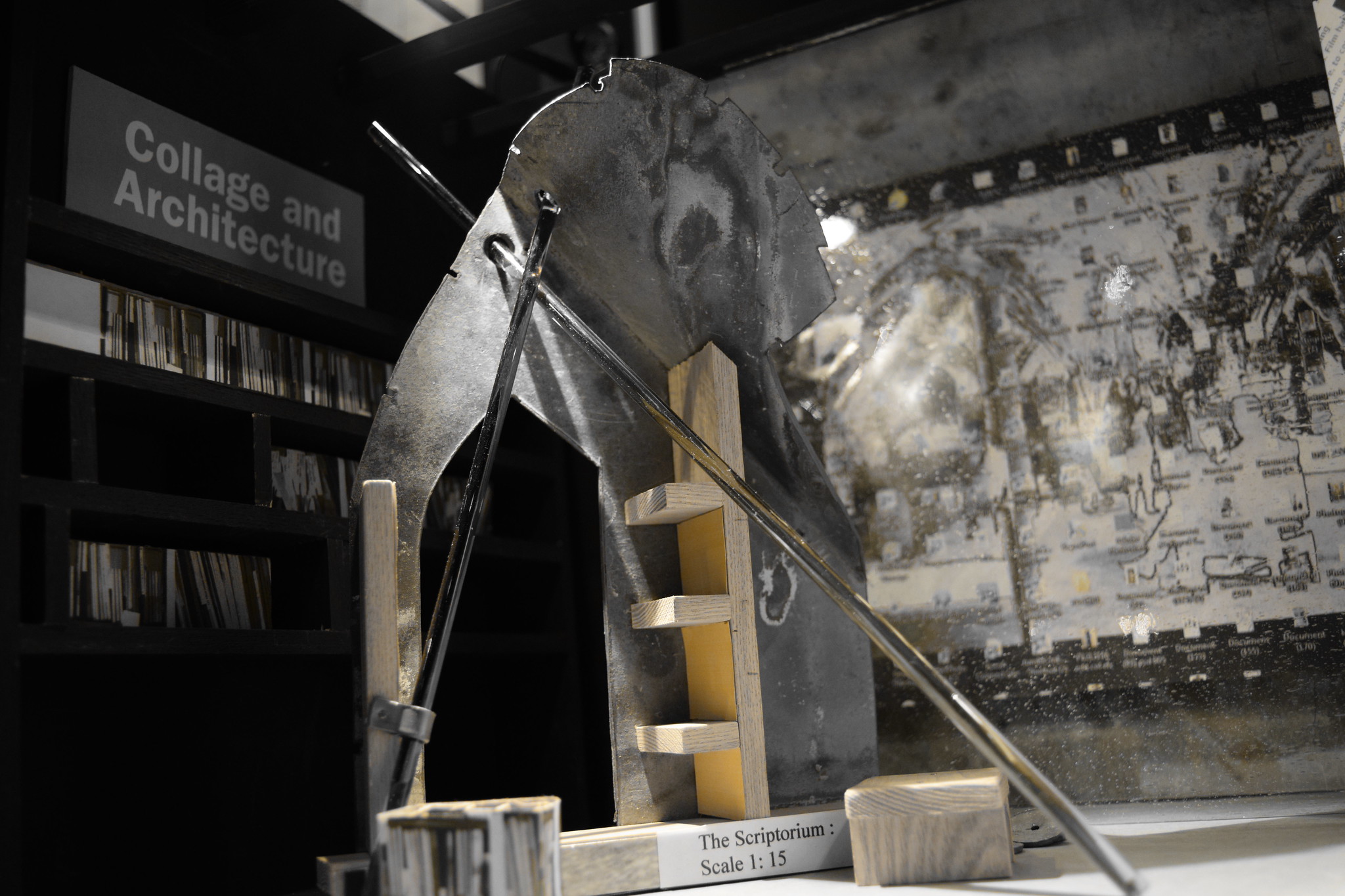
SCRIPTORIUM
 
THREE STAGE METHODOLOGY (Kikutake) Mitsuo Taketani
KA ‘ESSENCE’
KATA ‘SUBSTANCE’
KATACHI ‘PHENOMENON’
 
Characteristics of an architect
CHI ‘BLOOD’
TACHI ‘TEMPERAMENT’
KATACHI ‘EMBODIMENT’