Tuesday, 1 March 2022

Strategies Of Display : Relationscapes, Movement, Art, Philosophy

Research Material/Notes.
Outpost Studios, Norwich.

Parallel Texts, Interviews and Interventions about Art.
Victor Burgin

Sainsbury Centre for Visual Arts
UEA Norwich
Holga Pinhole Camera


RELATIONSCAPES
Movement, Art, Philosophy
Erin Manning

Prelude : What moves as a body returns as a movement of thought

Something in the world forces us to think. This something is not an object of recognition, but a fundamental encounter.
Gilles Deleuze, Difference and Repetition

AN
ANTHROPOLOGY
OF
LANDSCAPE
Christoper Tilley, Kate Cameron-Daum

Materiality
From our perspective in this book representations of landscape, textual or pictorial, are of secondary significance and we should treat them as such; they are selective and partial, and often highly ideological, ways of seeing and knowing.
It forms a material medium in which we dwell and move and think.
Redirecting the study of landscape from representation to the materially grounded messiness of everyday life and the minutiae of material practices that constitute it.
Landscapes are contested, untidy and messy, tensioned, always in the making. Our landscapes of modernity are frequently on the move and peopled by diasporas and migrants of identity, people making homes in new places.

Field Observations
Spatial relations within the landscape are complex.
The manner in which persons and their bodies cannot be understood apart from the landscapes of which they are a part, reciprocally involved in forms of movement, action, awareness and social memory.
Embodied Identities
Art in and from the landscape
Fragile Environments : Nature and Culture

On Ways of Walking and Making Art
A personal reflection
M Collier
Making art is a practical application of phenomenology
Engaging  with an embodied experience of space and depth (what Merleau-Ponty called the 'flesh of the world').

WATERLOG
Journeys Around An Exhibition
Landscape and Memory

AFTER SEBALD
Essays and Illuminations
Edited by Jon Cook


INTERVAL


Transactive Memory
Systems Virtual Teams
The Body
Minds and Metaphors
Laban-CHOREUTICS

The Mind In The Cave
David Lewis-Williams

The Matter of The World
Minds and metaphors
Cathedrals of Intelligence
The 'Looking mind'

Information Processing and Performance in Traditional and Virtual Teams
The Role of Transactive Memory
Terri Griffith, Margaret A. Neale

Acquisition/Sharing of Implicit and Explicit Information

Organisations increasingly rely on teams to do much of the work traditionally accomplished by individuals.
Successful groups are those who are able to create synergies in the form of information aggregation and innovation that is beyond the ability of any single member.

Nascent Knowledge
Information Diversity
Task Conflict

The knowledge and perspectives of group members from the same social networks may be more redundant than diversified. However a total diversity among work group members is not desirable; some 'redundancy' (agreement in perspective) among group members is necessary to ensure enough common ground to facilitate successful group interaction.

Transactive Memory : Knowing and Accessing What We Know

For teams to have synergy they must be able to access their information, it is important to know who does what.
Wegner 1987; 1995)

RELATIONAL DEVELOPMENT
TIME
Synchronous/ Asynchronous
COMMUNICATION

Transactive Memory : A Contemporary Analysis of the Group Mind
Daniel M. Wegner

The study of transactive memory is concerned with the prediction of group (and individual) behaviour through an understanding of the manner in which groups process and structure information.

Individual Memory
Information is entered into memory at the encoding  stage, it resides in memory during a storage stage, and is bought back during the retrieval stage.

Organisation : differentiated/ integrated
Label
Location

THE LABAN SOURCEBOOK
Dick McCaw

Rudolf Laban (1879-1958) was a pioneer in dance and movement, who found a extraordinary range of application for his ideas; from industry to drama, education to therapy. Laban believed that you can understand about human beings by observing how they move, and devised two complimentary methods of notating the shape and quality of movements.

Diagram : Three Planes of Movement from Choreography
Inner and Outer Tension : Inner and Outer Form

CHOREUTICS : Principles of Dynamic Space and Movement

Choreutics presents the grammar and syntax of spatial form in movement and the nature of movement's harmonic content.

Effort
Exertion of Power, Physical or/and Mental

Force
Space
Time
Flight

Indulging/Contending
SPACE Flexible/Direct
WEIGHT Light/Strong
TIME Sustained/Quick
FLOW Free/Bound

Shadow Moves
An acute observer of Shadow Movement of a person in different situations and at different times will show the consistency of that individual's basic attitude and personality.

Effort and Recovery
Movement Psychology
Thinking
Intuiting
Sensing
Feeling


Friday, 25 February 2022

Speculative Drawings/Paintings/Projects : Choreography of Light /Becoming Spatial/Figural

Immateriality and Transparency

DSC_2038 Biomedical : Architectural Glass Design
2014 Stevens Competition
Cambridge University Hospitals
Biomedical Campus

Photography and Drawing
Marks and movements of precision and indeterminacy

Outpost 240222


Procession

Choreography of light for the moving eye.

Henry Plummer, 2009.


The Interplay of Light and Movement.

The visual attraction that can electrify space with strong perceptual and emotional forces.


Simulacrum, E.ON Munich, Andreas Horlitz, 2006.


'Art in construction' is a wall installation that describes a superimposition of different systems for interpreting the world. Astronomical motifs are superimposed on micro array structures, while lines of force from the world of electricity and imaged quotations from that of quantum physics are, in turn, superimposed on the astronomical images.


Andreas Horlitz no longer saw photographic images as images intended to reflect reality, but rather as raw material to be worked, a source of artistic creativity. Photography simply supplies the material that the artist then reorders and combines in order to establish another unexpected sensual context and thus provide insight into what we perceive as reality. For Horlitz the idea of the image detail, its meaning as part of a larger reality, and the idea of superimposition have been present in the artist's work from the very beginning.


Horlitz's pictures raise the question of whether photography is even capable of reproducing the complex structures of reality.

Barbel Tannert.


Primal Images, Gaston Bachelard's loss and then recovery of light in darkness.


Due to its power to seduce and attract, light has always played a pivotal role in successions of space  that are rewarding and memorable.


Immateriality and Transparency.

Technique and Expression in Glass Architecture.

Pallasmaa, 2003.


Anglian Potters

Undercroft, Norwich.

Ferini Gallery, Lowestoft. 


Gas Reduction Firing.

Architectural Ceramics.

Re-Installation of 20 cubic foot kiln surrounded by building materials.


Forming Inside Spaces

Propositions on Architectural Objects/Spaces : Hand-built slab ceramics.


Raw clay slips/oxides/glazes, paper stencils and other intermediary materials.

Post reduction, wood chippings, wire inclusions and wrappings/layerings.


Studio Thinking/Sensory and Sensate : The body in contact with its mattering.

Collage explorations between the division of things.


Immaterial and concrete materials in contact with the corporeal human/social body.

Peter Zumthor, Therme Vals, 1996.


Beyond the symbolic depictions of diagram/map or chart and their mappings/relationships.


Further Study : Working Title


Transitions : Intervals in visual thinking.


Passive/Kinetic Fields : Spatial surfaces of agency between Fine Art, Performance and Architecture.

Capacitance as a working condition/spatial agency of a diffractive art based inquiry/practice.


Definition/Physical Phenomena/Concepts used to attach feelings to things.


Displacements/Situatedness/Patterning/Redundancy.


Capacitance and its relationships, movements between space, surface, volume and subjectivity.


Bitumen Paintings/Pierced Membranes : Encapsulated Layering/Textile

Social noise cancelling art works derived from sound deadening pads.


Baffles/Filters : Spatial Intermediaries.


Richard Serra : Paint Stick Drawings.


Reading Matter and Rooms

The Lake of The Mind/Stochastic Thinking : Steven Holl.
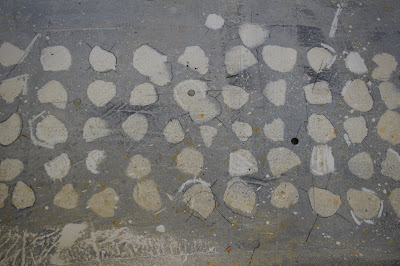


Temporal Surfaces : Moments of Translucency/Halting the camera's fetishising gaze.


Pinhole oil drum camera traps a vechicle in its shallow and temporal depth of field. 
Sun Street , Canterbury.

Digital prints from two paper negatives (45cmx60cm)


DSC_1930 Sun Street : Canterbury
DSC_1926 Sun Street : Canterbury
DSC_1927 Sun Street : Canterbury
DSC_1944 Sun Street : Canterbury
DSC_1931 Sun Street : Canterbury


Thursday, 24 February 2022

Dark Renderings : Pages from Artist's Books

Photographic Process/Thinking
Drawings : Speculative Constructions in Photography

Deleuze claimed that he did not write “about” art, literature, or cinema, but, rather, undertook philosophical “encounters” that led him to new concepts.  As a constructivist, he was adamant that philosophers are creators, and that each reading of philosophy, or each philosophical encounter, ought to inspire new concepts. Additionally, according to Deleuze and his concepts of difference, there is no identity, and in repetition, nothing is ever the same.  Rather, there is only difference: copies are something new, everything is constantly changing, and reality is a becoming, not a being.

http://www.iep.utm.edu/deleuze/

Layered Landscape

"Thus we cover the universe with drawings we have lived. These need only to be tonalized on the mode of our inner space."
 
Gaston Bachelard.
The Poetics of Space.


Sunday, 20 February 2022

Unheimlich Collages : Making Strange/The Handcrafted Object

The uncanny return of an object back into the social/spatial register of things.


Indexical Inscriptions

Found Imagery

Past Constructs

Anachronistic

Outmoded

Temporalities


Heuristic Material : Collage 


1. encouraging a person to learn, discover, understand, or solve problems on his or her own, as by experimenting, evaluating possible answers or solutions, or by trial and error: a heuristic teaching method.

2. serving to indicate or point out; stimulating interest as a means of furthering investigation.


Unheimlich Collages : Making Strange/The Handcrafted Object

Aesthetics of Silence : Susan Sontag

Art becomes the enemy of the artist, for it denies him the realization, the transcendence, he desires.

Every era has to reinvent the project of “spirituality” for itself. (Spirituality = plans, terminologies, ideas of deportment aimed at the resolution of painful structural contradictions inherent in the human situation, at the completion of human consciousness, at transcendence.)


Krishnamurti claims that we must give up psychological, as distinct from factual, memory. Otherwise, we keep filling up the new with the old, closing off experience by hooking each experience into the last. We must destroy continuity (which is insured by psychological memory), by going to the end of each emotion or thought. And after the end, what supervenes (for a while) is silence.


In the modern era, one of the most active metaphors for the spiritual project is “art.” The activities of the painter, the musician, the poet, the dancer et al, once they were grouped together under that generic name (a relatively recent move), have proved to be a peculiarly adaptable site on which to stage the formal dramas besetting consciousness, each individual work of art being a more or less astute paradigm for regulating or reconciling these contradictions. Of course, the site needs continual refurbishing. Whatever goal is set for art eventually proves restrictive, matched against the widest goals of consciousness. Art, itself a form of mystification, endures a succession of crises of demystification; older artistic goals are assailed and, ostensibly, replaced; outgrown maps of consciousness are redrawn. But what supplies all these crises with their energy — an energy held in common, so to speak — is the very unification of numerous, quite disparate activities into a single genus. At the moment at which “art” comes into being, the modern period of art begins. From then forward, any of the activities therein subsumed becomes a profoundly problematic activity, each of whose procedures and, ultimately, whose very right to exist, can be called into question. Following on the promotion of the arts into “art” comes the leading myth about art, that of the “absoluteness” of the artist’s activity. In its first, more unreflective version, this myth considered art as an expression of human consciousness, consciousness seeking to know itself. (The critical principles generated by this myth were fairly easily arrived at: some expressions were more complete, more ennobling, more informative, richer than others.) The later version of the myth posits a more complex, tragic relation of art to consciousness. Denying that art is mere expression, the newer myth, ours, rather relates art to the mind’s need or capacity for self-estrangement. Art is no longer understood as consciousness expressing and therefore, implicitly, affirming itself. Art is not consciousness per se, but rather its antidote — evolved from within consciousness itself. (The critical principles generated by this myth were much harder to get at.) The newer myth, derived from a post-psychological conception of consciousness, installs within the activity of art many of the paradoxes involved in attaining an absolute state of being described by the great religious mystics. As the activity of the mystic must end in a via negative, a theology of God’s absence, a craving for the cloud of unknowingness beyond knowledge and for the silence beyond speech, so art must tend toward anti-art, the elimination of the “subject” (the “object,” the “image”), the substitution of chance for intention, and the pursuit of silence. In the early, linear version of art’s relation to consciousness, a struggle was held to exist between the “spiritual” integrity of the creative impulses and the distracting “materiality” of ordinary life, which throws up so many obstacles in the path of authentic sublimation. But the newer version, in which art is part of a dialectical transaction with consciousness, poses a deeper, more frustrating conflict: The “spirit” seeking embodiment in art clashes with the “material” character of art itself. Art is unmasked as gratuitous, and the very concreteness of the artist’s tools (and, particularly in the case of language, their historicity) appears as a trap. Practiced in a world furnished with second-hand perceptions, and specifically confounded by the treachery of words, the activity of the artist is cursed with mediacy. Art becomes the enemy of the artist, for it denies him the realization, the transcendence, he desires. Therefore, art comes to be estimated as something to be overthrown. A new element enters the art-work and becomes constitutive of it: the appeal (tacit or overt) for its own abolition — and, ultimately, for the abolition of art itself.

https://www.opasquet.fr/dl/texts/Sontag_Aesthetics_of_Silence_2006.pdf

https://www.brainpickings.org/2015/07/06/the-aesthetic-of-silence-susan-sontag/