Showing posts with label movement. Show all posts

Friday, 10 April 2026

Friday, 14 November 2025

Erin Manning for Brian Massumi : Sylvian & Fripp - Every colour you are (live '93)

Relationscapes
Erin Manning
Movement/Art/Philosophy

For Brian Massumi

The self is only a threshold, a door, a becoming between two multiplicities.
Gilles Deleuze and Felix Guattari, A Thousand Plateaus.


Thursday, 25 September 2025

Tarkovsky filming the Instant : Flux and Quality in Nature's Time

Reflective Narratives around The Instant.
Art and Aesthetic Patterns.

The theme of the human body as landscape and the biological link between humanity and nature. 

Filmic Modalities


An Ecology of Mind

We are so accustomed to thinking of aesthetic phenomena as a discursive or representational construct, that we often forget that without arousal of perception, no aesthetic experience is possible.

Going beyond what it may represent into the important psychic information it contains

Bateson credits art with playing the role of confronting the quantitative limit built into consciousnesses


Art assists mind in recognizing that the potentiality of heightened consciousnesses exist and that it resides in you and in me


Flux and Quality in Nature's Time

Perception of Environment/Relational Situations

Tim Ingold

Each thing framed dwells in the world differently.

The frame and framing, through its configuration, must never offer a gap or a bridge through which as it were, the world could get in, or from which the picture could get out.

The picture frame reminds us that the work of art, while it hangs in our room, does not disturb our day-to-day sentient and perceptual ecologies.

It is like an island in the world that waits until one approaches it and which one can as well pass by and overlook.

On The Picture Frame, Simmel


Art becomes art by virtue of literal and institutional framing

Aesthetic contemplation blurs reals and emotional space in a way that produces tangible affects in the world

The thinking hand that mediates a haptic bridge in which creating and holding, becoming and grasping are all practical everyday activities extending the thinking body

Objects that stand in two worlds at once and becoming drawn into the movement of practical life through the virtue of being held in the hand

The intermingling of persons and objects in pictorial space and the aesthetics of the intermingling of function and form in everyday things


The pictorial space is one in which persons and images intermingle and passions can be aroused. 

Art and Agency, Alfred Gell


Nature as “Comfort Zone” in the Films of Andrei Tarkovsky by Donato Totaro 
 
Volume 14, Issue 12 / December 2010  18 minutes (4324 words)

In this essay Totaro analyzes the unique thematic and aesthetic import of Tarkovsky’s use of nature.


Tarkovsky relies on nature and natural phenomena to underscore and often dictate the time-pressure (rhythm) of a shot. The movement of time, its flux and quality, flows from the life-process that is recorded in the shot. Even though the fires, downpours and gusts of wind are staged, re-shot or recreated there still remains the spontaneous element of “nature’s time” within the filmic time. Each of the natural events and elements (water, wind, fire, snow) have their own sustained rhythm. Tarkovsky uses these natural rhythms to express his own, that of his characters and the temporal shape of the film (23-24).

I would like to conclude this analysis of Tarkovsky’s unique use of nature as a ‘comfort zone’ by saying a few things about his two science-fiction films, Solaris and StalkerSolaris is based on the great same-titled science-fiction novel by Stanislaw Lem. The many philosophical and ethical differences between the novel and film can be summarized by the fact that, whereas the novel begins in space on the Solaris space station orbiting the planet Solaris, the film begins with a 45 minute prologue on earth, which establishes the importance of home, family, and ‘mother’ earth to the psychologist Kris Kelvin (and by extension all humans), who is soon to leave for outer space. The theme of the human body as landscape and the biological link between humanity and nature is established right from the opening, a (second) slow motion close-up shot of plant life swaying under a crystal clear stream that slowly pans right to reveal the hand of a man wearing brown trousers and a dark leather coat standing amidst waist high reeds.


http://offscreen.com/view/nature_as_comfort_zone


Waverley Abbey
Reflected ruins in flooded interior


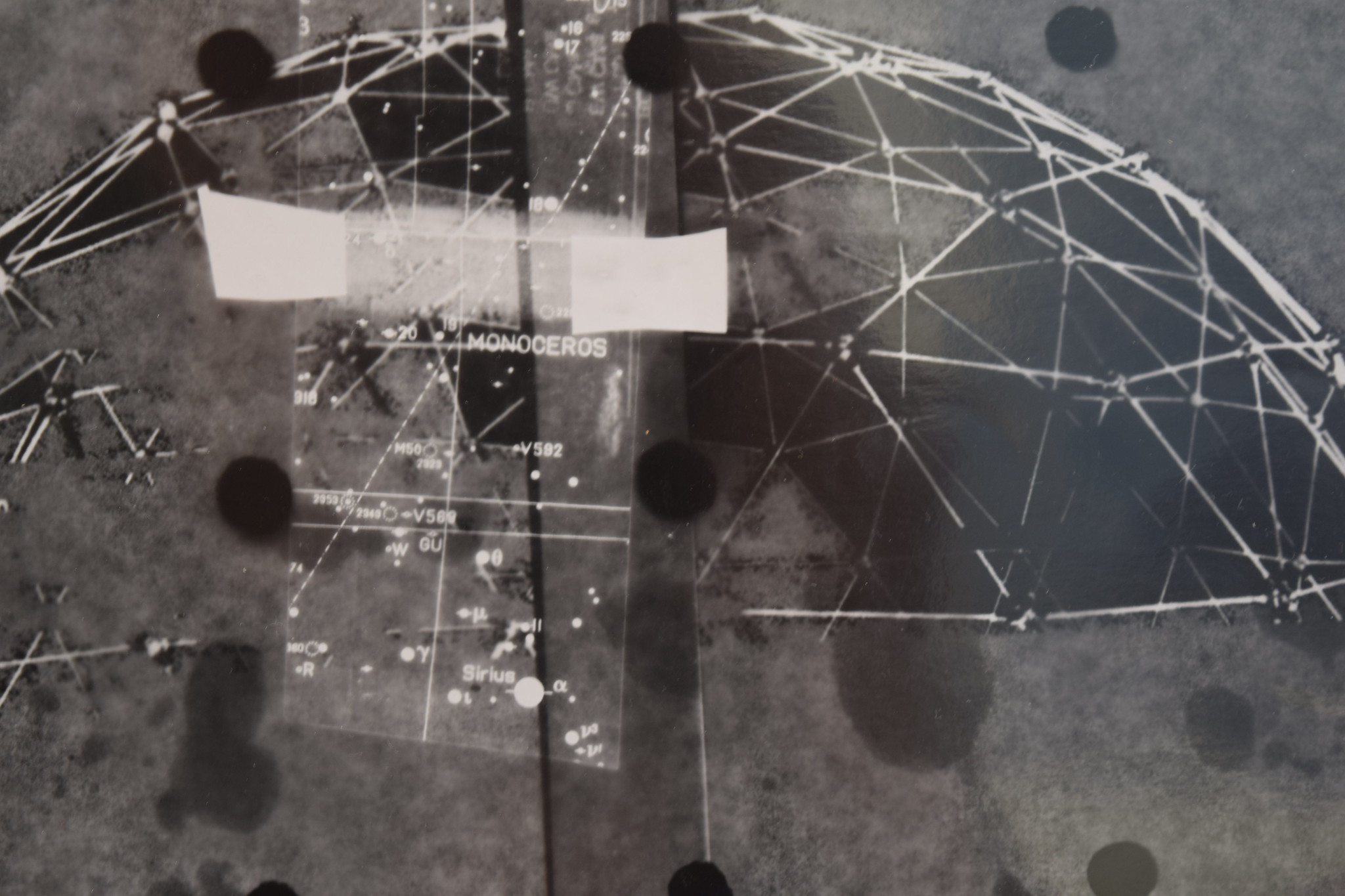
Photogram formed from a design collage for The Reading Room, Waverley Abbey.

Intuition of the Instant : Gaston Bachelard


Monday, 12 May 2025

Diffracted Bodies~Matter(s) in Movement : Speculative~Performative Space~Time Drawings

Evidencing Atmospheres/A Calling To Think.

Reading diffractively through reimagined patterns/atmospheres that penetrate the body-text-space-time compositions. 

Spatial blueprints/propositional and emergent diagrams on speculative readings from The Order of Time by Carlo Rovelli.


Apparatuses and Intermediaries.

Everyday Practices, Harleston. 2022


Tuesday, 21 March 2023

From Naked to Nude : Drawing from Life/Luminosity/Movement/Corporeality.


From Naked to Nude.

Life Drawing.


https://www.flickr.com/photos/russellmoreton/


Drawing as an inquiry of seeing/being/feeling

Bodies in an abstracted atmosphere of absence


Luminosity/Movement/Corporeality.


The blurring/dissolution of the conventional distinction/relationships between the figure and the ground.


The luminescent dematerialization of the subject. 


The nude, mediated by the mechanical effects of photography/blurring/fragmentation and the distance/blindness of drawing/memory.

Saturday, 4 February 2023

Processual Drawing : Bioscleave/Blue Particle Cloud/Diagram.

 https://www.flickr.com/people/russellmoreton/


ARCHITECTURAL Body
An ORGANISM that PERSONS
Gins and Arakawa 2002

Although the human condition is a crisis condition if ever there was one, few individuals and societies act with the dispatch a state of emergency requires. The fact that the human condition is a crises condition gets routinely covered up, with culture invariably functioning to obscure how dire the condition is and to float it as bearable

If organisms form themselves as persons by uptaking the environment, then they involve not only bodies but domains, spheres of activity and influence 

Start by thinking of architecture as a tentative constructing toward a holding in place. Architecture's holding in place occurs within and as part of a prevailing atmospheric condition that others routinely call biosphere but which we, feeling the need to stress its dynamic nature, have renamed bioscleave
Procedural Architure/Architectural Body 
Gins and Arakawa

The role of architecture as a tool for researching the body-environment towards the implementation of these considerations is paramount
The goal of an experimental teaching and learning space based on architectural procedures would be that the process of design and construction would allow students/staff to rethink, re-imagine and enact the curriculum
An Arakawa and Gins Experimental Teaching Space/A Feasibility Study 2013
Jondi Keane

An Architecture of Viability
To help to sustain one throughout life/ to stay tentative
Bioscleave House as an inter-active laboratory of everyday life 

Wayfinding (unpacking discourse/meaning) through Landing Sites and Architectural Bodies
What is the metachallenge that bioscleave demands of us? Is it, I propose, wayfinding, a wayfinding defined at many scales from finding one's way as a person to finding one's way in a strange physical or social environment
Exploring the Roles of Trajectoriness, Affectivatoriness, and Imaging Along 2013
Reuben M. Baron


Figure/Ground : Double Occupations of Discourses and Events (relationships/co-existances)
So as a diagram (performative agent), the figure/ground does not function to represent even something real. But rather constructs a real that is yet to come (theoretical object/apparatus) as a new type of reality
Situated Field/Constructed Site of People, Institutions, Apparatuses, Events, Discourses

We see intraventions as heuristic devices, as apparatuses that are imbued with a will to transform.
The intravention is not autonomous but contingent and relational and dependent on many other things
The intravention is made as it happens, and it makes us at the same time
Immediate Architectural Interventions, Durations and Effects
Oren Lieberman, Alberto Altes

AEffect initiating Heuristic Life
Procedural architecture, developed in both their written and buillt discourse, providing a process by which to connect theory to practice, disciplinary inquiry to knowledge and art to life
Research should be conducted , not in a library or laboratory but where living happens, enabling the complexity of relationships to be studied within and across the organism-person-environment 
Jondi Keane


Carnal Knowledge
Towards a New Materialism through the Arts
Estelle Barrett, Barbara Bolt


To provide observational heuristic devices so that persons may devise transformational and reconfigurative opportunities

Heuristic tools whether built hypothesis or discursive sequences, are of no use if they do not provide a way forward, a way of learning

This house is a tool, a procedural one
A functional tool, whether it be a hammer, a telephone, or a telescope, extends the senses, but a procedural tool examines and reorders the sensorium

Interlude : Cornering a Beginning
An object becomes the threshold for thinking feeling
Relationscapes : Movement, Art, Philosopy
Erin Manning 

Born into a new territory, and that territory is myself as organism. There is no place to go but here. Each organism that persons finds the new territory that is itself, and having found it, adjusts it

Ellipsis,(gaps in everyday narratives) 
The Construction of Representation of Identity
Using their bodies and immediate surroundings and environment as both subject and context
An Organism-Person-Environment
You cannot see me from where I look at myself
Francesca Woodman

An organism-person-environment has given birth to an organism-person-environment
Bioscleave

Chaos, Territory, Art
Deleuze and the framing of the earth
Elizabeth Grosz

Body, Personal Relations, Spatial Values
Upright Human Body : Space and Time
Yi Fu Tuan

Figuring It Out
The Parallel Visions of Artists and Archaeologists
Colin Renfrew

The act of relating is analysed as a constitutive feature of human agency. Relating is viewed as the continuous work of connecting and disconnecting in a fluctuating network of existential events
Categories and things may make it easier for us to grasp reality but they also hide its underlying complexities
Relationality 2005
Robert Cooper


Aesthetics and Subjectivity : Experiential Spaces/The feeling of what happens

Tides of Being/Becoming


Antonio Damasio
The Feeling of What Happens
Body, Emotion and the Making of Consciousness

Gaston Bachelard, The Poetics of Reverie.

Nick Cave, The Lyre of Orpheus.

Hildur Gudnadottir, Saman.


Wednesday, 2 March 2022

Landscape/Slow Motion : A Porous Atmosphere of Light/Experience


River Waveney, Mendham Marshes


The Experience of Landscape

Landscape, Memory and Desire

An Anthropology of Landscape

Up, Across and Along

Slow Motion

Tim Ingold


Tuesday, 1 March 2022

Strategies Of Display : Relationscapes, Movement, Art, Philosophy

Research Material/Notes.
Outpost Studios, Norwich.

Parallel Texts, Interviews and Interventions about Art.
Victor Burgin

Sainsbury Centre for Visual Arts
UEA Norwich
Holga Pinhole Camera


RELATIONSCAPES
Movement, Art, Philosophy
Erin Manning

Prelude : What moves as a body returns as a movement of thought

Something in the world forces us to think. This something is not an object of recognition, but a fundamental encounter.
Gilles Deleuze, Difference and Repetition

AN
ANTHROPOLOGY
OF
LANDSCAPE
Christoper Tilley, Kate Cameron-Daum

Materiality
From our perspective in this book representations of landscape, textual or pictorial, are of secondary significance and we should treat them as such; they are selective and partial, and often highly ideological, ways of seeing and knowing.
It forms a material medium in which we dwell and move and think.
Redirecting the study of landscape from representation to the materially grounded messiness of everyday life and the minutiae of material practices that constitute it.
Landscapes are contested, untidy and messy, tensioned, always in the making. Our landscapes of modernity are frequently on the move and peopled by diasporas and migrants of identity, people making homes in new places.

Field Observations
Spatial relations within the landscape are complex.
The manner in which persons and their bodies cannot be understood apart from the landscapes of which they are a part, reciprocally involved in forms of movement, action, awareness and social memory.
Embodied Identities
Art in and from the landscape
Fragile Environments : Nature and Culture

On Ways of Walking and Making Art
A personal reflection
M Collier
Making art is a practical application of phenomenology
Engaging  with an embodied experience of space and depth (what Merleau-Ponty called the 'flesh of the world').

WATERLOG
Journeys Around An Exhibition
Landscape and Memory

AFTER SEBALD
Essays and Illuminations
Edited by Jon Cook


INTERVAL


Transactive Memory
Systems Virtual Teams
The Body
Minds and Metaphors
Laban-CHOREUTICS

The Mind In The Cave
David Lewis-Williams

The Matter of The World
Minds and metaphors
Cathedrals of Intelligence
The 'Looking mind'

Information Processing and Performance in Traditional and Virtual Teams
The Role of Transactive Memory
Terri Griffith, Margaret A. Neale

Acquisition/Sharing of Implicit and Explicit Information

Organisations increasingly rely on teams to do much of the work traditionally accomplished by individuals.
Successful groups are those who are able to create synergies in the form of information aggregation and innovation that is beyond the ability of any single member.

Nascent Knowledge
Information Diversity
Task Conflict

The knowledge and perspectives of group members from the same social networks may be more redundant than diversified. However a total diversity among work group members is not desirable; some 'redundancy' (agreement in perspective) among group members is necessary to ensure enough common ground to facilitate successful group interaction.

Transactive Memory : Knowing and Accessing What We Know

For teams to have synergy they must be able to access their information, it is important to know who does what.
Wegner 1987; 1995)

RELATIONAL DEVELOPMENT
TIME
Synchronous/ Asynchronous
COMMUNICATION

Transactive Memory : A Contemporary Analysis of the Group Mind
Daniel M. Wegner

The study of transactive memory is concerned with the prediction of group (and individual) behaviour through an understanding of the manner in which groups process and structure information.

Individual Memory
Information is entered into memory at the encoding  stage, it resides in memory during a storage stage, and is bought back during the retrieval stage.

Organisation : differentiated/ integrated
Label
Location

THE LABAN SOURCEBOOK
Dick McCaw

Rudolf Laban (1879-1958) was a pioneer in dance and movement, who found a extraordinary range of application for his ideas; from industry to drama, education to therapy. Laban believed that you can understand about human beings by observing how they move, and devised two complimentary methods of notating the shape and quality of movements.

Diagram : Three Planes of Movement from Choreography
Inner and Outer Tension : Inner and Outer Form

CHOREUTICS : Principles of Dynamic Space and Movement

Choreutics presents the grammar and syntax of spatial form in movement and the nature of movement's harmonic content.

Effort
Exertion of Power, Physical or/and Mental

Force
Space
Time
Flight

Indulging/Contending
SPACE Flexible/Direct
WEIGHT Light/Strong
TIME Sustained/Quick
FLOW Free/Bound

Shadow Moves
An acute observer of Shadow Movement of a person in different situations and at different times will show the consistency of that individual's basic attitude and personality.

Effort and Recovery
Movement Psychology
Thinking
Intuiting
Sensing
Feeling


Saturday, 18 December 2021

Sunday, 17 October 2021

Transactive Memory : INFORMATION/MOVEMENT differentiated/integrated

Research Outpost Norwich #1

Transactive Memory
Systems Virtual Teams
The Body
Minds and Metaphors
Laban-CHOREUTICS

The Mind In The Cave
David Lewis-Williams

The Matter of The World
Minds and metaphors
Cathedrals of Intelligence
The 'Looking mind'

Information Processing and Performance in Traditional and Virtual Teams
The Role of Transactive Memory
Terri Griffith, Margaret A. Neale

Acquisition/Sharing of Implicit and Explicit Information

Organisations increasingly rely on teams to do much of the work traditionally accomplished by individuals.
Successful groups are those who are able to create synergies in the form of information aggregation and innovation that is beyond the ability of any single member.

Nascent Knowledge
Information Diversity
Task Conflict

The knowledge and perspectives of group members from the same social networks may be more redundant than diversified. However a total diversity among work group members is not desirable; some 'redundancy' (agreement in perspective) among group members is necessary to ensure enough common ground to facilitate successful group interaction.

Transactive Memory : Knowing and Accessing What We Know

For teams to have synergy they must be able to access their information, it is important to know who does what.
Wegner 1987; 1995)

RELATIONAL DEVELOPMENT
TIME
Synchronous/ Asynchronous
COMMUNICATION

Transactive Memory : A Contemporary Analysis of the Group Mind
Daniel M. Wegner

The study of transactive memory is concerned with the prediction of group (and individual) behaviour through an understanding of the manner in which groups process and structure information.

Individual Memory
Information is entered into memory at the encoding  stage, it resides in memory during a storage stage, and is bought back during the retrieval stage.

Organisation : differentiated/integrated
Label
Location

THE LABAN SOURCEBOOK
Dick McCaw

Rudolf Laban (1879-1958) was a pioneer in dance and movement, who found a extraordinary range of application for his ideas; from industry to drama, education to therapy. Laban believed that you can understand about human beings by observing how they move, and devised two complimentary methods of notating the shape and quality of movements.

Diagram : Three Planes of Movement from Choreography
Inner and Outer Tension : Inner and Outer Form

CHOREUTICS : Principles of Dynamic Space and Movement

Choreutics presents the grammar and syntax of spatial form in movement and the nature of movement's harmonic content.

Effort
Exertion of Power, Physical or/and Mental

Force
Space
Time
Flight

Indulging/Contending
SPACE Flexible/Direct
WEIGHT Light/Strong
TIME Sustained/Quick
FLOW Free/Bound

Shadow Moves
An acute observer of Shadow Movement of a person in different situations and at different times will show the consistency of that individual's basic attitude and personality.

Effort and Recovery
Movement Psychology
Thinking
Intuiting
Sensing
Feeling


Flickr

Thursday, 14 October 2021

ANTHROPOLOGY/LANDSCAPE : Urban Materiality/Movement and Relationscapes

Research Outpost Norwich #2

RELATIONSCAPES
Movement, Art, Philosophy
Erin Manning

Prelude : What moves as a body returns as a movement of thought

Something in the world forces us to think. This something is not an object of recognition, but a fundamental encounter.
Gilles Deleuze, Difference and Repetition

AN
ANTHROPOLOGY
OF
LANDSCAPE
Christoper Tilley, Kate Cameron-Daum

Materiality
From our perspective in this book representations of landscape, textual or pictorial, are of secondary significance and we should treat them as such; they are selective and partial, and often highly ideological, ways of seeing and knowing.
It forms a material medium in which we dwell and move and think.
Redirecting the study of landscape from representation to the materially grounded messiness of everyday life and the minutiae of material practices that constitute it.
Landscapes are contested, untidy and messy, tensioned, always in the making. Our landscapes of modernity are frequently on the move and peopled by diasporas and migrants of identity, people making homes in new places.

Field Observations
Spatial relations within the landscape are complex.
The manner in which persons and their bodies cannot be understood apart from the landscapes of which they are a part, reciprocally involved in forms of movement, action, awareness and social memory.
Embodied Identities
Art in and from the landscape
Fragile Environments : Nature and Culture

On Ways of Walking and Making Art
A personal reflection
M Collier
Making art is a practical application of phenomenology
Engaging  with an embodied experience of space and depth (what Merleau-Ponty called the 'flesh of the world').

WATERLOG
Journeys Around An Exhibition
Landscape and Memory

AFTER SEBALD
Essays and Illuminations
Edited by Jon Cook


Thursday, 5 August 2021

Drawing as a participant in amongst a world of active materials


Art as Spatial Practice.
Space folds : Containing "Spatialities around historicality and sociality"

"All that is solid melts into air"

Karl Marx, Friedrich Engels,
(Poetic observation concerning the constant revolutionizing of social conditions)

Perceptions now gathering at the end of the millennium. Spatiality, Robert T. Tally Jr. 2013

http://pictify.saatchigallery.com/user/russellmoreton