Monday, 17 April 2023

Work : Filtered Light/Colour


Brian Clarke
The Art of Light/Paul Greenhalgh, 2018. Sainsbury Centre for Visual Arts

Properties of Matter and Imagination 
FUSION OF PHYSICAL/METAPHYSICAL

WORK : An Inquiry with Material Practice
The poetics of glass as a super-cooled liquid. Molten Fluidity.
An organic flux frozen for an instant.
Chaos and order, flow and turbulence, pooling and shifting translucence.

Chemistry becomes alchemy, the banality of the raw materials - sand, metal and minerals - turn into a magical universe of the imagination. Perhaps this is the key to Brian Clarke's stained glass; it embodies the fusion of two things that normally don't mingle; the physical and metaphysical.

Botanical 
Cosmological 
Biographical

The screens are an intense site of innovation and artistic consolidation. Some of the screens are principally about the organic flow of forms derived from nature; some of them deal with ideas that push into universal concepts and have a symbolist, otherworldly ambiance; and some yet their driving force incidents, memories and emotions that shaped the artist's life.

The Modern World (the artist's attitudes to) 
Life
Violence 
Mortality

Many of the screens are highly specific to an incident or influence, the titles give us a clue to the complex symbology at work and the intertwining of the artist's personal response with wider perceptions about place.

Contrapuntal/Counterpoint music introduces multiple melodies that are equally important. Polyphony describes the use of overlapping melodies.

For Clarke the concept of a screen as a vehicle of artistic expression is not a new concept, rather it clearly resonates back through his life, becoming part of his artistic consciousness virtually from the start of his work in glass.

Literal and Phenomenal Transparency Layering of Planes/Layering of Spaces
Rowe and Slutzky 1982

What exactly is a screen and what does it mean in the context of modernity?

A screen is simultaneously a physical object and a complex conceptual metaphor. 
We use screens to divide and to mask things off from each other, and as boundaries/barriers to hide behind. 
At the same time, the screen provides ways of looking at things/displaying; we screen films and we screen people. 
We look through them, and they can act as a catalyst that changes our vision of whatever is on the other side. 
In its usage in art, a screen is automatically a series of images - a diptych, triptych or polyptych - a sequence of free standing panels that allows the artist to develop a narrative and aesthetic theme.
Screens divide up space and make it function differently.

Alabaster windows before glass, contemporary windows by both Soulages/Sigmar Polke 
Iglesias, 
The Glass House

The screen as emblematic of modernity.

Conceptually, the sensibility at work in many early Modem buildings was one of space divided by screen walls and windows. In this sense, the giant windows at either end of Norman Foster's seminal Sainsbury Centre building for example are light-screens.

The nature of Brian Clarke's architectural practice, in which his core practice is painting.

It is through painting that I understand how to view architecture. It is through painting that I can appreciate the rhythm of the poem. 
It is through painting that I can appreciate and draw pleasure from the structure of a well-composed sentence. And it is through painting that the complexity of music makes itself understood to me. It is through painting, in fact, that I am.
Brian Clarke, 1989.

I do not identify mostly with painting, but I identify mostly with all other things because of painting. Brian Clarke, 2018.

Clarke is gripped by the technology and engineering of how a building is made, but also by the psychological function and its emotional impact, he refers to himself as an architectural artist.
The medium of glass in its modern form will only be seen when people have been sufficiently exposed to it.
During the 20th century - the age of specialization - theorists and historians were obsessed with separating out the arts disciplines, positioning them in specific groups or classes, and then subjecting them to philosophical discourse as to why they belonged there. 
In short, the Anglo-Saxon world in particular artificially created the categories of art, design and craft, and then intellectually policed them. Stained glass was inevitably positioned as a craft, with all the confused cultural and economic consequences of this class allocation.

Clarke with the complexity of his practice and interests has led to embrace the concept of gesamtkunstwerk (total works of art). 

A concept first championed by Richard Wagner, who perceived opera as a means of combining all of the arts, including music, and literature, in order to completely surround the spectator. In the visual arts, it is essentially about generating a complete art environment, in which all elements are orchestrated into an aesthetic whole.

Charles Rennie Mackintosh, Frank Lloyd Wright, designers of the De Stijl movement.


Wednesday, 12 April 2023

Openings and Conclusions/Frameworks with Enclosures : Site Specificity/Installation

On the horizon, then, at the furthest edge of the possible, it is a matter of producing the space of the human species-the collective (generic) work of the species-on the model of what used to be called "art" ; indeed, it is still so called, but art no longer has any meaning at the level of an "object" isolated by and for the individual.

Henri Lefebvre, Openings and Conclusions.
On Installation and Site Specificity (introduction) Erika Suderburg

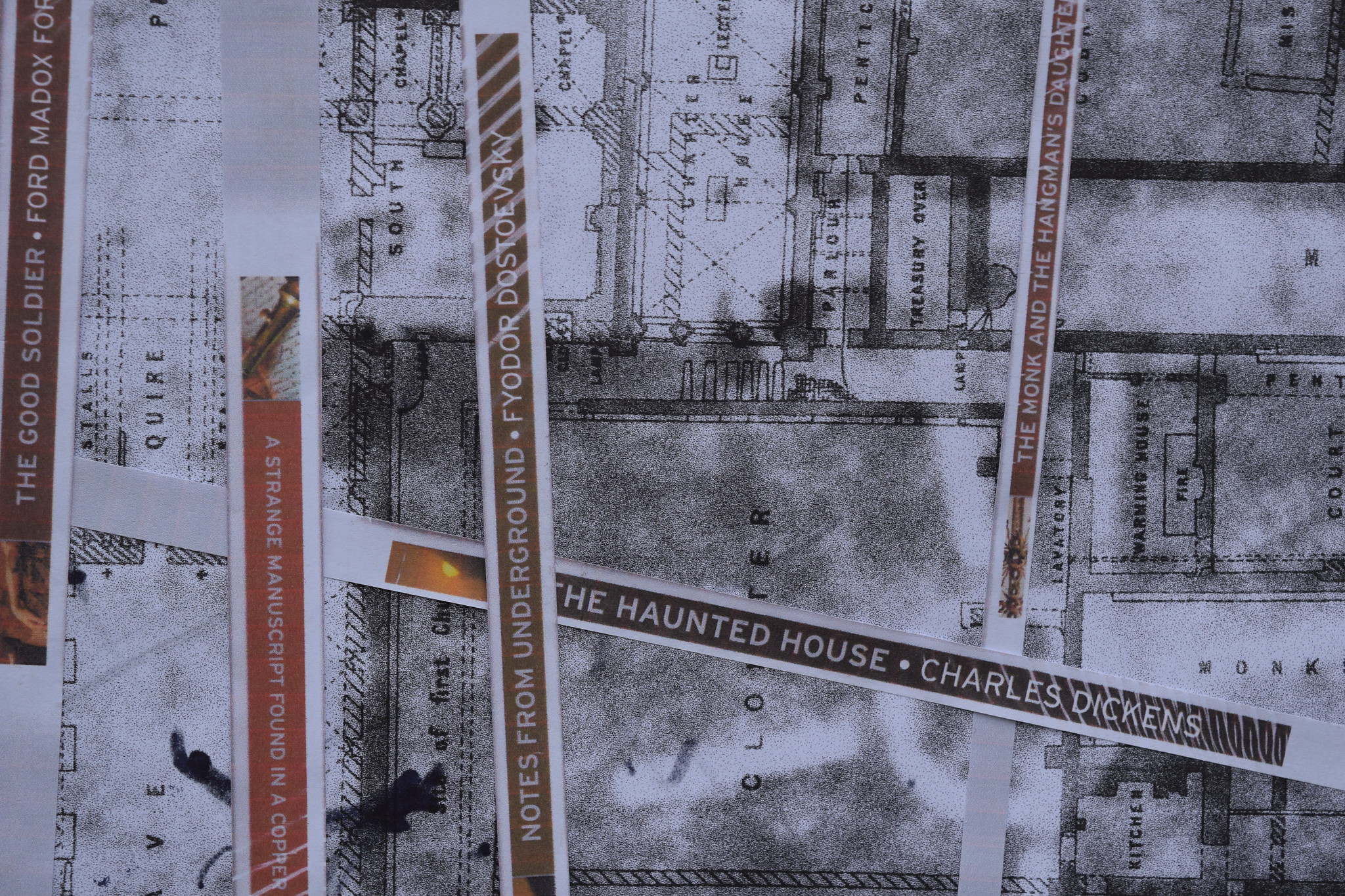
Collage on paper,written fragments and images from Peter Greenaway, Josef Albers and Robin Evans.

Photo montage of The Physical Self (Greenaway) and Waverley Abbey UK.
Visual research as part of The Waverley Project/Obscura and Reading Room.

TheThinking Hand: Existential and Embodied Wisdom in Architecture.
Juhani Pallasmaa

Frameworks with Enclosures

Of the mason's who built them, we can say that they both designed as they drew, and drew as they designed. But their designing, like their drawing, was a process of work, not a  project of the mind.


Tim Ingold 'Making'


Tuesday, 11 April 2023

Another/Alternative Photography : Apparatuses/Pattern Making/Redundancy/Collage

 Outpost 060423


https://www.flickr.com/photos/russellmoreton/

Searching For Redundancy/Making Patterns Making.

Time/Duration/Perception.


What Is An Apparatus?

Giorgio Agamben


Bringing things back to life, to switch our perspective from the endless shuttling back and forth from image to object and from object to image, that is such a pronounced feature of academic writing in the fields of anthropology, archaeology, art and architecture, to the material flows and currents of sensory awareness in which images and objects reciprocally take shape.

Tim Ingold.


Immaterial Architecture/Creation/Contemplation/Artist/Architect.


Diffraction, understood as a material-discursive phenomenon that makes the effects of different differences evident.

Karen Barad.


Troubleyn Laboratorium, Jan Fabre.

The Empty Space, Peter Brook.

Verb List Compilation/Actions to relate to oneself, Richard Serra.


Ceramics.

Slab built architectural forms and crucible raku bowls.


Raku bowls thrown and turned in a coarse clay with wide flat rims inspired by crucible forms for melting materials.


Architectural slab built pieces investigate ceramics as a dwelling place or a model for a building construction.


Undercroft Exhibition Norwich.

Anglian Potters.


Notion of a moment of impeding transposition.

Transformation of derelict buildings into newly evocative spatial experiences.

Building Cuts/Physical Alteration to a space is a revelation of a particular response.


The Body To The Building.

Social Activism/Mindful Lawlessness. 

Gordon Matta-Clark.


Performativity, subject and object do not pre-exist as such, but merge through intra-actions.

Karen Barad.


Architectural Body/The Organism That Persons.

Madeline Gins and Arakawa.


You cannot see me  from where I look at myself.

Francesca Woodman.


Thinking Bodies/Becoming Woman.

Images that created a sense of confinement, a temporal identity for herself, a place for a personal resonance/self inquiry.


The body as architecture itself as the support that constitutes the spatial agency of photography.


Negative Capability.

The Link Gallery, Winchester.2013.

Morn Hill Winchester.


Site of the corporation or the master, brethren and sisters of the blessed Mary Magdalene hospital near Winchester erected in 1148 and demolished in 1772.


Founded on the eastern hill in remote antiquity for lepers.

The Hospital of St. Mary Magdalene.

Raymond Elliott. 1994.


Becoming Decay.

Clemintina and Francesca.


Domestic Liminality, a psychological, neurological, or metaphysical subjective conscious state of being on the threshold of or between two different existential planes.


Places where we make new domestic worlds, where we reconstitute family.

Carol Mavor.


Figurative Drawings and Sculptural Reliefs.

Matters of Form/Construction.

Manuel Neri.


Norton Star Atlas

Map 1 

Epoch 2000.0

Stellar Magnitudes

Double or Multiple Stars

Variable Stars

Novae.


Alternative Darkroom Photography

Corporeal/Astronomical

Body/Cosmos/Imagination

Scale/Proximity/Vastness


Tuesday, 4 April 2023

Open Studio/Cyanotypes and Collages : Harleston Revisited/Norfolk and Norwich 2018

Civilizing Rituals
Inside Public Art Museums
Carol Duncan

Julian Stair
Quietus reviewed
Archaeology of an exhibition

Spirituality in Contemporary Art
The Idea of the Numinous
Jungu Yoon

The Aesthetics of Silence
Susan Sontag

A Field Guide To Getting Lost
Rebecca Solnit

Essays On The Blurring Of Art And Life
Allan Kaprow

Ways of Curating
Hans Ulrich Obrist

The Fitzwilliam Museum, Cambridge

On Show : Contemporary ceramics in the Goodison gift in the context of a historic museum collection.

A rare opportunity to hear different perspectives on how the art of display can animate objects and deepen insight into historical collections.


The study day will draw on two current displays exclusive to the Fitzwilliam Museum: the Goodison gift of contemporary ceramics and the exhibition Things of Beauty Growing: British Studio Pottery. Speakers include four internationally-acclaimed UK ceramicists whose work features in both displays: Julian Stair, Carol McNicoll, Philip Eglin and Jennifer Lee. The study day concludes with a conversation between Amanda and Sir Nicholas Goodison, followed by the opportunity to share reflections on the subject.


Art has the power to affect our thinking, changing not only the way we view and interact with the world but also how we create it. In Art and Mind, Ernst van Alphen probes this idea of art as a commanding force with the capacity to shape our intellect and intervene in our lives. Rather than interpreting art as merely a reflection of our social experience or a product of history, van Alphen here argues that art is a historical agent, or a cultural creator, that propels thought and experience forward.
Art in mind : How contemporary images shape thought
Ernst van Alphen

Walking and Mapping
Artists as Cartographers
Karen O'Rourke

A Bigger Splash
Painting after Performance
Catherine Wood 


Sunday, 2 April 2023

Atmosphere and Surrounding Objects : Loose Assemblages/Living Emotions/Theoretical Gaze

Paintings being living emotions. Mark Rothko

The atmosphere of a work of art, what surrounds it, that 'place' in which it exists - all this is thought of as a lesser thing, charming but not essential. Professionals insist on essentials ... not understanding that everything we use to make art is precisely what kills it. This is what every painter I know understands. And this is what almost no composer I know understands.

The Music of Morton Feldman, reprinted from his essay  "The anxiety in art"


OUTPOST STUDIO  July 2021


Loose Assemblages : The Movement of Ideas and Feelings

Touch and materials as a normative support/exploration for the theoretical gaze


Bento's Sketchbook : John Berger


Existence appertains to the nature of substance.


A substance cannot be produced from anything else: it will therefore be its own cause, that is its essence necessarily involves existence, or, existence appertains to its nature.

Ethics, Part 1, Proposition VII, Proof


Conscious minds arise from establishing a relationship between organism and an object-to-be-known. Damasio


Architectural Body

Organism-Person-Environment


Drawing is a  form of probing. And the first generic impulse to draw derives from the human need to search, to plot points, to place things and to place oneself.


The Human Body through drawing and philosophy

Berger/Spinoza 141


Matters of a discursive consciousness are explicit and explainable, and the line between discursive and practical consciousness is fluctuating and permeable, both drawing on the other in the act of agency/making social.


The defining point of agency is namely its potential to transform the given.


Generative energies, entanglements, sensorial diversions from an open studio window overlooking Anglia Square


Improvisations/choreographed with the music/ambient noise are exploratory encounters  between flesh and sound


A hut of ones own (within and bounded by others), crafted and organized around simple processes and interactions within a fallow site given over to creative ecology of energies and enterprise


Vibrant yet curiously passive form of  urbanism


Affectivity as a mimesis of lively transfers between things, humans and non-humans


Human subjectivity : Mimetic Encounters/Explorations


Art works by gathering up forms and materials for affective experimentations in subjectivity


Corporeal unconscious animated by sensitivities/sympathies, a putative affinity (haptic) between certain things including bodies and organs which makes them liable not only to be similarly affected by the same influence, but more especially to affect or influence one another. 


Intentionality/Sympathy/Sentiment/Difference

Inducing a particular set of ethical/political/social responses in actor/social audience 


Mimesis : Paradox or Encounter. Jane Bennett


Calling a sympathy/subjectivity between coloured cloth/wallpaper/display cabinet and human flesh

Francesca Woodman


Mimesis and suggestion in the social,enacted through layers of mediation surrounding humans, objects and non-humans.


Camouflage. Neil Leach


Mimesis

Sensuous Correspondence

Sympathetic Magic

Mimicry

Becoming 

Sensations in Space and Time (the experience/entanglement of phenomena and idea)
Agency/Foraging/Making/Gathering
Subjectivity is relational (always in process)
A Species of Making Spaces
Tentativeness, attentive to situatedness 

A diffractive methodology enables a critical rethinking of science and the social in their relationality, moving beyond separate entities, separate sets of concern. 
Karen Barad 

Organism 
Person
Environment
Arakawa and Madeline Gins

For Merleau-Ponty, Experience can only be understood between the mind and the body or across them in their lived conjunction.

The mind is always embodied, always based on corporeal and sensory relations.
Elizabeth Grosz.

Richard Serra : Verb List Compilation
Actions to Relate to Oneself, 1967-1967

Drawing in its frameworks and dimensions/presence and absence/its here and elsewhere

Exploring the fragility of a painting in the landscape
Canvas as sheltering construction, Raveningham Sculpture Trail

Diagram-Map-Chart, is a symbolic depiction emphasizing (mapping) relationships
Diagrams For The Imagination : Arakawa

Apokatastasis : Jim Jarmusch, Jozef Van Wissem
Litany Of Echoes : James Blackshaw
New Music, for old instruments : Paul Metzger, Jozef Van Wissem
Brilliant Trees : David Sylvian

Body As Cultural Product
Both psychic and social dimensions must find their place in reconceptualizing the body, not in opposition to each other, but as necessarily interactive.
Volatile Bodies/Chaos-Territory-Art : Elizabeth Grosz


Spatial Asperity/Mesh, Membrane and Gauze, Möbius Strip, Pattening, 

Actuality : Robert Mangold
Paintings around the particles/flows of things/boundaries/intervals of presence and absence
Induction/Capacitance/Encapsulated Layers

Drawing and its attempts to map out/make visible contingent things
Contingency, is what remains, as it comes up against causality/constantly passing through
Objects/Things conceptualized by the exploration of drawing (intervals of blindness)

Linking Surface to the Aesthetic Experience of Space.
Experiences incorporating interests with environmental textures into Art.
Points of Contact/Confluence of Circumstances
Materials bound by contact/canvas
Patina, absences, gesso, textile wrappings, field chalk, exhumed oyster shells, yellow ochre,

A philosophy of Reading/Matter/Rooms, 
The Lake of The Mind
Stochastic Thinking, Steven Holl
Solitude/Libraries : Cell/Court/Domain
Capacitance, relationships between intensities and movements
Clay, Waxed Surface, Liquid Rust, Calico,

Sensate Bandages/Windings/Armatures : Corporeal Landscapes/Assemblages/Things
Flesh, elementary pre-communicative, subject and object develop.
Making as Growth : Tim Ingold

Social Architectures/Anthropologies/Imaginary Projects/Interfaces/Screens

Timothy Morton : Realist Magic
The elasticity of sensation, affective and wonderous

Sally Mann : Matter Lent/Collodion wetplate negatives
Corpus, liquid light, flesh, spirit, trace, outline, human body, performative,

Paintings/Enactments : Canvas as a spatial verb


Espace-Milieu, painting as environment/entanglements and situations

Ceramic/Process and its theoretical objects 
As a series of practices, making reality by bringing things together or separating them into their singularities, or making machines/desiring machines

Desire can be seen as an Actualization
Gathering Notations : Bernard Tuchumi  

Both presence and absence are coupled in this framework
Deleuze/Guattari

Glass/GLAS : Resistivity/Inclusions, A Field in England.
Translucent aesthetics, beyond the opacities of the sensible the rational.

An image that adequately expresses both the efficacy and the temporariness of the phenomena ( joining a diffused/invisible flow of energy, a breadth that wends its way ceaselessly through the world). Animating it as it goes.
Vital Nourishment, Departing from happiness, Francois Jullian.


What is a body capable of -  
Spinoza

Building/Making, into the theoretical performative object (that does theory)

Albers/Clarke : Interactions, Counterpoints, Intervals between colour/forms, 
Membrane, Discursive, Diffractive, Sensory, Layered and Filtered Light,
Body, Movement, Mind, Assemblages, Exploratory, Speculative, Choreographic,

Deleuze/Guattari, understand the body more in terms of what AFFECTS it is capable of, instead of the consequences of having a body.


Peter Zumthor : Thermal Baths
Human Agency/Temporal transitions between matter and movement.
Immaterial/Concrete/Water : Bodies in contact/the corporeal social human body


Manifolds/Theory of Temporality/3 Synthesis of Time

Memory     Past Preserved                    Condition
Present       Habit Instants                     Agent
New           Future, actual/virtual          Creation of The New
 
Multiplicity, purality of contemplating souls.

Asymmetries between particular past and general future.

Temporality involves multiple interacting processes.


Architecture becomes Spatial Agency
We all make space : Jeremy Till
Paintings, space, volume, surface, passages, actualizations, claddings/camouflage 

One conceives and reads a building in terms of sequences, both phenomenological and filmic, reading a space by its depth of field, its thickness.
Turbulence House, New Mexico, Steven Holl.

Aesthetics/Asperities : Resultants that incorporate the friction (asperity) of their trajectories through a medium. Tilt-up concrete construction, Chapel of St, Ignatius, Seattle. Steven Holl.

Navigations and Vectors/conduits/intervals and traces between discursive practices.

Wrapped Silences : Assembled Sectional Elements/Thresholds

Surfaces on Mourning/Samsara, a beauty fed on emptiness