Sunday, 21 May 2023

A Nomadic Narrative/One Place After Another.

 A nomadic narrative, a path articulated by the passage of the artist which is phenomenological, social, institutional and discursive.

Site specificity of competing definitions, overlapping with one another and operating simultaneously within both cultural practices and the artist's own single project.


A provisional conclusion might be that in advanced art practices of the past thirty rears, the operative definition of the site has been  transformed from a physical location, grounded, fixed, actual, to a discursive vector, ungrounded, fluid, virtual.

One Place After Another.

Notes On Site Specificity 

Miwon Kwon. 1997

Thursday, 18 May 2023

Transience of Presence : Drawing Gestures, Postures and Movements/Philosophies of Art

 Outpost 241121


The Artist's Reality

Philosophies of Art

Mark Rothko, 1940-41.


Without question the work I  found as incomplete and in places, frustratingly obscure, but it was a book, and a substantial one. It was clearly written as a volume, its contents speaking to a public rather than constituting an artist's private musings

Christopher Rothko, 2004.


The Artist's Dilemma

Art as a Natural Biological Function

Art as a Form of Action

The Integrity of the Plastic Process

Art, Reality, and Sensuality

Particularization and Generalization

Genalization since the Renaissance

Emotional and Dramatic Impressionism

Objective Impressionism

Plasticity

Space

Beauty

Naturalism

Subject and Subject Matter

The Myth

The Attempted Myth of Today

Primitive Civilizations Influence on Modern Art

Modern Art

Primitivism

Indigenous Art


Rembrandt discovered that his patrons were not interested in his plastic preoccupations with light when he painted The Night Watch, and that they preferred the obvious illustrative gifts of his contemporaries and followers. Monet and Cezanne discovered the same, watching Sargent and the exhibitors at the academy sell far inferior goods, succeeding because they adopted the French masters' method in its superficial aspects, while including enough familiarity so that the spectator revelled in the familiar while he was talking about the unfamiliar.


Things and Bodies/Shifting Signs

The haptic image/indexical/involuntary markings and the present instant, a body at the limit of its moment when it is most definitely intensely alive and in the present.


Beyond the body's blurred contours and indexical markers, to see through, to see sense challenged.


Time is persistently liminal, a suspended, extended present.

Mattering/Mutability,Accident, Flux

Experience/Existence/Presence 

Life Drawing/Staging Oneself/Others

Body in Space/Resilience,Endures

Organism-Person-Environment


Haptic slippages/propositions between subject and object, human and non human, between what is alive and what is animate.


Drawing/Anamorphic Perceptions, apprehended and felt, more than seen.


Drawing is not the form; it is the way of seeing the form.

Edgar Degas.


The human figure, like any animated object is alive. Even when in a seemingly static position- whether sitting or lying- it is actually in constant motion. To capture this fundamental fact, which makes the body profoundly different from a statue or a mannequin, one must learn to see both its physical structure and its actions in space.

Daniela Brambilla.


Between seeing and drawing, what is felt, hidden, made rendering visible.

Blindness, searching, instants marking the barely known phenomena between organism, person and environment.


The searching and reflexive nature of drawing, a questioning through the performative social body, and its perceptual spatial agency and with materials, environments and others.


Human Figure Drawing

Drawing Gestures, Postures and Movements.

Daniela Brambilla, 2014.


With a series of curved lines drawn quickly, without lifting the pencil from the paper, in a loose way and almost without looking away from the subject, identify the lines that make up not the outside, the external contour or the details, but the morphological whole of the figure at that precise moment- in a certain sense the internal engine, a synthesis between intentions and actions, between mind and body.


To achieve this result draw around the form's centre and at the same time beyond it, without defining volumes with closed lines.


Gesture

Seeing Contours

Superposition

Interior and Exterior

Proportions

Modelling


What It Isn't

Memory

Balance

Techniques

Light and Shadow

Chiaroscuro

Viewpoint

What to Say?


Movements of the Soul

The Forms of Age

The Sketchbook

Imagination


If you have learnt to write, you will also learn how to draw. The manual skill is the same; you are just changing your way of seeing and feeling. To understand the meaning of this statement, ask yourself: “Where am I when I am drawing?”


Thinking Bodies : Deleuze and Guattari's becoming-woman

Nicole Dawson, 2008.


Deleuze and Guattari have argued that we cannot reach outside of a dualistic conceptualization of human bodies simply by seeking to transcend or bypass it. They contend: “The only way to get outside the dualism is to be-between, to pass between, the intermezzo”. We  do not get past or move beyond the dualism. This is not a successive stage of progression. The dualism is a conceptual event whose historical and contemporary activity gives rise to consequences that cannot be invalidated or ignored, thus, the situation is not such that we put the dualism behind us, move on or forward as if unaffected. The only place to go, to move, if we are to get outside the dualism is between: “one must pass ...through binaries, not in order to reproduce them but to find terms and modes that befuddle their operations, connections that demonstrate the impossibility of their binarization, terms, relations, and practices that link the binarily opposed terms”.

A Thousand Plateaus : Capitalism and Schizophrenia, Deleuze and Guattari.

Volatile Bodies : Towards a Corporeal Feminism, Elizabeth Grosz.


Sunday, 14 May 2023

 Outpost 100523


The line that develops freely and in its own time goes out for a walk, and in reading it the eyes follow the same path as did the hand in drawing it.

The Thinking Eye, Paul Klee. 1961


Lefebvre acknowledges that geographical space created through the body, through routes which were inscribed by means of simple linear markings. These first markings, paths and tracks drawn into the landscape would become the pores through which without colliding would produce the establishment of places and localities made special for one reason or another.  

Another kind of line however is in a hurry. It wants to get from one location to another, and another but has little time to do so. For Klee, the appearance of this line is more like a series of appointments than a walk. This appointment seeking line goes from point-to-point, in sequence as quickly as possible and in principle in no time at all. For every successive destination is already fixed prior to setting out and each segment of the line is predetermined by the point it connects.

The Walk and The Assembly.

Tim Ingold.


Life Drawing.


Herbert Boeckl is not concerned with beauty of line, as his predecessors Klimt and Schiele were; he always sees the body in the context of space and draws 'from within': he builds up his figures from a structural core. The surface thus takes on a strongly moulded, modelled aspect.


Georg Eisler.

From Naked to Nude.

Wayfaring a Human Landscape.


Material : The ways/movements of practice.


Making : The designed/the discursive.


The lines of the network in a contemporary sense, join the dots, they are connectors. 

The lines of the meshwork by contrast are the trails along which is lived.

Up, Across and Along. 

Tim Ingold.

Saturday, 13 May 2023

Camera Obscura : Reflections and the dark room.


Twilight Abstractions : Liminal Zones/Psychological Realities


La Jetée "a fusion of science fiction, a psychological fable"
Textual Realities, J G Ballard on Chris Marker.

P6120006 MOV
CCTV Installation/Visual Fine Art.
UK based Visual Artist using drawing and experimental photography to explore issues around embodiment. Interested in creating spatial charged architectural interventions using glass and ceramics as conductive and introspective spaces, surfaces and structures between buildings.

Pinhole Camera/Molecular Sieve Drum : Time as a structure and an event #1


Pinhole Camera/10 Days in the Laundry, Winchester : Blueprint, text and place.

Friday, 12 May 2023

New Ceramics/Drawings/Constructions/Apparatuses/Daylight

Ceramic Forms/Inscriptions/Lines of Knowing.

Wayfaring, walking/sensing between things. 

As wayfarers we experience what Robin Jarvis has called a progressional ordering of reality, or the integration of knowledge along a path of travel.

Up. Across and Along, Tim Ingold.


Structural Modalities/Making/Tensions : Spatial Forms to gather/interact with discursive research

Sensing Spaces : Through displacements and hidden volumes.


The Hut is a vessel in the making for reflective dwelling.

The Pot with its interior underpins its fidelity, its completeness.

Some pots are tuned and balanced for their “innerness”; others promote their surfaces (noise) at the expense of their interior integrity (quietness)


Vessels of Defined Spaces : Creatures of Light and Dark

In sensing a pots interior from its surface, we are as it were in some intimate tacit correspondence with its spatial sensing centre. We become known to it through its maker’s creative gesture of innemess. This anthropological inner space linking us to the potter is both sensual and distant; its vacancy allows us dwell in the maker’s absence.


To build, dwell and explore the space of drawing through intuitive and abstract making.

Drawings/Constructions/Apparatuses.

There is no stage at which humankind does not demarcate, beacon or sign their space, leaving traces that are both symbolic and practical.

The Production of Space.

Lefebrve.


Like drawings, assemblages drawn and made showing the paths taken.

Landing Sites/Holding Places.

Between The Body/Sensing Spaces/Voids.

Perceptions, body, organism, environment,

Mezzanines, lofts, basements, balconies, walkways, scaffolds, access platforms.


Living Architectures/Narratives/Dwelling within the Ruinous. 

Tarkovsky.

Bachelard.

Making Gestures and Connections in Space. 
The Memory of Objects.

The Provocative Combination of Densities.

Inner Architectures/Clay/Sensorial/Conceptual/Places


I placed a jar in Tennessee, 

And round it was, upon a hill. 

It made the slovenly wilderness 

Surround that hill.


The wilderness rose up to it,

And sprawled around, no longer wild. 

The jar was round upon the ground 

And tall and of a port in air.


It took dominion everywhere. 

The jar was gray and bare. 

It did not give of bird or bush, 

Like nothing else in Tennessee.


Wallace Stevens, ‘Anecdote of the Jar’ (1919)


Innerness for the potter is always at the heart of the practice, as manifested through the opening up of the thrown vessel.

Inner spaces of defined interiors forming vessels that are intrinsically cyclical through light and dark by way of their surfaces and volumes.


Like the cellar, the pots interior and its containment of light and shadow becomes a dwelling space for a submerged primordial memory. (Bachelard/Trigg)


The clay links the vessel to both locality and our geocentric position.


‘Pleasure is moving from darkness to light and vice-versa.’ 
Grafton Architects. Sensing Spaces: 2014


The pot promotes an architecture of the soul, of an intimate yet social interior illuminated through the imagination.

In The Making : Hollowing out Space through Innerness and Difference. 
Quietus : Interiors of Silence and Space.

Innerness : A (sensorial) space or even a place interior to its environment 


Splitting.
Spatial representations/cuttings into the urban/social fabric of architectural redundancy.

Gordon Matta-Clark.


The co-existence of overlaying fragments of construction, by selective excavation and creative demolition.

Castelvecchio an attitude to history. Carlo Scarpa.


Site is the un-doing of place.

Generative and provisional, site-specific investigations for sensing place.  


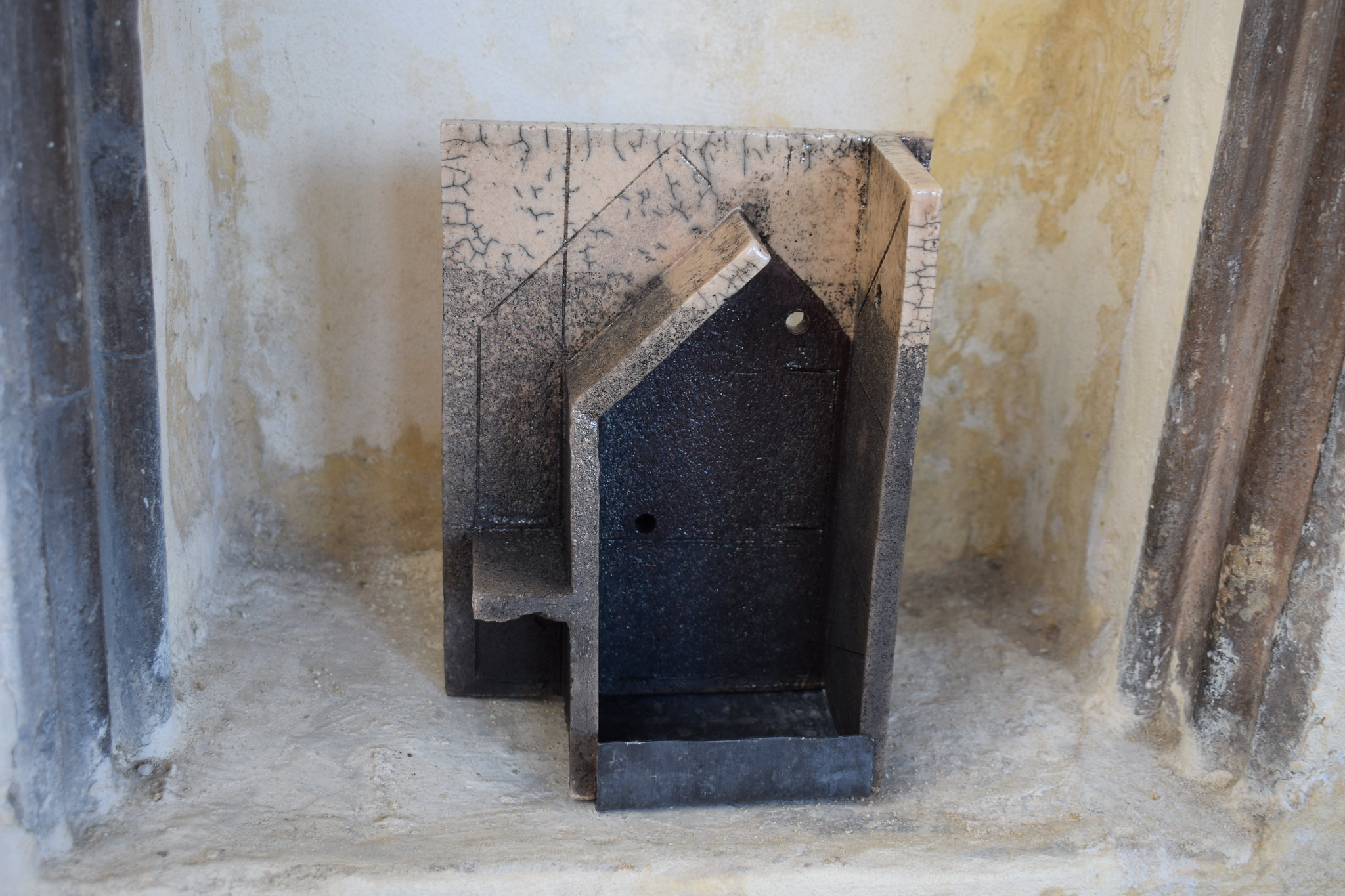
Hand Built, Slab Ceramics.

Oxide washes, incised lines and piercings undertaken to the raw clay forms.

Architectural Facades/Camera Obscura. 


Dark Room.
Garry Fabian Miller.

The internal mechanisms with which we see and experience visual and physical phenomena depend on a bottom-up approach. Building up from elements of abstraction, the opposite top-down approach of given figuration stifles necessary imagination.


Curiosity, imagination and enthusiasm all hold a power in the mind to ignite the creative act.

The Lake of The Mind.

Steven Holl.


Stochastic thinking suggests an interconnected ecosystem of architecture together with all of the arts to achieve new levels of correlation.lay