Showing posts with label archaeology. Show all posts

Friday, 19 June 2026

Hortus Conclusus : A Serious Place, Peter Zumthor, working ideas.

Hortus Conclusus : A Serious Place

01/04/2021


Hortus Conclusus : Enclosed Garden
Often translated as meaning “a serious place”
To construct a contemplative room, a garden within a garden.
Pavilion as both a monumental physical structure and as a site of emotional encounter.


With a refined selection of materials he has created a contemplative space that evokes the spiritual dimension of our physical environment, in so doing he is successfully emphasising the role the senses and emotions play in our experience of architecture. (Zumthor 2011: 15)
 
 
Enclosed all round and open to the sky.
A garden in an architectural setting.
“ Sheltered places of great intimacy where I want to stay for a long time.” (Zumthor 2011: 15)
 
Every plant name listed here evokes a distinct image; with each of them I associate specific lighting, smells and sounds, many kinds of rest, and a deep awareness of the earth and its flora.
 
A garden is the most intimate landscape ensemble I know of. In it we cultivate the plants we need. A garden requires care and protection. And so we encircle it, we defend it and fend for it. We give it shelter. The garden turns into a place.
 
There is something else that strikes me in this image of a garden fenced off within the larger landscape around it: something small has found sanctuary within something big.
(Zumthor 2011: 15)
 
 
Illustration of “Orchard” from Bible of Wenceslaus IV,Vienna, Austrian National Library
 
Depicts in the manner of an illuminated manuscript, the husbandry and community of the medieval workforce in the secure and sheltered space of a walled garden. This pastoral craft/gathering is evocative of Zumthor’s Hortus Concluses.
 
Working with ones hands, with the earth in sheltered spaces of a pastoral community.
 
Zumthor underscores this pastoral setting when he places a pavilion at the centre of the garden; he talks of future meeting there, of looking forward “to the natural energy and beauty of the tableau vivant of grasses, flowers and shrubs. I am looking forward to the colours and shapes, the smell of the soil, the movement of the leaves.” (Zumthor 2011: 15)
 
The Vintner’s Luck, Elizabeth Knox.
Tasting the soil in the wine, the soil and the wine are of the same substance, from the same locality; they are bonded together by the landscape.
 
Gardens Are Like Wells: Alexander Kluge
Inside every person (however serious or playful) lies an “enclosed garden”
 
Monasteries in medieval Europe were wells in which the clear waters of antiquity mingled with the dark waters of faith. At the centre of these monasteries was a garden, the most important part of which was enclosed. It was here that the most beautiful plants and medicinal herbs were concentrated. (Kluge 2011: 19)
 
Interestingly Kluge notes that these gardens were not everyday places, they were “timeless” because they were not subject to the general daily rituals of monastic life. These gardens were dedicated to the Blessed Virgin, but exposed perhaps to other texts, Homer, Ovid or the Gnostics. This relationship of literature finding a place of contemplation in the enclosed garden speaks perhaps of an “innerness”, an ability to unite mind and eye in the confusing realities of our age.
 
Civilisation and societies need ground that is uncultivated, gaps that are not subject to the principle of unity, something that is sufficient unto itself, which we do not consume: a sacrifice. Cities need spaces of piety. (Kluge 2011: 21)
 
“We need places in which we can engage in acts of mourning” Richard Sennett
(Sociologist)


Gardens of Information: DCPT (Development Company for Television Programmes)
 
 
Using the emblem of the Hortus Conclusus/The Enclosed Garden to stand for the relationship between the barren wastes on the one hand, and the happy isle on the other.
 
“To rescue facts from human indifference”
 
“To make gardens out of raw material and the bare bones of information.”
 
“A precursor of individualism, but has unmistakable traits in a way individualism never can.” (Kluge 2011: 21)
 
 
Spatial Practices for the Next Millennium.
 
Forming relationships not through superstructures, concepts or societies, but through inclusive structures/practices and localities. The Hortus Conclusus could stand for this type of concentration of identity (an inquiry, a person and a practice) within an intimate setting or situation.


Relationscapes : Open Systems/Speculative,Dynamic, Creative. An assemblage/energy of images,collage, drawing and texts and other disparate elements.

Thursday, 9 April 2026

Anthropological Concerns~Thing~Ties : The Social Life of Materials and Making

Creative Fictions/The Social Life of Thing~Ties.

Spatialities exploring dynamic inductive reasoning.


Making~Dissolution : Building Documents/Composite Bodies


Urbanism : Making Disorder

Urban Bodies : Disorder~Dwelling~Dissolution


Performing and Crafting Spaces.

Spatial Material : Making Learning Experiences~Holloways.


Vibrant Matter.

Studio Spaces : Undone by theory.


On Materiality~Ruination : Ceramics Of Scepticism.

Palimpsest Mapping, Site Occupations and Structures.

Scriptorium : Drawing~Listening~Reading : Spatial Document.

Listening Compositions~Bodies : Creative Matter(s)/Materialisms.


Friday, 13 June 2025

Cyanotype Drawings : Landscapes/Maps and Performative Drawings

Mapping Relationships : Contexts and Locations #2
Collage and drawing with cyanotypes, photographs, negatives and painted surfaces.

Mesh/Material/Light, Cyanotype Process
Cyanotype is a photographic printing process that produces a cyan-blue print. Engineers used the process well into the 20th century as a simple and low-cost process to produce copies of drawings, referred to as blueprints. The process uses two chemicals: ammonium iron(III) citrate and potassium ferricyanide.


The English scientist and astronomer Sir John Herschel discovered the procedure in 1842.[1] Though the process was developed by Herschel, he considered it as mainly a means of reproducing notes and diagrams, as in blueprints.[2] It was Anna Atkins who brought this to photography. She created a limited series of cyanotype books that documented ferns and other plant life from her extensive seaweed collection.[3] Atkins placed specimens directly onto coated paper, allowing the action of light to create a silhouette effect. By using this photogram process, Anna Atkins is regarded as the first female photographer.[4]

From Wikipedia, the free encyclopedia


The Cathedral : Place Studies

Pastoral Space: Material, Inquiry and Craft.#5

Material Agency : Carl Knappett, Lambros Malafouris
Visualising Environmental Agency
 
"Agents are defined as persons or things, which have the ability and intention to "cause" something "in the vicinity" or "in the mileau" to happen ( Gell 1998)"
"These latter artefacts are described with the term "index", to remove the appellation "art" and to imply that they are indexes of agency."
Some Stimulating Solutions, Andrew Cochrane.
 
Template and Form 2010.The Yard, Winchester.

Omslagsfoto : 

Landscapes from the Metropolis of Death. Otto Dov Kulka.

Mapping Relationships : Contexts and Locations #3
Collage and drawing with cyanotypes, photographs, negatives and painted surfaces.


Blueprint : Kengo Kuma, Sensing Spaces.

Panspermia : Cyanotype Drawing
Drawing on paper,150x240 cms
Full size human form drawn through "performance" on paper with cyanotype and black ink. Astronomical data and traces of seed heads together with reference material/notes (directed panspermia) in pencil.

Anthropomorphic and Botanical Cyanotype Drawing (Detail)
Botanical traces with leper graves


We live our lives sunk in vast forgetting. Milan Kundera, IGNORANCE.

Human mapping of social groups from the occupancy of the Winchester Cathedral "Space for Peace" 2011.
Mono Print : Cyanotype process on paper, 52x42cm.


Monday, 26 May 2025

LIVING Intensity : FRONTIERS OF ARCHITECTURE, Kirosan Observatory/Anti-Object/Anthropology/Art

040521

Anti Object

We are composed of matter and live in the midst of matter. Our objective should not be to renounce matter, but to search for a form of matter other than objects. What that form is called architecture, gardens, technology is not important. 

Kengo Kuma


Procedural Architecture

Start by thinking of architecture as a tentative constructing toward a holding in place. Architecture's holding in place occurs within and as part of a prevailing atmospheric condition that others routinely call biosphere but which we, feeling the need to stress its dynamic nature, have renamed bioscleave.

Architectural Body

Madeline Gins and Arakawa


LIVING : FRONTIERS OF ARCHITECTURE

Louisiana Museum of Modern Art.


Wang Qingsong : Dormitory, China, 2005


Key Words : Observatory, Camera Obscura, Living, Seeing, Intensity


BEHAVIOROLOGY ( the study of the combination of natural dispositions, social environment and personal experience)


Deals with the special atmosphere and character of the suburb. In film, literature and art the suburb often has an undertone of something mysterious, eerie, of events that are kept hidden.


The dual desire to see and to be seen leads to instability. An object may be made transparent, but it remains an object. And transparent, it is more thoroughly under observation and more thoroughly dominated. Conditions in the suburbs are in a sense even more wretched than those in the panopticon.

Kengo Kuma/Observatory/Anti-Object


Uchronia, Burning Man Festival, Nevada. 2006


Rouen Concert Hall and Exhibition Complex

Architectural Envelope/Heterogeneous Composite

Movement Vectors/Layers : Interior Concrete Skin/Visible Arches of the Steel Skeleton


Painting Space : Yellow ochre on white gesso over kraft paper

An Anthropology of Landscape

Christopher Tilley

Kate Cameron-Daum


Spirituality in Contemporary Art

The Idea Of The Numinous

Jingu Yoon


New Global Ecologies

Baratunde Thurston


INTENSITY : Portable Architecture as Parable. Mark Prizeman

The act of moving through mobile societies makes this transient architecture understandable.


A nomad uses what is to hand and able to be replaced or adapted.


The success of a tent depends on the exploration of an idea in the workshop by wandering through the dream and not being restricted by the finite parameters of a drawn representation of the future object.

Like explorers planning to venture into the unknown, an ability to imagine the consequences of what one takes and what one leaves behind is imperative.


ERASING :


Kirosan Observatory, Kengo Kuma

Observatories demonstrate the self-centred nature of human perception. They are generally objects, that is the core of the problem. I wondered if this observatory could be made transparent, that is, effectively erased, so minimising the damage to the environment.


In terms of erasing an object, the settin is more important than the choice of material. In this case, the setting was a summit that had already been levelled and turned into a perfect pedestal. Anything that is set on a pedestal becomes an object, regardless of what it is made of or how discreetly it is placed.

Most works of contemporary art are tiresome because they rely on this particular property of the pedestal.


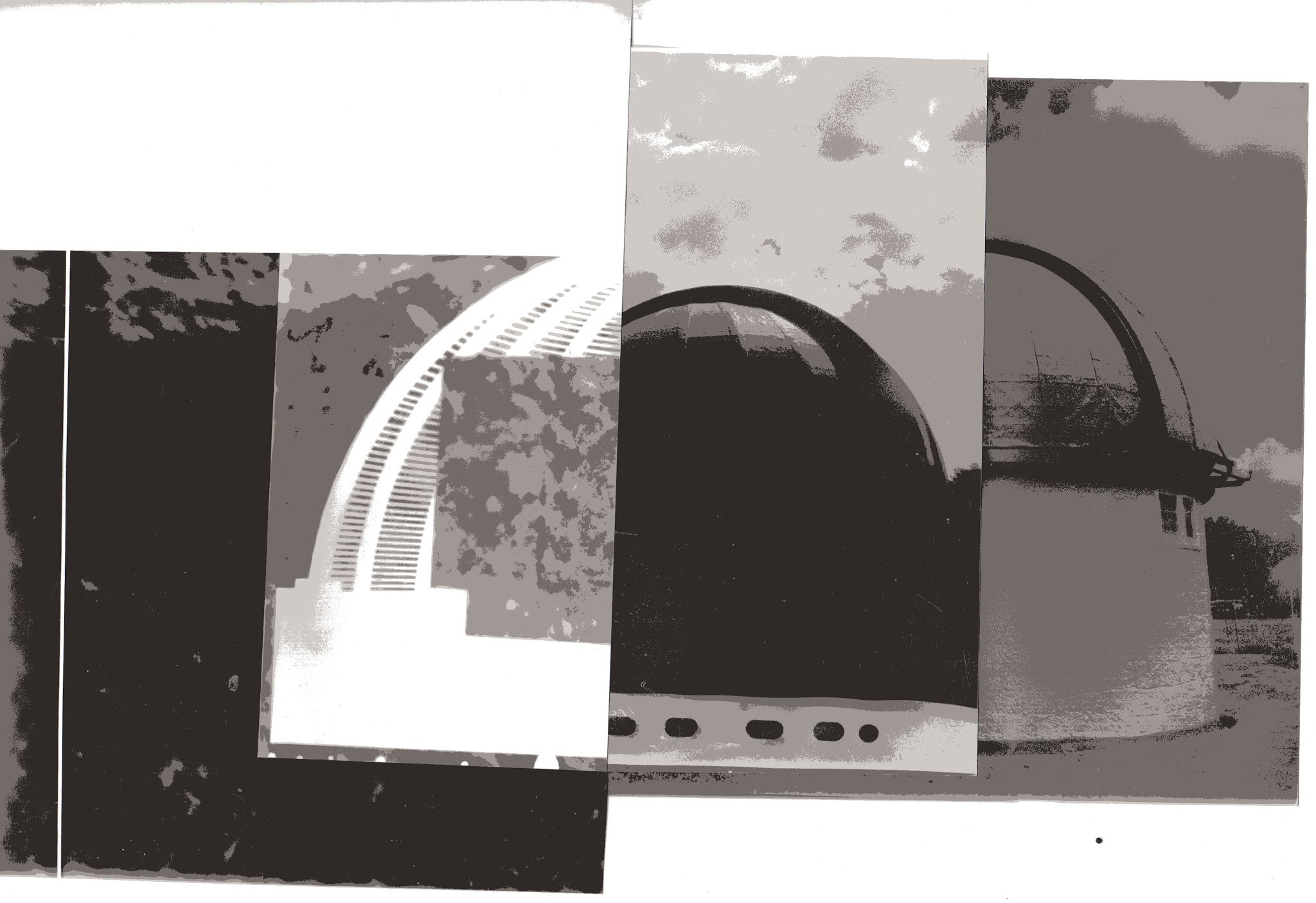
Observatory/Artists Outdoor Studio with astronomical 'Hortus Conclusus' /pavilion/segment built from the walled garden.


IMMATERIAL :

Layer upon layer of reality and image, the material and the immaterial, were thus overlapped. 

The Camera Obscura and Telescope, Dumfries. 1836

It is not quite clear what the real astronomical purpose of camera obscurae was, not only the Royal Observatory at Edinburgh but also the Royal Observatory at Greenwich still posses theirs, though dismantled and stored in cupboards for a century or more.


Paramatta Observatory, New South Wales, 1822

Sepia stained cyanotypes of architectural building plans


Plaster tabletop viewing screen, concave, chalk/matt surface

Lead weights on natural ropes used to control the apparatus


What I am most interested in now is inverting the structure of a culture that is centred around the city. The twentieth century was an age of industry, and an age in which everything from material goods, information and culture flowed from the cities to local towns and villages. Following the same vector, architecture, too, flowed out from the centre to the periphery.

Kengo Kuma


APPARATUS :


The Observatory is a facility for stealing looks at visitors


Electronic technology is used in these devices to expose the imperfection of vision and reverse its privileged status. Under ordinary circumstances, the seeing object is under the illusion that he/she dominates what they see. However, seeing also opens up the possibility of being seen. Anyone who dominates another through vision is always vulnerable to a brutal reversal.

High and Low, 1963. Akira Kurosawa


I therefore tried designing a transparent object. My real aim was not to create an object, but to choreograph a sequence of movements by the subject, that is, to create a device controlling his/her vision. Anti-Object, Kengo Kuma.

Your Chance Encounter, 2010. Olafur Eliasson


Messr Barr and Stroud, Optical Engineers, Glasgow, used to produce obscuras for industry, they were much cheaper to purchase and maintain in a large industrial establishment than closed-circuit television.


Saturday, 5 April 2025

Objects and Traces/Map Reading : Visual Archaeology/Anthropology in Social Space

The map fosters interpretation and exploration

Inseparable Attendant : Place and Process

Assemblage and blueprint : Site drawing/Leper Graves

Drawing figure/ground, documentation of work in progress.

Life "drawing" trace on paper with water and field chalk. Work submitted to Interfaith Group Show at the Link Gallery, Winchester 2010.

"This particular event invokes for me the notion of simple material relations and collaborative gestures that underpin human agency. Art space/practice can promote these working intimations."       Artist's Statement (archive)  07.12.2009.

Anthropological Landscape : Morn Hill, Winchester

Panspermia : Cyanotype Drawing
150x240 cms
Human form drawn on paper with cyanotype and black ink. Astronomical data and traces of seed heads together with reference material/notes (directed panspermia) in pencil.


180621