Showing posts with label Colin Renfrew. Show all posts

Saturday, 20 June 2026

Colour Sympathies~Modes of Existence


Visual Art Landing Site : A site of situated awareness.

Landing Site : Glass/Filtered Lightworks : Cleaving Collage.

Colour Sympathies~Modes of Existence.

Atmosphere~Landscape : Entanglements of Affect/Aesthetics.


The Poetics of Space. Gaston Bachelard.

The classic look at how we experience intimate places. 


The Eroded Steps. Giuseppe Penone.

Dean Clough Contour Lines.

Land Drawings, Installations, Excavations. Kate Whiteford.

Remote Sensing. Colin Renfrew.

https://www.flickr.com/photos/russellmoreton/


Sunday, 8 December 2024

Drawing The Body/Figure Event : The Luminescence Of Space.

Outpost 230323


Drawing, depicting something found through the process of making visible.


https://www.flickr.com/photos/russellmoreton/


The Luminescence Of Space.

An Archaeological Inquiry Into Drawing.

Correspondences/Reclaiming the drawings.


The Affect and Memory of Drawing.

To interrogate ways of seeing/looking, John Berger. 


The world of the creative practitioner promotes conditions, gestures and responses that articulate social, political and other theoretical findings which are all 'present' at the inception of the work.

Colin Renfrew.


The Myth of Butades.

Figure/Ground Relationships.


Theoretical Thought : Diagram and map.

Neo-Sumerian temple plan on clay tablet from c. 2100BC.


The drawing/work may take the form of the result of an act or action carried out at a specific time but which itself does not persist.


Art can be the expression in the material world of a concept, or the transformation into one material form of a structure that exists in another.


Drawing/Substance/Memory/Display.

The artist's creative act, is of a self amongst others.

Material/Thinking Matter.

Drawings mediated by the distance of memory.


Art Works, subtle embodiments, visual markers both spatial and sociological.


Life/Drawing/Figuring It Out.

The Luminescent Dematerialization Of The Subject.

Expressions Of Both Figuration And Abstraction.

Phenomenological approaches to Drawing/Looking/Others.


Demarcation/drawing boundaries/wayfaring/paths on the land, re The Making of Space.


Walking/Movement is quiet literally what made us human.


The walk is a 'mark' laid upon thousands of other layers of human and geographical history on the surface of the land. Bipedalism is the precursor to the evolution of a large brain, creative intelligence and language.

Richard Long/Colin Renfrew.


Charles Mausson.

Walking Man, No. 3. 1990.

Oil, crayon, 203.0 x 137.0 cm.


Starting from a subject or a simple figurative form, Charles Maussion sets of like an explorer, in search of unexplored lands, looking for something spiritual. It is through walking/drawing/thinking that one can remain human even while seeking out, and without even knowing it, finding it, or finding yourself in lands which are thousands of light years from our society, whilst nevertheless being very close to it. A calm, a loudness, that is extreme, beautiful.

Robert Combas. 1993.


The simple presence of a figure is sufficient to suggest the unity of the individual in a universe which is patiently observed and precisely apprehended. There is a complete absence of any compositional device suggested within the canvas, all that emanates is a climate of strangeness, serenity and disquiet. 

Sophie Dupont. 1995.


The blurring of the conventional distinction between the figure and the ground, so as to capture an atmospheric effect, which sought to approximate the murkiness of visual perception.

The legibility of the photographic image was denied by the process of blurring the image.

Paintings, abstract identities of surface and material, introducing content via a dematerialization, so as to engage in a process of pure vision, pure silence, reincarnated, vibrant, alive.

William Jeffett. 1995. 


Drawing on the consciousness and corporeality of others, of figural dissolution of the traditional figure/ground relationships, and fragmentation/blurring of the human form. The contemporary body and its environments are experientially brought into abstracted absences, corporeal traces of visual matter, movement and dissolving/reappearing forms.


Figural Expressions.

Figural dissolution of a nude descending a staircase, Marcel Duchamp.

Stop-motion photography of the human body in motion, Etienne Marey.


Figural, paintings/drawings not as representations of tangible subjects, but as registers of a more abstract range of emotions, as a series of studies, always incomplete and never finished, a work in progress. The nude/ the human body has become mediated by the mechanical effects of photography and the distance/blindness of memory.


Notations.

Contemporary Drawing as Idea and Process.

Fred Sandback.


The Drawing Room.

The Secret Theory of Drawing.


Jim Dine.

Figure Drawings, 1975-79.


The Drawings of Richard Diebenkorn.

John Eldenfield.


Manuel Neri.

Drawings/Relief Sculptures.


Naked To Nude.

Life Drawing in the Twentieth Century.

Georg Eisler.


Sunday, 6 August 2023

Ecology of Life/Energies between things

 Outpost 180523


Wandering Lines.

Material : The Ways/Movements of Practice.


https://www.flickr.com/photos/russellmoreton/


An ecology of life, in short must be of threads and traces, not of nodes and connectors, and its subject of inquiry must consist not of the relations between organisms and their external environments, but of the relations along their severally enmeshed ways of life.

Tim Ingold.


Learning in the making.


Processual learning that occurs in movements, gestures, postures, expressions and exchanges with other bodies and things.


A caring curiosity that wants to know,understand and explore relations.


We need to live the consequences of non-stop curiosity inside a mortal situated, relentlessly relational worlding.

Donna Harraway.


Practices that do engage in the complexities and contingencies of corporeal experiences, ie partners-with-things.


Space-Enfolding-Breath.

Inhabiting the Wall, 1992-93.

Monica Wyatt.


Monica Wyatt asks what it means to occupy architecture, not just ordinary interior spaces but also those that are inaccessible, such as a wall and its poche. Acting as a physical limit, a wall is a boundary that cannot be traversed without an opening, but the reality of a wall's thickness and the peculiar desire to be in a wall inform Wyatt's curiosity about occupying this space.


When educating architects and interior designers, the question is often resolved by expanding the wall's thickness to contain programmed space, or left behind as a space deemed unoccupied. Wyatt does not give in to either direction. Rather, she looks to the wall, entering it to find answers to these questions.


Wyatt uses poetric interpretations of poche and interior space to produce these unconventional mappings. The result is a map and a body wrapped with wallpaper, where body and wall share the same material. Wyatt finds an entry point into the wall, through a map of the body that also reinserts the body back into the wall.

Lois Weinthal, 2011.


To define a wall : What is a wall?


The questions are phenomenological and psychological, attempting to account not only for the physical presence of the wall itself but for how it is there for her.


Like Wyatt's own body, walls have fronts and backs, interiors and exteriors. They can separate and bind, and they also possess the point of view of an other from which one is viewed. For Wyatt the wall is ambiguous: even though it presents itself as a physical limit to her body, it provokes the desire to move beyond its bounds. Her confessed desire to 'get into the wall,' to escape from the physical limits of the surroundings so that she may see herself from the other side. 


Wyatt desires to be simultaneously in both places, impossible if one accepts the materialist proposition that two bodies cannot occupy the same space at the same time. She desires, however to make this possible, to conceive of a situation in which space and material become intertwined, as if consciousness and body were intertwined with in the space of a fold.


In the end Wyatt entered the wall through a logic that allows for multiple faces of consciousness. It is possible to occupy a wall only if we accept that we are present for others as well as for ourselves. By projecting ourselves into another's point of view, we construct a space within which being is defined and constituted. 

Dan Hoffman, 1994. 


The architecture and public spaces of the built environment enclose and contain. Yet the structures that confine, channel and contain are not immutable. They are ceaselessly eroded by tactical manoeuvring of inhabitants whose 'wandering lines' (de Certeau) undercut the strategic designs of societies master builders causing them gradually to wear out and disintegrate.


For inhabitants, however the environment comprises not the surroundings of a bounded place, but a zone in which their several pathways are thoroughly entangled. In this zone of entanglement, this meshwork of interwoven lines. There are no insides or outsides, only openings and ways through.

Up, Across and Along, Tim Ingold.


Architectural Body.

Organism-Person-Environment

Arakawa and Gins. 


Ambivalences : Hostile/Intimate Relationships.

Reclining Figures and Wall Reliefs.


There is also something of the ambivalent sensualist stirred by a mixture of passion and hostility that both caresses and abrades the surface it touches.

In the hand of Manuel Neri, Marcia Morse.1983. 


Francesca Woodman.

then at one point I did not need

Camouflage.

Neil Leach. 


St Peter Hungate.

Conceptual/Corporeal Frameworks

Visual Art Facility/Making/Curation.


As the work interacts with the body of the observer the experience mirrors these bodily sensations of the maker. Consequently, architecture is communicated from the body of the architect directly to the body of the inhabitant.


Understanding architectural scale implies the unconscious  measuring of an object or a building with one's body, and projecting one's bodily scheme on the space in question. We feel pleasure and protection when the body discovers its resonance in space.


The sense of gravity is the essence of all architectonic structures and great architecture makes us conscious of gravity and earth. Architecture strengthens verticality of our experience of the world. At the same time architecture makes us aware of the depth of earth, it makes us dream of levitation and flight.


In memorable experiences of architecture, space, matter and time fuse into one single dimension, into the basic substance of being, that penetrates the consciousness. We identify ourselves with this space, this place, this moment and these dimensions as they become ingredients of our very existence. Architecture is the art of mediation and reconciliation.

Juhani Pallasmaa.


Like mothers of men, the buildings are good listeners. Long sounds, distinct or seemingly in bundles, appease the orifices of palaces that lean back gradually from canal or pavement. A long sound with its echo brings consummation to the stone.

Adrian Stokes.


Initial works made and manifested through entanglements of practice/making/place.

Slab, box, extrusions/industrial/handbuilt, flue linings, corten architectural  models.


Water/Anchorages between the sacred and the secular.

Cell-Court-Domain

Body-Water-Air


Piscina in the south wall.

Squint into the nave and tower.


Clay-Water-Fire

Five clay slab fabrications exploring intimate spaces, notion of inhabitation/anchorite within social/sacred space.


Art/Spiritual Space.

Ambivalences/Uncertainties/Paradoxes

Something Endures between The Made/Un Made.

Raw Clay Construction, lead tray, water.


The Hungate : Ambient Atmosphere/Precarious Situation/Fragile Structure and Social Relationship.


Water (secular) both corrodes/penetrates the structure, and water (sacred) caresses/comforts the soul.


White slip/emulsion paint/ yellow ochre.

Nocturnal sounds/long sounds as reminders of human solitude and mortality


Parallax.

Steven Holl.


The Eyes Of The Skin

Architecture and the Senses.


When working, both the artist and craftsman are directly engaged with their bodies and their existential experiences rather than focused on a external and objectified problem. In our imagination, the object is simultaneously held in the hand and inside the head, and the imagined and projected physical image is modelled by our bodies. We are inside and outside of the object at the same time. Creative work calls for a bodily and mental identification, empathy and compassion. A remarkable factor in the experience of enveloping spatiality, interiority and hapticity is the deliberate suppression of sharp, focused vision. 

Juhani Pallasmaa.


Figuring It Out.

The Parallel Visions Of Artists And Archaeologists.

Colin Renfrew.


Life-Class/Drawing.

The Impossible Nude.


Figural Floor Drawings.

Drawing/Wayfaring : Traces and trails over and amongst the landscape of the body.

The surface takes on a strongly sculptural sense of being moulded, modelled, abraded and yet caressed.


Thursday, 29 June 2023

Earthbound : Alternative Processes/Art/Archaeology/Philosophy

 The Archaeological Site : Speculative Fields/Spatial Practices

What are we? Art/Archaeology.

Contact Photography.

Historical Presence #4


Figuring it out.

What are we?

Where do we come from?

The parellel visions of artists and archaeologists.

Colin Renfrew.


Do you live as Humans in the Holocene or as Earthbound in the Anthropocene? (50.37)


Dr. Bruno Latour on climate change and the "Anthropocene": Wall Exchange, Fall 2013


Studio Practices
Silver Gelatin
Cyanotype
Drawing
Liquid Light


Sunday, 18 June 2023

Spatial Diffractions : Architectures of Exclusion

 Outpost 280922


Peripheral Vision : Relationality.


Categories and things may make it easier for us to grasp reality, but they also hide its underlying complexities.

Robert Cooper, 2005.


Developing a constitutive nature within practices.


Qualitative Reseachers.


Entangled practices are productive, and who and what are excluded through these entangled practices matter, different intra-actions produce different phenomena.


It is in and through an understanding of these entangled practices presented by Barad that we can begin to understand how diffractive readings can help us in our work as qualitative reseachers to produce knowledge differently.


Interactions Matter.

Spatial Agency.


Walking 

Wayfinding in the City.


Thinking intra-actively.


Thinking with Barad's intra-action helps us fashion an approach that re-inserts the material into the process of analysis. It is a reclaiming of the material absent in its modernist limitations. It is the work of Karen Barad and other named as 'new materialists, or material feminists' to ask how our intra-action with other bodies (both human and nonhuman) produce subjectivities and performative enactments.


Such questioning shifts our thinking away from how performative speech acts or repetitive bodily actions produce subjectivity, but also how subjectivity can be understood as a set of linkages and connections with other things and other bodies, both human and nonhuman.


The Discursive Text/Material.


Phenomenology is interested in the now, what we see, how we perceive, and how those perceptions shape or come the world that is constitutive both of our environment and us.


The Keatsian concept of negative capability, that of being with uncertainty, of seeking to transcend and revise contexts, to reject constraints and open up dialogue as a throughfare for all thoughts, to ask questions and develop empathy.

John Keats 1795-1821.


Local artists and writers respond to the University of Winchester's

Magdalen Hill Archaeological Research Project.


On-site, co-directors Dr Simon Roffey and Dr Phil Marter talk about process.


A negative, destructive archaeology of taking away, of context sheets for a cut (negative) or a deposit (positive): how the processes are physical and sensory as well as interpretative, how their work is forensic, piecing together, visceral, more instinct than intellect, tactile and haptic, sculptural, revealing, never final, and as much an art as a science.


The Parallel Visions of Artists and Archaeologists.  


The artist's role here is to bring their own kind of knowledge setting aside logic and reason, to use the imagination and senses, to express through body and mind, the self, the messiness and uncertainty evoked by these material traces, mystery and wonder.

Colin Renfrew, Figuring It Out, 2003.


Spatial Diffractions in Interior Design.


A final diffraction is to think about how the office space itself creates a diffraction.


The office door, the opening, the threshold, can be viewed as the place through which waves pass, creating a diffraction.


This diffraction passes both ways: in inviting those who enter and those who fail to enter.


This opening further serves to reconstitute the office door as a threshold to be crossed, or as a threshold that welcomes. One invites, the other excludes.


We presented examples of how Sera and Cassandra were produced differently through intra-actions with office space, other bodies, clothing, and furniture, and similarly how their entanglement with these material fixtures resulted in a mutual constitution of the material and discursive.


It is through an enactment of a diffractive analysis and a re-thinking of our relationship to/with data, and to/with the material in our research sites, that we see much productive potential for research methodologists.


Project Spaces/Presentations.


Diagrams, maps and charts are all a symbolic depiction that emphasises mapping relationships.


Keywords: Agency, Spatial Agency, Practice, Making, Architectural Body,Relational Movements,Outreach, Urban Walking, Interactions, Cultivation Field,  Foraging, Finding, Gathering, Harvesting, Organism, Person, Environment, Anthropology, Archaeology, Art, 

Friday, 21 April 2023

Drawing Into The Human Form/The Architectural Body

 Drawing Into The Human Form.


Its conceptual frameworks, aesthetics and contexts.


Inclusions/Enclosures/Involuntary Mappings and Erasures.


Figuring it out, sensuality through making the drawing heard.


Drawing from a blindness, a memory of seeing.


Derrida.


Drawing into the perspectives and  sociological relationships of the Architectural Body, organism/person/environment.

Gins and Arakawa.


Explanations/Gestures of Looking and Mark Making.


Scale/Proximity/Seeing Distance/Situatedness/Environment/Art Work.


Haptic Seeing/moving over the surface of the sociological subject.


Frottage, life drawings with involuntary textures and marks derived from their particular locality and working methods, concrete floors, wooden floorboards, graphite sticks, charcoal, pencil and wax crayons.


The body and its nakedness becomes the instrument of our emotions and our sensuality.


The Psychology of Nakedness.


Naked to Nude, Life Drawing in the Twentieth Century.


Georg Eisler.

Wednesday, 1 March 2023

Figuring it out : Display and Process : Conceptual Frameworks/Contexts

 Outpost 010323


https://www.flickr.com/people/russellmoreton/


The Parallel Visions of Artists and Archaeologists.

Figuring It Out.

Colin Renfrew.


Archaeologists/Artists, intuitively working with materials that are local and quotidian.

New insights into the way humans use things/people/the earth.


Encounters.

Art as archaeology, archaeology as art.


What is Art.

The tyranny of the renaissance.


Off the plinth.

Display and process.


The human condition.

Being and remembering.


The (al)lure of the artefact.


Baneful signs.

The archaeology of now.


Figuring it out.

The Indexical Body.

Corporeality/Aesthetics.

Contemporary Fine Art/Working from/with the body


Francis Bacon.

The figural body.


Manuel Neri.

The sculptural body in relief.


The Body/Spatial/Temporal

Rituals/Places/Vessels

Awareness/Repetition/Ritual can give meaning to existence.


What Are We?

Where Do We Come From?


The Anthropology of Art.

Constructed as a theory of agency or of the mediation of agency by indexes understood/conveyed through material entities which motivate/create inferences, responses and interpretations.


For Gell, art is not 'axiomatic' about a 'matter of meaning communication' but rather it is about doing that is theorized as agency in a process involving indexes and effects. Art, its actions and their effects are similarly not discrete expressions of individual will, but rather the outcomes of a mediated practice in which agents and recipients are all implicated in complex 'participations, ways of relations and their diffractions.


Artists/Prototypes/Things/Recipients/Affect/Generative Relations.

Practical Experience/Cognitive Knowledge/Analysis.


Art and its complex participation/phenomena is distributed by an agent with other agents, the artist attempts to distribute elements of their own efficacy amongst others. 


Artists are those who are considered to be immediately causally responsible for the existence and characteristics of indexes, artists/a person both distributed and implicated may also be vehicles of the agency of others.

Alfred Gell. 


Conceptual Frameworks/Context


Axes of Coherence/Indexes/Formal Analysis/Repetition/Improvisation. 


Resultants that incorporate the friction/asperity of their trajectories through a medium.

Tilt-up concrete construction, Chapel of St Ignatius, Seattle, Washington, USA.

Steven Holl.


Cathected, Aesthetic Phenomenon, Aesthetic Causality, Sensual Object, Allure,


The Projects.


Hungate.

Water, niche, Priscina, font, vessel, grounding body/spirit, apparatus, scaffold, un-doing of Place, Site, Reading the existential qualities of architectural spaces into the corporeal/haptic body, plaster, lime, canvas, whitewash, yellow ochre, water becomes a sacred conduit running through the architectural body.


Raveningham. 

Ground Marking, ceramic spheres, Fontana, clay/raku. Movements/Durations on grass to leave temporal traces. String line, shadow sticks, involuntary markers, found objects, collected phenomena,  


Undercroft Anglian Potters, Norwich.

Ferini Gallery, Lowestoft.

Tuesday, 21 February 2023

Drawing passages in the ecology of experience : Disappearances opposed by assemblages of evidence

Outpost21022

Drawing passages in the ecology of experience.

The Silent Room.

Silence/Intimacy/Reading.


Drawing is about following/keeping up with a form/becoming in life.


What shall I do next?

The entwining of ever extending trajectories.


I was asking you: where are we when we draw? The question seems to be expecting a spatial answer, but mightn't it be a temporal one? Isn't the act of drawing as well as the drawing itself, about becoming rather than being? 


Isn't a drawing the polar opposite of a photo? The latter stops time, arrests it; whereas a drawing flows with it. Could we think of drawings as eddies on the surface of the stream of time?


From each glance a drawing assembles a little evidence, but it consists of the evidence of many glances which can be seen together. On the one hand there is no sight in nature as unchanging as that of a drawing or a painting. On the other hand, what is unchanging  in a drawing consists of so many assembled moments that they constitute a totality rather than a fragment. The static image of a drawing or painting is the result of the opposition of two dynamic processes. Disappearances opposed by assemblage. If, for diagrammatic convenience, one accepts the metaphor of time as a flow, a river, then the drawing, by driving upstream, achieves the stationary.


John Berger 1926-2017.


Improvisation is to join with the world or to meld with it. One ventures from home on the thread of a tune.

Deleuze and Guattari.


Points are not joined so much as swept aside and rendered indiscernible by the current/energy as it sweeps through.


Life is open-ended, its impulse is not to reach a terminus, but to keep on going. The plant, the musician or the painter in keeping going, hazards an improvisation.

Tim Ingold.


Moments of shared physical and bodily intensities in the enactment of constructions, activities and inhabitatations.


Drawing/movements into transitions articulated with gaps and spaces for improvisation and the incorporation/corporeality of the quotidian and the unexpected. 


Francis Bacon, The Human Figure.


Figuring it out, Colin Renfrew.


The assemblage/collaged/choreographic object works to keep us attentive and entangled/engaged in the world.


LiAi:

Laboratory of immediate architectural intervention.

The workshops/laboratory demonstrated how architecture could be about encounters in space, sensitive material tectonics and social urban exploration, engagement and transformation.


Saturday, 4 February 2023

Processual Drawing : Bioscleave/Blue Particle Cloud/Diagram.

 https://www.flickr.com/people/russellmoreton/


ARCHITECTURAL Body
An ORGANISM that PERSONS
Gins and Arakawa 2002

Although the human condition is a crisis condition if ever there was one, few individuals and societies act with the dispatch a state of emergency requires. The fact that the human condition is a crises condition gets routinely covered up, with culture invariably functioning to obscure how dire the condition is and to float it as bearable

If organisms form themselves as persons by uptaking the environment, then they involve not only bodies but domains, spheres of activity and influence 

Start by thinking of architecture as a tentative constructing toward a holding in place. Architecture's holding in place occurs within and as part of a prevailing atmospheric condition that others routinely call biosphere but which we, feeling the need to stress its dynamic nature, have renamed bioscleave
Procedural Architure/Architectural Body 
Gins and Arakawa

The role of architecture as a tool for researching the body-environment towards the implementation of these considerations is paramount
The goal of an experimental teaching and learning space based on architectural procedures would be that the process of design and construction would allow students/staff to rethink, re-imagine and enact the curriculum
An Arakawa and Gins Experimental Teaching Space/A Feasibility Study 2013
Jondi Keane

An Architecture of Viability
To help to sustain one throughout life/ to stay tentative
Bioscleave House as an inter-active laboratory of everyday life 

Wayfinding (unpacking discourse/meaning) through Landing Sites and Architectural Bodies
What is the metachallenge that bioscleave demands of us? Is it, I propose, wayfinding, a wayfinding defined at many scales from finding one's way as a person to finding one's way in a strange physical or social environment
Exploring the Roles of Trajectoriness, Affectivatoriness, and Imaging Along 2013
Reuben M. Baron


Figure/Ground : Double Occupations of Discourses and Events (relationships/co-existances)
So as a diagram (performative agent), the figure/ground does not function to represent even something real. But rather constructs a real that is yet to come (theoretical object/apparatus) as a new type of reality
Situated Field/Constructed Site of People, Institutions, Apparatuses, Events, Discourses

We see intraventions as heuristic devices, as apparatuses that are imbued with a will to transform.
The intravention is not autonomous but contingent and relational and dependent on many other things
The intravention is made as it happens, and it makes us at the same time
Immediate Architectural Interventions, Durations and Effects
Oren Lieberman, Alberto Altes

AEffect initiating Heuristic Life
Procedural architecture, developed in both their written and buillt discourse, providing a process by which to connect theory to practice, disciplinary inquiry to knowledge and art to life
Research should be conducted , not in a library or laboratory but where living happens, enabling the complexity of relationships to be studied within and across the organism-person-environment 
Jondi Keane


Carnal Knowledge
Towards a New Materialism through the Arts
Estelle Barrett, Barbara Bolt


To provide observational heuristic devices so that persons may devise transformational and reconfigurative opportunities

Heuristic tools whether built hypothesis or discursive sequences, are of no use if they do not provide a way forward, a way of learning

This house is a tool, a procedural one
A functional tool, whether it be a hammer, a telephone, or a telescope, extends the senses, but a procedural tool examines and reorders the sensorium

Interlude : Cornering a Beginning
An object becomes the threshold for thinking feeling
Relationscapes : Movement, Art, Philosopy
Erin Manning 

Born into a new territory, and that territory is myself as organism. There is no place to go but here. Each organism that persons finds the new territory that is itself, and having found it, adjusts it

Ellipsis,(gaps in everyday narratives) 
The Construction of Representation of Identity
Using their bodies and immediate surroundings and environment as both subject and context
An Organism-Person-Environment
You cannot see me from where I look at myself
Francesca Woodman

An organism-person-environment has given birth to an organism-person-environment
Bioscleave

Chaos, Territory, Art
Deleuze and the framing of the earth
Elizabeth Grosz

Body, Personal Relations, Spatial Values
Upright Human Body : Space and Time
Yi Fu Tuan

Figuring It Out
The Parallel Visions of Artists and Archaeologists
Colin Renfrew

The act of relating is analysed as a constitutive feature of human agency. Relating is viewed as the continuous work of connecting and disconnecting in a fluctuating network of existential events
Categories and things may make it easier for us to grasp reality but they also hide its underlying complexities
Relationality 2005
Robert Cooper


Wednesday, 9 June 2021

Drawing/Openings and Conclusions/Collages for the Reading Room : Heuristic/Discursive/Practical/Agency

Ordinary things contain the deepest mysteries


On the horizon, then, at the furthest edge of the possible, it is a matter of producing the space of the human species-the collective (generic) work of the species-on the model of what used to be called "art" ; indeed, it is still so called, but art no longer has any meaning at the level of an "object" isolated by and for the individual.

Henri Lefebvre, Openings and Conclusions. from On Installation and Site Specificity (introduction) Erika Suderburg


Is there still an aesthetic illusion? And if not, a path to an “aesthetic” illusion, the radical illusion of secret, seduction and magic? Is there still, on the edges of hypervisibility, of virtuality, room for an image?

Jean Baudrillard : The Conspiracy of Art, 2005


The Social Condenser in Operation.

Five figures and a stature distributed evenly in its isotropic space; a picture of the socialized as opposed to the sociable.

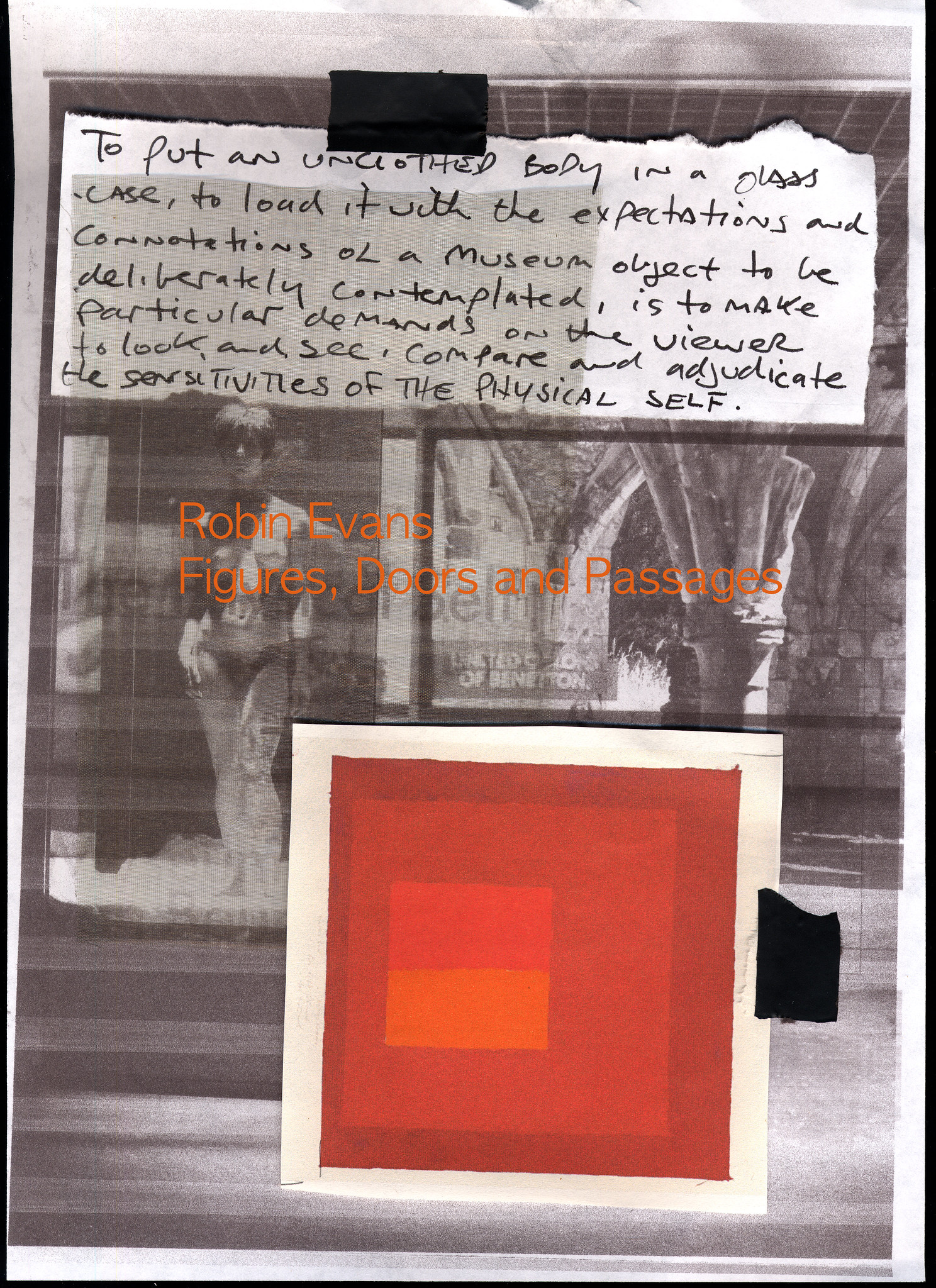
Robin Evans : Figures, Doors and Passages.


A Hut of One's Own : Ann Cline

Texts, Annotations, Foundations, Pathways, Corridors, Bookmarks, Walking, Thinking, Ramble, Cross Country, Disciplines, 

Collage on paper, written fragments and images from Peter Greenaway, Josef Albers and Robin Evans. Photo montage of The Physical Self (Greenaway) and Waverley Abbey UK. 

Visual research as part of The Waverley Project/Obscura and Reading Room. 

A heuristic technique (/hjᵿˈrɪstᵻk/; Ancient Greek: εὑρίσκω, "find" or "discover"), often called simply a heuristic, is any approach to problem solving, learning, or discovery that employs a practical method not guaranteed to be optimal or perfect, but sufficient for the immediate goals.


Sunday, 29 October 2017

Research Notes : Matters of The Mind/ Contemporary Art Practices

Information Processing and Performance in Traditional and Virtual Teams
The Role of Transactive Memory. Terri Griffith, Margret A. Neale
Research Paper No. 1643

Transactive Memory : A Contemporary Analysis of the Group Mind. Daniel M. Wegner.

Prehistory/Making of the Human Mind. Colin Renfrew. 2007

The Mind In The Cave. David Lewis-Williams. 2004
The Matter of Mind, Cathedrals of Intelligence/Steven Mithen

The Poetics of Space. Gaston Bachelard. 1958

The Poetics of Reverie, Childhood, Language, and the Cosmos. Gaston Bachelard. 1960


A particular cosmos forms around a particular image as soon as a poet gives the image a destiny of grandeur. The poet gives the real object its imaginary double, its idealized double. This idealized double is immediately idealizing, and it is thus that a universe is born from an expanding image.

O silence round like the earth
movements of the mute star
gravitation of fruit around the clay nucleus
May no one wound the Fruit
it is the past of joy which is becoming round.

Jean Cayrol
Reverie and Cosmos.175

The sun has gone mad and stripped the earth of its ionosphere. For decades blasting radiation has poured upon earth, melting the polar caps and turning permafrost into streams, rivers, oceans. Huge deltas have been built, lakes formed, seas have risen.

The Drowned World, JG Ballard.


Biosphere (Ecology and Entropy) Cyanotype Drawing.


Thursday, 28 January 2016

Russell Moreton Openings and Conclusions 6


https://uk.pinterest.com/russellmoreton/

Collage on paper,written fragments and images from Peter Greenaway, Josef Albers and Robin Evans. Photo montage of The Physical Self (Greenaway) and Waverley Abbey UK.Visual research as part of The Waverley Project/Obscura and Reading Room. 

On the horizon, then, at the furthest edge of the possible, it is a matter of producing the space of the human species-the collective (generic) work of the species-on the model of what used to be called "art" ; indeed, it is still so called, but art no longer has any meaning at the level of an "object" isolated by and for the individual.

Henri Lefebvre, Openings and Conclusions. from On Installation and Site Specificity (introduction) Erika Suderburg