Showing posts with label anti-object. Show all posts

Friday, 18 July 2025

Spatial Bodies/Visual Art Practices : Material Assemblages/Drawing : Cultivation Fields/Thinking Diffractively

Matter(s) of Inquiry : Abject(ion) Gathering Affective Energy.

Affective Formulation : Processual/Durational Material Flows/Mattering Matter(s).

Transitional Compositions and Events/Anti-Objects. 


‘We are composed of matter and live in the midst of matter. Our objective should not be to renounce matter, but to search for a form of matter other than objects. 

What that form is called-Architecture, Gardens, Technology- is not important.’
Kengo Kuma.


On Anti-Object : An extended essay that is not so much history or theory as a volume of self-assessment that gives an opportunity for the author to contextualise his own body of work through considered self-reflection.

‘A monument is a form that preserves time through the compression of space, a form in which visual perception is the parameter. A monument is a compression of time and space’ (Kuma,2008:92) Anti Object.

‘My purpose in writing this book is to criticise architecture that is self-centred and coercive.’ Kengo Kuma.

‘Like McTiernan or the theorist Paul Virilio, Kuma sees new digital and information technologies as leading us to an aesthetics of disappearance, rather than image or form.(Steele,2008:3)

‘My ultimate aim is to erase architecture’(Kuma,2008:3)
How then, can architecture be made to disappear?


Monday, 16 June 2025

Kengo Kuma, anti object, hut, poetics of shelter in the immediate environment.

Thinkers and Vessel Makers.
Weaving the body into architecture
Kengo Kuma

Poetics as an evolving and discursive system of dialogues that acknowledges environmental changes, of other spatial narratives and histories, and things that are not just about place and space.


‘The phenomenology of space – the matter of how we experience it.’


Raveningham Sculpture Trail : Spatial Garden/Dwelling with the Landscape.


Hungate Exhibition. 2023.
Making felt through intervals/editing from within.
The Scriptorium 
Performative Canvas as Shelter ( prearticulation for an installation, not used) 


Gaston Bachelard, Poetics of Space (space and reverie), The Psychoanalysis of Fire.


‘Architecture that forces us to confront our own spatial intelligence by moving us so much that we recall the eidetic origination of our own mental space.’ (Schaik,2008:80)

‘Speculations about the first shelters, the relationship between our home and the universe, about spaces that we first use as surrogate houses as we form our spatial histories and our mental space. It is about the contemplative effects of the miniature, about the paradoxical way in which the scale of many of our most cherished monuments can switch in our minds from large to minute- the quality of intimate immensity. It is also about propositions around the complex relationships between inside and outside and the surface between, about the phenomenology of roundness’ (Schaik,2008:86-87)

‘We are composed of matter and live in the midst of matter. Our objective should not be to renounce matter, but to search for a form of matter other than objects. What that form is called-Architecture, Gardens, Technology- is not important.’
Kengo Kuma.

On Anti-Object : An extended essay that is not so much history or theory as a volume of self-assessment that gives an opportunity for the author to contextualise his own body of work through considered self-reflection.
‘A monument is a form that preserves time through the compression of space, a form in which visual perception is the parameter. A monument is a compression of time and space’ (Kuma,2008:92) Anti Object.

‘My purpose in writing this book is to criticise architecture that is self-centred and coercive.’ Kengo Kuma.

‘Like McTiernan or the theorist Paul Virilio, Kuma sees new digital and information technologies as leading us to an aesthetics of disappearance, rather than image or form.(Steele,2008:3)

‘My ultimate aim is to erase architecture’(Kuma,2008:3)
How then, can architecture be made to disappear?


‘To be precise, an object is a form of material existence distinct from its immediate environment. I do not deny that all buildings, as points of singularity created by humankind in the environment, are to some extent objects. However, buildings that are deliberately made distinct from their environment are very different from those that attempt to mitigate this isolation, and the difference is perceptible to everyone who experiences them.’ (Kuma,2008:Preface)

Art and The Humanities in reference to Waverley Abbey
Contemporary Art Practices, Installations and Interiors


This research and its design proposal are centred on the arts and the humanities and their ongoing function in our contemporary society. The emphasis of this inquiry is located by the spatial practices of architecture, fine art and performance. My project is a field event and symposium that would be able to host intellectual dialogues, lectures (TED) workshops, performative events and exhibitions. I am particularly interested the relational production of social spaces and the aesthetics of builtspaces, both historical and ephemeral. The proposed use of Waverley Abbey near Farnham as a possible site and retreat for this venture is valid as it links a possible interdisciplinary territory of anthropology, archaeology, art and architecture. Tim Ingold (Making) Colin Renfrew (Figuring it Out) and others have for many years been researching and mapping this new spatiality.

What remains of Waverley Abbey and its sense of place are critical to the holistic and contemporary underpinning of this experiential event. Founded in 1128 it was the first Cistercian Abbey to be built in England. It is recorded that Cistercian life was initially based on manual labour and self-sufficiency, this was further supplemented by other activities like agriculture and brewing that enabled the abbey to support itself. Later over the centuries education and academia began to dominate the concerns of the abbey. The abbey was suppressed with its dissolution in 1536, although records show its activities were already at this time substantially diminished. The ruins and their site then enter into the imaginary realm through classic literature in the novel Waverley by Scott. Further on a pictorial reference from an engraving shows the ruins now incorporated as a fashionable landscape feature within the newly built Waverley Abbey House.

On a contemporary note Waverley Abbey has featured in a number of films ranging in genres from period costume dramas through to fantasy, together with post apocalyptic visions of dystopia. A recent film shoot required the construction of a sixty-foot tower made from internal scaffolding with a skin that recreated the adjacent ruinous fabric of this historic site.

Encountering the site is currently only manageable by foot; this short walk in the surrounding landscape sets up the sense of place and prepares our own subjectivities to its reception. It is in this expectation, this thinking in the landscape that the pastoral and educational aspects of the site become apparent. Currently access is only available through one directed pathway; a multiplicity of other access points and even other structures (bridges, earthworks and thickets) could begin to open up the spatial palimpsest already located at Waverley. What remains of the architectural fabric with its diminished interiors still grants a hospitality and refuge for both the body and the imagination. This activity opens up the experiential space of encountering ourselves through the enjoyment/entanglements of layered social space.


Waverley Abbey is a public monument in the custodian care of English Heritage. It can only be accessed by walking about a quarter of a mile from the limited parking spaces.  


Monday, 26 May 2025

LIVING Intensity : FRONTIERS OF ARCHITECTURE, Kirosan Observatory/Anti-Object/Anthropology/Art

040521

Anti Object

We are composed of matter and live in the midst of matter. Our objective should not be to renounce matter, but to search for a form of matter other than objects. What that form is called architecture, gardens, technology is not important. 

Kengo Kuma


Procedural Architecture

Start by thinking of architecture as a tentative constructing toward a holding in place. Architecture's holding in place occurs within and as part of a prevailing atmospheric condition that others routinely call biosphere but which we, feeling the need to stress its dynamic nature, have renamed bioscleave.

Architectural Body

Madeline Gins and Arakawa


LIVING : FRONTIERS OF ARCHITECTURE

Louisiana Museum of Modern Art.


Wang Qingsong : Dormitory, China, 2005


Key Words : Observatory, Camera Obscura, Living, Seeing, Intensity


BEHAVIOROLOGY ( the study of the combination of natural dispositions, social environment and personal experience)


Deals with the special atmosphere and character of the suburb. In film, literature and art the suburb often has an undertone of something mysterious, eerie, of events that are kept hidden.


The dual desire to see and to be seen leads to instability. An object may be made transparent, but it remains an object. And transparent, it is more thoroughly under observation and more thoroughly dominated. Conditions in the suburbs are in a sense even more wretched than those in the panopticon.

Kengo Kuma/Observatory/Anti-Object


Uchronia, Burning Man Festival, Nevada. 2006


Rouen Concert Hall and Exhibition Complex

Architectural Envelope/Heterogeneous Composite

Movement Vectors/Layers : Interior Concrete Skin/Visible Arches of the Steel Skeleton


Painting Space : Yellow ochre on white gesso over kraft paper

An Anthropology of Landscape

Christopher Tilley

Kate Cameron-Daum


Spirituality in Contemporary Art

The Idea Of The Numinous

Jingu Yoon


New Global Ecologies

Baratunde Thurston


INTENSITY : Portable Architecture as Parable. Mark Prizeman

The act of moving through mobile societies makes this transient architecture understandable.


A nomad uses what is to hand and able to be replaced or adapted.


The success of a tent depends on the exploration of an idea in the workshop by wandering through the dream and not being restricted by the finite parameters of a drawn representation of the future object.

Like explorers planning to venture into the unknown, an ability to imagine the consequences of what one takes and what one leaves behind is imperative.


ERASING :


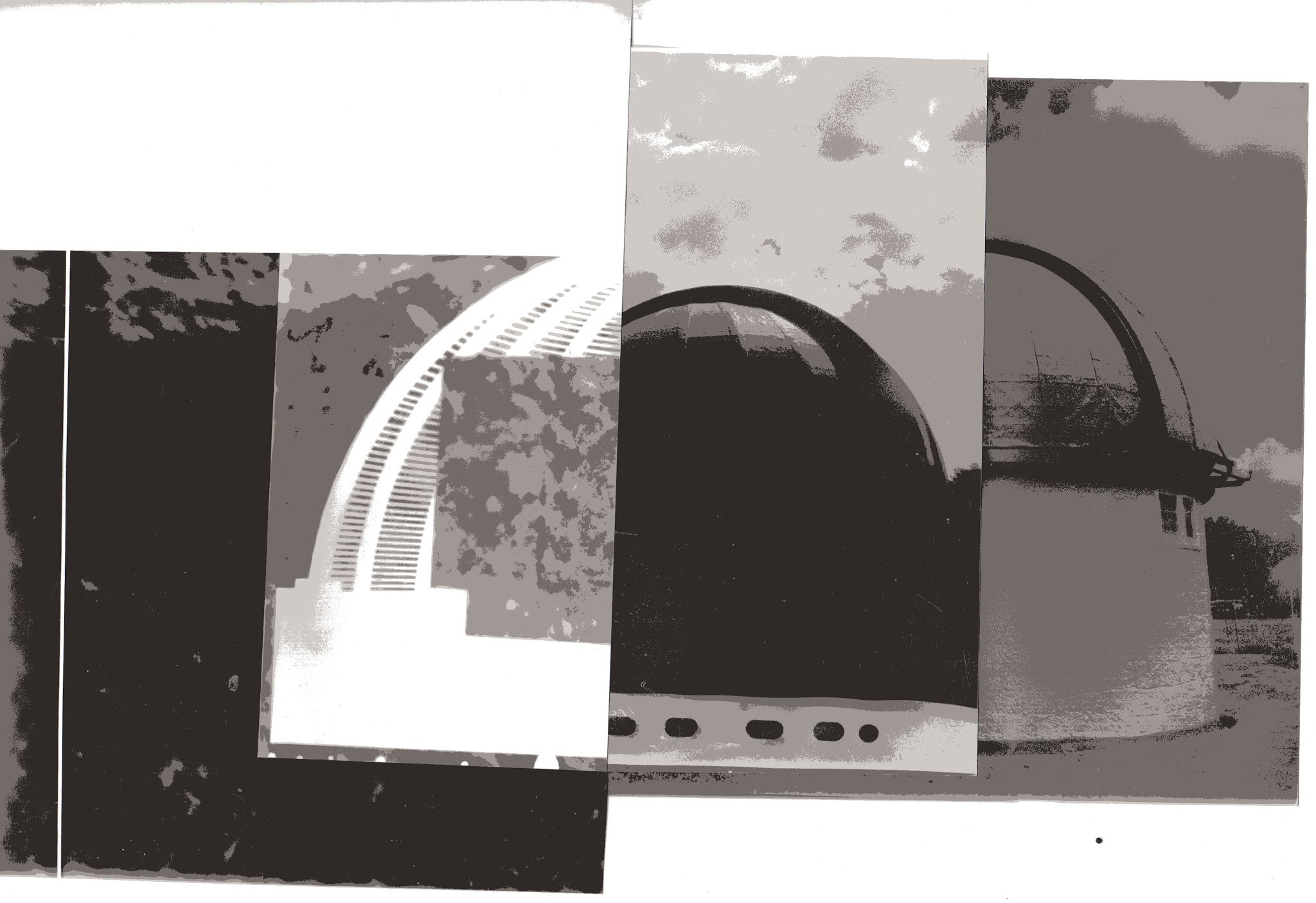
Kirosan Observatory, Kengo Kuma

Observatories demonstrate the self-centred nature of human perception. They are generally objects, that is the core of the problem. I wondered if this observatory could be made transparent, that is, effectively erased, so minimising the damage to the environment.


In terms of erasing an object, the settin is more important than the choice of material. In this case, the setting was a summit that had already been levelled and turned into a perfect pedestal. Anything that is set on a pedestal becomes an object, regardless of what it is made of or how discreetly it is placed.

Most works of contemporary art are tiresome because they rely on this particular property of the pedestal.


Observatory/Artists Outdoor Studio with astronomical 'Hortus Conclusus' /pavilion/segment built from the walled garden.


IMMATERIAL :

Layer upon layer of reality and image, the material and the immaterial, were thus overlapped. 

The Camera Obscura and Telescope, Dumfries. 1836

It is not quite clear what the real astronomical purpose of camera obscurae was, not only the Royal Observatory at Edinburgh but also the Royal Observatory at Greenwich still posses theirs, though dismantled and stored in cupboards for a century or more.


Paramatta Observatory, New South Wales, 1822

Sepia stained cyanotypes of architectural building plans


Plaster tabletop viewing screen, concave, chalk/matt surface

Lead weights on natural ropes used to control the apparatus


What I am most interested in now is inverting the structure of a culture that is centred around the city. The twentieth century was an age of industry, and an age in which everything from material goods, information and culture flowed from the cities to local towns and villages. Following the same vector, architecture, too, flowed out from the centre to the periphery.

Kengo Kuma


APPARATUS :


The Observatory is a facility for stealing looks at visitors


Electronic technology is used in these devices to expose the imperfection of vision and reverse its privileged status. Under ordinary circumstances, the seeing object is under the illusion that he/she dominates what they see. However, seeing also opens up the possibility of being seen. Anyone who dominates another through vision is always vulnerable to a brutal reversal.

High and Low, 1963. Akira Kurosawa


I therefore tried designing a transparent object. My real aim was not to create an object, but to choreograph a sequence of movements by the subject, that is, to create a device controlling his/her vision. Anti-Object, Kengo Kuma.

Your Chance Encounter, 2010. Olafur Eliasson


Messr Barr and Stroud, Optical Engineers, Glasgow, used to produce obscuras for industry, they were much cheaper to purchase and maintain in a large industrial establishment than closed-circuit television.


Monday, 24 July 2017

Alan Watts - Full Unedited Version of 'Conversation with Myself'


We are composed of matter and live in the midst of matter. Our objective should not be to renounce matter, but to search for a form of matter other than objects. What that form is called-architecture,gardens,technology- is not important. Anti-Object : Kengo Kuma

Friday, 7 July 2017

Anti Object : Kengo Kuma

We are composed of matter and live in the midst of matter. Our objective should not be to renounce matter, but to search for a form of matter other than objects. What that form is called-architecture,gardens,technology- is not important. Anti-Object : Kengo Kuma