Showing posts with label traces. Show all posts

Tuesday, 23 June 2026

Primordial Memory/Dreaming/Making/Corporeality : Antony Gormley/Francesca Woodman/Bodies/movements of becoming.

Concept of the Body : Merleau-Ponty

Fundamental assumption that the body was not an object, the body is the condition and context through which I am able to have relations with objects. 

The mind in its insertion in (creating/becoming) corporeality creates the ambiguous relation with our body, and correlatively with perceived things/superimpositions/entanglements.

Understanding the material/body image in discursive terms


https://www.flickr.com/photos/russellmoreton/

The body generates and presumes interpretations, perspectives which serve its needs in the world, its will to power and its drive towards self expansion/self overcoming, the movement of becoming, vigorous, free, joyful activity. (Nietzsche)


Francesca Woodman explores the spatial relationship of the body in space and time.

These performative images and her relationship to the pictorial space, her body traces, are witnessed and further manipulated/annotated by drawn lines enclosing and creating other spaces.


Barad: Thinking with intra-action

There is an important sense in which practices of knowing cannot fully be claimed as human  practices,  not simply  because we use nonhuman  elements in  our practices but because knowing is a matter of part of the world making itself intelligible to another part. Practices of knowing and being are not isolable; they are mutually implicated. We don’t obtain  knowledge by  standing  outside the world; we know because we are of the world.  We are part of the world  in  its differential becoming.  The separation  of epistemology from ontology is a reverberation of a metaphysics that assumes an inher­ent difference between  human  and  nonhuman,  subject and  object,  mind  and  body, matter and discourse. Onto epistemology—the study of practices of knowing in being— is probably a better way to think about the kind of understanding that we need to come to terms with how specific interactions matter.

Karen Barad, Meeting the Universe Halfway: Quantum Physics and the Entanglement of Matter and Meaning (Durham: Duke University Press, 2007), 141.


Antony Gormley, states, that one of his central concerns has been to recover a sense of being in the conditions of today's increasingly materialist and mediated social environment. He uses sculpture, via the intimate process of the body cast, to construct surrogate forms, derived from an almost sacrificial process. A rehearsal of death of an absent body, recorded as an enclosed volume of air, entombed in a lead sarcophagus of fragmented body sections, soldered to reconstruct a new wholeness. He creates, within this sculptural volume, an “infinity of space within the body.” His works are embodiments of the body. They are literally body cases. The use of lead with its own alchemical and historical contexts and its particular non­ aesthetic further adds to the tomb like qualities of the work. 

Each sculpture invites occupation; it is complete when the imagination or the mind inhabits them.

Gormley’s body cases are almost orphans, cast adrift from their symbolic maternal mother. They have become shells; empty humanoid spaces, awaiting an identity in the mind of the post-modern witness. In return their identification identifies the witness. The experience of metaphysical inhabiting this surrogate human space might allow us to lose all sense of the present and our identity with ourselves. Gormley’s sculptures, with this lack of identity or questioning of identity with the space they are placed in, prompt a different mode of questioning the purpose of their presence. The viewer becomes more interrogatory, more concerned, almost asking the sculpture to confirm its placement, not its actual identity. We see in them something of ourselves, externalised for scrutiny, a dialogue of intervention caused by a bodily proximity to something unknown, which can compound meaning, or conversely it can fragment it. 


An investigation into a disembodied physicality, inducing elements of fetishism and narcissism, with the search for an identification of the feminine, within the confines of spaces, loaded with tactility, dust, dilapidation and decay?

Some of  Francesca Woodman’s work involves herself and female characters in staged film, feminised melodrama. Stills with an unknown and possibly convoluted narrative, together with ambiguous relationships amongst the characters. The images are shot as straight documentary stills and seem to be searching for the identity of the partially hidden women, as seen through the response and body language of the other characters facing us. These works are full of conceptual ambiguities.

Photographs are indexical; they point to something else; a mirror with a memory; a stage for an inquiry.

Francesca Woodman’s use of the camera’s ability to witness and document, is subverted into a personal language of aggressive tactility and the notion of the body’s identification being partially hidden or even lost; just its trace remains recorded in the latency of the camera’s recorded time.

Her work seems to have an inherent almost codified, femininity, probably due the semiotics and symbolism of early surrealist influences. She performs, re-enacts and exposes her body for the witnessing of the camera. She seems to, fleetingly, seduce and then disappear, just leaving a trace of her being, her sexuality and its actions, entrusted to the fragility of the light sensitive gelatin.

 (extracts from The Body, Francesca Woodman and Antony Gormley, WSA Russell Moreton 2006)


Reading The Landscape

This Enchanted Isle : Peter Woodcock 2000

Radio On by Chris Petit.

The film has a hallucinogenic noir-like quality, a weird hybrid of Fifties Americana and a displaced Britain. It is a seismographic disruption of British culture in a limbo land of displaced dreams, elements of an almost mythical Britain fleetingly appear.


What distinguishes Neo-Romanticism from traditional romanticism is the feeling of danger, the juxtaposition of the urban with the countryside, the element of darkness, dissolution, an almost pagan reverie breaking through the ruins of post-industrialism (Woodcock,2000:55)


England Dreaming : Primordial Memory/Dreaming

The darkness is a silent solid, the light etches its surface, it is simultaneously sign and cypher. The light etching itself on the dark surface is akin to a revelation, an epiphany before the building is transformed by its users and movement. (Daniel Libeskind)

The Drought : J G Ballard

The Tempest : Alchemy, Prospero.

The Neo-Romantic Vision from William Blake to the New Visionaries. 

‘A new alchemy is being formed which encompasses traditional methods of art, the new technology, and the revolutionary new scientific discoveries.’

Re-Enchanting the Land. (Woodcock,2000:140)

‘When one lacks outer space one creates inner space. Invention becomes more complex, cup and circle markings on stones, intricate Celtic spirals and knots, illuminated manuscripts, gothic architecture with its inherent story telling.’ (Woodcock,2000:131)

Throughout John Piper’s long and prolific life he remained fascinated not only with churches, country houses and landscapes but also ancient sites. He comments on the landscape of Snowdonia, each rock lying in the grass had a positive personality, for the first time I saw the bones and the structure and the lie of mountains, living with  them and climbing them as I was, lying on them in the sun and getting soaked with rain in their cloud cover and enclosed in their improbable, private rock-world in fog. Piper never dismissed the archaic spirit of place.  

(Woodcock,2000:31)


To take a picture is to have an interest in things as they are in the status quo remaining unchanged. It is to be in complicity with what makes a subject interesting.

Cameras consist of small voids, the ‘camera’, a lens and photographic film. They are camerae obscurae  that collect light and allow it to meet the surface of the film. But in fact the light comes from the larger void outside the camera. The moment the light has registered on the light-sensitive surface of the film, memories are constructed. The memory is literally conceived in this meeting and is added to life as an additional layer of being. The process through which void meets surface is therefore also about love—the love of ancestors and relatives, but also of life and its conception.

The camera records subjects considered disreputable, taboo and marginal. Sontag notes Times relentless passage and photographs as a pause of evidence, Together with the camera’s ability to turn people into objects that can be symbolically possessed. She recognizes the inherent pathos in .objects being photographed, and the compulsion to take photographs. Sontag realizes the photographic recycling of reality, acceptable as a daily activity in our consumer society. Photographs do not explain themselves, they just acknowledge.

Bibliography

Bachelard, Gaston, Psychoanalysis of fire, New York, Beacon press 1964 

Benjamin, George, Antony Gormley: critical mass, London, Royal Academy of the Arts 1998 

Curtis, Penelope, Sculpture in 20th Century Britain, Leeds, Henry Moore Institute 2003

Deneuve, Catherine, Bettina Rheims, Munchen, Schirmer-mosel, 1989 

Douglas, Mary, Purity and Danger, London, Ark Paperbacks, 1984 

Gormley, Antony, European Field, Museum of Modem Art, 1994 

Greenaway, Peter, The Physical self, Rotterdam, Museum-Boymans, 1992 

Israel, Deborah Turbeville: Wallflower, London, Quartet, 1978 

Karabelnik, Marianne, Stripped Bare, London, Merrell, 2004

Krauss, Rosalind, L ’Amour fou, New York, Abbeyville, 1985 

Moszynska, Anna, Antony Gormley Drawing, London, British Museum, 2002

Sollers, Philippe, Francesca Woodman, Paris, Foundation Cartier, 1998 

Solomon-Godeau, Abigail, Francesca Woodman, Photographic work, New York, Hunter College, 1996

Thewelt, Kllaus, Antony Gormley, Germany, Kerber Verlag, 1999 

Articles

Riches, Harriet, A disappearing Act; Francesca Woodman’s portrait of a reputation, Oxford Art Journal, 27.1 2004 95-113, Oxford university press

Rus, Eva, Surrealism and self-representation in the photography of Francesca Woodman, www.palazzoesposizioni.it/schede/woodman, 2004


Tuesday, 20 August 2024

From One Place to Another : Contained Inner Spaces/Systems.


Outpost 220724

Thus we cover the universe with drawings we have lived. These need only to be tonalized on the mode of our inner space.

Gaston Bachelard.

The Poetics of Space.


Art is energy.

Graham Gussin.


We take ...our everyday external reality very much for granted: the room that we sit in, the streets around us, the virtual space of billboards, and movies and TV ... we take all this for granted. But in fact it is, literally speaking, an illusion generated by our central nervous system. It's as much a virtual reality as the one the cyber people are working on ...Within our minds all these different planes of spatial reality are intersecting.
J.G. Ballard, KGB 7, KGB Media, 1995

All of Graham Gussin's work engages in some way with the human experience of the infinite. He is conscious that our perception and understanding of the world is manipulated and transformed by a complex layering of mass communications and consumer culture. Often his work suggests a sense of displacement, playing on our desire to be somewhere else, in a different time or space.

He has been particularly influenced by science fiction, especially of the sort that presents a set of circumstances requiring resolution, such as H.G. Wells's The Island of Doctor Moreau, or touches on what J.G. Ballard has described as the 'internal landscape',

Any Object in the Universe relates to a romantic tradition of landscape, together with the idea of a uropian space which is often explored in these types of science fiction.

Much of Gussin's work is experiential, dependent on the viewer for its completion. In Beyond the Infinite of 1994, for example, the artist appropriated a scene from Stanley Kubrick's film 2001: A Space Odyssey. He edited and displayed two film loops of the same scene, one slightly longer than the other so that one loop appears to wait for, or follow, the other: 'The shorter loop has the spaceman wandering around the hotel, endlessly looking for himself. The longer loop includes not only this search but also the discovery of himself as an old man', Kubrick's narrative sequence is effectively disrupted. Standing between the two monitors, the viewer becomes a conductor of time and space between the two scenes.

States of mind seem to be the main subjects of Gussin's work, conditions or states that might be, for example, associated with the sublime, the sense of awe and wonder that takes one out of oneself, But it is the failure to find the sublime moment that he appears to linger on. In Fall (7200-1) he deals very literally with the agitated state of expectation, Confronted by a large video projection of an unspectacular landscape the viewer stands on the edge of it waiting for something to happen, Suddenly the tranquility and emptiness of the landscape is disturbed by something falling dramatically out of the sky, shattering the still surface of a lake: 'I like the idea that Fall embodies the possibility of this thing happening without anybody seeing it. The splash occurs infrequently so the subject of this piece isn't really the disturbance- rather it's the possibility of it happening'.

The idea for Any Object in the Universe stemmed from a short story by Edgar Allen Poe, A Tale Of The Ragged Mountains, which the artist summarises as follows: 'The whole text is a vision ...there is a character who takes a lot of opium and coffee. He then goes for a walk and slips into a previously unrecognised region within his geographic locality. Within that second or parallel space he dies, but somehow returns to tell the tale of his death in that space. When his tale is complete he dies in real space and time. So it's a kind of closed loop, returning in and out of and being effected by two parallel spaces, an illusory space that becomes so powerful that it results in death'.

A similar notion of slipping between two spaces underlies Any Object in the Universe. Walking in to a darkened room the viewer steps on to a slightly raised floor, each step producing an electronically generated echo. The walls are clad with what appears to be sound-proofing material. Projected on to one wall is an image of the same room, empty but for a microphone on a stand. Confusingly, the echo appears to be coming from the fictional, projected space. 'What at first seems to be an echo chamber becomes a space where sound cannot escape, a trap of some kind.' The viewer, like the echo, seems to be caught between a real and an imaginary space.

The other fictional space that influenced Gussin's making of Any Object in the Universe is the sound- proofed capsule depicted in Nicolas Roeg's 1976 film The Man Who Fell To Earth, a capsule where, as Gussin describes it, 'all sound is deadened and disappears ...It's an enclosed, very precise and exactly measured space, but also an infinite space ...In the film David Bowie falls to earth. The whole film is a struggle against gravity, ...about him attempting to get back into the sky, which he doesn't achieve'. Commenting on his use of an image from the cinema screen the artist has said, 'I like the way that filmic space spills out into reality'.

As if standing in front of a painting by Mark Rothko, or on the 'beam-me- up' platform in Star Trek, we stand on the raised floor, waiting for something to happen, desiring to be transported in some way to another dimension. The artist explains: 'What I was interested in trying to do was to place the viewer in the space that is projected, just for a split second, so that it makes him or her disappear from the space he or she is standing in to occupy that space, even just for the blink of an eye ...That's where the work really lies, in that momentary confusion of not being able to tell'.

Alongside Any Object in the Universe Gussin shows a number of black and white line drawings. Like the installation, these Drawings of Nothing and Nowhere explore how we experience space. The rectangular shapes seem to hover on the surface of the paper yet perspectivally they disappear towards a central vanishing point. As familiar as the introductory credits for Pearl and Dean advertising that prepare audiences for the immersive space of cinema, they ask the viewer to think about location, about their position in time and space. The drawings cannot succeed in the aim suggested by their title, instead they draw attention to the way we attempt to articulate and measure both internal and external space.

Text written by Virginia Button

https://www.tate.org.uk/whats-on/tate-britain/art-now-graham-gussin


From One Place to Another.

From Another System.

Contained Spaces/Systems.


It's true, I know, that there are more gaps in the island than there used to be. When I was a child, the whole place seemed ... how can I put this? ...a lot fuller, a lot more real. But as things got thinner, more full of holes, our hearts got thinner too, diluted somehow. I suppose that kept things in balance. And even when that balance begins to collapse, something remains. Which is why you shouldn't worry.

Yoko Ogawa.

The Memory Police.


Things oriented in time present themselves to us as irreversible phenomena.


Drawing, traces that create the intermediate spaces of perception.

Visual traces of both the macroscopic and microscopic phenomena/memory/of matter.

Art is all about energy (free energy from one system/person to another)


Durational/Immediate Matters of Concern/Media.

Things/Correspondences in their propositional state of becoming.


Developing the creative liberty with a conceptual structure. This development grows through analogy and recombination. Making an analogy involves taking an aspect of a concept and re-using it in another context, preserving something of its original meaning, while letting something else go. In such a way that the resultant combination produces new and effective meaning.

Carlo Rovelli.


Drawing as an analogically informing process.

Architectural/Conceptual Frameworks.

Making Immediate Spatial Relations/Situatedness.


What Remains?

Why Does It Remain?

The intermediate/immediacy space of drawing as the traces of disequilibrium. 


The formation of every trace is nothing other than an intermediate step towards equilibrium. 


If the present has traces of the past it is solely due to the disequilibrium of that past. It is for this reason that we remember the past not the future. Because of the disequilibrium in the past, we know the past, because there are traces of it in the present, in our memories for example. To say that the past is determined is to say no more that we have traces of it. It is not a direction intrinsic to time that makes the past knowable, determined.


What we call the past is how things were arranged at one point in time.


It is the disequilibrium of the past, only that, that gives rise to traces.


A meteorite that falls on the moon carries free energy with it, its crater is the trace that it leaves until the incessant unravelling of things erases it. In this intermediate phase, the crater is a trace of the impact/event, a memory of it. Only traces exist in this intermediate period. 


The same goes for a photograph, for the memory in our brain, it exists thanks to the fact that free energy has arrived in a system, the camera film, our brain, from another system that was not in equilibrium with it, and the fact that it takes time for equilibrium to be re-established.


White Holes

Carlo Rovelli.


Notes

36. The low entropy of the past is the ultimate source of all the information contained in every trace or memory.

37. The distinction between causes and effects has no meaning in the microscopic description of phenomena. At the microscopic level of things there are regularities, physical laws, and probability and these notions do not distinguish between past and future. The distinction between past and future is a property of history of the universe from the variables that we call macroscopic, it is only for this reason that we can speak about causes.


Gaston Bachelard never developed a metaphysics capable of unifying his reflections on science and poetry.


Much that our powers here cannot sustain is permitted there.

We fly to the other side of space and of time.


The equations of quantum gravity describe a world more complex than a simple spatiotemporal continuum.


Monday, 19 June 2023

Anthropological Settings : Drawings/Photograms and Intermediaries


Found Objects : Archaeological Photogram

When you make photograms, without the use of a camera, you can indeed call that abstract photography, as the lens and the corresponding registration medium are lacking. No longer do you have pictures of reality or objects; you only have their shadows. It is a bit like Plato’s cave, where one could only imagine reality; the objects themselves were not visible.

Thomas Ruff

Archipelagic : Solar Drawing/Circumpolar Star Chart

Sociological Gathering : Winchester Cathedral/Space For Peace

Blueprints : Anthropological Forms/Botanical traces with leper graves


Saturday, 4 February 2023

Maternal Body/Dwelling Place : Clay Impression and Fragmented Form/Raku Beaker Form

Auguries into the maternal body. Un-fired clay and silica sand.

Constructed in-situ at the Yard, Winchester. A life-size record and memory of a human presence as a site for mutual introspection.

 Inspired in part from the novel  " The  Children of Men "  by P D James.

Artist Statement/Chapel Arts Residency 2010

Practitioner using the creative receptiveness of material together with the inclusion of drawing to harbour transits and passages of human presence, vulnerabilities centred around the human condition. My work adopts strategies which articulate a sense of absence and anonymity within the abandonment of the work to its location. I feel drawn to this registering of passage, encounter together with its farewell. The choice of materials gathered together implies a personal geography, with both an emotional and aesthetic sense of locality and place. The performative recording by physical means which renders itself as a trace of human presence, now becomes a vacant territory open for the consideration of others.
My work continues to investigate this sense of material response with the performative trace of a human absences. The place-ment of these acts attempts to promote thresholds from which to reflect upon spatial, sociological and psychological conditions and perceptions.
Currently working in clay, low fired to produce and promote a fragile vessel. This vessel is installed to act as a dwelling presence reverberating in a resting place. from which work is drawn into the human form to register a surface of absences resulting from past gestures and solitudes.

Russell Moreton a visual artist uses simple gestures of drawn Human traces gathered and presented amongst natural materials. Exploring themes around the Human condition, vulnerability and abandonment. Materials are employed to further underpin our sense of place and time. The act and gesture of drawing adds a ephemeral mark amongst the materiality and locality of place. Currently using clay to register these themes, installing work Augury Vessel into Chapel Arts as part of their research residency programme.


Thursday, 26 May 2022

Sun Prints : Blue Works/Drawings into the Photographic Surface


The sun has gone mad and stripped the earth of its ionosphere. For decades blasting radiation has poured upon earth, melting the polar caps and turning permafrost into streams, rivers, oceans. Huge deltas have been built, lakes formed, seas have risen.

The Drowned World, JG Ballard.

Cell
Court
Domain

Botanical traces with leper graves

Drawing into the photographic process
Dynamic/Affective Cyanotypes

Biosphere (Ecology and Entropy)
Architectural Blueprint
Archipelagic Architectures
Blueprints : Anthropological Forms
Cyanotype : Architectural Drawing


Wednesday, 10 November 2021

The Mirrored Abbey : Anamorphic Photographic Process

The Custodians, Richard Cowper 1976.
russellmoreton.wordpress.com/

russellmoreton.tumblr.com/archive

Humanity : An Emotional History
Stuart Walton. 2004

Fear
Anger
Disgust
Sadness
Jealousy
Contempt
Shame
Embarrassment
Surprise
Happiness

Friday, 26 February 2016

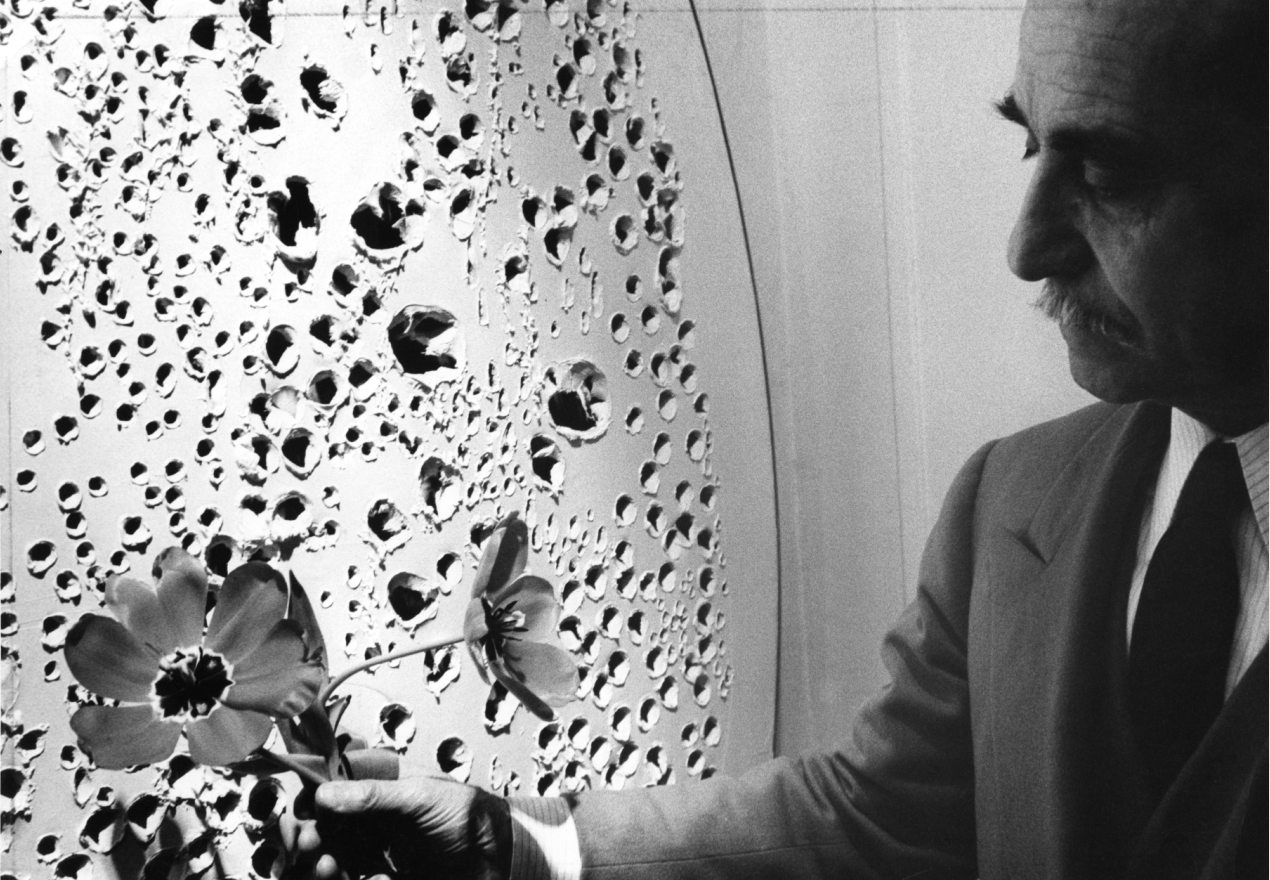
Lucio Fontana : Beyond The Picture

"There is no stage at which "man" does not demarcate, beacon or sign his space, leaving traces that are both symbolic and practical."

Lefebvre, The Production of Space, 


My art rests wholly on this purity, on this philosophy of nothingness, which is not a nothingness of destruction, but a nothingness of creation. And the cut, or properly, truly, the hole, the first holes, was not the destruction of the picture. The formless gesture … was precisely a dimension beyond the picture, the freedom to conceive art through any medium, through any form. —Lucio Fontana 
 The Italian artist born February 19, 1899 in Rosario, Argentina. 
__________ 
Image: Lucio Fontana at his exhibition opening, Galerie Iris Clert, Paris, 1964, Photo by Shunk-Kender, © Fondazione Lucio Fontana http://russellmoreton.tumblr.com/post/139739887062/gagosiangallery-my-art-rests-wholly-on-this

Wednesday, 15 May 2013

Panspermia 2010

Panspermia 2010 by Russell Moreton
Panspermia 2010, a photo by Russell Moreton on Flickr.


Panspermia 2010

Drawing on paper,150x240 cms
Full size human form drawn through "performance" on paper with cyanotype and black ink. Astronomical data and traces of seed heads together with reference material/notes (directed panspermia) in pencil.