Showing posts with label Arakawa. Show all posts

Monday, 26 May 2025

LIVING Intensity : FRONTIERS OF ARCHITECTURE, Kirosan Observatory/Anti-Object/Anthropology/Art

040521

Anti Object

We are composed of matter and live in the midst of matter. Our objective should not be to renounce matter, but to search for a form of matter other than objects. What that form is called architecture, gardens, technology is not important. 

Kengo Kuma


Procedural Architecture

Start by thinking of architecture as a tentative constructing toward a holding in place. Architecture's holding in place occurs within and as part of a prevailing atmospheric condition that others routinely call biosphere but which we, feeling the need to stress its dynamic nature, have renamed bioscleave.

Architectural Body

Madeline Gins and Arakawa


LIVING : FRONTIERS OF ARCHITECTURE

Louisiana Museum of Modern Art.


Wang Qingsong : Dormitory, China, 2005


Key Words : Observatory, Camera Obscura, Living, Seeing, Intensity


BEHAVIOROLOGY ( the study of the combination of natural dispositions, social environment and personal experience)


Deals with the special atmosphere and character of the suburb. In film, literature and art the suburb often has an undertone of something mysterious, eerie, of events that are kept hidden.


The dual desire to see and to be seen leads to instability. An object may be made transparent, but it remains an object. And transparent, it is more thoroughly under observation and more thoroughly dominated. Conditions in the suburbs are in a sense even more wretched than those in the panopticon.

Kengo Kuma/Observatory/Anti-Object


Uchronia, Burning Man Festival, Nevada. 2006


Rouen Concert Hall and Exhibition Complex

Architectural Envelope/Heterogeneous Composite

Movement Vectors/Layers : Interior Concrete Skin/Visible Arches of the Steel Skeleton


Painting Space : Yellow ochre on white gesso over kraft paper

An Anthropology of Landscape

Christopher Tilley

Kate Cameron-Daum


Spirituality in Contemporary Art

The Idea Of The Numinous

Jingu Yoon


New Global Ecologies

Baratunde Thurston


INTENSITY : Portable Architecture as Parable. Mark Prizeman

The act of moving through mobile societies makes this transient architecture understandable.


A nomad uses what is to hand and able to be replaced or adapted.


The success of a tent depends on the exploration of an idea in the workshop by wandering through the dream and not being restricted by the finite parameters of a drawn representation of the future object.

Like explorers planning to venture into the unknown, an ability to imagine the consequences of what one takes and what one leaves behind is imperative.


ERASING :


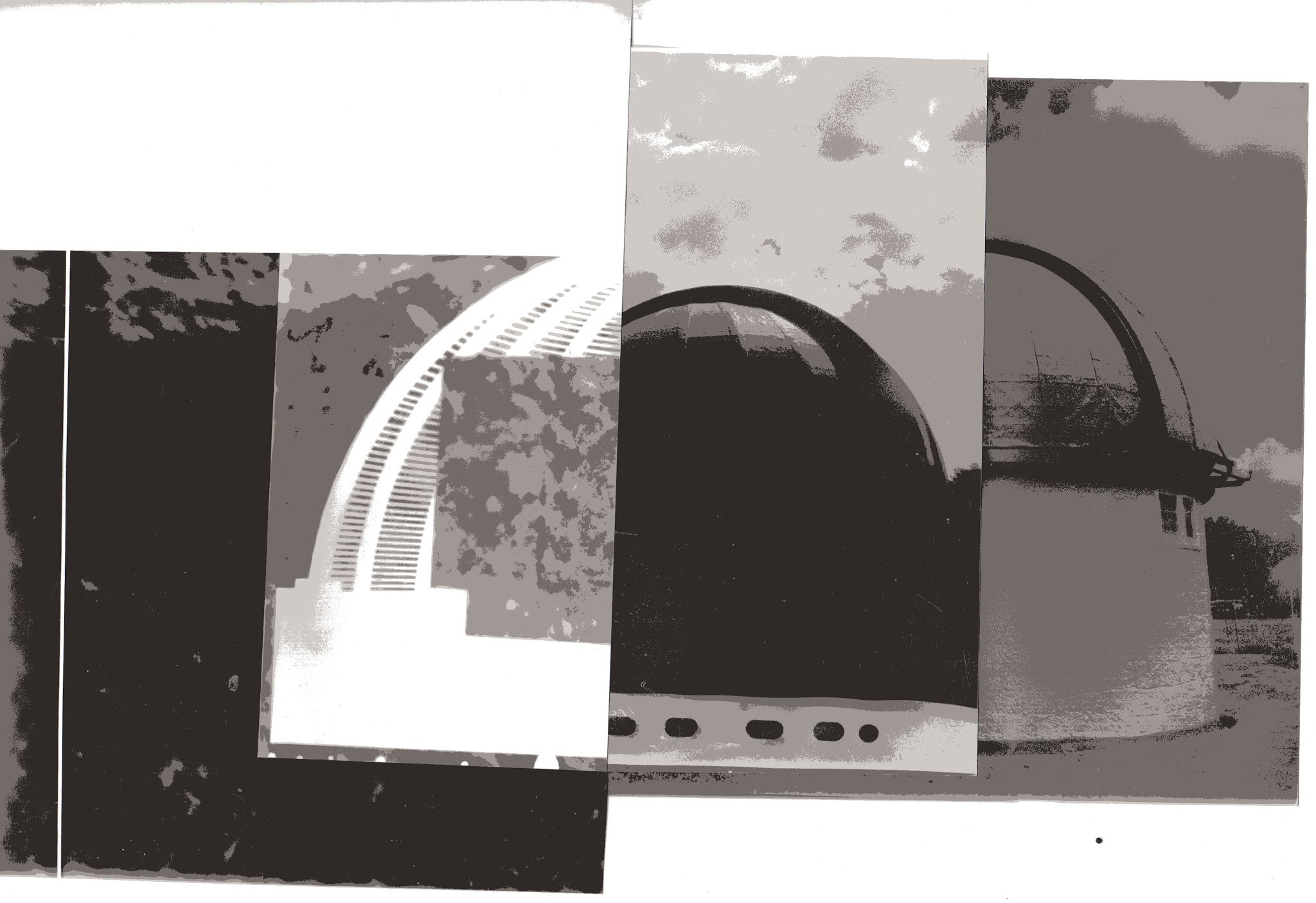
Kirosan Observatory, Kengo Kuma

Observatories demonstrate the self-centred nature of human perception. They are generally objects, that is the core of the problem. I wondered if this observatory could be made transparent, that is, effectively erased, so minimising the damage to the environment.


In terms of erasing an object, the settin is more important than the choice of material. In this case, the setting was a summit that had already been levelled and turned into a perfect pedestal. Anything that is set on a pedestal becomes an object, regardless of what it is made of or how discreetly it is placed.

Most works of contemporary art are tiresome because they rely on this particular property of the pedestal.


Observatory/Artists Outdoor Studio with astronomical 'Hortus Conclusus' /pavilion/segment built from the walled garden.


IMMATERIAL :

Layer upon layer of reality and image, the material and the immaterial, were thus overlapped. 

The Camera Obscura and Telescope, Dumfries. 1836

It is not quite clear what the real astronomical purpose of camera obscurae was, not only the Royal Observatory at Edinburgh but also the Royal Observatory at Greenwich still posses theirs, though dismantled and stored in cupboards for a century or more.


Paramatta Observatory, New South Wales, 1822

Sepia stained cyanotypes of architectural building plans


Plaster tabletop viewing screen, concave, chalk/matt surface

Lead weights on natural ropes used to control the apparatus


What I am most interested in now is inverting the structure of a culture that is centred around the city. The twentieth century was an age of industry, and an age in which everything from material goods, information and culture flowed from the cities to local towns and villages. Following the same vector, architecture, too, flowed out from the centre to the periphery.

Kengo Kuma


APPARATUS :


The Observatory is a facility for stealing looks at visitors


Electronic technology is used in these devices to expose the imperfection of vision and reverse its privileged status. Under ordinary circumstances, the seeing object is under the illusion that he/she dominates what they see. However, seeing also opens up the possibility of being seen. Anyone who dominates another through vision is always vulnerable to a brutal reversal.

High and Low, 1963. Akira Kurosawa


I therefore tried designing a transparent object. My real aim was not to create an object, but to choreograph a sequence of movements by the subject, that is, to create a device controlling his/her vision. Anti-Object, Kengo Kuma.

Your Chance Encounter, 2010. Olafur Eliasson


Messr Barr and Stroud, Optical Engineers, Glasgow, used to produce obscuras for industry, they were much cheaper to purchase and maintain in a large industrial establishment than closed-circuit television.


Thursday, 14 September 2023

From The Bookcase to The Field Table : Landing Sites of Inquiry

Tentative Building Profiles : Speculative landing sites of surface, image and texts.

Procedural Architecture


Start by thinking of architecture as a tentative constructing toward a holding in place. Architecture's holding in place occurs within and as part of a prevailing atmospheric condition that others routinely call biosphere but which we, feeling the need to stress its dynamic nature, have renamed bioscleave.

Architectural Body

Madeline Gins and Arakawa


Working Notes/Holding in Place


Wayfinding/Movements through accumulated research

Running scripts, enactments, instances, involvements

Collaborative texts, complexity, emergent, discursive 

From The Bookcase to The Field Table : Landing Sites of Inquiry


Camouflage

Neil Leach

For Benjamin, the twentieth century is an age of alienation. Human beings are no longer 'cocooned' within their dwelling spaces. Architectural spaces are no longer reflections of the human spirit. Something has been lost.

Mimesis, 19.


New Concepts of Architecture

Existence, Space and Architecture

Christian Norberg-Schulz

A child 'concretizes' its existential space.


A Philosophy of Emptiness

Gay Watson

Artistic Emptiness

Everything flows, nothing remains.

Heraclitus


Rethinking Architecture

Neil Leach

Figure 1, Sketch by Jacques Derrida for Choral Work project. 343

Foucault, Figure 2 Bentham's Panopticon (1791). 360

Page laid in, The Atrocity Exhibition by J. G. Ballard, new revised edition,annotations, commentary, illustrations and photos.


Tracing Eisaenman

Plenum, juxtaposed to form/haptic values/body absences

Robert Mangold

Between moments of 'meaning' lie spaces or blanks of immediate experience. Such blanks are actuality. Usually the blank, the actuality, goes unnoticed because it works so efficiently to differentiate one meaningful event from another. Kubler discussed this in The Shape of Time.


Interactions of the Abstract Body

Josiah McElheny

Object Lesson/Heuristic Device

The term 'heuristic' is understood here to denote a method of addressing and solving problems that draws not on logic but on experience, learning and testing. In this regard stories and fictional narratives can be heuristic devices in acting as ideal models that are not to be emulated but which help to situate characters, actions and objects.


Space Between People

Degrees of virtualization

Mario Gerosa


Adaptive Architectural Design

Device-Apparatus

Place

Function

Adaptation

The second phase of project activity acknowledges that the proposal involves two sites; the landscape of settlement and the artifice of the factory. The design is intended to be a reflection of the conditions of each, so there was a need to work directly with the manufacturing process, at full scale, as early as possible. This would provide an immediate counterpoint to the earlier representations and a necessary part of exploring the manufacturing medium in the context of architectural design. 69


Building The Drawing

The Illegal Architect

Immaterial Architecture

Mark Cousins suggests that the discipline of architecture is weak because it involves not just objects but relations between subjects and objects. And if the discipline of architecture is weak, then so, too, is the practice of architects. Architecture must be immaterial and spatially porous, as well as solid and stable where necessary, and so should be the practice of architects.

Jonathan Hill

Index of immaterial architectures


Herzog and De Meuron

Natural History

Exhibiting Herzog and De Meuron

We are not out to fill the exhibition space in the usual manner and to adorn it with records of our architectonic work. Exhibitions of that kind just bore us, since their didactic value would be conveying false information regarding our architecture. People imagine that they can follow the process, from the sketch to the final, photographed work, but in reality nothing has really been understood, all that has happened is that records of an architectural reality have been added together.


My studio is a piece of architecture that is silent. The things of which it is made say all and at the same time nothing. Its strength lies in its demanding silence. A stern silence in order to permit works to occur. I imagine that a painting by Newman could be hung there.


The arrival of Beuys in a world that was gradually falling asleep amidst minimalism generated a kind of confusion that was truly excellent for opening up the mind. Comfort vanished, driven away by subversive complexity.


Speculative architecture

On the aesthetics of Herzog and De Meuron


Without opposition nothing is revealed,

no image appears in a clear mirror

if one side is not darkened

Jacob Bohme, De tribus principii (1619)


Reflections on a photographic medium

Memorial to the Unknown Photographer

Thomas Ruff's Newspaper Photos

Valeria Liebermann


Working Collages

Karl Blossfeldt


Anti Object

We are composed of matter and live in the midst of matter. Our objective should not be to renounce matter, but to search for a form of matter other than objects. What that form is called architecture, gardens, technology is not important. 

Kengo Kuma


Tuesday, 25 October 2022

The phenomenal nature of the idea : Architectural Intertwining/Environs, object scripted inquiry


Architectural Body
Madeline Gins and Arakawa

Working Notes/Holding in Place

Wayfinding/Movements through accumulated research
Running scripts, enactments, instances, involvements
Collaborative texts, complexity, emergent, discursive 

From The Bookcase to The Field Table : Landing Sites of Inquiry


Spatial Collage 2010

Lead, photographic (pinhole) and inkjet visual material from flickr stream, fixing tapes, cyanotype on tracing paper, pierced and re-positioned elements on paper.


Idea is, 

the invisible of this world, which inhabits this world, sustains it, and renders it visible

Merleau Ponty


Start by thinking of architecture as a tentative constructing toward a holding in place. Architecture's holding in place occurs within and as part of a prevailing atmospheric condition that others routinely call biosphere but which we, feeling the need to stress its dynamic nature, have renamed bioscleave.

Architectural Body

Madeline Gins and Arakawa


For Steven Holl, the intertwining of idea and phenomena occurs with the realization of a building as the means for the materialization of the idea force

A methodology of connecting phenomenal properties with a conceptual strategy

Camouflage

Neil Leach

For Benjamin, the twentieth century is an age of alienation. Human beings are no longer 'cocooned' within their dwelling spaces. Architectural spaces are no longer reflections of the human spirit. Something has been lost.

Mimesis, 19.


New Concepts of Architecture

Existence, Space and Architecture

Christian Norberg-Schulz

A child 'concretizes' its existential space.


A Philosophy of Emptiness

Gay Watson

Artistic Emptiness

Everything flows, nothing remains.

Heraclitus


Rethinking Architecture

Neil Leach

Figure 1, Sketch by Jacques Derrida for Choral Work project. 343

Foucault, Figure 2 Bentham's Panopticon (1791). 360

Page laid in, The Atrocity Exhibition by J. G. Ballard, new revised edition, annotations, commentary, illustrations and photos.


Tracing Eisaenman

Plenum, juxtaposed to form/haptic values/body absences

Robert Mangold

Between moments of 'meaning' lie spaces or blanks of immediate experience. Such blanks are actuality. Usually the blank, the actuality, goes unnoticed because it works so efficiently to differentiate one meaningful event from another. Kubler discussed this in The Shape of Time.


Interactions of the Abstract Body

Josiah McElheny

Object Lesson/Heuristic Device

The term 'heuristic' is understood here to denote a method of addressing and solving problems that draws not on logic but on experience, learning and testing. In this regard stories and fictional narratives can be heuristic devices in acting as ideal models that are not to be emulated but which help to situate characters, actions and objects.


Space Between People

Degrees of virtualization

Mario Gerosa


Adaptive Architectural Design

Device-Apparatus

Place

Function

Adaptation

The second phase of project activity acknowledges that the proposal involves two sites; the landscape of settlement and the artifice of the factory. The design is intended to be a reflection of the conditions of each, so there was a need to work directly with the manufacturing process, at full scale, as early as possible. This would provide an immediate counterpoint to the earlier representations and a necessary part of exploring the manufacturing medium in the context of architectural design. 69


Building The Drawing

The Illegal Architect

Immaterial Architecture

Mark Cousins suggests that the discipline of architecture is weak because it involves not just objects but relations between subjects and objects. And if the discipline of architecture is weak, then so, too, is the practice of architects. Architecture must be immaterial and spatially porous, as well as solid and stable where necessary, and so should be the practice of architects.

Jonathan Hill

Index of immaterial architectures


Herzog and De Meuron

Natural History

Exhibiting Herzog and De Meuron

We are not out to fill the exhibition space in the usual manner and to adorn it with records of our architectonic work. Exhibitions of that kind just bore us, since their didactic value would be conveying false information regarding our architecture. People imagine that they can follow the process, from the sketch to the final, photographed work, but in reality nothing has really been understood, all that has happened is that records of an architectural reality have been added together.


My studio is a piece of architecture that is silent. The things of which it is made say all and at the same time nothing. Its strength lies in its demanding silence. A stern silence in order to permit works to occur. I imagine that a painting by Newman could be hung there.


The arrival of Beuys in a world that was gradually falling asleep amidst minimalism generated a kind of confusion that was truly excellent for opening up the mind. Comfort vanished, driven away by subversive complexity.


Wednesday, 14 July 2021

Corpus : Propositions/Proofs and the situatedness of an environment

Architectural Body/An organism that persons

Organism, Person, Environment : Madeline Gins and Arakawa


You cannot see me from where I look at myself 

Francesca Woodman


Therefore the idea of the human body is composed of the many ideas of the component parts.

The idea which  constitutes the formal being  of the human mind is the idea of the body, which is composed of many indi­viduals,  each  composed  of many  parts.

(Ethics, Part II, Proposition XV, Proof)


Camouflage : Neil Leach

Mimesis

Sensuous Correspondence

Sympathetic Magic

Mimicry

Becoming


Mimesis : Paradox or Encounter. Jane Bennett


Yet,  freed  from the block, the relations between her and everything which was not her had changed. An absolute yet invisible change. She was now the centre of what surrounded her. All that was not her made space for her.

Where there are no  words, knowledge comes through  physical acts and  through  the space through which those acts are made; by permitting each act the space conferred  meaning  upon  it and  no  further meaning  was necessary.

John Berger


We sense and experience that we are eternal. For the mind no less senses those things which it conceives in understanding than those which it has in the memory. For the eyes of the mind by which it sees things and observes them are proofs. So although we do not remember that we existed before the body, we sense nevertheless that our mind in so far as it involves the essence of the body under a species of eternity is eternal and its existence cannot be defined by time or explained by duration.

(Spinoza, Ethics, Part V, Proposition XXIII)

Situatedness is a theoretical position that posits that the mind is ontologically and functionally intertwined within environmental, social, and cultural factors. As such, psychological functions are best understood as constituted by the close coupling between the agent and the environment.