Showing posts with label camera obscura. Show all posts

Tuesday, 2 September 2025

Anachronistic Grisaille/Space and Architecture : Cyanotype/Diaphanous And Indexical Negatives

Research as a discursive activity gathering new forms of expression.

Duration, Steven Holl
Time is only understood in relation to a process or a phenomenon.

The duration of human beings alive in one time and place is a relational notion.
The time of one's being is provisional; it is a circumstance with an adopted aim for the time being.

SPACE-and ARCHITECTURE-exceeds the provisional

Concrete/Abstract Painting : Areas of Grisaille. Outpost Studios, Norwich.


We are not in the presence of a passively representative image, but a vector of subjectivation.
Guattari, 1995 :25

Cyanotype is a photographic printing process that produces a cyan-blue print. Engineers used the process well into the 20th century as a simple and low-cost process to produce copies of drawings, referred to as blueprints. The process uses two chemicals: ammonium iron(III) citrate and potassium ferricyanide.

The English scientist and astronomer Sir John Herschel discovered the procedure in 1842.[1] Though the process was developed by Herschel, he considered it as mainly a means of reproducing notes and diagrams, as in blueprints.[2] It was Anna Atkins who brought this to photography. She created a limited series of cyanotype books that documented ferns and other plant life from her extensive seaweed collection.[3] Atkins placed specimens directly onto coated paper, allowing the action of light to create a silhouette effect. By using this photogram process, Anna Atkins is regarded as the first female photographer.[4]

From Wikipedia, the free encyclopedia


Blue Spaces Of Everyday Enchantments : White Absences #2. Silence/Void : Gap/Reveal


The Enchantment of Modern Life.
Attachments, Crossing and Ethics

The performativity of social representations

When I gather together the animals, arguments, molecules, suggestions, forces, interpretations, sounds, people, and images of this study, one theme emerges. The modern story of disenchantment leaves out important things, and it neglects crucial sources of ethical generosity in doing so. Without modes of enchantment, we might not have the energy and inspiration to enact ecological projects, or to contest ugly and unjust modes of commercialization, or to respond generously to humans and nonhumans that challenge our settled identities. These enchantments are already in and around us.

Jane Bennett


Tracing Light : Petworth House, West Sussex 2000
David Alan Mellor, Garry Fabian Miller.

Light And The Genius Loci
For Derrida, the sun not only marks the beginning of metaphoricity but it is also an inescapable reminder of the solar system and oscillations, hidings and occultrations, inherent in 'a certain history of the relationships; earth/sun in the system of perception'.

Mutations Of Light
Petworth Window, 6 July 1999

Light's Windows And Rooms
Passing towards the Invisible.
The prospect of some metaphysical realm beyond the blue end of the spectrum and beyond material things illuminated to carnal sight, was a recurrent  theme in William Henry Fox Talbot's early speculations.


BROUGHT TO LIGHT
PHOTOGRAPHY AND THE INVISIBLE 1840-1900


Sight Unseen
Picturing The Universe
Corey Keller
Invisible objects, penciled by nature's own hand.
In his introduction to the exhibition catalogue Iconoclash: Beyond the Image Wars in Science, Religion, and Art, the historian of science Bruno Latour argues that scientific pictures are powerfully affective because they more than mere images; they are, as he puts it, the 'world itself'.

The Social
Photographic Eye
Jennifer Tucker
Nineteenth century science was characterized by both the appeal to visual evidence and the need for confirmation by the testimony of eyewitnesses. The latter explains why scientists pursued public viewings of their photographs by means of illustrated slide lectures, exhibitions, and reproduction in newspapers and magazines.
An understanding of the social boundaries of nineteenth century science helps make sense of a certain paradox within contemporary attitudes towards photography of the invisible. The ideal of mechanical objectivity in documenting visual knowledge demanded the elimination of the artist-observer and all of the subjectivity implicit in drawing by hand.

Invisible Worlds
Visible Media
Tom Gunning
William Henry Fox Talbot, Slice of horse chestnut, seen through the solar microscope, 1840, salt print 18.6x22.5 cm.

Techniques Of The Observer
On Vision And Modernity In The Nineteenth Century
Jonathan Crary

The Camera Obscura and its Subject
Above all it indicates the appearance of a new model of subjectivity, the hegemony of a new subject-effect. First of all the camera obscura performs an operation of individuation; that is, it necessarily defines an observer as isolated, enclosed, and autonomous within its dark confines. It impels a kind of askesis, or withdrawal from the world, in order to regulate and purify one's relation to the manifold contents of the now 'exterior' world.

UNDER THE SUN
By The Light Of The Fertile Observer

Metaphors of illumination in the photography of Christopher Bucklow, Susan Derges, Garry Fabian Miller, and Adam Fuss.

An Epiphany Of Light
David Alan Mellor


Monday, 26 May 2025

LIVING Intensity : FRONTIERS OF ARCHITECTURE, Kirosan Observatory/Anti-Object/Anthropology/Art

040521

Anti Object

We are composed of matter and live in the midst of matter. Our objective should not be to renounce matter, but to search for a form of matter other than objects. What that form is called architecture, gardens, technology is not important. 

Kengo Kuma


Procedural Architecture

Start by thinking of architecture as a tentative constructing toward a holding in place. Architecture's holding in place occurs within and as part of a prevailing atmospheric condition that others routinely call biosphere but which we, feeling the need to stress its dynamic nature, have renamed bioscleave.

Architectural Body

Madeline Gins and Arakawa


LIVING : FRONTIERS OF ARCHITECTURE

Louisiana Museum of Modern Art.


Wang Qingsong : Dormitory, China, 2005


Key Words : Observatory, Camera Obscura, Living, Seeing, Intensity


BEHAVIOROLOGY ( the study of the combination of natural dispositions, social environment and personal experience)


Deals with the special atmosphere and character of the suburb. In film, literature and art the suburb often has an undertone of something mysterious, eerie, of events that are kept hidden.


The dual desire to see and to be seen leads to instability. An object may be made transparent, but it remains an object. And transparent, it is more thoroughly under observation and more thoroughly dominated. Conditions in the suburbs are in a sense even more wretched than those in the panopticon.

Kengo Kuma/Observatory/Anti-Object


Uchronia, Burning Man Festival, Nevada. 2006


Rouen Concert Hall and Exhibition Complex

Architectural Envelope/Heterogeneous Composite

Movement Vectors/Layers : Interior Concrete Skin/Visible Arches of the Steel Skeleton


Painting Space : Yellow ochre on white gesso over kraft paper

An Anthropology of Landscape

Christopher Tilley

Kate Cameron-Daum


Spirituality in Contemporary Art

The Idea Of The Numinous

Jingu Yoon


New Global Ecologies

Baratunde Thurston


INTENSITY : Portable Architecture as Parable. Mark Prizeman

The act of moving through mobile societies makes this transient architecture understandable.


A nomad uses what is to hand and able to be replaced or adapted.


The success of a tent depends on the exploration of an idea in the workshop by wandering through the dream and not being restricted by the finite parameters of a drawn representation of the future object.

Like explorers planning to venture into the unknown, an ability to imagine the consequences of what one takes and what one leaves behind is imperative.


ERASING :


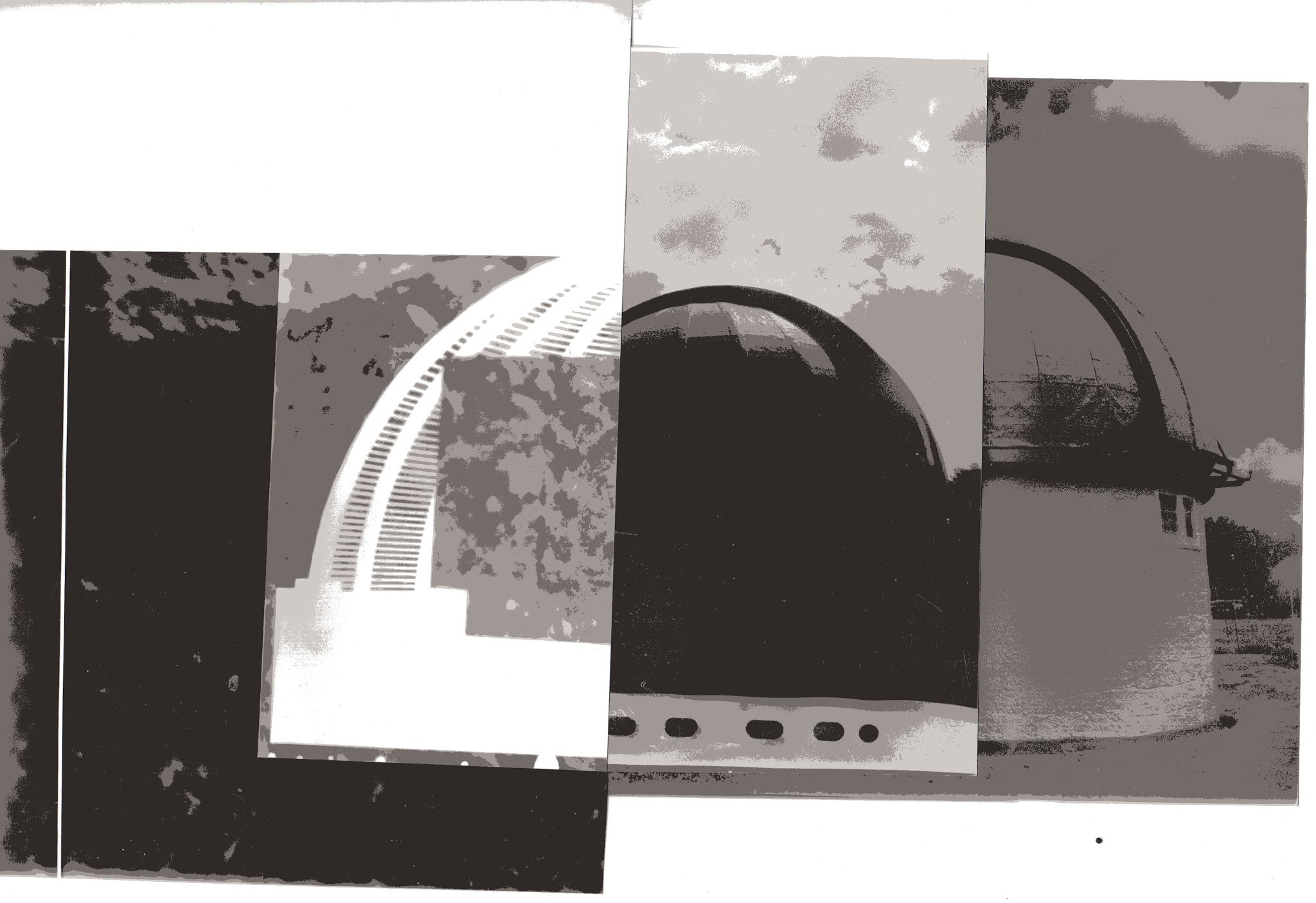
Kirosan Observatory, Kengo Kuma

Observatories demonstrate the self-centred nature of human perception. They are generally objects, that is the core of the problem. I wondered if this observatory could be made transparent, that is, effectively erased, so minimising the damage to the environment.


In terms of erasing an object, the settin is more important than the choice of material. In this case, the setting was a summit that had already been levelled and turned into a perfect pedestal. Anything that is set on a pedestal becomes an object, regardless of what it is made of or how discreetly it is placed.

Most works of contemporary art are tiresome because they rely on this particular property of the pedestal.


Observatory/Artists Outdoor Studio with astronomical 'Hortus Conclusus' /pavilion/segment built from the walled garden.


IMMATERIAL :

Layer upon layer of reality and image, the material and the immaterial, were thus overlapped. 

The Camera Obscura and Telescope, Dumfries. 1836

It is not quite clear what the real astronomical purpose of camera obscurae was, not only the Royal Observatory at Edinburgh but also the Royal Observatory at Greenwich still posses theirs, though dismantled and stored in cupboards for a century or more.


Paramatta Observatory, New South Wales, 1822

Sepia stained cyanotypes of architectural building plans


Plaster tabletop viewing screen, concave, chalk/matt surface

Lead weights on natural ropes used to control the apparatus


What I am most interested in now is inverting the structure of a culture that is centred around the city. The twentieth century was an age of industry, and an age in which everything from material goods, information and culture flowed from the cities to local towns and villages. Following the same vector, architecture, too, flowed out from the centre to the periphery.

Kengo Kuma


APPARATUS :


The Observatory is a facility for stealing looks at visitors


Electronic technology is used in these devices to expose the imperfection of vision and reverse its privileged status. Under ordinary circumstances, the seeing object is under the illusion that he/she dominates what they see. However, seeing also opens up the possibility of being seen. Anyone who dominates another through vision is always vulnerable to a brutal reversal.

High and Low, 1963. Akira Kurosawa


I therefore tried designing a transparent object. My real aim was not to create an object, but to choreograph a sequence of movements by the subject, that is, to create a device controlling his/her vision. Anti-Object, Kengo Kuma.

Your Chance Encounter, 2010. Olafur Eliasson


Messr Barr and Stroud, Optical Engineers, Glasgow, used to produce obscuras for industry, they were much cheaper to purchase and maintain in a large industrial establishment than closed-circuit television.


Sunday, 27 April 2025

The Social : Catching The Light/Architectural Apparatuses/Spatial Methodologies

It would probably not be wrong to define the ex­treme phase of capitalist development in which we live as a massive accumulation and proliferation of apparatuses.

To recapitulate, we have then two great classes: liv­ing beings (or substances) and apparatuses. And, be­ tween these two, as a third class, subjects. I call a sub­ject that which results from the relation and, so to speak, from the relentless fight between living beings and apparatuses. Naturally, the substances and the subjects, as in ancient metaphysics, seem to over­ lap, but not completely. In this sense, for example, the same individual, the same substance, can be the place of multiple processes of subjectification.­

 I shall call an apparatus literally anything that has in some way the capacity to capture, orient, determine, intercept, model, control, or secure the gestures, behaviors, opinions, or discourses of liv­ing beings.

What Is an Apparatus? Giorgio Agamben 2009.


Alternative Photography : Photography and Architectural Space.

Photogram, a numinous construction, spaces amongst and within other spaces

Catching The Light.

The Entwined History of Light And Mind. Arthur Zajonc


PROXIMITY OF SPACE 

INTIMACIES IN SOCIAL SPACES 

SCRIPTORIUM


THREE STAGE METHODOLOGY (Kikutake) Mitsuo Taketani 

KA ‘ESSENCE’

KATA ‘SUBSTANCE’ 

KATACHI ‘PHENOMENON’ 

Characteristics of an architect

CHI ‘BLOOD’

TACHI ‘TEMPERAMENT’ 

KATACHI ‘EMBODIMENT’


The Phenomenology of Reading. GLAS, Derrida Literature and Language. 

The Stride of The Mind

Reading Rooms. Figuring Space. Text/Fumiture/Dwelling Reading with Paths

The Production/use of Space into Places to engender Societies.

A site specific induced inquiry into dwelling and building through/by way of an attentive awareness (anthropological) to people and place.

‘What I am post interested in now is inverting the structure of a culture that is centred around the city.’

‘The richness and strength of that (their) culture cannot be understood until one has worked with the people who live their- until one has eaten their food, drunk their sake, talked together with the craftsmen and made things with them.’

Kengo Kuma, Complete Works, (preface) 2012 

Relativity/Relationality through Walking and Thinking. Subjectivity. Space - Politics - Affect


Waverley Abbey. Cistercian Monastery

The peculiarity of the ruin is defined in that it demythologises the impression of seamlessness and linearity. In the ruin, we are at once removed from dichotomised and levelled down space by entering a place at the threshold of experience. At the threshold, we return to the pre- spatial, if primordial, landscape, yet to submit to the suppression of space and site. Instead the place of ruin creates protrusions, which desolates the category of clean space.


The Aesthetics of Decay, An Uncanny Place. Dylan Trigg 


Immaterial Architecture : The Glass Observatory

Photograph (132) Cyanotype Alternative Photography

Documents from research archive

Tracing Light: Petworth House, West Sussex 2000 David Alan Mellor, Garry Fabian Miller.

Light And The Genius Loci

For Derrida, the sun not only marks the beginning of metaphoricity but it is also an inescapable reminder of the solar system and oscillations, hidings and occultrations, inherent in 'a certain history of the relationships; earth/sun in the system of perception'.

Mutations Of Light

Petworth Window, 6 July 1999 Light's Windows And Rooms

Passing towards the Invisible.

The prospect of some metaphysical realm beyond the blue end of the spectrum and beyond material things illuminated to carnal sight, was a recurrent theme in William Henry Fox Talbot's early speculations.

CATCHING THE LIGHT

The entangled history of light and mind Arthur Zajonc

BROUGHT TO LIGHT

PHOTOGRAPHY AND THE INVISIBLE 1840-1900 Sight Unseen

Picturing The Universe Corey Keller

Invisible objects, penciled by nature's own hand.

In his introduction to the exhibition catalogue Iconoclash: Beyond the Image Wars in Science, Religion, and Art, the historian of science Bruno Latour argues that scientific pictures are powerfully affective because they more than mere images; they are, as he puts it, the 'world itself.

The Social Photographic Eye Jennifer Tucker

Nineteenth century science was characterized by both the appeal to visual evidence and the need for confirmation by the testimony of eyewitnesses. The latter explains why scientists pursued public viewings of their photographs by means of illustrated slide lectures, exhibitions, and reproduction in newspapers and magazines.

An understanding of the social boundaries of nineteenth century science helps make sense of a certain paradox within contemporary attitudes towards photography of the invisible. The ideal of mechanical objectivity in documenting visual knowledge demanded the elimination of the artist-observer and all of the subjectivity implicit in drawing by hand.

Invisible Worlds Visible Media

Tom Gunning

William Henry Fox Talbot, Slice of horse chestnut, seen through the solar microscope, 1840, salt print 18.6x22.5 cm.

Techniques Of The Observer

On Vision And Modernity In The Nineteenth Century Jonathan Crary

The Camera Obscura and its Subject

Above all it indicates the appearance of a new model of subjectivity, the hegemony of a new subject­ effect. First of all the camera obscura performs an operation of individuation; that is, it necessarily defines an observer as isolated, enclosed, and autonomous within its dark confines. It impels a kind of askesis, or withdrawal from the world, in order to regulate and purify one's relation to the manifold contents of the now 'exterior' world.

UNDER THE SUN

By The Light Of The Fertile Observer

Metaphors of illumination in the photography of Christopher Bucklow, Susan Derges, Garry Fabian Miller, and Adam Fuss.

An Epiphany Of Light

David Alan Mellor

Christopher Bucklow, Guests Jeanette Winterson, Gut Symmetries

Matter is provisional and that includes me. If the physics is correct then we are neither alive or dead as we commonly understand it, but in different states of potentiality.

From The Adamantine Land

Variations on the art of Christopher Bucklow David Alan Mellor

Etienne-Jules Marey

A Passion For The Trace Francois Dagognet

Painting, Photography, Film Laszlo Moholy-Nagy

A Bauhaus Book

L. MOHOLY-NAGY:

DYNAMIC OF THE METROPOLIS SKETCH FOR A FILM

ALSO TYPOPHOTO OSKAR SCHLEMMER

MAN

Interaction of Color Josef Albers

The Elements of Color Johannes Itten

Pedagogical Sketchbook Paul Klee

The New Landscape in art and science Gyorgy Kepes

The Colour of Time Garry Fabian Miller

The Majesty of Darkness Adam Nicolson

The Unmade

The Pregnant

The Half Erotically Unmade


Camera Obscura of Ideology Sarah Kofman

An optical instrument, which used in drawing, allows one to see at the same time the objects being drawn and the paper.

I Am Not This Body 

Barbara Ess


Working Collages

Ann Wilde, Ulrike Meyer-Stump

A German Tradition of Photographic Typology

Collages made from contact prints from Blossfeldt's negatives, showing the isolation of particular motifs. The working collages were an archive, not for the negatives but for motifs.

The viewer is less interested in the subjects of the pictures, than in the effect created by the formal system subsuming them.

His photographic archive of plant forms is not a finished work, but material awaiting processing.


Enchantments and Crossings : Somatic Effects

Spatial Methodologies. Worlds and Thresholds.


The Fanciful and The Scientific.

The Playful and The Reverent.

The Material and The Metaphysical.


Tensions in built spaces.


Between Evanescence and Substance.

Between Illusion and Specificity.

Between Slickness and Tactility.


Today there is not even a single instant in which the life of individuals is not modeled, contaminated, or controlled by some apparatus, In what way, then, can we confront this situation, what strategy must we follow in our everyday hand-to-hand struggle with ap­paratuses?

What Is an Apparatus? Giorgio Agamben 2009.

Making Places where times and tastes, human fabrications and accidents of nature, all collide; in these situations under the shelter of a forming/becoming architecture these ‘spatial texts’ or ‘visual conversations’ of one sort or another are suggested and are manifested and explored through a praxis of inquiry and making.


Facility and retreat for cross-disciplinary inquiry (Humanities and the Social Sciences).

Repository and archive of artefacts, texts and objects.

Exhibition and making spaces, workshops and residential living spaces. Walled garden complex containing a reading pavilion and library.

Philosophy of Solitude, thresholds/spaces of serenity, a poetics of dwelling.

Relationships between Art, Photography, Craft and Building. Expanded through Exhibition, Performance, Teaching and Making.

Realized as a dialogue/delivery (Built Work) into Architectural Terms between Sites of Collection and Sites of Construction.


Art as Spatial Practice.

Catalyst Events/Situations to engender the experience of learning.

West Dean, Singleton. Residential courses in the arts, both the grounds and the house are fully utilised in the social activity of learning.

Kilquhanity,Scotland. Free School in country setting, used as a site for exploratory fine art practices(converted a pottery into a camera obscura and drew a garden from the movements of the sun across a specific terrain).

Brockwood Park School, Bramdean. Re-imagining learning, conducted a walk across a landscape with clay, and hidden curriculum in the library with objects and texts centred around philosophy and architecture.

Space folds : Containing "Spatialities around historicality and sociality"

Perceptions now gathering at the end of the millennium. Spatiality, Robert T. Tally Jr. 2013

"All that is solid melts into air"

Karl Marx, Friedrich Engels,

(Poetic observation concerning the constant revolutionizing of social conditions)

Posted 2018


Thursday, 14 September 2023

Corporeal Phantoms/Attendants/Skins : Alternatives/Others in Photography/Phantasy Surfaces

Landscapes : entering/intruding/emerging (holga819)

Working Title : Montage Samples
Historical Presence #4

Helena Eflerova, 18 minute rehearsal ,GASP 2009

Art as Spatial Practice.
Space folds : Containing "Spatialities around historicality and sociality"

"All that is solid melts into air"

Karl Marx, Friedrich Engels,
(Poetic observation concerning the constant revolutionizing of social conditions)

Perceptions now gathering at the end of the millennium. Spatiality, Robert T. Tally Jr. 2013

Do you live as Humans in the Holocene or as Earthbound in the Anthropocene? (50.37)

Dr. Bruno Latour on climate change and the "Anthropocene": Wall Exchange, Fall 2013

Camera Obscura : Physical Touch #2

Photograph (240) drawing

Sequential Photograph : Performing Photography/The Inseparable Attendant


Friday, 25 August 2023

Collage/Abstraction/Assemblage/Beyond Discourse : Architectural Plan/ Library/Victorian Corset/Blueprint/Spatial Frame

Postmodernity is no more than 'modernity' without illusions
Zygmunt Bauman

We are less interested in whether we are living in a critical or post-critical era, because these terms circle round each other. Indeed, it is the fate of all 'post' terms (postmodern, post-critical, post-theoretical) that they never escape the hold of the condition that they would wish to succeed.


On Discourse

From a sociological point of view, discourse includes all that a particular category of agents say (or write) in a specific capacity and in a definable thematic area. Discourse commonly invites dialogue, but discourse is not open to everyone, but based on social appropriation and a principle of exclusion.
Beyond Discourse : Notes on Spatial Agency. Tatjana Schneider and Jeremy Till.


Blueprint, Photogram and Collage
Collage : Diversions/Contradictions/Anomalies
Collage and Architecture


https://www.flickr.com/photos/russellmoreton/


a thousand plateaus
Deleuze, Guattari

http://www.rhizomes.net/issue5/poke/glossary.html

Assemblage

The beauty of the assemblage is that, since it lacks organization, it can draw into its body any number of disparate elements. The book itself can be an assemblage, but its status as an assemblage does not prevent it from containing assemblages within itself or entering into new assemblages with readers, libraries, bonfires, bookstores, etc.


Becoming
Body Without Organs
Nomad
Rhizome
Smooth Space
State
War Machine

Camera Obscura : Reflections and the dark room.

The Library : A Meditation on the Human Condition (Giacometti, artist-philosopher)


Books can step up to us- into us- in many ways.
Voices from Chernobyl by Svetlana Alexievich was for me that rare precipitate force which calls another book into being.

Mario Petrucci, Heavy Water, a poem for Chernobyl.

Paths and Boundaries : Stonehenge

Postmodern : Ever Changing, Fleeting, Positive, Nihilistic,

"There are no simple concepts. Every concept has components and is defined by them.
It therefore has a combination [chiffre]. It is a multiplicity, although not every multiplicity
is conceptual...
Not only do Descartes, Hegel, and Feuerbach not begin
with the same concept,
they do not have the same concept of beginning...
Every concept has an irregular
contour defined by the sum of its components,
which is why,
from Plato to Bergson,
we find
the idea of the concept being a
matter of articulation,
of cutting and
cross-cutting.
The concept is a whole because it totalizes
its components, but it is
a fragmentary whole.
Only on this condition can it escape the
mental chaos
constantly threatening it, stalking it, trying to reabsorb it."


-- Gilles Deleuze and Felix Guattari, What is Philosophy?, pp. 15-16.

Footnote

Critical Modernism, where is post-modernism going?
The Garden of  Cosmic Speculation
Charles Jencks