Saturday, 15 April 2023

Wednesday, 12 April 2023
Openings and Conclusions/Frameworks with Enclosures : Site Specificity/Installation
Henri Lefebvre, Openings and Conclusions.
On Installation and Site Specificity (introduction) Erika Suderburg
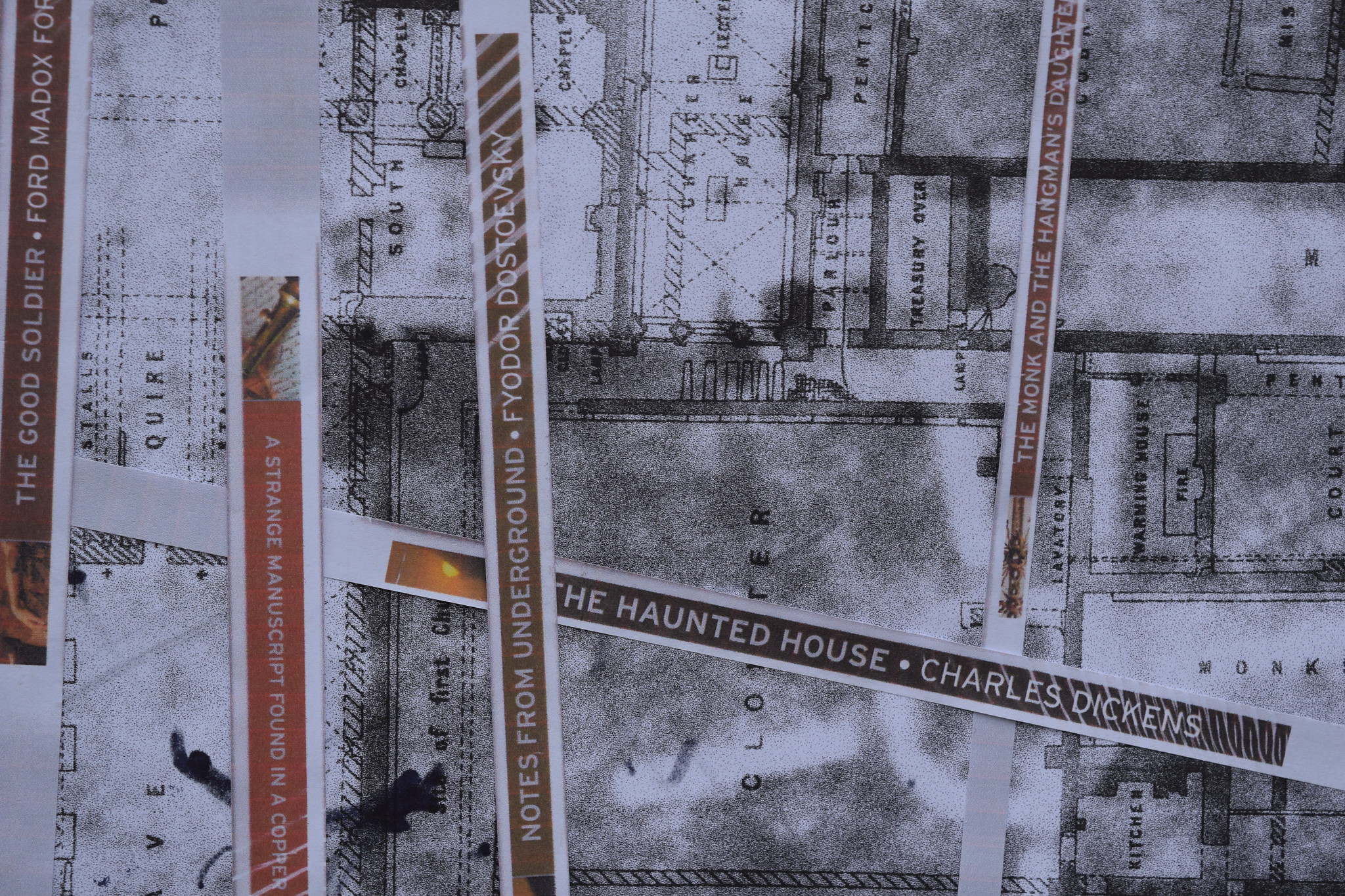
Collage on paper,written fragments and images from Peter Greenaway, Josef Albers and Robin Evans.
Photo montage of The Physical Self (Greenaway) and Waverley Abbey UK.
Visual research as part of The Waverley Project/Obscura and Reading Room.
TheThinking Hand: Existential and Embodied Wisdom in Architecture.
Juhani Pallasmaa
Frameworks with Enclosures
Of the mason's who built them, we can say that they both designed as they drew, and drew as they designed. But their designing, like their drawing, was a process of work, not a project of the mind.
Tim Ingold 'Making'


Tuesday, 11 April 2023
Another/Alternative Photography : Apparatuses/Pattern Making/Redundancy/Collage
Outpost 060423
.jpg)
.jpg)

.jpg)
.jpg)
https://www.flickr.com/photos/russellmoreton/
Searching For Redundancy/Making Patterns Making.
Time/Duration/Perception.
What Is An Apparatus?
Giorgio Agamben
Bringing things back to life, to switch our perspective from the endless shuttling back and forth from image to object and from object to image, that is such a pronounced feature of academic writing in the fields of anthropology, archaeology, art and architecture, to the material flows and currents of sensory awareness in which images and objects reciprocally take shape.
Tim Ingold.
Immaterial Architecture/Creation/Contemplation/Artist/Architect.
Diffraction, understood as a material-discursive phenomenon that makes the effects of different differences evident.
Karen Barad.
Troubleyn Laboratorium, Jan Fabre.
The Empty Space, Peter Brook.
Verb List Compilation/Actions to relate to oneself, Richard Serra.
Ceramics.
Slab built architectural forms and crucible raku bowls.
Raku bowls thrown and turned in a coarse clay with wide flat rims inspired by crucible forms for melting materials.
Architectural slab built pieces investigate ceramics as a dwelling place or a model for a building construction.
Undercroft Exhibition Norwich.
Anglian Potters.
Notion of a moment of impeding transposition.
Transformation of derelict buildings into newly evocative spatial experiences.
Building Cuts/Physical Alteration to a space is a revelation of a particular response.
The Body To The Building.
Social Activism/Mindful Lawlessness.
Gordon Matta-Clark.
Performativity, subject and object do not pre-exist as such, but merge through intra-actions.
Karen Barad.
Architectural Body/The Organism That Persons.
Madeline Gins and Arakawa.
You cannot see me from where I look at myself.
Francesca Woodman.
Thinking Bodies/Becoming Woman.
Images that created a sense of confinement, a temporal identity for herself, a place for a personal resonance/self inquiry.
The body as architecture itself as the support that constitutes the spatial agency of photography.
Negative Capability.
The Link Gallery, Winchester.2013.
Morn Hill Winchester.
.jpg)
Site of the corporation or the master, brethren and sisters of the blessed Mary Magdalene hospital near Winchester erected in 1148 and demolished in 1772.
.jpg)
Founded on the eastern hill in remote antiquity for lepers.
The Hospital of St. Mary Magdalene.
Raymond Elliott. 1994.

Becoming Decay.
Clemintina and Francesca.
Domestic Liminality, a psychological, neurological, or metaphysical subjective conscious state of being on the threshold of or between two different existential planes.
Places where we make new domestic worlds, where we reconstitute family.
Carol Mavor.
Figurative Drawings and Sculptural Reliefs.
Matters of Form/Construction.
Manuel Neri.
.jpg)
.jpg)
Norton Star Atlas
Map 1
Epoch 2000.0
Stellar Magnitudes
Double or Multiple Stars
Variable Stars
Novae.
.jpg)
Alternative Darkroom Photography
Corporeal/Astronomical
Body/Cosmos/Imagination
Scale/Proximity/Vastness
Tuesday, 4 April 2023
Open Studio/Cyanotypes and Collages : Harleston Revisited/Norfolk and Norwich 2018
Inside Public Art Museums
Carol Duncan
Julian Stair
Quietus reviewed
Archaeology of an exhibition
Spirituality in Contemporary Art
The Idea of the Numinous
Jungu Yoon
The Aesthetics of Silence
Susan Sontag
A Field Guide To Getting Lost
Rebecca Solnit
Essays On The Blurring Of Art And Life
Allan Kaprow
Ways of Curating
Hans Ulrich Obrist
The Fitzwilliam Museum, Cambridge
On Show : Contemporary ceramics in the Goodison gift in the context of a historic museum collection.
A rare opportunity to hear different perspectives on how the art of display can animate objects and deepen insight into historical collections.
Art has the power to affect our thinking, changing not only the way we view and interact with the world but also how we create it. In Art and Mind, Ernst van Alphen probes this idea of art as a commanding force with the capacity to shape our intellect and intervene in our lives. Rather than interpreting art as merely a reflection of our social experience or a product of history, van Alphen here argues that art is a historical agent, or a cultural creator, that propels thought and experience forward.
Art in mind : How contemporary images shape thought
Ernst van Alphen
Walking and Mapping
Artists as Cartographers
Karen O'Rourke
A Bigger Splash
Painting after Performance
Catherine Wood


Monday, 3 April 2023
Sunday, 2 April 2023
Atmosphere and Surrounding Objects : Loose Assemblages/Living Emotions/Theoretical Gaze
Paintings being living emotions. Mark Rothko
The atmosphere of a work of art, what surrounds it, that 'place' in which it exists - all this is thought of as a lesser thing, charming but not essential. Professionals insist on essentials ... not understanding that everything we use to make art is precisely what kills it. This is what every painter I know understands. And this is what almost no composer I know understands.
The Music of Morton Feldman, reprinted from his essay "The anxiety in art"


OUTPOST STUDIO July 2021
Loose Assemblages : The Movement of Ideas and Feelings
Touch and materials as a normative support/exploration for the theoretical gaze
Bento's Sketchbook : John Berger
Existence appertains to the nature of substance.
A substance cannot be produced from anything else: it will therefore be its own cause, that is its essence necessarily involves existence, or, existence appertains to its nature.
Ethics, Part 1, Proposition VII, Proof
Conscious minds arise from establishing a relationship between organism and an object-to-be-known. Damasio
Architectural Body
Organism-Person-Environment
Drawing is a form of probing. And the first generic impulse to draw derives from the human need to search, to plot points, to place things and to place oneself.
The Human Body through drawing and philosophy
Berger/Spinoza 141
Matters of a discursive consciousness are explicit and explainable, and the line between discursive and practical consciousness is fluctuating and permeable, both drawing on the other in the act of agency/making social.
The defining point of agency is namely its potential to transform the given.
Generative energies, entanglements, sensorial diversions from an open studio window overlooking Anglia Square
Improvisations/choreographed with the music/ambient noise are exploratory encounters between flesh and sound
A hut of ones own (within and bounded by others), crafted and organized around simple processes and interactions within a fallow site given over to creative ecology of energies and enterprise
Vibrant yet curiously passive form of urbanism
Affectivity as a mimesis of lively transfers between things, humans and non-humans
Human subjectivity : Mimetic Encounters/Explorations
Art works by gathering up forms and materials for affective experimentations in subjectivity
Corporeal unconscious animated by sensitivities/sympathies, a putative affinity (haptic) between certain things including bodies and organs which makes them liable not only to be similarly affected by the same influence, but more especially to affect or influence one another.
Intentionality/Sympathy/Sentiment/Difference
Inducing a particular set of ethical/political/social responses in actor/social audience
Mimesis : Paradox or Encounter. Jane Bennett
Calling a sympathy/subjectivity between coloured cloth/wallpaper/display cabinet and human flesh
Francesca Woodman
Mimesis and suggestion in the social,enacted through layers of mediation surrounding humans, objects and non-humans.
Camouflage. Neil Leach
Mimesis
Sensuous Correspondence
Sympathetic Magic
Mimicry
Becoming
Social sites of space/situatedness/matter : Explorations in developing spatial intelligence
Discursive and practical apparatuses, both drawing on the other in the act of agency.
The defining point of agency is namely its potential to transform the given.
Spinoza : Practical Philosophy by Gilles Deleuze
Bento's Sketchbook : John Berger


Beams and Netting: Negotiations in the chamber, Hyde Abbey Gatehouse, Winchester.
Clay, hessian, drawings and transparencies, drawing frame, antique glass, lead and nylon lines.
‘Leylines’ has been appropriated and employed as both a practical and as a conceptual strategy to inquiry into places and localities. Site visits and sensitive dialogues with the other artists at a number of locations have further brought materials and processes into the creative realm. The spatial practice of setting-up this work has produced a social narrative of its own invention.
This intervention into a listed building has become a temporary refuge for a work in progress. The work attempts to show a creative agency as it encounters a host of installed hierarchies and conditions. The architectural motif on the drawings has been derived directly from the open apertures of the chamber.
Artist’s Book: white and coloured pages
A hand-bound book comprising of five signatures each with four folios. This book contains a collection of postcards made from contact prints and photograms from Tidbury Ring using the cyanotype process.

