Showing posts with label Lucio Fontana. Show all posts

Wednesday, 17 June 2026

Inquiry is essentially the way of learning : Fragile Architectures of Hapticity and Time.

In an era in which architecture is once more learning its potential as a form of inquiry, rather than as a service — as a producer of knowledge, and not merely of ‘projects’.

Brett Steele, Atlas-Tectonics in Barkow Leibininger, Bricoleur Bricolage. AA 2013

Inquiry is essentially the way of learning.

On Learning ‘The Cultivation of a Good Mind’ J. Krishnamurti, Brockwood 1963


THE WAVERLEY INQUIRY

Interior Design MA, UCA Farnham 2013-2015.

https://www.flickr.com/photos/russellmoreton/


This image is a collage or study board that explores the intersection of minimalism, spatial concepts, and art history. It primarily focuses on the works of Robert Mangold and Lucio Fontana. Key Elements. Robert Mangold: The text mentions "Plane/Figure" and discusses concepts like autonomy and actuality. Mangold is known for his minimalist paintings that explore the relationship between the shape of the canvas and the lines drawn upon it Lucio Fontana: The central photograph is labelled "Lucio Fontana's Studio in Milan 1961." It shows his iconic "Concetto Spaziale" (Spatial Concept) works, specifically the Fine di Dio (End of God) series—ovular canvases characterized by punctures and gashes that break the two-dimensional plane. Historical Reference: The top right features a photograph of a gothic or vaulted architectural space, with handwritten notes mentioning "Baroque" and "For the Void - Fontana." This suggests a comparison between historical architectural voids and Fontana’s modern exploration of space. Conceptual Themes. The collage reflects on how art occupies space: The Void: Exploring how Fontana used physical cuts to incorporate the "void" into the artwork. Geometry and Shape: Represented by the orange triangular overlay and Mangold’s theories on the "figure" vs. the "plane." Actuality: A section of text titled "Actuality" likely references George Kubler’s The Shape of Time, discussing the "intermittent" nature of the present moment in art history.

ROOMS AS EXPERIENTIAL OUTPOSTS 

Translations from Drawing to Building.

Robin Evans.

Interiors crafted as a palimpsest of augmented realities. 

Robin Evans, Figures, Doors and Passages.

The architect is Not a Carpenter:

On Design and Building, a talk by Tim Ingold Fieldwork on Foot: Perceiving, Routing, Socializing

Jo Lee, Tim Ingold.

The Perception of the Environment,

Essays on Livelihood, dwelling and Skill, Tim Ingold.


The Aesthetics of Decay

Nothingness, Nostalgia, and the absence of Reason, Dylan Trigg. The Projection Room (the darkened room, camera obscura)

Ruin In Architecture and Cinema, Kiefer, Pallasmaa

Sculpting in Time, Tarkovsky

The Artist/'Monk, Andrei Rublev (Tarkovsky 1966)

Six Memos for the New Millennium, Italo Calvino Architecture as a stage for the effects of an immersive cinema. Palimpsest

Edward De Waal, Antony Gormley, Studio Spaces designed by Architects. Tony Fretton on Retreats, Creative Centres and Exhibition Spaces. Herzog and De Meuron, Working Models, Surfaces, Images and Materials.

Subversive Libraries, researching between the walls of culture and politics.

A HUT WITHIN THE INFLUENCE AND NATURE OF ARCHITECTURE

The tendency of technological culture to standardize environmental condition 

and make the environment entirely predictable is causing a serious sensory impoverishment. Our buildings have lost their opacity and depth, sensory invitation and discovery, mystery and shadow.

Juhani Pallasmaa. Hapticity and Time. Notes on Fragile Architecture. 2000


The Scriptorium Description of Work

The ruined site of the abbey at Waverley, near Farnham has been appropriated as a site and as a place within which to position and develop architectural and sociological inquires. The design processes of interiors have been employed as a tool to both critique and to create how we might further develop the contents of architecture. This Spatiality and its diffractions of differences and similarities, narratives and subjective experiences are what my interior spaces attempt to initiate.

Design as a interactive structure, an interlocutory interior in the making of space and spatial relations.

Interior design presented as an interactive and immersive spatial inquiry

The Scriptorium brings together a varied and discursive set of objects, texts and i interior architectures. This work seeks to understand how the virtual changes physical architecture and how this affects the space between people and buildings. The “performativity of research” is presented through specifically designed apparatuses and partitions. These designed components, made objects together with annotated texts and drawings conspire to create a complex design led inquiry a “Place Study” staged in a niche-like space. This interior presents itself as both distinct and relational to the other projects in the MA Interiors Show. The interior presents the many manifestations of creative research, structures and even symposia that have been developed through engaging with the site. The visualization of the research and the relational architectures rendered through montage and collage explores digital and analogue technologies. This hybridisation and the use of pinhole photography and film footage further explore interests in the field of performance as an immaterial architecture drawn in the presence of place.

The realisation of my interiors project consists of two separate but relational elements that are presented into a built environment. The small ‘Scriptorium’ conceived as a space as a refuge, an intimate minimal construction that features a doorway and an interior that contains a place for objects, perhaps books, as well as a small sitting area. This construction, an open cell perhaps is evocative to a state of contemplation between the fabric of the everyday. The rather hybrid design appropriates a merging of minimalism, modernism and the plastic architecture of a ruined Cistercian Abbey. The construction comes into close contact with its occupant, it is a restricted spatial apparatus that attempts to promote through its awkwardness distinctive experiences. In particular the apparatus of the Scriptorium and its materiality is attempting to promote a sensory intensification that is further underpinned by the cognitive processes of reading and perhaps other social dialogues. The sensory intensification of a hut like space promotes a haptic sensibility, allowing the nearness and intimacies of both the built space and the imaginative, virtual realm to become entangled. Ultimately the Scriptorium is trying to build on unique human subjectivities that are manifested through a kinaesthetic repertoire or script that helps to enact further spatial experiences. It might be useful to think of this constructed space as itself still under construction, a site that acts as its own vessel within the multiplicities of human perception itself. The influence of the Cistercian Order, the site of Waverly Abbey and its pastoral landscape, have all contributed to a sense of the design process, The Scriptorium like the ruins themselves is open to the elements. Waverley Abbey remains as a sensory site between the remains of architecture and its society and the effects of our own global culture in the information age.

In troubled times they all sought to experience life away from social definitions of success or failure. From there, these primitive huts marked personal, original inquires into the ever-mysterious nature of human existence.

Anne Cline. A Hut of One’s Own

Life Outside The Circle Of Architecture.

The Scriptorium began through a research of both architectural themed texts and documentation of the site, and creative practice involving photography (digital, analogue and film) art practices of collage and drawing. The many visits promoted my own subjectivities to the site and these were also frequently subjected to change by the intervention of others in unexpected ways, these social intrusions by other revealed the very boundaries that the historic site engenders, some playful other malicious. These extremities within the social order of the visitors became problematic in designing for the site itself. An earlier proposal to host a Symposium centred on the Arts and The Humanities, that would use the Abbey and its surrounding ground appeared to be a project of vast diversities and logistics better suited to a cultural project through arts management and funding. As the project developed certain creative methodologies around particularities of the site itself began to appear, the notion of palimpsest being one of them. This promoted the idea of a reading room, as an ephemeral interior space that gathers up the experiential values of ‘ruins’ and re-enacts them as a site to explore the architectures of images. It became apparent that ‘palimpsest’ could be both a visual surface of erasures, earlier markings partially over written by newer ones ‘annotations’ and it could be a scaffold of developing ideas clearly visible merging as adaptations into the very usage of the site.

These re-imaginations through the notion of palimpsest seemed filmic and as such they would able to display a vast amount of diversities and subject matter, a library of recourses that would require users or an audience or both. The referencing of the reading room to the library, and the symposium to the cinema or theatre allowed me to realise that I was dealing with a number of spatial arrangements that needed to develop together, but which could be employed separately. The theatre of research became the vehicle in which to see if this collaboration might be possible.

The use of the image and text in my architectural collages allowed me to visualize associations, to create the possibilities of interior spaces that might be manifested into the built environment. The use of the collage in Architecture is widely acknowledged, architects from the likes of Mies van der Rohe, Daniel Libeskind and Rem Koolhaas. The ability of the collage process to juxtaposition fragments, images and texts from irreconcilable origins into an experience, that is visual, tactile and time-based makes it an interesting tool into the realms of architectural design. Collage begins to visualise not only the structure of spaces but also there content and circulation. The theatre of research is interested in how to promote collage and its use as a cognitive and perceptive tool in architecture.

Collage and montage are quintessentially techniques in modern and contemporary art and filmmaking. Collage combines pictorial motifs and fragments from disconnected origins into a new synthetic entity, which casts new roles and meanings to the parts. It suggests new narratives, dialogues, juxtapositions and temporal durations. Its elements lead double-lives; the collaged ingredients are suspended between their originary essences and the new roles assigned to them by the poetic ensemble.

Juhani Pallasmaa. The World is a Collage

Jennifer A. H. Shields. Collage and Architecture

Both the Scriptorium and The Theatre Of Research exist only in the form of the exhibition presentation. What they singularly of together propose can only be imagined through their manifested form as static objects placed within a built structure that loosely references architectural concerns and materials. They appear diminished and assigned to the voyeuristic gaze of the visitor that is equally curios and dismissive. These objects and the interior spaces they promoted seem stilled and stalled, as much they appear beyond reach as if the authenticity of their materials and construction have some how been subsumed by their stature and scale. The issues and qualities of which they are attempting to speak of seem reduced by the hegemony of vision, there is little hapicity and time to encounter, only it seems by investing narratives can we begin to re-enact the spatial encounter.

How might the performativity of research be staged, and into what contexts might it be appropriated?

As Hans Ulrich Gumbrecht notes, we live in a culture of meaning, not in a culture of presence. We constantly produce effects of meaning and multiply them with mass media. This applies not only to the humanities but also to a large degree to our wholly normal everyday lives. And in this respect, our experience of presence is getting drastically lost.

Art works may never completely be explained by theory or meaning. The sensual, material makeup of the work in its presence is not the cinders, slag, and ashes, the undigested remains of theory, but remains of an intensified moment

Peter Lodermeyer.Time, Symposium Amsterdam 2007.

Personal Structures, Time, Space, Existence.

The question I ask is do these objects and their interior spaces cause me to think beyond mere representation and recognition, or rather do they create enough of an encounter to force me to engage with them, even if I or the viewer are un-certain as to their meaning or possible outcome. Deleuze comments that something forces us to think. This something is not an object of recognition, but a fundamental encounter. Something that challenges us. Have these miniature architectures of objects become relational, do we start to use them in perhaps a heuristic manner, a hands-on approach to learning or inquiring, something that we can discover for ourselves. This heuristic finding-out could be made informative through collective collaborations and exhibition through the theatre of research. Is design stripping us of our qualitative spaces as the digital tooling removes the makers trace.

The model object has served as a thinking place in the development of the idea of the Scriptorium. The materials used and their proportions echo interests in Minimalist Sculpture, the intervals between things in the work of Donald Judd and the architectural languages of memory and tectonics of the craftsman turned architect Peter Zumthor. This open sided hut seems cut away almost anatomical as if we were looking into the internal workings of an environment and resident. The structure would have to be made relational to its surroundings if it were to be placed in the landscape. Adaptations to weather the structure, to make it serviceable for use. The Scriptorium has analogues to the notion of a fire-place and its chimney stack. It is a the heart of a building the place of warmth, of dialogues and under the influence through fire of the imagination. The incompleteness that surrounds the scriptorium creatively asks for further design proposals that are even more site specific. The Solar Pavilion built by the Smithsons utilised the old fire place and chimney from the demolished cottage. Around this central element they developed the beginnings of their Modernist (Brutalism) pavilion, an architecture clad with glass, wood and zinc and contained by a walled garden and situated in the pastoral landscape of Wiltshire. Furthering the themes of being in the landscape the Scriptorium could become an observatory, as place from both to look out from and also to look in. The mobility or need to be re-assembled from site to site could promote innovative design solutions as well as interesting detailing or use of materials and surfaces that would facilitate interactions between visitors.

The notion of the Scriptorium becoming clad by an exterior skin, an ephemeral membrane which would then render the differences between the interior and the exterior into the realms of an almost immaterial architectural experience; in as much as the usual distinction between the unpredictable forces of nature outside and the predictable domestic spaces inside. This prompt further investigation into an  architecture that blurs the boundaries of both architecture and nature, this could be further explored through the notion of quixotic gestures, art and performance that can capture the experience and the experiential engagement with the natural elements. The Scriptorium becomes the centred structure of remnant that is surrounded by an architecture that can create imprecise boundaries through inconsistent materials. This spatial arrangement will create its own qualitative responses, dialogues and subsequent movements. Architecture in this context becomes purely a sensorial response.

The body as the vector for active mediation with the world of the spirit. The body is the instrument of a qualitative evaluation, the measure of intensity, which alone is capable of giving space extension and modifying it Space is no objective parameter; it must be ‘excavated’ related to the mobile living parametrics of the body.

Frederic Migayrou. Architectures of the Intensive Body. Yves Klein. Guggenheim. 2005

Mark Prizeman. Intensity. Ephemeral, Portable Architecture.

Time, space and existence are amongst the greatest of themes-so great that we could never be so presumptuous to think we could do them justice, and too close that we could ever escape them, whether with our thoughts or actions, in life or in art.

Peter Lodermeyer. Personal Structures Time. Space. Existence. 2009

My design project has attempted to produce spaces and their interiors together with the apparatus of the Scriptorium that qualitatively seek to inquiry into the world we inhabit. The Theatre of Research attempts to establish some sense of a community that can do field work that invigorates the perception of the environment. My own interests are centred through experientially and mindfully exploring voids, cavities, and spaces between things, together with use of clay, glass and other vernacular materials. As an interior designer/artist I have become experiential to the agency of spaces. The theatre of research becomes a meeting place for furthering my programme initially proposed as a symposium at Waverley Abbey.

Through experiencing familiar images, smells, sounds, and textures, but also through making certain familiar movements and gestures, we achieve a certain symbolic stability. Disrupt that familiar world, and our psychic equilibrium is disturbed. From this we can surmise that home, and the operations performed at home, are linked intimately with human identity. Architecture, it would seem, plays a vital role in the forging of personal identities.


Neil Leach. Camouflage

Analysing the desire to blend-in with our surroundings


Beyond the limits of academic levels of discourse and learning 

Building/Working with Theoretical Objects in Architecture

The Scriptorium would need to collect up and question considerable more qualitative data. Some sort of portable shelter, lightweight and offering some protection from the elements; would have allowed longer periods of stay and the possibility of experiencing different times of day. The activity of walking to the site, of having to incorporate it into a journey would help to create a stronger sense of place and routine. I am interested in the ‘thingness’ of this place, its influence and how its influence might be transposed into a methodology of reading, theorising and making. I am reminded of the Peter Brook who deliberately demolished his avant-garde theatre building Bouffes du Nord in Paris so as he could create a more emotionally responsive space for theatre. It is this under the influence of the Abbey, which I wish to explore as a creative catalyst, a tool that picks up on its differences as qualitative readings. The ruin by its very nature has re-defined its own architecture from one of form into that of experience, this sense of liminality or immateriality that constitutes itself as the architectural experience.


A good space cannot be neutral, for an impersonal sterility gives no food to the imagination. The Bouffes has the magic and poetry of a ruin, and anyone who allowed themselves to be invaded by the atmosphere of a ruin knows strongly how the imagination is let loose.

Peter Brook. The Open Circle

Andrew Todd. Peter Brook’s Theatre Environments. 2003


Tuesday, 21 April 2026

Material Matters : When your mind starts moving~mattering spaces between actuality

Making : The Processual Character of Attentionality.

An Ecology of Materials.

https://www.diaphanes.net/titel/an-ecology-of-materials-3064

Clay.

Dwelling.

Rethinking the animate, re-animating thought.

Tim Ingold.


Ingold insists on a flat, continuous and processual ontology of dwelling and becoming.

A Practice of Transformational Modalities.

Making/Curriculum/Dwelling/Landscape/Place.

The Processual Character of Form.


Organic life, as I envisage it, is active rather than reactive, the creative unfolding of an entire field of relations within which beings emerge and take on the forms they do, each in relation to the others. Life is the very process wherein forms are generated and held in place.


For Ingold, there is no environment without the folding and enmeshment that is the process of life. Organisms are not folded in on themselves and surrounded by an 'environment'. Instead organisms are points of growth of environment, and whose relations are rhizoidal; and the environment is better understood as a domain of entanglement.


Tuesday, 15 April 2025

Slow Philosophy/Discursive Attachments : Gathering Inquiry/Materials/Objects/Things

Slow Philosophy/Discursive Attachments : Gathering Materials/Objects/Things

Research as a discursive activity gathering new forms of expression.

Duration, Steven Holl

Time is only understood in relation to a process or a phenomenon.


The duration of human beings alive in one time and place is a relational notion.

The time of one's being is provisional; it is a circumstance with an adopted aim for the time being.


SPACE-and ARCHITECTURE-exceeds the provisional

The Enchantment of Modern Life.

Attachments, Crossing and Ethics

The performativity of social representations

When I gather together the animals, arguments, molecules, suggestions, forces, interpretations, sounds, people, and images of this study, one theme emerges. The modern story of disenchantment leaves out important things, and it neglects crucial sources of ethical generosity in doing so. Without modes of enchantment, we might not have the energy and inspiration to enact ecological projects, or to contest ugly and unjust modes of commercialization, or to respond generously to humans and nonhumans that challenge our settled identities. These enchantments are already in and around us.

Jane Bennett


Be not inhospitable to strangers

lest they be angels in disguise

Jackie Leven, The Dent In The Fender And The Wheel Of Fate

David Childers, Heart In My Soul


Collage Works : Architectural Studies. Outpost Studios, Norwich.

Studio Works : Praxis between theory and practice. Outpost 2020.


Outpost Studios Norwich, collage, textual, intermedia, 

spatial practice, resource, project space, art practice, research, book works


Architectural Inquiry : Metaphysical Surfaces

Blue Spaces Of Everyday Enchantments : White Absences #2. Silence/Void : Gap/Reveal

Slow Philosophy : Materials/Objects/Things

Few boundaries are impenetrable

They are rather, semi-permeable membranes providing housing while allowing selective commerce


In a world of materials, nothing is ever finished : 'everything may be something, but being something is always on the way to becoming something else'

Tim Ingold 2011


Materials, Tim Ingold, slow philosophy, studio works, textile, clay, painting, yellow ochre

New works around fired clay, painting, wrapping forms, metal, textiles and stones.

Architectural research for a library within a studio.


clay, textile, wrapping, painting, natural objects, 

photographic surface, asperity, poetics of process, studio


Palimpsest/Surface Sprays : Spaces Between Objects


Site based inquiry for sculpture trail at Raveningham


collage, research, spatiality, art practice, alternative photography, 

drawing, architectural, intervention, visual fine art, craft


studio, metaphysical space, collage, Palimpsest, Cristina Iglesias, Steven Holl, Jackie Leven, Tim Ingold, Julian Stair, drawing, sprays, Jane Bennett, Russell Moreton, Lucio Fontana,

Sunday, 14 April 2024

Celestial Architecture/Skyspaces/Serenity/Re-Animating Thought.

Outpost 190923

Matter and materials that create the potential to act. 

STRUCTURE AS OBJECT

Light supply's the raw material for consciousness and its perception. 


The structural frame as generator of architectural form.

Vitruvius implies that the geometric forms of both the  Colchians and the Phrygians primitive houses are the consequence of direct operation with physical objects, rather than the abstractions that pre-existed in the mind of the builder.

Space/Structure/Light/Performativity/Physical Participation and Play.

Tate St Ives. 2011


Profound but intimate subjective evocations/assemblages of space and time.

Prototypes for Sculpture.

Model for Spheric Theme. 1937

Naum Gabo.

These prototypes give a unique insight into his working process, one in which he employed a playful intuition and childlike, hands-on approach to the development of what were often extraordinarily complex and apparently 'manufactured' forms.


Concetto Spaziale/Spatial Concept 1962

Lucio Fontana.

Buchi Works by Lucio Fontana are characterised by holes or punctures through various surfaces. By opening up these surfaces, Fontana introduces another dimension to his work, one of space, depth and time. In their almost infinite variation and difference, as well as their primal simplicity, they seem to approach something both fundamental and universal. 


Celestial Architecture.

Architecture Without Architects.

Bernard Rudofsky.

Among abstract architecture, some of the most imposing examples stand in Jaipur, India. They are gigantic astronomical instruments built in the eighteenth century to the plans of Maharajah Sawai Jai Singh 11.Their purpose was to achieve greater accuracy of astronomical data than that available from portable brass instruments. Since they never lived up to expectations, they represent that rare instance of pure, or nearly pure, architecture of a functionless kind.


Oxfam, Madeleine Street, Norwich. 

Aesthetics of Installation Art, Juliane Rebentisch.

Situation, Documents of Contemporary Art, Claire Doherty.


Deer Shelter Skyspace, James Turrell.


The layering of traces where the reader can find the intricacy of memory and imagination.


Rethinking The Animate.

Re-Animating Thought.

Tim Ingold. 2006


Contemporary western cultures have created our estrangement to nature, which has been established by the spiritual and religious ascendency of humankind over nature, and by the rational dissociation of the human intellect from the organic world. 

European civilizations neglect of the natural world and its needs has clearly been encouraged by a style of awareness that disparages sensorial reality denigrating the visible and tangible order of things on behalf of some absolute source, assumed to exist entirely beyond, or outside of, the bodily world.

Spell of The Sensuous, David Abram.


Cosmic Serenity/Solitude.

A Mind Attuned to the Intimate Garden.


In a culture exhausted and irreparably fragmented, the walls surrounding Luis Barragan's gardens are, perhaps one of the last defences to preserve centuries of thought and emotion.


On Nomadology.

Gilles Deleuze and Felix Guattari. 1980


Fieldwork.

Deterritorialized Spaces.


The nomad has a territory; he follows customary paths; he goes from one point to another; he is not ignorant of points (water points, dwelling points, assembly points, etc.). But the question is what in nomad life is a principle and what is only a consequence. To begin with, although the points determine paths, they are strictly subordinated to the paths they determine, the reverse of what happens with the sedentary. The water point is reached only in order to be left behind; every point is a relay and exists only as a relay.


A path is always between two points, but the in-between has taken on all the consistency and enjoys  both an autonomy  and a direction of its own. The life of the nomad is the intermezzo. Even the elements of his dwelling are conceived in terms of the trajectory that is forever mobilizing them. 


The nomad is not at all the same as the migrant; for the migrant goes principally from one point to another, even if the second point is uncertain, unforeseen, or not well localized. But the nomad goes from point to point only as a consequence and as a factual necessity; in principle, points for him are relays along a trajectory.


Skyspaces.

James Turrell.


The sky is no longer out there, but is right on the edge of the space you are in. The sense of colour is generated inside you. If you then go outside you will see a different coloured sky. You colour the sky. 


In working with light, what is really important to me is to create an experience of wordless thought. The Deer Shelter is one of only a handful of private and public Skyspaces in Britain, including Cat Cairn, Kielder Forest in Northumberland.


Across the world Turrell has realised around forty temporary and permanent Skyspaces, although the Deer Shelter is one of very few that have been formed from an existing historic structure.

Drawing/Diagram/Script as a gesture of propulsion into the world.

Emotional Sensibility/Selective Intuition.

Making with the Inner Tensions of Each Element.


Timbre/Tone/Colour/Patina.

On Sonority.

Art and Technique.

Marcel Moyse. 


Spatial Distinctions/Piercings and their Movements.

In and Out of Material/Traces and Trails.


Interstices/Voids, Surfaces, Ceramic Forms, Black and White Slip over Terracotta.


Templates,Setting Bocks, Prototypes, Geometry Sets, Monoprints, Boxes.


Use of experimental photographic techniques and new materials through invention and application.


Thursday, 9 November 2023

Breathing/Drawing : Inhalation and an exhalation of being.

Outpost 091123

Situated Practice Live.

Critical Spatial Practices.

The conditions of a particular instant, a moment, an event.


Making/Living in the matrices of situatedness.


Seated nude, 1958 Oil 116x89cm.

Alberto Giacometti devoted much of his career to the struggle between matter and meaning, engaging in an extended exploration of how to reduce the figures's mass as far as possible while imbuing it with essential force. Up until his death in 1966, Giacometti pushed the limits of representation, setting into motion ever-unfolding phenomenological investigations that remain at the core of art making today.

How can matter-bronze, plaster, charcoal, paint-embody truth? And how, if at all, can art preserve the essence of the living?


Nothing disappears completely.


In space, what came earlier continues to underpin what follows. Pre-existing space underpins not only durable spatial arrangements, but also representational spaces and their attendant imagery and mythic narratives.

Production of Space.

Henri Lefebvre. 1991


Spatiality-Space and the Object.

Of or relating to space, existing or occurring in space, having extension in space.


The Multiplicities and heterogeneous nature of space and spatiality.

Abstract and concrete, produced and producing, imagined and materialized, structured and lived, relational, relative and absolute.


Concetto Spaziale, Lucio Fontana.

The protean nature of space and its ability to bring the unconscious into the open. 


Merleau-Ponty.

Lived Body and Space.

Situatedness and Place, multdisciplinary perspectives on spatio-temporal contingency in human life.

Hunefeldt/Schlitte. 2018


Sites, Situations and other kinds of Situatedness.

Fields of Care.

Interactions between bodies and our habitats.


What is outside eventually comes inside.


The irreducible fact of the human condition is that we are open. The bodies we house are open bodies, dependent on interchange and communion with surrounding life. Surfaces are two-sided like the skin, we cannot touch without being touched in return, and because we are open , we need boundaries strong and flexible enough to also close. Complementarily and interdependence belong to this openness. 

Architecture is a Verb.

Sarah Robinson. 2022


The associated verb to situate describes the action of positioning something in a particular place, while the adjective situated defines something's site or situation.


The way we inhabit our everyday spaces, reveals the extent to which our bodies extend into and integrate with the features of our surrounding.


The Architectural Body.

Organism/Person/Environment.

Arakawa and Gins.


Making, is a question of surrendering to the wood, then following it where it leads, instead of imposing a form upon a matter. Matter so shaped informs the processes of its shaping.

Deleuze and Guattari.


Making is not a matter of imposition or a hylomorphic process. But of intervening in the fields of force and flows of material. What this understanding entails is that rather than interpreting the creative process 'backwards' from a finished object to an idea in the mind of an agent, one must rather 'read it forwards' in an ongoing generative movement, that is once itinerant, improvisatory and rhythmic.

Sarah Robinson, Tim Ingold. 


The mutual shaping of body and place is captured in the Greek word Choros. The root of choreography referred not only to dance, but also to the dancing place, and the group that dances.


Chora, closer to the meaning that Suzanne Langer articulates is the space of forces, a generative place that depends on participation, a territory that appears through continual remaking and reweaving. 


Topos, like its modern usage in topography suggests, was space that can be mapped.


Notion of a Place-Ballet.

The 'Spanish Steps' are not only crystallisations of movement, but generators of movement. We can navigate our living spaces in the dark, because we have already integrated the locations of our furnishings into our repertoire of movement. We create a zone of familiarity, with its integrated gestures, behaviours and actions that sustains a particular task or aim.


The reciprocity between one's body-routine and the environment supports these integrated movements, resulting in a fusion of interpersonal and communal exchange and effective attachment.


Places/Public Spaces become meaningful because they support our personal body-routines in an inter personal setting. 

David Seaman.


Place-Ballet, propositional movements of dancers around objects and the exhibition space.

10 Days in The Laundry, Winchester. 2009 


Bodies/Interchange/Communion with Surrounding Life.

Breathing, a balancing act of sustaining openness.


There really is an inhalation and an exhalation of being.


We not only breathe in and out, we breathe in a certain rhythm, our heart beats in rhythm, our perceptual experience oscillates in rhythms. Our experience of colour once again lays bare the facts of this unending rhythm.


We speak of 'inspiration' and the word should be taken literally. There really is an inspiration and expiration of being.


My flat is, for me, not a set of closely associated images. It remains a familiar domain round about me only as I still have 'in my legs' the main distances and directions involved, and as long as from my body intentional threads run out towards it.

Phenomenology of Perception.

Merleau-Ponty.


If a site is a location that can be defined in physical and material terms, a situation can be both spatial and temporal, the location of something in space and a set of circumstances bounded in time.


Practitioners and theorists whose work overlaps, diverges, converges, runs in parallel and in circles, and in many cases came before and goes beyond. 


Practices that incorporate, event scores, insertions, even banalities, and pay close attention to relation, position, performance and situation as well as duration. 


Projects located between Art and Architecture, that both critiqued the sites into which they intervened as well as the disciplinary procedures through which they operate. Such projects operate at a triple crossroads, between theory and practice, between art and architecture, between public and private, Jane Rendell is keen to stress three particular qualities of these works, the critical, the spatial, and the interdisciplinary.


Situatedness then is a way of engaging with the qualities of these processes of situating or/and being situated.


Outpost 090222


Architectural Body/Procedural Architecture

Organism/Person/Environment

Earth, House, Hold, Dwelling Places.


Unlike the sense of sight or hearing, only the sense of touch can discern space and time at once.


The skin as the harbourer of a subjects sense of touch.

Skin/Subjectivity becomes as flesh a connective tissue which both unites and divides.


The skin can judge time less well than the ear, and space less well than the eye, but it is skin alone that combines the spatial and temporal dimensions.

Maternal Skin/Subject Formation, Anzieu.


A Field in England : On the nature of Photography.

Between Art and Information.

Brought to Light : Photography and the Invisible.

The Visible/Invisibility between the potential of  things.


The Photograph and The Lacanian Mirror.

In which identity is constantly shored up and broken down, but also as a persistent space invested with the paradoxical qualities of intimacy and alienation, of proximity and utter detachment all through which an offer of an encounter is held out in invitation.


Inter-Subjective Encounters, a space in which the subjectivities of the artist and the spectator might meet and mingle.


The skin is the surface through which self and other are mediated.


The mutuality of touch itself is echoed by the skins structure, it both touches and is touched and this duality is reflected in the way the skins surface is exposed to the outside world, whilst also protecting and containing the unseen interiority of the body.

Harriet Katherine Riches, 2004.


Light and Spaces of Intersubjectivity.

Tactile Light.


The photograph holds out the promise of an encounter through its carnal medium.


For Riches, the self-representational photograph becomes a kind of veil or mask, a displaced surface whose skin-like relationship to the subject is always suspended, and perpetually deferred. It frames a space of contact and a fantasy of union with the original subject, the photograph's skin-like quality also enables it to be imagined as an inter-subjective space of exchange.


Light creates the spatiality/transitions that passes beyond subject/object relationships.


Skin/Surface/Subjectivity : Movements in thinking through Spatial Agency


Skin becomes a site of symbolic acts of aggression/gesture.

Surfaces of suggested pain/experience through which subjectivity is created.


Conduits of colour specificities and counterpoints

Relationscapes : Movements, created through colour temperature and spatial contact.


The phenomena of things being brought into perception/focus.


Through a body every colour creates movement and has its own/creates its own perspective/its mapping/layering/extension of spatial temporal material.


Analogies/Difference : Spaces created through mimesis, wavelengths intermingling with the spatial.


Glass/Lead/Filtered Light.

Glass Slide/Subjectivities brought into the light


Colour Subjectivities, the appearance/experience of mattering material.


Monday, 13 February 2017

Working Spaces : Force Fields, sign and trace


Contents List from a folder in the Theatre of Research

 Unlike a Library the Theatre of Research is a working space that creates and crafts both theoretical and practical objects, things and documentation. Its reason for being is to explore the praxis for creative narratives between the Arts and The Humanities.


Chora Body and Building
Space as Membrane

Chora (Exhibition) 1999

Lessons of a dream. Karsten Harries

Concrete Blonde: Joanna Merwood
A probe into the negative spaces where mysteries are created.

Surrealist Paris : Dagmar Motycka Watson
The non-perspectival space of the lived city

Body and Building : George Dodds
Essays on the changing relation of body and architecture.

Sphere and Cross : Karsten Harries
Vitruvian refections on the Pantheon Type

Body and Building : Marcia f. Feuerstein
Inside the Bauhaus’s Darker Side

Desiring Landscapes/Landscapes of Desire. George Dodds

A Tradition of Architectural Figures: Marco Frascari

Interwining Metamorphoses : Germano Celant
On the work of Guiseppe Penone

Space as a Membrane : Siegried Ebeling


Sensorium : Embodied Experience, Technology, and Contemporary Art.

https://citythroughthebody.files.wordpress.com/2013/08/sensorium.pdf


Friday, 26 February 2016

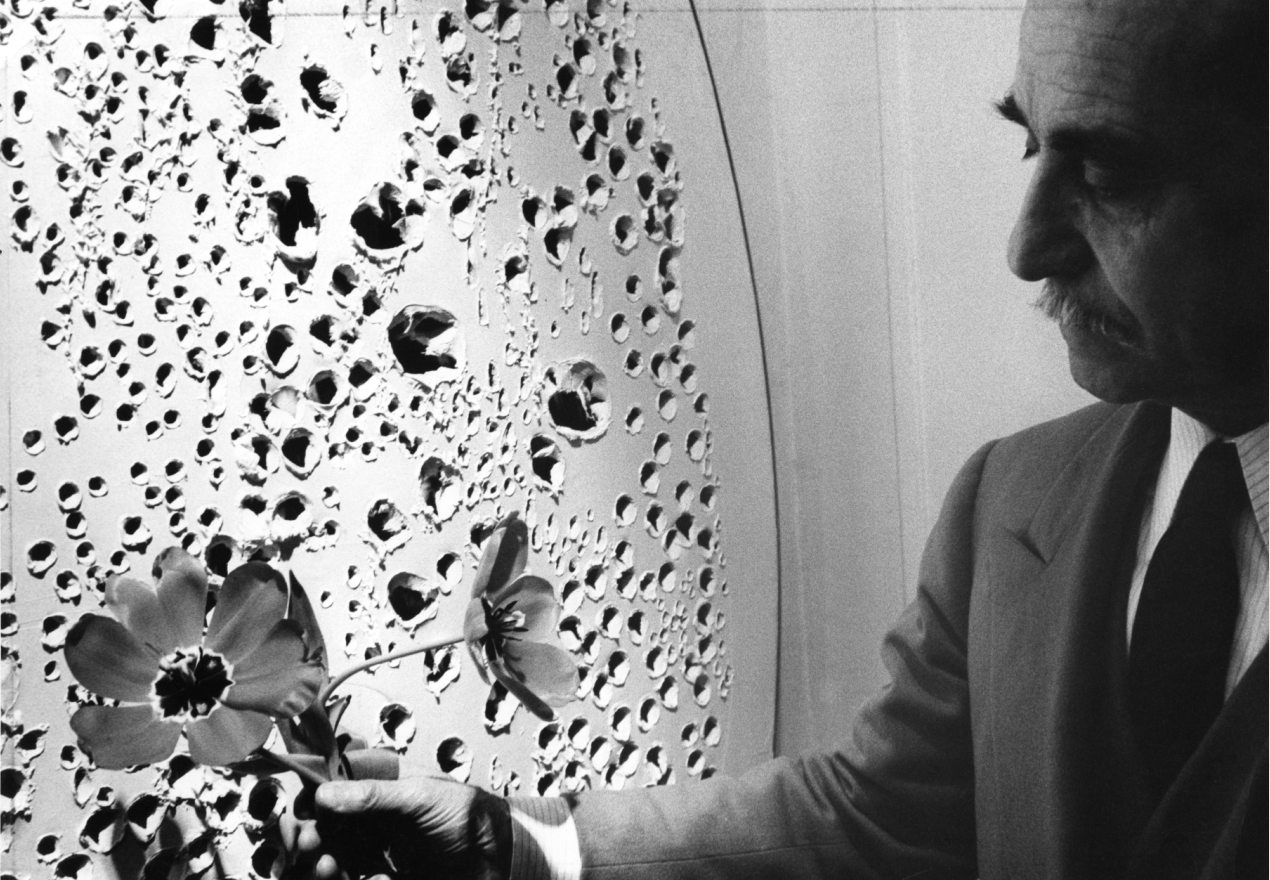
Lucio Fontana : Beyond The Picture

"There is no stage at which "man" does not demarcate, beacon or sign his space, leaving traces that are both symbolic and practical."

Lefebvre, The Production of Space, 


My art rests wholly on this purity, on this philosophy of nothingness, which is not a nothingness of destruction, but a nothingness of creation. And the cut, or properly, truly, the hole, the first holes, was not the destruction of the picture. The formless gesture … was precisely a dimension beyond the picture, the freedom to conceive art through any medium, through any form. —Lucio Fontana 
 The Italian artist born February 19, 1899 in Rosario, Argentina. 
__________ 
Image: Lucio Fontana at his exhibition opening, Galerie Iris Clert, Paris, 1964, Photo by Shunk-Kender, © Fondazione Lucio Fontana http://russellmoreton.tumblr.com/post/139739887062/gagosiangallery-my-art-rests-wholly-on-this