
Tuesday, 19 April 2022

Monday, 4 April 2022
Simplicity and Complexity : Artist/Archivist (playing/thinking with material practices)
Archive Research Material
Developing non-linearity/entanglements throughout creative practice
Curiously, we live in a conflicted time of both accelerated change and business-as-usual, a time of both transformation and stagnation. For the first time in history we have a global network that is in constant and instant communication with itself-everywhere. We have the much examined problems of ecological stress, urban alienation, and spiritual confusion.
The Architecture Of The Jumping Universe, Charles Jencks.
Emergence/Self Organisation
Maternal Body : Clay Impression and Fragmented Form
Pastoral Space: Material, Inquiry and Craft.
Material Agency : Carl Knappett, Lambros Malafouris
Visualising Environmental Agency
"Agents are defined as persons or things, which have the ability and intention to "cause" something "in the vicinity" or "in the mileau" to happen ( Gell 1998)"
"These latter artefacts are described with the term "index", to remove the appellation "art" and to imply that they are indexes of agency."
Some Stimulating Solutions, Andrew Cochrane.
1000 "pots" performative site 2011. The Yard, Winchester.
Auguries into the maternal body. Un-fired clay and silica sand.
Constructed in-situ at the Yard, Winchester.
A life-size record and memory of a human presence as a site for mutual introspection.
Inspired in part from the novel " The Children of Men " by P D James.
CLAY : Speculative City : From Pilgrim to Tourist
From Pilgrim To Tourist (or a short history of identity). Zygmunt Bauman.
Clay drawing/situation/collage based on a performative script/reading.
Human trace drawing with unfired clay bodyscape
Artist Statement/Chapel Arts Residency
Practitioner using the creative receptiveness of material together with the inclusion of drawing to harbour transits and passages of human presence, vulnerabilities centred around the human condition. My work adopts strategies which articulate a sense of absence and anonymity within the abandonment of the work to its location. I feel drawn to this registering of passage, encounter together with its farewell. The choice of materials gathered together implies a personal geography, with both an emotional and aesthetic sense of locality and place. The performative recording by physical means which renders itself as a trace of human presence, now becomes a vacant territory open for the consideration of others.
My work continues to investigate this sense of material response with the performative trace of a human absences. The place-ment of these acts attempts to promote thresholds from which to reflect upon spatial, sociological and psychological conditions and perceptions.
Currently working in clay, low fired to produce and promote a fragile vessel. This vessel is installed to act as a dwelling presence reverberating in a resting place. from which work is drawn into the human form to register a surface of absences resulting from past gestures and solitudes.
Russell Moreton a visual artist uses simple gestures of drawn Human traces gathered and presented amongst natural materials. Exploring themes around the Human condition, vulnerability and abandonment. Materials are employed to further underpin our sense of place and time. The act and gesture of drawing adds a ephemeral mark amongst the materiality and locality of place. Currently using clay to register these themes, installing work Augury Vessel into Chapel Arts as part of their research residency programme.
Reflective Journal/Spatial Practices
Spatial/Visual Coordinates
https://www.pinterest.co.uk/russellmoreton/


Developing non-linearity/entanglements throughout creative practice
Curiously, we live in a conflicted time of both accelerated change and business-as-usual, a time of both transformation and stagnation. For the first time in history we have a global network that is in constant and instant communication with itself-everywhere. We have the much examined problems of ecological stress, urban alienation, and spiritual confusion.
The Architecture Of The Jumping Universe, Charles Jencks.
Emergence/Self Organisation
Maternal Body : Clay Impression and Fragmented Form
Pastoral Space: Material, Inquiry and Craft.
Material Agency : Carl Knappett, Lambros Malafouris
Visualising Environmental Agency
"Agents are defined as persons or things, which have the ability and intention to "cause" something "in the vicinity" or "in the mileau" to happen ( Gell 1998)"
"These latter artefacts are described with the term "index", to remove the appellation "art" and to imply that they are indexes of agency."
Some Stimulating Solutions, Andrew Cochrane.
1000 "pots" performative site 2011. The Yard, Winchester.
Auguries into the maternal body. Un-fired clay and silica sand.
Constructed in-situ at the Yard, Winchester.
A life-size record and memory of a human presence as a site for mutual introspection.
Inspired in part from the novel " The Children of Men " by P D James.
CLAY : Speculative City : From Pilgrim to Tourist
From Pilgrim To Tourist (or a short history of identity). Zygmunt Bauman.
Clay drawing/situation/collage based on a performative script/reading.
Human trace drawing with unfired clay bodyscape
Artist Statement/Chapel Arts Residency
Practitioner using the creative receptiveness of material together with the inclusion of drawing to harbour transits and passages of human presence, vulnerabilities centred around the human condition. My work adopts strategies which articulate a sense of absence and anonymity within the abandonment of the work to its location. I feel drawn to this registering of passage, encounter together with its farewell. The choice of materials gathered together implies a personal geography, with both an emotional and aesthetic sense of locality and place. The performative recording by physical means which renders itself as a trace of human presence, now becomes a vacant territory open for the consideration of others.
My work continues to investigate this sense of material response with the performative trace of a human absences. The place-ment of these acts attempts to promote thresholds from which to reflect upon spatial, sociological and psychological conditions and perceptions.
Currently working in clay, low fired to produce and promote a fragile vessel. This vessel is installed to act as a dwelling presence reverberating in a resting place. from which work is drawn into the human form to register a surface of absences resulting from past gestures and solitudes.
Russell Moreton a visual artist uses simple gestures of drawn Human traces gathered and presented amongst natural materials. Exploring themes around the Human condition, vulnerability and abandonment. Materials are employed to further underpin our sense of place and time. The act and gesture of drawing adds a ephemeral mark amongst the materiality and locality of place. Currently using clay to register these themes, installing work Augury Vessel into Chapel Arts as part of their research residency programme.
Reflective Journal/Spatial Practices
Spatial/Visual Coordinates
https://www.pinterest.co.uk/russellmoreton/


Friday, 1 April 2022
Exploring the individual constituent parts of painting : Cyanotype substance on paper.
Outpost 010422

Delicate Cutting
Symbolic of the 'connective tissue' which the photograph itself embodies, the pressure of the cold glass against warm skin glorifies the terms of the medium's indexicality, whilst also pointing out a fundamental disparity.
Notes On The Index, Krauss.
IMMATERIALITY AND TRANSPARENCY : Juhani Pallasmaa.
Technique and Expression in Glass Architecture, 2003.
The Poetics Of Glass
Glass And Modernity
All That Is Solid Melts Into Air
The Technological Imperative
Between Polarities
Technique And Poetry
Return To Animistic Thought
Illusions And Reflections
From Form To Matter
The Secret Life Of Buildings
Mirrors And Symbols
Perfection And Imperfection
The Re-Enchantment Of Architecture
Introduction To Modernity
Henri Lefebvre
SPAB
Leaded Glass, repair, restoration, contemporary use of glass, architectural models in ceramic/glass.

.jpg)
In its framed state, Rothko's painting was constricted and not able to exist, as it should, on its; in other words, to be what it was intended to be.
Robert Ryman : The Dallas Installation.
Exploring the individual constituent parts of painting.
Untitled 1980-2003
Oil on steel plate with four fasteners, 48.3 x 48.3cm.
Page 1998
Oil and graphite on stretched linen, 38.4 x 38.4cm.
A series of visual experiences (interpretations on the art of painting), bracing,sensual, austere and luxuriant forms, calibrated to register from one work of art to the next.
The remarkable thing about Robert Ryman is that he has been working within his own matrix of questions, problems, and definitions for the past fifty years, and is still finding ways to make his art evolve from what has gone before.
Going beyond its appearance, to answer the question of what Ryman's art might mean is, of course, the challenge of abstraction itself, a challenge that has proven to be central to the art of the past century up to the present moment and that can arguably be seen still to define many of the issues of the art of our time.
Robert Ryman has investigated a basic set of closely related questions: how are paintings made, what are they made of, how are they installed in gallery and museum spaces, and hoe are these works experienced by those who come amidst them?
Ryman has concentrated on this specific line of inquiry by exploiting a highly select range of painting's parts: surface, support, medium, placement before the viewer, and importantly colour.
Ryman's art is about, and is itself, the paint on the surface of a material that is affixed to or hung on a lighted wall in a gallery or a museum.
It is a square made from any number of materials, and it shows exactly how it was made, what type of brushes or other instrument the artist used in applying liquid pigment, what its surface is, how its paint is affected by underpainting (the placing of one pigment over another to render a visual sensation), how its colours behave, what its material support is, and how it is placed before the eyes (scale has much to do with this), whether on a flat wall or somehow otherwise installed in relation to that wall.
Ryman describes the existence of something mysterious in Rothko with which Ryman was intrigued, so much so that he remembered its effect decades later. What stayed with Ryman, it appears, were Rothko's “form, structure, surface, and light,”
By the extreme boiling down of a painting's constituent parts, Rothko presented the viewer with an experience unlike any other to be found in contemporary life: that of a work of art defining itself and then acting strictly within this definition according to its own set of rules.
What was radical about Rothko, was that there was no reference to any representational influence. There was colour, there was form, there was structure, the surface, the light, the nakedness of it, just there.
What Rothko was after, the invocation of universal themes of human existence voiced through a vocabulary of numinous light-filled forms, was clearly not something Ryman pursued in his own art. Over and over, Ryman makes openly visible the way he paints and what he paints with: the meaning of the work seems to radiate insistently from these facts.
Charles Wylie, 2005.


.jpg)
Thursday, 31 March 2022
Building Within The Drawing ( The Studio) : Immaterial Architecture
'Ordinary things contain the deepest mysteries'
The Social Condenser in Operation.
Five figures and a stature distributed evenly in its isotropic space; a picture of the socialized as opposed to the sociable.
Robin Evans,
Figures,Doors and Passages.
Building The Drawing
The drawing as analogue allows more subtle relations, of technique, material and process, to develop between drawing and building.
Immaterial Architecture
The Illegal Architect
Jonathan Hill
Oak Tree
Oil
Paper
Plaster
Rust
Sgratfito
Silence
Sound
Steel
Television
Weather
Frosted Light
Index of immaterial architectures
TRANSPARENCY : LITERAL AND PHENOMENAL
Colin Rowe, Robert Slutzky
Interactions of the Abstract Body
Josiah McElheny
Object Lesson
Interactive Abstract Body (Square)
The Spatial Body (After Fontana)
Tracing Eisenman
Stan Allen
Indexical Characters
FABRIC=MASS+ FORM
Alan Chandler
The interest in fabric formwork is in its deployment in a building process, which is faster than conventional formwork. Fabric formwork is inherently more sustainable due to the minimising of both concrete and shuttering, and more radically, allows the constructor to intervene in the process of casting even as the cast is taking place.
ANTI OBJECT
Kengo Kuma
We are composed of matter and live in the midst of matter. Our objective should not be to renounce matter, but to search for a form of matter other than objects.
What that form is called- ARCHITECTURE, GARDENS< TECHNOLOGY is not important.
ReThinking Matereriality
The engagement of mind with the material world
Elizabeth DeMarrais, Chris Gosden, Colin Renfrew
The Affordances of Things
Towards a Theory of Material Engagement
Aesthetics, Intelligence and Emotions
Relationality of Mind and Matter
Material Agency
Towards a Non-Anthropocentric Approach
Carl Knappett, Lambros Malafouris
At The Potter's Wheel : An Argument for Material Agency
We should replace our view of cognition as residing inside the potter's head, with that of cognition enacted at the potter's wheel.
The Neglected Networks of Material Agency : Artefacts, Pictures and Texts
Material Agency as Cognitive Scaffolding
The Cognitive Life of Things
Material Engagement and the Extended Mind
Lambros Malafouris, Colin Renfrew
Minds, Things and Materiality
Michael Wheeler
Communities of Things and Objects : A Spatial Perspective
Carl Knappett
Imagining the Cognitive Life of Things
Edwin Hutchins
Things and Their Embodied Environments
Architectures for Perception
Structuring Perception through Material Artifacts
Charles Goodwin
Leach Pottery, Studio and Museum
A Potter's Book
Bernard Leach
Adventures of the Fire, Vessels Through Time
Ceramic Pavilion
People make space, and space contains people
Ceramic space and life
Gordon Baldwin
Objects For A Landscape
David Whiting
Vessels-Spaces that cannot be drawn, rather they need to be experienced.
Imagining a Vessel in a Rock on a Beach, 2006,(charcoal on paper)
The Architecture of The Ceramic Vessel
The use of the vessel in the investigation of our world.
The exploration through the dichotomy of the analysis between exterior and interior, of one pot to another and from the message they convey.
MATERIAL MATTERS
ARCHITECTURE
AND MATERIAL PRACTICE
Katie Lloyd Thomas
PLENUMS : RETHINKING MATTER, GEOMETRY AND SUBJECTIVITY
Peg Rawes
ARCHITECTURE
IN THE AGE OF DIVIDED REPRESENTATION
The Question of Creativity in the Shadow of Production
Dalibor Vesely
The Nature of Communicative Space
Creativity in the Shadow of Modern Technology
The Rehabilitation of Fragment
Towards a Poetics of Architecture
The Projective Cast
Architecture and its Three Geometries
Robin Evans
Architects do not produce geometry, they consume it
Analysing ARCHITECTURE
Simon Unwin
Geometries of Being
Architecture as Making Frames
Space and Structure


The Social Condenser in Operation.
Five figures and a stature distributed evenly in its isotropic space; a picture of the socialized as opposed to the sociable.
Robin Evans,
Figures,Doors and Passages.
Building The Drawing
The drawing as analogue allows more subtle relations, of technique, material and process, to develop between drawing and building.
Immaterial Architecture
The Illegal Architect
Jonathan Hill
Oak Tree
Oil
Paper
Plaster
Rust
Sgratfito
Silence
Sound
Steel
Television
Weather
Frosted Light
Index of immaterial architectures
TRANSPARENCY : LITERAL AND PHENOMENAL
Colin Rowe, Robert Slutzky
Interactions of the Abstract Body
Josiah McElheny
Object Lesson
Interactive Abstract Body (Square)
The Spatial Body (After Fontana)
Tracing Eisenman
Stan Allen
Indexical Characters
FABRIC=MASS+ FORM
Alan Chandler
The interest in fabric formwork is in its deployment in a building process, which is faster than conventional formwork. Fabric formwork is inherently more sustainable due to the minimising of both concrete and shuttering, and more radically, allows the constructor to intervene in the process of casting even as the cast is taking place.
ANTI OBJECT
Kengo Kuma
We are composed of matter and live in the midst of matter. Our objective should not be to renounce matter, but to search for a form of matter other than objects.
What that form is called- ARCHITECTURE, GARDENS< TECHNOLOGY is not important.
ReThinking Matereriality
The engagement of mind with the material world
Elizabeth DeMarrais, Chris Gosden, Colin Renfrew
The Affordances of Things
Towards a Theory of Material Engagement
Aesthetics, Intelligence and Emotions
Relationality of Mind and Matter
Material Agency
Towards a Non-Anthropocentric Approach
Carl Knappett, Lambros Malafouris
At The Potter's Wheel : An Argument for Material Agency
We should replace our view of cognition as residing inside the potter's head, with that of cognition enacted at the potter's wheel.
The Neglected Networks of Material Agency : Artefacts, Pictures and Texts
Material Agency as Cognitive Scaffolding
The Cognitive Life of Things
Material Engagement and the Extended Mind
Lambros Malafouris, Colin Renfrew
Minds, Things and Materiality
Michael Wheeler
Communities of Things and Objects : A Spatial Perspective
Carl Knappett
Imagining the Cognitive Life of Things
Edwin Hutchins
Things and Their Embodied Environments
Architectures for Perception
Structuring Perception through Material Artifacts
Charles Goodwin
Leach Pottery, Studio and Museum
A Potter's Book
Bernard Leach
Adventures of the Fire, Vessels Through Time
Ceramic Pavilion
People make space, and space contains people
Ceramic space and life
Gordon Baldwin
Objects For A Landscape
David Whiting
Vessels-Spaces that cannot be drawn, rather they need to be experienced.
Imagining a Vessel in a Rock on a Beach, 2006,(charcoal on paper)
The Architecture of The Ceramic Vessel
The use of the vessel in the investigation of our world.
The exploration through the dichotomy of the analysis between exterior and interior, of one pot to another and from the message they convey.
MATERIAL MATTERS
ARCHITECTURE
AND MATERIAL PRACTICE
Katie Lloyd Thomas
PLENUMS : RETHINKING MATTER, GEOMETRY AND SUBJECTIVITY
Peg Rawes
ARCHITECTURE
IN THE AGE OF DIVIDED REPRESENTATION
The Question of Creativity in the Shadow of Production
Dalibor Vesely
The Nature of Communicative Space
Creativity in the Shadow of Modern Technology
The Rehabilitation of Fragment
Towards a Poetics of Architecture
The Projective Cast
Architecture and its Three Geometries
Robin Evans
Architects do not produce geometry, they consume it
Analysing ARCHITECTURE
Simon Unwin
Geometries of Being
Architecture as Making Frames
Space and Structure


Monday, 28 March 2022
Working Notes : Sensing Space a camp within a creative landscape
WORKING NOTES
IMMATERIAL
ARCHITECTURES
MAKING IN THE LANDSCAPE
The House-sheds :
Camping
There's more truth
about a camp than a house. Planning laws need not worry the
improvising builder because temporary structures are more beautiful
anyway, and you don't need permission for them. There's more truth
about a camp because that is the position we are in. The house
represents what we ourselves would like to be on earth: permanent,
rooted, here for eternity. But a camp represents the true reality of
things: we're just passing through.
Roger Deakin
WILDWOOD
A Journey Through Trees
Russell Moreton,
Speculative Spatial Practices
A reflective building
is an echo not a statement.
Haptic devices/seating/dwelling in the landscapes of the mind.
Landscape assemblages and the significance of solitude.
The immensity/intimacy and its immediacy to the imagination.
Immensity is within ourselves Bachelard
Haptic devices/seating/dwelling in the landscapes of the mind.
Landscape assemblages and the significance of solitude.
The immensity/intimacy and its immediacy to the imagination.
Immensity is within ourselves Bachelard
The site a Raveningham
offers the spatial practice of a social event and the opportunity to
playfully engage with architectural forms, fine art surfaces and
textures.
The sensing space, a
sculptural assemblage created at Raveningham is an inquiry into
'making' and 'reflexivity' amongst a social landscape.
Supportive
Material/Texts/Cyanotype Drawings from found objects
AFFECT
SENSATION / CAUSALITY
LIVING
THINKING
LOOKING
DRAWING and THE LAW OF
STRATIFICATION, the inevitable results of the working of GRAVITY
STRATIFICATION OF
RECOLLECTION / MEMORY OF THE WORLD. (A Land, J Hawkes )
FACTORING THE TACTILE
CONDITIONS OF THE REAL WORLD into perceptual awareness
PERCEPTUAL
psychologist, J.J. Gibson departs from 'the classical approach to
depth or space' in favour of an ECOLOGICAL approach to VISUAL SPACE
PERCEPTION, which take SURFACES and TEXTURE as its starting point.
Mediating the
experience of LANDSCAPE
SITE / COLLAGE /
COMPONENTS working/walking, developing a creative spatial syntax
COLOUR AS CONDUIT /
PERCEPTUAL ENVIRONS / CRAFT MEDIA / IMPROVISATION
PIERCED / DAPPLED
NATURAL LIGHT
DIFFERENTIATED SHADOW /
SURFACE
EXTRAORDINARY MATERIALS
/ TECTONICS AND TEXTILES
INDEXICAL / GESTALT /
VISUAL PERCEPTION
NETWORKS / RESOURCES /
AGENCY for the potential of BUILDING
SCAFFOLDS / GAUZE /
POCHE solids of a building/architectural plan
ABSENCES /
INTERSECTIONS / GRIDS / MESHES / SPRAYS / MOTIFS
ACTUALITY
IMMATERIAL / REPETITION
/ SINGULARITY
ENCLOSURES /
ITERATIONS / THINKING FORMS
MINIMALIST SPACES /
INTERVALS, tuning objects to construct environments
A child 'concretizes'
its existential space.
Dwelling,
Reverberations, Epiphanic Instant, Gaston Bachelard.
Tidbury Ring, field
drawings with cyanotype liquid on paper.
A Hut of Ones Own.
Heidegger for
Architects.
Immaterial
Architectures.
SENSING AND SPATIAL
PRACTICE
EXPLORING THE
LANDSCAPE, through the CORPOREAL EXPERIENCE of OTHERS
A STRUCTURE INTERPOSED
between the sunlight and the interior space it encloses.
Poetic
abstractions/Physical experience
Soft/Blurring
boundaries between art and the everyday making/becoming
REFLEXIVITY /
TRANSLUCENCY surfaces into an architectural presence
TEXTURES / LIMINALITY
on the absence of material
STATIC ENVIRON /
ANIMATED THROUGH THE BODY
THE ARCHITECTURAL SKIN
/ SURFACE, Blurring, revealing, masking, filtering,
ARCHITECTURAL FEATURE /
WALL / ARCH / PASSAGE /
VISUAL TOOL / POCHOIR,
hand coloured through stencils
SCULPTURAL ASSEMBLAGES,
towards Speculative Forms/Expression
TECTONICS IN MAKING,
and the tectonics of immateriality/traces hidden by building.
Concerned with
bringing the material from its physical form into the meta-physical
world.
PAVILION
FUSELAGE
THE CAMP/HUT
represents the true
reality of things, Deakin.
The building as nothing
more than an exposition of itself.
A subjective
hypothesis, a drawing developed into an objectivity for
experience/learning.
SITE, the undoing of
PLACE
BRICOLAGE / HEURISTIC
PRACTICE, Using things at hand, temporal, self constructions,
becomings, mind forming explorations.
MOBILITY
MOVEMENT
TEMPORAL CONSTRUCTED
SPACE
A building component,
scaffold, joists and fixings, a surface of absences and the movement
of others come together.
MAKING, from form to
programme.
ABSURDITY
POLEMIC POETRY
CONFLICTING
DYSFUNCTIONAL
TETHERED FOLLY against
a fabric of time.
ART AS INDETERMINATE,
able to arrest perceptions into different states (becomings)
Stone Worlds
Narrative and
Reflexivity in Landscape Archaeology
Architecture and
Ritual, how buildings shape society.
Bought to Light
Photography and The
Invisible 1840-1900
CURATORIAL / DEVICE /
BENCH / INTERLOCATOR
Jannis Kounellis,
Theatre, stage crew shifting actors during a performance.
Interconnected, between
contexts, opening places between the social fabric.
Making spaces,
expanding vision to create spaces 'between' in which to write
ourselves.
CONTEXT AND
CONSIDERATIONS / MAKING, EXHIBIT, VIEW
ART MUSEUM CULTURE
THE CONTEXT FOR
CONTEMPORARY ART IS THAT WE MAKE, EXHIBIT AND VIEW
MUSEUM DIRECTOR,
CURATOR, COLLECTOR, ARTIST
None of that means
anything anymore. Artists are now more DIVIDUALISTIC. They discover
themselves not by securing a role within the historic narrative of a
chosen medium. But by INTERGRATING into a more DIFFUSE ECOLOGY that
involves not only making art, but also putting on shows, publishing,
organizing events, teaching, networking.
THE STUDIO is no longer
a retreat, but it now INTEGRATES, IT IS ALL EXTERIOR.
THE NETWORK places the
artist as a 'like' ITEM within an INTEGRATIVE INVENTORY or
DATABASE.


Tuesday, 22 March 2022
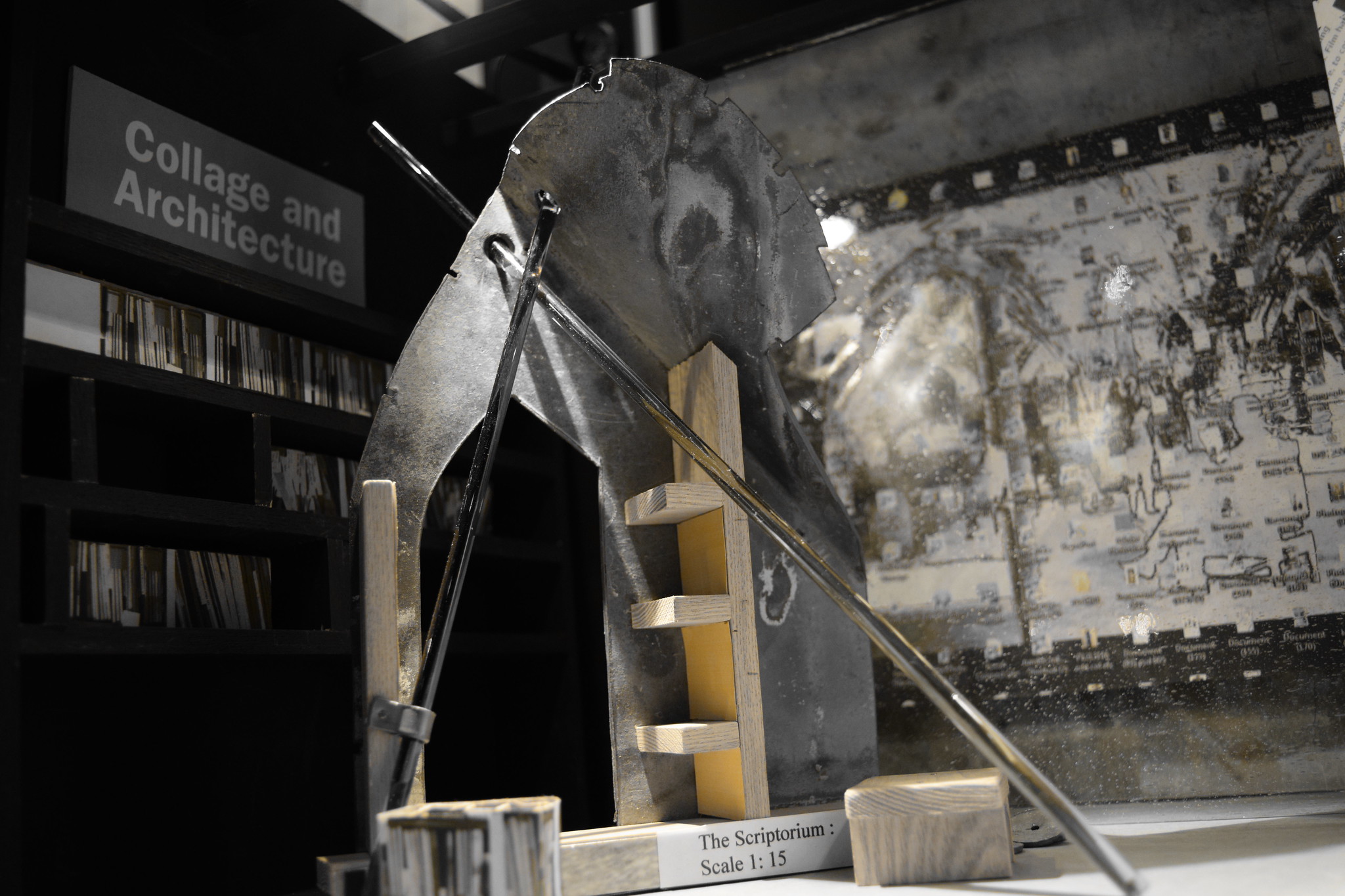
The Scriptorium : Collage and Architecture
Theatre for Speculative Research/Architectural Model
Russell Moreton
Monday, 21 March 2022
Anthropological Entanglements : Strange Tools/The Rings of Saturn
Walking into Emergent Landscapes : Covehithe Beach
The OLD WAYS, a JOURNEY ON FOOT, Robert Macfarlane
“ Walking was a means of personal myth-making, but it also shaped his everyday longings:
Edward Thomas not only thought on paths and of them, but also with them.”
“To Thomas, paths connected real places but they also led out-wards to metaphysics, backwards to history and inward to the self. These traverses- between the conceptual, the spectral and the personal-occur often without signage in his writing, and are among its most characteristic events. He imagined himself in topographical terms.”
DSC_0585 Covehithe : Walking/Thinking/Physical Entanglements in the Landscape
Natural History : Dried Carnations
Blueprints : Anthropological Forms
Botanical traces with leper graves
https://www.flickr.com/photos/russellmoreton/


24 March 2018
Thursday, 17 March 2022


Wednesday, 16 March 2022
Affective Materials : Fragile and Bandaged Subjectivities
Painting and Clay Construction : Few boundaries are impenetrable : They are rather, semi-permeable membranes providing housing while allowing selective commerce
Orange School Graph Books, Harleston, Norfolk.
Elliptical Phenomena
Body/Landscape : Vessels and Patina
Site-Specificity/Spatial Practice
The vessel (making, thinking, subject) as both a historically grounded form, and a vehicle to examine abstract aspects of the physical body and the natural world.
The distinguishing characteristic of today's site-oriented art is the way in which both the art work's relationship to the actuality of a location (as site) and the social conditions of the institutional frame (as site) are subordinated to a discursively determined site that is delineated as a field of knowledge, intellectual exchange or cultural debate
Miwon Kwon 1997
Whilst temporary exhibitions can expand the scope of medium-specific discourse, they can also impose alternative, but equally restrictive frames
Participation, creating a bridge between socially engaged practice and the permanent collection
Expressing itself expressing
Creating a conceptual and linguistic dexterity between absolutes, certainties, definitions
Dissolving the intellectual relevance, with its symbiotic relationship with utility to create 'vessels' beyond art and artifact
The strategy of making artworks as response
The Ceramic Object, by means of preservation and display becomes a vehicle/vessel for a social and historical narrative/entanglement/engagement
Making vessels, beyond the examining and intellectually impoverished questions
A vessel is identified as such by its physical disposition, giving shape to the contents and clarifying what is inside and what is outside
Few boundaries are impenetrable
They are rather, semi-permeable membranes providing housing while allowing selective commerce
Like the vessel, the house shapes and nurtures the life contained inside
The Factory I build in the Tate is a place to discuss the transactions and transformations of Labour that Create Knowledge and Community
In the Factory we will examine skills and how we form Exchanges at Work , with ourselves and with others
Clare Twomey, Lead artist at Tate Exchange 2017
Post Studio Ceramics
Interfaces between Making-Makers-Museums
Exploring object engagement beyond the known historical models of clay practice
'Generate' Historical Material and Spatial Relations as they interacted with the work, and reflected on the role of the Museum/Hospital
Clare Twomey
Ceramics In The Environment
An International Review
Janet Mansfield 2005
With Fire, Richard Hirsch
A Life Between Chance and Design (invites the unknown)
Scott Meyer 2012
Hirsch takes us to the heart of the interface between ageless earth and the spare evidence of the rhythm of human utility
Raku as an Ideology
Breath-Energy-Immanence
Raku, A Review of Contemporary Work
Tim Andrews 1994
The Poetry of The Vessel
A calm invitation to thought and imagination
Chris Tyler
DSC_6918 Ceramic Slabs, wire and cloth on painting
Fragments from Augury Vessel Series


Subscribe to:
Posts (Atom)