Showing posts with label memory. Show all posts

Friday, 10 April 2026

Wednesday, 11 September 2024

Studio Works : In art we conceive and combine new forms that enrich our lives.

Outpost 281123

Studio Works.


Human beings are unique in retaining the capacity for play.

In art we conceive and combine new forms that enrich our lives.


To live more intensely than usual, inhabiting the whole of our humanity.


Mythology is an art form that points beyond history to what is timeless in human existence, and as such it (myth) helps us to get beyond the chaotic flux of random events, and perhaps allows a glimpse at the core of reality.

A Short History of Myth.

Karen Armstrong.


The Haptic Sense of Making.

Doing and feeling at the  same time.


The physical/spiritual/corporeal sense of being/becoming.


The Spatial Dimension.

Defining Self/Organizing Experience.

The human body its feelings at the centre of the architectural form.


Making Atmospheres/Environments. 

A Place Set Apart.

Mark Rothko.


WORK, volumes 1-6.

Don't Forget The Lamb.

Lamina.

Brian Clarke.


NOT FOR RESALE.

BOOKS FOR EDUCATIONAL USE ONLY.

Sowing the seeds of knowledge.

Dawson Books.


Body, Memory, and Architecture.


In the hands of a brilliant craftsman like Mies van der Rohe, a spatiality of alienation may still provide its rewards through the elegance of material and construction. But the more extreme applications of Cartesian space present an insidious threat to our identity as individuals. The other extreme to alienation of the body is over-manipulation of the body. Our bodies are circuited out of existence as our world is realized in electonically stimulated sensation.


To help people inhabit the world, we feel, the basic act is not organizing but caring; the architect's client is not undifferentiated society but caring individuals. In the rhetoric of the past decades, the difficult act of dwelling , based on the act of caring, is elitist. It requires effort, and that sets some apart from others. 


The architects' proper role, it seems to us, is an accepting and absorbing one, to encourage others to make the effort and to develop the physical surrounds that make dwelling possible and attractive. Curiously, the wholesale inhuman 'social' manipulation of urban form by twentieth-century architectural and planning offices has put a disproportionate emphasis on originality, on the unique.


Rather, we believe, the design of the environment is a choreography of the familiar and the surprising, in which the familiar has the central role, and a major function of the surprising is to render the familiar afresh.


Kent C. Bloomer, Charles W. Moore. 1977


Alternative Construction.

Contemporary Natural Building Methods.


Prototyping For Architects.

Sensing Spaces.


Marking The Line.

Ceramics and Architecture.


Sunday, 30 June 2024

The Sleeper Awakes : Veiled Melancholy/Book Narratives : Film Collages. #3

Preface (1921) ” The great city of this story is no more than a nightmare of Capitalism triumphant, a nightmare that was dreamt a quarter of a century ago. It is a fantastic possibility no longer possible. Much evil may be in store for mankind, but to this immense, grim organization of servitude, our race will never come” H.G. Wells. Easton Glebe, Dunmow,1921.

28/01/2016

https://uk.pinterest.com/russellmoreton/art-objects-russell-moreton/

"Spatial turn" The increased attention to matters of space, place and mapping in literary and cultural studies, as well as in social theory, philosophy, and other disciplinary fields.

Spatiality, Robert T. Tally Jr. Routledge 2013.


 The Politics of Architecture : Theorizing through speculative spatial practices.

Immediate Architectural Interventions, Durations and Effects : Apparatuses, Things and People in the Making of the City and the World. Alberto Altes Arlandis, Oren Lieberman. 2013


"He rubbed his eyes. The riddle of his surroundings was confusing but his mind was quite clear - evidently his sleep had  benefited him. He was not in a bed at all as he understood the word, but lying naked on a very soft and yielding mattress, in a trough of dark glass. The mattress was partly transparent, a fact he observed with a sense of insecurity, and below it was a mirror reflecting him greyly. Above his arm- and he saw with a shock that his skin was strangely dry and yellow - was bound a curious apparatus of rubber, bound so cunningly that it seemed to pass into his skin above and below. And this bed was placed in a case of greenish-coloured glass (as it seemed to him), a bar in the white framework of which had first arrested his attention. In the corner of the case was a stand of glittering and delicately made apparatus, for the most part quite strange appliances, though a maximum  and minimum thermometer was recognizable."

H. G. Wells : The Sleeper Awakes. 1899/1910


Sunday, 21 April 2024

Communicative Space Of Drawing : Radical pedagogy transduces rather than transmits.

 Outpost 081223


The Communicative Space Of Drawing.

Braking down research.

Radical pedagogy transduces rather than transmits.

Re-combinent poetics/praxis.


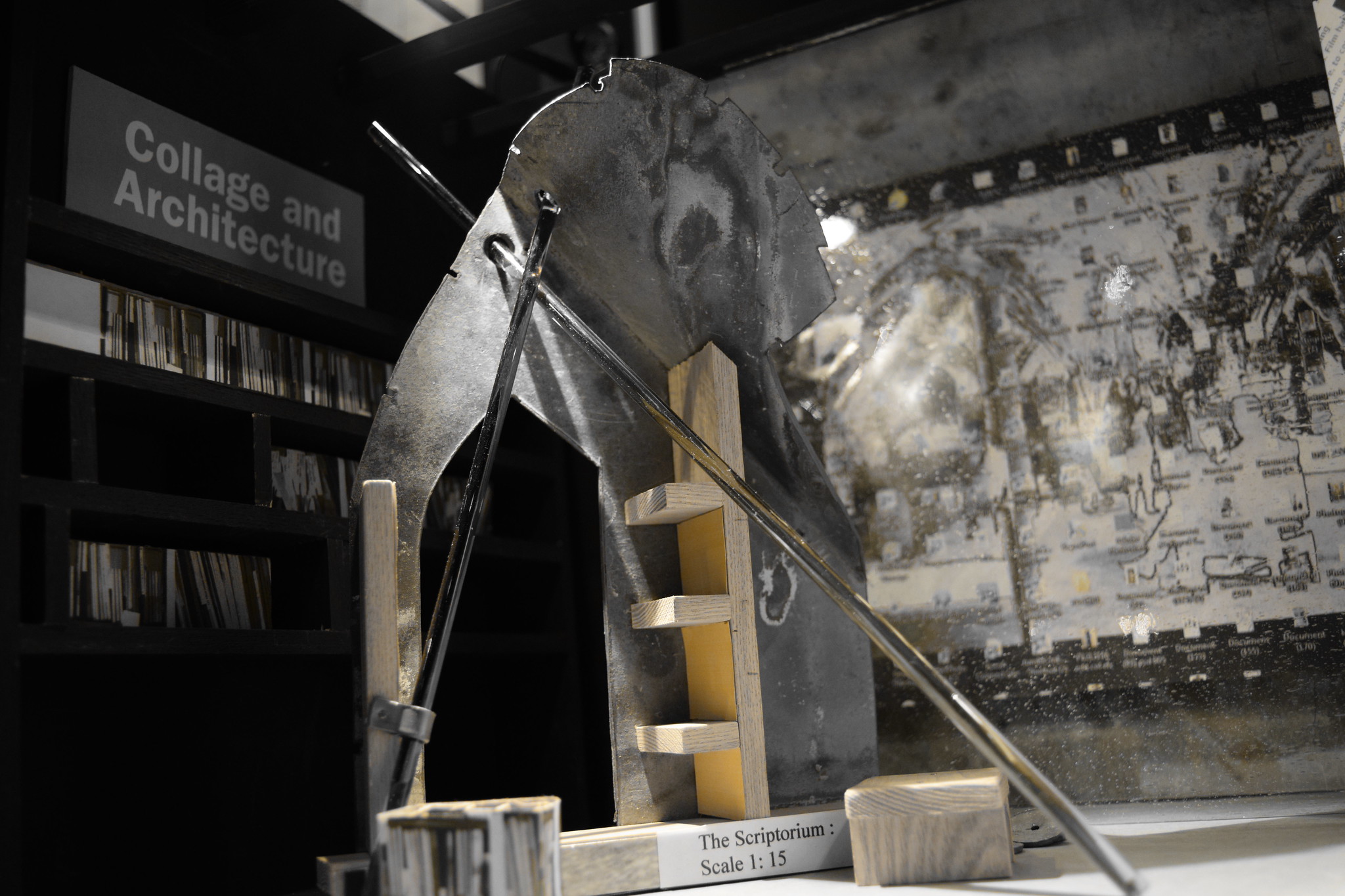
The Architectural Scriptorium

The Photographic Darkroom.

The Observatory.


Drawing, defined variously as an extruding, a gathering and/or a pulling closer.


The paradoxical nature of drawing is that it is simultaneously a form of recording and invention, somewhere situated between unconstrained gestures and the reiteration of a point of view.


To re-examine the significance of the human body through drawing performatively and architecture.


To understand how buildings affect individuals and communities emotionally, how they provide people with a sense of joy-identity-and place.


Across The Space Of A Page.

Drawing Propositions/Propulsions from the Body.  

Landing Sites: Organism/Person/Environment


The World Opens Up In Front Of Us And Closes Behind.


The experience of our bodies, of what we touch and smell, of how well we are 'centred' is not locked into the immediate present, but can be recollected through time and memory.


Collisions with Bounded Spaces.

The Haptic and Geometric Grid/Centripetal and Centrifugal Radials. 


Haptic choreographies/circulations that create collisions with environments and bodies.


Body 'fit' and movement is affected by the haptic sense and by the tactile qualities of the surface and edges we encounter.


Patterns are composed mostly of paths and places, but it is the system by which they are related, that allows us to make sense of a bounded space.


Place and its choreography of collision that facilitate the transaction between body, memory and architecture, allowing us to dwell in them in the fullest sense.


All architecture in its beginnings was derived from a body-centred sense of space and place. The power of the home, comes from its being the one piece of the world around us which still speaks directly of our bodies as the centre and the measure of that world.


Buildings can encourage a choreography of dynamic relationships among the persons moving within their domains. 


Emily had been playing house in a nook right in the bow of a boat and tiring of it, she was walking rather aimlessly aft – when it suddenly flashed into her mind, that she was SHE.


Gaston Bachelard.

Poetics of Space.


Emily was neither particularly conscious of, nor looking at, the centre from which she was departing – nor the centre towards which she as walking. But she was able to detect her identity in the bodily act of moving from one centre to another, she recognized that SHE had been withdrawn and was now emerging.


How can the personal world of the body provide an alternative to excessive and disorienting events in the environment?


To diminish the importance of the body's internal values is to diminish our opportunity to make responses that remind us of our personal identity.


Memories at the Centre.

Body, Memory, and Architecture.

Bloomer/Moore.


John Latham.

Drawing/Unbounded Sensations of Time.


The Stage Of Drawing.

Gesture and Act.


Conversation : Avis Newman/Catherine de Zegher.


CdZ: What happens in the space between the gesture moving away from the body, towards everything that is outside of the self, and its landing as a trace on the page?


AN: I was thinking on the way the transmission of thought can depend on the hand and eye, and how this relates to the psychic space in which the mark exists as a potentiality. The effort of the mental and physical act of projection out from the body, away from the body, firstly into the air  -  an act that pitches the hand across the space of the page to site a mark where one intends – is quite a precise act : the most thoughtful and deliberate of acts, which I would speculate harbors a necessary thoughtlessness, in the sense that the certainty of coordinated actions is always in some way provisional and as such relies on the vigilant cooperation between eye and hand.


CdZ: Drawing may also be a recovery of the gesture that allows a discovery for the eye.


AN: To retrieve the gesture in a drawing is to translate the mark back into the action of the hand. It is very pleasurable to recover the gesture in that way and in so doing to follow the action of making. I think that experience in a drawing is very precise.


CdZ: Because the eye manages to discern what has become a trace on paper from a gesture in the air?


AN: Yes, the mind's eye. Perception becomes an act of reconstruction that moves unobtrusively between interior and exterior. I would make an analogy here between how we experience unconscious emotions in the repetition and accumulation of marks (irrespective of what is being drawn) and the intonation, hesitations, and inflections of speech, all of which hold a complexity of messages and can be at odds with what appears to be said, but which nonetheless determine meaning. It seems to me that this occurs independent of sight, as that which is generated by the mind and mediated by perception.


CdZ: In drawing, the space is open-ended and unframed, while the marks are articulated over time and in time.


AN: My concern in making images relates more closely to the conceptual space of drawing, which is less circumscribed  than painting. In particular, the manner in which the boundary or edge comes to define the work is of a completely different order in drawing. In fact, the idea of inside  and outside does not occur in the same way. The marks define a position across the surface and are not registered in relation to limits. As a result the often ambiguous nature of borders can leave a vague uncertainty as to the stability of the image.


CdZ: Can you elaborate on this different notion of boundary?


AN: The natural inclination of mark-making is a relational organisation of individual inscriptive acts, which is not an expression of a unitary world. The frame as the window on the world, which traditionally internalizes the picture. This view creates an illusion  of the unique experience of looking, in the sense that there is coherence to the image. There is not that illusory consistency in drawing, as the space and image are essentially open-ended and speculative. The unframed interferes with any anticipation we might have of ordered limits or completion, and suggests the possibility that something is missing and will always elude our attention, because it cannot be framed. It is the uncertainty of the edge and how it meets the real that I find fascinating.


CdZ: Drawing is thus not to do with perceptual illusionism, but with infinite space as mental possibility. Is the drawing itself, the ground, a space of transience?


AN: There is no pressure from the outside inwards; in drawing, it bis all pressure from the inside outwards. And the idea of boundary then becomes problematic, our boundary as we project it onto the work. The physical structure of a drawing is always conditional, and when one looks, for example, at the drawing by John Latham, One-Second Drawing (17'' 2002) (Time Signature 5: 1) the work itself defies any possibility of framing because the action is embedded in the pure sensation of time. We are left with only the effect. So the idea of framing as a way of 'confirming' the space – this is not part of  drawing's language. The condition of boundaries is that they are dissolvable.


Body, Memory, and Architecture.

Sense/Sensing/Feeling/Memory.

Hapticity and The Body of Memory/Experience.


Haptic drawings are composed of piece by piece responses to the situation at hand, rather than being based on any kind of visual or conceptual grand design.


The stone and wood of a house itself are embodied in these memorable centreplace's and even they belong to the body of memory, something that maybe regarded as possessing uniquely haptic properties.


The heat  from a fire, the rushing water in the fountain, and the smooth tactile objects on the mantle deliver feelings of touch and even permanence. Here in this interior space the lifetime memories of the person collaborate with the timelessness of the world outside.


Exercises on the Haptic Experience of Space.


Drawing Choreographies : Hapticity/Mark-making/The Body.


All architecture functions as a potential stimulus for movement, real or imagined. A building is an incitement to action, a stage for movement and interaction as such it is one partner in a dialogue with the body. 


Egon Schiele/Jenny Saville, drawings rendering an insistent corporeality.

Drawing marks that can be possessed, felt, touched and known, haptic drawings are memories of human experience, seeing, feeling, experiencing and exploring corporeality.


Saturday, 10 February 2024

Lightness/Thresholds of loss and of inside spaces constituted by darkness.

Outpost 050224

Walking with Carlo Scarpa, Brion Cemetary.

Trust in the material and its 'spiritual incitement' that comes from the world.


The spatial dimension of this small building is a metaphor for the mental workings of meditation. The Pavilion is the place where we can enter the minds' empty space/stillness, where we can get away from all our passing concerns.


Thresholds, Carlo Scarpa/Ina Macaione.


Life Affirming Sentiments.

Light-Shade

Bitter-Sweet


Vital Nourishment.

Departing from Happiness.


Feeding the Body.

Feeding the Soul.

Francois Jullien


The Flame of a Candle.

Gaston Bachelard.


On the Loss of (Dark) Inside Space.

Constanze Kreiser.


Is inside space on the verge of disappearing? 

Is it being hindered by constantly improved light technology which is causing one of its fundamental qualities – darkness – to dissipate?

And for what reason?

Is it for the benefit or more outside space?

Or for the benefit of a new spatial quality?

Questioning the way increased use of artificial lighting affects interiors, architectural designer and installation artist Constanze Kreiser opens a philosophical examination of the mediating effect of light. She observes how an enclosure is gradually made lighter in the sense of weight and mass through the addition of openings that emit or filter light. Her polemic on lightness and darkness raises questions of how light measures time, space and inhabitation and the temporal rhythms of everyday existence. 

Light constitutes space in that it creates bright and dim zones, enabling the physical perception of a space.

Space does not originate with the construction of a building, but exists in the act of marking a small unit from an infinite quantity. It is exactly this process which is achieved by sunlight: that which it illuminates is outside, shadowed surfaces forming inside.

Depending on whether lightness or darkness dominates, inside space is a dark space by day and a light space at night. Thus inside space is dependent on light, it is in constant contrast to the prevailing light conditions. Inside space at night has, however, existed only as of the invention of artificial means of lighting – from pine-torches to light bulbs. By day, inside space floats like a dark island in a sea of light.


Bodies and Mirrors.

Ann C. Colley discusses the correlation between physical bodies and their surrounding, particularly  the space of nostalgia and recollection in Victorian literature. Working from the role memory plays in recalling our relationship to known environments. Her text through selected autobiographical accounts discusses the spaces of childhood through the invisible, aesthetic and ubiquitous body, and the proposal that the interior is not simply defined by objects within it, but by our movement and inhabitation around and among them.

Three distinct models of how the consciousness of one's physical being illuminates the interiors of home. John Ruskin text speaks of the invisible body, Walter Horatio Pater of the aesthetic body and Robert Louis Stevenson of the ubiquitous body.

They, Ruskin, Pater and Stevenson considered how their physical being had related to the walls and windows of childhood. Conscious of how this relation defines the sense of one's surroundings, they let their memories resuscitate the dialogue their bodies had once had with these interiors. They understood that it is the child's being that shapes and illuminates the interiors of home. Articles do not define interiors; bodies that move and feel their way among these objects do.


Intimus, Interior Design Theory Reader.


Their orientation anticipates those like Maurice Merleau-Ponty in The Primacy of Perception who argues that it is not through thought, absented from the body, that one knows one's surroundings, but through one's 'bodily situation' – that one is conscious through the body's position in space. This is taken further by twentieth- century architectural theorists such as Kent Bloomer, Charles Moore and Robert Yudell, who insist that one measures and orders the world from one's own body, and that the body is in 'constant dialogue' with the buildings surrounding it.


Body, Memory and Architecture. 


Drawing Inscriptions/Spaces/Breaths.

Remaining in the simplicity of our origins.


A Breathturn.

A flow of energy that wends its way ceaselessly through the world, animating it as it goes. 


Simple pots of simple thinkings/orderings and findings/feelings attained through the privilege/practice of the beginner's mind.

Sadhana, bearing the difficulties of existence.


Working Interiors for the making of the imagination.

Marking of a small subjective space from a infinite quality.

Ceramic Volumes/Vessels and Surfaces/Openings of Light and Dark.


On Drawing/Conversation.

Twombly/Artaud.


Corporeal Acts.

Documents and Sensation.


Images 'exist' in a domain of emotional and physical extremes.

.In drawing, acts of reading and perceiving are concurrent as a simultaneity of mental factors.

I am interested in the way the inter-connectedness between inscription and representation is 'grounded' in the primitive body. I an not speaking of the language of depiction and representation, but of what constitutes the mental energy of engagement, that is so evident in drawing. How the markers of an action translate the murmurings of the mind. For both drawer and viewer the mark and its imaginary space are encountered as a fact of existence as such it is the evidence of beingness, concerning those primitive, dark, and distant moments, etched in our psychic history that exist within the framework of the image that is now being invested in the work.

Avis Newman.


The Doctrine of Introversion.

The artist struggling to conform to the patterns of everyday existence. 

I can't respond to the society I live in.

David Sylvian.


Placidity.

Condemned to the eternal silence of processes.

Zhuangzi.


INTIMUS.

Mark Taylor, Julieanna Preston.

Matrix Key/Components, clockwise.


Practical Issues

The Field of Possibilities.

The Organizing Matrix.

Date of Publication.

Time Period Discussed.

Disciplinary Orientation.


Friday, 25 August 2023

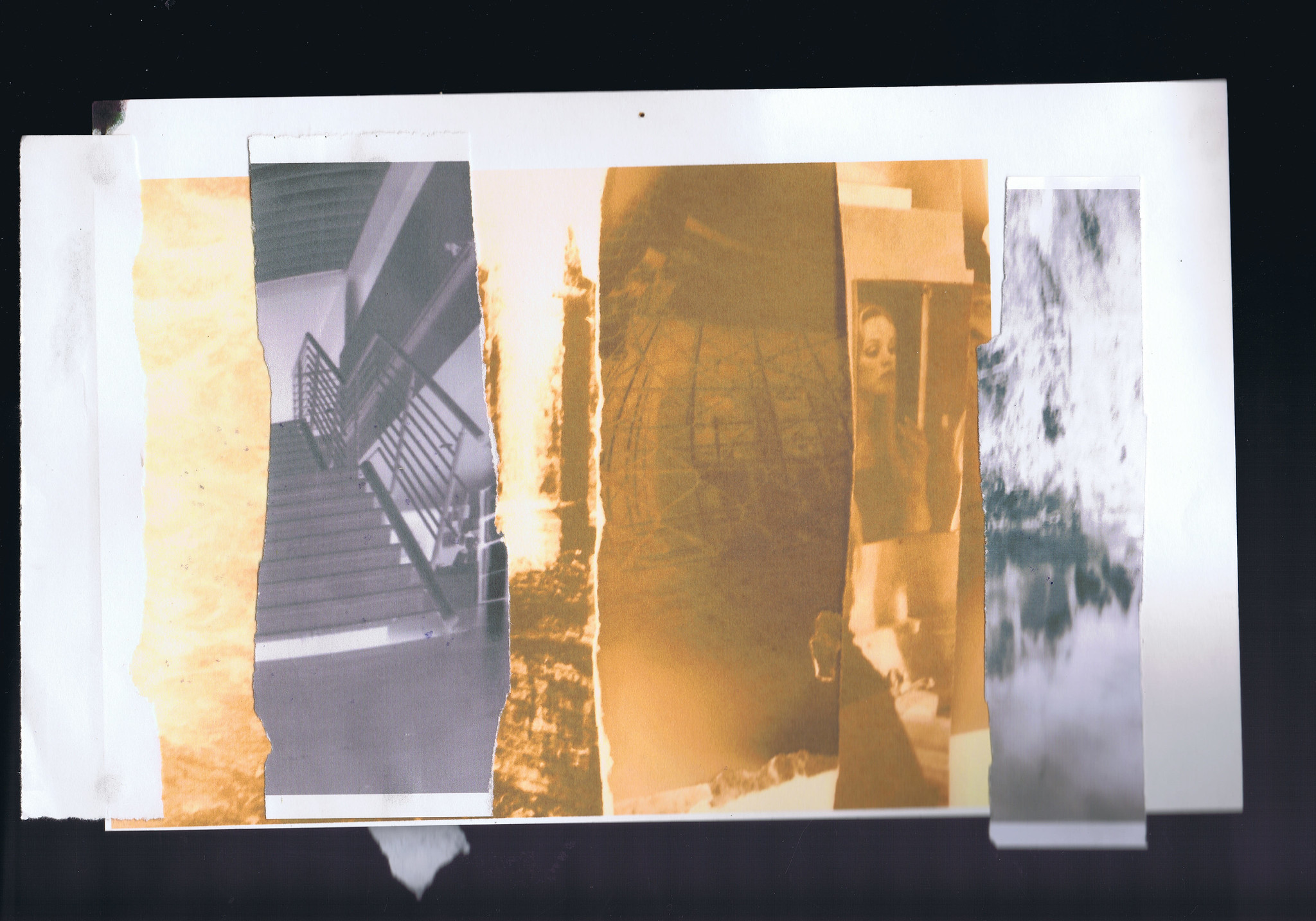
Collage/Abstraction/Assemblage/Beyond Discourse : Architectural Plan/ Library/Victorian Corset/Blueprint/Spatial Frame

Postmodernity is no more than 'modernity' without illusions
Zygmunt Bauman

We are less interested in whether we are living in a critical or post-critical era, because these terms circle round each other. Indeed, it is the fate of all 'post' terms (postmodern, post-critical, post-theoretical) that they never escape the hold of the condition that they would wish to succeed.


On Discourse

From a sociological point of view, discourse includes all that a particular category of agents say (or write) in a specific capacity and in a definable thematic area. Discourse commonly invites dialogue, but discourse is not open to everyone, but based on social appropriation and a principle of exclusion.
Beyond Discourse : Notes on Spatial Agency. Tatjana Schneider and Jeremy Till.


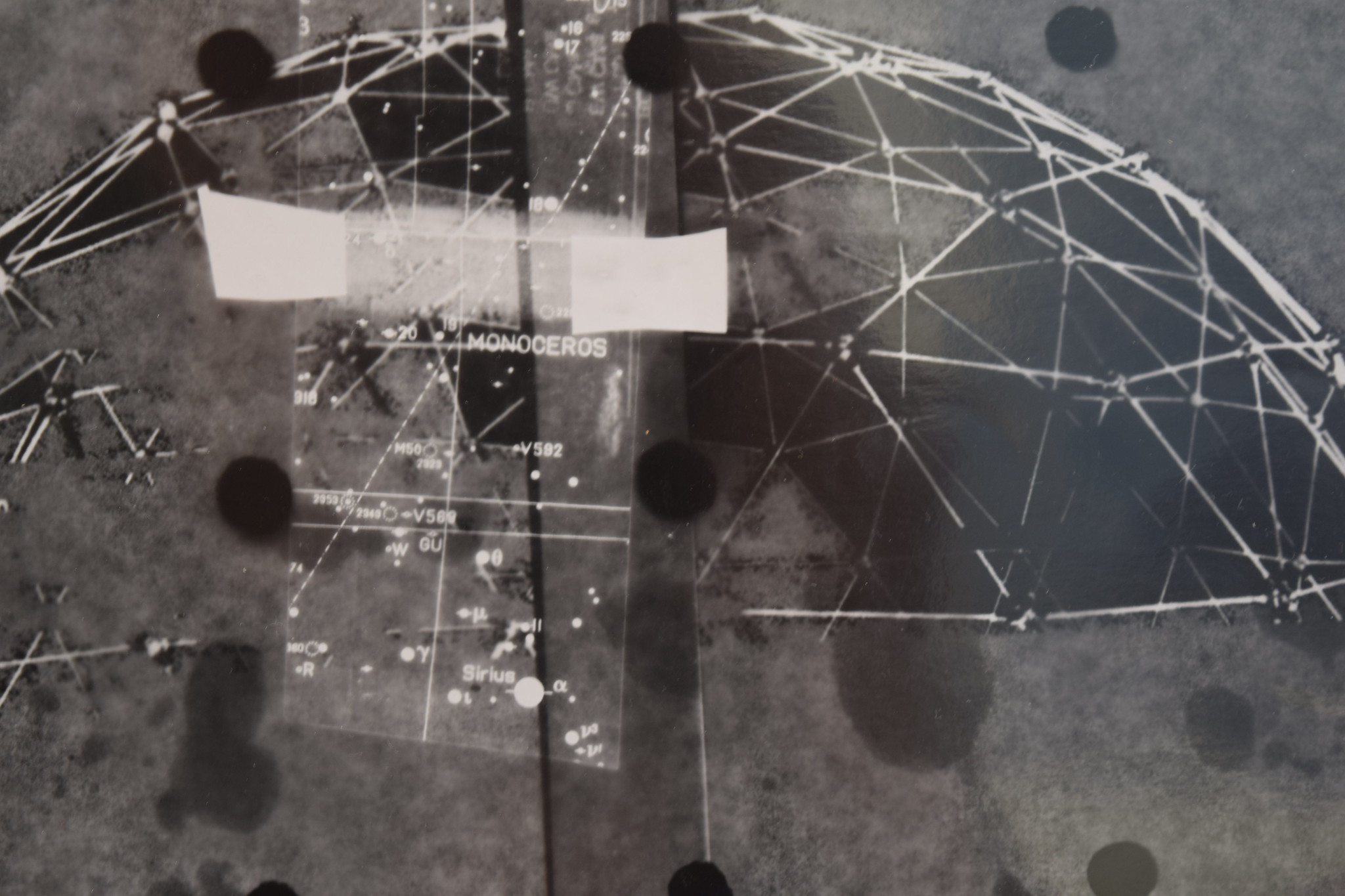
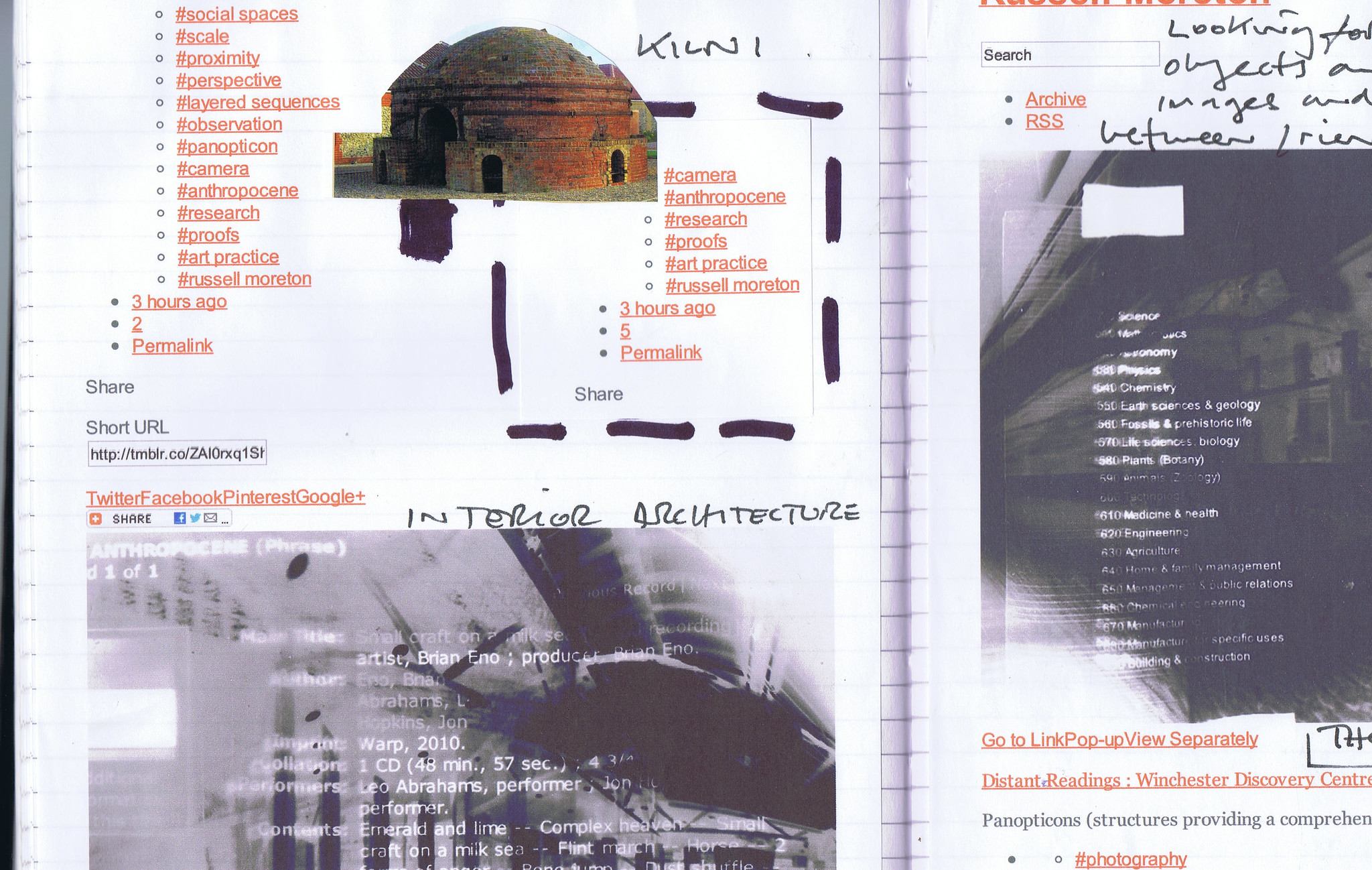
Blueprint, Photogram and Collage
Collage : Diversions/Contradictions/Anomalies
Collage and Architecture


https://www.flickr.com/photos/russellmoreton/


a thousand plateaus
Deleuze, Guattari

http://www.rhizomes.net/issue5/poke/glossary.html

Assemblage

The beauty of the assemblage is that, since it lacks organization, it can draw into its body any number of disparate elements. The book itself can be an assemblage, but its status as an assemblage does not prevent it from containing assemblages within itself or entering into new assemblages with readers, libraries, bonfires, bookstores, etc.


Becoming
Body Without Organs
Nomad
Rhizome
Smooth Space
State
War Machine

Camera Obscura : Reflections and the dark room.

The Library : A Meditation on the Human Condition (Giacometti, artist-philosopher)


Books can step up to us- into us- in many ways.
Voices from Chernobyl by Svetlana Alexievich was for me that rare precipitate force which calls another book into being.

Mario Petrucci, Heavy Water, a poem for Chernobyl.

Paths and Boundaries : Stonehenge

Postmodern : Ever Changing, Fleeting, Positive, Nihilistic,

"There are no simple concepts. Every concept has components and is defined by them.
It therefore has a combination [chiffre]. It is a multiplicity, although not every multiplicity
is conceptual...
Not only do Descartes, Hegel, and Feuerbach not begin
with the same concept,
they do not have the same concept of beginning...
Every concept has an irregular
contour defined by the sum of its components,
which is why,
from Plato to Bergson,
we find
the idea of the concept being a
matter of articulation,
of cutting and
cross-cutting.
The concept is a whole because it totalizes
its components, but it is
a fragmentary whole.
Only on this condition can it escape the
mental chaos
constantly threatening it, stalking it, trying to reabsorb it."


-- Gilles Deleuze and Felix Guattari, What is Philosophy?, pp. 15-16.

Footnote

Critical Modernism, where is post-modernism going?
The Garden of  Cosmic Speculation
Charles Jencks


Monday, 31 July 2023

Daily Rituals : Moving with the affective tone of objects

Outpost 100723

Hungate/Water

The House of Spiritual Retreat.


Emilio Ambasz/Emerging Nature.

Sculpture in the Expanded Field, Rosalind Krauss.


The Art of Memory/Frances Yates.

https://monoskop.org/images/b/be/Yates_Frances_A_The_Art_of_Memory.pdf


Objects and their Relational Potential.

Propositions for Thought in Motion.

Landing Sites, Organism/Person/Environment


Affective tone is an environmental resonance of a feeling-in-action.


The immanent value of objects is intrinsically connected to the relations they create within the conditions of a felt realm of a therapeutic becoming or in conjunction with the ways in which the environment proposes its own constitutive limits.


For Lygia Clark it is how these relations take form that is key, and this is where the artistic process makes itself felt. Without a set of enabling constraints to make the work take form, Clark's objects would melt into an already overcoded environment. 


Lygia Clark's relational objects create worlds, produce events in the making, this is how their value is felt. The value of her relational objects is not expressed in their capacity to stand alone as objects, rather it is felt in the emergent qualities their coupling with bodies in relation brings forth. Their value lies in how the forces of potential express themselves in their relational movement towards the world. Her relational objects are defined by the constraints of their pairings, these constraints are the limits borne out of the environment that incite the ways in which complex series can conjunctively take form.  


In a relational world where language dances, thoughts becoming form.


Resonances that modulate her body, her own becoming-movement in tandem with the environment moving. A slowness rich with the eventfulness of sensation-in-the-making.

Amanda Baggs, Erin Manning.


Some Notes on the Nature of Abstraction.


One thing is clear: when the level or kind of reality resides in the events of perceptual phenomenon, as well as in those abstracted concepts of image transference, such methodologies (tools) as language, script, graphs, photography, and the various games of pictorial, historical, curatorial, and literary analysis and description have only thethe appropriate limited meaning of their present currency in the world.


It is in this sense that modern (so-called abstract, non-objective) art mat seem obscure, as it generates direct questions aimed at each of these seemingly established roles and practices making up the historical distinctions for art.


Being and Circumstance.


What our perception presents us with (at every moment) is an infinitely complex, dynamic, whole envelope of the world and our being in it. In summary, we can thus state that all perceptual knowing is knowing in action (change) and the equivalent of the phenomenal.


Robert Irwin.

Notes Towards A Conditional Art.


Inquiry.


By the turn of this century, nothing, absolutely nothing, was on certain ground: everthing was being challenged; this is the main fact of our lives.

Alfred North Whitehead. 


Objects expressing different ways (feeling-thinking) of making practices.


Hungate : Figural/Watery Form.

Chinese paper on used white linen sheet with sea pebbles, cyanotype fluid, black spray paint.

Simple plain ceramic bowl, water, bandage.


Monday, 1 May 2023

Littoral Zones

Littoral Zones by Russell Moreton
Littoral Zones, a photo by Russell Moreton on Flickr.

Landscapes of the Metropolis of Death, Otto Dov Kulka

"Elegiac, poetic and extraordinarily important, these deeply moving recollections vividly convey the horror of the death-camp. One of the most remarkable testimonies to inhumanity that I know"

Ian Kershaw

www.penguin.co.uk/nf/Book/BookDisplay/0,,9781846146831,00...

Friday, 25 January 2013

Leylines : Modes of Articulation~Speculative Making

Research~Creation : Art Begins In the Manner~Way of Practice.
Clay Matter(s) as innate knowledge, intuition, speculation.
A Serious Place : Pronouncements of both play and inquiry.

Artist's Book. Collage and drawings, research images from Josef Albers.


The Call of Indigenous Philosophy as story, as performance, as practice.

Modes of Articulation~Speculative Making.