Sunday, 10 September 2023

Molecular Sieve/Performative Apparatuses : CREATING CREATIVE ANTHROPOLOGY INTO TEMPORAL SITES/10 DAYS WINCHESTER

Winchester - Hyde Abbey Laundry

The site of approximately 1,500 sq. metres comprises redundant industrial buildings and a yard at the edge of the city centre and close to the Winchester School of Art. The site is considered to be important in townscape terms and being vacant is an underused resource. The Laundry ceased trading in 2007 and has been empty since. It is a short walk from the city centre, near car parks, leisure centre, Winchester School of Art, the Colour Factory artists’ co-operative, but in an otherwise residential neighbourhood. The site consists of a large industrial space with high ceilings, a series of different sized workshops around this main zone, and on its upper floors, office accommodation, staff canteen and a workshop. The private owner and his developer wish to demolish the old buildings and develop the site for housing; however, WCC planning officers wish to see the site or part of the site, retained as offering employment within the city.

Urban Fallow could encourage the owner to consider live-work units and studios for artists to be constructed on the site and demonstrate that there is demand for this type of activity. The Council’s Estates, Arts Development and Economic Development staff have for some years, been looking for potential sites and business models to establish affordable studios in Winchester. While demand is known, the value of assisting in the establishment of such a scheme is unproven. Urban Fallow has the potential to provide further evidence and advocacy for a permanent studio facility on this site. Winchester City Council would want to work with Winchester School of Art (arts faculty of Southampton University) and the University of Winchester, and the Hampshire Economic Partnership as partners in this scheme.

The building in its present state, although unsuitable for most purposes, is viewed by creative practitioners from a range of practice, as having great potential as studio space (in great demand in Winchester where suitable premises are hard to find - and afford). In the current market conditions, the site is likely to remain ‘fallow’ for some time to come until these issues are resolved, and the market conditions improve.

 Urban Fallow will bring into sharp focus areas of vacant urban land resulting from the slowdown in construction and the halting of some major redevelopment and housing projects. It is important that these spaces, many of which are significant in both scale and location are not allowed to deteriorate and damage the public perception of a place. The project will reanimate these areas of land by offering them for use by artists, architects, performers and other professionals with an interest in engaging with the public to develop temporary events and interventions. As well as transforming the spaces and reducing urban blight, this project could also have the effect of reinvigorating interest and potential investment in the spaces, encouraging developers and local authorities to look at them again with renewed creativity and optimism.

Urban Fallow/Solentcentre for architecture and design aims to develop a pragmatic but fluid approach to public access, cultural intervention, use and temporary transformation of urban spaces.


https://www.flickr.com/photos/russellmoreton/


CREATING CREATIVE ANTHROPOLOGY INTO TEMPORAL SITES


between the concrete and the spatial

THE WORKING PRACTICE IS FUNDAMENTALLY SUPPORTED BY ANTHROPOLOGICAL NOTIONS AROUND ISSUES OF SPACES, ORIGINS, SOCIAL RITUALS AND TABOOS


CAPTURED BY APPARATUSES  
Heuristic Practices : The trace/space of the anthropological

Utilising processes and strategies and terminologies. 

Demarcation, set the boundaries or limits.

Acculturate, assimilate to a different culture.

Ethnology, the study of the characteristics of different peoples and the differences and relationships between them.

NON- SPACES, Introduction to an anthropology of super modernity. Marc Auge.

My working practice intuitively reflects and responds to what Marc Auge considers to be the condition of Supermodemity, briefly his defining parameters on the idea of Supermodemity are.

Overabundance of events. 

Spatial overabundance.

The individualization of references. 

A SOCIETY IN EXCESS.

My creative practice attempts to reconstitute spaces from this condition of Supermodemity into temporal sites, places from which to solicit a sense of a mobile anthropology, a dwelling that is both intimate and public and promotes solitudes and subjectivity.

Marc Auge states the twenty-first century will be anthropological, not because the three figures of excess are just the current form of a perennial raw material which is the very ore of anthropology, but also because in situations of supermodemitiy the components pile up without destroying one another.1

Contemporary Practitioners like anthropologists will attempt to make sense, they will attempt to resolve, to make or rather remake meaning through the processes of observing the phenomena of acculturation. My practice has now entered into a process that proposes a site for research driven by condition of acculturation. This site of inquiry will attempt to set up an anthropological place of localised relations amidst the condition of Supermodemity.

This proposed temporal demarcation, a marking out of a territory which will become adaptive, reflexive and spatial. Sets out to engender the inquiry of the ethnologist, to attempt of rather to reflect on how the place is organised. This site marks a private acculturation of material sourced from the world, from a hermetic and esoteric realm of private geographies, now processed and made available, accessible to the social.

The observer in the role of the ethnologist with others is invited to formulate their own invention of place through their own curiosity of encounter. This demarcation of space into the social, anticipates an intervention which creates a common adventure for a group in movement.

An interesting comment about gendered space in classical literature examines the relationship between what might theoretically and spatially link the interior with its exterior boundary is to found Mythe et pensee chez les Grecs written by Jean-Pierre Vemant. In this account Vemant describes the spatial and social arrangements of the Hestia/Hermes couple. Marc Auge acknowledges this relation as

“Hestia symbolizes the circular hearth placed in the centre of the house, the closed space of the group withdrawn into itself (and thus in a sense of its relations with itself);

while Hermes, god of the threshold and the door, but also of crossroads and town gates, represents movement and relations with others.”2

Auge makes the critical point that in anthropology studied by both classic literature and history it is identity and relations that form spatial arrangements which are also inscribed in time. It is this time that materially renders the temporal dimension of these spaces and with it our reading of anthropology.

My earlier usage of long durational photographic devices (large pinhole cameras) was an attempt to realise the identity and relation of a place (its spatial activity and fixity) is totally contingent to its method of register and the particularities of fixed and temporal details. In fact these surfaces rendered from these devices are evidences of historical spaces of hidden social itineraries.

1  Marc Auge, Non-Places, introduction to an anthropology of super modernity. (London: Verso, 1992) page 41.

2  Marc Auge, Non-Places, introduction to an anthropology of supermodernity. (London: Verso, 1992) page58.

Fragment, research/Mechanisms of Seeing/The Architecture of Image

Architectural Apparatuses of Affect : Daniel Libeskind/Small Voids/Cameras

light; the darkness is a silent solid, the light etches its surface, it is simultaneously sign and cypher. The light etching itself on the dark surface is akin to a revelation, an epiphany before the building is transformed by its users and movement.

Daniel Libeskind’s building will, when finished, offer a path for the visitor, the path of history that crosses the void of commemoration. This void is the body of an absence—that of the Berlin Jews who perished in the Holocaust. The void makes us meet this absence, but we meet it by passing through it. When an absence, in the form of a void, meets the surface of daily reality, memory marks that surface. The Holocaust has created such a void, which, in projects such as the Berlin Museum with the Jewish Museum, is brought to the surface and given a place and a house. The void intersects the surface of time and creates a place of passage, of commemoration, of ritual in our daily life. The void is linear sign: lest we forget. But the incisions in the walls of the main exhibition spaces, spaces which house the historical material about the city of Berlin, create voids through which light is let in. These calligraphic empty spaces create a near biblical writing on the wall.

Cameras consist of small voids, the ‘camera’, a lens and photographic film. They are camerae obscurae  that collect light and allow it to meet the surface of the film. But in fact the light comes from the larger void outside the camera. The moment the light has registered on the light-sensitive surface of the film, memories are constructed. The memory is literally conceived in this meeting and is added to life as an additional layer of being. The process through which void meets surface is therefore also about love—the love of ancestors and relatives, but also of life and its conception.


Russell Moreton, 10 Days in the Laundry


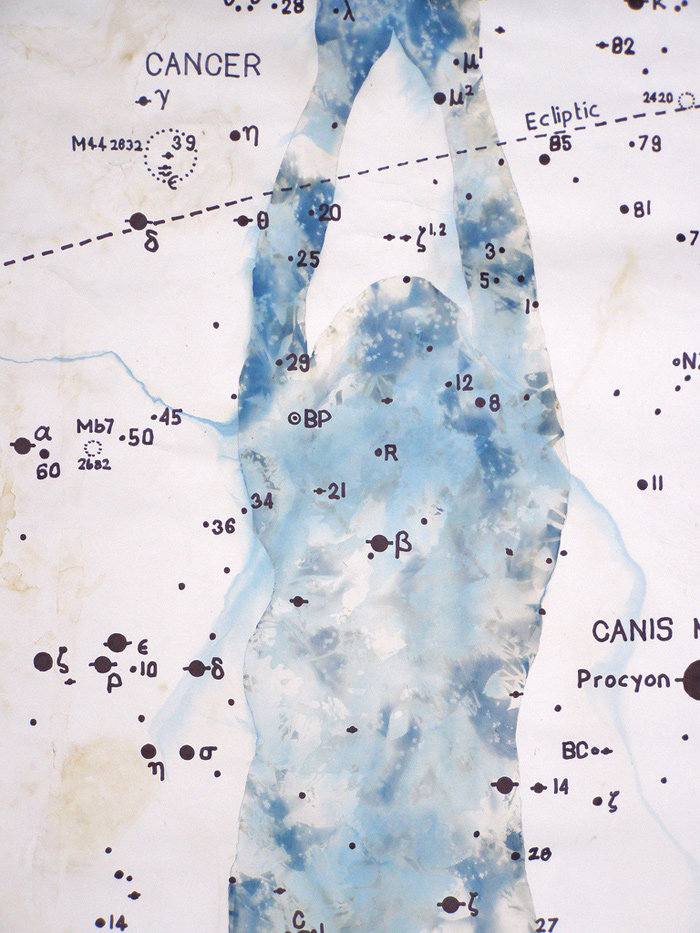
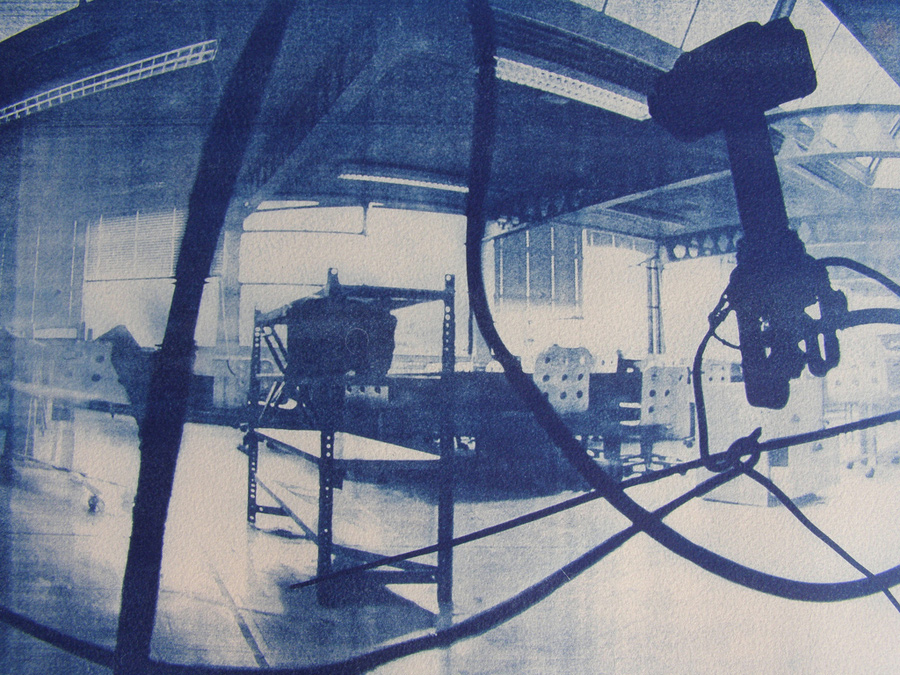
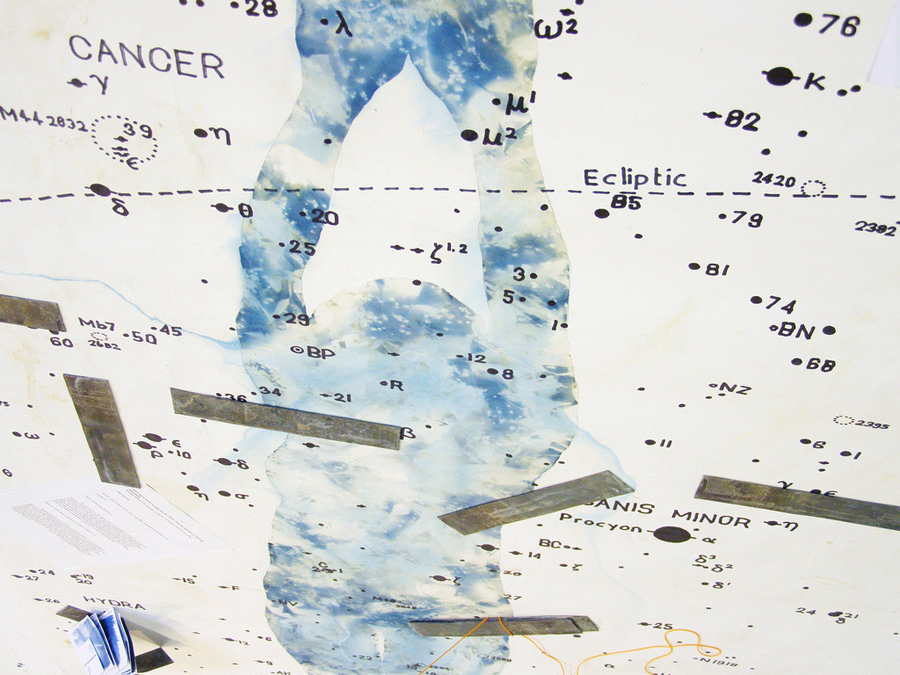
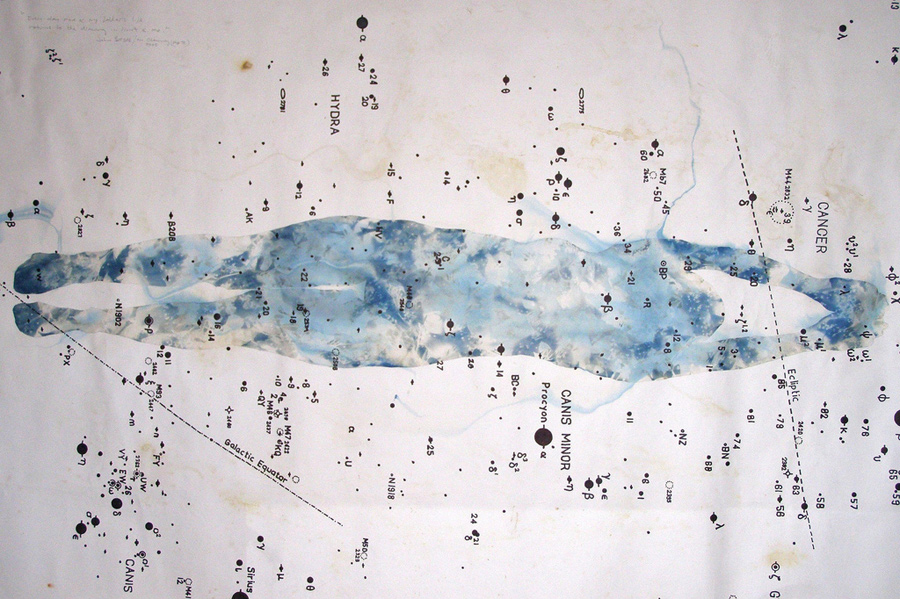
MOLECULAR SIEVE, is a performative analysis of “this place” utilising the simple properties of the pinhole camera. This appropriated apparatus makes visible the extrusive nature of time as it is deposited on the photographic surface. The extended durations required to register “place” impart a sense of dwelling as recorded by the apparatuses passive gaze. These surfaces record and register a relation constructed by the architecture of the chamber and what is beyond it. Movements when visible appear as simple abbreviated enactments caught like inclusions within this consolidated and timely consolation of place.


Time as it accumulates on a photographic surface.

This performative investigation utilizes a large pinhole chamber which is given mobility via a sack-barrow. This apparatus produces through its very inclusion into spaces a “spatial practitioner” in its own right. My aim is to utilize this device as a means of registering “worksites” both in the duration of the event and in its pre-performative state. The mobility of this research could be used to illustrate a constantly changing set of dynamics throughout the site and its event. The use of perhaps adjacent wall spaces or even a

“sandwich board” would render a tangible re-presentation of spatial information for the visitor. Darkroom facilities or conversely off-site arrangements would be organised.


Artist Statement 2009/10 Days

SITE is anti-place hovering precariously over the abyss of no-place.1

This “undoing of place” might instigate a threshold and a situation/room from which to reflect upon critical spatial, sociological and psychological conditions and perceptions.

Practitioner with earlier experience in ceramics and glass, recently completed visual arts course at Winchester, now at Canterbury studying spatial practices. Interested in drawing, photography and interventions that can explore our sense and experience of place. My work seems to harbour a need for a reflective solitude, a sense of dwelling amongst absences. The use of materials from the locality (field chalk) imply a personal geography drawn from the direct relationship to an inherited Earth. There is the suggestion that the absence recorded by the trace is an inclusion, a legacy set into a field of materiality, but it might also suggest a metaphysical field of thought. This act of drawing becomes its own experimental field of exploration, a sort of “in­ between reality"( Merleau-Ponty) an enmeshed experience. Perhaps all that remains is some sense of a material memory encountering the realm of the insubstantial.

Interested in collaborative projects and ventures that might facilitate issues of “site” as being the very undoing of place. Site for me is part of the rehearsal for the construction of place, site holds relations and intimacies/geographies that will be over-written by methodologies destined to be terminated to create place.


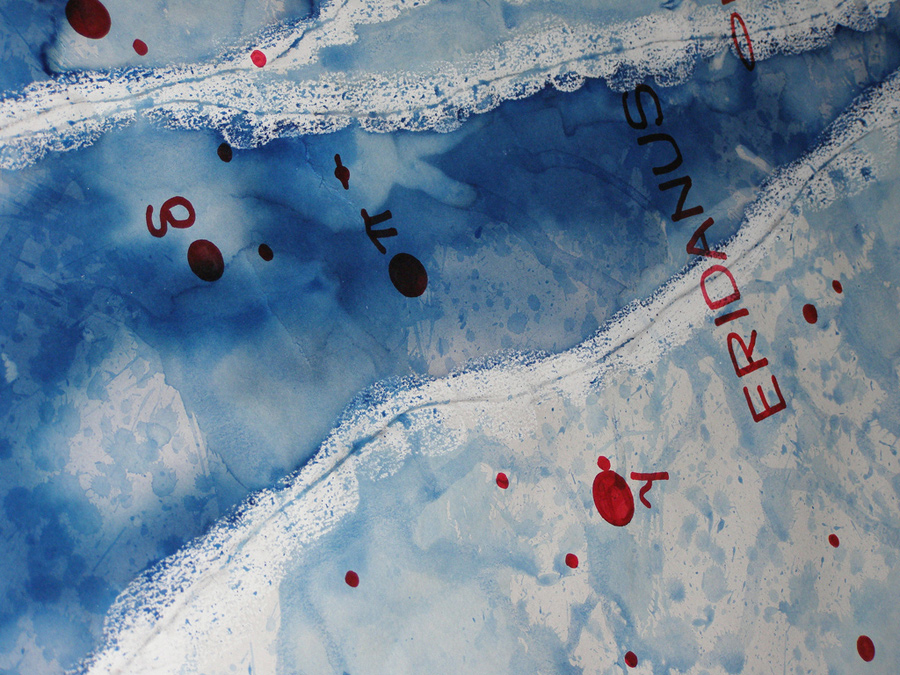
What is an Apparatus? Giorgio Agamben
by the term “apparatus” I mean a kind of a forma­tion, so to speak, that at a given historical moment has as its major function the response to an urgency. The appa­ratus therefore has a dominant strategic function.
I said that the nature of an apparatus is essentially strategic, which means that we are speaking about a certain manipulation of relations of forces, of a rational and concrete intervention in the relations of forces, either so as to develop them in a particular direction, or to block them, to stabilize them, and to utilize them. The apparatus is thus always inscribed into a play of power, but it is also always linked to certain limits of knowledge that arise from it and, to an equal degree, condition it. The apparatus is precisely this: a set of strategies of the relations of forces supporting, and supported by, certain types of knowledge.
I wish to propose to you nothing less than a gen­ eral and massive partitioning of beings into two large groups or classes: on the one hand, living beings (or substances), and on the other, apparatuses in which living beings are incessantly captured. On one side, then, to return to the terminology of the theologians, lies the ontology of creatures, and on the other side, the oikonomia of apparatuses that seek to govern and guide them toward the good. 


Tuesday, 29 August 2023

Researching Bodies/Discursive Collages : Theoretical Objects/Desiring Machines/Diversions/Anomalies/Contradictions


OUTPOST STUDIO 3.16


Sensations in Space and Time (the experience/entanglement of phenomena and idea)

Agency/Foraging/Making/Gathering

Subjectivity is relational (always in process)

A Species of Making Spaces

Tentativeness, attentive to situatedness


A diffractive methodology enables a critical rethinking of science and the social in their relationality, moving beyond separate entities, separate sets of concern.

Karen Barad


Organism

Person

Environment


For Merleau-Ponty, Experience can only be understood between the mind and the body or across them in their lived conjunction.


The mind is always embodied, always based on corporeal and sensory relations.

Elizabeth Grosz.


Richard Serra : Verb List Compilation

Actions to Relate to Oneself, 1967-1967


Drawing in its frameworks and dimensions/presence and absence/its here and elsewhere


Exploring the fragility of a painting in the landscape

Canvas as sheltering construction, Raveningham Sculpture Trail


Diagram-Map-Chart, is a symbolic depiction emphasizing (mapping) relationships

Diagrams For The Imagination : Arakawa


Semper Femina : Laura Marling

Apokatastasis : Jim Jarmusch, Jozef Van Wissem

Litany Of Echoes : James Blackshaw

New Music, for old instruments : Paul Metzger, Jozef Van Wissem

Brilliant Trees : David Sylvian


Body As Cultural Product

Both psychic and social dimensions must find their place in reconceptualizing the body, not in opposition to each other, but as necessarily interactive.

Volatile Bodies/Chaos-Territory-Art : Elizabeth Grosz


Spatial Asperity/Mesh, Membrane and Gauze, Möbius Strip, Pattening,


Actuality : Robert Mangold

Paintings around the particles/flows of things/boundaries/intervals of presence and absence

Induction/Capacitance/Encapsulated Layers


Drawing and its attempts to map out/make visible contingent things

Contingency, is what remains, as it comes up against causality/constantly passing through

Objects/Things conceptualized by the exploration of drawing (intervals of blindness)


Linking Surface to the Aesthetic Experience of Space.

Experiences incorporating interests with environmental textures into Art.

Points of Contact/Confluence of Circumstances

Materials bound by contact/canvas

Patina, absences, gesso, textile wrappings, field chalk, exhumed oyster shells, yellow ochre,


A philosophy of Reading/Matter/Rooms,

The Lake of The Mind

Stochastic Thinking, Steven Holl

Solitude/Libraries : Cell/Court/Domain

Capacitance, relationships between intensities and movements

Clay, Waxed Surface, Liquid Rust, Calico,


Sensate Bandages/Windings/Armatures : Corporeal Landscapes/Assemblages/Things

Flesh, elementary pre-communicative, subject and object develop.

Making as Growth : Tim Ingold


Social Architectures/Anthropologies/Imaginary Projects/Interfaces/Screens


Timothy Morton : Realist Magic

The elasticity of sensation, affective and wonderous


Sally Mann : Matter Lent/Collodion wetplate negatives

Corpus, liquid light, flesh, spirit, trace, outline, human body, performative,


Paintings/Enactments : Canvas as a spatial verb


Espace-Milieu, painting as environment/entanglements and situations


Ceramic/Process and its theoretical objects

As a series of practices, making reality by bringing things together or separating them into their singularities, or making machines/desiring machines


Desire can be seen as an Actualization

Gathering Notations : Bernard Tschumi


Both presence and absence are coupled in this framework

Deleuze/Guattari


Glass/GLAS : Resistivity/Inclusions, A Field in England.

Translucent aesthetics, beyond the opacities of the sensible the rational.


An image that adequately expresses both the efficacy and the temporariness of the phenomena ( joining a diffused/invisible flow of energy, a breadth that wends its way ceaselessly through the world). Animating it as it goes.

Vital Nourishment, Departing from happiness, Francois Jullian.


What is a body capable of -

Spinoza


Building/Making, into the theoretical performative object (that does theory)


Albers/Clarke : Interactions, Counterpoints, Intervals between colour/forms,

Membrane, Discursive, Diffractive, Sensory, Layered and Filtered Light,

Body, Movement, Mind, Assemblages, Exploratory, Speculative, Choreographic,


Deleuze/Guattari, understand the body more in terms of what AFFECTS it is capable of, instead of the consequences of having a body.


Peter Zumthor : Thermal Baths

Human Agency/Temporal transitions between matter and movement.

Immaterial/Concrete/Water : Bodies in contact/the corporeal social human body


Manifolds/Theory of Temporality/3 Synthesis of Time


Memory Past Preserved Condition

Present Habit Instants Agent

New Future, actual/virtual Creation of The New

Multiplicity, purality of contemplating souls.


Asymmetries between particular past and general future.


Temporality involves multiple interacting processes.


Architecture becomes Spatial Agency

We all make space : Jeremy Till

Paintings, space, volume, surface, passages, actualizations, claddings/camouflage


One conceives and reads a building in terms of sequences, both phenomenological and filmic, reading a space by its depth of field, its thickness.

Turbulence House, New Mexico, Steven Holl.


Aesthetics/Asperities : Resultants that incorporate the friction (asperity) of their trajectories through a medium. Tilt-up concrete construction, Chapel of St, Ignatius, Seattle. Steven Holl.


Navigations and Vectors/conduits/intervals and traces between discursive practices.


Wrapped Silences : Assembled Sectional Elements/Thresholds


Surfaces on Mourning/Samsara, a beauty fed on emptiness

Sunday, 27 August 2023

Oscar Tuazon “See Through” : Working with Disjunction/Spatial Forms/Windows/Spatial Collages

Oscar Tuazon “See Through”


Galerie Eva Presenhuber is pleased to present “See Through,” the gallery’s third solo-exhibition featuring new works by the Los Angeles-based artist Oscar Tuazon.
Oscar Tuazon‘s sculptural oeuvre is situated at the border of art, architecture and technology. His large-scale works – shown in exhibition spaces as well as public space and nature – often seem like functional do-it-yourself structures which were once inhabited or will be made inhabitable soon. In terms of form, Tuazon is close to artists of Minimalism and Land Art, such as Donald Judd or Carl Andre. He goes so far as to copy single works of artists like Richard Serra, but without the ironical distance that characterizes appropriation. The process of copying is rather to be understood as a re-building that reduces the work to its sheer material and potential. Furthermore, Tuazon doesn’t focus on the relation between work and architectural space, but on material, the process of building, and the physical agency of the work itself. Often, the collective process of constructing his large-scale sculptures could be seen as a performance which naturally takes place before the actual work is realized.
In “See Through,” Tuazon borrows a form which condenses various concepts explored in his previous work: the window. He installs massive wooden frames made of spruce, cedar, and plywood, that stand in the middle of the gallery space or directly against the wall. At first glance the sculptures seem minimalistic: geometrical frames that define and order space, and at the same time evoke, like Fred Sandbacks sculptures, larger structures. However, Tuazon transcends minimalism: his windows consist of two parts. One part is transparent with a pane of glass built into it, while the other part is crossed by three wooden bars which belong to the wall of a house. These objects, quite clearly, have a certain function. They are windows that separate inside from outside and, at the same time, are transparent. The title gives account to this main feature of windows. But contrary to minimalist sculptures, which put the focus on the surrounding architecture, Tuazon‘s windows exist as architectural elements themselves– constructed by the artist in the studio.
In the exhibition space, the windows are fundamentally alienated in several ways. First, they are not part of a house. Second, their layout creates doubt about their ability to separate inside and outside – to be tight. Furthermore, they don’t allow to look outside anyway: They are positioned either in the middle of the gallery or on the wall. In their quasi-functionality, they go beyond the way of perceiving space expressed by minimalist artists.
Tuazon’s sculptures are easy to grasp, but it’s difficult to spell out their complexity. As windows, their basic function is to disappear. They should be transparent. At the same time, they are displaced, don’t quite work the way they are supposed to, and so are alienated from their usual function. Ultimately, Tuazon’s objects create their own space, which is not equivalent with the surrounding gallery space. What happens within this new space expands the space itself: What happens between the objects and their perception is left to the exhibition visitors – and even that can’t always be controlled individually.

at Galerie Eva Presenhuber, Zurich


The Living Thing : Hidden Curriculum (Intermezzo)

a thousand plateaus
Deleuze, Guattari

Assemblage
Becoming
Body Without Organs
Nomad
Rhizome
Smooth Space
State
War Machine


ASSEMBLAGE:

An assemblage is any number of "things" or pieces of "things" gathered into a single context. An assemblage can bring about any number of "effects"—aesthetic, machinic, productive, destructive, consumptive, informatic, etc. Deleuze and Guattari's discussion of the book provides a number of insights into this loosely defined term:

In a book, as in all things, there are lines of articulation or segmentarity, strata and territories; but also lines of flight, movements of deterritorialization and destratification. Comparative rates of flow on these lines produce phenomena of relative slowness and viscosity, or, on the contrary, of acceleration and rupture. All this, lines and measurable speeds constitutes an assemblage. A book is an assemblage of this kind, and as such is unattributable. It is a multiplicity—but we don't know yet what the multiple entails when it is no longer attributed, that is, after it has been elevated to the status of the substantive. On side of a machinic assemblage faces the strata, which doubtless make it a kind of organism, or signifying totality, or determination attributable to a subject; it also has a side facing a body without organs, which is continually dismantling the organism, causing asignifying particles or pure intensities or circulate, and attributing to itself subjects what it leaves with nothing more than a name as the trace of an intensity... Literature is an assemblage. It has nothing to do with ideology. There is no ideology and never has been. (3-4)
The book, as described above, is a jumbling together of discrete parts or pieces that is capable of producing any number effects, rather than a tightly organized and coherent whole producing one dominant reading.
The beauty of the assemblage is that, since it lacks organization, it can draw into its body any number of disparate elements. The book itself can be an assemblage, but its status as an assemblage does not prevent it from containing assemblages within itself or entering into new assemblages with readers, libraries, bonfires, bookstores, etc.

http://www.rhizomes.net/issue5/poke/glossary.html


Speculative Learning Environment : Russell Moreton.

Re- Imagining Education, Brockwood Park School.

2011.


Spatial Representation/Practice : Discursive photography and documentation

 The Poetics of Space : The house, from cellar to garret. The significance of the hut.


"He will revive the primitivity and the specificity of the fears. In our civilization, which has the same light everywhere, and puts electricity in its cellars, we no longer go to the cellar carrying a candle. But the unconscious cannot be civilized. It takes a candle when it goes to the cellar."

 
Gaston Bachelard.

 
"All religions, nearly all philosophies, and even a part of science testify to the unwearying heroic effort of mankind desperately denying its contingency."

 
Jacques Monod,

The Human/Straw Dogs, John Gray.

Is there still an aesthetic illusion? And if not, a path to an “aesthetic” illusion, the radical illusion of secret, seduction and magic? Is there still, on the edges of hypervisibility, of virtuality, room for an image?

— Jean Baudrillard, The Conspiracy of Art, 2005


Jana Sterbak
Remote Control 1989

<a href="http://art-history.concordia.ca/eea/artists/sterbak.html" rel="noreferrer nofollow">art-history.concordia.ca/eea/artists/sterbak.html</a>

A heuristic technique (/hjᵿˈrɪstᵻk/; Ancient Greek: εὑρίσκω, "find" or "discover"), often called simply a heuristic, is any approach to problem solving, learning, or discovery that employs a practical method not guaranteed to be optimal or perfect, but sufficient for the immediate goals.

A Hut of One's Own, Ann Cline

Texts, Annotations, Foundations, Pathways, Corridors, Bookmarks, Walking, Thinking, Ramble, Cross Country, Disciplines, 


Sensorium : A Partial Taxonomy, Caroline A. Jones.

Contemporary artists aim to produce specific relations with the technologies they adopt and adapt;
This schematic offers a partial taxonomy.

Caroline A. Jones, Sensorium : Embodied Experience, Technology and Contemporary Art 2006

Immersive
the "cave" paradigm, the virtual helmet, the black-box video, the earphone set

Alienated
taking technology and "making it strange," exaggerating attributes to provoke shock, using technologies to switch senses or induce disorientation

Interrogative
work that repurposes  or remakes devices to enhance their insidious or wondrous properties; available data translated into sensible systems

Residual
work that holds on to an earlier technology, repurposes or even fetishizes an abandoned one

Resistant
work that refuses to use marketed technologies for their stated purpose; work that pushes viewers to reject technologies or subvert them

Adaptive
work that takes up technologies and extends or applies them for creative purposes, producing new subjects for the technologies in question

Friday, 25 August 2023

Red is not a colour/Filtered Light/Program/Tschumi/Sainsbury Centre.

 RODIN AND BEUYS

THE ALCHEMY OF BUILDING WORKING PRACTICES

RUINS, REDUCTIONS, and the LOSS of SUBSTANCE.

FRAGMENTS, ASSEMBLAGES and INTERIORS that re-enter the world of creativity.

The Theatre of Research is a working space that creates and crafts both theoretical and practical objects, things and documentation. Its reason for being is to explore the praxis for creative narratives between the Arts and The Humanities. It attempts through performance, fine art and architecture to collage qualitative and diffractive dialogues into new relational discourses, the results of which become exhibited or staged as open workshops engendering praxis, publication and production. In its fledgling state it is seen as being part of a University faculty that has interests in the Arts and The Humanities.

We have art so that we may not perish by the truth. Friedrich Nietzsche Can one achieve architecture without resorting to ‘design’? What if, instead of designing a new building, you keep the one skated for demolition? How do you insert an original program inside the old and new structures simultaneously? How do you reconcile coherence with multiplicity? Bernard Tschumi 2012


 PROGRAM. Tschumi, Le Fresnoy: Architecture In/Between, 1999/2012 Architecture was no longer an autonomous and isolated discipline but participated in the movement and confrontation of ideas. Tschumi, Red Is Not A Color. 2012