Showing posts with label consciousness. Show all posts

Tuesday, 31 March 2026

Art and Architecture : Situated interactions between bodies and habitats.

Jane Rendell

Art and Architecture. 2006


If a site is a location that can be defined in physical and material terms, a situation can be both spatial and temporal, the location of something in space and a set of circumstances bounded in time – the conditions of a particular instant, a moment, an event. The associated verb to situate describes the action of positioning something in a particular place, while the adjective situated defines something’s site or situation. Situatedness, then, is a way of engaging with the qualities of these processes of situating or being situated.

 ‘Critical spatial practice’ came to my mind back in 2003 as a helpful way of describe projects located between art and architecture, that both critiqued the sites into which they intervened as well as the disciplinary procedures through which they operated. In Art and Architecture (2006), I argued that such projects operated at a triple crossroads: between theory and practice, between public and private, and between art and architecture, and I was keen to stress three particular qualities of those works: the critical, the spatial and the interdisciplinary. 

Other practitioners and theorists have since worked with the term, evolving it in different directions. For example, there was the reading group and blogspot initiated by Nicholas Brown in the early 2000s, which came out of discussions around Brown’s own artistic walking practice. In 2011, Nikolaus Hirsch and Marcus Miessen started a book series with Sternberg Press called Critical Spatial Practice which focused on architectural discourse and practice, and in the first publication they asked the question: ‘What is Critical Spatial Practice?’.

But as this website shows a whole multitude of practitioners and theorists have been developing work in an ‘expanded field’ such as this, quite different perhaps from the one Rosalind Krauss identified in 1979. This is work that overlaps, diverges, converges, runs in parallel, and in circles, and in many cases came before and goes beyond; from transparadiso’s ‘direct urbanism’ to Steve Loo’s ‘sites of perdurance’, these practices incorporate ‘event scores’, ‘insertions’ even ‘banalities’ and pay close attention to relation, position, performance and situation, as well duration.

https://www.flickr.com/photos/russellmoreton/

The artwork in the image consists of slab-built ceramic sculptures created by the visual artist Russell Moreton. 

His work often explores the intersection of architecture, spatial practices, and ceramics, using clay as a medium to investigate themes of construction, silence, and architectural space.

These specific pieces feature a rugged, structural appearance, incorporating textures and forms that evoke architectural elements.

Moreton's practice is deeply rooted in process-based inquiries, where the material and the act of constructing the sculpture are central to the final expression.

The artist is based in the UK and his sculptural work is frequently described as a meditation on materiality and existence.


Artistic Practice: Moreton is known for his work that explores ceramics through an architectural lens, often creating pieces that evoke the feeling of interior spaces or structures where the "drama of the building has now ceased". 

Style: His work frequently features weathered, structural forms with muted, monochromatic palettes and textured surfaces. 

Focus: His practice often investigates the interconnectedness of materials and the creation of interior, spatial structures. 


This image shows a field containing several poles, which are often used in environmental or ecological studies as Robel poles. These poles are typically used to measure visual obstruction, which helps estimate the density of vegetation or the amount of biomass in a specific area. 
The poles are placed at various locations within the meadow or grassy area to collect observational data.
In studies, these measurements are often combined with other techniques to assess habitat quality or vegetation growth.

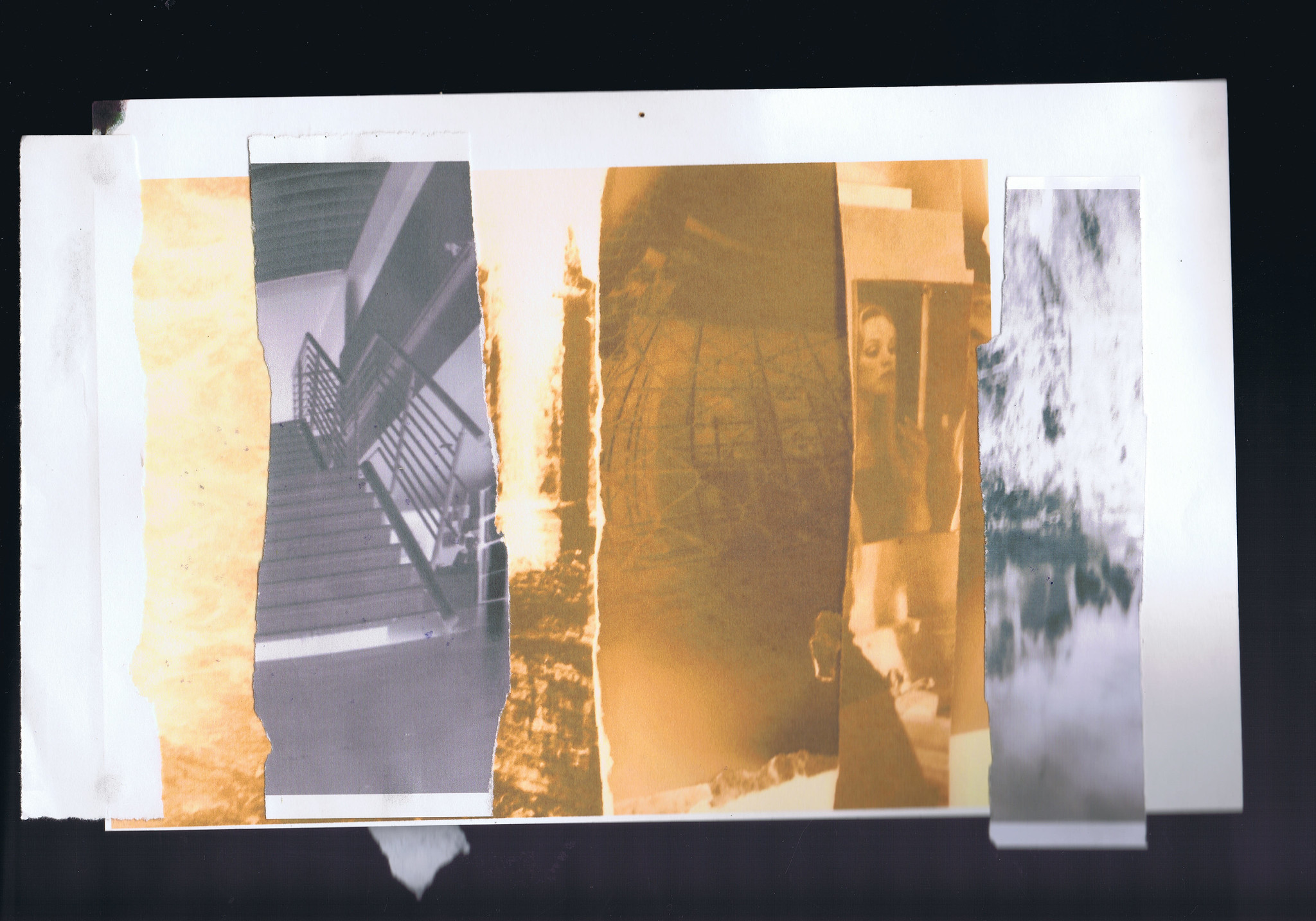
Research collage with objects (Shoa) appears to be a mood board or an artist's research wall, heavily focused on the themes of film, memory, and decay. It features references to seminal filmmakers and philosophers who explore how time and history are captured or lost.
Key References in the Image
Andrey Rublev (1966): The central black-and-white photograph is a still from the film Andrei Rublev, directed by the legendary Russian filmmaker Andrei Tarkovsky. The text box explicitly identifies "Andrey Rublyov: The painter-monk on his journey." The film follows a 15th-century icon painter through a turbulent period of Russian history.
Bill Morrison: On the far left, a vertical strip of text quotes the experimental filmmaker Bill Morrison: "maybe what the ruins of Cinema, patiently and violently are tracing, is disappearing." Morrison is best known for his film Decasia (2002), which uses decaying archival film footage to create a haunting meditation on the fragility of the medium and human memory.
Marc Augé: On the right, there is a quote from the French anthropologist Marc Augé: "Ruins, as a notion and phenomena are slowly disappearing from our cities. Out of a lack of time, we are condemned to preserve the past." Augé is famous for coining the term "non-places" and writing extensively on the relationship between time and space in the modern world.
Themes and Context
The collection of these specific quotes and images suggests a deep interest in "The Ruins of Cinema" and the physical or conceptual disappearance of history.
Tarkovsky is often associated with the concept of "Sculpting in Time," where the filmmaker uses the medium to fix and observe the passage of time itself.
Bill Morrison's work literally shows "ruined" film, where the chemical emulsion is melting or rotting away, yet creating something new and beautiful.
Marc Augé's quote reflects on how modern society lacks the "slow time" required for ruins to form naturally, instead opting for immediate, artificial preservation.
The architectural drawing and the physical cardboard model (possibly a "section" or "maquette") visible on the right suggest this board might belong to a student or professional in architecture or film production design, exploring how physical spaces can embody these abstract concepts of memory and decay.


Making/Matter/Material : Situated interactions between bodies and habitats.

Claywork/Correspondences : Situated interactions between bodies and habitats.

Drawing Participation : Situated interactions between bodies and habitats.

Indexical Awareness : Situated interactions between bodies and habitats.

Mechanisms of Mutuality : Situated interactions between bodies and habitats.

Viewing Assemblage : Situated interactions between bodies and habitats.

A Process of Consciousness : Situated interactions between bodies and habitats.


https://www.flickr.com/photos/russellmoreton/

Sunday, 30 June 2024

The Sleeper Awakes : Veiled Melancholy/Book Narratives : Film Collages. #3

Preface (1921) ” The great city of this story is no more than a nightmare of Capitalism triumphant, a nightmare that was dreamt a quarter of a century ago. It is a fantastic possibility no longer possible. Much evil may be in store for mankind, but to this immense, grim organization of servitude, our race will never come” H.G. Wells. Easton Glebe, Dunmow,1921.

28/01/2016

https://uk.pinterest.com/russellmoreton/art-objects-russell-moreton/

"Spatial turn" The increased attention to matters of space, place and mapping in literary and cultural studies, as well as in social theory, philosophy, and other disciplinary fields.

Spatiality, Robert T. Tally Jr. Routledge 2013.


 The Politics of Architecture : Theorizing through speculative spatial practices.

Immediate Architectural Interventions, Durations and Effects : Apparatuses, Things and People in the Making of the City and the World. Alberto Altes Arlandis, Oren Lieberman. 2013


"He rubbed his eyes. The riddle of his surroundings was confusing but his mind was quite clear - evidently his sleep had  benefited him. He was not in a bed at all as he understood the word, but lying naked on a very soft and yielding mattress, in a trough of dark glass. The mattress was partly transparent, a fact he observed with a sense of insecurity, and below it was a mirror reflecting him greyly. Above his arm- and he saw with a shock that his skin was strangely dry and yellow - was bound a curious apparatus of rubber, bound so cunningly that it seemed to pass into his skin above and below. And this bed was placed in a case of greenish-coloured glass (as it seemed to him), a bar in the white framework of which had first arrested his attention. In the corner of the case was a stand of glittering and delicately made apparatus, for the most part quite strange appliances, though a maximum  and minimum thermometer was recognizable."

H. G. Wells : The Sleeper Awakes. 1899/1910


Saturday, 30 December 2023

Anthropological Entanglements/Emergent Landscapes : Strange Tools/The Rings of Saturn


Walking into Emergent Landscapes : Covehithe Beach

The OLD WAYS, a JOURNEY ON FOOT, Robert Macfarlane

“ Walking was a means of personal myth-making, but it also shaped his everyday longings:

Edward Thomas not only thought on paths and of them, but also with them.”


“To Thomas, paths connected real places but they also led out-wards to metaphysics, backwards to history and inward to the self. These traverses- between the conceptual, the spectral and the personal-occur often without signage in his writing, and are among its most characteristic events. He imagined himself in topographical terms.”


DSC_0585 Covehithe : Walking/Thinking/Physical Entanglements in the Landscape


Natural History : Dried Carnations


Blueprints : Anthropological Forms

Botanical traces with leper graves


https://www.flickr.com/photos/russellmoreton/
Contexts:

Art therapy , Exhibition , Open studio , Practice-based research,

Artforms:

Film & video , Painting , Photography , Printmaking,

Wednesday, 5 July 2023

The World is Blue : Evoking an inner room in the Mind/Consciousness

Walking In My Mind, Stephanie Rosenthal. Hayward Gallery 2009

At last we could talk about and investigate mental imagery, subjectivity, imagination and creativity. At last scientists could tackle the mystery of consciousness without being laughed at.
Mysteries Of The Mind, Susan Blackmore.

Between The Microcosm And The Macrocosm, Mami Kataoka.

A Field Guide To Getting Lost, Rebecca Solnit.
The Blue of Distance

The world is blue at its edges and its depths. This blue is the light that got lost. Light at the blue end of the spectrum does not travel the whole distance from the sun to us. It disperses among the molecules of the air, it scatters in water. Water is colourless, shallow water appears to be the colour of whatever lies underneath it, but deep water is full of this scattered light, the purer the water the deeper the blue. The sky  is blue for the same reason, but the blue at the horizon, the blue of land that seems to be dissolving into the sky, is a deeper, dreamier, melancholy blue, the blue at the farthest reaches of the places where you see for miles, the blue of distance.

This light that does not touch us, does not travel the whole distance, the light gets lost, gives us the beauty of the world, so much of which is in the colour blue.

Celestial Crater
Digital Dye : Blue
Photogram

Blue Spaces : White Absences #2. Silence/Void : Gap/Reveal

DSC_6772 Absence/Potential  of Dialogue : Raveningham
Cyanotype, paper negative on used canvas frame

DSC_6761 CELL COURT DOMAIN FIELD