Showing posts with label life drawing. Show all posts

Friday, 23 May 2025

Drawing on Life : Bento's Sketchbook/A Hut of One's Own : John Berger/Ann Cline/Bento de Spinoza

In the backyard of where she was living, Cline once decided to build a hut inspired by Kakuzo Okakura's The Book of Tea.

As my dwelling took shape, it began to shape my life as well. And when I sat inside reading the recluse poets, the terse simplicity of their record framed my own perception, one I likened to a camera recording a world of pure experience.


The hut has a sense of immediacy that no room-filled house can achieve. The hut focuses its dweller on immediacy and meaning fulness. "I had found the commodity of my dwelling through the poetry of its use," Cline concludes.

The hut addresses the core of ritual as a part of nature versus the supposed freedom of modernist thought and the architectural contrivances it pursues. The hut represents the convergence of ritual and naturalness, at the same time addressing cultural issues and practices.

With an agility larger structures can never match, huts bring together the physical environment with such disparate aspects of culture as necessity, fantasy, faith, and "life-style." The hut, then, may be humankind's supreme experiment.

This may seem a bold conclusion given the modesty of the hut throughout history, and the modest ambitions of its makers, but this is Cline's point, that the experiment in solitude and simplicity is bolder than any social or culturally-sanctioned experiments or projects, simply because the latter are contrived and unnatural, even anti­ natural.

https://www.hermitary.com/bookreviews/cline.html


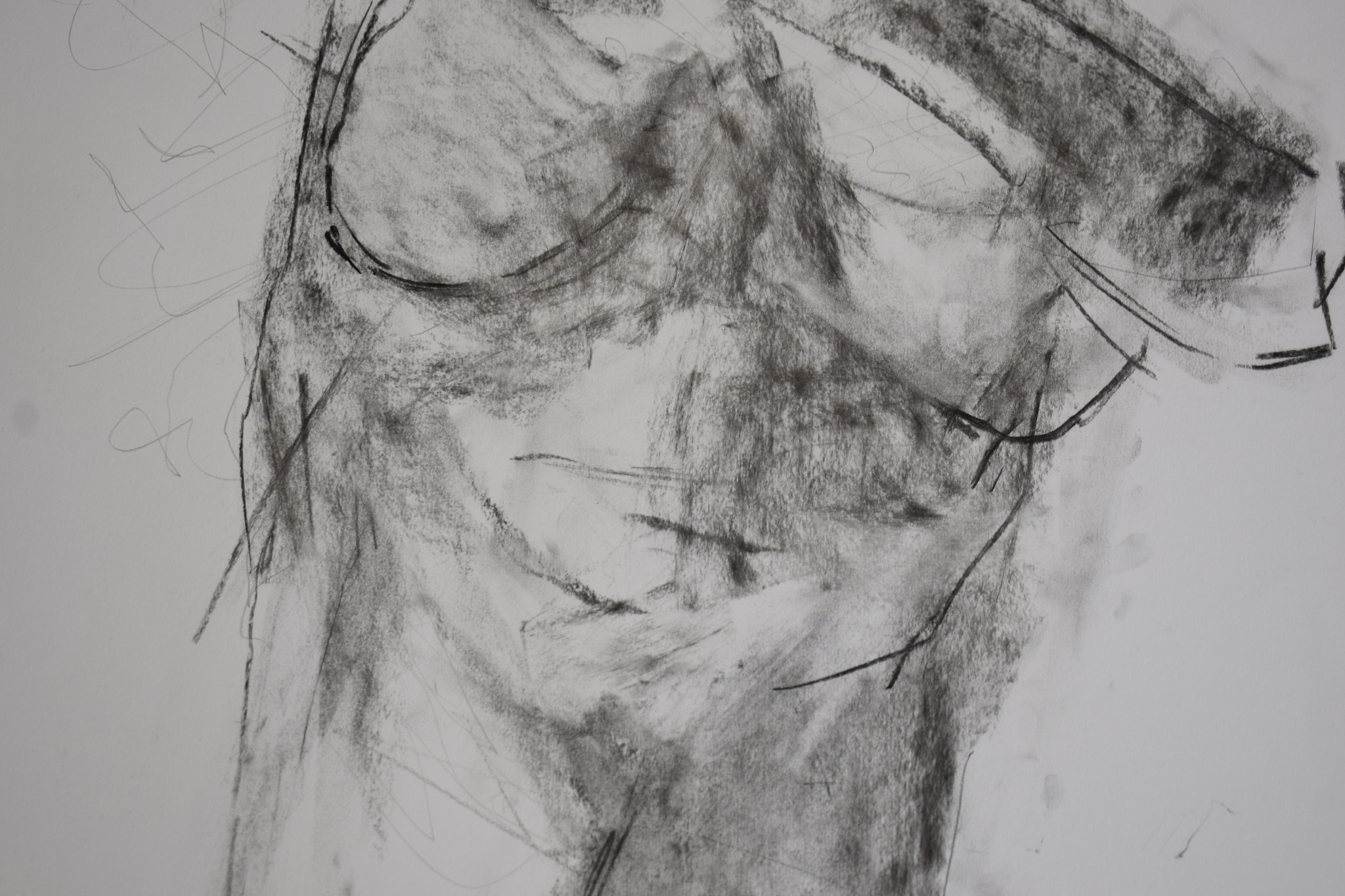
Then the days of working at home on it. The image in my head was often clearer than the one on the paper. I redrew and redrew. The paper became grey  with  alterations and  cancelations.  The drawing didn’t get better, but gradually she, about to stand up, was more insistently there.

The effort of my  corrections and  the endurance of the paper have begun  to resemble the resilience of Maria’s own body. The surface of the drawing - its skin, not its image — make me think of how there are moments when a dancer can make your hairs stand on end.

We who  draw do  so  not only  to  make something  observed visible to others, but also to accompany something invisible to its incalculable destination.


The bodies of dancers with their kind of devotion are dual. And this is visible whatever they are doing. A kind of Uncertainty Principle determines them; instead of being alternately particle and wave, their bodies are alternately giver and gift.

They know their own bodies in such a penetrating way that they can be within them, or before them and beyond them. And this alternates,  sometimes changing  every  few seconds,  some­ times every few minutes.

The duality  of each  body  is what allows them,  when  they perform,  to  merge into  a single entity.  They  lean  against,  lift, carry, roll over, separate from, co-join, buttress each other so that two or three bodies become a single dwelling, like a living cell is a dwelling for its molecules and messengers, or a forest for its animals.

The same duality  explains why  they  are as much  intrigued by falling as by leaping, and why the ground challenges them as much as the air.


Monday, 5 May 2025

Drawing/Sociology/Art : Figuration/Flesh and the Body.

Drawing/ Being Part of Space and Time : A DISPERSION
Antony Gormley

Drawing is the most immediate way of making your ideas, sensations, and information explicit.
Euan Uglow

What do we look for from the nude today?
Drawing/Man : Oskar Schlemmer

The use of pure line compels the artist to a process of abstraction.
Energy/Tension : The Social Form of Living Flesh

To create a new intellectual image of reality

Line has an autonomous relationship with surface (a rhythmic lineation)
Rhythm is the means by which all kinds of movement are delineated.
It follows that the physiological movement of the body is rhythmically organised.

The figuration of the contemporary body through abstractions and representations.


INTERIOR : Environment, physical and psychological realms.

INTERIORITY : SELF.

The Picture Plane
Composition, elements and scale
Context-Content-Beginnings
Relationships- Figure- Ground, becomes psychological state of a figure both becoming and entropic

All pictorial representation is an intellectual and visual organisation.
Flesh follows the physiological movement of the body and is rhythmically organised/balanced.

ANTHROPOMETRICS
THE FIGURE IN SPACE
Performative, Sociological ; Structure and Agency (Klein)(Duality)
Measurement, Reach/Movement/Proportion

Making relationships between the spatial figure and the spatial arrangements of the picture plane. Bringing the spatial figures into the system of axes of the picture space.
Schlemmer's plane and spatial prospects contain architectonic motifs, which are presented orthogonally or in exaggerated perspective.

Anthropomorphic Collage
Morn Hill, chalk grave/leper hospital
Joseph Beuys/Reg Butler


Deleuze, Francis Bacon
Haptic Vision/Colour Space
Light is time, but space is colour.

Carnality/Sensation/Logic/Colour Space
Entropic/Seeing/Haptic/Violence


Sunday, 13 April 2025

Drawing Towards an Ecology of Materiality/Embodiment/Emotion/Affect

Outpost 280623


Relation-In-The-Making.


Spaces between objects, Giorgio Morandi.

Emergent Evolutions.


These micro-perceptions are perceptions without objects, hallucinatory tendencies in the sense that they express nothing but the emphasis on the quality of becoming. They do not give us a body fully formed or an object-in-place, rather they fold perception into a becoming-body-of-movement, creating the emphasis of quasi formation that is relation-in-the-making.


An object becomes the threshold for thinking feeling.

Momentum Wheel : Lucie Rie Installation.


We perceive/perception is the force for the worlds infinite unfolding, with objects catching the edges of their contours, participating in the relation they call forth.

Erin Manning.


The smooth paint of the background turns out to be made of many translucent layers, intended to cover over outlines that Giacometti rejected, always in favour of a smaller and smaller head.

John Berger.


Diffractive Thinking/Reading abstractions in the middle of things and both ways at the same time.

Karen Barad.


MAKING

Anthropology

Archaeology

Art and Architecture.


Making creates knowledge, builds environments and transforms lives. Anthropology, archaeology, art and architecture are all ways of making. For Ingold instead of treating art and architecture as compendia of objects for anthropological or archaeological analysis, he advocates a way of thinking through making in which sentient practitioners and active materials continually answer to, or correspond with one another in the generation of form.


Hungate Site Visit.

Water/Light/Architecture.

Ceramic Vessels/Lead Tray/Water/Mirror.

Cyanotype Solution, unexposed, unwashed.


White gesso on biscuit ware.

White lead glaze.


Ceramics and Architecture.

Ceramics for a reflective solitude, an architecture of silence.

Figural Jars/Abstracted Human Clay Vessels/Cinerary Pots.


Sainsbury Centre.

Julian Stair.

Art, Death and the Afterlife.

Mezzanine Gallery.


Towards an Ecology of Materials.

Materiality, Embodiment, Nonhumans, Hylomorphism, Things.


One of the peculiarities of material culture studies over recent decades has been its virtual divorce from the traditions of ecological anthropology. This is odd, given that both fields are broadly concerned with the material conditions of social and cultural life. Students of material culture are interested in people's relations with things. Ecological anthropologists study how human beings relate to their biotic and abiotic environments. For the former, persons and things are bound in relational networks; for the latter, human beings and other organisms are bound in webs of life. Yet practitioners of these two fields are speaking past one another in largely incommensurate theoretical languages. 

Tim Ingold.


Archaeology, Volume 41, 2012.

The Archaeology of Emotion and Affect.

Sarah Tarlow.


When David Sylvester asked Giacometti about the thinness of the sculptures he had made without a model, Giacometti said 'they get narrow despite myself'.But then added, 'from life, they do this less'. Models put up a resistance to the thinning gaze, as if they were resisting Giacometti's willingness to let them go.


Drawings That Shrink.

Drawings that are extremely tense, a sign that the object/model is resisting.

Relations on the figure and the rejected lines and their borders on the drawing.


And so Yanaihara tilted and shrank, and sank down towards the bottom of the frame. As he shrank down, he also shrank away, back in space, away in time and perhaps in imagination, away from firm memory and towards insecure recollection. At some point Giacometti abandoned the drawing and began another.


Giacometti was fastidious about the placement of the easel, the canvas, and Yanaihara's chair, and he put little red blocks of clay under the stretcher to keep the canvas at a precise angle. None of that helped him anchor the figure: still it kept shrinking. The principle of its shrinking is clear in the dozen preparatory drawings, because many of the rejected lines remain visible. What mattered was the relation between the head and the borders of the drawing. That's why the drawings have drawn borders with lines scattered like matchsticks inside them.


On Drawing/Seeing to abolish the principle of disappearance, but it never can, and instead it turns appearance and disappearance into a game.


The crucial sadness of drawing  is it is unsurpassably close to the object, but always separated from it. Drawing bends my thoughts towards the nearly indescribable distance between the model and the motions of my hand, or should I say between the movements of my eyes as they pass over the model, and the sweep of my hand as it moves across the paper. Or the feel of the model, as I imagine it, and the texture of the paper as it slides under my hand.


The game of drawing is intricate enough with its slant rhymes between the feel of the model in my mind and the feel of the paper. It is made more difficult because drawn lines have the power to remake my own imagination. Every line I draw reforms the figure on the paper, and at the same time it redraws the image in my mind. And what is more, the drawn line redraws the model, because it changes my capacity to perceive. 


As I draw, the model becomes defective. The image in my mind is marred by the marks I put on paper. And so because a drawing cannot quite be touched, because it shifts when I try to fix it on paper, because it does not simply transcribe something in the world, because it can never bring back what I once loved – because of all that, drawing is an intense expression of the defect of distance.

John Berger.   


Sunday, 8 December 2024

Drawing The Body/Figure Event : The Luminescence Of Space.

Outpost 230323


Drawing, depicting something found through the process of making visible.


https://www.flickr.com/photos/russellmoreton/


The Luminescence Of Space.

An Archaeological Inquiry Into Drawing.

Correspondences/Reclaiming the drawings.


The Affect and Memory of Drawing.

To interrogate ways of seeing/looking, John Berger. 


The world of the creative practitioner promotes conditions, gestures and responses that articulate social, political and other theoretical findings which are all 'present' at the inception of the work.

Colin Renfrew.


The Myth of Butades.

Figure/Ground Relationships.


Theoretical Thought : Diagram and map.

Neo-Sumerian temple plan on clay tablet from c. 2100BC.


The drawing/work may take the form of the result of an act or action carried out at a specific time but which itself does not persist.


Art can be the expression in the material world of a concept, or the transformation into one material form of a structure that exists in another.


Drawing/Substance/Memory/Display.

The artist's creative act, is of a self amongst others.

Material/Thinking Matter.

Drawings mediated by the distance of memory.


Art Works, subtle embodiments, visual markers both spatial and sociological.


Life/Drawing/Figuring It Out.

The Luminescent Dematerialization Of The Subject.

Expressions Of Both Figuration And Abstraction.

Phenomenological approaches to Drawing/Looking/Others.


Demarcation/drawing boundaries/wayfaring/paths on the land, re The Making of Space.


Walking/Movement is quiet literally what made us human.


The walk is a 'mark' laid upon thousands of other layers of human and geographical history on the surface of the land. Bipedalism is the precursor to the evolution of a large brain, creative intelligence and language.

Richard Long/Colin Renfrew.


Charles Mausson.

Walking Man, No. 3. 1990.

Oil, crayon, 203.0 x 137.0 cm.


Starting from a subject or a simple figurative form, Charles Maussion sets of like an explorer, in search of unexplored lands, looking for something spiritual. It is through walking/drawing/thinking that one can remain human even while seeking out, and without even knowing it, finding it, or finding yourself in lands which are thousands of light years from our society, whilst nevertheless being very close to it. A calm, a loudness, that is extreme, beautiful.

Robert Combas. 1993.


The simple presence of a figure is sufficient to suggest the unity of the individual in a universe which is patiently observed and precisely apprehended. There is a complete absence of any compositional device suggested within the canvas, all that emanates is a climate of strangeness, serenity and disquiet. 

Sophie Dupont. 1995.


The blurring of the conventional distinction between the figure and the ground, so as to capture an atmospheric effect, which sought to approximate the murkiness of visual perception.

The legibility of the photographic image was denied by the process of blurring the image.

Paintings, abstract identities of surface and material, introducing content via a dematerialization, so as to engage in a process of pure vision, pure silence, reincarnated, vibrant, alive.

William Jeffett. 1995. 


Drawing on the consciousness and corporeality of others, of figural dissolution of the traditional figure/ground relationships, and fragmentation/blurring of the human form. The contemporary body and its environments are experientially brought into abstracted absences, corporeal traces of visual matter, movement and dissolving/reappearing forms.


Figural Expressions.

Figural dissolution of a nude descending a staircase, Marcel Duchamp.

Stop-motion photography of the human body in motion, Etienne Marey.


Figural, paintings/drawings not as representations of tangible subjects, but as registers of a more abstract range of emotions, as a series of studies, always incomplete and never finished, a work in progress. The nude/ the human body has become mediated by the mechanical effects of photography and the distance/blindness of memory.


Notations.

Contemporary Drawing as Idea and Process.

Fred Sandback.


The Drawing Room.

The Secret Theory of Drawing.


Jim Dine.

Figure Drawings, 1975-79.


The Drawings of Richard Diebenkorn.

John Eldenfield.


Manuel Neri.

Drawings/Relief Sculptures.


Naked To Nude.

Life Drawing in the Twentieth Century.

Georg Eisler.


Thursday, 8 August 2024

Figure/Foreground/Afterimage : Drawing


In drawing the moments of choice have been kept visible.
John Berger, Berger On Drawing.

A drawing is essentially a private work, related only to the artists own needs.
The Drawn Line-A Recession-A Past Statement Brought Forward

The Body of Drawing
Drawings by Sculptors
South Bank

Drawing registers the transforming effects of the imagination and the memory.
Drawings are images of flux; flux both imaginative and physical.

Drawing is a verb.
There is no way to make a drawing-there is only drawing.
Richard Serra

The Drawing Book
Tania Kovats

Drawing is something where you have  a really direct-immediate relationship with the material. You make a mark, and then you make another mark in relation to that mark.
Kiki Smith

The Body
Rodin's lines dont just represent carnality; they are themselves carnal, invasive, sexy. Uninterrupted by the space between the material and the body; the line made by the drawing hand stands in for other haptic things. The body is where drawing begins and where it ends.

Looking at images does not lead us to the truth, it leads us into temptation.
Marlene Dumas

Sexuality and Space
Beatrice Colomina

Drawing and Random Interference
From Chaos To Order And Back Again
Sally O'Reilly

Quantum Chance
Janna Levin

AFTERIMAGE : Drawing Through Process
Cornelia H. Butler


Rather than regarding life-drawing as an event of realism, it may be more productive to
explore it as an assemblage of events, a field of practices, or as a cluster of performances.

Saturday, 22 June 2024

Acts of Drawing/Derrida : Becomings through immaterial, memory and blindness.

JACQUES DERRIDA THE SCEPTICISM OF DRAWING:

“perception belongs to recollection.” Butades daughter’s act is in blindness, as if she was drawing a declaration of love.

Jacques Derrida in 1993 wrote an extensive text to accompany an exhibition of paintings from the Louvre. This text titled Memoirs of the Blind, The Self-Portrait and Other Ruins contains within it some particular references to “Pliny’s Origins of Painting." Together with the aid of illustrations of paintings on this theme, he examines and interrogates their philosophical and historical qualities.

Derrida makes particular mention and emphasis of the “state of blindness” in his analysis of the Butades myth. In particular the notion of  “scepticism” which is at the very heart of drawing. This notion of the “difference between believing and seeing”1, and what he remarks as “believing one sees and seeing between” evokes the emergence of a “glimpse” caught in a state in which “doubt ever becomes a system“2. There is a moment of delay between the gaze with its vigilance and attention, and what one reflects upon seeing. These actions will conspire to create the moment of conclusion. So by keeping the thing in sight it is being constantly examined but not reflected on, until the point when the gaze is averted to the drawing .It is a this instant, withdrawn from the sight of the object, that a “blindness” forces the recollection (the moment of conclusion to emerge) to which the drawn mark is visual evidence of that moment Derrida makes the observation that representations substitute memory for perception and that blindness is a constant withdrawal into memory. Derrida is of the view that drawings, paintings are “representations drawn most often from an exemplary narrative." This myth of Butades with its “exemplary narrative” relates directly to the absence or invisibility of (being in) the drawing process whilst in the presence of the object, that the very act of drawing withdrawals and blinds its participant. Butades daughter is “blinded” in the acts of both love and the act of drawing. Through these conditions it can be seen that Butades daughter is blind to the vision of her lover and in drawing around his projection she is forced to recollect and reflect to produce a conclusion of that action by the simple gesture and act of an inscription drawn aided by a flickering silhouette.

Derrida uses the example of the painting by J. B. Suvee “Butades or the Origin of Drawing 1791” or as it is referred in English as “The Daughter of Butades Drawing the Shadow of Her Lover ” to illustrate that it was “as if one drew only on the condition of not seeing.” The drawing in effect becomes a “declaration of love destined for or suited to the invisibility of the other.”3 Derrida comments that the origin of drawing may have become born from the desire to create some sort of surrogate mark which originates “from seeing the other withdrawn from sight.“4 The important observation Derrida continues to make is that the daughter in “following the traits of a shadow or a silhouette” who is in effect drawing on a blindness which will through recollection, initiates a sense with which she is in effect “already loves in nostalgia.”5

Derrida dwells on the very nature of drawing moving away from “the origin of drawing” to “the thought of drawing” he comments that the thought of a drawing has a “certain pensive pose, a memory of the trait that speculates, as in a dream, about its own possibility.”6 It is as if the potency of drawings is a projected development that occurs as Derrida states “on the brink of blindness.” This notion of the “trait” (a feature to a line, stroke, or mark) a visible presence that accompanies the lines odyssey, a sense of presence that can witness something of the invisible in the visible is touched upon. ’’Merleau-Ponty’s The Visible and the Invisible is cited by Derrida as having already made “Indications” in this respect Derrida footnote from The Visible and the Invisible seems to sum up something of the invisibility and presence of the trait acting on a drawing. This extract taken from the “working notes” section of the book it reads” One has to understand that it is visibility itself that involves a non visibility.”7

Distilled from the salient points of Derrida’s extensive interrogation Memoirs of the Blind seems to acknowledge the fact that “whether Butades daughter follows the tracts of a shadow or a silhouette or even if she draws on the surface of a wall or in a veil.”8 the resultant inscription in any event “inaugurates an act of blindness.” Derrida’s revelation is that “perception belongs to recollection.” Butades daughter’s act is in blindness, as if she was drawing a declaration of love that simultaneously that also contains her anticipation of a loss, and as a result, a nostalgia that is reflected upon before it is actually perceived.

1  . Jacques Derrida, Memoirs of the Blind, The Self Portrait and Other Ruins (Chicago: Chicago Press, 1993),page 1.

2  .Ibid., page 1.

3  .Ibid., page 49.

4  .Ibid., page 49.

5  .Ibid., page 51.

6  .Ibid., page 3.

7   Maurice Merleau-Ponty, The Visible and the Invisible (Evanston: Northwestern University Press, 1968),257.

8   Jacques Derrida, Memoirs of the Blind, page 51.


Friday, 21 June 2024

Materials at the Hungate Norwich/The Eyes Of The Skin.

Outpost 050823


Dwelling/Reading with Intensity.

Hungate Medieval Art.

11 Princes Street.

Norwich.


NUA Degree Show, Interior Design/Architecture. 2023.

Boardman House.

Redwell Street.

Norwich.


https://www.flickr.com/photos/russellmoreton/

Dwelling with Intensity.


In our houses we have nooks and corners in which we like to curl up comfortably. To curl up belongs to the phenomenology  of the verb to inhabit, and only those who have learned to do so can inhabit with intensity. There is a strong identity between naked skin and the sensation of home. The experience of home, like that of a large cradle, is essentially an experience of intimate warmth. Our houses, and their homecomings from snow-covered landscapes turn the pleasure of the skin into a singular sensation.

Gaston Bachelard.


Architecture in the flesh of the lived world not as a construction of an idealised vision.


An Architecture of Visual Images.


The ocular bias has never been more apparent in the art of architecture than in the past 30 years, as a type of architecture, aimed at a striking and memorable visual image, has predominated.


Instead of an existentially grounded plastic and spatial experience, architecture has adopted the psychological strategy of advertising and instant persuasion; buildings have turned into image products detached from existential depth and sincerity.


The current deluge of images has consequences on the architecture of our time, producing a retinal art for the eye. Instead of being a situational bodily encounter, architecture has become an art of the printed image fixed by the hurried eye of the camera. 


As buildings lose their plasticity, and their connection with language and wisdom of the body, they become isolated in the cool and distant realm of vision. With the loss of tactility, measures and details crafted for the human body, and particularly for the hand, architectural structures have become repulsively flat, sharp-edged, immaterial and unreal. The detachment of construction from the realities of matter and craft turns architecture into stage sets for the eye, into a scenography devoid of the authenticity of matter and construction.


The contemporary city is the city of the eye, one of distance and exteriority.

The haptic city is the city of interiority and nearness.


The Significance of the Shadow.


In our time, light has turned into a mere quantitative matter and the window has lost its significance as a mediator between two worlds, between enclosed and open, interiority and exteriority, private and public, shadow and light. Having lost its ontological meaning, the window has turned into a mere absence of the wall.


Take the use of enormous plate windows, they deprive our buildings of intimacy, the effect of shadow and atmosphere. Architects all over the world have been mistaken in the proportions which they have assigned to large plate windows or spaces opening to the outside. We have lost our sense of intimate life, and have become forced to live public lives, essentially away from home.

Luis Barragan.


An architecture that addresses our sense of movement and touch.


Acoustic Intimacy.


Sight isolates, whereas sound incorporates; vision is directional, whereas sound is omni-directional. The sense of sight implies exteriority, but sound creates an experience of interiority. The wide, open spaces of contemporary streets do not return sound, and in the interiors of today's buildings echoes are absorbed and censored. The programmed recorded music of shopping malls and public spaces eliminates the possibility of grasping the acoustic volume of space. 


Sight is the sense of the solitary observer, whereas hearing creates a sense of connection and solidarity. Every city has its echo which depends on the pattern and scale of its streets and the prevailing architectural styles and materials.


On Skin-Architecture-Corpus-Corporeality-Matter-Sensuality


Architecture and its materials of patina and petrified silences.


The hollow smells of abandoned houses stimulated by the emptiness observed by the eye.


In The Notebooks of Malte Laurids Brigge, Rainer Maria Rilke gives a dramatic description of images of past life in an already demolished house, conveyed by traces imprinted on the wall of its neighbouring house. The retinal images of contemporary architecture certainly appear sterile and lifeless when compared with the emotional and associative power of the poet's olfactory imagery.


Architecture presents the drama of construction silenced into matter-space-light. 


The most persistent memory of any space is often its smell.

Every dwelling has its individual smell of home and every city has its spectrum of tastes and odours.


The experience of home is essentially one of intimate warmth.


The Visible and the Invisible.

The Intertwining – The Chiasm.


The skin reads the texture, weight, density and temperature of matter. The surface of an old object, polished to perfection by the tool of the craftsman and the assiduous hands of its users, seduces the stroking of the hand.


Spaces of Intimate Warmth.


The fireplace and its immaterial alcove, sensed by the skin, a warm cave carved into the room itself that is an intimate and personal space of warmth. Antonio Gaudi, Casa Batilo, Barcelona, 1904.


The bath with its heightened experiences of intimacy, home and protection are sensations of the naked skin. Pierre Bonnard, The Nude in the Bath, 1937.


The door handle is the handshake of the building. The tactile sense connects us with time and tradition, through impressions of touch we shake the hands of countless generations. It is pleasurable to press a door handle shining from the thousands of hands that have entered the door before us, the clean shimmer of ageless wear has turned into an image of welcome  and hospitality.


My body is made of the same flesh as the world, this flesh of my body is shared by the world and the flesh of the world or my own is a texture that returns to itself and conforms to itself.


Merleau-Ponty's sense of sight is an embodied vision that is an incarnate part of the flesh of the world. Our body is both an object among objects and that which sees and touches them. Merleau-Ponty saw an osmotic relation between the self and the world - they interpenetrate and mutually define each other – and he emphasised the simultaneity and interaction of the senses. My perception is not a sum of visual, tactile and audible givens; I perceive in a total way with my whole being: I grasp a unique structure of a thing, a unique way of being, which speaks to all my senses at once.

Maurice Merleau-Ponty, Juhani Pallasmaa.


Being and Circumstance.

Notes Towards A Conditional Art.

Robert Irwin.


Here in the phenomenal realm we can no longer say that one is more real than the other. Consequently, this 'mark X' no longer rises out of ground as before, but remains an integral part of, and interacts with, its circumstances. To quote Merleau-Ponty on this point, 'Our visual field is not neatly cut out of our objective world, and is not a fragment with sharp edges like a landscape framed by a window. We see as far as our hold on things extends. Far beyond the zone of clear vision and even behind us.'


The Condition of Postmodernity


The experiences of space and time have become fused into each other by speed (David Harvey uses the notion of 'time-space compression), and as a consequence we are witnessing a distinct reversal of the two dimensions – a temporalisation of space and a spatialisation of time. The only sense that is fast enough to keep pace with the astounding increase of speed in the technological world is sight. But the world of the eye is causing us to live increasingly in a perpetual present, flattened by speed and simultaneity.


Silence-Time-Solitude.


A powerful architectural experience silences all external noise; it focuses our attention on our very existence, and as with all art, it makes us aware of our fundamental solitude.


Architecture emancipates us from the embrace of the present and allows us to experience the slow, healing flow of time. Buildings and cities are instruments and museums of time. They enable us to see and understand the passing of history, and to participate in time cycles that surpass individual life.


The essential auditory experience created by architecture is tranquillity. Architecture presents the drama of construction silenced into matter, space and time. Ultimately architecture is the art of petrified silence. The finished construction becomes a museum for a waiting, patient silence. The silence of architecture is a responsive, remembering silence.


Power Of Gentleness

Meditations on the Risk of Living.

Anne Dufourmantelle.


The Eyes Of The Skin

Architecture and the Senses.

Juhani Pallasmaa.

Wednesday, 21 June 2023

The Process Of Drawing Is Left Visible.

 Outpost 270323


The Process Of Drawing Is Left Visible.

On Drawing, John Berger.


Raveningham.

Garden/Ground/Circulation Diagrams.


Notes appropriated from 


The Scripted Drawing.

Social conditioning underpinning education.

Cultivation Field.

Spatial Registers/Spatialities/Ideologies between consciousness and social existence.

Collaged Activities/Inquiry


Boundaries/in the making between the personal and the commonly shared.

A space where the individuals mental reality meets cultural narratives.


Frames of Consciousness.

Stencils/Templates/Windows/Intermediaries.

Double Occupancy/Discourses and Events.


The Confessional Metaphor.

Jean-Jacques Rousseau.


Corpus.

The Individual/Birth to Presence.

Jean-Luc Nancy.


Circulation Diagram.

Architectural Programming.


The Shower Room.

The Changing Room.

The Life Drawing Room.

The Darkroom.


Mobile Architecture/Event Architecture.


Further Figuring It Out.


Maussion's very choice of the nude recalls the most classic of strategies within the tradition of easel painting, but as we have seen it is one mediated by the mechanical effects of photography and the distance of memory.

William Jeffrett, 1995.

Charles Maussion. SCVA/UEA Norwich.


Life Drawing/The Contested Sociological Subject/Corporeal Gaze.

Drawing as an extended method of seeing and of recording experience.

Drawing From Life as Ideas and Process.


We have schooled ourselves to see, by acquiring the capacity to depict ourselves.


The human body, drawings/depictions seen through concentrations of our personal/private selves.


Alberto Giacometti. 1901-1966.

Standing Nude, 1955.

Sainsbury Centre, UEA Norwich.


The body as the instrument of our emotions and our sensuality. 


In all its starkness this figure is a most sensitive and complicated mechanism. The naked human is seen as a symbol of existence achieved through observation of painful acuteness.


Herbert Boeckl. 1894-1966.


All Boeckl's life-drawings are distinguished by a strong physical presence. He is truly concerned with interpreting life in terms of human bodies, of the beauty of functioning muscle and bone and with the tactile aspects of flesh, as well as the knowledge of what lies beneath it. His nudes speak a physical language. He uses charcoal as a technical means to best achieve lucidity.


Boeckl is not concerned with 'beauty of line' as his predecessors Klimt and Schiele were, he always sees the body in the context of space and draws 'from within'. He builds up his figures from a structural core, the surface of his forms take on a strongly moulded, modelled aspect through a great economy of means.


Naked to Nude, Life Drawing in the Twentieth Century.

Georg Eisler. 1977. 


Rendering sensuality in everyday occurrences.

Drawings as concepts, forms of thought/seeing.


Ambient light and shadows over architectural surfaces.

Blurring the conventional distinction between the figure and the ground.


Life Drawing and the psychology of nakedness.

The practical and theoretical problems of confronting/drawing the human form.


Drawings from life contain a sense of physical presence, of a functioning logic.


Monday, 5 June 2023

Life Drawing : An Emotional History of The Performative/Rhizomatic Body

Humanity : An Emotional History
Stuart Walton. 2004


Fear
Anger
Disgust
Sadness
Jealousy
Contempt
Shame
Embarrassment
Surprise
Happiness


Oxford Dictionary of Geography: spatiality
 
The effect that space has on actions, interactions, entities, concepts, and theories. Physical spatiality can also be metaphorical. It is used to show social power—thrones are higher than the seats of commoners, and ‘high tables’ for university teachers in most Oxbridge colleges physically elevate the teachers over the taught. People use proximity to show how intimate they want to be with others (See personal space), or orientation; we may face someone or turn away from them. Institutions and governments have used large architectural spaces to invoke awe, while restaurateurs may create ‘cosiness’ in small spaces.


LIFE DRAWING : Phenomenological Reductions

The body is not an object, but the condition and context through which I am able to have relations with others. 
Merleau-Ponty

A study of one body in front of another body.

Our body is our connection with the world and all its phenomena, it is fundamental in our communication and interactions.

The body is a force of creative action and a site of resistance.

An exploration in various forms of physical dialogue between performing bodies.
Energetic flows from others, what energy and phenomena will these relationships bring about on these bodies and the space they inhabit.

Personal and public boundaries of others, a being towards things through the intermediality of the body.

For Deleuze and Gauttari the body is rhizomatic (containing multiplicities, intensities and flows) and in active connection and interaction with its becomings, surroundings and situatedness.

What a body can do, what a body is capable of

The body without organs (BwO) is an attempt by Deleuze and Gauttari to denaturalize 'human bodies' and place the body in direct relation and connection to flows and particles of other bodies and things, creating constellations from its modes of organization of disparate substances.


"Spatial turn" The increased attention to matters of space, place and mapping in literary and cultural studies, as well as in social theory, philosophy, and other disciplinary fields.

Spatiality, Robert T. Tally Jr. Routledge 2013.

The origin of "True Humanity" : Tim Ingold