Showing posts with label Graham Harman. Show all posts

Thursday, 4 September 2025

Drawing Surfaces : Situated Knowledges/Constructing Atmospheres

Outpost 120123


Constructing Atmospheres/Test Sites for an Aesthetics of Joy.

Margit Brunner. 2015

https://issuu.com/aadr_publishing/docs/constructing_atmospheres_s


Red Is Not A Colour

Architectural Concepts

Bernard Tschumi


What role does the audience play in the definition of a provocative project?


What are the ways in which I want to construct my world?


The in-between chapters that reveal his underlying beliefs and influences. From movies to built spaces or from art pieces to historical events, a melting pot of his imagination. This is where we understand what Tschumi means by his endless questioning  of the world and what the architect's contribution could be.

Antoine Vaxelaire, AA 5th Year. 2013. 


Marking The Line

Ceramics and Architecture.

Christie Brown, Carina Ciscato, Nicolas Rena and Clare Twomey in response to Sir John Sloane.


Cathected

Aesthetic Phenomenon

Aesthetic Causality

Sensual Object

Allure


Graham Harman reminds us that moments of allure, the fusion of always accessible sensual qualities onto a reified sensual object, are ontologically special experiences, but they are very common in human life.


Architecture articulates our experiences of being-in-the world.


The very essence of the lived experience is moulded by hapticity and peripheral unfocused vision.

Pallasmaa. 2005


The simple complexity of the sensibility found in textures and the drama of shadows.


Developing natural aptitudes through the sense of touch.


The senses considered as perceptual systems are defined as a haptic system in which the sensibility of the individual to the world adjacent to their body and by use of their body.

J Gibson. 1966


In some cultures, the senses of smell, touch and taste have collective importance for memories, behaviour and communication.


Indigenous clay and mud constructions, with their plastic properties, seem to be generated more from the haptic senses than the eye.


Hapticity and Alvar Aalto's Architecture.

Sam Barnham.


David Abram, The Spell of the Sensuous. 1996


Juhani Pallasmaa, The Eyes of the Skin. 2005


Juhani Pallasmaa, The Thinking Hand. 2009


Gaston Bachelard, The Poetics of Space. 1969


Tuesday, 13 August 2024

Spatial Object Diagram/Drawings as Tuning Towards OOO

All Art is Ecological.

Timothy Morton.

On the significance of things, an attunement that is alert and relaxed.


Site drawing from a propositional garden.

Causal Environment.

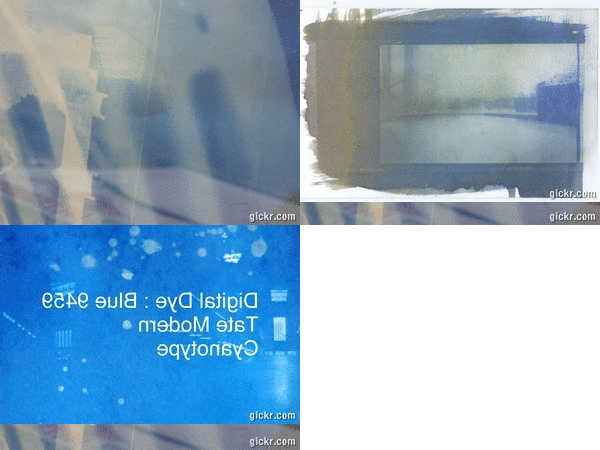
Cyanotype/Sculpture Trail.


Art/Agencies and movements that open up the world to curiosity, wonder and lightness.

Tuesday, 30 July 2024

Form Giving Improvisations : Creative Entanglements in a world of materials.

 Outpost 060123


https://www.flickr.com/photos/russellmoreton/


Haecceity, a certain gathering together of the threads of life.

Deleuze and Guattari, A thousand plateaus. 2004.


Intermediaries : Inducing place between things and the process of practice.

The drama/performativity of encountering place.

Setting things in motion. 

Reading diffractive phenomena.


Bringing things to life, creative entanglements in a world of materials.


Life is all about relations that hold a being in place.


Tim Ingold, The environment without objects (EWO).


Graham Harman, Object-oriented ontology (OOO), a new theory of everything.


Steven Holl, Parallax.


Carlo Rovelli, Helgoland.


Penelope Curtis, Elective affinities.


Mark Burry, Jane Burry, Prototyping for architects.


Lynne Elizabeth, Cassandra Adams, Alternative Construction, contemporary natural building methods.


Bridget Riley, The minds eye.

Tuesday, 25 July 2023

The Mechanism/Sequence of Allure : Colour/The Sensual Object.

Because the faculty of sight is continuous, because visual categories (red, yellow, dark, thick, thin,) remain constant, and because so many things appear to remain in place, one tends to forget that the visual is always the result of an unrepeatable, momentary encounter. Appearances, at any given moment, are a construction emerging from the debris of everything which has previously appeared.

John Berger, Berger On Drawing.


Art and Ontography.

Open Philosophy.

Remonstrating on art's openings, their natural theatricality, and on the truthful deceptiveness of all revelations of the real.

Simon Weir, Object-Oriented Ontology and Its Critics. 2020


Revelations : Filtered Light : Visual Contiguities

PSYCHOLOGY

the sequential occurrence or proximity of stimulus and response, causing their association in the mind:

"contiguity is necessary in all forms of learning"

https://www.flickr.com/photos/russellmoreton/46959196972/in/dateposted-public/


Revelations as a truthful deceptiveness.

Art and Ontology.

An Infra-Realist Ontographic Art Object.


Friday, 25 June 2021

Spatial Mediators and Intercessors : Creating Loops/Rhetorical Silences/Strange Tools


Immaterial Architectures
Painting/Form for Reading Spaces/Intervals
Pattern and Chaos/Liminality/Tectonics
Architectural surface for a Library,  raw materials, light, silence and solitude.

Christopher Wilmarth ; Poetics/Duality of Light and gravity
Other Architecture
Constructing Metaphysical Space

Wilmarth's art reveals his essential concern with the mystical and physical properties of light, especially the ways in which light evokes reverie and generates sensations of space and containment.

The Architecture of Natural Light : Henry Plummer

EVANESCENCE
Orchestration of light to mutate through time

Intensity and integrity of Wilmarth's practice/vision.

PROCESSION
Choreography of light/moving eye

VEILS OF GLASS
Refraction of light/diaphanous film

Wilmarth made possibly his strongest, most beautiful works on paper, exploring a new level of expression while retaining continuity with past work.

ATOMIZATION
Sifting of light/through a porous screen

These drawings also contain allusions to the human presence. Their haunting, foreboding quality is prefigured in the grave, austere tones of some of the glass and steel structures.

CANALIZATION
Channelling of light/through a hollow mass

The duality of light and shadow and contrasts between abstraction and representation continue to be central concerns in his final drawings.

ATMOSPHERIC SILENCE
Suffusion of light with a unified mood

Wilmarth's sculptures from the early 1980's are influenced by the poetry of Stephane Mallarme. To affirm Mallarme's emphasis on the spiritual, the artist used a simple ovoid form, evoking a multitude of symbols, including the human head. These ovoids were made of blown glass, which Wilmarth viewed as "frozen breath". The artist pursued this figurative impulse into the mid 1980s, combining the anthropomorphic ovoid shapes with the larger abstract forms of his earlier sculpture.

LUMINESCENCE
Materialization of light in physical matter

Wilmarth composed with planes of delicate colour and light, placing plates of blackened steel behind translucent sheets of etched glass imbued with a luminous, greenish cast.

"He employed a painterly technique that emphasized the tactility and fichness of his materials, which like an alchemist he persistently sought to transform. He continually examined the concept of duality: contrasts between light and shadow, transparency and opacity, heaviness and weightlessness, materiality  and ethereality, form and spirit are repeatedly presented; the synthesis of geometric with organic forms, the range between abstraction and representation are constantly explored."
Laura Rosenstock, catalogue essay.


White Noise : Nocturnes of Silence


Behind Appearance
A Study of the relations between painting and the natural sciences in this century
C. H. Waddington

Adam Fuss
Home and the World

Strange Loops
Art, Science and Consciousness
An Exploration of Mind, Matter and Form through the Work of Susan Derges
Stephen Gaughan

The Music of Waves
The Poetry of Particles
Thoughts on Implicate Order for Susan Derges
Martin Kemp

Adam Fuss
Eugenia Perry


Aesthetic Allure
Rhetorical Silences/Strange Tools

the sensual energy of the dimension in which causality/aesthetics happens

Graham Harman, Timothy Morton

Paintings/Research/Archive/Art Practice
Cyanotype material,objects on canvas.
Russell Moreton 2018

https://www.flickr.com/photos/russellmoreton/40286364403/in/dateposted-public/


Spaces/Aesthetics : 'Spatiality' between Objects, Concepts and Beings

In his discussion of mediators, Gilles Deleuze (1995,121) describes being taken up in the motion of a big wave. He notes that instead of looking for 'points of origin' attention should be directed to mediators that enable a 'putting-into-orbit' that facilitate the movement of concepts, sensations and matter without recourse to origins or destinations.

Katve-Kaisa Kontturi uses the term 'intercessor' instead of  'mediator' as it aligns better with Deleuze's argument, where importance is placed not on mediating between already formulated shapes or beings, but on opening beings up to movement through a third actant.
For Deleuze (1995,125), Intercessors are about entering into or creating a series.

Gilles Deleuze. 1995, Negotioations, 1972-1990.
Translated by Martin Joughin. New York: Columbia University Press.

Notes, Introduction
Ways of Following
Art, Materiality, Collaboration
Katve-Kaisa Kontturi

Open Humanities Press
London 2018


Immaterial Architectures : Raveningham Pavilion #1
DSC_3283 Raku Beakers : Lead Glaze/Yellow Ochre
DSC_4049 Field Aesthetic : Causality/Layered Drawings
DSC_3776 Sacred/Secular : Vessels on Painting
DSC_4097 Field Aesthetic : Causality/Layered Drawings
DSC_8923 Artists Studio : Collage/Photography/Painting

Outpost Studies
Norwich
UK